Eric C. Sheninger's Blog, page 11
April 2, 2023
10 Ways to Grow as a Pedagogical Leader
I have vivid memories of my early days as an assistant principal and principal, where overseeing instruction was just one of many duties that came with the job. Managing budgets, developing memos, attending meetings, responding to emails and phone calls, and other tasks also consumed a significant portion of my time. The advent of social media introduced yet another responsibility into my already packed schedule: digital leadership. As a school administrator, one must be proficient in many different areas, but it's essential to maintain sight of the most crucial aspect of the role: pedagogical leadership.
Despite my best efforts, I couldn't visit classrooms as frequently as I would have liked, and the feedback I provided in written reports could have done more to enhance teaching and learning both inside and outside the classroom. If our ultimate goal is to improve, we need to prioritize the aspects of our job that impact student learning most. Pedagogical leaders recognize that management is a necessary part of the job, but it shouldn't come at the expense of cultivating a positive learning culture to boost academic achievement.
It's simple to offer advice on improving in this area or anything else, but putting it into practice can be a constant challenge. To help you get started, I've compiled ten specific strategies that I used during my tenure as a high school principal and now help other leaders with during coaching cycles.
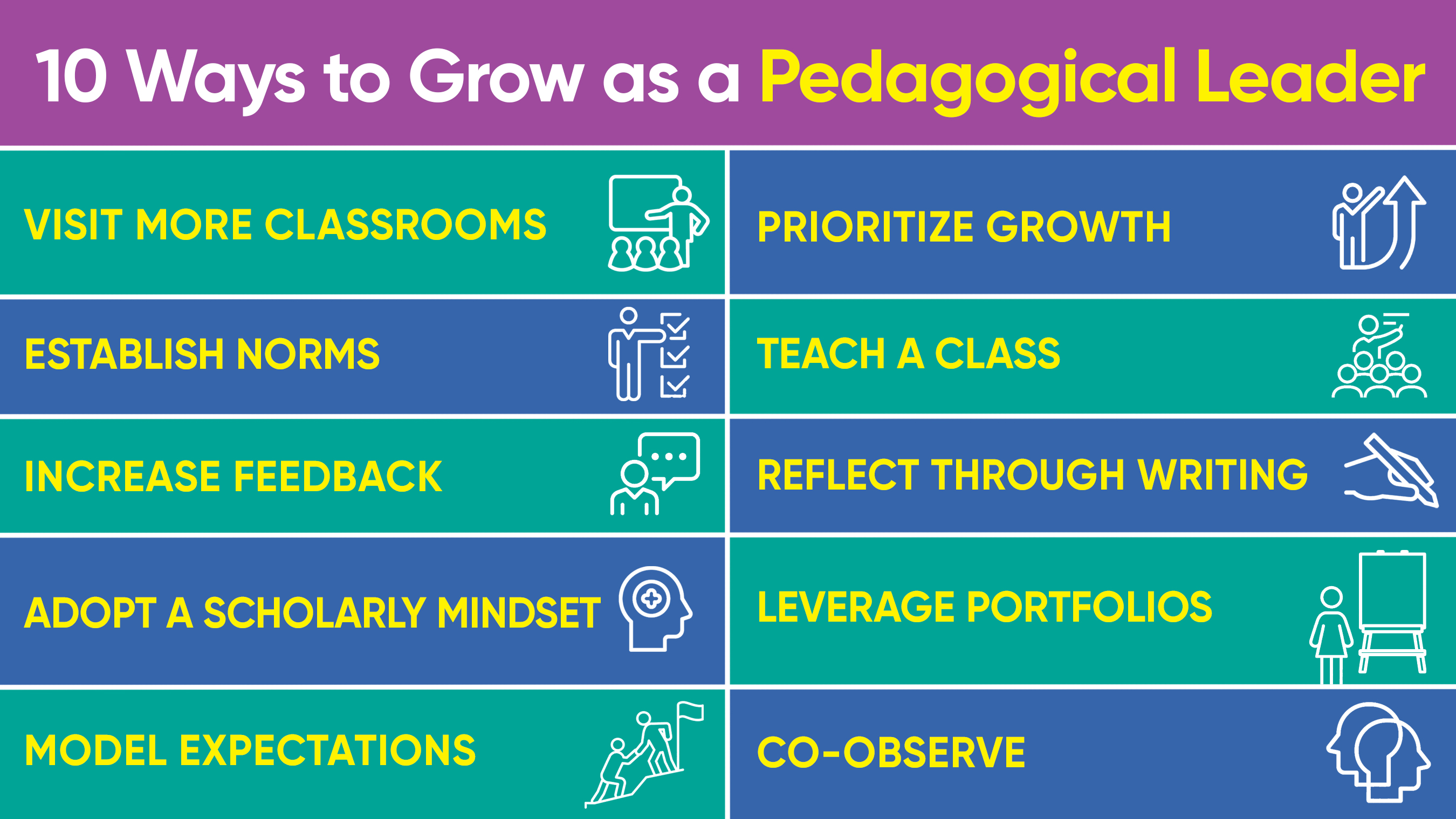
Visit more classrooms
Firstly, begin by increasing the number of formal observations conducted each year and sticking to a schedule to ensure that all teachers are observed three times annually, regardless of experience. Secondly, develop an informal walk-through schedule with your leadership team, mandating at least five walks per day for each member, and track visits and improvement comments on a color-coded Google Doc.
Establish norms
Establishing a shared vision and expectations for all teachers is crucial. You can do this by utilizing the Rigor Relevance Framework to provide them with consistent, concrete elements to focus on when developing lessons and deciding which high-effect strategies to use. Abolishing the routine of announced observations, having teachers provide artifacts of evidence to show the bigger picture since you can never see all that is done in a single observation, and prioritizing the collection assessments over lesson plans can also be effective.
Increase feedback
When observing lessons, always provide at least one practical suggestion for improvement, no matter how excellent the lesson was. These suggestions should be clear, straightforward, actionable, and timely. For learning, consider curating data weekly and present at an upcoming staff meeting. Feedback is critical to encourage growth and development.
Adopt a scholarly mindset
Improving professional practice as a leader is not the only benefit of being a scholar. It also enables you to have more effective conversations with teachers about their own growth, adding credibility to post-conference feedback. You can align critical feedback to current research by keeping a document of effective pedagogical techniques found in your readings. This approach saved time when writing up observations and improved relationships with staff as the instructional leader. When in doubt, lean on Google Scholar. Another key aspect of a scholarly mindset was brought to my attention by Thomas William Miller and that is to get curious and ask questions. When it comes to leading pedagogical change, questions are often more important than answers.
Model expectations
As I shared in Digital Leadership, leaders should lead by example and not ask teachers to do anything they wouldn't do themselves, especially regarding technology integration and improving practice. When a teacher struggles with assessments, provide or co-create an example assessment. Developing and implementing professional learning is also an effective way to lead by example and build better relationships with staff.
Prioritize growth
Attending at least one conference or workshop a year that aligns with a significant school or district initiative and reading one education book and one from another field, such as general leadership strategies or self-help, can yield powerful lessons and ideas. Creating or further developing a Personal Learning Network (PLN) is also essential to access 24/7 ideas, strategies, feedback, resources, and support.
Teach a class
One can achieve this regularly throughout the year or by co-teaching with both struggling and exceptional teachers. I personally taught a high school biology class during my first few years as an administrator, which is an excellent example of leading by example. This approach also provides a better understanding of teachers' changing role in the disruption age. When a pedagogical leader sets an example, it strengthens relationships with staff and puts them in a better position to discuss and enhance learning.
Reflect through writing
As a connected educator, writing has been a valuable tool for me to process my thoughts and critically reflect on my teaching, learning, and leadership work. Our reflections aid in our personal growth and serve as a catalyst for others to reflect on their own practice and develop professionally. Encouraging teachers to write brief reflections before post-conferences can foster a more collaborative conversation on improvement.
Leverage portfolios
Incorporating portfolios into our observation process was a helpful way to provide more detailed insight into pedagogical practices over the course of the school year. Portfolios can showcase personalized learning activities, assessments, unit plans, student work, and other forms of evidence to enhance instructional effectiveness and validate good practice.
Co-observe
During the first quarter of each year, I collaborated with members of my administrative team to co-observe lessons. This allowed us to benefit from each other's perspectives and expertise and provided opportunities for us to improve our pedagogical leadership skills and reflect on our observations. In my role as a coach, I have K-12 leaders visit classrooms beyond the grade levels they serve when working with districts. For example, elementary will conduct walks in secondary to provide feedback and vice versa. We then share collective insight while processing the feedback. Gaining a perspective of strategies used at various grade levels is invaluable.

Ultimately, ensuring quality learning takes place in our classrooms is of utmost importance. These ten strategies can be implemented immediately to improve pedagogical leadership, but there may be additional strategies that others find effective. The image below provides further insight.


March 27, 2023
#EDvice: Moving from Impersonal to Personalized
There is a great deal of confusion out there as to what personalization is when it comes to learning in and out of the classroom. When terms that are new materialize, there is a natural inclination to develop a meaning that works for a particular narrative or goal. A lack of clarity or pedagogical understanding translates to people and organizations making up whatever fits best. From my lens, this is exactly what has occurred with personalized learning. Below is my strong opinion on the issue, which I shared in Disruptive Thinking in Our Classrooms:
Putting all kids on a device and having them use an adaptive tool at the same time is NOT personalization. Understanding WHO our students are and helping them ALL succeed with or without tech is at the heart of personalized approaches that ensure equity in the classroom.
The last few words above are the most critical. Personalized learning encompasses an array of strategies that provide all learners with what they need, when and where they need it to succeed. This flies in the face of all students doing that same thing, the same way, at the same time during the majority of a lesson, especially the instructional component, or a task. I dive a bit deeper into the concept in this piece of #EDvice.
There is not one right or best way to personalize. However, a significant culture shift is required at all levels, including district, school, and classroom. I shared the following in a past post:
An impersonal approach is all students doing the same thing the same way at the same time. While this can have merit in moderation, excessive use of one-size-fits-all approaches is inequitable. They also tend to focus on the “what .”On the other hand, personalization is where all learners get what they need when and where they need it through equitable experiences. There is also clarity in terms of why they are learning what they are and how it will be used outside of school.

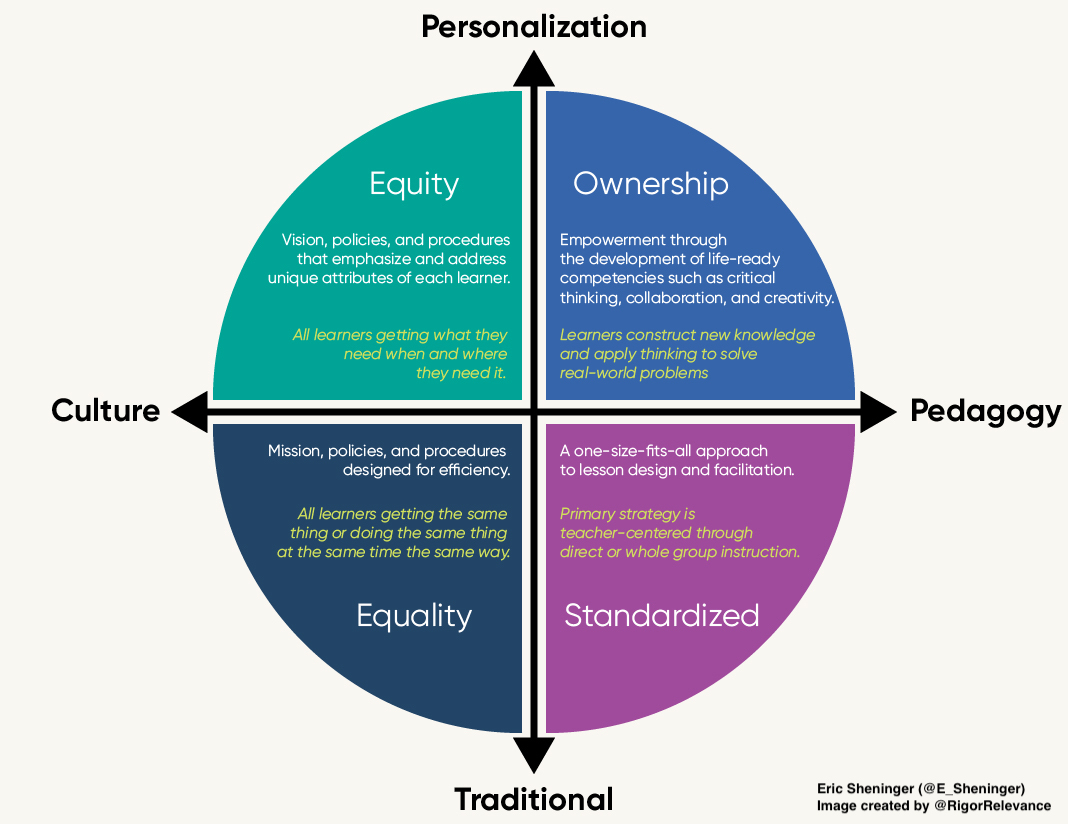

Personalization can occur through many high-agency approaches such as rotational models, choice activities, playlists, flipped lessons, and virtual courses. It can also be achieved through an array of strategies that have been around, in some form or another, for years, including differentiation, response to intervention (RTI), and the purposeful use of technology in alignment with Tier 1 instruction.
If we are serious about equity in learning, then the best path forward is to make concerted efforts to develop a shared vision that emphasizes who we serve and work from there.
March 19, 2023
Leading Digitally-Rich Cultures of Learning
A thriving culture views technology as a seamless component that can enhance learning in a multitude of ways. When digital tools are intentionally integrated, students are able to produce tangible evidence of their conceptual comprehension, develop a range of competencies, illustrate the construction of new knowledge, and become self-directed in their learning. Additionally, technology can increase relevance and make the curriculum more contextual. This is only a glimpse of how digital learning can complement current school practices while also demonstrating the value of learning to students. To ensure long-term success, it is essential to establish a culture that embraces digital learning and integrates it into every aspect of the school's operations. Otherwise, isolated instances of success will be the only outcome.
In a recent post, I shared the Purposeful Use of Technology for Learning (PUTL) framework as a means to develop a foundation and inform how technology can be used to support learner-driven experiences and outcomes. Upon reflection, I discovered that a critical aspect was missing and that was leadership. Below you can view the updated image.

Digital leadership is necessary now and in the future. Leaders need to understand the pivotal role that technology plays in learning. I shared the following in Digital Leadership:
Digital leadership is a strategic mindset and set of behaviors that leverage resources to create a meaningful, transparent, and engaging school culture. It considers recent changes such as ubiquitous connectivity, open-source technology, mobile devices, and personalization. It represents a dramatic shift from how schools have been run and structured for over a century. What started as a personal use of technology has become systemic in every facet of leadership. Digital leadership can thus be defined as establishing direction, influencing others, initiating sustainable change through access to information, and establishing relationships to anticipate changes pivotal to school success in the future. It requires a dynamic combination of mindset, behaviors, and skills that are employed to change and/or enhance school culture through the assistance of technology.
Authenticity lies at the core of digital leadership, which involves utilizing digital platforms and tools to build relationships, foster transparency, highlight achievements, openly introspect, and share impactful narratives. By effectively communicating the reasons, methods, and outcomes, leaders can proactively shape a story that is rooted in evidence, aligned with research, and demonstrates effectiveness. Genuine leaders recognize the significance of personal interaction but also strive to innovate and anticipate future needs. This is where the digital element becomes crucial.
To support educators and build capacity, consider applying the tenets of pedagogical leadership, which naturally aligns with components in the PUTL Framework shown above. Leaders can also leverage the Pillars of Digital Leadership to develop and sustain digitally rich cultures of learning. Below you will see visuals for both and links to blog posts offering detailed insight.
To move schools forward in the present time, it is essential to engage in continuous learning and reflection. The world is constantly changing, and with it, jobs and expectations are evolving. If the objective is growth and improvement, then teaching, learning, and leadership must also transform where digital isn’t seen as an add-on but a ubiquitous asset. It is crucial for all leaders, regardless of their title, to explore important questions that can lead to innovative ideas that enhance outcomes for all in a digitally rich culture.
March 13, 2023
#EDvice: The Power of Stories
Everyone loves a great story. We spend countless hours visualizing how they unfold when reading and watching them come to life through our device of choice. It comes as no surprise that civilizations across the globe have been curating and sharing them since the beginning of time. From cave paintings, stone carvings, and ancient papyrus paper, the most significant stories of our past have been preserved. In the modern era, the invention of the printing press and advances in technology have proliferated storytelling and allowed virtually everyone to evolve into a storyteller role if they so choose.
While the means to share has changed, the overall impact has not. The power of well-told stories is undeniable and can transcend time. They CONNECT, INSPIRE, EMPOWER, and UNITE us often when it is most needed. We need stories, as do those who we serve, especially students. In this piece of #EDvice I dive into the various research-based components that great storytellers leverage, whether they know it or not.
In both Digital Leadership and BrandED I dive into the intricacies to unleash the power of stories. While research paves the way and shows us how to elicit emotion to engage others, there are also many other critical elements to be aware of when developing a narrative. Below are two images that provide additional context.

 Blog post and image credit
My call to action to all educators is to become the storyteller-in-chief. This is not a relatively hard thing to do. Social media allows us to take sole control of our public relations and tell our classroom, district, and school stories consistently, accurately, and transparently. Educators are making a difference every day and these success stories resonate with local, national, and even international stakeholders. Telling stories of student successes and staff accomplishments help to combat and drown out the negative rhetoric that has become rampant in the education profession.
Your work and that of your students is downright amazing. Be proud and share.
March 5, 2023
When Growth is the Only Path Forward
Truth be told, when it comes to education, there is no perfection, no matter where quantitative and qualitative metrics reside. Even if you have the best test scores, graduation rates, innovative practices, and attendance numbers, growth should still be pursued. Authentic leadership is being honest and vulnerable about where you are to help others get to where they need and want to be to succeed. Whether you lead a district, organization, school, or classroom, you should always strive to get better. There is always work to be done and effective educators embrace this wholeheartedly.
Consider the following questions when it comes to professional growth:Who do we serve?Why are our practices effective or not?How can we improve?What will tell us whether or not we are successful?Where do we go from here?

A standout example of this is Quest Academy Junior High School in Utah. During the spring of 2022, I met Nicki Slaugh, who serves as principal, and many of her staff at a school system where we were all there to facilitate professional learning on Personalized Competency-Based Learning (PCBL). In typical fashion, I moved from ideas and concepts to concrete examples of evidence from my other coaching projects to illustrate practicality and efficacy. In Nicki’s words, she saw many direct connections to what she and her staff were doing at Quest, but more importantly, she saw an opportunity to grow. It was at this point that we planned longitudinal work over the course of the year, which included a book study using Disruptive Thinking in Our Classrooms.
After several workshops, I began coaching cycles in the fall of 2022. What I immediately saw blew my mind as it was some of the best examples of personalization at scale that I have ever seen. In every classroom, I saw evidence of a vibrant culture of learning and competency-based strategies where students followed a unique path and worked at their own pace. Teachers were seen pulling students based on data for targeted support in small groups or individually in math and ELA. Rubrics were everywhere and accessible in Google Classroom. I also saw the consistent use of exit tickets and pathways to provide feedback. My brief summary does not do justice to what these teachers and their leader have accomplished. It is simply amazing.
After reading the paragraph above, you are probably wondering why I am even supporting Quest. Well, this ties directly to the title of my post. Even though they are clicking on all cylinders in many areas, Nicki and her staff live by the mantra that growth is a never-ending journey. Collectively, we came to the consensus that there were opportunities to grow in the use of high-agency strategies, most notably voice and choice, as well as the development of customized supports schoolwide. Thus, we created a personalized coaching plan to target these focus areas.
To date, there has been so much progress made. I have included a few pictures below, but to get a better sense of all that is happening at Quest, take a look at THIS PRESENTATION Nicki and I have facilitated for the Utah State Board of Education in person and virtually. You will see what they already had in place, but also growth in the areas of station rotation, flipped lessons, playlists, amplification of voice through technology and dry-erase surfaces, rigor, and relevance. Please note that this is only a small sampling of evidence.
The culture of learning that Nicki has established at Quest empowers teachers to take risks and actively reflect on their practice. After each coaching session, she takes my feedback and then works with her staff to pull out the most essential parts. Growth is happening because Nicki and her teachers own the process. They change not because they necessarily have to but because they want to in an effort to serve their students better. I have been so impressed that I took my ICLE team to Quest to see firsthand what true personalization looks like as we put the finishing touches on our support model for districts and schools across the world. Nicki shared the following:
"To be the 1%, you need to do what 99% are either hesitant or unwilling to do. Our entire school culture is based on always reaching for better. We had already implemented several aspects of PCBL, but upon meeting with Eric, it was clear that we still had room for growth. While listening to Eric present, I felt he was my kindred spirit. It was so exciting for us to meet someone who shared our passion and vision. We had already experienced how valuable feedback was in helping our students grow, so we were excited for the opportunity to receive feedback from an expert in the PCBL field to help take us to the next level. The strategies Eric has given my teachers have been invaluable. He has connected with both my students and staff and has genuinely become part of our team."My point is as simple as it is proud. Growth can and should be the only path forward, no matter where you are in your practice or as a system. Professional learning should be anything but “cookie cutter” and personalized based on your needs and goals. It should be something you want to engage in, not viewed as another thing to do or a waste of time. If you want to have a conversation about what this could look like in your district, organization, or school, send me an email.
Register now for the Model School Conference in Orlando, where Nicki and I will be presenting on Efficacy in Personalization: Improving Outcomes Through Action and Coaching.
February 27, 2023
#EDvice: The Significance of Student Voice
I see student voice as the gateway to personalization. Educators can easily implement it as part of Tier 1 instruction and for students to report out during cooperative learning, projects, and choice activities. It can also allow students to advocate for needed changes to school culture. You would be hard-pressed to find a more valuable strategy that is universal in nature across virtually all pedagogical techniques. The reason for this statement is straightforward. For learning to occur, students both NEED and WANT to be involved. If the goal is to have kids engaged and to set the stage for empowerment, it is critical to utilize strategies that amplify student voice.
In this episode for #EDvice I dive into the concept a little deeper to unpack its significance while also providing some K-12 examples.
I shared the following in Disruptive Thinking in Our Classrooms:
In the classroom, it can be facilitated by posing questions or problems to solve and then allowing students to use digital tools to respond through text, video, audio, drawings, images, and gifs. Having every student respond on an individual whiteboard and then holding their board up for the teacher to see is a non-tech example. In many cases, voice can be amplified through the cover of anonymity, which is critical for introverts and shy students. They can also be provided with opportunities to share opinions on classroom design, assessments, and feedback. Student voice includes any act that empowers a student or students to make their voices heard when shaping their learning experiences. The main takeaway here is that everyone is involved in the classroom and feels more of a part of the experience.
As you look to further integrate or begin to develop strategies that amplify student voice you can refer to the images below.

Read the blog post HERE

Read the blog post HERE
How are you or your teachers amplifying voice in the classroom or school? Please share in the comments below.
February 19, 2023
A Framework for Learning Through the Purposeful Use of Technology
Technology has the potential to transform teaching and learning in a number of ways. One way it can be used to transform teaching and learning is by providing students with access to a wealth of information, including multimedia resources, educational apps, and online databases. This means that students can engage with a wide range of material and have access to resources that they might not have been able to access otherwise. Additionally, this allows teachers to personalize the learning experience to meet all students' needs by providing them with access to different resources that can help them learn at their own pace and in their own way.
Another way technology can be used to transform teaching and learning is by enhancing engagement and motivation. It can be leveraged to create interactive and immersive learning experiences that can help students stay engaged and motivated in the classroom. For example, students can use virtual reality to explore different parts of the world or use interactive simulations to learn about scientific concepts. This kind of technology also allows for collaboration, where students can work together on projects and assignments and share their work with one another in real-time, which helps foster a sense of community and teamwork in the classroom.
Finally, technology can be harnessed to transform teaching and learning by enhancing assessment and feedback. Technology can be used to create assessments, quizzes, and evaluations, providing teachers with real-time data on student progress, enabling them to give feedback and adjust instruction accordingly. This helps ensure that students are getting the support they need to succeed and allows teachers to identify areas where students are struggling and provide additional support. Furthermore, technology can be used to track student progress over time, which can help teachers identify trends and patterns in student performance and adjust instruction accordingly.
.jpg)
The framework above, which I am tentatively calling Purposeful Use of Technology for Learning (PUTL), serves to develop a foundation and inform how technology can be used to support learner-driven experiences and outcomes. It includes the following components that are interconnected:
Sound pedagogy: A foundation should be established through the consistent use of effective Tier 1 instructional strategies that are research-based such as anticipatory set, reviewing prior learning, checking for understanding, modeling, scaffolded questions, guided practice, independent practice, and closure. From here, a variety of practical techniques can be employed, such as cooperative learning, differentiation, performance tasks, problem or project-based learning, etc.Rigor & Relevance: Technology can be used to create interactive and immersive learning experiences that can help students stay engaged and motivated in the classroom. Activities should challenge students to think, construct new knowledge, and apply what has been learned to solve real-world predictable and unpredictable problems. Refer to the Rigor Relevance Framework to assist in integrating technology with purpose (image below).Student agency: Technology can be used to create a personalized learning experience where all students get what they need, when and where they need it to succeed. Digital tools naturally support and enhance high-agency elements such as voice, choice, path, pace, and place. When looking to personalize through blended pedagogies, consider station rotation, choice activities, playlists, flipped lessons, and asynchronous virtual options (image below)Critical competencies: Technology is becoming an increasingly important part of everyday life, and by incorporating it into the classroom, students can develop the competencies they will need to succeed in a disruptive world that is digitally connected and reliant.Streamlined assessment and feedback: Technology can be used to create transparent and challenging assessments while providing teachers with real-time data on student progress, enabling them to give feedback and adjust instruction accordingly.Actionable data: Technology has made it much easier to routinely collect data that can be used to monitor progress, offer quality feedback, analyze in professional learning communities (PLCs), and then provide needed student support through personalization. The immediacy with which metrics can be accessed provides all educators with invaluable knowledge at their fingers tips when combined with ongoing and job-embedded professional learning..jpg)

Technology should be leveraged in a seamless fashion that supports and enhances learning for all kids, something I highlight extensively in Disruptive Thinking in Our Classrooms. The key takeaway from the framework presented is to help inform purposeful use in the classroom while unearthing opportunities to grow professionally. A great deal of money has been spent globally on technology. It is now our duty to make sure that investment pays off.
February 13, 2023
#EDvice: Timeliness of Feedback is Vital
Assisting others to be their best is something that we all can do through feedback. Sometimes it is as simple as making an effort to point out commendations that serve as validation and pieces of advice to improve performance. However, sometimes our delivery and words mean otherwise. It is vital to make the distinction between feedback and criticism. Feedback is information about reactions to a product or a person's performance of a task, which serves as a basis for improvement. Criticism, on the other hand, is the expression of disapproval of someone or something based on perceived faults or mistakes. With growth being the end goal, feedback must be facilitated in a way that moves others to reflect on their work and take the necessary steps to get better.
The importance of feedback to grow and improve is undeniable. EVERYONE benefits when it becomes a consistent component of culture. However, we must make sure feedback is TIMELY for it to have value to those we are trying to help.
If the main goal is to use feedback as a catalyst for improvement, then why delay it? This is one of the reasons why I don’t really like final exams. Students rarely receive good feedback that informs their learning as they are typically given these exams at the end of the school year and are then graded up until the last minute. Delaying feedback allows minor problems to fester into larger ones potentially. The bottom line is that the more time that goes by the feedback that could have really made an impact will not be valued as much, if at all.
Feedback stings when it is not:
Delivered with sincerityGrounded in practicalityGiven in a timely mannerAs I shared in Disruptive Thinking, timeliness is critical, but keep in mind that it must be practical, specific, consistent, and facilitated positively. It is also crucial to determine the right strategy or medium for facilitation.
February 5, 2023
How to Lead with Little to No "Experience"
I vividly remember how frustrating it was to interview for various school administrator positions only to be told that I didn’t have enough practical experience related to the position(s). Well duh, of course I didn’t, as I was an aspiring leader who was just venturing into this space. I am sure virtually everyone reading this post has been in the same situation at some point, whether in the past or currently. Frustrating is putting it mildly. It should be noted that experience can certainly be beneficial when it comes to leadership, as it can provide a leader with valuable knowledge, skills, and perspective. However, it is not the only factor that determines a person's ability to lead effectively. Some people may have a natural talent for leadership and are able to inspire and guide others, even if they don't have a lot of experience.
That being said, there are certain situations where experience can be essential for a leader. For example, if a leader is facing a complex or unfamiliar challenge, their past experiences may give them a better understanding of how to approach and solve the problem. Most would agree that the COVID-19 pandemic fits the bill here. Experience can also help a leader to build credibility and gain the respect of their team. Overall, experience can be a valuable asset for a leader, but it is not the only factor that determines a person's ability to lead.
Leadership is not necessarily about having a lot of experience but rather having the ability to inspire, motivate, and guide others toward a common goal. Eventually, I began revising my resume and linking to instances where I actively cultivated leadership characteristics or built capacity through coaching sports, writing curriculum, and advising clubs. Think about what you have done that can translate into a school administrator role.
Once you get your first position, the key is to hit the ground running. Here are a few other tips that may help you to lead effectively, even if you don't have a lot of experience:
Set clear goals: Clearly define what you and your staff are working towards. This will help to keep everyone focused and motivated.Communicate openly: Make sure to keep the lines of communication open with all stakeholders. Encourage open and honest dialogue while being approachable.Be adaptable: Be open to new ideas and approaches and show a willingness to pivot when necessary.Empower your people: Trust your staff and give them the autonomy to make decisions and take ownership of their work.Lead by example: Show everyone what it means to be a good leader by being a good follower. Set a positive example through your own actions and work ethic.As I shared in Digital Leadership, it's not about having all the answers but creating a vision and guiding others toward its realization.

So, what if you have never been an administrator? If you are lacking in leadership experience, there are several steps you can take to compensate for this and become a more effective leader:
Seek opportunities to develop your leadership competencies: This can include taking on capacity-building roles within your school or district, enrolling in educational leadership programs, creating a Personal Learning Network (PLN), or participating in pertinent workshops or conferences.Learn from more experienced leaders: Seek out mentors or coaches who can provide guidance and support as you develop.Practice self-reflection: Take time to reflect on your strengths and areas for growth. This can help you to identify areas where you need to focus your professional learning efforts.Stay current on trends and best practices in the education field. Make an effort to stay up-to-date on the latest developments and incorporate this knowledge into your leadership style.Be open to feedback: Seek out feedback from others and be open to learning from their experiences and insights.Remember, leadership is a never-ending journey and everyone starts at a different point. By being proactive in your development and continually learning and improving, you can effectively compensate for a lack of experience and become a strong and effective leader.
January 30, 2023
#EDvice: Interest Powers Learning and Outcomes
Humans crave a deep connection when it comes to learning something new, especially if they initially don't see any value in what's being taught or facilitated. We expect this as adult learners, so it goes without saying that our students both want and need this as well. In the absence of authentic meaning there is a tendency to disconnect or go off task, putting the learning experience at hand in jeopardy of not being successful. No one wants this, especially teachers who have spent a great deal of time planning lessons.
In the classroom making connections to content and concepts embedded within standards is of utmost importance, but these have to be captivating as some kids naturally won't be jazzed up about certain content. The key is to elicit attending behavior. Interest is a powerful element that acts as a motivator and is a key component that drives learning. NEVER underestimate the importance of a "hook" during the opening movements of a lesson to empower ALL learners. In this piece of #EDvice I unpack some tips on how utilize simple strategies as well as share some practical examples.
Whether you refer to the strategy as a hook or anticipatory set, they key is to infuse relevance that piques the interest of diverse learners. Below are some of the startefgies I shared in Disruptive Thinking in Our Classrooms:
Picture promptReal-world problem of the dayCurrent event or personal storyOpen-ended writing prompt that sparks inquiry and creativityRiddleShort, engaging video followed by a turn and talkSensory exploration If we want to improve outcomes, in the classrooms or during professional learning, we must make efforts to impart interest.