Quinn McDonald's Blog, page 63
July 5, 2013
Avoiding the Hook
When I took the hook last Sunday, I decided to set some guidelines to keep me from making the same mistake again. Today, I avoided the hook. Twice.
Because I shared my mistake, I also want to share how I avoided it when it came around again. If it helps you, celebrate! Celebrating victories is an important step in making a habit out of good decisions.
Here’s how you can avoid taking the hook of a marketing involvement that isn’t good for you.
 First, When you hear an opportunity offered, look at your current marketing plan. Is yours two years old? Five? Time to take a look at where you are and re-focus your marketing plan.
What do you want to achieve in the next year?
What do you need to do to make that happen? (Include research and discussing the plan with others in your field)
What is the right order of the steps you need to take?
Line up the steps in the order so that each step completes an action toward your goal.
You don’t have to wait till January to start a plan. Anytime is good.
Five year plans are fine, but no one knows what will be invented to change your market or audience. Start with a one-year plan and break it into 12 steps.
Second, keep the goal in front of you. Everything that doesn’t lead to your goal is a distraction. Distractions are tempting, make you want to change goals, or start a new direction. Distractions are the biggest pitfall to getting what you want. My first victory was not following a distraction. It was tempting, easy, and made my heart beat faster. Good sign. But it didn’t feel like freedom, it felt like renewed regret, and that’s a sign to ignore it.
Third, look at the opportunity and see what it holds for your goals. A real opportunity may not be a money-maker. You will also need building blocks, community-building, and sharing success.
Sometimes you need to stretch our your hand for help, sometimes you can stretch our your hand to offer help. Both involve holding out a hand, and both are important for building a business. I like paying it forward–thanking people publicly, helping someone without expectation or acknowledgment, because it makes it easier for me to ask for help when I need it. Asking for help provides an opportunity for someone else to step up.

Celebrate your victories!
Fourth, ask for what you need. Be clear and set limits. Answer questions. Accept “no” for an answer politely. There is a difference between re-visiting a request and acting out until you get what you want.
Fifth, do not act out of anger or fear. Choosing to do something because you want to get attention from someone who hurt you or hurt someone to pay them back for hurt they inflicted on you . . .well, there is no end to that cycle. That was my second decision. Someone pushed a button–a big one. I thought a long time about how I wanted to take the hook and react. And then closed my computer and walked away. Fear and anger breed more fear and anger. If that’s not what you want, find another answer.
The hook didn’t make contact today. And I’m a bit closer to my goal for this year.
What hook will you avoid–envy? the easy answer? not choosing your own creativity? Celebrate when you avoid the hook.
—Quinn McDonald is celebrating this victory by starting a new project, without regret, in her studio.
Filed under: Coaching, In My Life, Inner Critic, Recovering Perfectionists Tagged: avoiding the hook, creative marketing, marketing plan, paying it forward


July 3, 2013
Featuring #4: Giveaway
 The fourth Featuring magazine arrived from the Netherlands, so it’s time for a giveaway. The magazine’s focus is on international art journaling, expressive arts and mixed media.
There is an article about Maria Prados, a Spanish artist and her combination of photography and painting. Maria is fascinated by the immediacy of photography and her painting adds the inspiration of the moment to it.
Miranda Robb from Blueberry Muffin Studio is featured in an article on the benefits of art journaling. She called it “inexpensive therapy” and that made me smile. (Looking at my studio, I’m not at all sure it’s that inexpensive, Miranda!) The article has some beautiful illustrations from her journal.
 Julie Elman knows fear. And she knows about others fears, too. As an associate professor at the School of Visual Communication at Ohio University she sees the people who participate in her Fear Project and who admit to having lots of fear. The article is fascinating in several ways–the content, the breadth of the artwork, and the topic–not what you’d find in a run-of-themill art magazine.
Tammy Garcia (of Daisy Yellow) has a page on creative change–which is about perspective and gathering ideas. You won’t want to miss her perspective and some very interesting tips.
Lexi Dali and Marjorie Schick are featured in an article on wearable  art–sculpture in which the wearer becomes part of the art and still uses the beautifully crafted work as jewelry or adornment. One of the benefits of Featuring is that the Marit Barentsen, Editor-in-Chief, allows the stories to develop and includes enough photographs to enrich the effect fully.
The magazine is generously sized, 74 pages plus a cover. I loved the artwork of St. Petersburg artist Aleksandra Kabakova–it’s minimal and spare and still expressive and evocative.
There is much, much more in the magazine, from people you will recognize and about art to drool over.)

The spare graphic art of Aleksandra Kabakova
I’m giving away one of my copies. Because the magazine is less expensive to ship in Europe, the drawing is for North America this time. Leave a comment and I’ll include you in the drawing to be announced on this Saturday, July 6. You won’t want to miss this one! And if you don’t win the copy, you can order one for yourself here.
Filed under: Book Reviews, Journal Pages, The Writing Life Tagged: art journaling, Featuring magazine, the fear project


July 2, 2013
Firefighters
We lost 19 of them, each one doing what they love: Trying to stay ahead of a wildfire roaring up the mountains. It turned on them, swept over them.

Yarnell wildfire © David Kadlubowski / Associated Press / June 30, 2013
We should all die doing what we love.
But no one should die huddled in a tinfoil tent, hearing the teeth of death grinding up the landscape, breathing smoke into their last-ditch shelter.
It’s hard to understand what drives a soul to fight fire with a spade and chainsaw, even taking in the after-fire gratitude.
The fire that swept over them roars on. The sun will come up tomorrow and beat relentlessly down on the houses with the empty beds and empty chairs and lonely plates and cups–
Those empty spaces will jerk back wives and children, mothers, fathers, siblings to a reality they did not ever want to have to think about or talk about or explain to children who cannot fathom the length of forever so keep asking. The patience of the bereaved weighs heavy as they repeat the horrible words until they themselves believe it: “never coming back.”
I do not believe the simple answer “God has a plan.” Unquestioned plans do not allow for anger, they demand subservience. Even Moses fought with a burning bush, demanding explanations. But bone-deep, I understand laying down your life, risking it all, because you wanted to save a mountain, save a house, save your own soul with a spade and chainsaw.
These firefighters and the others, live the life that matters.
Even now, you matter.
* * *
–Quinn McDonald lost her studio in a fire in 2003, but firefighters saved the rest of the house and cats. They ran toward what others run away from. She will always be grateful.
Filed under: Creativity, In My Life, Nature, Inside and Out Tagged: firefighters, gratitude for firefighters, hotshots, Yarnell fire


July 1, 2013
Sharing the Fig Tree
In July, the figs on the tree ripen. Finches, starlings, doves, woodpeckers, and grackles feed on the figs. For years, I fought them off. Now I’ve come to accept them. The birds need the figs because it’s a source of food and water when the heat destroys other food sources.
 Early in the morning, while the birds are feasting on figs, I hose down the walkway and scrub the ruined fruit off the cement. By noon the fig hulls will be as dry and hard as walnuts and the seeds will be stuck to the cement.
Now that I’ve accepted sharing as part of having a tree in my yard, I also gather figs from the tree and make jam. I can’t eat the jam, but it’s wonderful to see others enjoy it. Same with the figs. There is enough for both uses
And both uses require work. Watering the tree, fertilizing it, trimming it. Picking up the fig leftovers, scrubbing the sidewalk. Gathering the figs, washing them, cleaning them, cutting, cutting and bottling them. It’s work with a purpose.
We expect trees to be work. We expect food to be work. But somehow, when it comes to our creative work, we think of it as play. And are surprised when it takes work to nurture it, maintain it, and yes, reap the benefits. Creativity is somehow supposed to be immune from the focus, goals and results of the rest of our lives. It’s supposed to be fun and ephemeral. Most of the time, creativity is hard work, but satisfying work. And, like ripening figs, sweet and worth it.
—Quinn McDonald is a naturalist and teacher. Join her in Madeline Island on July 22-26 for a deep writing and intuitive art class. Or in Phoenix on July 13 for a class on Monsoon Papers and accordion folders.
Filed under: In My Life, Nature, Inside and Out Tagged: creative work, figs, metaphor


June 30, 2013
The Inner Critic’s Martyr Mask
No matter how long you have been working creatively, it’s tempting to take the hook of possibility.

It’s well-designed, but it’s still a hook.
Sometimes that hook lands a big opportunity. Sometimes it pulls up a discarded, decomposing piece of junk. Almost always, it’s hard to tell the difference.
I’ve written about those “great exposure for you” false opportunities. A promoter wants you to donate your time, energy, artwork, writing and dresses it up like an opportunity. Choose carefully, make sure it is a real opportunity for you.
So when the woman called from a town three hours away and asked me to teach a class in her town rather than have her drive to Phoenix for the class, it was understandable. When she promised she would bring her friends to fill up the class, the warning bell clanged in my head. But my Inner Critic stepped up and whispered “opportunity” sweetly and seductively. The Inner Critic pointed out that asking someone to drive three hours was too much for them (but not for me), and I needed exposure, and getting in that market would help the new book sales.
Instead of pointing out that exposure is what kills people if they go out unprotected, or listening to Pema Chodron’s wisdom that we keep learning the same lesson until we understand what we need to learn, I took the hook. And the line and sinker while I was swallowing.
Yes, I did. Instead of calling on my “You are Enough” Inner Hero, I chose the Martyr Mask of the Inner Critic. Two hours and five phone calls later, I had arranged a class and a demo, rented a hotel room, spoken to the marketing manager and created the to-do list for the class. After hotel, gas, demo time there was no profit, but who cares? It was an “opportunity.” (You may now start to snicker).

From the website: howtodrawcartoons.com
I proudly emailed the woman who wanted to take the class–it was scheduled. I sent her the date and time, and gave her registration details. (You may now slap my forehead and ask, “What were you thinking?”)
No reply. You already know what happened. You are smarter than I am. The next day I got an email telling me the day really wasn’t good for her or any of her friends, and I should email her next time I was in town. You see, she had good resistance to the hook.
Learning from my mistake (again), step-by-step:
1. When talking to a prospect, find out exactly what they want–a class close to their location? Attention? Conversation? Mention a price range to see if it changes their interest level. If they mention friends who will be brought along, ignore it. That phrase is very similar to “I’ll call you” after a first date or “How are you today?” when your boss comes into your office. It’s something polite to say. No offers or interest are implied.
2. Compare what they want to what you have to offer and what you need. Travel is expensive, so your class price might have to increase. Would you go to that town to teach without the call? What real opportunity exists for you? Is there interest? Is there a client base? Consider this before taking any action.
An excellent counter-offer on my part would have been to ask her to gather her friends, agree to a location, and have me come to teach a custom class at a price that made me a modest profit. Don’t take the hook until you have something you need, too.
3. Do not make a commitment to please a prospect. A prospect is an unknown quantity. A prospect is not yet a client. Every company, business, and freelancer has to weigh the conversion cost of prospect to client. If you lose money occasionally, it’s part of doing business. If you lose money frequently, you need to look at how you are doing business.
4. Avoid needy puppy behavior. Needy puppies don’t get the business.

From the WordPress blog The Transfer
Worse, they don’t get respect. Think about what you have to offer. That’s enough. Do not offer to jump through burning hoops to prove your worth. That will just get you burned.
5. Create a marketing plan and stick to it. Set a time in the future to evaluate it. Changing it based on the last thing you heard (“Squirrel!”) is not a good business plan.
—Quinn McDonald wishes she had stopped, looked and listened to herself before lighting the hoop on fire and jumping through it.
Filed under: Creativity, In My Life, Inner Critic, Opinion, Quinn's Classes Tagged: business of art, marketing opportunities, marketing your art


June 29, 2013
Saturday Creative Links
OK, I need to admit I am a science geek. My first job out of college was teaching biology. And I still love the connection between science and creativity. I’m a sucker for the Fibonacci sequence, Phi, and Golden Geometry.
Vivian Hart, known as ViHart on You Tube, has a way of combining math and creativity in ingenious ways. Here’s a video with her explaining the Fibonacci sequence and how to draw a spiral while being photo-bombed by an artichoke.
Wade Kavanaugh and Stephen B. Nguyen are collaborating in Brooklyn, New York and they are making trees out of paper. Big trees. People are dwarfed under

Tree by Kavanaugh and Nguyen
the structures, which can also look like veins and arteries in paper and wood.
It’s the scale that is surprising, although we are not surprised by big forests. But this combination of art and nature is stunning.
You’ve seen the white buckets at construction sites and at the side of the road. The white bucket holds paint, cement, and eventually, holds garbage and becomes garbage. Except to Jason Peters. He gathered them up and turned them into giant, winding installations. The buckets are lit from within, either in color or with natural light, striped and sinuous.
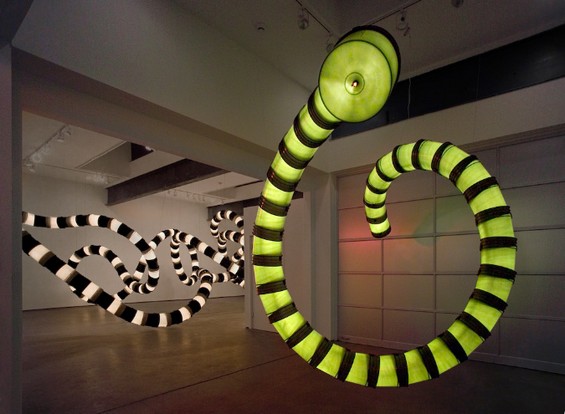
Jason Peters installation
The images are fascinating and airy. One man’s art is another man’s garbage. The difference is creative vision.
Kirsten Hassenfeld creates gems in Brooklyn. Seen in soft light, these gems seem to be fragile and detailed. Once you see that these gems are made of paper–light and translucent–you fall in love with them.
 The spatial relationship of a group of these gems is both intricate and intense.The images look drawn in shadow and light.
Have a wonderfully creative weekend.
—Quinn McDonald is doing a demo at the Scottsdale location of Arizona Art Supply on Saturday. She loves involving people in creative joy.
Filed under: Creativity Tagged: bucket art, Creativity, paper trees, vihart


June 27, 2013
Seed-Pod Creativity
In Arizona, we are entering the Season of Seeking Shade. Oranges stop growing, figs dry on the branches, birds sit in the tiniest patches of shades, beak open.

Seed pods ready for threshing
But there is another fascinating process that unfolds in the heat. Native trees produce seed pods. Most of them are hard and protective–understandable, soft seeds would wither and dry up in hours.
Nothing rots here; it’s too dry. Leaves that drop, branches that blow down, rot in weeks on the East Coast. Not so here. You’ll find them years later, just where they fell. They will be the bones of trees, bleached and stiff, but not rotting.
In order for seed pods to free the seeds, they need a threshing machine. Well, something to break open the pods so the seeds can drop to the dirt and wait for rain, or birds, or coyotes. Unless those pods break open, the seed can’t put out roots.
The lucky trees are the ones planted close to sidewalks and roads. The pods fall, we stomp or drive over them, the pods are crushed, the seeds released and ready to be washed into a gully by a Monsoon Rain.
I was crunching over pods yesterday, loving the hollow, rattly sound the seeds make in the pods, when I thought how this is creative work. Well, it is like creative work. You have an idea, but it’s not ready to work, to grow, to connect with other ideas. You create an idea-pod, but you hoard it. Nothing happens.
Then you drop it and other people walk over it, kick it aside, roll over it, and suddenly, you can see it in a fresh new light, ready to grow. And that’s when you see that letting it go, not forcing it, was what it took to break out into a project that you can do. You had to let it go to make it work.
—Quinn McDonald is a naturalist for whom everything is grist for the mill.
Filed under: Coaching, Nature, Inside and Out, The Writing Life Tagged: creative work, growing ideas, idea seeds


June 26, 2013
Walking the Talk
A few weeks ago, I hit a slump. A few bumps in the road and the road seemed too hard to travel. I discussed it with my coach (I believe in coaching, so yes, I have a coach, too. She’s brilliant.) The problem I keep coming back to is being different is not always fun, interesting, or a trait that draws clients. Some clients are afraid of “different.” It’s not always easy to create classes when you are different, and once you have created them, filling them can be a challenge, too.

Inked papers drying. Don’t they look like fabric?
Retreat producers prefer to have popular teachers teaching popular classes that will result in a satisfying experience and a product that can be a gift. My classes tend to be complex, involve both writing and an art techniques, and deep work. You don’t always work away with a give-away gift. You often walk away with a gift of self-knowledge, acceptance and understanding. You’d be surprised how many people feel guilty about feeling good.
Sometimes I want to do the easy thing. My coach warned me off. “If you do the easy thing, how do you think you will teach it?” I imagined myself zipping through a class without traction and knew that I’d not seem engaged, interested or involved. And an instructor has to be all three.
My coach suggested something I have suggested to my clients many times. Remember the story of my motorcycle, Suzie Lightning, and the instructions to “look where you want to go”? The technique of imagining success works, because you begin to make small adjustments that build your ideas, decision-making and choices. You feel settled with your ideas and make the most of them. (That’s what yesterday’s post was about). So I got busy and visualized the class and people enjoying it. Had some great ideas. Re-worked the plan.
It was still a big surprise and a bigger joy when Madeline Island School of Art called this morning to tell me my class made (Enough people had enrolled to run the class.) I had reached one of the dreams I’ve had for years–to teach a week long retreat combining both deep writing and intuitive art.
 And right after that, the flyer went out for the in-person class I’m teaching here in Phoenix on Monsoon Papers and making accordion folders went out. And people began to register! It’s true that to have a successful class you have to find the right audience and teach the right class. It’s also true that the combination is not always easy to fit together.
Both classes still have open slots. If you have always wanted to try combining writing and intuitive art, now is the time to sign up. The give-away of gift cards and a month of creativity coaching will happen at the retreat. And if you are in the Phoenix area, come join me in making Monsoon Papers.
Quinn McDonald practices what she preaches or her coach will kick her butt.
Filed under: Coaching, In My Life, Links, resources, idea boosts, The Writing Life


June 25, 2013
Working With What You Have

Some trees can’t stand the sun’s intensity.
July is the hottest month for most Northern Hemisphere areas, and we often have 30 days of more than 110 degrees in the Sonoran Desert. Most of those over-hot days happen in July and August. Each year, I buy plants that say “full sun” on their needs. Now, “full sun” may mean 6 to 8 hours of sunshine, but it doesn’t mean the intense heat we have here. And each year I struggle to keep those plants alive. That makes as much sense as trying to keep the leaves on the trees in October in Vermont. It’s just not going to happen.
This morning I quit watering the straw those plants turned into and decided to put my efforts into the ones that could survive without a lot of extra work.
And that’s exactly what happens with your creativity, too. Put it in a place where it can’t possibly survive, and the struggle is ugly and non-productive.
Whether that’s a bad relationship, bad conference you feel you should have loved, bad project you thought would be great, or bad book you are reading, there are some efforts that won’t be rewarded. Goethe, the German thinker and poet, said “Die Arbeit ist nicht immer mit Erfolg gekrönt,” —Your work is not always guaranteed success. (I know it’s not the literal translation, the interpretation was called for here.)

A plant that thrives in the desert.
So why not eliminate all those dead creative places that aren’t worth saving? Sometimes it’s far more worthwhile to be very honest, determine that you do not have the stamina, strength, materials, smarts or spirit to make this project succeed, or even move forward. The smart thing to do is to stop pouring your effort into a bottomless pit and spend more of your effort doing something that will give you a better result.
Yes, this is different from stopping because you are bored or tired, or walking away from your job because there is something more appealing to go after. Spend the precious water you have in the Sonoran desert to nurture the plant that can adapt to the desert. Put your energy behind the projects that will work. You will be better off for it.
–Quinn McDonald lives in the desert and is happily thriving.
Filed under: Coaching, In My Life, Nature, Inside and Out Tagged: adapting to conditions, thrive where you are planted


June 24, 2013
The Word We Hide
No one dies anymore. And no one is dead. Last week, when I wrote about my parents’ deaths, the emails started up. It seems, according to the emails, that “death” and “dead” are no longer politically correct. If you only knew.
No one is born to stay. It’s not a dirty word. You might prefer “pass,” “pass on,” “go home,” “go to their eternal reward,” or “shuffle off the mortal coil,” but all those things happen after the body dies.
What death is, however, is taboo. We hide it from our children. We pretend it doesn’t exist in our house. We die in hospitals. Death is more taboo than sex in our society, and because death is not as much fun as sex, most people buy into the “let’s not look at it and it will go away,” school of thought.
Several generations ago, children attended their grandparents at their death. Wakes were held in the living room, and family sat around a body, laid out in their best clothes, and held watch all night by praying or sitting in silence. If a child was old enough, he or she was generally pressed into service to wash a body after death and clothe it. This was a sacred ritual, done in silence or while singing hymns, and it allowed children and adults to see death, know it was coming and discuss the events around death. You don’t see a lot of that anymore. Too scary. Too gruesome. Better send the kids to play video games where they blow up “the enemy” or zombies.

Dan Somers (center) and band members, in Phoenix. From the Lisa Savidge website.
We don’t talk about death and the young men we send to war. We send those men to kill people. Not on our land, of course. Far away. It’s not a video game. Our husbands, wives, fathers, mothers, daughters, sons–we send them to go kill people. And when they come back changed, we don’t want to talk about it. We expect them to find that most difficult of all emotional passageways–closure– and join life where they left off. “Get on with your life. You are home now,” is a fast answer. But not a good one.
For soldiers, there are two jarring realities. One day, each stranger could kill them or be an innocent bystander, and our loved ones make that decision and live with the consequences. The next day, they are back home settling squabbles over Barbies, sleepovers, whether a child should have a toy gun to play with, and school visits.
There are precious few resources to prepare families for the return of a soldier who has killed people and now is expected to be concerned with daily life. Most returning soldiers just struggle. Many of them, having survived killing people, cannot survive living with that knowledge. Our country is losing more veterans to suicide than to war. And suicide means choosing death over life.
The most-often question when we hear of suicide is “how?” when it should be “why?” We want the gory details we can do nothing about instead of the harder uncertainties we can’t deal with.
Daniel Somers told us. Daniel did two tours in Iraq, and could not fit back into life here in Phoenix. Daniel’s father, Howard, wants others to know about Daniels’ death, so I am talking about the death. There are vets in your life, too, and most likely, you just want them to get closure and get on with their lives. And they can’t.
Dan fronted his Phoenix band, Lisa Savidge. He had a wife. He had friends. But on June 10, this 30-year old vet killed himself. He was one of 22 vets who kill themselves every day. More than the number of children who died at Sandy Hook. But we look away. The Veterans Administration is supposed to handle that. They can’t. There are too many. The problems can’t be solved by a pat on the back and a pill.
Here’s what Dan wrote in his suicide note:
I really have been trying to hang on, for more than a decade now… In truth, I was nothing more than a prop, filling space so that my absence would not be noted. In truth, I have already been absent for a long, long time. . . . I am left with basically nothing. Too trapped in a war to be at peace, too damaged to be at war… This is what brought me to my actual final mission. Not suicide, but a mercy killing.
Dan did not pass on. He killed himself. He is dead. There is no neat wrap up for this story. And not for his family. But when I use the word “dead” I don’t use it lightly. And I’m not using some euphemism instead.
—Quinn McDonald knows about death. A long time ago, in another war, she knew a soldier who came home, but never came all the way home.
Filed under: Creativity