Quinn McDonald's Blog, page 10
April 5, 2015
Starting Over

The gallery is in Yarmouthport, Massachusetts
Starting over. Starting fresh. It sounds like a new coat of paint over a tired life. The messy slate of the past is wiped clean, and ahead is a shiny new start. We can put on a new face, a new attitude, a new effort. It seems like we can create a whole new identity with as little effort as a new website.
Soon enough, that new effort is overwhelmed by the old ideas, old habits, old behavior–the old us. Alcoholics Anonymous figured this out years ago when they said, “If you are a drunk in Cleveland, moving to Peoria for a fresh start isn’t the answer. You’ll be a drunk in Peoria, too.” It’s a wise saying, although a tough one. (AA never pretended to have easy answers.)
When I went to Catholic school (I’m not a Catholic, but that’s another story), I loved seeing my friends go to confession. They’d say their prayers and their sins were wiped away. Poof! Just like that, they were brand new and sin free. Unfortunately, the old habits didn’t vanish, and my guess is that the same sins got repeated in the confessional time after time. And since there were different priests, no one really noticed or cared, and little personal growth resulted.

Teresa Jennings Robinson read this post and sent me the gorgeous hand-lettered quote she made for her art journal. See more of her work at rightbrainplanner.com
And that’s the danger of new projects. They seem free of the past baggage, but they are not free of us. We show up with our past, and relive it because it’s familiar. In a few days that new project takes on the fingerprints of the old us. If we don’t like the old us, we’ll hate the new project, too.
I have friends who are start-up junkies. Addicted to new beginnings, these eager people will start up a company with the fervor of Ron Popeil selling the Veg-O-Matic. But they aren’t good at running a company, which seems tedious and boring, so they dash off to do another start-up, leaving the clean-up team to handle the rest.
Any beginning feels like the creative part. And it is. But the road-test of creativity is showing up every day to do the hard work. The book I am writing is hard work. It’s satisfying, and I enjoy it, but it’s not riding rainbow unicorns. It involves saying “I can’t go to the movies with you, I’m writing,” or thinking, “I need to re-write this chapter, it’s not working, even if it is the fourth re-write.”
Creative work is hard. We want to give up, we get bored,�� we want to do something fun and new. Yet what gets the work done is moving steadily ahead, when it’s not fun and not new.�� Learning from your mistakes and getting up every time you fall is what the real work of creativity. And it pays off.
—Quinn McDonald is working on a re-write of a trio of chapters. She has done it before, and she may well do it again.
Filed under: Art/Freelance Biz, Coaching, Creativity, Living life awake, The Writing Life Tagged: creative work, Creativity, starting fresh, starting over


April 4, 2015
Creativity Hop, April 4, 2015
Broken mirrors have brought New York photographer Bing Wright a lot of luck. He photographs sunsets in the shifting glass surface of broken mirrors, then creates prints.

The exhibition, called Broken Mirror, Evening Sky�� at the Paula Cooper Gallery looks like vibrant stained glass windows.
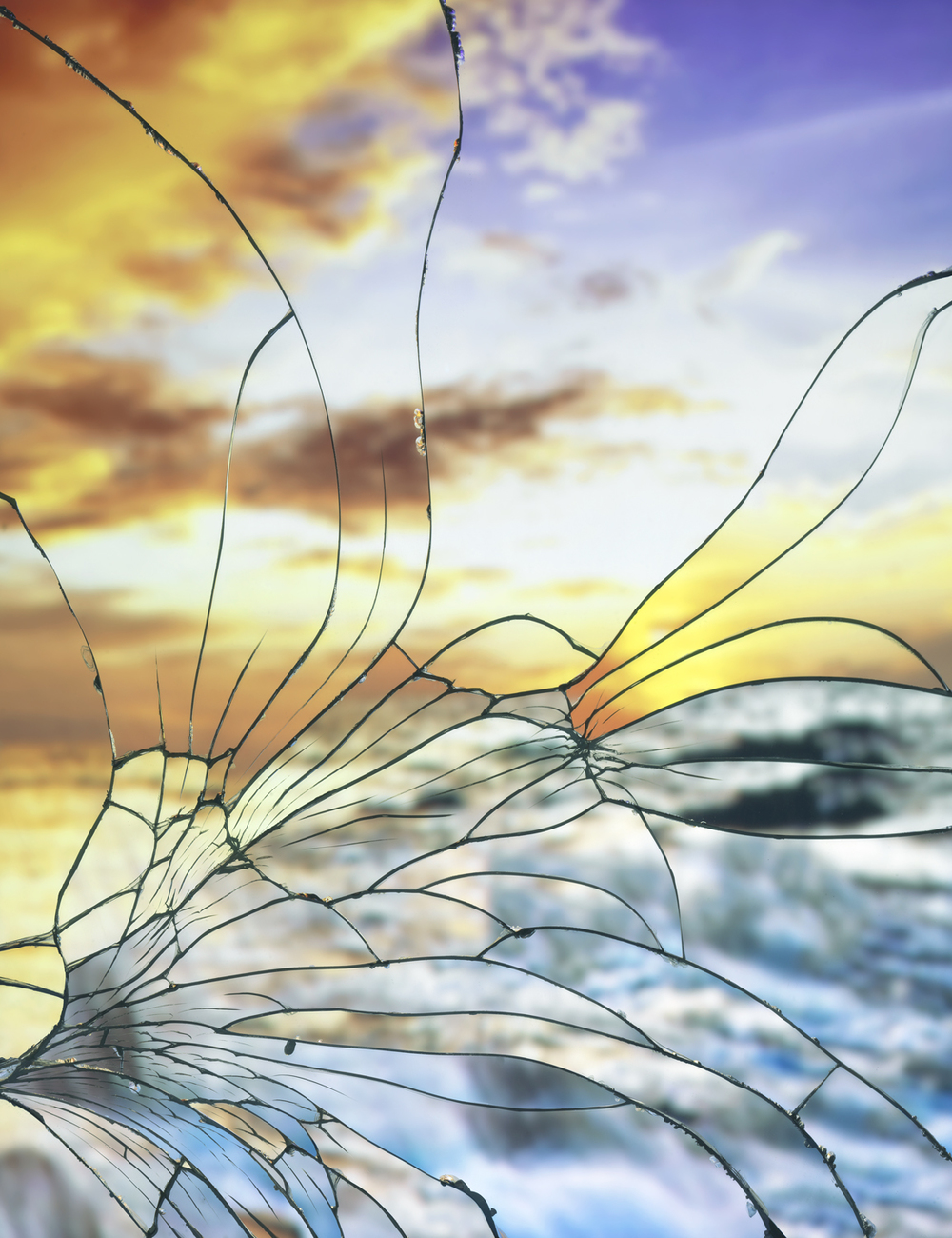
A quote from the gallery’s website says, “Cracked glass seemingly generates doubled reflections, disjointed gleams and refracted light into shards of images.”
While on the topic of glass, here is more interesting work, this done with mirrors.

Alyson Shotz created a picket fence of mirrors and let it reflect the scenery around the fence within the mirrors.
 Here is the same fence from a distance. You have to work to see it behind the first row of trees.�� If you look slightly above the ground, you can see the straight line created by the top of the fence.

Here’s another�� installation that both reflects and disappears into the landscape.
Have a creative weekend!
—Quinn McDonald loves the reflective nature of art.
Filed under: Links, resources, idea boosts, Nature Tagged: art in mirrors, broken window art


April 3, 2015
What To Put on the Last Page of Your Journal
You already know what to put on the�� first page of that new journal. No more staring at blank pages for you!�� Once you get past the middle, you can decide how to end your journal.
How do you�� end a journal so you don’t have to continue a thought, a project, or a story into another journal?
Create a table of contents of favorite pages.�� I like to come to the end of a project or idea flow in my journals. I don’t mind having a few blank pages in the back. Over time, I’ll fill those blank pages with dates of pages I keep looking up or those with favorite quotes or poems.�� I don’t number my journal pages, but I date each page, so sometimes I write the start and end date at the end of the journal. It becomes a useful index to the contents.

Three pages at the end of a journal, cut decoratively. Do not cut the last page that is glued onto the cover.
Decorate the end pages. If there are a few blank pages left, I also cut steps into them. I trim the last page about an inch from the end, the next one two inches, and the third one three or four inches in from the book edge. Using a craft knife, I cut a wavy line and create a three-page landscape. Remember to put a cutting mat under the page you are cutting.
Tinting the page edges gives it a nice finish. I use a water color wash to keep the color pale. You could tear the pages straight down or give them a deckled-edge look. I like the curved look better.
Use stickers or postcards. Daniel Smith, the art supply house, puts a sticker  on small or lightweight packages in larger deliveries. The sticker is bright orange, about 4 x 6 inches and says “Don’t throw me away.” It strikes a chord, so I often use one on the final page of a journal. It seems about right. You might be done with it, but there is lots of meaning to be made.
Add a photo of yourself, your children, your pets.�� That way, when you look back over them in the years to come, you’ll have an evolving view of what you looked like. Adding a photo of your house shows how it changes over the years. A photo of the kitchen is always fun with advancing technologies changing what our appliances look like.
The last page of a journal doesn’t have to be an ending. For a powerful last page, flip back to the beginning, and read the first post or two. End the book with a recognition of how far you’ve come.
—Quinn McDonald keeps a journal and helps others do, too.
Filed under: Art in Progress, Journal Pages Tagged: deckled-edge paper, journal beginnings, journal endings, last page of the journal


April 2, 2015
The Universe Has a Future
Yesterday, when I was so bummed that I couldn’t grab an opportunity, I remembered another story from a different time in my life. That story still has value.

That’s the right way to break the board–both feet have to be off the ground.
Some years ago, I decided that taking martial arts would help me stay flexible and strong. Instead of starting slowly, I visited a studio for TaeKwonDo, a powerful fighting martial arts, in which you can get hurt. Eventually I broke several bones sparring and doing exhibitions, but I digress.
At the studio, Sensei Lee put me through some paces to see where I would start, and put me in the beginner’s class. Because I have always been competitive, I immediately asked, “How long will it be till I am a black belt?” Mr. Lee, who did not take kindly to women in martial arts, sighed.
He then said, “If you make it through all the tests, if you work out three times a week here in class, you will make it to black belt in five years.” It might as well have been till the 12th of Never.

Sparring match in TaeKwonDo.
I looked at him with disbelief and said, “But I will be 37 years old by then!” It seemed to me that I’d be ancient. And the progress was so slow!
Mr. Lee remained placid. He sighed again. “Yes,” he said. “But in five years, you will be 37 years old anyway.”
It was an important lesson in setting goals and working toward them steadily. It was an important lesson in knowing what you want before you start and planning. But most of it, it was knowing that anything worth having is worth waiting for.
—Quinn McDonald no longer practices TaeKwonDo, although she did earn her black belt and celebrated by kicking through four cinder blocks, barefooted.
Filed under: Creativity, idea boosts, In My Life, Life as Metaphor Tagged: black belt training, Tawkwondo


April 1, 2015
The Universe Says “No” Sometimes
The dream first. I was standing in a tall building, looking out over the mountains in Phoenix. A voice behind me said, “This is a higher calling.” I looked around, and I was standing in a room of packing boxes. A poetry book was on a box next to me. I’d probably been reading it.
The next morning, I wrote down the dream, and indulged in an ancient kabbalistic meditation on the creative spirit. Then, to work. And hard work it is, writing my new website. I’m on the third draft, and the webmaster is trying hard to stay polite and the account executive is probably going home to stick pins an a voodoo doll of me. I don’t blame her. But I won’t put up a website that isn’t well done. So. It’s hard work.
The phone rings and on the other end is a poet whose books I’ve read and whose writing and teaching I admire. A wonderful conversation later, I discover he teaches a course that sounds as if it were designed for me. Two years and I’d have a certification in healing through poetry. I want to do that. It sounds perfect. It matches the dream!
I check into the price, and it is more than I can afford. Way more. Of course, the price is worth it, that’s not the point. But both of our cars are more than 12 years old, one of them has more than 200,000 miles on the odometer. The family room needs a new floor. The carpet, even when clean, looks like a plowed field waiting to be seeded.

Sometimes the dream is not a sign.
It seemed like a good time to turn over the problem to the Operating System of the Universe. I went back to work. OK, I may have mentioned it whined a little on Facebook. I should have kept my fingers concentrating on the website.
The emails began to trickle in: “Jump and trust. The money will show up as you fly.” “The universe will provide you the money. Sign up!” “This is an investment in the future, just do it.” “The dream was a sign! Go now and the money will come.” “Write a love letter to money!” Oh. I’m not big on blind trust. I noodle some numbers, and nope, it’s just not feasible right now. That happens, too. Even in an enlightened universe. Sometimes the Universe says, “No,” even if you have a dream.
 The next step was also interesting. “You didn’t try hard enough.” “You didn’t trust enough.” “Maybe you didn’t deserve it after all.” “You are playing small.” “Write another love letter to money.” Wow, so if the universe doesn’t deliver, suddenly it’s my fault. What happened to blind trust?
I have a few days left. Maybe the Universe will write me a check. But if it doesn’t, I’ll have to be disappointed. There is nothing wrong with disappointment. It does not reflect on my character, my will or my ability to manifest. It simply means that something I wanted it out of my financial reach. That happens. Even to deserving people.
Tomorrow there will be more webwriting, but mostly workbook writing. Sometimes the Universe helps you by letting you deal with loss and then move on.
—Quinn McDonald trusts in the Universe, even when the answer is “No.”
Filed under: Dreams, In My Life, Life as Metaphor Tagged: finances first, living with disappointment, the universe says No


March 31, 2015
Unlikely Persistence
Sometimes stubborn is persistence, sometimes it’s annoying, and sometimes it’s just baffling.
We had an early Spring here in Phoenix, and we are now roasting, way too early. We’ve had three days of record-setting weather. A high of 97��F is too hot for March.
 We had a bit of rain, and grass began to sprout in cracks in the street. Big, wide, black-tarred street, tiny crack filled with green grass. They will last until lack of rain and heat kill them.

Grass is opportunistic, it will start up anywhere. Maybe it lasts, maybe not. But it is worth a shot. What’s truly amazing is that after it browns, if it rains, it turns green again. A mystery.
—Quinn McDonald loves the mystery of grass.
Filed under: Life as Metaphor, Living life awake, Nature, Inside and Out Tagged: grass, grass in asphalt, growing grass


March 30, 2015
Compassion v. Boundaries
We all want to be compassionate. Unless, of course, the other person doesn’t deserve compassion. Oh, wait, isn’t that exactly when we are supposed to be even more compassionate? But what if the other person is a jerk? What if compassion isn’t working?

Boundaries can be beautiful and useful; you have to plan them that way.
That’s what boundaries are for. Boundaries are limits we set for ourselves and other people. It is completely unrealistic to think that you have unlimited compassion, patience, and ability to shift to please other people, even if they are family or friends.
Sometimes, people’s bad behavior, demands, or blame-game is theirs to own. Your job is not to fix, educate, or change them. Your job is to set a clear boundary and enforce it.
Boundaries are not a judgment of others. It is calling them to a higher level of discipline. If they can’t make it, or don’t want to, that’s fine. That’s why boundaries work so well. You can walk away cleanly from abusers. When they try to blame you, you point to the clear boundary.
When you set a boundary, make sure you can live with it.�� Not enforcing

A line in the sand can be a ditch or a design; it’s up to you.
the boundary is equal to not having a boundary and putting a doormat on your chest and saying, “please walk over me.”
Be clear about the boundary and enforcing it. No fair saying, “if you forget to put gas in the car one more time, I’m leaving you,” and then not leaving. Don’t create a threat you won’t carry through. Boundaries are not threats, they are reasonable lines that show the level of your discipline and self-care.
Saying “No” is your responsibility. When you set a boundary, you can expect your family and friends to think it doesn’t apply to them. When it does, learn to say “No” and mean it.
Boundaries are healthy for your own well-being and help those around you be clear about what they can expect from you. Think them through and set them. Then enforce them. That is true compassion.
—Quinn McDonald is still learning the difference between “No” and wanting others to approve of her.
Filed under: In My Life, Inner Critic, Living life awake Tagged: boundaries, compassion, personal boundaries, saying No


March 29, 2015
The Joy of a Trashy Novel
 People who work on airplanes are admirable. I watch them take out their laptops, open documents and work as if their lives depended on it. Maybe they do. Then there are the game players who hold their iPads like steering wheels and race through narrow lanes on their screens. It’s hard not to feel sorry for the people who are watching a movie on their iPhone. Seriously, I would not want to watch a movie that expanded across a big screen shrink down to the size of my phone. I’d keep wondering, “Which one is that? Was he the driving the getaway motorcycle or was he the guy who crashed through the window in France?”
On airplanes, I bring a book. The kind you don’t have to put away until you are at 10,000 feet. The kind the flight attendant doesn’t ask you to turn off until the Captain tells you it’s OK to read. The kind that makes you look like a matronly grammar teacher on her way to teach a class and . . . let’s leave her alone.
These airplane-reading books are a slice of heaven. I keep my eyes glued to the pages t hrough turbulence. Ignore the man in the next seat whose head is on my shoulder and he’s drooling. Ignore the squalling toddler who is kicking my seat.
For I have the trashy novel and am loving it. I pick them carefully. They have to be well-written and the plot has to capture my attention. I’m willing to suspend a lot of disbelief if the main character is flawed in a believable way and has to struggle to solve his problems.
When I say “trashy,” I don’t mean bodice-busters or Fifty Shades of Gray. I have standards. There are genres I don’t like. But give me a good mystery with an interesting protagonist, and I’ll have to be pried off the plane like a dried-on diaper from a baby that’s been asleep since we passed over Cleveland.
 During the work week I often read non-fiction books on writing, coaching, critical thinking. Art books and magazines for fun. But I do have a weakness for novels, and audiobooks have made many a car trip not just fun but deeply satisfying. Airplane books fall into that category. Yes, I’ve read Middlemarch and Moby Dick, Light in August and The Gulag Archipelago, but I don’t read classics on an airplane.
My latest airplane novels:
Inferno by Dan Brown. More of the same, but if you love Italy or are a folklorist, there is a wealth of interesting information buried in the so-so plot.
A book of short stories by Neil Gaiman. That led me to reading The Ocean at the End of the Lane and then onto American Gods and The Ananzi Boys. Not trashy, incredible. Some of the best story-telling I’ve read.See where a book of short stories can lead?
Several by Jodi Picoult. She writes page-turners with interesting characters and interesting plots.
Peter Robinson writes about an English detective, Inspector Banks, who is flawed and troubled and a very stubborn and a good detective. The books are always interesting because they weave the personal life of the characters into the crime plot.
You don’t have to get on an airplane to read an interesting novel you like. Good writers almost always are also voracious readers–of anything. Enjoy an old-fashioned book. You won’t be disappointed.
–-Quinn McDonald reads books in bed. Her iPad hurts too much when it drops on her face as she falls asleep.
Filed under: Creativity, In My Life, Links, resources, idea boosts, The Writing Life Tagged: enjoying reading, novels, reading books


March 27, 2015
Saguaro: Home in the Desert
 Saguaro cacti (Sa-WAR-oh) provide food and homes for a large number of desert animals. You wouldn’t think so–the cactus has big thorns, are tall (40-60 feet), and live for 150 years. Doesn’t sound like a friendly place to set up housekeeping.
Saguaros attract Gila Woodpeckers. With their tough beaks, they drill holes in the low- to middle areas of the cactus, between the ribs.�� You can see one in the center of the cactus in the photo on the right.
A saguaro is not hollow. It’s made up of tough, long ribs and woody structure. This is what a cross section of a dead saguaro looks like:

Cross-section of a saguaro, showing the woody interior and the ribs that hold it upright.
A bird has to be pretty persistent to drill through the outer skin into the cactus. When the bird breaks through and hollows out a space big enough for a nest, the bird abandons the cactus. The cactus protects itself by secreting a material that hardens into a waterproof lining for next year’s nest.

Hand holding a saguaro boot. �� Take a Hike, Arizona.
The lining is called a boot, and the Native American tribes used the boots to carry water and to use as waterproof shoes. The next year, when the boot is firm, Gila Woodpeckers will build a nest. After the woodpeckers abandon the nest, elf owls, screech owls, purple martins and starlings will take turns. There is a strict pecking order (yeah, I said that) of birds.
 Higher up the saguaro, the Gilded Woodpecker can drill through the harder ribs. They build nests underneath the arms of a saguaro, which protects the entrance to the nest. It can also provide important shade in a landscape that rarely has overcast days.
In late April the saguaro sets flower buds. Bats, moths, and small birds pollinate the flowers.
Once the fruit forms–at the top of the arms of the cactus–it provides necessary liquid and food for birds, and the chunks that are spilled and drop provide food and liquid for rabbits, desert squirrels and rats.
A saguaro grows slowly. A 10-year old plant may be only a few inches tall. While they are still small, the cactus is food for bighorn sheep and mule deer.
Those that survive to the 30-foot mark or higher and develop arms (at around 75 years of age) provide the support for the large platform nests of Red-Tail and Harris Hawks. Once the nests are built, Great Horned owls and other large hawks might battle for the nest. Harris Hawks are team-hunters and they get the first call on the nest. Take on a Harris Hawk, and you have the whole family to deal with.
Saguaros are fascinating and do a lot more than stand around and look tall.
–Quinn McDonald is a naturalist and writer who lives in the Sonoran Desert.
Filed under: Living life awake, Nature, Nature, Inside and Out Tagged: adapting to the desert, living in the desert, saguaro, saguaro cross-section


March 26, 2015
Kickstart Your Journal
Yesterday, my friend Marit said she was “waving from her journal page to mine,” and I thought, “what a great idea!” Need something to focus on? Need a jumpstart on writing?

Dialog can intersect and circle around, like this path in King’s County (Washington)
This is more than a journal prompt. It’s not a word to write about, it’s a whole technique. And it’s powerful. Let’s get started:
1. Warm up by focusing on your emotions: Right now, I feel [fill in the blank.] One word may be all you need.
2. The reason I feel [blank] in 20 words: [describe how you reached this emotion.]
3. Almost always, someone else is involved in this story about your emotion. Whether you are happy, anxious, excited, or skeptical, most of our emotions are connected to other people, often for reasons we don’t understand.
4. Use the next page to write a dialog between you and the other person. Writing dialog means you will make things up. That’s fine. You want to figure out a reason for the emotion and what your role is and what the other person’s role is. By putting words in someone else’s mouth (and you know you are doing this), you are resolving old issues, exploring new ways to happiness, or clarifying ideas.
Example: I’m feeling anxious. A friend has asked me to help her in a way that I feel uncomfortable with. I want to help my friend, but I want to hold onto my values.
Q: I’m not sure I can do this, Friend.
F: But it will help John and it will be a big favor to me, too.

You can also draw speech bubbles and fill them in.
Q: I think speaking up at the Writers’ Club and supporting John as another member isn’t a good idea. The club rules say you have to be a published writer, and John isn’t.
F: It’s not about you, Quinn, it’s about getting John into a place where he can find business. And the club is great for that. You’ve gotten business that way. John is a good guy.
Q: I have gotten business from the club. But I was a published writer when I joined. And John isn’t.
F: He writes his own blog, and that’s publishing. You are just afraid he’s a better writer than you.
Q: A blog is not publishing. And I want what’s best for John. But getting him into the club is not in his best interest.
F: What’s wrong with you that you won’t help this friend? Haven’t you needed a hand before?
Q: I’ll be happy to help John in some way that helps John. Being dishonest doesn’t help anyone. Least of all John, if he gets a job he can’t handle.
. . . .the dialog can go on as long as you need it to. In this example, I see my own stubborn character, but also my clarity in not being dishonest. Yes, it’s a small thing, but I can see that if I vouch for John, and he doesn’t do well, the lie I told will be the reason John got in over his head. What I am understanding from this dialog is that my need for approval is pretty big, not not big enough to lie for someone.
Is this the dialog the way it really happened? No, but by making up the other half, I’m giving myself the opportunity to dig into my own emotions in ways that help me see my own motives clearly.
The dialog exercise is a good way to find out more about yourself.
–Quinn McDonald is an explorer in her journal
Filed under: Inner Critic, Journal Pages, Living life awake Tagged: journaling through dialog, writing dialog, writing yourself whole