Shubnum Khan's Blog, page 8
November 4, 2016



October 31, 2016
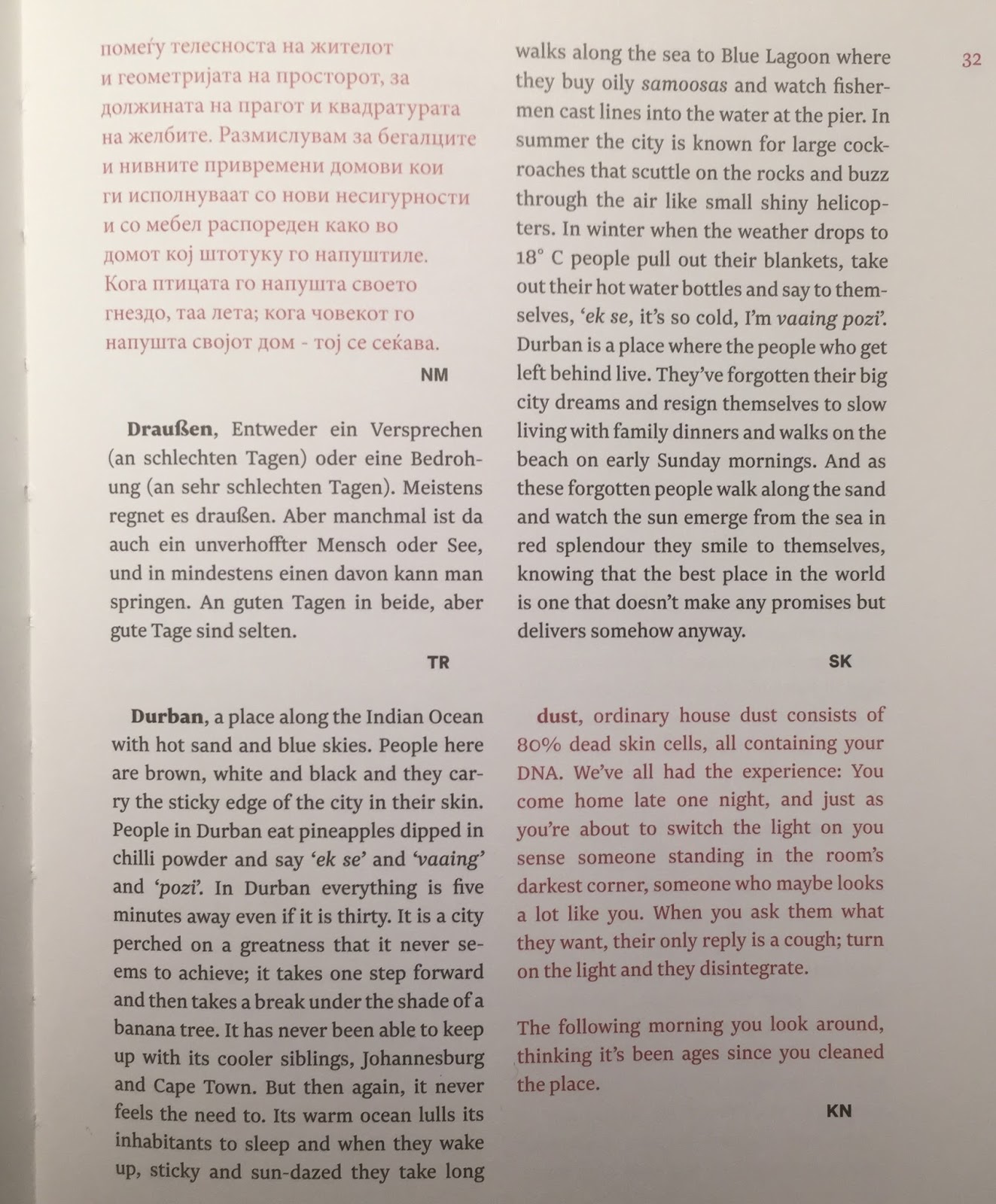
Durban Definition
Durban: A place along the Indian Ocean with hot sand and blue skies. People here are brown, white and black and they carry the sticky edge of the city in their skin. People in Durban eat pineapples dipped in chilli powder and say ‘ek se’ and ‘vaaing’ and ‘pozi’. In Durban everything is five minutes away even if it is thirty. It is a city perched on a greatness that it never seems to achieve; it takes one step forward and then takes a break under the shade of a banana tree. It has never been able to keep up with its cooler siblings, Johannesburg and Cape Town. But then again, it never feels the need to. Its warm ocean lulls its inhabitants to sleep and when they wake up, sticky and sun-dazed they take long walks along the sea to Blue Lagoon where they buy oily samoosas and watch fishermen cast lines into the water at the pier. In summer the city is known for large cockroaches that scuttle on the rocks and buzz through the air like small shiny helicopters. In winter when the weather drops to 18 degrees Celsius people pull out their blankets, take out their hot water bottles and say to themselves, ‘ek se, it’s so cold, I’m vaaing pozi’. Durban is a place where the people who get left behind live. They’ve forgotten their big city dreams and resign themselves to slow living with family dinners and walks on the beach on early Sunday mornings. And as these forgotten people walk along the sand and watch the sun emerge from the sea in red splendour they smile to themselves, knowing that the best place in the world is one that doesn’t make any promises but delivers somehow anyway.
(Durban, by Shubnum Khan from Cappelens Forslag, a Norwegian conversational dictionary out in November 2016)

(Durban, by Shubnum Khan from Cappelens Forslag, a Norwegian conversational dictionary out in November 2016)
October 30, 2016
Definition: Refugee
I recently contributed definitions for Cappelens Forslag Conversational Lexicon, which is an eclectic and beautiful hardbound leather conversational Norwegian dictionary out at the end of November.
Refugee: A man, woman or child in search of a home where there is no screaming at night. Often they travel to places far away, to places that are part of the reason why they have no home. Refugees are in a constant state of dreaming. They look at the strange bowls of food in their hands and dream of food from home. They dream of the sun and the market and the smell of spice in the air. They dream of their mothers who hummed old folk songs as they baked cakes of honey. They dream of the marbles that jostled in their pockets as they walked through the corridors in school and the giant mango trees they climbed with their cousins in the backyard. They dream of their oceans and their beaches and the way small silver fish thrashed at the end of their fishing lines. They dream of their summers and their winters and the holidays where their families gathered together and ate grapes and lamb and took photographs in the kitchen. They dream of their neighbours, of the big watermelons they cut open to share with each other. They dream of sunrise over the desert and sunset over the sea. They are told they must Integrate; a word they are unsure about, a seemingly practical word that bristles with underlying threat. They are told that Integrate means they must adapt to ensure they fit in with everyone else. They are told there will be Consequences if they do not. The word Consequence too, comes out politely but in it lurks bigger and worse things. Like a tank full of sharks. So the refugees try to wipe out memories of summer holidays, images of climbing mango trees and late afternoons at the water’s edge catching small silver fish. They try to Integrate, learn new histories, change their dressing, eat new foods and put new words in their mouth. But they cannot control their dreams at night; when they sleep they are back in their cities, sitting on their roofs, smoking pipes, drinking tea and looking out at the stars above them. And there are no bombs and no Consequences. In the morning they wake up slowly, dress in their new clothes and eat their new breakfasts and go out and try to Integrate. They forget about dreams and focus only on Consequences. Eventually their memories begin to fade and they only remember when the wind blows a certain way at a certain time in the year.

Refugee: A man, woman or child in search of a home where there is no screaming at night. Often they travel to places far away, to places that are part of the reason why they have no home. Refugees are in a constant state of dreaming. They look at the strange bowls of food in their hands and dream of food from home. They dream of the sun and the market and the smell of spice in the air. They dream of their mothers who hummed old folk songs as they baked cakes of honey. They dream of the marbles that jostled in their pockets as they walked through the corridors in school and the giant mango trees they climbed with their cousins in the backyard. They dream of their oceans and their beaches and the way small silver fish thrashed at the end of their fishing lines. They dream of their summers and their winters and the holidays where their families gathered together and ate grapes and lamb and took photographs in the kitchen. They dream of their neighbours, of the big watermelons they cut open to share with each other. They dream of sunrise over the desert and sunset over the sea. They are told they must Integrate; a word they are unsure about, a seemingly practical word that bristles with underlying threat. They are told that Integrate means they must adapt to ensure they fit in with everyone else. They are told there will be Consequences if they do not. The word Consequence too, comes out politely but in it lurks bigger and worse things. Like a tank full of sharks. So the refugees try to wipe out memories of summer holidays, images of climbing mango trees and late afternoons at the water’s edge catching small silver fish. They try to Integrate, learn new histories, change their dressing, eat new foods and put new words in their mouth. But they cannot control their dreams at night; when they sleep they are back in their cities, sitting on their roofs, smoking pipes, drinking tea and looking out at the stars above them. And there are no bombs and no Consequences. In the morning they wake up slowly, dress in their new clothes and eat their new breakfasts and go out and try to Integrate. They forget about dreams and focus only on Consequences. Eventually their memories begin to fade and they only remember when the wind blows a certain way at a certain time in the year.

A Lot Like Love
There's a moment in A Lot like Love, when Amanda Peet is watching helplessly as the man she loves kisses someone else at the end of the New Year count down and as she watches in despair, Ashton Kutcher suddenly rushes in, grabs her sorry face, pulls her into his arms and kisses her deeply.
Cheesy, I know.
Psychotic too.
But still, it makes me tear.
Cheesy, I know.
Psychotic too.
But still, it makes me tear.
October 29, 2016

October 28, 2016
Musing (from tonight)
I like, when a piece, begins to form and days after beating your head against a wall and finding every other thing to do and check, you finally at your seat, begin to write and finally the piece is flesh and you know how to clothe it and you know where to cut and like a corset it becomes tighter and fuller at the same time and you can look at it and say, yes I am satisfied with what I have written.
A Moment (from the smog-covered mountain)
On rainy days in the village, N and I would press our faces to the window and watch the mountain disappear as the clouds rolled in. The world was a quiet whispering thing then and we stayed indoors lest we be carried away with it.
The Things You Learn
There are things you learn as you get older, that you do not learn from books about how to be a human being. For instance you learn not to say certain things, you learn to avoid certain people, you learn that it is better to be quiet, that it is better to offer to help and to mean it and to pay the bill for everyone. It is better to laugh it off than cry and it is better to dust yourself off and wake up. It is better to wash dishes at people's functions and it is better to make tea even if someone says no. Especially if someone says no. It is better to cook someone a meal and it is better to pick up someone from the airport. It is better to phone someone than text and it is better to give more than less. It is important to tip. It is important to help people in the kitchen at their functions and to have plastics and tupperwares to give people extra food. It is important to have empathy for everyone including your enemies.
These are the things you learn that you do not learn in books.
These are the things you learn that you do not learn in books.
Most Days
I still find it difficult and most days I do not think about it, but on the days that I do, when I see something or hear something or remember something (I hide from my memory now, play a game, always evading its fingers) it is hard, harder than I expect it to be and I know now the triggers and most days I avoid them and most days I have become better than bearable and most days I am glad to be here but somedays, the bad days, they pull me down and it is hard to come up, but easier than before. And I think I can say that it is easier, not easy, just easier than before.
A Moment (from Monday)
When we entered my grandfather's room my father caught sight of his father's watch and he stepped out of the room and walked away overwhelmed and I, went to the shelf and turned the face of the watch around so that his grief may be a little less.