
Jon Alston's Blog: The Year(s) After, page 3
March 18, 2014
FOMO (sort of)
Urban Dictionary:FOMO: "Fear of missing out". The fear that if you miss a party or event you will miss out on something greatEx. Even though he was exhausted, John's fomo got the best of him and he went to the party.
Wikipedia:Fear of missing out or FOMO is a form of social anxiety — a compulsive concern that one might miss an opportunity for social interaction, a novel experience, profitable investment or other satisfying event.[2] This is especially associated with modern technologies such as mobile phones and social networking services.
A study by Andrew Przybylski found that the condition was most common in those who had unsatisfied psychological needs such as wanting to be loved and respected.[3] The condition is also associated with social networks such as Facebook and LinkedIn, which provide constant opportunity for comparison of one's status.[4]
Some thoughts by John M. Grohol (PSY. D) from his article on PsychCenral titled FOMO Addiction: The Fear of Missing Out
“Teens and adults text while driving, because the possibility of a social connection is more important than their own lives (and the lives of others). They interrupt one call to take another, even when they don’t know who’s on the other line (but to be honest, we’ve been doing this for years before caller ID). They check their Twitter stream while on a date, because something more interesting or entertaining just might be happening.
“It’s not ‘interruption,’ it’s connection. But wait a minute . . . it’s not really ‘connection’ either. It’s the potential for simply a different connection. It may be better, it may be worse — we just don’t know until we check.
“We are so connected with one another through our Twitter streams and Foursquare check-ins, through our Facebook and LinkedIn updates, that we can’t just be alone anymore. The fear of missing out (FOMO) — on something more fun, on a social date that might just happen on the spur of the moment — is so intense, even when we’ve decided”
The Huffington Post, too, had dozens of articles all devoted to this ‘fear of missing out’.
* * *
Ok, so now here am I. This ‘fear of missing out’ plagues me. It is, in part, what prevents me from writing (which has been non-existent for the past few months; don’t worry, I’m working on it). It also prevents me from doing anything else, too. Like spending quality time with my Wife, or the Chubbs, or my friends and family. It prevents me from devoting time to endeavors other than just passing time to get through another day.
But everything I found when Googling ‘fear of missing out’ had to do with missing out on social connections, primarily when concerned with social networking--with the glow of those electronic devices severing our physical interactions. When I started researching this hollowness I felt, this ‘fear of missing out’, that’s not what I expected. At all. It’s not what I was looking for.
My perception of FOMO (which before writing this I didn’t know was a diagnosable condition [still not sure I buy that either]) has nothing to do with technology, social networking, or missing out on parties or whatever. It has everything to do with missing out on things.
Let me explain.
I have the fear of missing out on, for lack of a better word, media. Missing out on books, on music, on movies, on TV shows, even on video games. Mostly it’s music and books, because that is where I have developed my passion. It is impossible for any one human to read all the books ever printed, for three reasons: 1) too many books have been lost or destroyed over the centuries; and 2) there just isn’t enough time to read through every book that is available in your own language; 3) let alone in all other language, translated or not. I know some may say not every book is worth reading. Maybe that’s true. Maybe not. I don’t know, but having not read very much (especially for an English major), I am truly unaware of what’s out there, what I’m missing, what I’ll never see and think.
The same goes for music, movies and TV shows. I know there are not enough hours in a lifetime to listen to every artist and watch every movie and every episode of every TV show; that gives me intense anxiety. Thankfully, unlike books, there are bands and movies and shows I have no desire to listen to or watch (a list too long to mention). Except, secretly, I do want to listen and watch, because they exist. I know I won’t like them, because I know my tastes and what I can handle when it comes to gore and sex and violence and vulgarity and genres. But the not knowing, that feeling of missing out . . . sometimes I have panic attacks because of it. And as a creator of content that will become part of this grand expanse of media, my stress and anxiety increase almost exponentially.
But this FOMO (that really is a lame acronym, let’s call it the Glumps from now on) is not exclusive to books and music and film and TV, it also erupts over talents. Of learning new skills. I don’t worry about missing out on ‘experiences’, I worry about not having time to learn all the things I want to learn, and do all the things I want to do. I know those sound the same, but they really are quite different. To illustrate, here’s an incomplete list of talents I want to develop, and goals:· Blacksmithing· Welding· Jewelry making (like faceting and such)· Glass blowing· Design and build a house· Paper making· Print making· Armory· Gardening· Woodworking (mostly lathe work)· Be a mechanic (I love seeing how things work)· Build a go-cart· Build an Ultra-light· Get my pilot’s license· Be a stunt driver· Become an Astrophysicist· I want to learn to play violin, cello, clarinet, bassoon . . . · Make a real movie
And the list goes on. A list of skills I want to develop that only affect me, and no one else. That only involve me, and no one else. That’s where the difference comes in, the Glumps I get involve only my personal maturation. I want to learn and know and do almost everything. I want to be almost everything.
I’ve been this way for as long as I can remember. Not infected with the Glumps, but wanting to do all the things. When I was a child, I wanted to be cartoonist. For years, I told my parents that I was going to be one (thanks to Bill Watterson). Calvin and Hobbes was my childhood. Although I never actually read the comics while running in the newspaper, my brothers collectively owned all the anthologies of that brilliant strip, which I devoured. I copied image after image from those books in my little sketch book. I even got to the point where I started a mural on my bedroom wall (which is still there, still unfinished). But then, I got to high school, and I took a drafting class, because architecture always interested me. After that first class, I knew I was going to be an architect. For my entire high school career I wanted to be an architect. Or a chemist. Because I love(d) chemistry. And I was good at it. Aced AP Chemistry, got a 4 on the AP Exam, was accepted to BYU Provo as a Chemical Engineer. But that path changed. After a series of changes in my major, and a move back to California, I ended in Creative Writing (that is a story for another time, or one I’ve already told). I love writing, now. As a child and teenager, I hated it. Reading too. But now, it is a great passion of mine. Yet . . . there are all these little voices echoing between my ears, calling out: “What about me?” All the career paths, talents, trades, skills I could have learned, that I still want to learn, but that I haven’t, that I know I don’t have time for, that I will at some point have to put on the chopping block
You might think: well, that sounds tough, but at least you have something you are doing, and you can always work towards those other goals: read as much as you can, watch as many movies as you can, list to music all the time, just try to experiences as much as possible and hope for the best; have hope, have faith, it will all work out and you’ll be happy. Wonderful sentiments, but they are misguided, because they misread the problem.
See, the Glumps are debilitating. Overwhelmed knowing I can’t do everything, I end up doing nothing. I’ll sit on the computer scrolling through UberHumor or playing stupid mind-numbing internet games, when I want to be writing or reading or playing with the Chubbs. I want to hike and bike and just be outside, but knowing that I am this spec in the infinite cosmos of human life, this imperceptible period at the end of the shortest sentence no one has read, I just stare out the window and despair at my internal surroundings.
The deluge is a very self-deprecating experience. It’s self-destructive. It’s self-sabotaging. It’s a lot of big words that I don’t know, that I will never know. There is a lot of information I will never know. Knowledge I will never acquire. Trades I will never attempt, talents I’ll just never have, no matter how hard I do or don’t try.
And that’s life. Accepting the limitations of living. Of being human. Of dying. Of looking for the little in-betweens where someone stumbles onto your miniscule sentence, reads it, smiling, and you embrace, to know that each other are real, that you are more than the solitude inside your heads.


January 23, 2014
Lynching the Book: Rise of the eBook
In our modern age, every writer must ask the invariable question: to print, or not to print? More than ever before (which, duh, that’s how technology works), writers feel the push towards the eBook. To easy access, to lower prices (often $0.99 for a novel), to commodity.
The commodification of literature has been around for centuries. The Victorians took it to a whole new level in the mid 19th century, thanks to authors like Charles Dickens and serials. Marx and Engel based many of their writings on such divorces between the material, producer, product, and consumer. Even way back when the first book was printed in English (The Recuyell of the Historyes of Troye) on William Caxton’s printing press in the 15th century, books became consumable. Tyndale’s English Bible followed shortly thereafter from Guttenberg giving Christians access to religion in the English language. Give another hundred years or so, and the fledgling printed book grew into a product that nearly every individual had access to in some form, either obtaining money enough to purchase or to rent from the new founded Libraries.
Medieval Age: the time of Gower and Chaucer, of Sir Gawain and Green Knight and Beowulf, only royalty or the very top echelon of the rich had access to books. Only they could afford the expensive vellum, the hundreds and hundreds of monk hours spent painstakingly copying a book word for word, accompanied by gilt pages of Illuminated text. Books were uncommon. Seven hundred years ago, books weren’t just books, filled with words to read, ponder, and discard. They were pieces of art. Objects asking for interaction. And those that remain, such as the Ellesmere Manuscript and the Book of Kells, are invaluable treasures horded in museums.
2014: ‘publishing’ and ‘printing’ have changed. Technological advances in press machinery allow printers far more room for creative variance. The invention of the digital press (inkjet and laser printers) has made it possible for anyone to print anything they want, whenever they want. Those FedEx print shops are everywhere. Add the internet’s influence for the last 25 years, and that makes for a completely new world of printing and publishing. Where once writers were at the behest of a skilled typographer willing to print their work, or hoping some big publishing house would accept a manuscript from a previously unknown author of no publishing history, writers now have the ability to publish when and how they want. And not just physical text, but PDFs we try to pass off as books. Electronic documents that replace the heft of hundreds of pages, the smell of fresh paper and glue and book cloth; documents that can be passed around like STDs between various electronic devices quicker than it takes to read a few sentences. And people can access these documents whenever and wherever they want. No more hassle with carrying books around, no hurt backs and straining at fonts that are too small. Whatever you want, right in your hand: on your phone, or iPad, or Kindle, or Nook, or laptop, or whatever. You want it? You got it.
Places like CreateSpace, however, try to bridge the gap between this drive away from the printed volume. A print on demand approach. No wasted paper, or ink, or time, or money, or anything really. Rather than print hundreds, or even thousands, of books, a publisher (or author) can simply upload their text to a database, and whoever wishes to purchase it (if any) with one click and a credit card number, can get a book in a week or so. Not only that, make sure you have your PDF/eBook version to go along with it, just in case (again, at no charge). And if no one buys the book, the publisher/author won’t lose any money on unpurchased books. It’s almost a perfect avenue for self-publishers (which is a topic for another post). Without funds to support printing mass quantities of a book, the now destitute writer can bring their work to the masses at no cost (aside from hundreds of hours producing the work itself), while bypassing the time wasted waiting for someone to finally ‘accept’ their work. No more hoping a store will pick up your book if it happens to be published, because now it’s available online, in nearly every country, almost instantly. The consumer can be fed with perfect ease.
So what? you may ask. Where’s the down side?
Let me tell you a brief story.
The Oxford English Dictionary (O.E.D.), the world’s largest and most comprehensive dictionary of the English language (around 619,000 entries), got a new Chief Editor last November: Mr. Proffitt. Go read the article if you want more details. In summary, there will not be a printed third edition, which isn’t new news, and was a decision made long before Proffitt took over. There have been two past editions, the first in 1928, the second in 1989. A 20 volume set of everything English. And at a nice price of $995, it’s no easy thing to acquire. It’s why the O.E.D. has been moving to an online database. Yet, even online access to the dictionary will run you a sweet $295/year. If you’re lucky, maybe your library has a subscription. Either way, the O.E.D. will never be printed again, and Proffitt wants to move to a more modern digitized O.E.D, more than what they already have. So here’s the thing: I love the O.E.D. It’s brilliant. It’s beautiful. When I first learned about it in College (which that in itself is a travesty) it blew my mind. It’s the greatest resource, in my opinion, for all things related to the English language and English culture (someday I want to buy one of those 1989 editions). I hope that every language has a dictionary like this. Now to the point. I posted that article on Facebook a few days ago, with the caption: “I know, embrace technology, and the fluidity of language. But still, not sure how I feel.” Here is how the thread went with me and two friends:
F1: What would the point of a 20 volume dictionary be?Me: Is that a real question?F2: $$$ and to be an official pompous asshole. Or really, just an asshole.F1: Yes. You know how I feel about books. I still refuse to get a kindle. But a big ass dictionary? Thats obsolete.Me: I guess I'm an a-hole and obsolete. I think this dictionary is beautiful, and I would love to have a 20 volume set
Now, I’m not trying to cast my friends in a negative light, or say they’re bad people, because they aren’t. They are brilliant, and have their opinions just as I do. And the thread went a little better from there on out (thanks to the help of another “old soul”). Anyway, I mention this conversation to illustrate the fact that on a whole, we are moving away from the book as an object. An object of learning, of art, of expression, of existing. The book is no longer desired as a means of knowledge, of freedom, of escaping the tyranny of religious dogma controlled by dying old men speaking a dying language; no longer are books the sources of information, true information, because anyone can publish anything they want. And besides, we have the internet now. Books are just paper taking up space and need dusting. They are nuisances, something to avoid at all cost, something that distracts from Tweets and Instagrams and memes and YouTube and the glow of disillusionment (these are generalizations and hyperboles, I know, but you get my point).
The downside is this: there is no touch involved with the internet. That’s its goal: remove the human from our equation of living. Yes, the internet does bring people ‘together’ across vast distances that otherwise would be impossible. And yes, we are able to ‘experience’ the world in a whole new way. But we can’t touch any of it. We don’t reallyexperience anything. Seeing is more than your eyes. We touch to see. We hear and taste and smell, to see. The eBook denounces our other senses, as does the internet (although there are a lot of sounds drifting through webspace). Books, since the beginning of time, have been about touch, smell, and sound (sometimes taste, just ask The Chubbs about her books). Books create a physical experience, both in reading and creation. We interact with books when we read, as do those who write them and bind them. Even when the few books that are still printed are mass printed by machines, removing most of the human element, at some point someone touched the paper, or the ink, or the machines, or at the very least touched the book when it was placed on a shelf in a book store somewhere. People perused that shelf, picked up that book, thumbed through it, and put it back. Or it was purchased.
That connects people.
Art is intended to bring humans together to help understand and explain our world, or parts of it (my personal definition), but the intangible eBook removes humans from the process. There is no sharing of anything. Nothing real. No touch. Or smell. Or sound or taste. Some may say, “It’s the same story either way,” but it’s not. It can’t be.
This move away from the book terrifies me. What have I gotten myself into?
I want to write. And I do. But I also want to publish. Books. Physical books. Objects of material. Corporeal creatures that change depending on how you hold them, how you look at them, what paper they are printed on, whether you tear pages out and burn them or not (don’t do that). But does this new ease of publishing, the expected and demanded access to everything we want whenever and wherever we want it, does it nullify the need for the book? For publishing in general? Does the eBook abolish the historical and modern significance of the typeset text? What point is there in crafting words into sentences, images, feelings, experiences, complexities that even sometimes the writer does not understand? What point to creating when there is no concrete, tactile evidence that your creation exists? only megabits floating somewhere in the innerwebs, entombed in distance servers, alluding to a reality? I don’t have the answer, nor am I looking for one.
I know what I want, and how I feel about books. I love them. They are precious to me. I don’t want to see them disappear, but I fear that they are. And there is nothing I can do about it. No matter how much I fight it, how much I try to remain rooted in my beliefs about the substantial existence of ‘things’, I can’t stop the change. I can write. Hopefully if I publish books, whether through a press or by myself, people will buy them. But it won’t last. Soon, I won’t be able to make a book out of paper and ink, and be able to sell it to, because it doesn’t fit the proper commodity specifications.
And when that happens . . . I don’t know.
January 3, 2014
This has nothing to do with writing
It’s Friday.
And I was on my way to the grocery store, because that’s what you do when you only work 10 hours a week, when I got a text from the Wife (she had her 28 week check up today):
Baby’s heartbeat is in the 130 range. My blood pressure is 91 over 56 or something around there. The Nurse is guess we’re having a boy :) She said of course it’s just a guess and not a formal medical statement!
My first thought was: great! healthy kid, healthy wife, all is well. And I told her that sounded good (I text: “Cool cool!” because I’m lame). But my brain didn’t stop there and return to the road and driving and domestication. Somehow it made a jump to weak people. Sick people. The frail and dying. Those with countless allergies and syndromes and ailments, those that have to undergo seemingly infinite surgeries to continue correcting physical malfunctions, those who have a dozen orange bottles in their bathroom cabinets to stabilize their deteriorating insides. The Wife and I saw a lot of it from last year. But it’s everywhere, affects everyone’s lives. Now, I know I take for granted how strong and healthy the Wife is, how strong Chubbs the First is, and how strong Chubbs the Second is becoming (so far). In all honesty, we could have had the first at home, and probably this second one in a few months, without any complications. There would be two more people in the world, strong enough to survive it without help from modern medicine. Even my own health. I haven’t been to the doctor in years, and I’m still alive and well (I think). But what about those that aren’t (this is where the weak people thing came to mind)? What about those that would have died without intense medical services, both during pregnancy, birth, and the years after? I know two children specifically of good friends that would have died within the first 24 hours of birth because of serious birth defects. Prenatal improvements save their lives. There are probably a dozen children that I know close to their teens that would have died because of rising diagnoses that lay dormant until their pubescent years. One of my good friends from Grad School should have died at birth (according to doctors), but because of modern medicinal practices and his little baby strength, he miraculously survived.
What I’m about to write may upset some of you; take what I’m going to write in the vein of curiosity at our modern world, not a judgment or suggestion of any kind.
Should they all have lived? I do not ask this as a moral, ethical quandary, because it isn’t. I ask this as a man versus nature dilemma.
How many of us should have died at birth, or even before, but didn’t? Even I shouldn’t be here. I was breech, not coming out, and if it wasn’t for my mother having a C-section, I probably would have died during the stresses of labor. Turns out the Cesarean Section has been around for a long, long time. But the likelihood of survival only 100 years ago was so small compared to now. The Wife’s sister and the wife’s mother would have died during the third trimester of that pregnancy if it were for modern medicine. Her sister had come pre-mature, weighing only two pounds when she was removed by C-section from her mother to keep them both alive. Then for two months, the sister lived in an incubator to build up strength, grow lungs, finish the whole cooking process, before she could taste real air.
My point in writing all this is to ask the question: is the rising generation (of each epoch/millennia/century/decade) progressively lazier, weaker, more pathetic, because of the improvements in modern medicine? Are we creating fragile bodies that cannot, on their own, withstand the difficulties of life? Are we over-protecting sensitive minds from the stresses of normal living?
Are we going against nature?
Throughout history, only the strong have survived. There have been those that slip through the cracks (don’t ask me who, do your own research), but on a whole, the strong are born, live, progress, improve, conquer, succeed, etcetera, and THEN die. Then Penicillin was invented (by accident). A revolution, to say the least. Millions of people’s lives could now be saved because of that simple lump of mold. Jump ahead some years later, and now we have dozens of vaccines to fight against Measles, Typhoid, Tetanus, Diphtheria, Chicken Pox, and more that I don’t know the names of, but that I know my daughter has been vaccinated for. Simple diseases, no big deal to any of us now, because a majority of us have been vaccinated. We had parents who knew better than to believe correlations between Autism and vaccines. We were given a chance to bypass the lesser diseases so we would have a chance at Heart Disease and Cancer.
But people lived for . . . 50,000 years without those vaccines. Some may say: “But they died at 30,” “They didn’t live happy lives, they struggled to survive,” “Think how much better their lives would have been if they had known?” “They all got sick, all the time,” “Epidemics and Pandemics were almost common for them,” and so on. I’m no archeologist, or historian, or anything, but who is to say they weren’t happy? Or that they all died so young, or fell ill at the slightest anything? The fossil evidence that we have is very limited, and can in no way stand as a measure for the entire world and ancient life. I don’t think any scientist or historian has ever claimed such either. But ancient people they lived. They ate, they breathed, they breaded, and they flourished. Even with plagues like the Black Death, population overall continued to grow. Without medicine, people still lived, and lived well. Really, problems like the Black Death, and other diseases, weren’t much of an issue until we stopped hunting and gathering with our families, and started setting up communities where we interacted with far too many people, exposed to germ and bacteria unfamiliar to our immune systems (but that is another post entirely).
Whether you believe in God, Evolution, or the Flying Spaghetti Monster, is our current course the correct one? All three would come together to tell me: yes, we are on the right course, because we as humans have these magnificent brains (whether through evolution or from God, or a meatball), and it is by these brains that we have been able to manipulate our bodies, resurrect the dead or almost dead, reengineered our genes and bones and muscles and skin to escape the forces of nature, God, or that plate of delicious spaghetti. Through our advanced cognition, we are able to outsmart diseases, infections, tumors, genetic deficiencies, and external injuries. Because we are human, whatever changes we make to nature must be correct. But just because we can do something, does that mean we should?
Jenni with an “I”, a friend from college, wrote this about the Donner party after reading the book Ordeal by Hunger, by George R. Stewart: “I just sat back, breathless, in awe of what these people went through. I could not have done it. Their will to live was so much stronger than anything I've felt in my entire life. That is both my shame and their honor.” I don’t even want to begin a conversation about the Donner Party; read her blog post about it, she covers it well. But I saw something in her words that I’ve always believed: each previous generation was stronger than those who follow. I couldn’t have survived that frigid winter on the eastern slope of the Sierras. I don’t know anyone who could, especially with the conveniences they had then.
Fifty years ago people physically worked hard than we do now, because they had to, they didn’t have the technology that we have today to simplify life. One hundred years ago they worked even harder, because they had to. And you can keep going back like that to the beginning of man.
The reason I ask this question about modern medicine, and all the others I posed, is because I believe I am a part of the weak. I don’t like admitting it, but I’m lazy. I don’t like exercise. Perhaps it’s because I can choose not to do it, unlike manual labor just to survive, i.e. family farming. My mind is weak too, anxiety riddles my brain with “inabilities” to function, and torments my physical body with panic attacks and constant nausea. On all accounts, I should have died years ago, in Mexico, when the subtle anxiety tore through and revealed its seven vicious heads. But I didn’t. Because I had a way out. I had doctors. Psychologists. Medications. Others willing to carry my load for me when I found it “too difficult” to carry. And I know that my situation isn’t even that dire. My life is simple compared to the millions upon millions who suffer from real complications that they have no control over. But I just keep coming back to this idea: are we keeping the weak alive when nature would have rather them never to exist?
I don’t know the answer, and I don’t think I want to know. We are constantly making life easier, and allowing the very weak and inept to flourish. I know, it sounds sadistic and hateful, bordering on lunacy. I don’t mean it to, but you have to wonder: are we doing the right thing? Is there some happy medium between Stone Age medicine and Smartphone apps that can diagnose any disease? Where do we draw the line? Or is there a line at all?
December 31, 2013
Resolutions for the Same Beginning
Normally I write about how much I hate things, and talk about how much I hate things. Hate and hate and hate. My friends know. I use the word ‘hate’ far too often, especially since I don’t ‘hate’ as much as I lead on that I do.
I thought about starting this by writing: I hate New Year’s Resolutions. That I hate the people who make them, how resolutions are pointless, and no abides by them after January 2nd, etcetera (we’ve all read, said, heard, written, all this before). But I didn’t want my first post of the year to be about hate, so I decided not to. Instead, I thought about resolutions. About what they really are, what they really mean for those that make them, and I realized I just don’t like them, or understand them.
Over the years I’ve made resolutions along with the rest, mostly during high school, during that time when I still believed that I could change the world, make some kind of difference, be an influence for good; when I believed in individuality and the importance of the ‘One’. Somewhere between high school graduation and attending Sac State, I stopped resolving to ‘change’ solely because the date changed. I wish now that I had a list of all the resolutions I made as a teenager: be nicer, exercise, eat better, learn to play the guitar better, whatever. Something like that. But I digress.
The point is: I don’t make resolutions. They are meaningless word fodder. A list of hopes or dreams or desired outcomes for the year that I didn’t achieve the previous year. That’s all it is. And the list is always the same, a repetition of what was not accomplished from years previous. But we do it anyway, instinctually (whether inherent in genes or instilled by societal expectations), as if we cannot become better people without waiting for a number to change on the calendar and publicly announcing, “This year will be different. It will be better. I will do things. Because I said I will be, and now you know I mean it.” It makes no sense to me.
Internet news feeds for the last week have been filled with lists of “25 Resolutions You Should Make This Year” and “What Resolutions shouldn’t you make for 2014”. How do you what I need to resolve to do in the following year? Let alone at any time in my life?
Nonsense.
But all that is not to say that some form of resolutions can’t or don’t work for some people. They can. I’m sure they can. I know that there is someone out in the world right now who made some specific resolution to change in the New Year, that they needed a specific marker to initiate that change within their self, and that 2014 will actually be different for that person. To that I say: fantastic. For those that make and keep resolutions, you are far stronger than I am. And I’m okay with that. I know my limitations, and they include not making resolutions. Because I’ve never once kept a resolution. Not one.
Rather than resolutions, the Wife and I set goals. I know ‘goals’ and ‘resolutions’ sound the same, but they are not. Resolutions are arbitrary statements with no means or concept of how to achieve or complete. They are whimsical delusions of progress, made rashly, under pressure, without thought. Goals inherently are structured with a plan, an outline from beginning to end on how that desire will be accomplished. They are support by time and pondering, they are the way of pragmatism. When the Wife and I got married, someone gave us this black spiral-bound notebook. I don’t remember who, but that doesn’t matter. We got this book, and we decided that at the beginning of each year we would review our goals from the previous year, see what we accomplished and what we failed at, why we succeeded or failed, and then set new goals for the coming year. Here are a few of my goals from 2013:
Get the Novella published (fail)Find a job (sort of)Move out of my parents’ house (major fail)
Just to name a few. The outlook is not so good. But I tried. I submitted the Novella to half a dozen publishers, and one contest (I have only heard from two of the publishers). Technically I got a job, albeit not exactly what we were hoping for (but at least it’s a paycheck). And the parents . . . well that is just a straight up fail, but not for lack of trying. However, we also did a ton of stuff. Every year we have a theme for our family, and this year was the “Year of Exploration”. Each month we tried something new that we’ve always wanted to try but never have. I’m going to get into the specifics of it here, but if you want to know what we did, you can check out the Wife’s blog for details. I will say that we are amazing, and did some pretty sweet stuff (I don’t think I can be more vague than that).
My point in all this is that resolutions are too broad, too big, too unobtainable. They are crap. They mean nothing, and go nowhere. What we should be making (or setting) are goals. Aspirations that will make our lives better. As my good friend wrote just a few days ago: “Instead of making resolutions to live longer, let's resolve to live better.” And the Wife and I need to live better for 2014.
2013 was a difficult year (mostly for the Wife). Finding work was next to impossible for me. Thanks to a good friend I am teaching extremely part-time, which is better than my previous job: nothing. Before, it was a hard year of unemployment. A Master of Arts in Creative Writing means you have no marketable skills but are over qualified for regular jobs, or so it seems. But the part-time teaching has only been for the last six months, and that’s only one to two classes a term. Work has just not been good. Schools don’t want to employ you because you have no experience, but you can’t get experience without a degree, and you can’t get adequate experience while getting a degree. It’s a vicious cycle. Add on the disappearance of tenureship, and that basically kills the possibility of a stable, if even possible, teaching job at any Junior College or University. Now add over a hundred reject letters for short stories, flash fictions, prose poems, a few attempts at the Novella, even job applications at Junior Colleges, and it gets depressing (John Daulton if you are reading this, I know, self-publish, the eBook is the way of the future). But, like I said, it has been much much worse for the Wife. Compile all my stress and failures and put them on her shoulders, while taking care of our family with having the only somewhat fulltime job. Add our 17 month old child were trying to raise. And living with my parents. And being six months pregnant. That alone is enough to break the strongest of individuals. But that is nothing. Several of her friends and family members have been hospitalized, gone through surgery, or been diagnosed with stage four cancers. Then, her younger cousin died at age 17 of Ewing Sarcoma that he fought for six year, and a good friend from her childhood died at 26 from an intense infection that ravaged her already weak body. Both within a week of each other. The Wife has lost a lot this year. But she wouldn’t say it. Wouldn’t even think it. She, instead, worries about the families that have lost their loved ones, wonders how those families are doing, what they must be going through. Not a single complaint uttered. I know I wrote a month or two ago about empathy, stating that it doesn’t exist –- I still don’t think it does -- but if any mortal were to possess the actual ability to empathize, it would be her. She loves more than most can understand. More than I understand, for sure. By no means is she perfect, but when she loves someone, she loves them to the end, unconditionally.
We are glad to see 2013 finally end. It was a rough year. A year we would like to forgot. Maybe in 10 years it won’t look so bad. I hope so.
All I can say is that 2014 is going to be better. That’s not a resolution, it’s a choice. To improve. To live better. It sucks, really, that this rejuvenation has come right at the cusp of the year change, so this rant looks like a resolution, but it’s not. Trust me. It comes from going to two funerals in December for people younger than me, who were doing more with their lives than I am now; from a place where living with my parents may be killing me, my wife, my child(ren), and our marriage; from watching others be successful with their degrees, in careers that they are happy with, or publishing stories and books; from wanting to work on my own art, to focus on my work and taking care of my family. Wanting to be the husband, father, provider, friend, and artist that I want and deserve to be.
I want to live better. This year I am going to live better.
December 4, 2013
The point of no return (or something like that)
I’ve thought about writing this for a month now.
But I haven’t written anything since November 11th. I know the exact day because it was two days after starting the 27 Act Play about Capitalism (which was never completed, and most likely will never be completed).
Today was the first day I read a book in two months (I don’t want to read it, but I’m in a book club, and I need to man up). Even for work, where I teach two classes twice a week for four hours, I haven’t read a single text to prepare for class. I’ve avoided reading and writing like some bad simile or metaphor that I can’t think of.
I don’t know what happened. I know how it happened, but the why eludes me. At the beginning of November I got an email from Sixfold.org about some new fiction and poetry they recently released. Nothing special, just an update from one of the many publishers that I periodically receive. I read the excerpts from each book embedded in the email—then something sort of snapped in my brain: “I’ve read this before, a thousand times, these words in this order, trying to tell this story.” Or something very much close to it. Possibly from my own writing. Bland, predictable, naïve and inarticulate. Perhaps to the point of being amateurish. Maybe. I don’t know. But since then, I’ve done nothing except watch TV and play on the internet (in the time that I’m not at work, which isn’t much). I’ll do an occasional craft project with the wife, but my writing, my reading, my growth as a human: stagnant. Truthfully, dying, because without those valuable nutrients books offer, my brain and creativity are slowly wilting to dust.
I don’t know what to do, how to snap out of this.
Last week I published a book of short fiction and creative non-fiction that a select group of friends from Sacramento and I wrote. Twelve of us, all graduates for the same Master’s program at Sac State. I’ve been working on this book since July. We all have. Working with the authors editing their work, revising, proofreading, compiling, and finally designing and publishing the book through CreateSpace. But by the end, I didn’t want to read anymore. Nothing. Especially this book. Everything finalized, just upload the PDF, proof it, and approve. Of course I’d read through each of their stories intensely at least three times, and done a number of skims on top of that. When it came to that final proof . . . I couldn’t do it, I couldn’t read through it one more time, and because of it, there are inexcusable typos throughout the book, typos I could have easily avoided and rectified if I so chose. I didn’t. I want to care that I didn’t, but I don’t. And that scares me.
“It’s ok, you’re just going through a tough patch.”“Don’t worry, man, it’s just a rut, we all go through it.”“This happens to everyone.”“Me too, I totally know what that’s like.”
I hear it all the time. I expect some reading this think the same about me and my current state of being. Of course you do, we all do. We do it to anyone who is struggling, because we don’t really know what to say. How could we? It is impossible for any human being to feel what another human is feeling. We are not that person, and can never be that person. I’ve come to find the word ‘empathy’ to be impossible, one of those non-words we somehow created and gave meaning to without realizing its textual existence did not correspond to our corporeal reality. According to dictionary.com, empathy is: 1) the intellectual identification with or vicarious experiencing of the feelings, thoughts, or attitudes of another; 2) the imaginative ascribing to an object, as a natural object or work of art, feelings or attitudes present in oneself.The second definition I’m not even going to consider. The first one is impossibility. How can we presume to have the ability of “vicarious[ly] experiencing . . . the feelings, thoughts, or attitudes of another,” when we can’t even explain or understand our own internal machinations? For so long I lived under the pretense that I could ‘empathize’ with another human, that it was possible for me to feel exactly what someone else felt. Over the years I have doled out advice under the guise of empathic understanding, because I ‘felt’ someone else’s situation. Foolish dribble and delusion. Even if I wanted to live the life of another, make it part of my own living, my own experiencing, I couldn’t. Our physical partitions inhibit that possibility. Our separation, our inherent inability to ‘know’ another, is the only attribute that makes us unique. It is the epitome of individuality. We may never do anything truly original, or genius, or even noteworthy, but because we exist, that makes us unique, because our experiences and emotions and memories cannot be experienced by another. No matter how hard science tries to bridge that gap, it can never be crossed. Ever.
And that is what makes where I am at so difficult. I don’t want to talk to anyone, because I don’t want those generic answers, they don’t help. And I don’t want attempts at real advice, because they are meaningful and genuine and come from somewhere loving (I think), but they don’t help either, because they are wrong. They are always wrong. You. Me. Everyone. Always wrong. When it comes to giving people advice. We can get close. Damn close. But we will always come up short.
I don’t know where to go from here. Every day I get on the computer to check my emails, Facebook, do the good American routine and give my soul to the interwebs. And then I think, “eh, maybe I should try writing something.” Then I sit, staring. Avoiding the Microsoft Word icon on the bottom of the screen. Maybe look through some pictures, open those folders hiding old stories and read their titles but leave their contents alone. Afterwards, I slip back onto the internet, or go watch TV, or just sit and stare and mope.
Maybe it is just a phase. A rough patch. The weight of no job prospects and publishing almost an impossibility (let alone opening my own independent publishing house) and learning to be a good father and failing at being a good husband and dealing with living at my parents’ because I can’t afford a one bedroom apartment anywhere and squishing two entire lives into my old high school bedroom with reminders everywhere that even after ten years I have gone nowhere with my life (little glow in the dark stars burning on the ceiling at night, mocking, and Star Wars spaceship miniatures dangling amidst those stars watching my incapacity to grow) while on my wall the Calvin and Hobbes mural I started when I was 14 waits to be completed but never will be no matter how hard I try to finish it. I lay awake a lot at night with my room taunting me, asking me what I am still doing in there, now with a wife, and a child right down the hall, why nothing has changed, and where did that extra 30 pounds come from?
Maybe it’s not a phase. Maybe I broke something in my head. Maybe after 28 years my neurons aligned (or disconnected) in just the right way to fracture all my neuropathways that made it possible for me to function, to be happy, to create.
I don’t know.
So now I am here. Writing for the first time in over a month. It’s not much, but it’s something. A step forward, I guess. Perhaps this will open my mind to finally write that non-fiction piece I was going to start the week following the 27 Act Play on Capitalism, to finally put down on paper or digital space the sentence I’ve repeated to myself at least once every day since the beginning of November:
“I take drugs because I’m afraid.”
November 8, 2013
IBA and New Literary Theory
DISCLAIMER
this is long, just deal with it
Before I get to the good stuff (or what I think is the good stuff), let’s do a little update:
-THE JOB: still there, apparently. Term just ended, and I got my official exit date: December 2014. I know, not what I expected either, but I’ll take it. Turns out, they are actually trying to cut away the higher paid faculty before us peons, which really makes more sense. My supervisor goes six months before I do, so that’s weird. And the school’s President left at the end of October, so now we’re just running on the Education Department I guess.
-THE WRITING: way harder than I thought it would be. A few years ago (for those who remember), I did this experiment called The Daily Flash. Every day, for a year, I wrote a flash fiction or prose poem. Minimum 100 words, maximum 1,000. I lasted 152 (or so) days. Not bad, but certainly not all the way. For a myriad of reasons I stopped the project, but the biggest was I felt I wasn’t learning anything anymore. This time I have three completed stories so far, and I’m working on the fourth. Right on schedule. Rather than try and explain each story, I’ll just give you one of my favorite sections from each:
“He watched the painting, each lighting strike illuminating the dark, but from within. Flashes bounced between the frames, skipping out from the wall and into the room—each corner highlighted long enough for Malcolm to see the entire room. Crash after crash, moving closer, the gap between light and sound shrinking, until he heard both together, the storm raging from the wall, or outside, rattling the windows, Nell still sleeping away the night under her comforter. In the corner on the loudest thunder he saw a man standing: dark skin, short cropped black hair, wearing a loin cloth and red painted across his eyes. Just standing. Motionless. Staring at Malcolm on the bed. In the second Malcolm knew they saw each other, saw something deeper than he saw in the painting, some inexplicable variance. Malcolm tapped Nell, tried to wake her, but she groaned and swatted his hand away. Another flash. The corner was empty.”
“Unfortunately, it’s too loud to really talk to each other, so the conversation dies after it starts and I’m left to myself again. The worst part is I’m standing here texting myself sentences (these sentences) and ideas for a story (this story) because I don’t know how to be here, in this moment, to simply exist and experience. Seven texts all trying to understand why I am not excited to be here at this show.”
“Weeks after his father’s stroke, and Angus’ second trip down the California valley, he stopped listening to music. It was bad enough he to make the drive just to sit in an overly-sterilized hospital room while his father slept and his mother tried not to cry, eating fast food and take-out for a week straight—he making all the trips, his mother too afraid that Angus’ father would “pass away” the moment she left. It irked him how she said things like “pass away”, or “moved on”, as if no one ever died, but some magical transportation altered our consciousness and inserted it in someone else, somewhere else, still living, still breathing, just unseen. Angus didn’t like death, didn’t like corpses and formaldehyde and caskets and churches with people crying in black—or the ‘celebrators of life’ who thought by wearing color it made the person less dead—but death was death. When you died, you died. People are either alive or dead, and there is nothing in-between.”
AND then there is this week’s story. I’ll give you the title: “Capitalism, a play in 27 Acts”. I will say this about it, reading the Communist Manifesto will make you hate everything, especially when you realize that you too “. . . live only so long as [you] find work, and [you] find work only so long as [your] labour increases capital.” I won’t bore you with anti-capitalist rants, but I am on fire with this new story (not really the writing so much, but the ‘angry inside’ that will hopefully create the writing).
Ok. Enough of that. Now to the point.
-THE IBA AND LIT THEORY: So, I started this story “Hypotheses” months ago about a mathematician, Georg Cantor. It took me three months to finish it (and I recently submitted it to a contest, so I’ll keep you posted on how that goes). I had read earlier this year a book entitled The Mystery of the Aleph: Mathematics, the Kabbalah, and the Search for Infinity by Amir D. Aczel. It expounded on the history of ‘Infinity’ from almost the beginning of time down to our modern era, focusing primarily on Georg Cantor in the 19thCentury who invented/discovered the infinite set in set theory, which laid the foundation for studying the infinite in all mathematics and science. Sounds boring if you don’t love math, but really it was super intriguing. Anyway. This story took so long because I got lost in my own bizarre theorizing of beats and rhythm in writing, in relation to the infinite, that I couldn’t write my way out of it. I tried mathematically articulating and examining a sentence, as if I were a mathematician studying infinity. This is what I came up with (the middle section of the story):
He designated his finding “The Imaginary Beat Anomaly”, which he states as follows:In any given textual sequence, there exists S number of syllables (or Real Beats), that can be quantified through the summing of written pronounceable syllables with the use of scansion—stressed any unstressed given equal values. However, in the same spoken sentence, there can also exist any number of unwritten syllables outside the present number S. These "indefinite" syllables (or Imaginary Beats), are represented by the Greek letter Ψ, and only exist in the spoken word. If Ψ’s are to exist, every sentence must contain the same number of beats, written and spoken, when the real and imaginary beats are summed, in order for communication to be feasible. The Universe Syntax Coefficient (u), where u is the set value of any given sequence of Real Beats in single integer order: a set of 10 elements or less being one, a set of 11 to 20 elements being two, etc. ad infinitum, where each element in a set is a Real Beat. In order for u to function in its proper intent, 10 must precede, making it possible to calculate the number of Ψ for any rendered sequence, or sentence.Georg explicated this theory in a 35 page proof, concluding with the set of one u equaling 10, as it pertained to the number of God, a number Georg believed to not only circumnavigate his alephs, but the universe in general, especially communication, a number that intrinsically man inherited from his Creator. The proof designates a base 10 series to explain sentences of varied and compound/complex syntax. Georg graphed several examples—log10S, 10S, 10S, S10—all to what he thought possible outcomes in order to solve for Ψin text. Punctuation, incidentally, he did not consider as part of the IBA theory . . . concluding that punctuation was the absence of beat, where the speaker/reader paused to breathe between phrases—much like the empty set present in all sets finite and infinite.
Don’t ask me where I got this idea from, because I’m still trying to figure that out myself. But the idea is that Georg Cantor tried to rationalize spoken language with written language to better address his issue with exposing Shakespeare as a fraud (which he tried to do actually, I just made up how he tried to do it). That it could be possibly, through a series of simple mathematical equations (equations that still need writing) to accurately designate speech patterns—predict, study, and reproduce with precision any individuals speech patterns—through the use of Imaginary Beats.
At first, I just thought I was being clever. How brilliant of you, I thought, making up all this weird word math. You’re so smart, you should write a book or something. I was pretty proud of myself. I finally wrote something that I would actually like to read, which doesn’t happen very often for any writers (at least that I know of), and certainly has never happened for me until now. The story is imperfect, the math is wrong, but the idea is there and I was happy.
Until my brain thought more.
For those who know me well, know how much I loathe Literary Theory. My personal theory on Lit Theory goes something like this: somewhere in the 19th or 20thCentury people started graduating from college with degrees in Literature and didn’t know what the hell to do with them, so they started teaching; but then they realized they were teaching a subject just so students could learn it to teach to others, with no practical application, spiraling into an infinite cycle of uselessness among an ever-growing globalized world. And they knew that Universities would catch on, so they invented ‘Literary Theory’ to make their jobs seem relevant. Now, they could publish work to benefit the school using the high brow standards of ‘Literary Theory’, exposing what authors had ‘hidden’ in their writings, while applying social commentaries that fit the current fads. A system of semiotics was created by Literature nerds to make themselves feel useful.
It’s fine. People might hate me for that. Whatever. I hate theory, so we’re even.
At least I thought I did. Until this Imaginary Beat Anomaly started seeping into my every day thinking.
Nothing profound or miraculous, with lots of wind and billowing clothes and a changed heart; but something subtle, an inkling. I don’t know how to describe it, but my idea of words and sentences and language has started to shift. And I’ve thought about how to make this IBA thing tangible. Is it possible to write an infinite sentence, one that in itself appears complete with end punctuation, but no possible conclusion to its invisible parts? Or to speak such a sentence? Are our lives simply an experiment of the infinitely spoken sentence, all the silence and breathing and inarticulations a combination of one whole story, one whole sentence of seemingly infinite syllables that only death ceases; but rather a pausing until our ‘dying breath’ finds new lungs, new words and phrases and sentences and experiences to continue the infinite? Possibly only one seemingly infinitely syllabled word? To breathe in and out and speak an entire unknown language—even to yourself—an infinitude that materializes then vanishes in the blink of eye.
Can we talk about language this way? Is it possible to describe and theorize words with math and science and systematic methodology? I actually want to try. I don’t know how, yet, but hopefully I will find people as interested as I am to find something new with Literary Theory.
I wrote something down a few weeks that I wanted to use as a tagline if I ever start my own press:
“Roland Barthes once wrote: ‘The author is dead.’ He wrote a bunch of other nonsense, too, but he’s dead. All the old philosophers, theorists, narcissists are dead. So let’s move on.”
Again, I think I’m clever. But it’s true. We live in a new age. I know a lot of theory is moving towards examining technology and its influence on diction, syntax, theme, character, etc. Great. But it’s still the same in the end: we are examining the same things with just a slightly different lens. I want more. I want different. I want to really consider the Imaginary Beat Anomaly. I want to hybridize language and math and science and being. There is some bridge yet to be built that can traverse life, the universe, and everything.
Anyone want to help me build it?
October 16, 2013
Weltschmerz and a Plan
So, last night the Wife and I were watching the Big Bang Theory (because it's hilarious, and we were eating dinner). Rather than try to explain the clip and get everything wrong and boring, I'll just show you:
Of course, being the nerd that I am, I didn't believe "Weltschmerz" was a word, or that it meant what Sheldon says it means (because it's TV, and like the internet, the TV lies). So I looked it up in my German Dictionary (because I'm that awesome I have a German Dictionary that is an actual book, not some internet hooey). This is what it says:
Weltschmerz, m. weariness of life, pessimistic outlook, romantic discontent.
Crap dang it.
The show got it right, which is awesome. I've seen this episode before, and every time I see it, I always think: "I really need to remember that word, it's brilliant." Of course, I never do, so the next time I hear it, I'm excited all over again. And the reason being is that this is how I feel. All. The. Time. I would venture to say most of us do. Accepting the deluge of the world is not easy, or desirable. We want to be who we are, doing what we want to do, and people loving us for it; but, alas, we live in 2013 when that is not possible. Not to say that there was some Golden Age when it was possible (because who knows what was possible hundreds or thousands of years ago? Certainly not historians, or scientists).
Last night, I decided I would write some brilliant blog about this clip. About how watching the show helped me remember some small epiphany that has remained hidden somewhere in my memory for years, about how I've got the "weltschmerz" and how difficult it is to live in our modern society being diagnosed with this German terminology all while trying to be an "artist", how writer's don't get the credit they deserve for the work they and hours spent thinking and creating and thinking more. I'd link to this article about writers in the UK and how the world on a whole does not respect artists and blah blah blah, whine whine whine. The point is, I was going to write about this. Then, I checked my school email this morning (I've edited the email to remove names and things, because I don't want to get in trouble or whatever, because I'm a wuss):
Dear Faculty & Staff,
We greatly value the contribution you provide to our institution. That’s why I want to share an important development about our campus with you as early as possible.
Effective (DATE REMOVED), the (SCHOOL I WORK AT) will no longer enroll new students in its programs and will begin a gradual process of discontinuing operations — We recognize how hard everyone works, and we are deeply grateful for all of your efforts. This should in no way be seen as a reflection on your work here (WELL THAT MAKES ME FEEL ALL WARM AND FUZZY).
We have made the commitment to an orderly transition to closure that will provide current students a reasonable opportunity to complete their programs of study. (I cut out a long boring part that wasn't really pertinent to the blog, it was about what services students will have access to as the school slowly shuts down).
Here are some key facts that you should know about this decision:
The anticipated date for closing the campus is (WHEN THERE ARE NO STUDENTS LEFT).
This decision will result in immediate (I THINK THIS MEANS ME) and future staff reductions, which we will implement in phases without sacrificing the quality of our student-focused education and services.
We will follow up with each of you this week to provide you specifics about your individual situation.
We will offer severance pay to our full-time staff (THIS IS NOT ME).
Our intent is to make this process as transparent and supportive as possible, and we are committed to ongoing communication with faculty, students, alumni and all stakeholders.
While we know this is difficult news for you to receive, our students will count on you for support and guidance in order to complete their studies successfully. We thank you for your passion and commitment to our students, and we are confident that you will continue to show that dedication to students during this transition period.
Please know that the (THE SCHOOL) continues to operate campuses in the United States. We continue to be very proud of the education we provide.
Thank you again for your passion, commitment and continued support for each other and our students during this transitional period.
Wow. It was 8:00 AM, and I was getting ready to leave for that very job in an hour. All I could do was laugh (because my other option was to cry, and I don't cry, I'm a man). So, yes, I laughed. And then I told my wife, excitedly, that the school was closing. I'm not excited, I just like sarcasm and irony, though I suck at timing.
Now what? I'm still trying to process all this. It's not a lot, just frustrating and sudden, and I'm not sure what my next step should really be. I thought I would have this job for at least a year, teaching one or two classes a term, dealing with the same kind of students over and over, correcting the same issues, but still getting paid, and working my way out of the school to another school, or an editing job, or maybe get that book deal that makes me a millionaire writing household appliance romance fiction. Or win the lottery, who knows? But this . . . . I should explain that I felt this was coming. We have these mandatory meetings where we talk about the state of the school and students, and what we are doing to improve our teaching. In order for the school to keep its accreditation, they have to do these meetings. I've been to two in the last three months I've worked here. And at both all I heard was how things were changing, and they were adding new programs, and new advertising, and trying to bring in new blood to get more money. The higher ups made it sound great. Too great. Way too great. To be honest, I wasn't surprised by the email, none of the teachers should have been, though some were. It's simple business. Not enough money, close up shop. Even an English major can figure that much out.
Anyway.
What do I do now? I had finally come to some conclusion for myself in the last blog about where I'm at with my life: living in my head, disillusioned about the world around me. Kind of like the weltschmerz, but less Germanic. And I came to the conclusion that I needed a plan. Some change, some direction to follow until I can get to the horizon and steal that pot of gold from the dead Leprechaun and ride over the rainbow on a Unicorn to Avalon and the White Shores. Of course, that plan involved still teaching while I slowly made some significant changes that would allow me the freedom to create, to become, to explore and grow (because let's face it, I've got baby numero dos coming along and working super part-time doesn't buy diapers, or food, or air). And living with the parents needs to end, this can't continue much longer, or I might explode. Or implode. Or both. Like a Red Giant. Maybe I'll just shrink up to a White Dwarf or Brown Dwarf and use my intense gravity to bring everyone else down around me. Granted, it's not the best option, but it's something.
Back to the plan. It was going to be epic. Not the modern overly used internet meme sense, but in the classical literature Beowulf meets Odyssey sense. Slaying the wicked, traversing unfathomable landscapes and conquering fears and beasts and demons, et cetera, et cetera. But now, I feel like a deflated balloon. Slouched over, tide to a string, the garbage my imminent demise.
I've got the Weltschmerz. I've got it bad. But no one is going to change that for me. Not my job, not my wife, not my parents, certainly not society or capitalism or the world. So, for now, I have only A plan, not THE plan (because THE plan will blown my mind, and I can't afford that kind of medical coverage right now).
So, for the rest of the year, I'm going to write a new story, or chapter for a book, every week. Because I need to focus on MY work more. I've spent so much time editing other brilliant people's writing that I need to get lost in my stories, with my characters, in my worlds. This won't be easy I'm sure, but I did pull off over 150 days of writing flash a few years ago, how hard can a few months be? I mean, even with these being real stories (at least 1500 words or more), it shouldn't be too difficult . . . right? And, on top of writing, every contest I find, I'm submitting to. No matter the cost. I've already submitted to at least five in the last month, I'm working on the Novella again right now for another, I'm going to put together a chapbook of prose poems/flash fictions for another contest, and then see what else I can find.
I'm sick and tired of the world pocking me in the and laughing so hard it gets spit all over my face. It's time to start pocking and spitting back, yo. I'm no sissy-faced sitzpinkler.
Of course, being the nerd that I am, I didn't believe "Weltschmerz" was a word, or that it meant what Sheldon says it means (because it's TV, and like the internet, the TV lies). So I looked it up in my German Dictionary (because I'm that awesome I have a German Dictionary that is an actual book, not some internet hooey). This is what it says:
Weltschmerz, m. weariness of life, pessimistic outlook, romantic discontent.
Crap dang it.
The show got it right, which is awesome. I've seen this episode before, and every time I see it, I always think: "I really need to remember that word, it's brilliant." Of course, I never do, so the next time I hear it, I'm excited all over again. And the reason being is that this is how I feel. All. The. Time. I would venture to say most of us do. Accepting the deluge of the world is not easy, or desirable. We want to be who we are, doing what we want to do, and people loving us for it; but, alas, we live in 2013 when that is not possible. Not to say that there was some Golden Age when it was possible (because who knows what was possible hundreds or thousands of years ago? Certainly not historians, or scientists).
Last night, I decided I would write some brilliant blog about this clip. About how watching the show helped me remember some small epiphany that has remained hidden somewhere in my memory for years, about how I've got the "weltschmerz" and how difficult it is to live in our modern society being diagnosed with this German terminology all while trying to be an "artist", how writer's don't get the credit they deserve for the work they and hours spent thinking and creating and thinking more. I'd link to this article about writers in the UK and how the world on a whole does not respect artists and blah blah blah, whine whine whine. The point is, I was going to write about this. Then, I checked my school email this morning (I've edited the email to remove names and things, because I don't want to get in trouble or whatever, because I'm a wuss):
Dear Faculty & Staff,
We greatly value the contribution you provide to our institution. That’s why I want to share an important development about our campus with you as early as possible.
Effective (DATE REMOVED), the (SCHOOL I WORK AT) will no longer enroll new students in its programs and will begin a gradual process of discontinuing operations — We recognize how hard everyone works, and we are deeply grateful for all of your efforts. This should in no way be seen as a reflection on your work here (WELL THAT MAKES ME FEEL ALL WARM AND FUZZY).
We have made the commitment to an orderly transition to closure that will provide current students a reasonable opportunity to complete their programs of study. (I cut out a long boring part that wasn't really pertinent to the blog, it was about what services students will have access to as the school slowly shuts down).
Here are some key facts that you should know about this decision:
The anticipated date for closing the campus is (WHEN THERE ARE NO STUDENTS LEFT).
This decision will result in immediate (I THINK THIS MEANS ME) and future staff reductions, which we will implement in phases without sacrificing the quality of our student-focused education and services.
We will follow up with each of you this week to provide you specifics about your individual situation.
We will offer severance pay to our full-time staff (THIS IS NOT ME).
Our intent is to make this process as transparent and supportive as possible, and we are committed to ongoing communication with faculty, students, alumni and all stakeholders.
While we know this is difficult news for you to receive, our students will count on you for support and guidance in order to complete their studies successfully. We thank you for your passion and commitment to our students, and we are confident that you will continue to show that dedication to students during this transition period.
Please know that the (THE SCHOOL) continues to operate campuses in the United States. We continue to be very proud of the education we provide.
Thank you again for your passion, commitment and continued support for each other and our students during this transitional period.
Wow. It was 8:00 AM, and I was getting ready to leave for that very job in an hour. All I could do was laugh (because my other option was to cry, and I don't cry, I'm a man). So, yes, I laughed. And then I told my wife, excitedly, that the school was closing. I'm not excited, I just like sarcasm and irony, though I suck at timing.
Now what? I'm still trying to process all this. It's not a lot, just frustrating and sudden, and I'm not sure what my next step should really be. I thought I would have this job for at least a year, teaching one or two classes a term, dealing with the same kind of students over and over, correcting the same issues, but still getting paid, and working my way out of the school to another school, or an editing job, or maybe get that book deal that makes me a millionaire writing household appliance romance fiction. Or win the lottery, who knows? But this . . . . I should explain that I felt this was coming. We have these mandatory meetings where we talk about the state of the school and students, and what we are doing to improve our teaching. In order for the school to keep its accreditation, they have to do these meetings. I've been to two in the last three months I've worked here. And at both all I heard was how things were changing, and they were adding new programs, and new advertising, and trying to bring in new blood to get more money. The higher ups made it sound great. Too great. Way too great. To be honest, I wasn't surprised by the email, none of the teachers should have been, though some were. It's simple business. Not enough money, close up shop. Even an English major can figure that much out.
Anyway.
What do I do now? I had finally come to some conclusion for myself in the last blog about where I'm at with my life: living in my head, disillusioned about the world around me. Kind of like the weltschmerz, but less Germanic. And I came to the conclusion that I needed a plan. Some change, some direction to follow until I can get to the horizon and steal that pot of gold from the dead Leprechaun and ride over the rainbow on a Unicorn to Avalon and the White Shores. Of course, that plan involved still teaching while I slowly made some significant changes that would allow me the freedom to create, to become, to explore and grow (because let's face it, I've got baby numero dos coming along and working super part-time doesn't buy diapers, or food, or air). And living with the parents needs to end, this can't continue much longer, or I might explode. Or implode. Or both. Like a Red Giant. Maybe I'll just shrink up to a White Dwarf or Brown Dwarf and use my intense gravity to bring everyone else down around me. Granted, it's not the best option, but it's something.
Back to the plan. It was going to be epic. Not the modern overly used internet meme sense, but in the classical literature Beowulf meets Odyssey sense. Slaying the wicked, traversing unfathomable landscapes and conquering fears and beasts and demons, et cetera, et cetera. But now, I feel like a deflated balloon. Slouched over, tide to a string, the garbage my imminent demise.
I've got the Weltschmerz. I've got it bad. But no one is going to change that for me. Not my job, not my wife, not my parents, certainly not society or capitalism or the world. So, for now, I have only A plan, not THE plan (because THE plan will blown my mind, and I can't afford that kind of medical coverage right now).
So, for the rest of the year, I'm going to write a new story, or chapter for a book, every week. Because I need to focus on MY work more. I've spent so much time editing other brilliant people's writing that I need to get lost in my stories, with my characters, in my worlds. This won't be easy I'm sure, but I did pull off over 150 days of writing flash a few years ago, how hard can a few months be? I mean, even with these being real stories (at least 1500 words or more), it shouldn't be too difficult . . . right? And, on top of writing, every contest I find, I'm submitting to. No matter the cost. I've already submitted to at least five in the last month, I'm working on the Novella again right now for another, I'm going to put together a chapbook of prose poems/flash fictions for another contest, and then see what else I can find.
I'm sick and tired of the world pocking me in the and laughing so hard it gets spit all over my face. It's time to start pocking and spitting back, yo. I'm no sissy-faced sitzpinkler.
October 10, 2013
Welcome to the Château Irreal
In an effort to try and be the happy I want to be, I’ve spent a lot of time reevaluating life choices. Most of which are addressed through a series of conversations I have with myself, silently, in my head. Usually late at night. Trying to examine what makes my reality, and translates into happiness — or the lack thereof. It didn’t hit me until last week while driving to work: I live in my head. All writers do, I think. I know it sounds simple, a 'no duh' kind of revelation, but I never thought of my life in that way. Writers are imagination archeologist. We dig and dig and dig through ideas, possibilities, newnesses; something called ‘creativity’ and ‘inspiration’; we dig through all the sludge and muck of our gray synapses, trying to find that perfect story. That perfect image. That perfect metaphor, in some menial hope to change ourselves. And our readers. And, just for kicks, the whole world.
But it’s all just cerebral. It’s not real. Even the pages we print, covered in ink, it’s still just ideas. Shadows, imitations of what at some point was real; an experience remembered, altered, deformed, and regurgitated.
These blogs, and Facebook, and Twitter, and YouTube, and online articles, et cetera, ad infinitum; they are no more real then Never-Neverland. No more real then wishes and hopes and dreams. Blowing out birthday candles and wishing for a pony, or happy parents, or a spaceship, doesn’t increase the possibility of that happening. But as children we believe in it, and we do it all the same. Then, at some point, we grow up and out of childish traditions to the realization that everything we did as a child was ridiculous. We still go through the motions, though: blowing out candles and pretending to make wishes, to keep up pretenses.
I don’t want to blow out candles anymore, making wishes with the slight hope they will come true, but knowing, deeper then that hope, that wishing and dreaming and hoping is futile and pointless. Because it’s all just electric pulses in your brain. Imagined realities that we come to convince ourselves are real.
This is the life of a writer. My life. Dwelling in the spaces that don’t exist, fabricating individuals and events and emotions and objects to validate, or explore, or confuse, or whatever the intent; writing to know, to escape, to expose what troubles us inside in an attempt to rid ourselves of the darkness. Or to capture the light. But it’s not real. You can’t touch those stories, those characters, those experiences. I used to believe that books, the physical objects we hold encasing thousands upon thousands of words, were real. That the paper and ink and cover made the story real — a tactile reality unraveling some mysterious world that hitherto had not existed. It’s why I collect old books: some residual childhood hope that convinces me those old forgotten tomes connects me to the dead, the lost and forgotten, that our two worlds can be joined through those texts. It’s also in part what attracted me to bookmaking in the first place; some way to intertwine the imaginary realm of story with the concrete textures of papers and inventive bindings. A dream I’ve diluted myself with for years. A beautiful dream. One I shall remain in for the rest of my life, I think (at least in part). But it’s still all just imaginary.
So how do I (and We) translate imagination into corporeal realities?
In no way is that rhetorical. This is a new revelation for me, and which path to take from here I am uncertain. I suppose this comes out of my lack of monetary employ. Granted, I have a part-time job. Very part-time. More part-time than high school kids work part-time. But it’s work, and I can put it on a résumé. My situation as it stands is my fault. Or my doing. I chose this path of Creative Writing. I chose the dark and impoverished track that is the life of the ‘artist’ (whatever that means).
(This is not meant as a complaint, but as an expulsion of confusion and bewilderment in an attempt to make sense of my current reality)
I want to change. I want to be happy. I want my life to be filled with the realities I’ve always imagined. I don’t want to waste away a hunchback huddle in the corner of a dark room scribbling out my manifesto about the world and it’s struggles and terrors that no one reads and ends burning with my body and shack I call home because I died in the night of some easily avoided disease I contracted due to my lack of medical care, and my slumped-over body knocking over the candle by which I read, igniting my pants, transforming my corpse into a new, human candle: spontaneous combustion. If people don’t know who I am, that’s fine. I just want my life to feel real. To be real. I want dirt under my fingernails, salt on my lips, the smell of damp earth and wildflowers all around. I want to taste my world, taste my work. I want my blood to be part of what I create, of my world, of my reality. My tangible reality. The expanse that no longer stretches infinite across my brain. I want boundaries I can see and touch. Because they are real, not because I want boundaries. But because that is the world, and things have limits, measurable qualities like distance and weight and mass and volume. Velocities and Cartesian coordinates. All within the bounds of time, that indefinable decayer.
Step One: the realizationStep Two: the plan
September 2, 2013
I My Me Mine
If your wife ever asks you to watch a documentary, and uses the argument that it’s only an hour long: don’t. It will ruin you. It will destroy your perception of localized reality, of self, and of the world as a whole. Who really wants that?
Last night the wife and I watched the documentary Happy . It was released in 2011, and is one of the best documentaries I have seen (which isn’t saying too much, since I’ve only seen half a dozen; I’ll work on that). I won’t try to summarize the plot/intent of the movie, mostly because you can infer it from the title, but also because I will not do justice in trying to explain it. I’ll leave it at this: it’s about what it means to be “happy” on a neurological level, and what people around the world do to be happy, from Okinawa Japan (highest population of people over 100 years old) to Bhutan (the only country in the world to focus on GNH: Gross National Happiness).
The Misses and I talked about the movie for half an hour before going to bed. About how we need to change our lives, how we need to focus on our happiness and let everything else just fall into place after that (or fall off to never been seen again). This got me thinking. About me. Because that’s what I do these days, I think about myself. My life. My struggles. My successes (though few) and failures (which seem to be many). About my desires and hopes and dreams and goals. About how I’m feeling about everything. About me. Me me me me me. The realization didn’t sink in until I got into bed: that’s all I do, think about me. This blog, my writing here, is about me. Not my experiences, or ideas, but me. Capital “I”, and not in the grammar sense. My last post from a few days surfaced in my half sleeping brain, muddled and disjointed. I had to get up.
I thought. I pondered. I conjectured. I dissected.
I felt disgusted with myself. All my wasted time wallowing in self-deprecation, expecting that my introverted dialogues would somehow carry me out from this imaginary pit I think I’m in (a pit that I, no doubt, created). I intended to unload my thoughts in this space to elucidate the general populace on the conditions of having a Master’s degree and the lack of importance the world places on that achievement, as well as the difficulty of trying to be “successful” in our current economic, political, and social systems/communities/atmospheres. I did it for me, to try and be better. But that venture quickly dissolved into loquacious diatribes littered with whiney digressions about how I feel sorry for myself. How I’m not happy, not fulfilled, not successful. How I live at home with my parents, hoping that God will wave some magic wand and grant me my three wishes, or at the very least, someone will give me a real job and pay me to do whatever I want. I did it for attention. For everyone to read these posts and tell me:
“Hey, you are awesome.” “Thanks for being you.” “Don’t worry, things will get better.” “You are way better than I am at everything in the world, even when you suck at life.” “You are an amazing writer, I love your blog.” “We should hang out, and write, and make things, and take over the world and stuff.” “You are the best.” “We should be best friends, because everything you do is amazing.” “I love you.”
Some of you have found my rambles comical. I’m glad, I want to have some humor here. Some have found it mildly cathartic. I hope as much, since it was supposed to be for me too. Others may find it pretentious or pathetic or gripey or petty or Eurocentric or First World Problematic or whatever. You may be right. I’m positive you’re right. But I realized what it hasn’t been: progressive. And not in the new age rock sense. It hasn’t been progressive for me, or for you. It’s only been steps in the wrong direction, avoiding the true problems that disrupt my function as a human in this infinite community. Rather than dig for miles and years to find a few diamonds, I’m scouring beaches looking for lost jewelry.
Suddenly, I saw my life like this . . .
There’s me:

And there’s the earth:
 If you didn’t know, the Earth is actually hollow (it’s true: The Hollow Earth):
Some believe there is a smaller Sun in the center of the Earth, about 600 miles across, but for this diagram, that Sun is replaced by me. So this is my life, or at least, how I’ve come to realize I view my life (without actually being aware of it):
 Some would call this a subconscious egocentric ideal. Something to do with Id, or Ego, or Superego, I never learned that stuff. I don’t believe in the subconscious for bizarre personal reasons, but the diagram is clear: there’s me, inside the earth, around which orbits the sun and all the planets: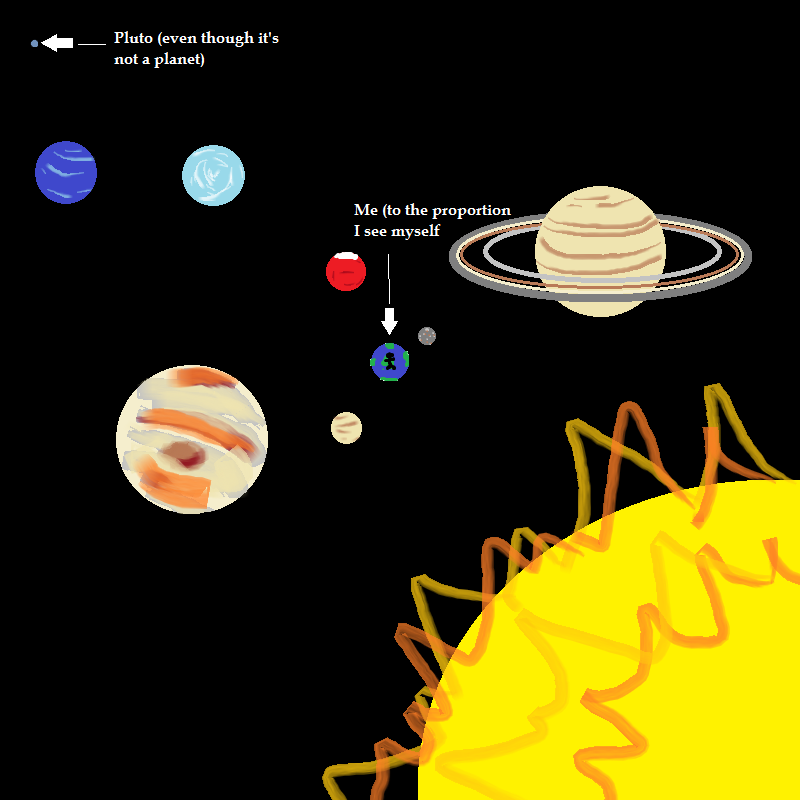
around which orbits other solar systems in our galaxy:
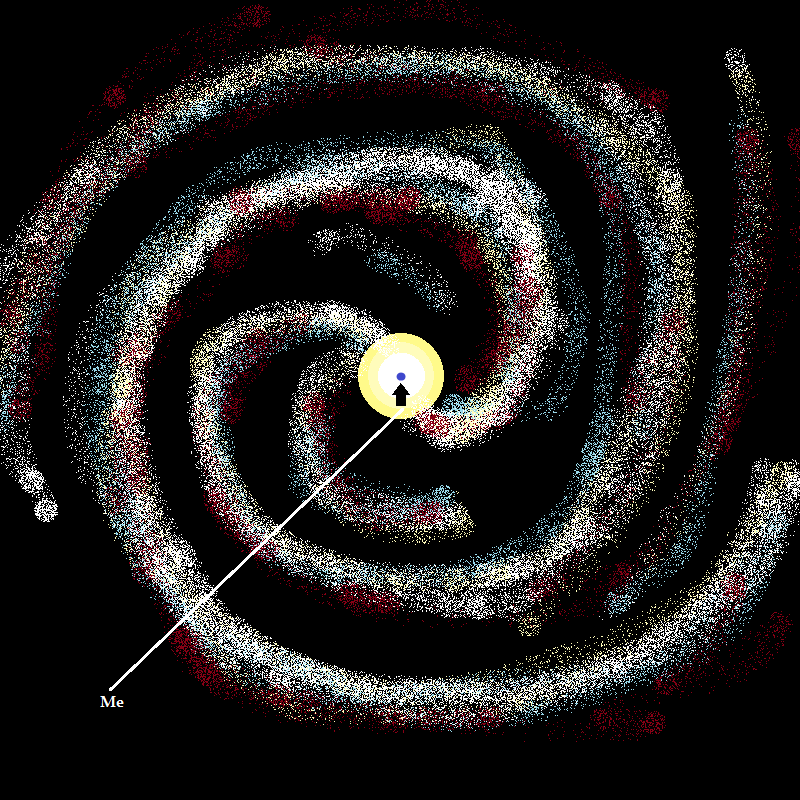
around which rotates all the galaxies:

It’s like I think I’m the black hole out of which the universe was created. The predecessor and creator of all matter and meaning and life.
But really, I’m just a dot. Not even a dot, because a dot has dimension, length and width and depth, but in the grand scale of everything, I can’t even be measured. None of us can. And all of my sorrows, complaints, wishes, failures, goals, none of them matter; they’re no bigger than a single Quantum String.
This new discovery, if you will, has me all jumbled. I’m not sure what to do next. Where to go, what to think, how to act, what I should focus my attention on. It’s like getting off the tea cups at Disneyland. Except, the spinning doesn’t slow down once you’ve reached solid stationary ground, because there is no truly getting off, no truly solid footing. The spinning goes on and on forever, until we die. It’s the gift our mothers and fathers give us by bringing us into this world. It is our inheritance from Adam and Eve: “Adam fell that man might be; and men are, that they might have joy.”I want to be grateful for the pain and struggles and the briars and thistles and noxious weeds. I want to be happy, to have this joy. I don’t want to die miserable, trying to claw my way up some mountain someone told me I had to climb because that’s what has been done for centuries, millennia even, that it’s my duty to follow the past, to follow the paths cut into the rock that billions of others painstakingly carved with their bare hands and flesh and bones and blood. I’m not expecting or wanting the path of least resistance, I’m not a river. And I’m not Frost. I just want to go bushwhacking through the Manzanita until I find a clearing where I can camp with my family and friends, and we watch the sun set over the mountains that we want to climb, the mountains that few have climbed, and laugh around the campfire surrounded by the tall and old and wise giants who have lived for hundreds and thousands of years, laugh until the lights die down and all we can see are the billion trillion stars overhead burning out because that’s all they know how to do, burning out for us to see and experience and love and learn from, all so this one zero-dimensional dot can say: “I am happy.”
August 29, 2013
Day 466 . . .
So. I’m here, scouring the infinite pages of Craigslist, trying to find a job. It’s hollow, Craigslist. Devoid of anything human, as I’m sure you know. Almost like robots generating pretend listings for the sake of confusing people who are, like me, trying to finding something. A job. A new couch. A tutor for their Autistic son or daughter. A nanny. Whatever it may be.
I have a job. Sort of. I wouldn’t call adjuncting one class a job, but I get paid. And my fellow adjunctees are decent people. The students . . . well, they are what they are. But still, it’s work, and it’s money, and that’s great. Except, as a Master of English (or not, it doesn’t really matter), one class a semester at around $11/hr just doesn’t cut. Not for anyone. You can’t live on $11/hr extreme part-time, it just doesn’t work. Even if you live alone, only eat Top Ramen, have no electricity or TV or water, no cell phone, no car or car insurance or gas, no medical insurance, even then, $11/hr for 15 hours a week, just isn’t enough. And I have a wife. And a kid. How am I supposed to make this work?
The wife, in all her of awesomeness, works too. Because she knows we need her to work. Because I need her to work. Because I am not enough. No matter how hard I try, no matter what work I try to do, it isn’t enough to take care of my family, even with all the schooling I have done. No schools are hiring. No one wants to publish art, only books that make money, because “literature” is a commodity, something to be bought and sold, to transfer hands only at the expense of materialization and capitalism. But I digress. This is about work, and money, and life, and the fact that it has now been 466 days since graduating, and I’m still living with my parents, still looking for a job, still hoping that I can find something so my wife can quit her inane semi part-time job at Beverly’s to allow her to stay at home with our daughter, being the stay-at-home mother she has always wanted to be, the stay-at-home mother that I want her to be. But, instead, we have to balance our work schedules to watch Katherine, to schedule days with our parents when we need them to watch her, because we can’t do it ourselves. Don’t get me wrong, I think family and community is beautiful. It’s not that. It’s the simple fact that I am unable to provide the necessities of life to take care of myself, let alone my family.
What am I doing wrong? Since graduating, I’ve stayed up on my reading and writing as best I can. I’m a nerd, a super nerd in fact, so I decided that I would keep a master list of all the books I have ever read since graduating with my Master’s. I don’t know why, I just thought it would be cool in 20 years to look back and see what I’ve read. So far, this is what I’ve read (in order oldest to most recent):- Paradise Lost, 7/1/12- The Senualist, 7/7/12- Mere Christianity, 7/15/12- Everything is Illuminated, 8/9/12- Charlie and the Chocolate Factory, 8/15/12- Charlie and the Great Glass Elevator, 8/25/12- Mad Cursive, 8/30/12- What It Is, 8/30/12- The Witches, 9/8/12- Enchanted Night, 9/19/12- The Phantom Tollbooth, 9/28/12- A Brief History of Time, 10/8/12- Matilda, 10/17/12- Hildafolk, 10/31/12- Everything We Miss, 11/23/12- The Familiar Beast, 12/5/12- LotR: The Fellowship of the Ring, 12/23/12- Piskies, Spriggans, and other Magical Creatures, 1/1/13- The Art and Craft of Handmade Paper, 1/7/13- Boy: Tales of Childhood, 1/11/13- Going Solo, 1/26/13- The Storylady’s: Italian Tales, 2/2/13- James and the Giant Peach, 2/13/13- Griffin & Sabine, 2/26/13- Sabine’s Notebook, 2/27/13- The BFG, 2/28/13- Frog and Toad are Together, 4/21/13- The Epic of Gilgamesh, 4/23/13- Sudden Fiction Latino, 5/8/13 (started two year ago)- The Sandman: The Doll’s House, 5/11/13- The Sandman: Dream Country, 5/14/13- The Sandman: Season of Mists, 5/17/13- Inch, issue 20 (Spring 2013), 5/26/13- Pour, 5/26/13- It Is Especially Dangerous to be Conscious of Oneself, 5/26/13- A Lover’s History of Nevada, 5/28/13- The Mystery of the Aleph, 6/20/13- Vigils, 7/22/13- The Road, 7/25/13- Danny, Champion of the World, 8/13/13- House of Leaves, 8/16/13 (started in April)- How to Shake the Other Man, 8/17/13- Animal Farm, 8/23/13- The Hollow Earth, 8/25/13And, of course, I am currently reading Don Quixote, because, yes, I am that English nerd. It’s a decent list, I think. I feel pretty good about it. I should be reading way more than this, but it’s not bad, I guess.
Then, there’s my writing. I have a few big projects in the works right now, projects that I won’t talk about just yet, because they are too young in the process. But soon. And then there is my personal writing, which to date is almost non-existent because of work, balancing my editor duties, and have a family, all while trying to find another, better, job. But I write, occasionally. Plus, I have a ton of older writings that I submit to literary journals. And I’ve gotten some published. Here is the list of all the pieces and places I have published/been published in (those in bold are forthcoming):- “Mortuary,” published by Convergence Journal(online), Fall 2011- “The Book Collector,” published by First Stop Fiction (online), July 2011- “Dream Burial,” published by In Parentheses, October 2012- “Forgotten,” published by Midnight Screaming, December 2012- “Written,” published by Conium Review, February 2013- “The All-Inclusive Guide on How to Brainwash,” published by Skive Magazine, April 1, 2013- “Continuums of Appearance: How Social Media Disassociates Possibilities of Seeing,” published by The Black Rabbit, May 2013- “The Artist,” published by Crack the Spine, (online) June 2013- “Black Hole,” published by The David Daedalus Internet Experience (online), June 2013- “The Chase,” published by Calliope Review, Summer 2013- “Listen,” published by Stinkwaves Magazine, June 2013- “(De)Constructed,” published by Hidden Animals, July 2013 (online)- “Steam,” publish by Back to Print, in The seXXX File, August 2013- “Mortuary,” published by Forgotten Tomb Press in 100 Doors Anthology, 2013- “Sound of Drums,” published by Indigo Rising, 2013- “The Power Out,” published by Dreamscape Press (Nuclear Town USA), in Of Beast and Warriors, 2013- “Hallowe’en,” “Baskets of the Dead,” “Stopping Time,” published by Twisted Dreams, October 2013- “I Asked a Color Once What Made it a Color,” published in Compose, 2013- “Chickens,” published by The Binnacle, December 2013- “Love” and “Social” published in The Encyclopedia Project, 2014- “Hegemonic Reform,” published in The Stray Branch, 2014I should feel good about that list. It’s not bad, for an emerging writer. Right? I don’t know. Maybe. If I could, I would show you the list of rejection letters that has led to these few publications. I’m neurotic, so I keep all the rejections. Every. Single. One. The stack (which I keep in a binder, in nice static cling protectors) is over an inch thick, and ever growing. But I should feel good about these publications, so I’m told. My wife is proud of me. My friends congratulate me whenever I mention a new publication. Not sure what my parents think. Well, I know my mother wishes I had become an engineer of some kind, because that was/is what I’m naturally good at. Anyway. I should be proud.
But I’m not.
I’m stressed.I’m terrified.I’m sick.I’m tired.I’m alone (yet not).I’m lost.
I’m trying to do my English duty: reading and writing, and furthering the cause of the English language in all of its beauty and splendor and wonder and excitement. As a possessor of a Master’s in English (which I am finding means nothing), I feel like I have a responsibility to language, to texts, to the world on a whole to help in the evolution of this vocalized and textualized communication that we call English. So I read. And I write. And now I even teach a little. I make fun of my friends when they use words incorrectly. I make fun of myself when I use words incorrectly. I melt when I read a beautiful sentence, or hear beautiful lyrics, and I just want to share those lines with everyone. It’s like being in the Matrix, but instead of seeing binary, I see words. And each word has its own unique color, a color that can’t be described or quantified, but can only be experienced. And the world is painted in these word-colors so minutely, that even the most infinitesimal scarps of matter cannot escape the idiomatic vibrancy. We are words, and they are us. One cannot exist without the other. There can be no color without an object to illuminate, and no object can be illuminated without color.
Words are just amazing.
My point in saying this, is that I don’t feel well. I don’t feel good. I feel terrible. I know I can work harder, that I waste my time (on occasion), but I’m not lazy. And I’m not stupid. Yet, here I am, waiting, hoping, praying, that someone, some company, will see my resume that I have sent them, or ask for a CV, and they will say, “Hey, this guy is brilliant, we need this guy;” and then, finally, someone will tell me I am worth something.
I know life isn’t about money. I hate money. Money is the root of all evil (girls are evil too, and I can prove it). But our world, our society, functions on a basic distribution of money. I almost have none. Almost. I know that there are billions of people in the world far worse off than myself. But all I know is what I know, and I know that I don’t feel good about my life, or my position.
466 days, and I’m still here. At the beginning. Or the end. I can’t tell the difference anymore. I should be proud of my accomplishments. Of my gifts and talents. Of my degree, my publications, the work I have been able to produce so far. Of my family, of Katherine and her ridiculous awesomeness and simple happiness. Of my beautiful wife and how much she loves me and our little family, of how much she devotes of herself and her time, always putting the needs of the whole above the wants of the one. Of the simple beauty of the world around me that God has created. But, I can’t. I can’t see past my own hands at the spinning planet that cares nothing for man, for life, for me, but only knows that gravity and orbits carry it through space. I don’t want to care anymore. I don’t want to worry about money, or people, or providing, or whether or not I can make it in this world. I just can’t do it anymore. I’m sick of the worry and the stress. It’s too heavy. I just want to orbit, without care, without complication, to spin around the brightest light in the solar system, and give beauty to those around me.
The Year(s) After
Where I write about life as a writer after graduating with Master of Arts in Creative Writing.
- Jon Alston's profile
- 4 followers


