Michael Golvach's Blog, page 7
January 14, 2016
“Split The Middle” (2009) has been totally revised and re-edited...
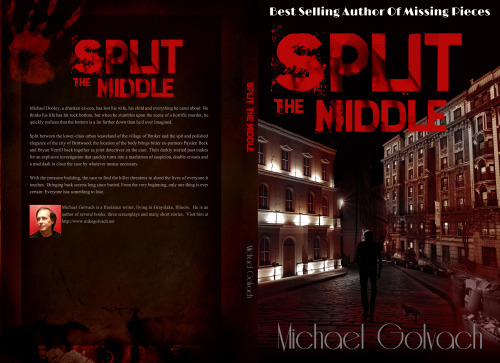
“Split The Middle” (2009) has been totally revised and re-edited and re-released and is now available for sale on Amazon! See my previous post if you purchased it previously. I will make sure you get a free copy of the new version :)
Peace,
Mike


“Split The Middle” Re-Released. Did you buy it a while ago?
“Split The Middle” (2009) has been totally revised and re-edited and re-released and is now available for sale on Amazon!
If you purchased it previously. I will make sure you get a free copy of the new version :)
Depending upon what you bought, the ways to get the newer version for free are slightly different.
NOTE: In no case do I suggest that you offer any personal information to me unless it’s via protected communication (DM’s, emails, Facebook Mail, etc)
1) KINDLE: If you bought the book through Amazon’s Kindle platform, you should be receiving an email from Amazon soon (maybe you got it already) informing you that a new version is available. If you didn’t, or you don’t want to wait, you can log into your Amazon account, go to your “Your Account” section and select the “Manage Your Content And Devices” drop down. On that page, in the farthest right column, there should be a button telling you that a new version is available and, if you want it delivered, all you have to do is click that button and confirm that you would like the new version delivered to your Kindle device.
2) THE ACTUAL PHYSICAL BOOK: If you purchased a physical copy of the book, just do one of a few things:
a) Answer this post and let me know what Amazon user ID you used to purchase the book and I can have it sent to whatever your address is directly from Amazon (Not entirely unsecure, but no one - including me - should be able to get any direct information about you from your user ID). This is the fastest way to get the book sent directly to you, but also exposes you the most (although that exposure is fairly minimal).
b) Email me at michael.golvach@gmail.com and send me a screenshot of your Amazon order (Listed under your account purchase history on Amazon) and let me know where to send the book.
c) Either @ message me or DM me (if we follow each other) on Twitter, or reply to my post (or email me) on Facebook and let me know you bought it. If we follow each other on either platform, you can DM me the screenshot of your previous purchase (Listed under your account purchase history on Amazon) or you can send me that via Facebook Mail directly.
d) If you know me personally, or we know each other well from social media, just contact me however you want and let me know you bought it. Just, please, call first if you’re going to stop by. My apartment is a mess ;-)
e) If you want to read the book and can convince me that I should just send you a free copy of the new version because you bought the old one (even though you didn’t), or you have some other compelling reason why I should just give it away, I may just send you a copy, anyway. It’s worth a shot.
Thank you to everyone who reads my books, blogs, insane posts on FB and Twitter and puts up with me in their personal lives.
I hope you enjoy the new version of the book and, if you’ve never read it, give it a try. It’s an inexpensive and fun way to spend a few hours :-)
Peace,
Mike
July 17, 2015
Writing: After The First Draft
I’m going to start this post off with an apology for not writing anything last week, since I usually write something every week.
I just finished writing a first draft of a new book that ran just over 120,000 words and I was totally exhausted. Emotionally and physically. I hate finishing writing stories. Even though that’s the only way anyone else ever gets to read them.
So this post is going to be mercifully short, and it’s a little advice about what to do after you complete a first draft of something.
I’m going to just keep that to “What do I do after finishing the first draft of a book?” Because, obviously, I’m not everyone else, so my advice doesn’t necessarily apply (and it’s certainly not law) and also because the amount of time I stay away from rewriting depends on the length of the piece. For instance, I rewrite short stories the day after I finish them. There’s no point in forgetting 10 to 40 pages of text, just so I have to reread it again to remember what I was thinking about that particular day.
But, here’s my process for that post first-draft period, and hopefully it helps you out, or gives you something to think about.
As you know, I strongly believe in creating character CV’s before writing anything, so that I know my characters before I begin writing, and that will, hopefully, keep me from writing them into situations that don’t make any sense to them. Because those situations would also be unbelievable to the reader.
When I’m finished with the first draft of a novel, I do the following things:
1. I decide how long I think it’s going to take me to become less emotionally invested in the novel. If I care about the story too much, I won’t be able to see any flaws that I wrote into it based on my emotional attachment.
2. I decide how long I think it’s going to take me to become objective about the piece itself, without forgetting about the gist of the story (even though I have outlines and reams of notes). Again, when I come back to do rewrites, I want to be able to see errors that I might have missed before. At this level, I’m thinking more of story flow problems (where does it flow well and where does it stagnate) and basic editing (how many words did I accidentally type twice, or leave out or just spell incorrectly)
3. THE GOOD PART (I believe): Even though most people might think this isn’t a good idea, during the waiting period, I like to write short stories about all the things in the novel that were referred to, but never shown.
For instance, if the reason a character is conflicted about some girl is because she used to be dating some other guy that he’s now friends with, that’s probably back story that’s explained, but glossed over, in the actual book. You see examples of this in almost all fiction. But, most of the time, those characters, whose back stories are integral to the plot, are also characters that are important to some degree, and I feel it’s my duty as a writer to create them just as believably as any other character.
So, in the above instance, I might write a short story about the girl and the other guy and how they met and what their relationship was like. It doesn’t have to be a great short story and it doesn’t have to even be something you think about ever publishing. It could have a lousy beginning, middle and end.
The point of the exercise is that, when I write those little stories about the characters, and things that happened outside of the book, I tend to write much more about those little details that got glossed over and, in the writing of them, I get to know my characters even better, because now I’ve explored those little parts of them in greater depth. Things that make them who they are. Things that define them. Details that aren’t included in the book itself, but may help better develop them as characters and help to better refine their descriptions. Details that may bolster, or perhaps even change, their actions in the book when I get to rewriting it.
4. Then I rewrite the damn thing.
And, since I promised I’d keep this post short and I’m fairly sure I unwittingly lied again, I’ll sign off for now.
As always, best wishes and best of luck to you both in life and with your writing!
Peace,
Mike
July 3, 2015
Writing: Plotting Vs. Improvising - Which Way Is Better? How I Write Any Story
Finally, I’m busy enough to write a short blog post :)
When it comes to writing, there are generally two distinct camps of thought on how one should go about crafting a story (and a millions sub-camps in between). They’re usually referred to as the Plotters and the Pantsers. The Plotters do as their name would suggest, and plot everything out to the last detail before they write a word. Pantsers, on the other hand, just start writing.
And the debate rages (I suppose. I’ve never actually gotten into an argument about this) over which of the two is the better method for a writer to use.
And I have the answer: Both and/or Neither.
Before your knees get all weak over my ability to take a stand on this subject (As bullets bounce of my chest ;) , let me just say that I don’t believe either way is necessarily the right way for anyone to write. Different people have different styles and, whichever one you are (A Plotter or a Pantser) is the way you should write.
If you think plotting stifles your creativity, then don’t plot, and if you can’t write a word without a plot, then don’t just start writing with no direction. Whatever you do, pick a style that suits you. You may just have to try both ways, and some variants thereof, until you figure out where you fall on that spectrum. And that’s okay. That’s part of what writing is all about. Finding the place from which you can best express yourself and expressing yourself from there.
I’m somewhere in the middle, as I believe most people are. And this is, pretty much how I write any story, long or short. It’s a simple formula that I’ll somehow make complicated ;)
1. I come up with a theme or message. Some interesting question. What I want to say with my writing (or that particular piece).
2. Then I’ll come up with a thin idea. Some sort of story that could wrap around my theme, and showcase it while being slightly more interesting than a simple dissertation on the matter.
3. Then I’ll start writing the beginning. This usually results in a few paragraphs, or pages of writing. Most of it is useless, because I just start writing and I don’t worry about whether the beginning is any good or not.
4. Next, I take the writing I have and remove everything up to the point where my thoughts actually start making sense and I feel like the story begins.
5. I write plot points after that, and list them, in order, on the page (or in the word document on my computer).
6. Then, I write the rest of my story, while looking to the plot points for guidance (As I address each one, I delete it. When I get to the next one, I know what I’m going to write next, because it’s right there to remind me).
7. At some point in the process (since I’ve familiarized myself with my characters to a certain degree and know what my story is about), the story, and/or the characters in it, have me writing scenes that I didn’t anticipate. I usually go with this and just write them. If they’re completely off, I get rid of them. If they’re better than what I’d originally planned (which is generally the case, because my subconscious mind knows better than my conscious mind how to get my story across), I work with that. This generally takes me right off the course of all the plot points that follow, although I usually find that the major turning points remain the same.
8. Next, if I feel like it, or the piece I’m writing is long enough, I rewrite the plot points that follow the particular scene where things started changing direction.
9. Then I do the same thing: Writing, refining, changing direction if necessary, plotting, and over and over until I reach the end.
It’s a pretty simple process, and it allows for a lot of freedom, while also keeping me on point and never putting me in a position where I have to worry that I’ll forget about where I intended the story to go, because the plot points are always right there on the page.
As with anything else, you probably have your own way of doing things, and my way certainly isn’t the only way. There are probably as many different “correct” ways to write a story out there as there are writers.
Hopefully, this little insight, into one more ways to go about cranking out some prose, has been helpful to you.
As, always, I wish you the best in your writing and in life.
Peace,
, Mike (This post may contain lots of typos ;)
June 26, 2015
Philosophy: There’s Always A Bright Side
I guess I should preface this post (the title of which probably made the miserable among you cringe) by stating that I’m well aware that life isn’t always super-great. Even so, I stand by the position taken in my title.
There’s always a bright side.
No matter what happens to you, how boring or sad or seemingly insignificant, there’s always a bright side.
Another way to look at it is that everything (from the birth of a beautiful baby to mass genocide) can be perceived in many different ways. Our judgements of anything are just that: Judgements. Some are more universally agreed upon, but most aren’t.
I like the example of the “heavy downpour of rain.” It’s one singular event that can be easily interpreted at least three different ways, depending upon our judgement of it.
1. It’s a huge bummer for the bride who’s planned her outdoor wedding at that particular time. Bad news!
2. But, that same rain shower is a godsend to the farmer whose crops have been suffering from a terrible drought. Good news!
3. And, at the same time, it’s basically a non-event for some kid who’s inside his nice safe house, comfy and cosy, hanging out in his bedroom reading a book.
Everything has a bright side. Even death, extreme sports and all the other inhumane shit that happens all over the world, in places I never seem to be at. All of those things (and everything else) has a bright side.
And if you think you might be guilty of ignoring reality by not focusing on the bright side, I’ve got a few questions for you.
1. Are you kidding me?
2. Are you afraid that, if you manage to find the “good” in something, the “bad” thing won’t have happened?
3. And, an even better question, if you focus on the dark side, is that going to make the “bad” things that have already happened any better, or possibly prevent them from recurring in the future?
Consider that everything we declare war on, especially in the US (probably everywhere else, too, but I happen to be living here for the time being), flourishes. Drugs, speeding, terror, murder, abuse, all of it. Thriving and prospering because of the attention we lavish on it as a society.
Everything we declare war on just gets bigger and stronger.
And everything we let slide gets weaker because we don’t pay any attention to it.
And some people, like me, lead pretty decent, contented lives with plenty of time, money, enough to do and lots to be grateful for. We somehow manage to appreciate and enjoy our lives, even while the guy, living in the apartment building down the block, thinks us idiots for being so naive as to be duped into buying the “bill of goods” that “the world’s a pretty great place filled with lots of wonderful things and interesting, pleasant people.”
Of course, that argument (that the world, and/or this life, can’t possibly be all that fantastic) rests on an opposite judgement. Basically, that argument insists that we take stock of all the “bad” things that happen, because happiness, blissful unity and peace are all illusions.
Really, it comes down to a matter of opinion and outlook. Like the heavy downpour of rain in the example above, the world just “is.” Whether it’s good, bad or inconsequential, is all a matter of interpretation. And a question of what kind of life we’d prefer to live.
All you really have to do, to see the huge downside to completely ignoring the positive in favour of the negative, is take a look at the quality of other peoples’ lives.
Which of them have lots of things to be happy about? Which of them have real, material possessions that bring them comfort and peace? Which of them enjoy loves, and other relationships, that aren’t built on bitching and griping? Which of them cherish their days (more often than not) and live the way they prefer, because they refuse to tolerate the intrusion of the negative?
And which of them can find nothing in life to celebrate? Which of them possess nothing that isn’t a burden? Which of them suffer relationships that suck the life from them moment by moment? Which of them spend their time moping (presumably until the end of days) about how bad life sucks, as it, miraculously, continues to suck harder and harder every day?
But, I’m not here to tell you what’s right or what’s wrong for you, because that, again, is a judgement. And we can only judge the quality of the world, and our lives, for ourselves.
Believe the world is a horror-show if you want to. I can’t stop you, and I’m not inclined to waste the energy that I could be putting toward nourishing something more valuable to me.
Your life can be miserable if you want it to be. And if you try hard enough, like you may do every single day with every single breath, that constant misery can be a reality. It probably already is. It’s really that simple.
On the other hand, you can knock that shit off and at least make a focused effort to see the good in everything. It doesn’t cost a dime and it might not even take up any of your TV time. And, maybe, when you start to give more attention to the positive, and quit reciting your mantra of misery, you might start seeing even more good come from that. You probably already are. It’s really that simple.
Concentrate your attention on all the good things that happen in the world (well over 50% of the things going on in this world are "good,” or even better) and let those things become your focal point. How can it possibly hurt?
If you’re among those folks, insistent on being miserable, that’s fine. I, and people like me, would never deign to tell you how you should be living your lives (I merely suggest with a lot of passion). The worst we would do would be to ask you to just stay out of ours, but that almost never happens, because you largely don’t exist there and, when you pop up from time to time, we’re quick to divert any feedback until you get sick and tired of us deflating your energy reserves through lack of reciprocity.
And, please don’t think that crying about the world, or recycling outrage over past injustices, is ever going to change the situation, as you see it. Just as you shouldn’t expect that celebrating the world, or recycling joy over past wonders, is ever going to change the situation, as you see it. Even if you’re the type of person for whom this life is one giant non-event, nothing is ever going to change the situation, as you see it. Not if you continue to think the way you’re thinking now. And that can be a good thing, a bad thing or nothing at all.
Everything is a judgement call. And your judgement of any given thing determines what it will mean in your life, and what kind of energy it will contribute.
Bad = Bad. Good = Good. There a million points on that spectrum from dark to light. In essence, whatever you put in, you get back. It’s a simple equation. And the mojo works no matter what mindset you hold.
Here’s hoping you’re enjoying the gift of this life and the many wonderful things in it. All of the beautiful, magical experiences. All of the love, happiness and joy of it.
If you’re not, here’s hoping you’re as miserable or detached as you seem to prefer.
Live as you see fit. Of course, you don’t need me to tell you that. You’re doing it already.
But, no matter how you judge this world, or this life, I wish you the best. And, for your future, I wish you more of the same.
Peace,
Mike
June 19, 2015
Writing: An Easy Way To Write Short Stories
Okay, I’m all done with philosophy for a while, so this week’s kind of regular post is going to be on a really simple way to come up with, and finish, a short story.
Most of the stuff I ever read, out in the world, about writing is about how difficult it is, and structure this and character that, and that’s all well and good. Most of it is solid advice. But most of it is also advice that harps on one thing and, even though I understand that the point is to challenge and bring out the best in the individual writer, it’s mostly advice that will stop you dead in your tracks if you think you have to conquer it or master it before you’re worthy of moving on.
I have a much more laid back approach to writing short stories. It still requires some amount of work (There’s just no getting around the fact that you’re going to have to put words on paper - I’m dating myself now ;) , but it’s not nearly as difficult or stringent as a lot of instruction on the web would have you believe.
To that end, here’s my three step process for writing a short story. And, remember, it’s just a process. Just a method. It’s a formula, by definition, but it’s not intended to (nor will it) make your writing formulaic. Only you can do that.
What you actually write may or may not be any good (and that’s still subjective), but the process isn’t ever to blame for that. In fact, I’m a big believer in writing a crappy story, if that’s what I’ve got in me at the moment. You can’t spend your life waiting for the perfect idea to come to you. In point of fact, if you don’t write the crap out of your system, you may be blocking that perfect idea from ever presenting itself to you.
I’m guilty of being lazy, myself, from time to time. I accept full responsibility for that. But let’s move on, because, if I let my stream of consciousness go, I’m going to end up repeating information as we go through this.
So, for the three step short story method, here we go:
Step 1: This part is purely mental. You just need to be ready to write.
You need to be able to accept that what you write may be crap. It may start out good and end up bad. More often than not, it will start out bad and end up good, and then you’ll have to rewrite the beginning. The most important thing is that, once you’ve got your really simple structure laid down, you just start writing.
A lot of times, in fact almost every time, when I write, whatever ends up being the beginning of the finished product, was originally about a half a page or more into what I originally wrote. Because, once I’m ready to go, I just start writing. At that point, I haven’t decided yet what voice works best, what point of view I should be using, or what tense. It just doesn’t matter. That stuff will figure itself out for me while I write the story. And it will do the same for you. You just have to trust that it will. That’s step one.
Step 2: Step two requires a little thought, but it’s still simple. Come up with an idea (or premise, if you prefer) and a theme.
Your theme should be some message you want to deliver with your story. It can be that “life is wonderful and we’re all just wasting it, and why can’t we see that?” Or it can be that “technology is slowly killing us and, if we don’t do something soon, the machines will take over and kill us all,” or it could be that “chocolate ice cream is the best ice cream ever.”
It doesn’t really matter what your theme is. The most important thing about your theme, or message, is that it should be something you believe in or care about. It can be something you don’t believe in or care about, but the writing will certainly come a lot easier if you’re passionate about what you’re writing, and you won’t have to reach for emotions and feelings that don’t exist within you in order to get your point across.
The second part of step two is to just have an idea for your story. The idea is different from the theme in that, while the theme is your story’s message, the idea is the thing you’re using to get your story started. Some people call this the premise and some people think that the idea (or premise) and the theme are the same thing. But they’re not.
For instance, one of the best ways I’ve found to generate ideas is to think in terms of “what if?” Or “what would happen if?”, etc. And you can find an idea doing this very easily just by writing lists of “what if?”s. It doesn’t matter if half, or all but one, of them are complete garbage. Just like it doesn’t matter if what you write initially is any good or not. And you can also come up with your idea before you come up with your theme. Either way works, as long as the process makes sense to you.
The idea and the theme feed off of each other, which is why they’re so often confused. So, to get you started, you could just start writing “what if?” lists. I would suggest making them completely insane on purpose. That will get you thinking about basic things more creatively. Like:
What if a beaver and a hot plate decided to overthrow the government?
What if ten people got lost on an island and they decided that the only way they were ever going to get off was if they drank lots of orange juice and started a vigorous exercise routine?
What if a down on his luck janitor found the cure to cancer in a professor’s wastebasket and decided to take credit for the work himself?
And elaborate on those “what if?” points. The more detailed your “what if?” the more ways your story can end up going. Of course, the same could be said of a less complicated “what if?”.
The point here isn’t to, necessarily, find a great story idea, but to get you thinking in terms of story. Every story poses a question, and short stories, for the most part, generally pose more limited ones. At the end of step two of this process, you should have a general idea and a theme.
For instance, a short story I have out there, that’s already on the market, has the loose theme of “Belief is more powerful than what we think we know. And it can colour our perception such that it can become our reality (even if that is only an illusion) to the point that we’re eager and willing to believe it, or be deceived by it” and a question of “What if a wrongly convicted prisoner used the knowledge he gained, training his mind and reading books in the prison library, to just walk right out the front door?”
The theme and “what if?” in the preceding paragraph probably sounds crazy, right? But the story actually makes sense when you read it, and it’s not quite as grandiose as my little summation might make it sound. It’s only about eight pages long, something like three thousand words, and it could use a rewrite. In fact, the version that’s out in the wild on the Internet, isn’t the final version that I like better (I’m not happy with the tense or point of view, ending, etc but it’s here if you want to check it out:).
I guess my point in bringing that story up (blatant self promotion of my lesser work aside ;) is that I used this method to generate that story and many more like it. Some of them as short as 4 pages, some of them as long as 35 pages. All of them, I would consider short stories.
Also, it occurred to me that , perhaps, taking the theme and idea that I’ve described above and reading what initially became of it, might help this step make more sense to you (By the way, if you are interested in checking out the story above, it’s for sale on Amazon.com, but they wouldn’t let me price it under 99 cents, which seems ridiculous, so I also made it available for free at the link above and here. All you need is a PDF viewer to read it and, trust me when I tell you, there’s a better version out there.)
Step Three: Step three of this super simple formula is to set up your plotting. You should do all of this stuff (parts one, two and three) before you write a word, but I’m guilty of breaking this last step many times over. I sometimes like to get the theme and the premise in my head and just start writing, because, a lot of the time, the setup to a story doesn’t really have to do with the plotting of it. It just serves to set the mood and establish the theme. The premise is dealt with more directly in the plotting. But I’m getting away from myself again.
In order to do plotting, which is pretty much essential to your writing if you want it make sense to anyone, it’s generally best to know where your story’s going before you start writing it (steps one and two). That being said, if your story is short enough, you can probably write it all off the top of your head. It’s been done. It can be done. It can be done well. I know for a fact.
The following is what some people call “however-many-point plotting.” Usually it’s three to ten points. Basically, what you do is that you write the progression of plot points down before you start writing your story (one per line), and then you use that progression of plot points to help guide your writing. It’s actually an invaluable practice if you’re not used to writing structured story, and it’s still helpful even if you are.
The trick to using this method most effectively is to use the plot points (examples coming up) as a skeleton for your short story. Actually start writing your story on the same paper (or in the same electronic document) that you have your plot points listed on. Then, when you’ve finished writing the first plot point, you’ll have the second one there, on the page, to remind you what you were going to write next. And you’re free to write and not have to think about the bigger picture while you paint your scenes.
It doesn’t matter how esoteric your story is either. It’s going to go from point A to B to C, and, even if it goes from point A to C to B, those non-linear events will still appear linear in your story because, even if you guide a reader through time in an non-linear matter, not many people are going to just pick up your short story and read the beginning, skip to the end and then come back and read the middle.
So you write out your story very simply. As simply as possible is best practice, in my opinion, because (and I know I come with a million disclaimers) creative writing is creative, by definition, and it almost never works out the way you originally intended. Generally, it works out better.
I find it’s best to start with just a beginning middle and end, and then build on that until you feel comfortable So your initial plot outline might look like this:
1. Bob is happy with his life
2. Something bad happens
3. Bob fixes the bad thing and everything goes back to normal.
Sure, that’s simple, but you can put as many points in between those points as you need to. Anything that outlines the story you have in your head. For instance.
1. Bob is happy with is life. His wife is satisfied with being a wage slave, too, but Bob dreams of living bigger
2. An opportunity comes up for Bob to really make something of himself, but it will mean leaving the security of his job.
3. Bob discusses the opportunity with his wife. She is dead set against it.
4. Bob decides not to accept the opportunity, but he keeps the information to himself
5. Bob’s best friend takes him out for drinks that night and convinces him to accept the opportunity, even though he knows Bob’s wife doesn’t like it. She’ll be happy when everything works out, and thank him for it later.
6. Bob agrees to accept he opportunity, but he doesn’t tell his wife.
7. The opportunity turns out to be a disaster and Bob is left in financial ruin. His wife finds out and all seems lost.
8. etc, etc, etc…
I’m assuming you would finish this story up with a path to a happy ending, but maybe it would be better with a miserable one. Although I may never write any fiction with the theme that “going out and taking a chance is a good way to ruin your life” (unless the real theme was that “ruining your life can make you see it for what it really was, and grant you opportunities to make it even better than it ever could have been”), your story is your story. Tell the story you want to. Who cares what story I want to tell (at least, when it comes to your writing)?
In fact (as is often the case for me when I start writing), I’ll have a random amount of plot points written up, but, usually by the time I get to the second or third one, I’ve already decided (or my characters or story have decided for me) that things are going to work out differently and the remaining plot points never happen or get changed. I generally don’t write out the new plot points or complications, but you definitely should if it helps you.
And that’s it. You now have a solid little method to crank out short story after short story. You can use the same method for writing longer fiction, or even non-fiction, but I usually stick to this level of simplicity for short stories. Because, in short stories, the character development and everything else is quick and immediate and you can keep those things in your head for the duration of the writing more easily.
There’s really no point, to my way of thinking, in over-complicating a simple thing. My apologies, of course, to those of you out there who know that short story writing isn’t simple. I couldn’t agree more. It can be incredibly complex. You have to pack more information into a smaller space, and layers of meaning, theme, premise, subtext, etc, make for a much better story and a more involving one. But this article, and this method, deals with the very basics.
And, if you want to make your story more complicated, and have several themes or premises, these same three steps will still help you achieve that end, because the real magic is in the writing. That’s where all of the creativity, complications and beauty (and everything else wonderful) of the story are actually born. If you don’t have to worry about what you’re writing while you’re writing it, your writing will be better.
The three step method described above is merely a method to get you going and to keep you on point.
As always, I wish you the best of luck in your life and in your writing!
Peace,
Mike
June 14, 2015
Pictures of the setlist from Rush live at the United Center...

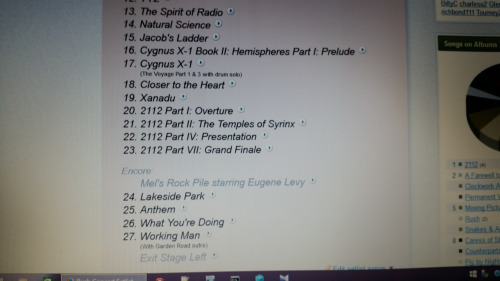
Pictures of the setlist from Rush live at the United Center 06/12/2015 - From here: http://www.setlist.fm/setlist/rush/2015/united-center-chicago-il-7bc9c624.html
RUSH 06/12/2015 - Picture Set 2 - What a show!








RUSH 06/12/2015 - Picture Set 2 - What a show!
RUSH 06/12/2015 - Picture Set 1 - Still Recovering ;)







RUSH 06/12/2015 - Picture Set 1 - Still Recovering ;)
June 13, 2015
Philosophy: Anxiety, Worry And The Healing Properties Of Time
It occurs to me, from time to time, that life seems like it’s filled with nothing but anxiety and worry. Which isn’t the greatest thing to have occur to me, but it’s honest, anyway. That generally isn’t a problem for me, because just worrying for a few minutes, or feeling anxious, gets old and I’m soon on to whatever (hopefully better feeling) comes next.
For a lot of people, though, anxiety and worry are traps from which they almost never escape. Maybe it’s because they don’t think about what they’re thinking. But, I believe that most people are smart enough to realize that they’re worrying, or feeling anxiety, and want to get out of it as soon as they possibly can. I also think that a lot of people feel helpless when they’re caught in a bout of anxiety or worry. And that’s totally normal.
When anxiety or worry get their hooks into you, one of the biggest, and best, tricks they pull is making you believe that there’s no way out. And, when you start believing that, it creates even more anxiety or worry, which is the way anxiety and/or worry reinforces itself. By becoming a self-fulfilling prophecy.
The more you worry, or the more anxious you get, the more proof you have that you have something to worry about. You must, or you wouldn’t be so worried or anxious. It’s a vicious cycle and it feeds off of itself, and your unwitting contribution, so it can, literally, sustain itself forever if you let it. And I don’t write “If you let it” as a condemnation of anyone. Quite the opposite. Most of the time (And I’d have to hope that would be 99.9% of the time) people let anxiety and worry run roughshod over them because they genuinely feel helpless and don’t know what to do. Not because they’re enjoying it and just want some more misery.
But there are easy ways to ditch anxiety and worry. Some of them work quickly, some slowly. Almost all of them probably won’t seem to work at first, because you have to learn how to get out from under anxiety and/or worry just like you’ve spent however many years of your life learning to accept and live with them.
The easiest thing you can do, although it probably isn’t very helpful if you haven’t gotten into the habit of doing it, is just completely ignoring them. Anxiety and worry are illusions. Fuck them. Move one. I know that may not seem like practical advice to you right now, especially if you have a lot of anxiety, or worry often, but, eventually, I hope, it will make perfect sense and be all you need to do to rid yourself of those pests.
Just realize that you’re worrying or feeling anxious, acknowledge those feelings, realize they’re complete bullshit and move on.
The next best thing you can do is use simple logic and small time. I use the term “small time” loosely and, when I use it, it means small increments of time. Maybe there’s a better way to put it. I can’t think of one right now and I’m typing like a mad man so I don’t want to stop and ruin the flow of this post by searching for the perfect word that may or may not exist ;)
To get rid of anxiety or worry in this way, all you need to do is remember that anxiety and worry can both be reduced to “friction caused by ignoring small gaps of time.” When you begin to worry about something, or feel anxious, it’s never about whatever is happening to you right now. There’s always a gap, no matter how small. You could be legitimately worried, or anxious, about something that’s going to happen in about two seconds. Like when you’re about to take the first hill down on a gigantic roller coaster. That still scares the Hell out of me, and I know everything’s most probably going to be fine. Even so, it’s a good example, because I worry about that first drop as we’re climbing up and up in our supposedly-safe roller coaster seats, and I get anxious as anything when we take the corner leading to the drop and, the second before the drop, I’m literally shaking.
But, as soon as we start screaming (literally and figuratively) down that incline, the anxiety and worry go away. I’m not saying I don’t yell out at the top of my lungs or hold onto the handlebars for dear life as we’re hurtling way too fast in a near vertical drop. I’m just saying that, while we’re on our way down, I’m no longer worried or anxious. At least, not about the initial drop. It’s already happened. I can’t worry about something in the past. I also can’t feel anxious about something that’s already happening. The act of going down that first incline completely erases my anxiety and worry about it. And, if I work backward to the point before we started heading down the hill in the roller coaster, the whole time gap scenario makes sense.
Up to the point at which we dropped, I was worried and I was anxious. But that worry and anxiety weren’t about the drop, even though I’d convinced myself that they were. The worry and anxiety were about my inability to be sure of what might happen when the drop occurred. There were a million different scenarios going through my head, most of them bad, and that’s where the anxiety and worry came from. That’s what created the feeling of helplessness.
And, if I’d taken the time to think about the basic underlying principle of small time gaps, I could have avoided that altogether. Because, in the time before the drop, everything I was worried and/or anxious about happening was in the near future. It wasn’t anything that was happening to me while I was feeling anxious or worrying. I was letting myself get more and more anxious, and feel greater and greater worry, because I was trying to fix (or know with absolute certainty) the near future in the present, and that’s just impossible.
If you think about anything you’ve ever worried about, or felt anxiety over, it was always something in the future that you had no control over yet. Once you get to the point or place over which you’ve been making yourself miserable with anxiety and worry, all of that goes away. Because, once you get to that place, there’s no more time gap. You’re in the experience.
You can’t worry or feel anxiety about something that’s happening to you now. Think about it. If you don’t believe it’s true, and can come up with an incident where you felt anxiety or worry while the thing you felt anxious, or worried, about, was happening, chances are that the time gap was just really really small. What it basically comes down to is the fact that you can’t modify or directly affect the future from any point before it becomes your “now.”
And that feeling of “no control” is where your anxiety and/or worry comes from. Once you get to the point where you’re experiencing the thing you were previously worried over, or anxious about, it’s no longer in the future and you’re just dealing with it. It may not be pleasant (I’m not promising you a rose garden, or even a tulip garden), but you won’t be worried about it or feeling anxious about it any more. Those feelings will be gone. You may even feel silly for having had them.
Still, if you don’t realize why it happened, or just let it go and forget, it can become a problem again in the future, in some totally unrelated circumstance. It happens to us all. If it barely ever happens to you, maybe it’s not worth keeping this stuff in mind, but if you worry or feel anxiety constantly, it can help.
Lastly, the absolute best thing, in my opinion, that you can do with anxiety and worry, is to project yourself into the future, if the analysis of time before the “event” didn’t help or you just didn’t think to do it (which is totally normal, too, because anxiety and worry can make you forget everything else, and act irrationally. They’re quite good at it, actually)
Project your own consciousness into the future with relation to whatever problem or issue you’re feeling worry or anxiety over at this moment. This can work wonders in just seconds if you commit yourself to just focusing on it, and blowing off everything and everyone else for the sake of your own mental well being. It’s a very simple process and one you may have heard before in a different way (actually, you may have heard of all of these thing before. I was born, just like you and everyone else, not knowing a damn thing. Everything that’s in my head today is a synthesis of stuff I picked up along the way).
Step by step, do the following. Take your issue, or your problem, that you’re feeling anxiety about or worrying over and
1. Experience the feelings of anxiety and worry totally and completely. Just accept them. They suck, but you’re feeling them anyway. No sense in fighting them. It just makes them stronger. Acknowledge that they exist and welcome them into your space. Quit fighting them, seriously.
2. Mentally project yourself five minutes into the future (any increment of time will do. I’m just feeling “five” for some reason, right now). Five minutes after the event you’re worried and anxious about is over. Take stock of how you feel about the problem now. Does it still bother you, worry you or make you feel anxious? It might. It just happened five minutes ago and you’re thinking about it, which is essentially making your mind relive a recent trauma which is the same thing as making your body relive it. Your subconscious mind doesn’t know the difference between reality and fantasy. If you think about something that someone did that made you feel slighted, even if it’s not still happening now, you’ll start feeling resentful. In any event, the “five minutes from now” you should feel a little bit better.
3. Mentally project yourself five days into the future. How important, or daunting, does that thing you “were” worrying about, and feeling anxiety over, seem now? Probably not so bad. It was five days ago. Who remembers anything that long? Then keep going. Five weeks. Five years. You’ll notice that the farther out you go, the less you give a good damn, or even remember, the anxiety or worry you felt so long ago. The event itself, the one that made you feel all those bad feelings, will probably begin to seem insignificant, too. Five years from now, you’re not going to care about that one morning you were going to be late to work and had to hurry and come up with a bullshit excuse.
Seriously, though, if you suffer from chronic anxiety or worry and you can’t seem to shake them, give these things a try. Even though they’ve been over-hyped as a “disease” by the pharmaceutical companies, in most people’s cases, they’re not. They’re just anxiety and worry. Everyone, and I mean everyone, has suffered from one, the other or both at some point in their lives, and they most likely will again.
Hopefully one of the things I’ve written today has been some measure of helpful to you (And there are many more ways to beat anxiety and worry naturally. I encourage you to look them up on the web if you deal with worry and anxiety constantly).
I’m currently worrying, and getting increasingly anxious, about how I’m going to get downtown, find a parking space, make it to the United Center, all with my twelve year old son in tow, get to the Rush concert on time, find our seats, buy our merch, not forget any of my forms of ID or payment needed to get into the show, getting home safely and …Aaahhh!!!!
Time for me to go take my own advice :)
Peace,
Mike