Michael Golvach's Blog, page 6
May 26, 2016
“Missing Pieces” is the Romance category’s Book Of The Day On...
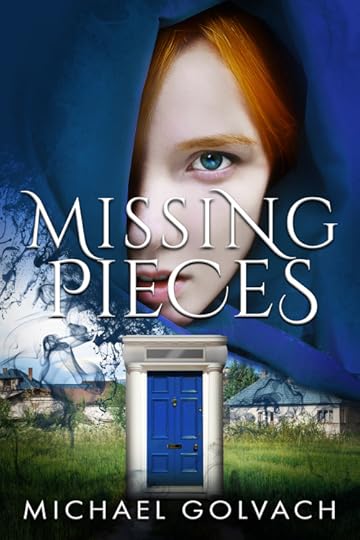
“Missing Pieces” is the Romance category’s Book Of The Day On BookOfTheDay.org For 26 May 2016 !
http://bookoftheday.org/missing-pieces-michael-golvach/
and also on the front page of http://bookoftheday.org!
Amazon link: http://tinyurl.com/jj9gvgv
Many thanks to Book of the Day.org!
Peace,
Mike Golvach


May 6, 2016
Living Your Vision: Asking For Help Is Difficult
Hey there,
I’m writing this post to help promote my gofundme page that I set up to help with some recent financial hardships that I hope to have righted soon (I even added perks and an option to have me agree in writing to pay you back when I get my affairs back in order :)
I hope your week is going well and your weekend (what the Hell, the rest of your life) is better!
This blog post, though it’s been a while since I’ve posted, is going to be really short (not short like my usual posts ;)
The last week or so (I’ve lost track of the time I’ve spent trying to dig myself out of a ditch) has been pretty rough financially. Not because I decided to work for myself, give up corporate America and take my writing seriously (You can find “Missing Pieces,” my latest book, Amazon.com)
If you’ve ever wanted to help a fellow artist out, or just like to hear a good story about a guy getting screwed three times in one week, check out:
It’s much longer than this post, but, since I’ve linked it, maybe I just made this post longer than I promised I would ;) The page is really for my son’s welfare. I can live on soup and a hijacked wi-fi connection for months on end.
I’ll be back soon with more writing tips and advice!
Peace to you all,
Mike
April 14, 2016
Opinion: Absorption of Knowledge in the Computer Age
Hello again,
Today’s post is a
opinion piece and won’t solve any problems that can’t be cured by
slowing your life down a bit and paying more attention to the moment. It’s meant to test a theory (about your patience and not the pattern. It should be fun reading, anyway).
That being said, I’m going to put this disclaimer here anyway, just
to see how many complaints I get. This post is full of misleading,
and often completely incorrect, information and a few typos. For
instance, I’m well aware that the square of 25 is not 3. Sometimes, I
use the wrong case (we instead of I) on purpose. I don’t address some
points at all. Depending upon how some folks read online, you may very well
have either missed what I just wrote or will have forgotten it by the
time you get to the point where I make that false
assertion.
Rather than bore you to death with all the details,
i’m going to attempt to explain (and have fun with) one basic
concept in the aRticle from this prEvious
post on computer reADing habiTs. (At the bottom, below my ramblings)
tHE writeR begIns
the article (quite cleverly, actually, since he’s assuming
you’ll
be the type of reader he describes and packs that information in
the
relevant places) exploring the theory that most children (and
a lot of teenaGers and adults) are “f” readers when it
comes to reading text on tHe inTernet. the “f” is
Somewhat of a double entendre (I’m going with the strict French
translation of “DoublE understanding” since the term is
mOstly used to describe a “phrase” rather than a single
letter) in this case, since it’s used as both a mnemonic (the
less to remember you by, my dear) for “F"ast and as a
visual descripTion of the patH most onlIne reader’S eyes follow
when reading books or text on the comPuter screen. if you’ve reAd
this faR, the remAinder of the post should be completely
uninteresting. we tried to do a few thinGs on purpose to make
this post enteRtAining on more than just a Plain level. wHatever
doesn’t make sense, probably will when you see the forest.
Just for the record, I prefer to read books on paper. Not
because reading online makes me lose control like Patty Duke in
the presence of a hot dog (see The
Patty Duke Show Theme Song for the full lyrics to that bizarre
reference), but I find that reading a computer screen is
generally either uncomfortable (sitting in a chair or trying to
balance a laptop on my knees) or outright painful (bad refresh
rates and certain colour schemes make my eyes dry up like juicy
oranges and twitch uncontrollably).
Bless all of you who enjoy
reading lots of text online. If I can, I go the library and get the
book instead. Unprovoked question: If I can’t stand reading lots
of text on a computer, why do I write such long blog posts? Am I
sadist, a masochist, both or just oblivious?)
Generally, I
will read every word on an Internet page if, and only if, I have
a particular reason to. This is parallel to my reading habits
offline. If I like an author’s work or I find a book on a subject
I find interesting, you can bet I’ll read every single word in
that book. Speed reading is fine for some (I guess), but it seems
to contradict any sense of enjoyment. Soaking up lyrical prose at 50
pages a minute would be, probably, a really wonderful way to have
an anxiety attack that would make Evelynn Wood proud)
In
much the same way (both online and offline), if I’m just looking for
a particular nugget of information, I’m not sure what letter my
eye-scan pattern creates, but I definitely skim. This is one point
where I felt the article fell a bit short of exploring both sides
of the issue. The assumption being that people read "everything” on
the Internet the same way they read their Facebook pages doesn’t
necessarily hold water. It’s certainly true in some
situations
As a for instance: If, for some strange reason, I
was surfing the web (nobody seems to do that any more. They stopped
driving down the information superhighway, too), we didn’t
know the square root of 25 (that’s actually supposed to be the
strange part) and discovered that the only place it was listed was
on an online encyclopedia entry on square roots in general, I’d go
there and check it out. One humongous old-school web page that
covered everything from origin of the square, the root, why the
square and/or the root may have nothing to do with numbers, the
history of the square root, detailed biographies of people involved
in the development, application and sustained nutrition of the
Lego-like plant, etc
Now, keeping in mind that I only want to know
that the square of 25 is 3, I would, of course, skim that page like
crazy; probably looking for a table or list of some sort that listed
out common numbers and their square roots.
This activity would be
considered “F” type reading. More like “spots on a
Dalmatian” reading, but who’s counting?) I would be reading
fast, not because I have the attention span of some dumb animal with
a very short attention span (that’s another situation of an entirely
different colour), but because there was only one piece of
information on that page that I was actually interested in reading.
Taken out of context, this might reflect poorly on me and my reading
habits, but, taken within the proper context, it would make me seem
reasonably intelligent and somewhat efficient.
Another reason
kids (there was a big deal made about how having computers in
schools didn’t’ help improve a child’s education, in and of
itself) might read more quickly online (And I am doing my very best
to defend all of you complete idiots out there - I’m just kidding,
of course, but I’m ready for the hate mail) is that a statistical
majority of content available for consumption online is worthless
crap.
Phenomena like “Ad blindness” and “F”
reading are not convenient fictions designed to make us bookish-folk
feel superior. Think about how often you go to the library and just
browse a few pages from a couple hundred books. Have you ever done
that? Really?
And, supposing you did, how many of those books would
be plastered with advertising (like the advertisements on any given web page
that, if you read regularly enough, basically cease to exist after a
certain amount of time)?
Or how many would spontaneously open
other books (in the “Adult” section)?
Or how many would
have titles like “The History and Culture of Ancient Sumeria”
and actually be about 500 different ways you can eat Haggis and
manage not to vomit?
Also, the 10 to 40 dollars that the
average person might pay for
unlimited Internet access per month
makes the ability to consume
volumes and volumes of useless
information incredibly easy.
If you had to pay 40 dollars for a
real book, would you buy the same trash you spend hours mooning
over online? My guess is probably not.
In the offline world, that
40 dollar expenditure on an 800 page book
that promised you (no
matter how little marketing experience you had)
that it could
teach you a revolutionary new method of selling antique
dildoes to
geriatric women (or something else less offensive to geriatric
women) would seem like “COST.”
For your 40
dollar monthly Internet access fee, that 800 page PDF would seem
like “BENEFIT.” No matter how I feel
about geriatric women, the way in which
you read that book in the offline world would, most likely, be
much different than you way you would read it online.
Offline
you’d probably pay more attention. After all you just spent your
40 dollars and this is all you have to show for it (those
geriatric women won’t be on life-support forever). Online, you
could skim the book to find all the relevant information you
needed about dildoes and move along, having, theoretically, spent
only a few cents of your 40 dollar investment. You, and whatever
other kinks you’re carrying around, would still have 39 dollars
and 98 cents worth of perusing to do.
DOGS IS GOOD
FOOD!
if you’ve even scanned down THis far, you probably
rEad that line. why? because it was pRintEd In bold in an article
that iS somewhat devoid of bolditude (it’s NOt a real word, Look it
up in the phonE book)
did you read that and consider that it didn’t
make a whole lot of sense?
are you wondering, right now, if I having
just been jerking you around in a solipsistic pseudo-intellectual
diatribe with the sole intention of wasting your time?
you’re
probably right. as a matter of FacT, you are almost definitely parked
on the left SIDE-street) thIs has beeN an experimenT, after all.
tHe thIng that’S really most questionable about this Piece is the
question of “why would I go to such lengths just to see whAt
happens?” Think about it. admitting you’ve just wRitten An
opinion piece that doesn’t necessarily Gel on puRpose, provides no
reAl value and
may not have even been worth scanning is a risky
Proposition for a blog autHor. okay, more directly, it’s a risky
proposition for a blog author who wants you to continue to read his
blog and has a reputation to uphold as a semi-competent
working professional in the field. i’m one of those kind of blog
writers.
But, now that you’ve read this post and its half-hearted
apology are you more or less likely to trust that the next post you
read will contain useful and/or relevant information?
Believe
it or not, I’m actually interested in your opinion. Let me know what
you think. Was this post as fun for you as it was for me? Did you
enjoy finding all the incorrect and goofed-up stuff inside it? Do you
think you found it all?
And, most importantly, do these little math
tricks at the end redeem this post in any way whatsoever?
If you want to multiply any number by 5, divide it
by 2 and then move the decimal place one over to the right.
If you
want to multiply any number by 25, divide it by 4 and move the
decimal place to the right two spaces.
And, yep, it even works for
multiplying any number by 125. To do that divide it by 8 and move the
decimal place over 3 spaces.
If you have trouble dividing by any
number greater than, but a multiple of 2, just divide by 2 twice (to
divide by 4) and divide by 2 three times (to divide by 8).
If you
can’t divide by two, I know a great Elementary school. I can probably
get you in on my kid’s recommendation ;)
Ex:
133 x 5 =
(133/2) = 66.5 = 665
133 x 25 = (133/4) = 33.25 = 3325
133 x
125 = (133/8) = 16.625 = 16625
Cool, yeah?
Peace,
Mike
April 8, 2016
Beta Readers Needed For My New Short Story Collection “Bloody Gullets”
As you may
know, or can probably still read (unless something horrible has
happened to my blog), I’m a serious writer and I like to share what I
know with other people to, hopefully, help them make their writing
better.
In that same
regard, I’m sometimes in need of help to make my writing better. In
fact, I always consider that I am before I release a book and publish
it. Even after it’s been written, revised, professionally edited,
revised some more, etc.
This collection of short stories (Bloody Gullets) is now at
the point where I can reach out and ask for help from readers who
want to read it and don’t mind giving me their opinion in return.
Depending on
what you want to know, I’ve divided this post up into three sections (that you can scroll down to and avoid the stuff you don’t want to read):
“Notes Concerning Content”
“Things I look For In A Beta
Reader”
“Benefits Of Being A Beta Reader For Me”
and, of
course, though not really a section, The many and varied ways you can contact me to indicate
interest.
On with the
show!
NOTES
CONCERNING CONTENT:
1. This
collection of short stories is at the end of its cycle. It has
already been professionally edited and revised numerous times, so
you won’t be reading a collection of messy thoughts. Well, perhaps
you’ll consider them messy, but they’re very professionally messy. And there are always more typos to find ;)
2. The book
is approximately 260 pages of material, composed of many short
stories, ranging from 3 to 30 pages in length. Some stories may end
up being pulled when the book is officially published, based on Beta
Reader feedback.
3. Since
this is a collection of short stories, and not just a singular book,
I welcome Beta Readers who may only read, and provide feedback for
some of the stories. I do not expect every single story to be read
by every Beta Reader. Some stories may not be to your liking, and I
respect your decision to skip those if you prefer (as long as it’s
not all of them).
4. This
collection of short stories is aimed at an audience aged 18+ years.
Some (not all) of the stories contain profanity, violence and/or
sexually suggestive content. All of them centre around themes of
loss, pain (physical and existential) and some degree of
misconception.
5. Depending
on your definition of what constitutes objectionable material, this
book may be offensive to you. Although it does not contain any
graphic depictions of sexual acts, it does contain graphic
descriptions of violence and sexually suggestive dialogue and/or
content. I do not edit my content for profanity, unless I deem said profanity
unnecessary or out of character. If any of my character’s swear,
they tend to swear profusely. My characters who don’t swear, tend
to “not swear” profusely.
The many and varied ways you can contact me to indicate
interest.
:
If you’re
interested in Beta Reading for this collection, please let me know
via any form of contact (Through this blog, on twitter, facebook,
direct email, or some other way, if you know me personally).
Below are a
list of things I look for in a Beta Reader, followed by the
(possible) benefits of being one for me!
Things I Look
For In A Beta Reader:
1. I
need Beta Readers who are able to be honest and absolutely direct
with me. I
can tell myself I’m great all day, every day. I do, actually,
though it doesn’t necessarily help my writing as much as it helps my
self confidence. I’m looking for honest and constructive criticism.
2. I
need Beta Readers who are able to criticise constructively.
I can tell myself my book sucks all day, every day. And, some
days, I do. Then I forget about those days because, really, what
good are they doing me? The same is true of the Beta Readers I’m
looking for. If you don’t like the book, that’s fine. If that’s
the amount of feedback you’re willing to give (e.g. “I didn’t like
it”) then you’re not an ideal candidate. The entire exercise
would probably end up being a waste of both of our time.
3. I
need Beta Readers who don’t mind answering a few simple questions
that I will provide.
Not to be insulting, but this point has to be made, as I’ve been
burned by it in the past. Every Beta Reader will receive a
questionnaire. It’s not important to me that every single question
in it is answered, however, at least a few answers are expected. If
you only answer one, and you have a really good point to make, that
counts, too.
4. I
need Beta Readers who are interested in the Genre of this particular
book. This
particular book, since it’s a collection of short stories, is hard
to definitely place in one specific genre, however I can safely say
that it’s for reader’s who prefer their fiction dark (sometimes in a fun way) and depressing.
If you’re teetering on the brink of sanity, this book is not going
to be enjoyable for you. It may be harmful.
Benefits
Of Being A Beta Reader For Me:
1. You
get a pre-release version of the book that’s yours to keep.
Any format you choose. If you like to read on a computer, tablet
or phone, I can give you an e-book version. If you like paperbacks,
I can give you a paperback version.
2. At
your request, you can be acknowledged in the book when it’s
released.
I write “at your request” because I don’t assume that everyone
necessarily wants to have their name in a book of mine. One day,
someone you know may find out you actually read it. Why that would
be a bad thing, I don’t know, but I also respect your right to
privacy and err on the side of “not naming names” purposefully.
3. I
will Beta Read for you in the future, if you need me.
No matter how busy I get, I’m never too busy to help people who’ve
helped me. Even if you write a book twenty years from now, assuming
I’m still alive, I will gladly Beta Read your book and provide
honest, fair, direct and constructive criticism.
4. If
you desire one, in return for Beta Reading for me, you will receive
a free copy of the finished book (and derivative formats) when it is
published.
Simple as that. As long as I know how to contact you (which I
should, or we’ve figured out how to exchange ideas in a brand new
way that could make us lots of money if we patent it fast), I will
gladly provide you with a free copy (Signed by me, if you wish) of
the book upon its release. The book can be in any format you
desire, as long as one of those formats is e-book or paperback. If
an audio book is made from the book you Beta Read, you will also
receive that for free, if you would like one.
The many and varied ways you can contact me to indicate
interest.
(Reprise):
Again,
if you’re interested in Beta Reading for this collection, please let
me know via any form of contact
(Through this blog, on twitter, facebook,
direct email, or some other way, if you know me personally)
.
I
look forward to hearing from you and, as always, I wish you the best
with your writing (if you write) and your life,
Peace,
Mike
April 1, 2016
Story Deconstruction Basics II: Which Characters And Scenes Actually Matter? ...Again
How the hell are ya?
This post is aimed at folks just finishing up with their first draft and looking at a rewrite, and is a follow up to my previous post on story deconstruction.
This time we’ll be going to the next step (short and sweet, as well, I promise. Unless I don’t stop wasting real estate promising you that ;)
Now that you’ve done everything in Part One of this, hopefully, helpful serial blog post, it’s time to do the next logical thing
List Out Every Single Scene Or Chapter And The Significant Parts Of It
For the purposes of this post (and because this is how I write), I’m going to consider a chapter and a scene to be the same thing. If you write chapters with breaks and include multiple scenes, then do this step for each scene within your chapters.
Now, the simple part. For each chapter, write a short little summation. I prefer to use this format:
CHAPTER NAME OR NUMBER (OR BOTH)
Pages/Words: 1-14/3775 (Not necessary, but might be helpful to you if you’re looking for disparity between chapter sizes)
Setting: Bob’s Childhood Town (Where does the scene take place?)
Characters: Bob, Some other guy (What characters are involved in this scene? - I usually include characters who may not be physically there, if their existence is causing some conflict or helping to further the plot)
Goals and conflicts: Bob is broke and he needs to pay his water bill. (What is the conflict (or are the conflicts) in this chapter? What are your character’s goals in this chapter? Who wants what? What’s standing in the way of them getting that?, etc.)
Purpose: To introduce Bob and his world. To show that Bob isn’t having a very good go of it. (Why are you writing this chapter? What thematic threads (See previous post) are being strung through this chapter, or which ones are being terminated or begun (SEE BELOW)? What questions are you raising? What questions are you answering?, etc.)
Summary: Bob is having a bad day and they’re going to turn the water off. The mail comes and he receives a check for a ton of money. (In as simple a form as possible, just write what happens in this chapter)
And, then, beneath that (unless you prefer to mix it into the summary above, which I find to be more confusing), I like to break it down even further so I can track the themes. From the previous post, you might recall that the only theme listed was:
(#)THEMATIC ELEMENTS #00 = MAIN THEME: (Ex: Life Is Awesome)
So, since this story is so plain-vanilla simple, I’d just list that, and what about the chapter, or in the chapter, relates to that theme
#00 = LIFE IS AWESOME: (JOE FALLS ASS-BACKWARD INTO A TON OF MONEY)
The primary goal here is to help you, as a writer, figure out, for each chapter or scene, all of the main elements. Where is it happening? Who’s involved? What goals or conflicts exist, are beginning or ending? What’s the purpose of the chapter or scene?
If any of these parts (especially the location and character portions) are lacking or essentially empty, the scene can go. Ultimately, it’s a judgement call on your part, as the writer. But, once you’ve done it (Written one summation for each chapter or scene in your story) it should be much easier to figure out what scenes are lacking and can go. It may also help you realise where some additional scenes are necessary.
Writing up each chapter or scene in this fashion, combined with the thematic weaving from the previous post on this topic, should give you a very nice bird’s-eye-view of your story and make it much simpler for you to find problems, fix them and maybe (if your story’s already perfect) see ways to make it even better!
As always, best wishes to you with your writing!
Peace,
Mike
March 21, 2016
Brain Spanking Book Going Away - Link To Freebies Below!
By midnight Amazon time, all 4 Brain Spanking books will be free for 5 days. At the end of the promo, I’m dumping them all from my catalogue, because they really don’t represent what I’m writing anymore.
All four editions will be repackaged into one cheaper big book (I’ll kindle it for 99 cents or whatever the minimum price is) and redistributed next week. I’ll do a paperback version, too, just so it’s there, but CreateSpace will probably make it cost 20 bucks or something
The paperbacks of the original 4 are already gone, because they won’t let me give them away, but Kindle versions will be free through Saturday.
Then, poof! Gone!
Enjoy :)
, Mike
P.S. Remember - these aren’t, technically, books. Not stories, anyway. And, oh yes, apologies for any typos (in this post, anyway)
March 17, 2016
Story Deconstruction Basics I: Which Characters And Scenes Actually Matter?
Good whatever-time-of-day-it-is,
This post is aimed at folks just finishing up with their first draft and looking at a rewrite. Of course, you could jump the gun and use this before you’ve finished your book, or do it three drafts in. All of the ideas are just as helpful no matter where you use them.
The primary goal here is to help you, as a writer, better define (and maybe discover) the hidden thematic elements that make up your story, the drivers that keep it moving (overall, in different parts, through character, plot, etc.) as well as the bones of the story itself, and use that knowledge to help you make your work better.
In fact, this very method has made it extremely easy for me to shave unnecessary characters and scenes (or chapters. Whatever you want to call them or however you define and space them). And, sadly, you’ll probably have to do that. Somewhere, in my experience, there’s a drag on the pacing of your plot (If you just “full out” wrote your first draft and didn’t waste a year editing while you cranked it out inch by inch). Maybe there’s none in yours. It’s possible. You’ll find out soon enough. One way or another.
The very first thing I do is: Define My Characters and Themes
I don’t define my scenes first, as the title of this post seems to suggest, but it all weaves together. Trust me. For a little while, anyway.
This isn’t going to deal much with what you’ve done before (Because I’m assuming you’ve written your Character CVs before you even started writing your book, and you know your characters like the back of your hand). You already know how they’d naturally react in any given situation, what they look like, what motivates them, drives them, etc.
This is the beginning of a template that I “made up” (I put that in quotes because I’m sure it’s a mixture of a bunch of different things I learnt here and there. I didn’t know how to speak until my parents taught me. Nothing is totally original. Except, perhaps, the individual’s expression of unoriginal things)
Part 1 is just a simple heading consisting of your characters and their hierarchy. Much like this (I like to use different colours for each type of character, for reasons that will become obvious in posts following, but I got sick of the html codes not working on this post very quickly):
PRIMARY CHARACTER (PROTAGONIST): Bob Roberts
SECONDARY CHARACTER (ANTAGONIST): Susie Johnson
TERTIARY CHARACTER (POSITIVE SUPPORT): Some Other Girl
QUATERNARY CHARACTER (POSITIVE/NEGATIVE SUPPORT): Some Other Guy
QUINARY CHARACTER (NEGATIVE SUPPORT): A Bad Bad Man
SENARY CHARACTER(S) (NEGATIVE/POSITIVE SUPPORT):
Another Guy
Another Girl
Bob’s Boss
Doctor(s) / Nurse(s) / EMT(s)
Police / Detective(s) / Lawyer(s)
The character names will be different for whatever you’re doing, and you may have more characters (or less), of different kinds, in different levels of the hierarchy, but this is just for example.
The next section of the template is where you begin to list out the thematic elements of your story (This will be built upon much more in following posts, because, as you discover your story – and its actual depths – you’ll realise that there are many other thematic threads running through it. The more the better. In my opinion.)
We’ll say, for argument’s sake, that you only have one thematic element that you’re aware of (Because your story has a theme, right? Please say yes).
The format I use below is the way I like to do things. Once you understand it, you can change it however you want. You can change it even if you don’t understand it. Maybe it’ll give you an even better idea than anyI can.
Whatever works best for you is always the best thing to do for yourself (Based on end results, of course. If your editor tells you a scene has to go and you feel it shouldn’t and that’s the one thing all your reader’s complain about, you need to revise your list of “Best Things To Do For Myself”)
(#)THEMATIC ELEMENTS
#00 = MAIN THEME: (Ex: Life Is Awesome)
I prefer to list things out like this so that I can do a search for them when I’ve deconstructed a whole work (600+ pages maybe). It makes it a lot easier to see if that thematic element drops off or becomes unnecessary.
It can also help (especially when you have a lot of thematic elements) to more clearly define scenes that you need to cut. If no thematic elements exist in a scene, it’s most probably not pushing the story forward. There are exceptions, but not very many.
I’ll go through the next step (Outlining Your Already Written Story) in my next post. It’ll be short and sweet, too (This is short for me. I don’t know if it’s too long. And I don’t care. It’s what works best for me ;)
For this step, just do the first two things (List Out Your Characters - and their hierarchy - and Define Your Thematic Elements) and breeze through your novel or script or short story.
In some instances you may be able to see, just by listing out the characters and thematic elements you’re aware of, that certain scenes (even certain characters) can go. If they contribute nothing, they won’t be missed and your story will be better. If they had really cool dialogue (or something else you loved) you can use that somewhere else in your story, give it to another character, or even save it for another tale.
Until next time, best wishes to you with your writing!
Peace,
Mike
March 11, 2016
pearwaldorf:
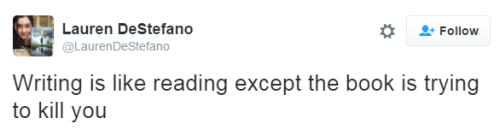
[A tweet from Lauren DeStefano:
Writing is like...
[A tweet from Lauren DeStefano:
Writing is like reading except the book is trying to kill you] (source)
March 10, 2016
Swearing in fiction. Is it necessarily "bad"?
This is an odd time for me to be writing this post, since my next project is a children’s book that contains no scenes of violence, blood, gore, aberrant sexual behaviour, swearing or anything else that might be considered offensive (although the world has proven me wrong before. Do a search on Google to see how many people are horribly offended by “The Giving Tree.”)
Still, here I am writing it, because, as has been brought to my attention before, my fiction generally (not always) has a lot of swear words in it. Although, by simple math I’ve found that my latest book “Missing Pieces” has less than 1% offensive words in it. Wow! NOT REALLY A SPOILER ALERT: That’s still a lot of swearing since it clocks in at 138,730 words.
I’ll sidestep the whole issue of whether or not swearing (among other things) is necessarily “bad” since I’ve already written a long-winded diatribe about how I feel about that on this page on my blog.
Instead, I’ll focus on the three complaints/arguments I hear most often, and, hopefully, answer them with some measure of clarity, although that should, technically, be impossible (see below).
1. Use of swear words in fiction is an indicator that the story, or the writing is weak, or that the story-teller is unable to tell the story in a compelling way without resorting to the use of profanity.
This may be the case in some instances, certainly. I won’t argue that. But, I think, in general, when a story is weak, or a story-teller is unable to tell a story in a compelling fashion, inclusion or exclusion of profanity is rarely the reason. I could write eloquently for days (and I have, literally, millions of words to prove this) and go absolutely nowhere while never ever resorting to the use of expletives in any form or fashion.
A good story is based on interest. And it really boils down to a very simple premise. Forget about three or four act structures, or any other formulae you may have learned. At the most basic level, a good story is based on how invested your reader is in finding out “what happens next.” And that boils down to them caring about your characters and/or plot (preferably both) enough to ask that question. Really, they should be dying to know “what happens next?”
If you can’t get a reader to wonder “what happens next?” (whether they consciously realise it or not), they’ll stop turning pages and then, no matter how great your story is, it will never be read to completion (unless you can work it into a school curriculum ;)
It’s certainly true that a good story can be told without the use of profanity. Authors like Lee Child (Jim Grant) prove this again and again. Of course, it’s also certainly true that a good story can be told with mild to excessive profanity. Authors like Stephen King prove this again and again. And it’s also certainly true that a good story can be told with loads of profanity. While he was still alive and kicking, Tom Clancy was busy proving this again and again.
So, it seems to me, in this case, that the use of profanity isn’t really the issue. Good, bad, and mediocre stories can, and will be, told with or without profanity and to varying degrees of commercial success. And that commercial success will likely not be entirely dependant upon the amount of profanity in the work.
2. The use of profanity weakens narrative, works against character believability and is a substitute for investing actual effort that the reader can sense instinctively.
This is an argument I honestly can’t believe exists. For instance, in many of my novels and stories (most of them, in fact) some characters swear all the time, some characters swear occasionally and some don’t swear at all. This, of course, has been my experience of life.
And, when it comes right down to it, the only things that weaken a novel, or hurt character believability, are the lengths to which you’re willing to go to tell your own story in a way that you think other people will want to hear it.
Go ahead and break out the Thesaurus. If you don’t have anything to say, it doesn’t matter what words you use.
For instance, if you never swear, but create a bunch of characters who do (perhaps even a narrator who does) because you want to be edgy, it’s going to come off as inauthentic, weak and contrived. Readers may not be able to put a finger on why, but something about your whole story (characters, narration, etc.) will feel off. They won’t like it.
By the same token, if the people in the story in your head swear constantly, changing all the f-bombs to h-bombs is going to come off as inauthentic, weak and contrived. Readers may not be able to put a finger on why, but something about the whole story (characters, narration, etc.) will feel off. They won’t like it.
3. Overuse of profanity reduces the impact of the words themselves and renders them impotent, which is (for some reason) not a good thing.
While I’ll agree whole-heartedly that use of profanity in excess (which I’m wont to do with certain characters and narrators) does dull the effect of those “bad” words, it brings another question to my mind:
If the use of excessive profanity is considered a sign of a weak writer, shouldn’t the dependency on that very same profanity, to shock the reader or command his/her attention, be considered just as much of a weakness?
My point being that, if one has engaged in the overuse of profanity in his or her narrative and dialogue, to the degree that its been rendered neuter, why is that considered a bad thing? Certainly it’s not the author’s intention that you be shocked for your entire reading experience. I can’t say for certain, but I’d imagine anyone who expects a reader to be shocked for 200 to 600 pages, straight-through, has his head in the clouds. Especially if he or she is counting on profanity to provide that constant experience for the reader.
It could just as easily be argued that, once the writer’s overuse (which, let’s face it, is a relative measure) of profanity has rendered those self-same naughty-words impotent, he or she is going to have to actually write something clever, intelligent or otherwise shocking, to knock you out of your boots. He or she can’t just have the good guy finally say: “This is some fucking bullshit." Not, at least, to let the reader know that the good guy is, finally, at the end of his rope.
But, in the end, the truth of "what happens when you use (or overuse) profanity” in your written work, is entirely subjective. You’ll almost certainly offend someone. And if your language doesn’t, your story, or something else, will.
You can’t win this battle, really. Unless you choose not to fight it.
The best thing you can do as a writer, in my own humble opinion, is to be true to your own voice. Don’t change anything to suit your audience, unless you desperately want to write YA novels and you have a foul-mouthed protagonist with a BSDM hang-up that you’re trying to work in there. Good luck with that stretch, or anything close to it.
Your audience will find you, if you wait long enough. If you’re impatient (or you just want to get noticed and appreciated, to whatever degree, before you die), go looking for your audience. I can virtually guarantee that there’s a group of people out there who want to read whatever you’re writing.
As long as it’s entertaining and true (not, of course, in the sense that it’s necessarily realistic), good writing will remain in play (and it will touch many hearts and minds) for a long time.
Peace, you beautiful bastards,
, Mike
March 9, 2016
MISSING PIECES - Late Release Notice! tinyurl.com/hyc256aMy new...
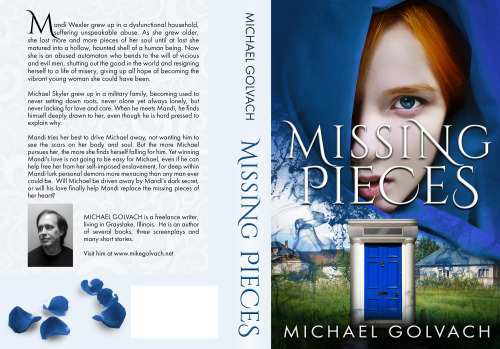
MISSING PIECES - Late Release Notice! tinyurl.com/hyc256a
My new novel “Missing Pieces” released on February 14th of this year (2016) and, in all the confusion I created doing my own marketing, I somehow forgot to update my tumblr!
Look for more posts from me very soon. I’m certain, if I don’t close this tab, I won’t forget to write here more. And, now that I have a goodreads author page, I made sure to inline it there, so I have no more excuses.
If you’ve already bought the book, I hope you enjoyed it (or are enjoying it) and I thank you for leaving me a review on Amazon. Good, bad, somewhere in between. I really do appreciate user reviews. The Editorial Reviews are nice, but it’s the reader reviews that really matter!
Peace,
Mike
(WARNING/GUARANTEE: “Missing Pieces” is about bad things and bad people, even though it has a positive message overall. It may be disturbing for some readers)