
Danny Chivers's Blog
February 11, 2016
Cleaner, fairer ways to power the planet
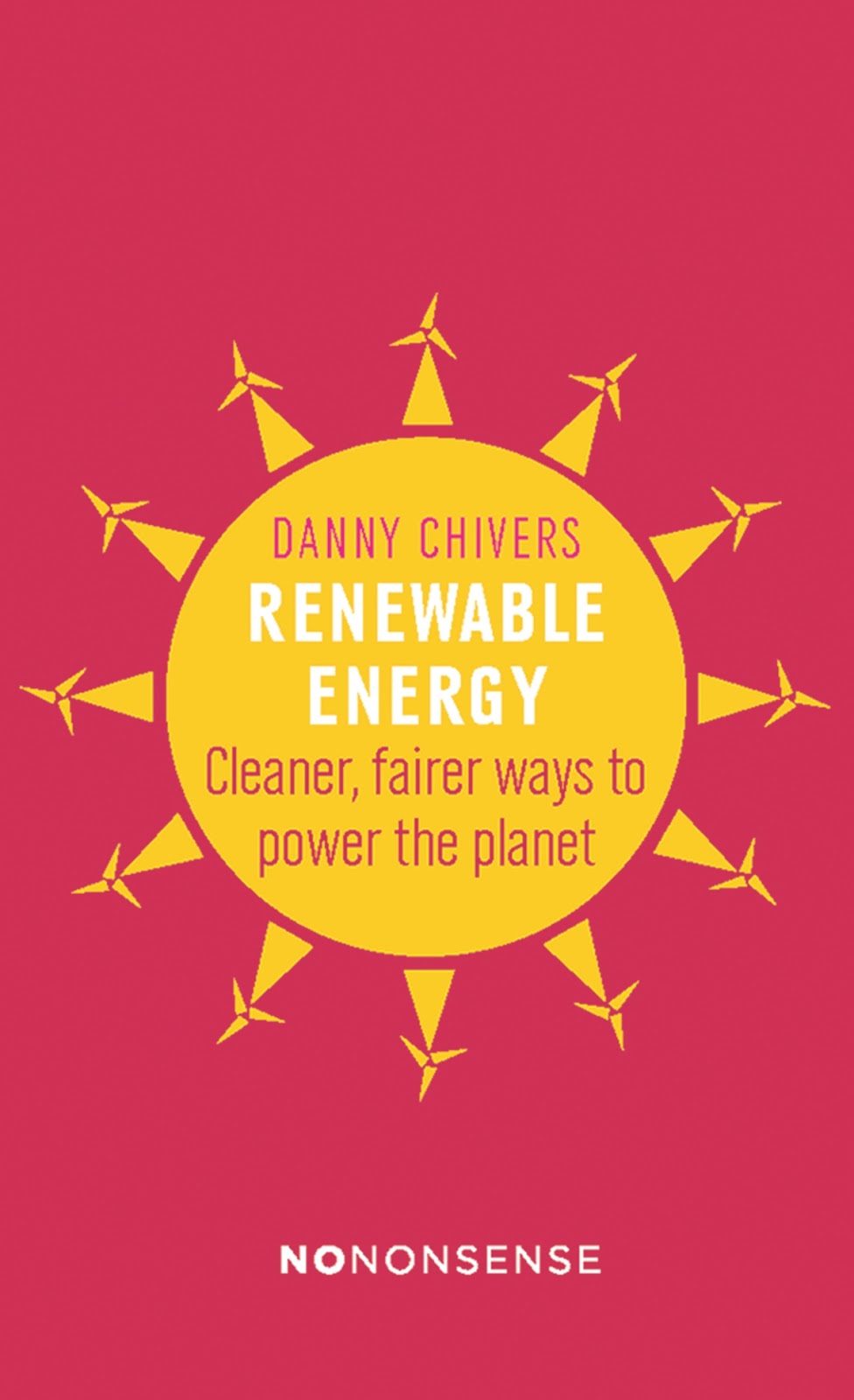
In case you haven't seen it - my new book is in the shops now!
In the book, I've tried to explain all the different types of renewable energy in friendly, jargon-free language. I then try to tackle the question: is a 100% renewable world truly possible, and what would it take to achieve it?
You can read a sample here - and please do share your thoughts here or on the New Internationalist website, I'd love to know what you think.


April 27, 2012
Just how bad are the Canadian Tar Sands?
Over the last few years, there's been a growing chorus of concern about the tar sands (or oilsands) in Canada. Tar sands are a kind of oily deposit that require more complex and energy-intensive extraction methods than "conventional" oil in order to convert them into a usable fuel. This means that until recently they were too expensive to be seen as a major energy source. However, as the rest of the world's cheap and easy oil has now pretty much been discovered, rising oil prices have made the tar sands a more attractive prospect for profit-hungry oil companies. Shell, for example, have staked about a third of their future profits on tar sands extraction; BP are in the process of building their first extraction facility.

The Suncor Millenium tar sands mine - photo from National Geographic
Even without considering the local environmental destruction, groundwater pollution and violation of Indigenous treaty rights that are necessary to rip or boil the tar sands out of the ground, the potential greenhouse gas emissions associated with the Canadian reserves alone have been described by campaigners as a "carbon bomb". Representing the third-largest stash of oil in the world (after Saudi Arabia and Venezuela), the threat of the expansion of Canada's tar sands was enough to spark one of the biggest environmental protests in US history last year, with the (at least partially successful) campaign against the Keystone XL pipeline. Respected climate scientist James Hansen has said that if we carry on with tar sands extraction then it will be "game over" for the climate.
But then, in February 2012 the waters were muddied by a University of Victoria study which concluded that burning all the recoverable Canadian tar sands would raise global temperatures by 0.03 degrees Celsius. This led to a whoop of delight from many pro-tar sands commentators, who gleefully pointed out that this was a pretty titchy amount of warming compared to, say, burning the world's remaining coal (14.8 degrees) or natural gas (2.9 degrees).
This was, of course, all pretty misleading, because 0.03 degrees is a lot for a single industrial project. Comparing just the tar sands to ALL of the world's coal or gas isn't a fair comparison at all - it's like saying "hey, maybe my Rottweiler has killed a few local kids, but compared to all the dog attacks in China every year that's really not so bad". More importantly, that 0.03 degrees figure doesn't come with any context about how much warming we're already committed to, and exactly where the tar sands would bring us in relation to the point of no return.
To try to clear this up, I've decided to come at it from another angle. According to researchers at the University of Oxford, we can only emit around 710 billion more tonnes of carbon dioxide in all of humanity's future if we want a decent (75%) chance of avoiding runaway climate change [1]. Just burning the Canadian tar sands would release around 110 billion tonnes [2]. That means that the tar sands would wipe out a seventh of our remaining atmospheric space all by themselves, just to power a small fraction (the IEA reckons 10% by 2035) of the world's vehicle fleet. That's before we start thinking about coal, gas, and all the rest of the oil in the world.
So yes, it's true that there's enough coal and gas out there to cook us several times over, but that doesn't make the tar sands any less deadly - just the Canadian deposits would take us 14% of the way towards the point of no return. Next time someone tells you we don't need to worry about the tar sands because other fuel sources are potentially worse, you can tell them that they're wrong. We need to stop burning all of these fuels, fast - and the relative isolation of tar sands in a few places, combined with its carbon intensity, local destructiveness and human rights impacts - make it a prime contender for one of the first things to shut down.
A world without fossil fuels is possible - in fact, I'm part of a project at the moment to illustrate this in an interesting and engaging new way, watch this space for more details!
[1] The figures on the Oxford University "trillionth tonne" website are in tonnes of carbon, not tonnes of CO2. I've converted the approximately 194 billion tonnes of carbon standing between us and a two degree rise into 710 billion tonnes of carbon dioxide.
[2] There are an estimated 170 billion barrels of recoverable oil in the Canadian tar sands, according to the Canadian Association of Petroleum Producers. According to official research accepted by the EU, oil from the tar sands releases 107 grams of CO2 per MJ. One barrel of oil represents approximately 5861.5 MJ, which means that extracting and burning all of Canada's tar sands would release 170 x 107 x 5861.5 / 100000 = 106.6 billion tonnes.
February 9, 2012
The climate: still crazy
I've written a short article to this effect for the Global Herald, and you may well see me popping up in various other places over the next few months to say similar things. It's really important - if we're going to make 2012 another much-needed year of climate activism - that we both understand the mess we're in but also understand the potential for change that is unfolding all around us.
Other things I'm up to at the moment:
* The No-Nonsense Guide to Climate Change is about to be released as an e-book, so I'm doing various talks and workshops around the country to promote it (see my other blog for a full list of upcoming appearances and gigs). I'm also keen to get mentions and reviews in blogs and other publications out there - if anyone has any suggestions, they'd be very welcome!
* I'm doing carbon footprinting work for Oxfam and Christian Aid. I'm thinking about taking on more work in this area (particularly relating to the carbon footprints of charities and NGOs) so please do drop me a line if this is relevant to you.
* I've got a few new poems in the works (check my other blog for upcoming gigs). In the meantime, videos of some old classics can still be seen here, here, here and here.
* I have a few schools appearances coming up, but not too many at the moment - if you'd like me to come and run interactive eco-poetry workshops at your school, please do get in touch (and see this page for more info).
* I'm doing some work for the UK Tar Sands Network on the future of fuel - what are the alternatives to burning fossil oil, and what would an oil-free future look like? Watch this space for developments!
* We're starting to line up some possible festival dates for our cycle and solar powered performance stage "Cyc du Soleil" - again, more information to follow.
That's probably enough of an update for now - keep warm everyone (in a low-carbon fashion) and I hope to see you (and the Spring) soon!
April 18, 2011
New tour dates for April/May/June
Just a quick post to update you all on my ongoing book / performance tour! I’m roaming around the country doing a rather unusual series of talks/gigs, mixing poetry, tales of protest, climate change news and bad jokes. It would be great to see you at any of the times and places listed below.
In the meantime, remember you can read the first chapter of my new book for free here, see me performing my anti-cuts poem here, and watch me wearing a terrifying T-shirt at last week’s BP AGM here.
Thanks so much to all of you for your ongoing support,
Danny x
***************************
LIVERPOOL, Saturday 23rd April, 7pm: Talk and performance at the Next To Nowhere Social Centre (next door to News From Nowhere bookshop), basement of 96 Bold St, L1 4HY - http://www.newsfromnowhere.org.uk/not...
MANCHESTER, Sunday 24th April: Talk and performance at the OKasional Café, tbc (email me for more info)
CAMBRIDGE, Monday 25th April, 7.30pm: Performance for Headstand, at The Emperor, Hills Road. https://www.facebook.com/event.php?ei...
ST ALBANS, Tuesday 26th April, 7.30pm: Performance at Rrrants at the Goat Inn, 37 Sopwell Lane, AL1 1RN. https://www.facebook.com/event.php?ei...
WALTHAMSTOW, Friday 6th May, 7.30pm: Night of the Green Poets at the Hornbeam Café, 458 Hoe Street, E17 9AH. https://www.facebook.com/event.php?ei...
LONDON, Monday 16th May, 7.30pm: Talk and performance at Pogo Café, 76 Clarence Road, Hackney, E5 8HB.
HEMEL HEMPSTEAD, Thursday 19th May, 7.30pm: Performance at Rrrants at the Olde Kings Arms, 41 High Street, HP1 3AF
WOOD FESTIVAL (TBC), 20th – 22nd May, Braziers Park, Oxfordshire. http://www.thisistruck.com/wood/
UPPSALA UNIVERSITY, Sweden, 24th-25th May: Talk, workshop and performance at the “Challenging Uncertainties” conference for Education in Sustainable Development, http://www.challenginguncertainties.se/
CARDIFF, Thursday 2nd June: Talk and performance organised by local Friends of the Earth groups, details tbc (email me for more info)
LONDON, Sunday 5th June: Performance at the London Green Fair, Regents Park, precise times tbc (email me for more info) http://www.londongreenfair.org/
That’s probably enough for now, but there are more gigs and talks in the pipeline for Edinburgh, St Andrews, Birmingham, Leeds, Narberth (oh yes) and of course the Glastonbury Festival and the Edinburgh Fringe. Watch this space…
March 2, 2011
It's here!

It starts arriving in shops this week. It's all rather exciting.
The book is a friendly pocket-sized overview covering climate science, targets, solutions, history, politics, and what action we can usefully take, all in one handy little guidebook. It's intended both as a primer for people new to the topic (or confused about it) and also as a "where are we at and where do we go from here" update for more experienced campaigners. As you'd expect, I've scattered the text with as many weird analogies, bad jokes, cheeky asides and snippets of verse as possible, and have done my best to leave the reader feeling positive and empowered rather than sunk in doom and gloom.
We're pestering various media outlets to review it, I'll let you know how that goes. It's already had a very positive review in Green Prophet, a Middle East environmental magazine.
It's available on Amazon, and direct from the New Internationalist website, but it's much better to support your local independent bookshop if you can. You can find your nearest independent bookstore on this website here. If your local bookshop doesn't have a copy yet, they should be very happy to order it in for you (why not suggest they order a few more for the shop while they're at it...?).
New Internationalist is a publishing cooperative that puts out all kinds of great books but has only a small marketing budget. That means that I'm relying heavily on word of mouth to get this out there. Do you have friends or relatives who ought to read this book? If so, please put a good word their way (or maybe buy them one as a super-thoughtful gift). While you're campaigning to save your local library from the spending cuts, why not drop in and suggest they buy a copy (this works far more often than you'd think)? Plus, of course, once you've read the book it would be wonderful if you could write up your thoughts in a reader review on Amazon, and of course share it all over the Twitbookosphere.
I'm also launching into a major run of talks and performances to plug the book all over the UK. Why not come and say hi at one of the events below? If there isn't one near you yet, drop me a line on dannychivers@excite.com with any suggestions for likely venues and we'll see what we can sort out.
Thanks for all your support everyone!
Danny x
Wed 2nd March, 6.30pm: Talk at the Dialogue Society, London on the topic of social movements
Friday 4th March, 7pm: Panel member, “A Million Climate Jobs” meeting, Environmental Change Institute, Oxford
Sat 5th March, 8pm: Evening poetry performance at 6 Billion Ways, London. http://6billionways.org.uk/
Tue 8th Feb, 6.30pm: Panel member at "Energy Union" event, Darwin Lecture Theatre, Malet Place, University College London
Fri 11th March, 7.30pm: Short talk at the opening night of the Conversations with the Earth festival, The Old Book Binders, 9 Green Street, Oxford
Sat 12th March, 7pm: Poetry performance at Re:Versing The Damage, part of the Conversations with the Earth festival, The Old Book Binders, 9 Green Street, Oxford
Sat 19th March: Climate activist poetry workshops, Visions for Global Justice (Scottish campaigners’ convention run by WDM), Renfield St Stephen’s Centre, Bath Street, Glasgow, near King’s Theatre. http://www.wdm.org.uk/events/scottish....
Sun 20th March, 2pm: Talk and performance at the Manchester University student anti-cuts occupation, Roscoe Building, Brunswick St, Manchester, M13
Mon 21st March, 8pm: Talk at Green Drinks Newport (Shropshire), The Royal Victoria Hotel, St Mary’s Street, Newport TF10 7AB. http://newport21.org.uk/
Thursday 31st March: Performance in support of Pete The Temp’s great new poetry show “Pete The Temp verses Climate Change”, Ovo Theatre, St Albans, http://www.ovotheatre.org.uk
Fri 1st April, 7pm: Book launch event at RISC, 35-39 London Street
Reading, RG1 4PS
Weds 13th April - Weds 20th April: Various dates to be confirmed as part of the Tar Sands Speaker Tour, featuring Indigenous activists from Canada and organised by the UK Tar Sands Network and Indigenous Environmental Network: www.no-tar-sands.org.uk
Tues 26th April: Poetry performance at Rrrants, The Goat Inn, 37 Sopwell Lane, St Albans, http://www.rrrants.com
Friday 6th May: Poetry performance at the Hornbeam Café, 458 Hoe St, Walthamstow, E17 9AH. http://www.hornbeam.org.uk
Sun 15th May – Weds 18th May: Talk and performance sometime this week at the Centre for Alternative Technology, Machynlleth (tbc) http://www.cat.org.uk/
Thurs 19th May: Poetry performance at Rrrants, The Olde Kings Arms 41 High Street, Hemel Hempstead, Hertfordshire HP1 3AF. http://www.rrrants.com
Fri 20th May – Sun 22nd May: Poetry at the Wood Festival, Braziers Park, Oxfordshire (tbc)
Sat/Sun 18/19 June: Speaking and performing at the SW Friends of the Earth regional gathering (tbc)
Thurs 23rd - Sun 26th June: Poetry at the Speakers' Forum, Glastonbury Festival, various times
Weds 13th July, 7.30pm: Talk at Warborough & Shillingford WI, The Greet Hall, Sinodun View, Warborough, OX10
August: Talk and workshop at Methodist Fellowship event, also possible performance at the Edinburgh Fringe (if I get my act together)
October 18, 2010
Coming Soon...
 ...my first book, The No-Nonsense Guide to Climate Change, published by New Internationalist. Available March 2011 in all good bookshops. An accessible overview of the science, the solutions, and the politics of climate change, complete with dubious analogies, wry asides and the inevitable poetic interlude. I'll remind you again once it's out, obviously...
September 1, 2010
Venturing into performance poetry
It was like a bizarre, teenage parallel universe in a field in Derbyshire, run on admirably communal lines - the youngsters were heavily involved in cooking, cleaning, running the onsite services and documenting Camp events via a nightly "news" screening. The place even had its own currency and time zone (I kid you not).
I was only there for a day and a night, but still came away with some pretty strong memories - it's probably the only place in the world where I could perform my poetry in front of five hundred 13- to 16-year-olds and be received with rapturous applause and enthusiastic audience participation. They even joined in without being asked at the end of my climate change denial poem. This means I can now pretend that I am totally cool and, like, down with the kids (so long as I conveniently ignore the fact that the room contained probably the only 500 teenagers in the country who'd react that way to my poetry).
The other great thing that happened was that a group of campers attended the poetry workshop I was running, wrote some poetry of their own, and then got up on stage that very evening to perform it to the rest of the camp. That takes guts - especially as none of them had performed poetry on stage before. I reproduce below - with their permission - two of the poems, from the two youngest participants in the workshop, Edith and Luke. Remember, they wrote these in a single short poetry workshop (after various exercises and discussions I gave them about half an hour of writing time), and then got up on stage in front of hundreds of their peers and gave, in both cases, fantastic spirited performances (in fact, the written versions of the poems don't fully do them justice, as is so often the case with performance poetry).
**************************************
Poem 1:
Eureka! Fantissimo!
I've solved the problemo!
No more cars, exhaust or smoke,
No more petrol smell as you choke
On the fumes from the old banger in front.
Never again that tiresome hunt,
For the car for you. the one.
For I have a proposition,
A fantastic, wonderful, ingenious solution!
For instead of cars, motors and so on
We will travel in bubbles for now on!!
For I have created a humongous bubble wand
That will blow bubbles 10 foot and beyond!
We will drift and float, bounce off walls,
Down roads, knowing we are free from the problems cars caused!
This idea is gold,
I don't need to be told
How fantastic I am for solving this boring
Issue that we call Global Warming!
- Edith Bannister, August 2010*********************
Poem 2:
hunger is demanded
so wealth can be handed over
the lines on a map
to handfuls of chaps
who seek only profit
and problems are worsened
as thousands of persons
are crushed in the rubble
then corpses are doubled
despite the donations
to relief organisations
because they are denied permission
to land and start their mission
by the soldiers of men
who seek only profit
earthquakes caused
families in scores now buried
change Obama?
Haiti needs food
Haiti needs tents
US sends guns and sweatshops
but dawn is breaking
nations are waking
people are rising
so are the seas
but our alliance
acts in defiance
to imperialist giants
and their environmental catastrophes
Cuban medics were there before
treating the sick
helping the poor
and since the eco-disaster they've been joined by Ecuador
Venezuela cancelled debt
Nicaragua sent a jet
full of supplies for Bolivian doctors
who did the work that Britain didn't
this is solidarity
saying no to US hegemony
dawn has broken
the masses have spoken
revolution is on their lips
Alerte! Alerte! Alerte que combina!
La espada de Bolivar por America Latina!
- Luke Lucas, August 2010
*************************
Two very different poems, two budding talents to keep an eye on in the future...
(Also, rhyming "hegemony" with "solidarity"? Awesome.)
August 10, 2010
Radio Silence
In the meantime, you should probably figure out how you're going to get to this year's Climate Camp - it's happening THIS MONTH and it's gonna be ace.
April 29, 2010
Chickening out of the climate challenge
It’s the defining issue of our times. It already kills 300,000 people every year, and threatens almost everything we take for granted about the world. We need urgent action across our whole society to avoid catastrophic consequences within our lifetimes. Yet in three hours of televised leadership debate, climate change has so far been discussed for…eight minutes. Last week, we learned that Brown and Cameron want more nuclear power (Clegg doesn’t), Brown wants a third runway at Heathrow (the other two don’t), Cameron wants to do something or other about insulation and all three of them want an international solution. They all agreed it was jolly important, then moved on to spend more time discussing what they’d like to say to the pope than they’d spent on the entire avoiding-global-cataclysm question. Great.
Luckily, there have been other opportunities to examine the three main parties’ policies on climate change – for example, the Guardian environment debate (analysed by George Monbiot here), and a new national carbon calculator (which I worked on with the Guardian web team), which maps out the UK’s greenhouse gas emissions and lets you play around with them.
The energy and climate change spokesbods from Labour, the Conservatives and the Liberal Democrats were all invited to plug their policies into the calculator to see how they measure up. Before we look at how they did, let’s remind ourselves of where we need to get to. Leaving aside the 2050 carbon reduction targets – anyone can promise anything for 40 years in the future – the science is telling us that we need to reduce the UK’s current emissions by as much as 50% by 2020 [1] in order to carry out our fair share of a sensible global cut. In other words, we should aim to halve our carbon emissions over the next two parliaments. It’s a tall order – but the consequences of not doing it are far worse, and many of the changes would benefit us in other ways (better public transport, warm homes, safer roads, healthier food, and so on).
Of the three big parties, only the Lib Dems have been brave enough to post their calculator results online. They’ve managed a 50% reduction (although it isn’t clear by when) – by switching electricity generation entirely over to wind, sun and tidal power, improving the energy efficiency of homes and businesses, cutting out food waste, reducing flights, moving people and freight from road to rail and converting half of the country’s car fleet to electric vehicles. Pretty bold stuff – but interestingly, they haven’t touched the top two sliders. These control the UK’s level of material consumption – how much stuff we use – and by leaving this untouched the Lib Dems have needed to make much bigger carbon cuts elsewhere in the economy.
However, it is worth noting that even leaving the consumption sliders where they are is a surprisingly radical thing to do. Our economy is based on the bizarre idea of endless growth on a finite planet, which requires the ever-increasing consumption of limited natural resources. Holding consumption steady – or reducing it, as the calculator suggests we will ultimately have to do – will require us to run our economy in a totally different way, finding ways to lead happy, healthy and exciting lives without relying on the myth of infinite growth. Have the Lib Dems cottoned on to this?
Labour, meanwhile, claim to have “a positive vision of jobs, empowerment and fairness with plans sector by sector from agriculture to transport…within a clear framework for carbon emissions.” Sadly, they haven’t taken the opportunity to show how these plans might translate into emissions reductions on the calculator, or how they are compatible with Government proposals for aviation expansion and new coal plants. They do say they are working towards cutting emissions to 34% below 1990 levels by 2020 – by my calculations, that’s 15% below 2007 emissions (on which the calculator is based). This is a far cry from the real reductions we need.
Intriguingly, while the Lib Dems’ Simon Hughes says that the calculator shows that we can power the UK without nuclear plants, Labour’s Ed Miliband claims that it shows the opposite. I’d suggest that the calculator simply presents the fact that nuclear power is just one option in a mix. We have other viable choices and so we can take it or leave it – which means that the arguments about the costs, reliability, risks and waste associated with nukes are absolutely crucial.
Both the Lib Dems and Labour also lament the lack of carbon capture and storage in the model – but this technology has not yet been proven to work on a large scale, so it would be speculative to include it in the calculator. Similarly, there's talk of far more efficient wind turbines, solar panels etc. in the near future, but to keep things grounded the calculator includes only existing technology. It also only includes things that we can reasonably measure – restoring Britain’s forests sounds like a good idea from the Lib Dems, but it would be near impossible to attach an accurate emissions saving figure to such a project. We just don’t understand enough yet about how carbon is stored and released from plants and soils.
The Conservatives’ Greg Clark completely fails to engage with the calculator, and instead decides to talk about watermelons. The Conservatives seem to believe that putting a price on carbon and giving out insulation grants will allow the market to sort the problem out by itself. But leaving the fate of humanity to the vagaries of the market (the workings of which are of course heavily influenced by large polluting corporations) seems incredibly reckless, and doesn’t take account of the urgency of the climate crisis. It also denies us the option of a carefully planned and fair transition to a low-carbon society, respecting the rights of workers in high-carbon industries to job transfers, retraining and compensation.
Nothing in the calculator suggests that we need to “micromanage” the details of people’s lives (Clark’s “watermelon environmentalism – green on the outside, red on the inside”). We need sensible plans for shifting our society onto a better path, and hopefully tools like the national carbon calculator can help us to understand the kind of changes we need to make.
The Guardian don't seem to have asked the Green Party to have a go on the tool. I suspect they'd do a bit better than the other three. However, this calculator was never intended solely as a tool for politicians and policy-makers. No matter how good or bad their pre-election climate proposals may seem, whoever takes power on May 6th will not take the necessary steps to tackle climate change unless there is enough public pressure to force them to do so. I’d urge everyone reading this to use the calculator yourselves, to test out politicians’ climate proposals to see how effective they really are. Map out your own vision for a low-carbon future and start taking action to achieve it, by putting pressure on decision-makers and creating effective solutions in your own community. If the big political parties won’t take this issue seriously, then it’s up to us to do it for them.
[1] According to research by Professor Kevin Anderson at the Tyndall Centre we need UK emissions to start falling by 2012 at the latest, and then drop by 9% year-on-year. This works out at about a 46% reduction on 2007 levels by 2020 – and this figure may even be an underestimate, as it does not take into account all the latest research into climate tipping points.
Danny Chivers is a freelance carbon analyst and environmental writer.
April 22, 2010
That breakdown in full
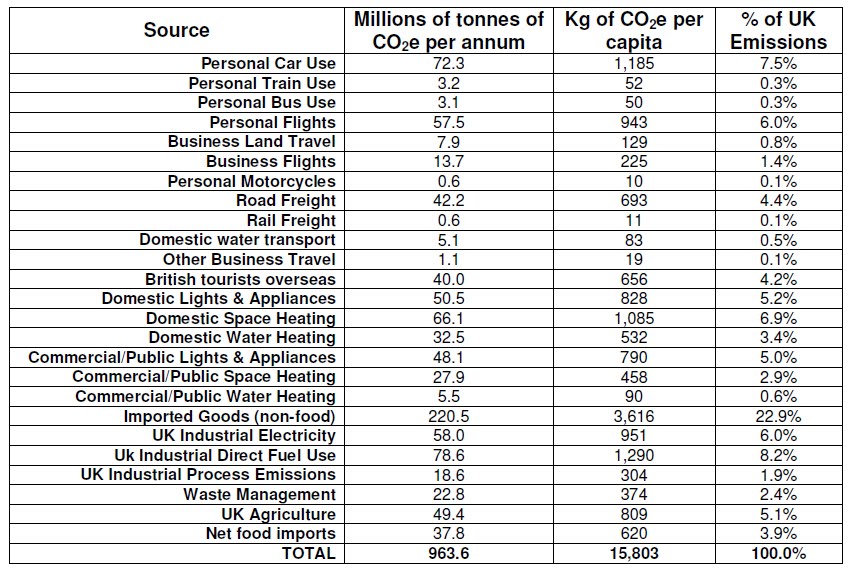
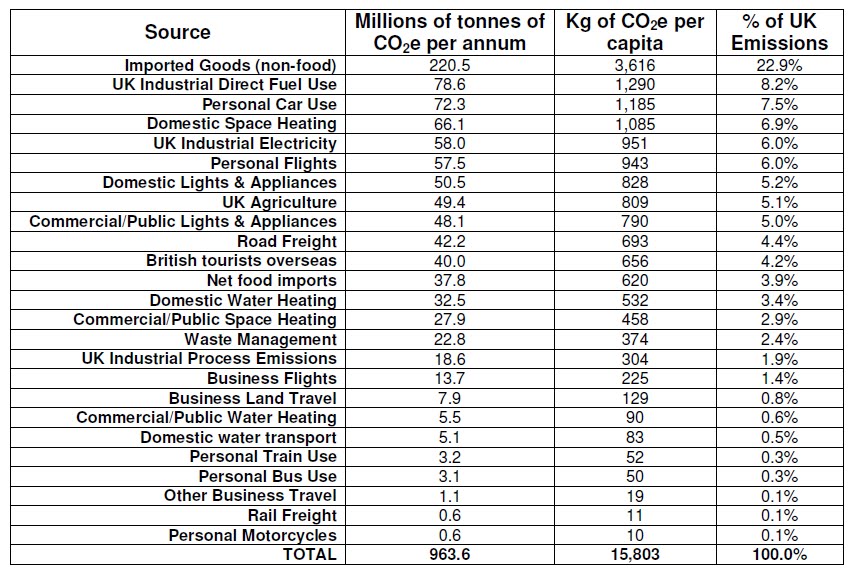
One question I've been asked is about the full, detailed breakdown of UK emissions. Due to reasons of space, it's not possible to have a slider for everything on the Guardian tool - but there's a fairly detailed (approximate) breakdown of UK emissions sitting behind it. It's all in the data and references sheet here - but that isn't the most user-friendly of documents (sorry) so I thought I'd reproduce the full breakdown below - hope you find it useful!
This first table lists the emission sources by approximate theme (click to enlarge):
[image error]
This second table shows the same information, but ranked in order of size (click to enlarge):
Some important things to note:
- All figures are approximate. Decimal places are included for reasons of clarity - the figures are almost certainly not accurate to this level!
- All figures are from 2007
- Imported goods refers to net imports - exported emissions have been deducted from this total (from this study)
- "British tourists overseas" refers to the emissions created by UK residents' travels abroad - not from flights, but from transport, acommodation etc. at their holiday destination. The emissions from foreign travellers doing the same things in the UK has been deducted from this total, to give a net figure (calculated by Dieter Helm)
Hope this is useful - I'll happily answer any questions in the comments below!
Danny Chivers's Blog

- Danny Chivers's profile
- 4 followers
