Michael Jacobson's Blog, page 25
February 9, 2020
Casting Symbols by Sylvia Van Nooten

Stamps, ink on paper
11 by 15 inches


February 4, 2020


February 2, 2020

January 28, 2020
January 27, 2020

January 26, 2020
A5EMIC Connotations And Asia In A Barbarian by Sean Cornelisse | A New Release from Asemic New Babylon
 Cover art


Click here to purchase a copy of A5emic Connotations And Asia In A Barbarian from Lulu.
Product Details:Price: $12.50 US ISBN: 9780244248758
Copyright: Sean Cornelisse (Standard Copyright License)
Edition: Eerste uitgavePublisher: Asemic New BabylonPublished: January 12, 2020 Language: EnglishPages: 76Binding: Perfect-bound PaperbackInterior Ink: Black & whiteWeight: 0.36 lbs. Dimensions (inches): 5.83 wide x 8.26 tall
January 22, 2020

January 16, 2020

January 14, 2020
A letter from Cecil Touchon to Peter Schwenger discussing asemic reading!
Hi Michael, I have been corresponding with Peter Schwenger a bit and he said...
" This is a wonderful meditation on reading asemic, a topic that hasn’t been dealt with all that much on the various blogs—at least not to my knowledge. I think you should send it to Michael Jacobson for posting, just as it is."
So here is what I wrote...
You know, I was thinking to myself that reading asemic writing is a completely different experience than making asemic writing. I notice I have a hard time putting the same attention on the asemic writing (of my own for instance) than reading actual text. Even though I am pretty clear about what I am doing, it is hard to take the required time to really read all the markings line by line. It seems like it should be read quickly but I tend to skip through the 'text' taking in mostly the pattern of it and feel that I need to look at it over and over again to take it in and feel like I have 'gotten it'. Maybe like listening to classical music, it is hard to maintain attention the whole time I am listening and have to listen to a piece many times to feel like I have really heard the whole thing and can anticipate what is coming. I have to become really familiar with it. Even like that, I discover new things now and then. Maybe asemic reading requires the same approach. I wonder what your experience of reading this type of work is. Or anyone else's for that matter.
I observe when I show people a notebook of my asemic writing they usually just very quickly page through it and I wonder what they think they are seeing or are they seeing it at all? One reason why I do this kind of work is to present the actual writing itself as its own concrete, unique reality rather being representative of something else.The same argument that stems from abstract or concrete art. I think you say in your book and certainly I have said and considered that the actual physical language text disappears when we are reading and just becomes a dialog in one's head. It is mostly a delivery system.
Painting was read the same way - looking beyond the actual painting to the image it is representing - before Impressionism that became much more involved with the optics of paint and really cut loose with Kandinsky and abstraction. People and even the artists themselves became confused about what they were supposed to see when they looked at it and how they were supposed to interact with it and what it might mean to an audience. I suppose that is still a problem for many.
Because of the very limited range of our focal point - maybe the size of a dime or even smaller I would say more like 1/4 of an inch around as far as actually seeing something - it seems that asemic writing is a very good way to present an artistic idea in a way where a viewer can look at the whole thing in a step by step logical flow that allows most of the work - line by line - to stay in the focal point while looking at it. Focused seeing.
A further thought...
Compared to normal text where you read through it and it becomes a story in your head that seems to be building an idea or following a train of thought that we are able to hold on to. With asemic reading, there may not be that same sense of having signposts to let you know where you are in the reading. Maybe asemic writing doesn’t have the sense of leading you along a trail since it is like walking through a wilderness where the reader has to develop his own rationale and cut his own internal trail through the work. Hence there may not be a sense of progression as with a literal text that moves along a paved and well marked road and this may cause an inclination toward disengagement.
And about seeing...
Testing 'seeing/reading' vision, look at the text on this page at a comfortable reading distance maybe 18 inches away I guess. Rest the center of your vision on a single word. Without moving your eyes, how many words around that word can you clearly make out while holding your focal point on the one word. For me, I can only see about a 4-5 letter word completely clearly with my eyes stationary. I assume that is roughly the same for everybody unless there is something wrong with my vision. Sure we can take in quite a bit peripherally but that is all fuzzy and out of focus until the center of your vision gets to it.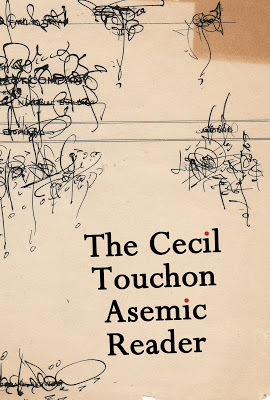 Be sure to check out
The Cecil Touchon Asemic Reader
published by Post-Asemic Press!
Be sure to check out
The Cecil Touchon Asemic Reader
published by Post-Asemic Press!
 And check out
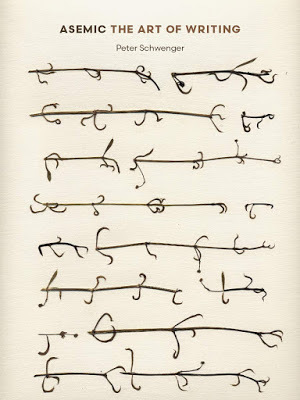
Asemic: The Art of Writing
by Peter Schwenger published by The University Of Minnesota Press!
And check out
Asemic: The Art of Writing
by Peter Schwenger published by The University Of Minnesota Press!
" This is a wonderful meditation on reading asemic, a topic that hasn’t been dealt with all that much on the various blogs—at least not to my knowledge. I think you should send it to Michael Jacobson for posting, just as it is."
So here is what I wrote...
You know, I was thinking to myself that reading asemic writing is a completely different experience than making asemic writing. I notice I have a hard time putting the same attention on the asemic writing (of my own for instance) than reading actual text. Even though I am pretty clear about what I am doing, it is hard to take the required time to really read all the markings line by line. It seems like it should be read quickly but I tend to skip through the 'text' taking in mostly the pattern of it and feel that I need to look at it over and over again to take it in and feel like I have 'gotten it'. Maybe like listening to classical music, it is hard to maintain attention the whole time I am listening and have to listen to a piece many times to feel like I have really heard the whole thing and can anticipate what is coming. I have to become really familiar with it. Even like that, I discover new things now and then. Maybe asemic reading requires the same approach. I wonder what your experience of reading this type of work is. Or anyone else's for that matter.
I observe when I show people a notebook of my asemic writing they usually just very quickly page through it and I wonder what they think they are seeing or are they seeing it at all? One reason why I do this kind of work is to present the actual writing itself as its own concrete, unique reality rather being representative of something else.The same argument that stems from abstract or concrete art. I think you say in your book and certainly I have said and considered that the actual physical language text disappears when we are reading and just becomes a dialog in one's head. It is mostly a delivery system.
Painting was read the same way - looking beyond the actual painting to the image it is representing - before Impressionism that became much more involved with the optics of paint and really cut loose with Kandinsky and abstraction. People and even the artists themselves became confused about what they were supposed to see when they looked at it and how they were supposed to interact with it and what it might mean to an audience. I suppose that is still a problem for many.
Because of the very limited range of our focal point - maybe the size of a dime or even smaller I would say more like 1/4 of an inch around as far as actually seeing something - it seems that asemic writing is a very good way to present an artistic idea in a way where a viewer can look at the whole thing in a step by step logical flow that allows most of the work - line by line - to stay in the focal point while looking at it. Focused seeing.
A further thought...
Compared to normal text where you read through it and it becomes a story in your head that seems to be building an idea or following a train of thought that we are able to hold on to. With asemic reading, there may not be that same sense of having signposts to let you know where you are in the reading. Maybe asemic writing doesn’t have the sense of leading you along a trail since it is like walking through a wilderness where the reader has to develop his own rationale and cut his own internal trail through the work. Hence there may not be a sense of progression as with a literal text that moves along a paved and well marked road and this may cause an inclination toward disengagement.
And about seeing...
Testing 'seeing/reading' vision, look at the text on this page at a comfortable reading distance maybe 18 inches away I guess. Rest the center of your vision on a single word. Without moving your eyes, how many words around that word can you clearly make out while holding your focal point on the one word. For me, I can only see about a 4-5 letter word completely clearly with my eyes stationary. I assume that is roughly the same for everybody unless there is something wrong with my vision. Sure we can take in quite a bit peripherally but that is all fuzzy and out of focus until the center of your vision gets to it.
 Be sure to check out
The Cecil Touchon Asemic Reader
published by Post-Asemic Press!
Be sure to check out
The Cecil Touchon Asemic Reader
published by Post-Asemic Press! And check out
Asemic: The Art of Writing
by Peter Schwenger published by The University Of Minnesota Press!
And check out
Asemic: The Art of Writing
by Peter Schwenger published by The University Of Minnesota Press!
December 28, 2019
ASEMIC: The Art of Writing by Peter Schwenger is available now from University of Minnesota Press!
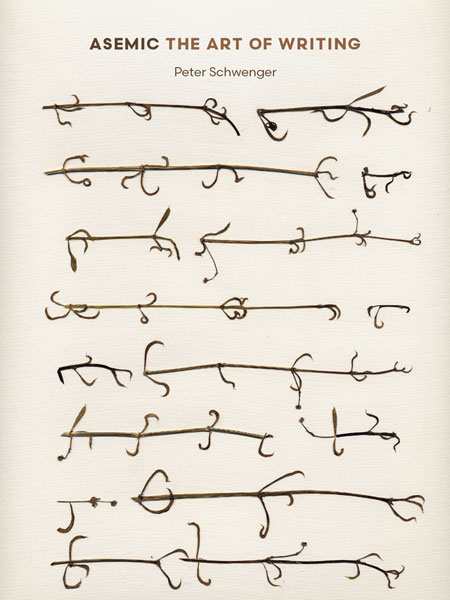 ASEMIC: The Art of Writing
By Peter Schwenger
University of Minnesota Press | 192 pages | December 2019ISBN 978-1-5179-0697-9 | paper | $25.00
ISBN 978-1-5179-0696-2 | cloth | $100.00
In recent years, asemic writing—writing without language—has exploded in popularity, with anthologies, a large-scale art exhibition, and flourishing interest on sites like tumblr, YouTube, Pinterest, and Instagram. Asemic is the first critical study of this fascinating field, proposing new ways of rethinking the nature of writing and exploring how asemic writing has evolved and gained importance today.
ABOUT THE AUTHOR:Peter Schwenger is resident fellow at the University of Western Ontario’s Centre for the Study of Theory and Criticism. He is the author of several books, including The Tears of Things: Melancholy and Physical Objects and At the Borders of Sleep: On Liminal Literature (both from Minnesota).
PRAISE FOR ASEMIC:"How does the noncommunicative communicate? This is the seemingly innocent question Peter Schwenger unpacks. At once storehouse and treatise, Asemic has the clarity of a dictionary entry, its sagacity delivered with deceptive ease, revealing a domain vaster than anyone would have thought: a Copernican marvel." —Jed Rasula, author of History of a Shiver: The Sublime Impudence of Modernism
"Asemic is a long-overdue study of poetries that occupy liminal spaces between art, like Cy Twombly's paintings, and recognizable words, like Henri Michaux's poetry. Peter Schwenger offers an extended theory and an introductory survey of contemporary asemic writing by Michael Jacobson, Rosaire Appel, Christopher Skinner, and others. From this book one can learn to read and, by extension, teach asemiological texts." —Craig Saper, co-editor of Readies for Bob Brown's Machine
"This is the first full-length exploration of the history and meaning of asemic writing. Important figures such as Michaux, Twombly, Barthes, Jim Leftwich, and Rosaire Appel are included, as well as examples from Chinese culture. Well-chosen illustrations accompany Peter Schwenger's insightful text. This book is a solid first map of a territory previously unknown to academic study." —Tim Gaze, publisher of Asemic magazine
For more information, including the table of contents, visit the book's webpage:https://www.upress.umn.edu/book-division/books/asemic
Asemic The Art Of Writing is also available at Amazon: https://www.amazon.com/dp/1517906970/?coliid=I39Q0KY70LAZWR&colid=RCOJWWCHZFSL&psc=1&ref_=lv_ov_lig_dp_it