Antony Loewenstein's Blog, page 223
July 18, 2012


Wikileaks documents know more about Afghan war than US military
Almost funny. This is what a floundering empire looks like (via Wired):
Insurgencies are amongst the hardest conflicts to predict. Insurgents can be loosely organized, split into factions, and strike from out of nowhere. But now researchers have demonstrated that with enough data, you might actually predict where insurgent violence will strike next. The results, though, don’t look good for the U.S.-led war.
And they’re also laden with irony. The data the researchers used was purloined by WikiLeaks, which the Pentagon has tried to suppress. And the Pentagon has struggled for years to develop its own prediction tools.
That data would be the “Afghan War Diary,” a record of 77,000 military logs dated between 2004 and 2009 that were spilled onto the internet two years ago by WikiLeaks. In a paper published Monday by the Proceedings of the National Academy of Sciences, a team of researchers used the leaked logs to (mostly) accurately predict violence levels in Afghanistan for the year 2010. (Behind a paywall, alas, but a summary is available for free in .pdf.)
It sounds simple. Take six years’ worth of data, plug in the right formulas, and out comes results that give a “deeper insight in the conflict dynamics than simple descriptive methods by providing a spatially resolved map of the growth and volatility of the conflict,” the researchers write. In practice, it’s maddeningly complicated — and suggests that the insurgency has successfully withstood the recent surge of U.S. troops.
One of the keys to accurate prediction, the report says, is a robust sample size. Though the military’s records almost definitely don’t contain every violent outburst that’s occurred in Afghanistan since 2004, and the events included range widely from “elaborate preplanned military activity and spontaneous stop-and-search events,” it’s better than relying on inaccurate or incomplete reports from NGOs or the media.
And yet the military has spent millions developing predictive tools. They don’t work very well. Darpa’sIntegrated Crisis Early Warning System actually predicts few crises. Its predecessors, which date back to the 1980s, were arguably even more inaccurate. But those seek to predict big, sweeping geopolitical events. Researchers have had better luck estimating expected fatalities from the wars in Iraq and Afghanistan. But predicting violent events with news reports as data? #Fail.
…
Two takeaways from the study won’t comfort the military. It would appear that the insurgency resisted the Obama administration’s surge of 30,000 troops into Afghanistan, at least in the first year. “Our findings seem to prove that the insurgency is self-sustaining,” Guido Sanguinetti, a computational scientist and the study’s lead author, told the Los Angeles Times. Even with a new offensive, “this doesn’t seem to disturb the system,” he said.
Time is now to fight vulture capitalism
I’m currently working on a film and book about disaster capitalism. Britain is currently experiencing a text-book example of the phenomenon. Here’s Seumas Milne in the Guardian with a necessary call to arms:
If nothing else, the spectacular failure of G4S, the world’s largest security firm, to get even close to meeting its Olympics contract should at least bury the fantasy that private companies are more efficient than the public sector. While G4S staff have failed in their thousands to turn up at one Games location after another, the police and the army have had to sort out the corporate chaos.
As even G4S’s Nick Buckles conceded in parliament on Monday, this is a “humiliating shambles”: of epic incompetence, driven by unrelenting cost-cutting and the lodestar of shareholder value above everything. And that from a company which as Group 4 was already famous in the 1990s for its prisoner escapes, and under whose control the Angolan refugee Jimmy Mubenga notoriously died two years ago.
The fact that this outfit is already running prisons and Lincolnshire police’s control room, detention cells and administration – and was poised to take over similar roles with a string of forces before the Olympics debacle – is truly alarming. But what has now become a global demonstration of the dangers of outsourcing can also be used to help turn the political tide against it.
Public opinion in Britain has always opposed privatisation. But after the G4S fiasco, even paid-up Conservatives are getting restless. The Tory MP Michael Ellis told Buckles the public was “sick of huge corporations like yours thinking they can get away with everything”. And the Thatcher minister William Waldegrave warned Conservatives in Monday’s Times never to “make the mistake of falling in love with free enterprise”, adding that people who believe “private companies are always more efficient than the public service have never worked in real private enterprise”.
Now they tell us. But of course privatisation failures are nothing new. Jeremy Hunt, the culture secretary, says it’s “completely normal” that private contractors fail to deliver – and he’s absolutely right. The G4S saga is only the latest in a series of recent outsourcing scandals: from the alleged fraud and incompetence of A4E‘s welfare-to-work contract, to the “staggering losses” incurred by Somerset council in a disastrous private-sector joint venture, to the shipping of vulnerable children half way across the country to private equity-owned care homes in Rochdale.
That’s not to mention the exorbitant private finance initiative to build and run schools, hospitals and prisons, which, it is now estimated, will cost up to £25bn more than if the government had paid for them directly; or the £1.2bn of public money lost every year because of rail privatisation and fragmentation; or the water shortage achieved in rain-drenched southern England this summer by a privatised water company that had sold off 25 reservoirs over the past 20 years while rewarding shareholders with £5bn in dividends.
The experience of privatisation and outsourcing is that it routinely reduces service quality while failing to deliver promised savings. And where it does make early savings, it typically does so at the expense of low-paid workers’ wages, jobs and conditions. Meanwhile, the public service ethos is eroded, and administration and transaction costs are driven up, as power slips from purchaser to provider and effective democratic control is lost.
…
But despite the growing revulsion against privatisation, the coalition is accelerating the outsourcing drive, while the European commission is forcing countries such as Greece and Portugal to privatise to “promote growth”. The G4S experience is a warning of where all this could end up: will the army be asked, say, to cover for contractors who find themselves unable to provide a full ambulance service?
The danger, as Ajay Bhalla of Cass Business School argues, is that as it devours core services and displaces public knowledge and capacity, outsourcing becomes more difficult to reverse. Difficult, but not impossible. As the failures and costs of privatisation have become clearer in recent years, there has been a parallel trend to “remunicipalise” services and bring them back in-house. Power companies in Germany, water in France, transport and other local services in Britain – and much more in Latin America and elsewhere – have been successfully returned to the public sector.
The privatisation juggernaut isn’t unstoppable. Just as energy and water were brought under public control through the “municipal socialism” of a century or more ago, services and industries can be taken into modern forms of democratic social ownership today.
Important background to the Marrickville BDS story
Following my post earlier today about the issue of BDS in Australia and the role of Australian politicians siding blindly with the Zionist state, an insider sent me the following information which provides essential understanding of the truth behind the story. If you think politicians who embrace Israel are principled, think again:
Sadly, this is not really about the issue of Palestine and Israel or even the Greens political party. It’s just more internal game playing by the Right.
A meeting of the Labor Left in 2010, attended by Luke Foley, Anthony Albanese, Andrew Ferguson and others, actually endorsed the BDS against Israel. Unanimously.
It wasn’t until Albanese saw an opening for political opportunism that he flipped, started attacking Greens party candidate Fiona Byrne and putting heavy pressure on his own Marrickville Councillors, particularly Mary O’Sullivan and then Deputy Mayor Sam Iskandar.
Iskandar (Albanese’s main numbers man) was holding firm under an immense amount of pressure to back down.
The real crunch was when the Greens party councillor Max Phillips publicly caved in and declared in the Sydney Morning Herald that he was now going to oppose the BDS. With no chance of the BDS remaining in place, Iskandar was off the hook and voted against it on the floor of council.
What does all this tell us (for those of you still reading this and remembering the internal politics at play)? Taking a stand against Israel, or at least its occupation, is growing worldwide (including in Britain) and the Jewish community establishment are freaking out, putting all kinds of pressure on journalists and politicians to make sure the party line is maintained. It’ll fail, of course, but in the meantime the ALP is happy to side with a Zionist lobby that can cause far more pain electorally than the Arab or Palestinian communities.
In the meantime, Palestine is ignored.
July 17, 2012
The news is now YouTubed
Fascinating new results on how we now consume news and what this may mean for the future of journalism (via Journalism.org):
Worldwide YouTube is becoming a major platform for viewing news. In 2011 and early 2012, the most searched term of the month on YouTube was a news related event five out of 15 months, according to the company’s internal data.
What is the nature of news on YouTube? What types of events “go viral” and attract the most viewers? How does this agenda differ from that of the traditional news media? Do the most popular videos on YouTube tend to be videos produced by professional news organizations, by citizens or by political interest groups or governments? How long does people’s attention seem to last?
The Pew Research Center’s Project for Excellence in Journalism examined 15 months’ worth of the most popular news videos on the site (January 2011 to March 2012)[2]-some 260 different videos in all-by identifying and tracking the five most-viewed videos each week located in the “news & politics” channel of YouTube, analyzing the nature of the video, the topics that were viewed most often, who produced them and who posted them.[3]
The data reveal that a complex, symbiotic relationship has developed between citizens and news organizations on YouTube, a relationship that comes close to the continuous journalistic “dialogue” many observers predicted would become the new journalism online. Citizens are creating their own videos about news and posting them. They are also actively sharing news videos produced by journalism professionals. And news organizations are taking advantage of citizen content and incorporating it into their journalism. Consumers, in turn, seem to be embracing the interplay in what they watch and share, creating a new kind of television news.
At the same time, clear ethical standards have not developed on how to attribute the video content moving through the synergistic sharing loop. Even though YouTube offers guidelines on how to attribute content, it’s clear that not everyone follows them, and certain scenarios fall outside those covered by the guidelines. News organizations sometimes post content that was apparently captured by citizen eyewitnesses without any clear attribution as to the original producer. Citizens are posting copyrighted material without permission. And the creator of some material cannot be identified. All this creates the potential for news to be manufactured, or even falsified, without giving audiences much ability to know who produced it or how to verify it.
Like good little lemmings, Australian politicians continue record of trashing Palestine
Here’s an article in yesterday’s Australian about the brave stance of the ALP against those shocking and principled Greens MPs and members who actually think about the Middle East without the only frame the blind can see, Israel. When history is written, and it’s happening right now, these hacks will be clearly seen on the side of apartheid and loyalty to a state that doesn’t even admit it’s actually occupying Palestinians. That’s ALP “values” for you:
Senior figures in the NSW Labor Right have explicitly linked action against the Greens at the ALP state conference with the party’s support for the anti-Israeli Boycott, Divestment and Sanctions movement.
Former state treasurer and ALP general secretary Eric Roozendaal and fellow Legislative Councillor Walt Secord, an adviser to premiers Bob Carr and Kristina Keneally, linked the successful conference motion to deny the Greens automatic preferences to the local party’s support for the BDS movement.
“The Greens will carry forever the stain of their support for the BDS campaign and their attempts to delegitimise Israel and the Jewish community – and this is one of the reasons why we must stand strong against the Greens,” the pair said in a statement.
BDS activists compare the Jewish state with apartheid-era South Africa and demand an end to dealings with Israeli businesses and institutions.
The NSW Greens backed away from formal commitment to the BDS movement last December, but their previous support is believed to have shattered the party’s chances of winning the inner-Sydney seat of Marrickville at the March 2011 state poll and divided Greens on the local council. Influential figures in the NSW party are understood to still support the policy.
Greens federal leader Christine Milne has said the party did not support the BDS campaign, but the NSW party defied her predecessor Bob Brown on the issue.
“The NSW Greens were terribly damaged by their support for BDS in 2010 and backtracked at their annual conference in 2011,” said Executive Council of Australian Jewry director Peter Wertheim.
He said three of the party’s six NSW parliamentarians had repudiated BDS in public statements and Greens MLC Jeremy Buckingham had been welcomed into the NSW Parliamentary Friends of Israel earlier this year.
“Only a minority faction of the Greens currently supports BDS, the so-called ‘watermelons’ faction’, led nationally by senator Lee Rhiannon and in NSW by MLCs John Kaye and David Shoebridge,” Mr Wertheim said.
“There continue to be deep divisions within the Greens on this issue.”
How the US is expanding its African reach
Nick Turse writes in TomDispatch:
They call it the New Spice Route, an homage to the medieval trade network that connected Europe, Africa, and Asia, even if today’s “spice road” has nothing to do with cinnamon, cloves, or silks. Instead, it’s a superpower’s superhighway, on which trucks and ships shuttle fuel, food, and military equipment through a growing maritime and ground transportation infrastructure to a network of supply depots, tiny camps, and airfields meant to service a fast-growing U.S. military presence in Africa.
Few in the U.S. know about this superhighway, or about the dozens of training missions and joint military exercises being carried out in nations that most Americans couldn’t locate on a map. Even fewer have any idea that military officials are invoking the names of Marco Polo and the Queen of Sheba as they build a bigger military footprint in Africa. It’s all happening in the shadows of what in a previous imperial age was known as “the Dark Continent.”
In East African ports, huge metal shipping containers arrive with the everyday necessities for a military on the make. They’re then loaded onto trucks that set off down rutted roads toward dusty bases and distant outposts.
On the highway from Djibouti to Ethiopia, for example, one can see the bare outlines of this shadow war at the truck stops where local drivers take a break from their long-haul routes. The same is true in other African countries. The nodes of the network tell part of the story: Manda Bay, Garissa, and Mombasa in Kenya; Kampala and Entebbe in Uganda; Bangui and Djema in the Central African Republic; Nzara in South Sudan; Dire Dawa in Ethiopia; and the Pentagon’s showpiece African base, Camp Lemonnier, in Djibouti on the coast of the Gulf of Aden, among others.
According to Pat Barnes, a spokesman for U.S. Africa Command (AFRICOM), Camp Lemonnier serves as the only official U.S. base on the continent. “There are more than 2,000 U.S. personnel stationed there,” he told TomDispatch recently by email. “The primary AFRICOM organization at Camp Lemonnier is Combined Joint Task Force — Horn of Africa (CJTF-HOA). CJTF-HOA’s efforts are focused in East Africa and they work with partner nations to assist them in strengthening their defense capabilities.”
July 16, 2012
“After Zionism” begins now
I’m pleased to announce that my new book, After Zionism, co-edited with Ahmed Moor, is now available in the UK, in bookstores across Australia, Amazon UK and Kindle (many other places and formats to come). The coming months will see a range of media and events in a host of countries and outlets.
But first this in Sydney on 2 August, part of University of Sydney’s Sydney Ideas program (all details about the event are here):
ISRAEL/PALESTINE IN TRANSITION: A POST-ZIONIST FUTURE?
A conversation with Antony Loewenstein, journalist and Associate Professor Jake Lynch, Centre of Peace and Conflict Studies
Co presented with the the Centre for Peace and Conflict Studies, Faculty of Arts and Social Sciences, the University of Sydney
The Israel/Palestine ‘peace process’ has failed and the occupation has never been more pervasive. The prospect of a two-state solution, a position advocated by all Western countries, is increasingly criticised as being at odds with the realities of the conflict. Jake Lynch and Antony Loewenstein have spent years contemplating these issues and here present new work that takes the debate further.
Loewenstein has co-edited a new collection, with Ahmed Moor, After Zionism, which presents the world’s leading writers on ways to achieve the only democratic outcome in the Middle East, a one-state solution. Lynch has written a paper, “Beyond Coincidence and Conspiracy Theory”, that analyses the relationship between Australia and Israel and the ways in which Canberra’s attitude towards the conflict is routinely pulled in a range of directions. Lynch and Loewenstein will also discuss the current proposals for BDS (boycott, divestment and sanctions) against Israel.

Antony Loewenstein is a freelance journalist, author and blogger. His bestselling book on the Israel/Palestine conflict, My Israel Question (2006), was shortlisted for the 2007 New South Wales Premier’s Literary Award and this was followed by The Blogging Revolution (2008), both titles now in translation. He is co-editor, with Jeff Sparrow, of Left Turn: political essays form the new left(2012), and is working on a book and film about disaster capitalism. His new book, co-edited with Ahmed Moor, is After Zionism: One State for Israel and Palestine (2012).

Associate Professor Jake Lynch is Director of the Centre for Peace and Conflict Studies (CPACS) at the University of Sydney. He is an Executive Member of the Sydney Peace Foundation and Secretary General of the International Peace Research Association. Jake has spent the past 15 years researching, developing, teaching and training in peace journalism – and practising it, as an experienced international reporter in television and newspapers. He was an on-air presenter, anchoring over a thousand half-hour news bulletins for BBC World TV.
The US still doesn’t know who the Taliban are and have thankfully lost the Afghan war years ago
Via Wired:
Since January 2011, the U.S.-led coalition in Afghanistan claims it’s killed or captured over 100 insurgent “leaders.” Too bad it doesn’t have any clear idea what “leader” means. Any insurgent who commands another person apparently qualifies. And worse, by that criteria, Taliban and aligned insurgents have killed twice as many U.S. troops in the same time period.
According to Danger Room’s count, since January 2011, ISAF troops have killed or captured at least 104 insurgent leaders. You might expect the insurgency to be battered from the loss of so many senior commanders in such a short period of time.
That’s the impression left from press release after press release. “A Taliban leader,” who happens to be an “explosives expert,” was taken into custody in Kandahar on July 8. Two days before, an airstrike killed “the Lashkar-e-Taiba insurgent leader Ammar” in Kunar Province. The day before that, the NATO command in Afghanistan, known as ISAF, killed “a senior Taliban leader,” Nek Mohammed, in the northern province of Sar-e Pul.
But what ISAF isn’t disclosing is that it doesn’t have any clear criteria for who it considers an insurgent leader. “The ISAF Joint Command does not have a specific definition for insurgent leaders in terms of geographical responsibility or numbers of men under command,” ISAF said in a statement provided to Danger Room. “In general, when we refer to an insurgent or terrorist leader, it is a member of an insurgent or terrorist organization who leads a number of insurgents in conducting attacks, facilitating attacks or coordinating the provision of support to permit the continuance of the insurgent or terrorist activities.”
“It depends a bit on the levels at which you’re taking the leadership down to,” adds U.K. Navy Lt. Cmdr. James Williams, an ISAF spokesman. “Any group of people have a leader, [whether there's] two or more, there’s always one of those people who’s in the lead.”
Danger Room tallied up ISAF’s announced kills and captures from the American Forces Press Service, the Pentagon’s official news service, which takes its information from ISAF. Permutations on “Taliban leader,” “Haqqani network leader” and “insurgent leader” stretching back to January 2011 counted for this sample. This total is surely incomplete, since not every ISAF announcement makes it into the American Forces Press Service.
July 15, 2012
#LeftTurn given a thorough and critical review
The following review appears in the Crikey blog Lit-icism:
Guest post by Adam Brereton
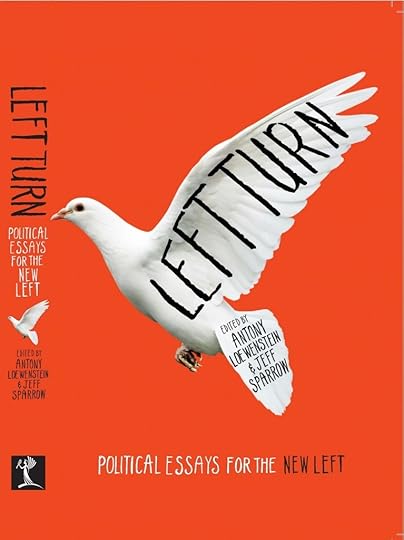
Antony Loewenstein and Jeff Sparrow, in the introduction to their new book Left Turn: Political Essays For The New Left, invite the reader to imagine current examples in popular culture that envision a future ‘in which the world to come is, in any respect whatsoever, an improvement on the present.’
‘Not so easy? What does that say about the cultural moment?’ they ask.
More prevalent, they note, are apocalyptic and post-apocalyptic fictions – anarchy, dystopia and a glut of zombie fiction, inspired by current anxieties about ruptures in the world around us:
We imagine the future by extrapolating the present…the endless, low-level wars…the pockets of already-existing environmental collapse; the media’s delight in summary executions and enhanced interrogations; and all the rest of what we see on the evening news…Capitalism’s accomplishments no longer seem distinguishable from its failings…it’s in this very present that we discern, however dimly, the shape of the future that scares us.
What is less obvious are the new ideas that will displace what the Slovenian philosopher Slavoj Žižek has called the ‘Fukuyamaist’ attitude that prevails across the political spectrum; that ‘free market’ capitalism and liberal democracy is the natural ‘final’ system, the flaws of which might be ameliorated through more equality and tolerance, the welfare state and the like.
Loewenstein and Sparrow rightly note that plenty of Australians are receptive to a ‘new Left’ project that breaks these strictures. Sixty-nine per cent of polled Australians supported the concerns of the brief Occupy Sydney and Melbourne protests. Campaigns for environmentalism, womens’ and queer rights, and other traditional Left causes, have become mainstream to an extent that many activists would not have thought possible.
But Left Turn is emphatically not a manifesto, Loewenstein told Crikey. It’s asking questions about the current order, but ‘what the answer should be, who the hell knows. That’s what’s to be discussed.’
In this spirit, the book lays out issues that might be of concern to a resurgent ‘new Left’. The compilation’s essays are too wide-ranging to deal with in any detail, but they encompass a range of both new and familiar Left issues. Racism, sexism and homophobia are addressed, alongside welcome discussions of the media’s cheerleading for the War on Terror, the Israeli Boycott, the Divestments and Sanctions movement, and the utopianism of Occupy Wall Street. Tracker editor Chris Graham’s contribution on Aboriginal violence is one of the stand-outs.
Whether many of the topics in Left Turn could be described as ‘new Left’, given that most are variations on old arguments from the 1970s, is another thing altogether. This is to say nothing against the importance of those movements, but we’re in the post-crisis 21st century. Where are our best Left-wing writers and thinkers on technology, international law, Wikileaks, high finance or bioethics – or even the mining boom, for that matter?
Greens Senator Lee Rhiannon, writing about the future of her party, is one notable exception. ‘The history of many parliamentary parties,’ Rhiannon writes, ‘is a stark reminder that progressive values and vision are often compromised or sidelined in the quest for votes, seats and power.’ Given the recent outrage over the Greens’ reluctance to buy into the asylum seeker politics of the major parties, such a discussion could hardly be more relevant both inside the party and among its supporters.
One obvious omission is a discussion of the decline of the ALP. That wasn’t an editorial decision, Loewenstein said, ‘[because] we don’t really think the ALP has any real chance of being a party who could harness a serious left vote on issues that matter,’ he said. While he doesn’t consider the Greens to be the ‘ipso facto answer’, Loewenstein thinks they’re in a position to harness both the disaffected Labor vote and those who have been excluded from the political process – new migrants, for example.
Members of the ALP’s Socialist Left might take umbrage with such a claim. For many in that branch of the party, Green politics has typically been viewed as a conservative, bourgeois concern that has little to offer workers. One could also argue, as do some of the sexier far-Left thinkers like Žižek, Alain Badiou and Jaques Ranciere, that environmentalism, as a symptom of our new ‘post-political’ world, has replaced religion as the increasingly legalistic and bureaucratic voice of prohibition. In this sense, Tad Tietze and Elizabeth Humphrys’ chapter on decoupling the climate debate from the market is a strong chapter, but one is also left wishing for a beefier Left critique of Australian green politics.
Many of Left Turn’s more polemical essays seem to lack an identifiable antagonist. If environmentalism, marriage equality, anti-racism and so on are becoming mainstream issues, with whom are we arguing? In fact, we’re already seeing many of the traditional ‘identity politics’ causes of the Left reorganised under a conservative or centrist rubric. The new Greens’ Senator Peter Whish-Wilson, who until becoming a Green had been a dyed-in-the-wool Howard conservative, may be the best example of how formerly incompatible positions may be reconciled in the one person.
One could argue, and many of Left Turn’s authors do, for matters of emphasis or position – ‘liberal choice’ feminism versus a more ‘collective’ feminism, to use Jacinda Woodhead’s excellent contribution on the state of contemporary feminism as an example. But it seems problematic to respond to the mainstreaming of much of the Left’s project as ‘a great success’ by bemoaning the public for getting the details wrong. If anything, Woodhead’s point that identity politics must be located inside a collective movement is all the more important by the ongoing conservative co-option.
What’s more, once activists for the current trendy causes win their gay marriages, increases to aid budgets and the like, will they bother to stick around without a deeper economic or structural politics? When our generation’s Patrick Stevedores arrives, how many members of GetUp! will be willing to go to gaol?
Loewenstein agrees with the proposition, conceding that ‘it’s not something many young people on the left do address’, but isn’t pessimistic. The Occupy protests have made economics sexy again, he says.
‘The central point of it was to question the economic reality in the US and Europe, that was the key question that engaged a lot of young people—the economic system doesn’t work.’
This is where the best essay of the collection, Crikey contributor Guy Rundle’s critique of Westfield mega-mall culture and casual employment, absolutely hits the mark. It’s the most prescriptive, and that’s a good thing. As G.K. Chesterton said, ‘definitions are very dreadful things: they do the two things that most men, especially comfortable men, cannot endure. They fight; and they fight fair.’ Rundle definitely fights fair:
“From the New Left, there exists a remnant puritanism around the act of consumption, a celebration of austerity. Among progressive forces there remains a focus on the systemic and managerial, rather than the possibilities for the transformation of everyday life.”
Rather than try and pull legal levers to regulate individuals’ behaviour, Rundle suggests ‘a program where the state is an enabler of real choice between genuine life alternatives… Since it is time and space that have been colonised by capital… it is at this nexus that a struggle must be waged’.
This would mean arguing for the extension of benefits to the expanding casual and part-time workforce, fighting the developer-local government nexus to ensure the building of houses affordable on a single full-time wage and breaking the stranglehold mortgages have over peoples’ lives – reducing precariousness, and ‘stabilising and guaranteeing security in what already exists.’
If precariousness and alienation are the killer issues today, as Rundle says, then the authors’ original zombie analogy only does half as much work as it could. While post-apocalyptic fiction certainly does mirror the current pessimism, it also contains its own conservative utopian ideal: rugged survivalism.
Once all the moralists, feminists and technocrats have been eaten by the living dead, the real men will rise again to claim the earth. Stoicism with occasional necessary violent outbursts will be the order of the day. Every decision is life and death – no time for democracy. Everyone imagines they’d be the survivor who leads the group, not zombie fodder.
But in America this post-apocalyptic situation is becoming real for many following the 2008 financial crisis. The individualist ideal has become further entrenched by the Tea Party and the rising popularity of American libertarianism. Corey Robin, author of The Reactionary Mind, calls the push ‘democratic feudalism’ – capital offering lower- and middle-management petty privileges over women, migrants and the underemployed in return for fealty, made possible by a lack of civil society and legislative push-back.
Similarly, the conservative tide in Australia is already coming back in. One suspects that the ALP, now beyond the pale and scheduled for termination, will be missed by even its critics before too long. Does the new Left have time to continue pondering models to replace the global order? Perhaps it is time for manifestos. After all, to quote Chesterton again, ‘modern broad-mindedness benefits the rich; and benefits nobody else.’
Antony Loewenstein and Jeff Sparrow’s edited collection, Left Turn: Political Essays for the New Left is available now through Melbourne University Publishing. RRP 27.99
– Adam Brereton is the Associate Editor of newmatilda.com. He tweets at @adambrereton