Anne Lyle's Blog, page 9
July 12, 2013
I&E follow-along: Characters
This week I’ve not been doing a lot of work on I&E, as the hot sticky weather doesn’t agree with me; it’s hard to sleep, which makes it hard to concentrate on work that needs my full attention. However I’ve made a start on HtTS Lesson 8 (if you’ve got the Ultra version – Lesson 7 in the original course), and have begun Module 1: Critical Characters.
My protagonist was easy; I already have a critical event that gives rise to his story motivation, so it wasn’t hard to fill in most of the questions about him, though I’m still prevaricating over the “three physical characteristics” section. The poor fellow has a very distinctive appearance that will make for a multitude of conflicts, so I hesitate to burden him with anything else!
The antagonist is giving me more problems—as per bloody usual! It’s not that I don’t have one; on the contrary, I have several candidates who “oppose” the hero in different ways. There’s the hero’s arch-nemesis, who in this book wants the same thing as the hero, albeit for different reasons; the arch-nemesis’s minion, who is therefore the person actively competing with the hero; plus the character whose aims both hero and villain are trying to thwart. Add in the fact that the hero is working against the villain in secret, so any actual “opposition” is somewhat one-sided, and you have one hot mess!
I guess I really need to develop both the first two characters and possibly the third as well. Whilst Holly cautions against doing too many characters at this stage, I’m trying to write a series here, so I think a little extra planning won’t hurt 


July 8, 2013
Guest post: Django Wexler on point-of-view
This week I’m very pleased to welcome Django Wexler, whose epic gunpowder fantasy featuring a military commander hero and a cross-dressing heroine sounds right up my readers’ street!

Reconnaissance: Point of View as a Precious Resource
First, the Universal Caveat—this is, of course, only the opinion of one reader/writer, so please take it for what it’s worth.
I read a lot of books, as you might expect. In fact, ever since getting involved with the writer/publisher/book reviewer blog-tweet-sphere-o-net, I have been deluged with more books than I can reasonably read. There’s a pile of about fifty on the end of my desk right now, shaming me and threatening to collapse and knock over my lamp.
As a result, I’ve had to get a bit more ruthless about abandoning books in the middle if I’m not actually enjoying them. I used to make a bit of a fetish about finishing books, out of a masochistic sense of duty, but the growth of the pile has made this impractical. My new rule is that each book gets a hundred pages to hook me. Recently, I found myself tossing several novels in a row, all for roughly the same reason—too many points of view. So I thought I would talk a bit about what that means.
Point of view (POV) is something every reader understands, at least intuitively. It can be in the first-person (“I went to the store.”) or the third-person omniscient (“Bob went to the store, unaware that a speeding taxi carrying his long-lost daughter was at that moment …”) but those are separate discussions, so let’s confine ourselves to the more common third-person limited. In this POV, I can write “Bob went to the store and bought some milk,” but I have to leave out the bit about his long-lost daughter because our POV character, Bob, is unaware of it. I am “in his head,” so to speak, and show the reader only things that he knows, observes, or could reasonably be aware of.
A novel with this kind of style can have multiple POV characters, usually separated by chapters or scene breaks. (Flipping from one character to another in mid-sentence, or even mid-paragraph, can be very disconcerting to the reader.) In my book The Thousand Names, for example, there are two perspectives, Marcus and Winter, who more or less alternate. (With some exceptions, see below!) It’s a standard, popular style, which as an author you can expect readers to be familiar with—Brandon Sanderson’s Mistborn is written this way, as is Joe Abercrombie’s The First Law trilogy.
The question, then, is how many POV characters you should have. At first glance it seems like the more, the merrier—after all, having more points of view gives you more ways to observe events, more perspectives on what’s happening, and the chance to spread yourself wider and write a more complex story. But there’s a countering tension, which I like to think of like this: POV time (that is, time or word-count spent in a particular POV) is a precious resource, which shouldn’t be needlessly squandered.
Why? Well, ideally, every scene in a novel accomplishes multiple goals simultaneously. Most scenes do something to drive the plot, but at the same time they serve to establish or deepen characters and relationships and help to establish reader sympathy. (For the characters who are supposed to be sympathetic, hopefully.) Being in a particular POV tends to be a good way to strengthen that character, to create reader sympathy for him or her, and to build relationships involving that character.
The book only has so many pages (and the reader only so much patience!) so the level of depth you can pack into a character is limited. Part of a writer’s skill involves squeezing the maximum effect out of every scene, but an easy way to handicap yourself is to spread that effort too widely. Think of the POV characters as balls you’re trying to keep in the air—the more of them there are, with all their attendant relationships and secondary characters, the harder the trick becomes.
The result of failure is that the characters feel thin. We don’t spend enough time with them to really understand them, or to establish sympathy for them, and so the plot of the book begins to feel irrelevant because the reader doesn’t care what happens. Alternately, if one character is clearly the “main” character, the other POVs may feel like annoying distractions. Another problem is that it may become difficult to differentiate between POVs, so that each has a distinct ‘voice,’ and all the characters can begin to sound alike.
How many POVs is too many is not a question that has a simple, numerical answer. In general, it feels like larger, more complex novels can support more POVs, while smaller and more tightly focused stories should have fewer. In many ways it is a matter of deciding what the primary story or stories of the book are going to be, and arranging the POVs to focus on that. If the book is about a relationship, having a POV on both sides can be helpful, and your POV characters may spend a lot of time together; if the story is about vast, sweeping events, they may never meet.
What is clear is that the decision to add another POV should never be taken lightly, because it imposes a cost in terms of the reader’s attention and sympathy. It’s worth considering (ideally at the outline stage) how many POVs you’re using, and if any of them could be eliminated. Multiple POVs who spend a lot of time in close proximity may be unnecessary—one of them might work better as a secondary character in the other’s perspective. Side stories, no matter how fun they are, are good candidates for the “kill your darlings” mantra unless they add more to the book than they take away.
In The Thousand Names, it took quite a few drafts to nail down how many POVs I wanted to use. The story is about a military campaign, and Marcus and Winter both take part, but they see it from opposite viewpoints. Marcus is a high-ranking officer, involved in planning and setting objectives, while Winter starts on the bottom and sees things progress from the point of view of the men in the ranks. A third major character, Colonel Janus bet Vhalnich, doesn’t get a POV at all. This is not because he isn’t important, but because as a character he worked better when seen from the outside—it allows him to retain an air of inscrutability that would be ruined if we had access to his thoughts.
One writer many of you are probably familiar with, George R. R. Martin, provides an interesting example of the ups and downs of POVs. (My personal opinion, of course!) The first book of his series, A Game of Thrones, is a masterpiece of POV economy. They all start out in one place (Winterfell) and we’re introduced to each POV via the previous one before they start spreading out to show us events taking place throughout the Seven Kingdoms. In the next two books, he adds POVs judiciously, and characters like Jaime Lannister are an excellent demonstration of the power of a well-placed POV to generate sympathy even for characters we previously despised.
However, as the scale of the books continued to spread (and as characters dropped like flies) new POVs kept being necessary. I found the fourth and fifth books a tougher read than the first three for this reason — we’re introduced to a dozen new POV characters, mostly people we’ve met only briefly, and the process of establishing sympathy has to begin again. (This is not remotely to imply I would know how to do a better job, of course. It was a tough spot!) If the series concludes, as planned, in book seven, I’m optimistic that the contracting scale will bring the POVs under control.
One common departure that deserves a look is the extremely brief POV, sometimes called a “mayfly POV.” These characters, often used for prologues, interludes, or other odd bits of story, come into focus only briefly and then disappear again. (Often, it seems, because they get killed!) They can be very useful for giving us a glimpse of a villain, or exposing part of the plot the main characters are unaware of. But they, above all, must be kept brief, since during these sections we’re getting plot and world detail, but not character information. Too much of that sort of thing and the readers will get distracted.
There are, of course, inevitable exceptions. Some writers are so skilled at what they do that they can handle far more POVs than would be possible for another author, and some books are structured in ways that don’t rely on generating sympathy for the characters, or are in some other sense unusual. Like any writing “rule,” this one is not hard and fast. But it is at least worth thinking about, when adding a new point of view, whether throwing another ball into the air really serves a purpose important enough to warrant the extra effort.
Curious about Janus, Marcus, and Winter? Check out the rest of Django Wexler’s blog tour for the inside scoop on The Thousand Names, Book One of The Shadow Campaigns!
Author Bio

Django Wexler graduated from Carnegie Mellon University in Pittsburgh with degrees in creative writing and computer science, and worked for the university in artificial intelligence research. Eventually he migrated to Microsoft in Seattle, where he now lives with two cats and a teetering mountain of books. When not planning Shadow Campaigns, he wrangles computers, paints tiny soldiers, and plays games of all sorts. Visit him online at djangowexler.com.
July 5, 2013
I&E follow-along: Stage 4
With my initial brainstorming period complete, I can finally start planning the books—hurrah!
Stage 4: Creating the framework
A lot of writers go straight from idea-generation into outlining their novel scene-by-scene, but I’ve discovered that this doesn’t really work for me. There’s a big difference conceptually between the narrative—the stuff you actually show the reader on the page—and the plot, i.e. the objective sequence of what happens in the world of the story. I like to know what my plot is before I decide which parts of it I want to show the reader (and through whose eyes).
However the biggest reason not to jump too early into scene cards is that unless you have a PoV character amongst the antagonist’s camp, you’re not going to have any scenes describing the antagonist’s covert actions—and that makes it very easy to underwrite the antagonist and particularly to fail to plot their story in a coherent way. This is something I really struggled with in Night’s Masque, where the PoV characters are all selected from amongst the good guys, and it’s a mistake I don’t intend to make twice.
Two major ideas I got out of the exploration stage were:
a small independent city-state on the edge of an empire that’s about to collapse, with a consequent breakdown of law and order
two separate protagonists who begin as strangers but in due course meet up and become allies against a common enemy (and go on to have further adventures together, assuming the first couple of books sell well!)
The first point gives me an external timeline; a framework of events that will happen regardless of my characters’ actions, because the fall of an empire is not normally within an individual’s control. The second gives me a narrative timeline predicated on a single fact: that the characters meet and become allies. Together that gives me an overall framework that I can eventually map individual books onto—but first I have to decide how these two timelines intersect, and work out some other major plot points that occur as a result of the conflicts I’ve brainstormed.
This is when I break out the serious technology! I like to use Scrivener, mainly because it has a free-form corkboard view that allows me to arrange events into multiple timelines and place them at arbitrary intervals, so I don’t have to determine dates or durations yet (of course you can use a physical pinboard and cards if you prefer). The only disadvantage is that you can only get so many index cards on the cork board before you have to start scrolling, so I prefer to use this method just for major plot points, not for the detailed outline. Although it all sounds rather logical and serious, this is actually a really fun stage of story development. I now have some idea of the story, and I can start filling in the main plot points and twists and focusing on the critical elements from Lesson 8 of HtTS.
That’s the plan, anyway! I suspect I’ll be on this stage for a while longer; my timetable for this project is to plan and outline it between now and late October, then begin the first draft for NaNoWriMo. I don’t want to start writing it any later than that, but on the other hand I may get impatient and start it sooner! I guess we’ll have to see…
July 2, 2013
Book review: The Painted Man, by Peter V Brett
Thus continues my summer of catching up on my reading, especially those (mostly epic) fantasies that came out a while ago…
*** Spoilers ahoy! ***

The Painted Man tells the stories of three exceptional young people—Arlen, Leesha and Rojer—growing up in a world where demons rise from the earth’s core every night and try to kill humans. The only things that can keep the demons back are wards: painted or carved symbols. Arlen has a talent for drawing wards and wants to become a Messenger (one of the couriers who defy the demons, travelling from town to town); Leesha is a skilled herbalist; and Rojer’s music has an Orpheus-like effect on the demons. Their stories run in parallel for most of the book until they meet up towards the end.
What drew me in with this book was the combination of voice and pacing. The opening is suitably tense and intriguing, and the voice strongly colloquial (albeit Brett is a bit too fond of his said-bookisms: characters don’t just say or ask; they explain, comment, confirm and use all those other unnecessary verbs to prop up their dialogue). However it was good to encounter a non-industrial civilisation that, despite its mentions of dukes and such, was not a third-hand impression of a European medieval world but in fact felt far more redolent of the American Frontier. Which brings me onto the worldbuilding…
There are some solid aspects to the worldbuilding, and others not so solid. The core premise (ha!) is a very strong one, permitting a straightforward conflict that’s pretty black-and-white in its morality. The demons exist only to kill humans, as far as one can see, and so killing them is morally unambiguous. Also, whilst the cultures we visit are misogynistic to some degree or other, unlike many such fantasy worlds it does at least make sense given the setting; the death rate is so high that motherhood is vital to the communities’ survival and women must be protected at all costs. Brett even manages to balance the sexism a little by having mothers highly revered in Thesa, to the point where one duke’s advisory council consists entirely of grannies!
On the other hand, we have the Krasians who, despite allegedly being based on a number of cultures, come across as way too closely modelled on Arabs/Muslims, and not in a good way. Also his trade networks feel more like video game mechanics than a realistically designed world. The mines of Miln (a single mine, it makes pretty clear) produce coal, metal and gems, and whilst I’m no geologist, this doesn’t sound entirely plausible to me. Meanwhile the aforementioned Krasians trade their silks and spices. From their city in the desert. Surely the limited amount of land encompassed by the warded walls is required for growing food, not luxuries such as mulberry trees? The Arabs of our medieval world were traders, but their spices came from India and further afield; there’s no indication that this is the case with Krasia.
These gripes aside, I was generally enjoying the book until fairly near the end, when for no good reason Leesha is gang-raped on her way back to her home village. In some ways it’s not very distressing, because Brett skips over the event itself and says little about it from Leesha’s PoV, though we get flashes of horrified memory from Rojer’s PoV (he’s now travelling with Leesha), and the rapists do at least get what’s coming to them eventually. However the event feels entirely gratuitous and unnecessary to the plot, because Leesha and Rojer are also robbed by the bandit-rapists and must try to survive a night outdoors without wards or weapons, but are saved from certain death at the last moment by the mysterious Painted Man. Worse still, barely a couple of days after the rape, Leesha comes on to the Painted Man (who is of course Arlen). WTF? I feel like Brett had done a workmanlike job up to this point, and then he throws it all away with a very tired cliché and a total lack of empathy with his female character.
For the most part this was a good, fast-paced read (it only took me about a week), let down by some carelessness and clunky prose. However I’m left in two minds about picking up the second one, since I know it features the Krasians rather heavily…
Bluffer’s tip: The Painted Man was actually the original title chosen by Brett, but his US publishers didn’t like it so they changed it to The Warded Man
June 28, 2013
I&E follow-along: Stage 3
So, I’ve done my preliminary musing (Stage 2), and now I’m ready to start planning the book, right? Wrong. I know that in Lesson 4 of How to Think Sideways, Holly jumps straight in with creating her Sentence (what is more generally known as a premise), but at this stage I still haven’t made any decisions as to what I’m writing about. I barely have characters, let alone a plot, so I need to do some more work before I can even think about nailing down the core conflict. In effect, I’m skipping ahead to Lesson 8: How to Develop Your Personal Writing Project System—which is appropriate, since I’m now in the position to know what works and doesn’t work for me.
I also have to confess that I don’t find mindmapping useful (heresy, I know!). It works well for the Sweet Spot Map where you’re just braindumping topics that hit your buttons, but for the story itself I need something more concrete. A line between two bubbles doesn’t tell me how those two things are causally related, or why I care about them. Nor does abstract thinking help me to develop my ideas—I need to write this stuff down, otherwise my Muse gets distracted (or maybe doesn’t think I’m taking her seriously). Hence my exploration takes the form of a long written discussion with myself, full of “what ifs” and “maybes”. All of this goes into my Project Journal and can run to many dozens of pages!
Stage 3: Exploring ideas
For me, conflicts grow out of the world that the characters find themselves in, rather than the setting being a mere backdrop. Also, because I’m planning on writing epic secondary-world fantasy, an interesting—no, awesome—world is obligatory. For these two reasons I began my exploratory process with worldbuilding.
Worldbuilding is a huge topic in itself, which is why I intend to blog about it separately from this follow-along (probably later this summer). However, as Holly makes clear in HtTS, you don’t want to do a shedload up front, because a) it puts off the writing of the story, which is the bit that you get paid for, and b) you probably won’t use most of it anyway. Instead you have to focus on the crucial details that will drive conflict.
Now, different writers are turned on by different aspects of worldbuilding. For Brandon Sanderson, it’s clearly magic systems; for me, it’s culture. Clashes between cultures are a rich source of conflict, and writing in an invented world means you can change the parameters to create cultures that aren’t found in our world. One of the reasons I wanted to switch from writing purely historical fantasy was that I was burned out on the sexism, racism and homophobia of Europe’s past. In particular, I was bored with having to write women whose lives were constrained by their legal and cultural status as second-class citizens. Yes, you can have strong female characters regardless of culture, but I wanted to write about a place where women could follow pretty much any choice of career (without having to disguise themselves as men!). I still want to write male protagonists as well, but I’d like to have more options when casting characters in diverse roles.
In tandem with exploring ideas about culture, I worked on the island city-state that I’ve mentioned in previous weeks as the focus of the setting. I looked at concepts for cities that I’d come across in fantasy fiction I enjoy, such as the world of Scott Lynch’s Gentleman Bastards series, where cities are built around the cyclopean ruins of an ancient alien civilisation, and thought about how I could make mine different. Why was this city originally founded? Who founded it? How has it developed over the centuries?
Once I had decided on the city’s origins—it was founded by a group of exiles expelled from the empire, hence the remote location—I started looking at how I could tie this into the character concepts I’d come up with. I knew I wanted to write a roguish maverick hero, so what is the establishment he’s defying? That’s where I’ll find my antagonist and conflict, and probably my theme as well.
Finally, if I’m ever going to get beyond refering to characters as ”the best buddy” or “Bad Guy A’s chief minion”, I need to work out a naming scheme for my imaginary world’s nations. I’m going for a quasi-European feel for much of the Empire, so I spent a while looking at different cultures’ names, both present day and historical. There will be characters from far-flung provinces as well—as with the Romans, my empire likes to move its officials around a lot to break up nationalistic loyalties—but they won’t be in the majority, so I can worldbuild those nations as and when I need them. (As an aside: I enjoy reading books set in other cultures, but Europe is what I know well and find easy to write about. Yes, it’s a comfort zone; bite me!)
Now I can finally start trying out different iterations of The Sentence, varying the details of the conflict and twist to sharpen it into something compelling. I’m still coming to terms with the idea that your initial premise is very much a work-in-progress; my impatient side wants to pin it down so I can get on with planning the book, but I know I’m not ready for that yet. A single conflict is too thin for an epic fantasy, so I need to add layers and subplots, and those in turn may shift the emphasis of the main plot or character arc.
As a result, this is the stage where I keep bouncing back and forth between HtTS Lessons 4, 5 & 8* and also referring to the other resources I mentioned in previous posts, debating with myself how the characters I have so far might interrelate and contribute to the plot and theme. The important thing is that I keep digging and don’t just accept the first idea that pops into my head; I’m constantly on the lookout for clichés, stereotypes and other lazy thinking. I also keep referring back to my original bullet-point list, to ensure that the project is staying on track.
Eventually it all begins to gel and I’m ready to move on to the next stage: planning!
* I’m deliberately missing out 6 & 7 because whilst they’re a valuable part of the course, they’re not relevant to my present situation—I’m happy with my current genre and have no interest in self-publishing this series.
June 25, 2013
Book Review: The Spirit Eater, by Rachel Aaron
This time last year I read and reviewed The Spirit Thief, the first Eli Monpress novel from Rachel Aaron. For some reason I didn’t review book two, The Spirit Rebellion, but I enjoyed both enough to continue with the series. In fact I picked up book three, The Spirit Eater, when I was having trouble getting into any of the new books I’d picked up—I thought perhaps it would be easier to slip into a story where I already knew the characters. Thankfully I was right, and Aaron’s book broke my reading dry spell!
 Omnibus edition of the first three Eli Monpress novels
The Spirit Eater opens in the immediate aftermath of the climax of The Spirit Rebellion. When Slorn, the bear-headed maker of Nico’s protective magical coat, goes missing, Eli is determined to find him—but instead finds himself caught between the ambitions of Izo the Bandit King and a renegade member of the League of Storms, an organisation dedicated to wiping out all demonseed.
For all that, however, Eli is a somewhat peripheral character in this book. Nico is one of the main PoVs, and it is her struggle against the demonseed inside her that provides the quiet inner conflict that drives the story. At the same time there’s no shortage of action, particularly at the climax of the book, which is worthy of a summer blockbuster!
This is definitely where the series starts to get darker; characters die (or come very close to death), and we learn just how coldly self-centred Eli’s patroness Benehime is. It also gives us a glimpse of the high-level magical politics of the world, and promises more revelations to come. All in all a very solid instalment in this entertaining series—I put books four and five on my TBR list immediately after finishing it!
June 21, 2013
I&E follow-along: Stage 2
Last week I kicked off this series of posts by talking about the preliminary planning I did for my new series (working title Island & Empire); today I’m going to expand on that.
(Note: these first few posts are past tense – this stuff’s all done, but I wanted to document the process from the beginning, which was way back last year.)
Stage 2: Gathering ideas
In Lesson 3 of How to Think Sideways, Holly talks about generating ideas on a deadline—priming your Muse (your unconscious mind) to offer up ideas on demand. This is a great technique to know, because for short stories in particular you may come across an opportunity in a very specific market and need an idea for it at short notice. For novels, however, I prefer to use a twist on this technique.
The thing about writing novels is that it takes a long, long time from the initial idea to having a final draft ready to send to an editor (or to submit to agents, depending what stage you’re at in your career). In particular, if at all possible you need to take a break between the initial completed draft and your pre-submission revisions, and that’s a great time to be working on your next project. So, this is where I take the parameters I set in Stage 1 and start mulling over how I’m going to put them into practice. In other words: initial ideas for character, setting and plot.
I began doing this way back in April 2012, whilst I was waiting for editorial feedback on The Merchant of Dreams, the middle book in my Elizabethan trilogy. I had already decided to write a new series set in a completely different world, and I based my initial prompts for my Muse on what I had enjoyed and disliked about writing the trilogy.
Positive: urban-based, action + intrigue
Negative: travel!
I knew I wanted to write something a bit more epic in scope, but continent-spanning treks (and sea voyages) were right out, and I’m also not interested in writing about war as the primary conflict. At first this didn’t seem to leave much “epicness”, because those two tropes are such staples of the genre. So I thought back to my non-fiction reading over the years and decided I might be able to do something that revolved around a trading city caught between much larger powers, a bit like Venice—hence the working title Island & Empire. If I don’t want my characters to travel the world, I need to bring the world to my characters!
Over the next year (and particularly between drafts) I jotted down ideas as they came to me: various reasons why this city might be remarkable enough to fit into the epic fantasy genre, as well as ideas for characters (I had one from an unsold short story that I particularly wanted to find a new home for). I didn’t commit to any of them at this stage; I discovered during my first run-through of HtTS that I’m very capable of coming up with ideas that seem good at the time, even exciting, but then when I extrapolate them they don’t lead in a direction that interests me. All I wanted to achieve was a foundation of raw materials to work with, so that when I was ready to start the project in earnest I wouldn’t be staring at a blank notebook page.
In between noting new ideas, I read through my worldbuilding notes for a project that I’d worked on for a bit between early drafts of The Alchemist of Souls, as well as much older projects that had stalled through lack of perseverance. Again I didn’t make any decisions on what or how much to use, just let the information brew in the back of my mind to see if it prompted any additional thoughts.
Thus by the time May 2013 came around and the last book in my trilogy was revised and handed over for copyediting, I was ready to move on to the next stage: working out which of these ideas I want to take forward. More about that next week!
June 18, 2013
BFS award nomination, oh my!
I had a number of possible topics lined up for today’s post, but when I got home from work last night I found this all over Twitter:
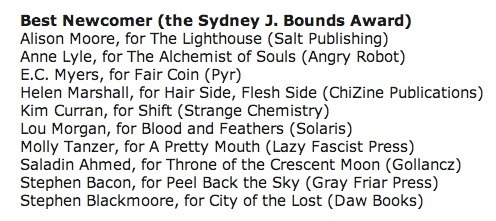
That’s a screenshot from the British Fantasy Society website, where I’ve been nominated in their 2013 awards
Needless to say, I’m gobsmacked and delighted—and just a little amused, since I accepted this award last year on behalf of fellow debutante Kameron Hurley, who couldn’t make it over to the UK. Ironically she’ll be at this year’s World Fantasy Convention in Brighton, where the BFS awards ceremony will take place, so it’ll be really weird if I win! Given the stiff competition, though, I’m not going to be putting any money on it…
#SFWApro
June 14, 2013
New fantasy series: follow-along
I recently went back to the forums of Holly Lisle’s online Novel Writing School, where I was somewhat abashed to discover I’m somewhat of a poster girl for the courses (well, I did get a three-book deal out of the manuscript I put through How to Revise Your Novel!). When I mentioned I was using the How to Think Sideways writing course materials to help me with the new series I was planning, one of the moderators thought that students would find it interesting to hear what I was doing. However I don’t just use Holly’s materials, and I thought it might be confusing to students on the course if I talked about my own methods on the official forum. So, if you’re here via a link from the HtTS forums (and even if you’re not), welcome!
Starting today and for the next few months, I’m going to be blogging every Friday with an update on my series’ progression. I’m not going to go into detail about the plot, characters, etc because I want to keep those under wraps until they’re ready to share with the world, but I’ll be talking about my process and the resources I’ve been drawing on over the past few weeks to kick this project into lumbering but relentless motion.
I don’t have an official series title yet, so I’m just going to refer to it as “Island and Empire” (I&E for short), because the setting is one thing I do have nailed down: an island city-state on the edge of an empire. The first book does have a working title, Eye of the Sun, the significance of which will have to remain a mystery for now since it’s central to the story. Sorry!
Stage 1
This is the stage that Rachel Aaron calls “Step 0″ in her essay “How I Plot a Novel in 5 Easy Steps“. Because before you can write a book, you need to decide what it is you want to write and make sure it excites you enough to power you through the slog of writing a novel (or harder still, an entire series).

I like to use a mixture of technologies – iPad and keyboard, but also old-fashioned pen and paper
I’m not one of those writers who has a flash of inspiration that sparks a story. No vivid mental images for me, no epiphanies, no roads to Damascus. Nope, for me it’s more like being an archaelogist—I dig around in my brain for ideas and then piece together the fragments into something that makes a coherent narrative. Also, I’m quite a left-brained person, so most of my development work is in the form of written notes, whether neat bullet points or page after page of stream-of-consciousness debate with myself. Thus, every project begins with a notebook—my Project Journal—where I explore ideas before I even begin to plan the actual book.
I start with the big picture: what genre do I want to write, and more specifically, what kind of book within that genre? Upbeat or gritty? Action, romance, mystery? What’s my market: fans of writer X, readers who are looking for Y? I throw in a list of elements that excite me about writing this kind of book—the tropes that are core to the atmosphere I want to evoke. For those of you doing HtTS, you’ll recognise this as drawing on Lesson 2: How to Discover Your Writing “Sweet Spot”.
Because I write fantasy and because series still sell well in fantasy (and good fantasy worldbuilding is a commitment of effort that practically demands multiple books), I’ve also been drawing on Lesson 1 of Holly’s How to Write a Series class. This is definitely going to be Big World (empire, remember!) with Consequential Time, probably a Bulletproof (Core) Cast because I don’t want it to get too grim—but I’m not certain at this stage whether it’ll be a Linked Sequential Series or some kind of Standalone series, because that depends on the plot(s) I come up with.
In addition to Holly’s classes I’ve also been reading Million Dollar Outlines by David Farland. I make no bones about the fact that I want to write books that sell well (without selling out!), so I used Farland’s exercises to analyse what’s successful in my genre, what those books have in common and see if I could blend some of those elements into my own work—and build on the ones I’m already intending to use—to hit a wider audience. Naturally I cherry-picked the ones that appeal to me and omitted the ones that bore me; you have to write what you love, first and foremost, even when you have a market in mind.
Having worked through all of the above, I’ve boiled it down to a handful of bullet points that define what I’m aiming for with this project. Since they’re too generic to constitute spoilers I’ll list them here, exactly as written in my Project Journal:
Secondary world epic(ish) fantasy
Multiple PoV
At least one young male protagonist with whom the core audience can identify*
Awesome world
Action
Humour
Camaraderie
Badassery!
(* I shall no doubt have multiple protagonists of various sexes and orientations, but truth is, I love writing dudes so this is pretty much a given anyway!)
With Stage 1 complete, I can move onto specifics—but you’ll have to wait until next week for that!
June 10, 2013
Mal Catlyn’s last stand
 As has become traditional, over the next few months Mal will be tweeting a “prequel” to his upcoming adventures in The Prince of Lies. Previous tweets ran in real time, connecting us with events 420 years ago, but owing to an unexplained phenomenon that Mal is in the process of investigating, there’s some kind of wibbly-wobbly timey-wimey thing going on that means his latest batch of tweets are arriving some months out of sync with our timeline. For clarity, the date at Mal’s end will be appended to all tweets.

Please feel free to tweet back to him with your questions, but bear in mind that for reasons of national security he may not be able to answer frankly or in full. Also, please be aware that Mal is being followed by @SirRobertCecil, the queen’s new secretary of state and alleged spymaster, and that any potentially seditious tweets may result in a closer acquaintance with the Tower of London. (Do not be fooled by any “page not found” messages when looking for Cecil’s Twitter account – you think a man with his influence can’t hide his activities from public view?)
Mal’s Diary
Want to read the original “Mal’s Diary” tweets, the prequel to The Alchemist of Souls, all in one convenient free download? I’ve compiled an ebook version of the feed for your reading pleasure: