Casey Calouette's Blog, page 3
October 13, 2015
Flashpoint Campaigns : A Time To Dance AAR
The HIND helicopter is a demon spawn from hell. This missile spewing, armor coated, AA immune, bastard has rained more destruction down onto my M1A1 Abrams than any other device. Was it really this tough? I guess, I mean Rambo had to drive a T-72 into one to kill it, right?
Flashpoint Campaigns is a WW3 simulator in the same vein as Command Ops. You give orders and trust that your subordinates can follow them. This will vary based on stress, electronic warfare, whether they’re under attack or not, if someone fired a nuclear weapon…
So what’s it really mean? You get to slam your fist onto your desktop and watch as your units get slaughtered and you can’t give them any orders for fifteen more minutes. It’s aggravating, realistic, and keeps drawing me back in.
The scenario I’m playing has a Soviet armored force crossing into West Germany. To model the un-preparedness of the US Army, my units trickle in. And I mean trickle.
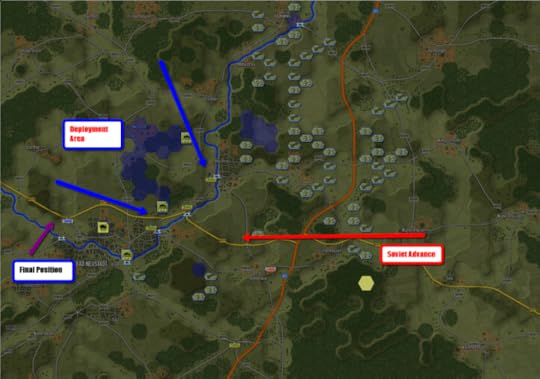
So far I’ve failed at this mission. Badly. So I spoke with a few internet friends and they helped me out. It seems I only have to defend my objectives and not try to take the Soviet ones. Welp.
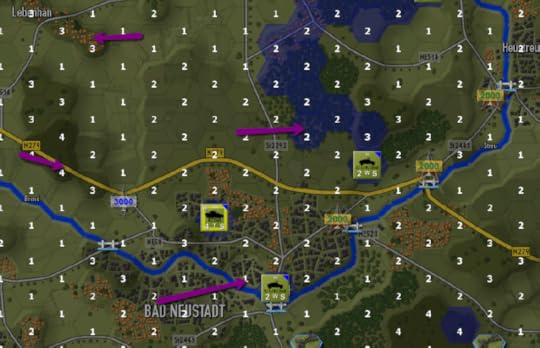
This is the initial plan. I can’t hold the bridges. Just can’t do it. They seem like the perfect chokepoint but my units can’t arrive in time. Then we risk piss-poor placement and get hammered by that nasty airstrike.
The goal is to hold the purple spots, and use the long range of our M1 Abrams to strike at a distance. Force preservation is the key while bleeding the Soviet units red. Holding Bad Neustadt is going to be tough. The Soviets are going to bum rush that spot, and crossing from my arrival zone and getting into the city has been really difficult. I might have to try going around that big plateau. (The 2’s North of the city).
For right now I’ve got some humvees and a pack of M4 Bradley’s. I need to be careful with the Bradley’s, as they are me.

This is worth explaining. You see the time, the date, and a START button. I’m in my orders phase, I can tell my units what to do and they will try to obey.
Beneath this you see 32 minutes to American orders. So once I hit START, I can’t give any more orders for 32 game minutes. In elapsed time it’ll be a couple of real minutes. In that time the sun will rise, units will be spotted, and hopefully we can get some reinforcements.
For this run we’ll do one cycle of the clock and see what happens.
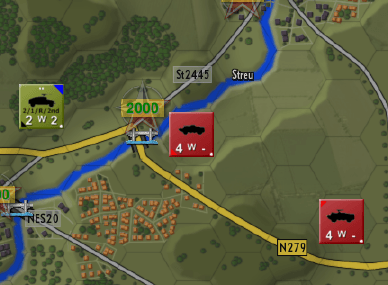
0413 : First thing we see is some BRDM scout vehicles. Our Humvee section immediately falls back as they have screen orders. Nor can they tangle with these guys. 19 more minutes until I can give orders. Dawn is here, visibility, 2,500 meters.
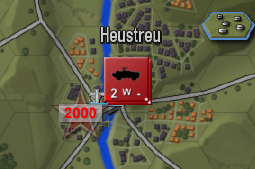
0430 : Another pack of BDRMs comes to the crossing at Heustreu. This is going to make it tough. Do I try to cover that approach? I almost have to, otherwise they could roll T-80s up my flank.
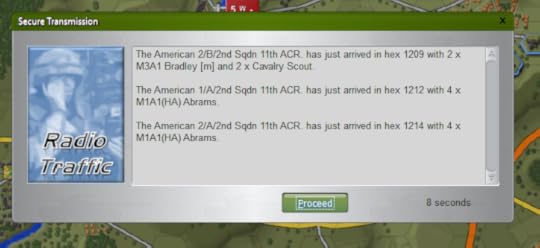
0430 : Tanks! And some Cavalry Scouts too. I’m going to cover one approach due west of Heustreu with one platoon of Abrams, and send the other into Bad Neustadt with the support of the Bradleys.
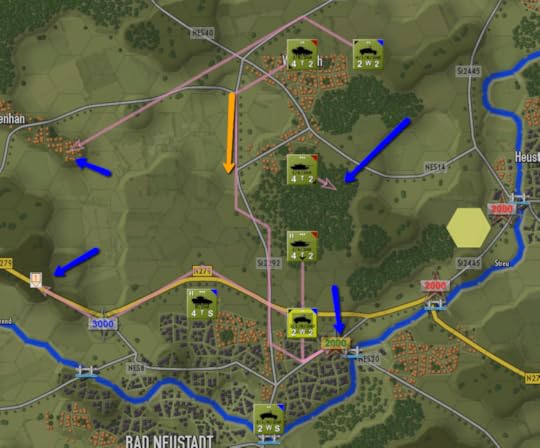
0432 : Here’s where we’re going. I’m moving 1/A/2nd over to the treeline to cover the approach from Heustreu. 2/A/2nd is heading over to Bad Neustadt along with 2/B/2nd M4’s. I’ve attached those cav scouts to the Abrams as well. I’m pulling my humvee sections out of the front and moving them out to scout on some potential positions to defend from.
We’ll continue this next time!
The post Flashpoint Campaigns : A Time To Dance AAR appeared first on Casey Calouette.


October 2, 2015
The Next Novel
This is the starting line of the Marquette Trail 50. A 50 mile trail run through the Huron Mountains. I’m a volunteer and deliver water and ice to the aid stations.
Writing a novel is a marathon. It takes preparation before you even start, practice, tapering, planning, and then you start to run (write). Go too fast, or stray from the course and you might not finish. Too fast and you might finish, but then the next race will be shot. It’s balance.
I’m still trying to strike that balance of words, pace, and plot. But I think I’m pretty close.
Hard Nova will be complete in under a week. I’m forcing myself to not exceed 2,000 to 3,000 words a day. It seems to be a nice spot where I don’t get burnt out and can still add fun little details. I have enough time to complete a chapter, think on it, and have time to prepare for the next. I still work from an outline, but things always change, it keeps the story lively.
I like that pace because it only takes a month or two to finish a novel. In a perfect world I’d be done in 30 days.
I’ve already started brainstorming on the next novel. This is an idea I’ve been mulling over for awhile. It’s not Colonel Clarke, or Captain Grace, instead it’ll be another stand alone. I won’t get into any details yet, mainly because I’m still adding the details, but it’ll be a space fleet story. I might, might, switch to first person. We’ll see how it feels.
If I can maintain pace this one should be done about December. Getting out two novels for this year yet would be amazing.
There’s one story I’ve started on twice and stopped on both occasions called Wright and Rong. The premise proves to be fun, but I’ve had a hard time striking the right balance in the story. I’d really like to return to it. I think you guys would love it. Take a drunk starship captain, his archaeologist ex-son-in-law, what’s left of a once crack mercenary crew, and send them out on a routine delivery mission that proves to be so much more. Intrigue, a threat of war, and a cargo pod that happens to contain the Emperor’s Clone… or is it a clone?
Any way we look at it, some good stuff coming soon.
The post The Next Novel appeared first on Casey Calouette.
September 21, 2015
48 of the Best Military Science Fiction Books Ever
The key element is the theme of military service. This could be for honor, for money, for glory, or just to save their own skin. But by the end of these books you’re guaranteed a great read, some awesome battles, and a fantastic way to spend the evening.
This list is not organized by popularity, rank, or even alphabetical. See something I missed? Leave a comment, I’d love to add more to my reading list.
Terms of Enlistment – Markos Kloos
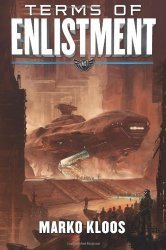

Terms of Enlistment follows a young man who enlists in order to escape the poverty on Earth. Marko does a great job painting a world that isn’t cut from the same cloth as most, but could be a more realistic version of our own. Humanity isn’t united. Everything isn’t rosy. And of course, wars are to be fought.
Leviathan Wakes – James SA Corey
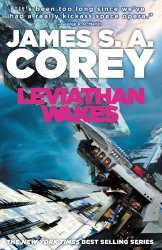

One part police procedural, one part alien invasion, one part fleet battle. The solar system has been colonized and then something was discovered. Nefarious forces that be release an alien supervirus into the population. Eventually the story wraps up a police detective on Ceres, an ice freighter crew, and a few nasty corporations and militaries.
Dauntless – Jack Campbell
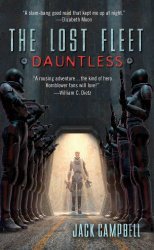

So the wars not going so hot, and you happen to stumble upon a 100 year old escape capsule that contains the legendary John “Black Jack” Geary. Problem solved right? Let him lead the navy, sucker punch the bad guys, and storm home! Not quite… Geary has to resurrect a destroyed and demoralized navy all while coming to grips with his own life.
The Warrior’s Apprentice – Lois McMcaster Bujold
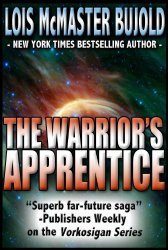

Toss an angsty teenager with too much money and time into an interstellar conflict. Then mix in a unique culture that he doesn’t fit into. You see Miles is as fragile as glass and can’t fight like your regular teenager. So instead he’s forced to use his mind, his will, and his charisma.
Empire of Man – David Weber and John Ringo
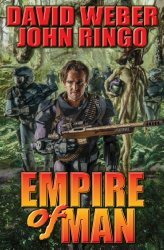

Remember when Metallica and Megadeth went on concert for like, 3 shows? John Ringo and David Drake is basically that in the military science fiction world. Both of these guys are big names. The story is about a fairly worthless young royal who makes his way across a hostile planet (with a bunch of Imperial Marines) and comes into his own. To top it all off, when he finally does escape, things get really interesting.
Swarm – BV Larson
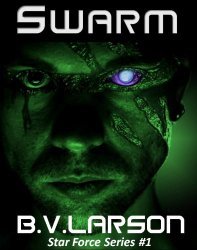

So you had a bad day? Picked up by a starship, tested by aliens, the weak ones are murdered, and then to make matters worse… You pass all the tests. Well bummer, because the aliens see Earth as a two bit shithole and they’re taking over. If you like getting wrapped up in a massive storyline, check it out.
Poor Man’s Fight – Elliott Kay
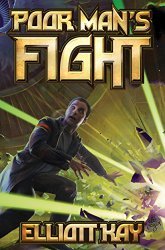

And you thought your student loans were bad. Tanner graduates from his corporate “sponsored” education with a pile of debt and not much for prospects. So what better thing to do than enlist. What can go wrong right?
Gaunts Ghosts : The Founding – Dan Abnett
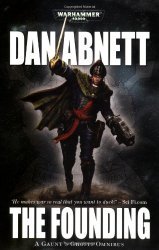

Warhammer books get a bad rap. Some of them are bad. Really bad. Dan Abnett does a fantastic job laying out a great story while also bringing the 40k universe to life. First they lose their planet, then they get Gaunt, a man most of them hate, and finally they have to fight, virtually forever. Well worth the read. (Note-There is no Kindle version, this link is to the paperback)
Forever War – Joe Haldeman
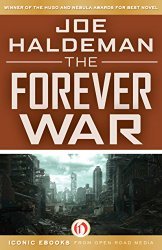

A bunch of elite recruits, the best humanity has, sets off to fight the first interstellar war. William Mandela returns to elderly parents and a world that is fundamentally different. Then he sets out again to the only thing he knows and understands. War. Watch humanity change through the eons as William remains the same.
Old Mans War – John Scalzi
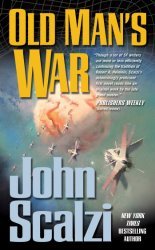

One of the best on this entire list. John Perry, a geriatric with a contract, enlists in the Colonial Defense Force when he turns 65. Only then do they learn the truth about the real universe. Add in genetic manipulation, a set of cats eyes, alien genes, and a whole universe waiting to brawl.
Armor – John Steakley
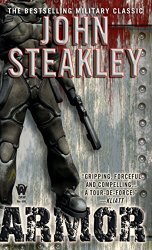

Felix.
You’ll feel his pain as he fights in a war with no point and no end. He suffers. Fights. Suffers more. Loses everything. And only then do you realize the scope of the story.
A book that deserved to be a series, but sadly John passed away in 2010
Starship Troopers – Robert Heinlein
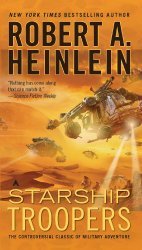

Both an amazing story and an interesting critique on politics. I know some of you are frothing at the mouth about why this isn’t #1. The story is great, the politics are dated. You can read it today and remember that when it was written WW2 was a brief memory away and the cold war was in full swing. While the politics aren’t timeless, the story is. Check it out.
Ender’s Game – Orson Scott Card


This is an example of an amazing story turned into a mediocre movie. Ignore the movie. If you’ve watched it, wipe it from your mind. You follow Ender as he struggles to understand that he is the ultimate commander that will destroy an entire race. All the while he’s still just an 8 year old boy.
Frontiers Saga – Ryk Brown
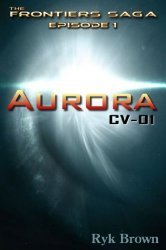

The first novel is a 14 book series. A biodigital virus wipes out 90% of humanity. Those that are left have to rebuild and eventually reach out to the stars. Then our protagonists suddenly find themselves in command of the Aurora, the first FTL ship in a very long time.
A Hymn Before Battle – John Ringo
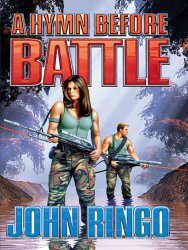

Don’t judge this one by the cover. Nothing like a laser beam pointing right back at your underarmored torso to keep the day interesting. The story really is great as mankind is thrust in a war with the Posleen. The mysterious Galactics come and provide information and technology and, of course, guess who does the fighting?
On Basilisk Station – David Weber
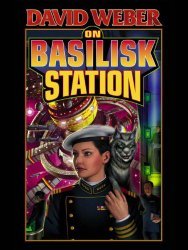

Honor Harrington makes her debut in On Basilisk Station. First in the Honorverse, a massive storyline. We follow Honor as she gets her first command, the Fearless, and manages to get stuck into a galactic backwater. Then she’s promptly caught between a bunch of conniving politicians and the real enemy.
Hammers Slammers – David Drake
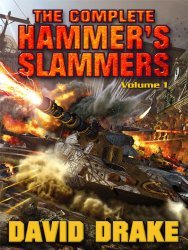

Mercenary tanks? Sign me up! We follow Colonel Alois Hammer as he forms up the Slammers and takes them on a few adventures. All of this wraps into the Hammerverse, where these hover craft tank driving mercs make their mark.
In Fury Born – David Weber
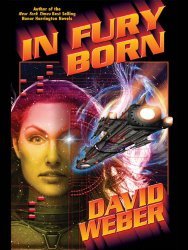

This is David Weber’s other female protagonist. Alicia DeVries is a genius, world class athlete and soon to be marine. Eventually she’s promoted to the cadre where service is forever and the outlook isn’t good. Then she goes insane, or so everyone thinks, and then the story gets good.
Live Free or Die – John Ringo
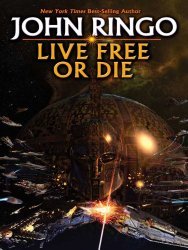

Ignore the politics and you’ve got a good story. The set up is a stargate suddenly appears and eventually Earth is enslaved. Then comes the maple syrup… which leads to freedom. It’s a fun read with a libertarian tilt to it.
All You Need is Kill – Hiroshi Sakurazaka
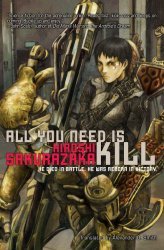

Groundhog day with guns. The original manga (Japanese comic book) was the inspiration for the Tom Cruise film Edge of Tomorrow. Keiji is forced to live, fight, die, and do it all over again until he gets it right. An interesting departure from the normal US centered combat view.
Slaughterhouse Five – Kurt Vonnegut

Now for something completely different. A classic that is almost indescribable. If you’ve never read any of Vonnegut you’re in for a real surprise. Non-linear, quirky, completely original. There’s nothing like it, nor will their be anything like it ever again.
Battle Cruiser – BV Larson
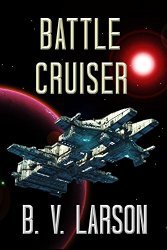

Earth is cut off from her colonies for an entire century. Then, instead of being the liberators and saviors, they discover the universe has changed. The lost colonies not only survived, but they flourished and it’s not off to a good start. Another great book from BV Larson.
The Forge of God – Greg Bear


So we got bad news. In this story Earth doesn’t make it, though the species does manage to survive. In this tale you get to watch that whole debacle unfold. A different take on the mil scifi and a refreshing read.
Mote in Gods Eye – Jerry Pournelle and Larry Niven


The moties are coming! After a nasty civil war space is finally coming together and then an alien arrives. Alone. A single fleet heads out to the alien planet. Everything looks amazing, until they discover that the aliens have one rather nasty little secret that even they can’t control.
Death’s Head – David Gunn
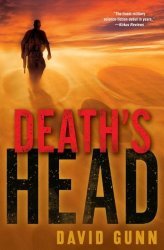

Sven is a bad ass. Sentenced to die, he’s instead drafted and turned into an enforcer for an evil empire. Except Sven isn’t all that good of a guy, in fact he’s an ideal assassin. Eventually he’s caught up in a disaster and chooses to strike back at those who framed him.
Use of Weapons – Iain Banks
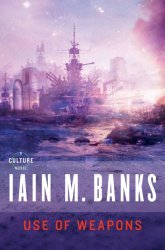

Actually the third novel in the Culture series, but widely considered the best. In a universe where you have everything, what purpose is left? Simply to enforce your ideals on lesser races and eventually give them everything, regardless of the price to do so.
The Traitor Baru Cormorant – Seth Dickinson
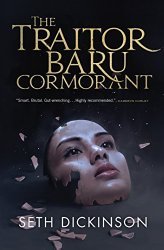

Seth Dickinson was one of the writers for the video game Destiny and penned some of the best fluff in the entire game. This is a dark book with a dark end. The writing and plot are both exceptional, you’ll get dragged into the story and it’s unlike any other.
Legion of the Damned – William Dietz
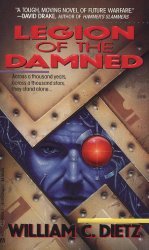

The first in a recently completed 11 book series. We get to follow the missions of the Legion, humans interred in cybernetic bodies, as they fight against the militaristic Hudathan empire.
Dune – Frank Hebert


Man is addicted to spice. He who controls the spice, controls the universe. A sweeping saga of nobility, betrayal, redemption, and in the end, madness. The opening scene to a jihad that makes the entire universe burn.
Startide Rising – David Brin
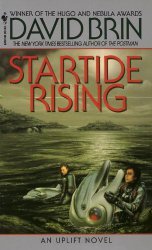

The second book of the Uplift Series won both the Hugo, and Nebula, awards. A starship filled with sentient dolphins, humans, and a sentient chimpanzee discover an ancient fleet of 50,000 starships. Then, of course, everyone wants to know where that treasure heap is! Throw in some racial tensions, a bit of betrayal, and a rich backstory and you’ve got one hell of a novel.
Semper Mars – Ian Douglas
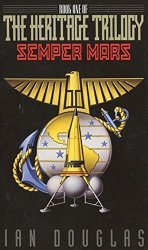

In the not so distant future the UN and US go to war, and part of the battles are fought in space and on Mars. The Marines stationed on Mars perform an epic march and assault the UN base using, of all things, smuggled beer. This is the first in a long series of Ian’s space marine stories.
The Long Watch – Robert Heinlein


This is the shortest story in the entire list, but one that still gives me goosebumps. It’s a story of duty, and the real price that comes from truly performing it. Sometimes you must sacrifice it all to save everything.
Empire Corps – Chris Nuttall
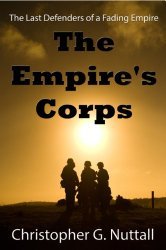

The Empire is falling. Not a particular good time to be honest about the outlook, especially to your boss. Well, that’s exactly what happens and Captain Stalker and his Marines get sent to a cozy post in the middle of nowhere. And that’s where the excitement begins. Because hey, what can go wrong? It’s just the end of the Empire right? This is the first in an 11 book series.
Ark Royal – Chris Nuttall
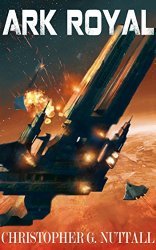

The aliens finally arrive, and they mean business. One problem, all you have left to defend Earth is an old starship and a drunk to command it. It doesn’t break any ground into philosophy or politics, this book is about action and a fast paced story.
Lost Starship – Vaughn Heppner
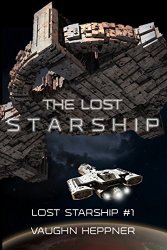

Humanity is about to fall and be replaced by the New Men. Captain Maddox of the Star Watch sets out with a ragtag crew in hopes of chasing a legend. Somewhere, there might be an ancient alien ship that could save mankind. But first he has to find it.
To Honor You Call Us – H Paul Honsinger
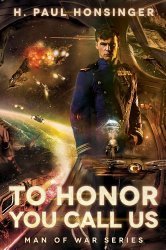

A Hornblower in space sort of tale with believable tactics and characters. If you’re a fan of O’Brians Master and Commander series or the tales of CS Forester you’ll like this. Max Robichaux is handed command of a stealth cruiser and sent out to raid, only then does he discover that his ship is the only thing saving humanity from total defeat.
Warship – Joshua Dalzelle
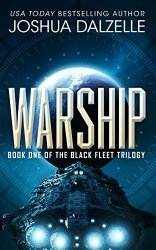

Jackson Wolfe has command of an amazing starship, except it’s out of date and part of a navy that’s falling apart. No one sees the need and it’s the last thing that could hold humanity together. Except no one sees the point. That is until the aliens show up.
Starship Eternal – M.R. Forbes
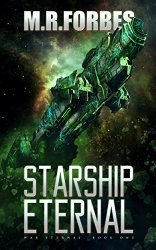

Captain Williams is a hero of the space marines, the kind of guy everyone wants for a commander. Dashing, brave, smart. Then he’s shot by an assassin and critically wounded. To top it off the hallucinations start, except they might be real and warning him of a terrible threat.
The Atlantis Ship – A.C. Hadfield
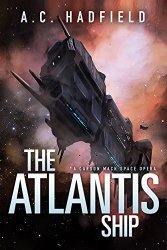

Yes, we have another lost ship novel. But hey, what can I say, they are fun stories. Carson Mach is on the path of the Atlantis ship, a legendary ghost ship. Then it shows up and obliterates an entire space station. Now his mission is even more critical, because if he can’t stop it that ship might just be the end of all humanity.
Constitution – Nick Webb


Constitution won’t break any ground or explore intimate alien cultures. But it will give you a great story with a truly kick ass crew. Mankind got his ass kicked, recovered, thought he was ready, and like that boxer who comes back… he gets his ass kicked again. But in this case the USS Constitution is the last boxer standing, and it’s not going down without a fight.
Steel Breach – Casey Calouette
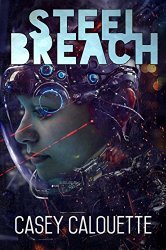

Mix the Dirty Dozen with Kelly’s Heroes, toss them into All Quiet on the Western Front, and you’ve got Steel Breach. A penal battalion uses second hand armor purchased off the scrap market and tries to end a stalemate that’s 35 years old. Except society rather likes the convenient war as it’s the only way to get ahead in the world. Fast paced, visceral writing style, and a great read.
Heir to the Empire – Timothy Zahn


Long before Jar-Jar Binks and far before Episode VII. This series was what Star Wars Nerds had to work with. Timothy Zahn spun a tale of what would have happened when a massive empire falls. It wrapped up all the characters we cared about and added a blue skinned alien who aimed to be the next Emperor. This is the story that should have been Episode VII. I’m still holding out to see Thrawn in a preview…
The Moon is a Harsh Mistress – Heinlein


Heinlein’s tale of freedom, war, and an artificial intelligence like no other. Of all the characters Mike sticks with me the most as he’s almost like a child that knows his strength. Luna wants freedom, and must fight for it. But the only thing they have to fight with is rocks. But luckily they sit on top of a gravity well and they have lots of rocks.
Calibans War – S.A. Corey
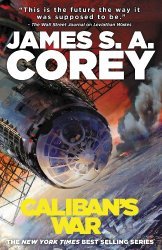

The sequel to Leviathan awakes. Venus is now a bubbling brew of proto-alien goo that’s about to spread into space. On Earth interstellar war looks imminent while Mars runs into an alien super soldier. James Holden, the guy who did the right thing in Leviathan Wakes, must now take his ship and hope to prevent an alien invasion.
Fortune’s Pawn – Rachel Bach
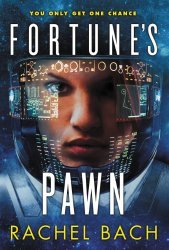

Rachel Bach cut her teeth writing the Legend of Eli Monpress before moving over to Science Fiction. This tale follows Devi Morris, a bad ass mercenary as she signs on to the crew of the Glorious Fool.
Scrapyard Ship – Mark Wayne McGinnis
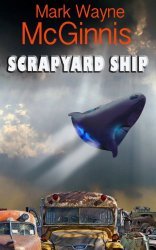

Why yes, that is a junked out school bus with a spaceship blasting off behind it. First Lt. Commander Reynolds gets himself in a bit of trouble that leads to him wearing a tether… then he stumbles on an ancient starship in an aquifer under his grandfathers junkyard. Once he discovers a terrible threat to earth he links up with his SEAL buddies and sets out solve the problem.
Omega Force – Joshua Dalzelle

Before Josh wrote Warship we penned Omega Force. Here we follow Jason Burke when he’s suddenly thrown into a world of interstellar crime and conspiracies. Luckily along the way he makes a few friends and eventually they make up the Omega Force.
Synchronicity War – Dietmar Wehr

Everything is going fine exploring space until we run into those horribly xenophobic aliens that are quite keen in killing everything in sight. Then one man starts having premonitions about how to win the war, except he can’t control when he has them. But even knowing the future, it might not be enough to win the war.
The post 48 of the Best Military Science Fiction Books Ever appeared first on Casey Calouette.
September 18, 2015
Starmap of Vasilov Space
 This isn’t anything terribly special. My goal is to show the reader a 2d layout of the star systems in Vasilov space and why Lishun Delta is so critical. With the star gate system choke points become everything. If the Kadan can bust through that spot, (or find another hole), then they can swoop in and then they have lots of paths to hammer other star systems.
I mentioned the Domino effect, and this is seen quite evidently in the map. If one entry point falls, then the invader can spread out and has the freedom of movement to really hammer the defender.
The post Starmap of Vasilov Space appeared first on Casey Calouette.
September 17, 2015
Bad Advice and Old Traditions
I have a few goals :
Write a great storyWrite better than my last bookWrite every single dayPublish itNo excuses, this isn’t a hobby, it’s a professionMake the Search Engines work for meRead Great Fiction William Faulkner, 1954, CCWrite a great storyThis should go without saying, but it’s the number one problem with books that don’t sell. They just aren’t entertaining. Hell, I have one of my own novels that doesn’t sell. Is it a bad book? Nope. It’s just not a great story. Amazon is really good, or at least on a whole, at letting good books rise up and not good slope down.
Now this is technical, and I don’t know if it’s true, but here’s how I expect Amazon to handle a new release. First they slot it in the proper category, then they show it in search results to people who have purchased books like it before.
Do they click in? Do they read the sample? Do they buy it? Do they read it? And finally, what is the acceleration of sales.
At any point, Amazon can compare to similar titles and probably knows exactly how the book will do. Now apply this on a massive scale. If 10,000 eyeballs see it, it get’s 50 clicks, 40 samples read, and zero sales. Amazon just learned a shitload of information. Maybe the cover is great, the blurb is great, but the writing sucks. The book will not sell.
Continue to massage those numbers, do A/B testing, send it out in different formats, and eventually decide if it’s a success or not. Just like shelf space in a grocery store, Amazon will not waste prime space on a bad book.Write Better than my Last BookIf I’m not improving, I’m not learning, and that means I’m stagnating. Not good.
Every scene must be more vivid, I must understand why I’m doing something, I must make that fight scene more intense than the last. And probably most importantly, I must be able to cut things that suck.
Continuous improvement is huge in the manufacturing world (my day job) and it’s something that must apply to writing. There’s opportunity for improvement every day, in every word, in every scene. It’s hard to make that happen, but without it I’m not growing as an author.Write Every Single DayThis is the most important thing an author can do. More than anything else just putting words on the screen trains your brain to think of scenes, acts, novels, and story. It has the added bonus of progressing you towards the end goal, writing a novel.
If you commit to writing 500 words a day, you’ll write an 80,000 word novel in 160 days, just over 5 months.
If you crank it up to 1,000 words a day (which I did for a long time), you’ll write that same novel in 80 days.
1,250 words turns into 64 days. A long weekend past two months.
1,500 words and now you’re at 54 days.
Just through the act of slogging along, you could easily write a novel in three months.Publish ItI write to see my work published. That’s my goal. To press the Submit button and watch the gears at Amazon grind along. There isn’t a one year wait that some “Experts” recommend. There isn’t even a one week. It’s not locked in a closet, or drawer, or some magic box.
By completing the act of publishing you’re forcing yourself to do it right. Your mind will treat it differently if you have a deadline. Even if that deadline is done. I’m not big on rewrites, slicing and dicing, or story surgery. I prefer my first ideas, and only rarely have I gone back to spruce it up. My first ideas tend to be my best.No Excuses. This isn’t a hobby, it’s a ProfessionThis one is simple.
Writing is your job.
Don’t treat it like a hobby. It deserves more respect than that. Don’t bitch about how you can’t make it in the big bad literary world when you’re just half assing it.
Are you sick? Too fucking bad.
A bad day at work? Too fucking bad.
Tired? Too fucking bad.
I wrote for over a year at 5:00 AM, on my coffeebreaks (worth about 100 words) and finally after my family went to bed. It’s called hustle, and I’m committed to making my writing goals happen.
Do you need breaks and vacations? Absolutely, I sure did, but even a few days away from writing and I can feel the writing gears start to rust.
Make the Search Engines Work For METhe more I write, the more books I have visible on Amazon. The more visibility I have, the more people can buy. The more they buy, the more often they pop up in the rankings. The better the ranking, the more visible. The more…See how this is going?
When I had one book my sales ranks were wild. Up and then mostly down. There wasn’t enough opportunities for eyeballs. Now, with 6 books, there’s a hell of a lot more eyeballs and it shows.
If you keep seeing my books, and see them with good reviews, you’re likely to buy them. That works pretty well eh?Read Great FictionA good rule for friends, hang out with people that are better than you are. Then you’ll always have something to strive for.
The same goes for books. Always be looking up, reading up, and studying why it’s better than yours. Stephen King laid this out as one of his rules in his book On Writing.
Reading fiction is the lubricant for the writing gears, those scenes and characters get ground up, refined, distilled, and laid out in your brain.
I focus on a few areas. Classics. Contemporary. Fine Literature. Here’s some examples I’m reading right now. (My nightstand is trashed)
Classics : Heinlein’s Expanded Universe, Rendezvous with Rama, Hemingway’s Short Stories
Contemporary : John Flanagan’s Brotherband Series, The Atlantis Gene, The Martian
Fine Lit : All the Light You Cannot See, The Revenant, Dead Wake
I read every day. Even if it’s just ten minutes. A few pages. A bit of a short story.Beware ExpertsIf someone is offering advice then go to Amazon and search there name.
Are they published? If not, or if it’s not selling worth a shit, then take it with a large chunk of salt. They might just be very good at internet marketing.
Everyone writes differently. You’ll be different than me. But the advice and steps above will help anyone.
Now go, write.
The post Bad Advice and Old Traditions appeared first on Casey Calouette.
September 14, 2015
Two Years an Author
 When my newest novel comes out, Hard Nova, it should be right about 2 year anniversary since Trial by Ice was released. In two years I’ll have written 7 novels. All totaled, I’ll have written over 500,000 words of fiction.
That first year was tough. It pains me sometimes to go back and read my original novels. Some of it was rather… clunky. Hopefully, you the readers, have found the newer novels to flow better. I learned a lot about the craft of just getting a novel finished. I was screwed by two editors before I finally hired a good one. (Hi Max!) I chalked those up to lessons learned, I paid a premium for my own incompetence.
Frustrating? Oh yes.
That’s the tricky part. If I had written my first four novels and tucked them into a chest. I’d never have had the motivation to write Steel Breach. Hell, for that matter, I doubt I’d have written my second novel Edge of Solace. By being able to cut my teeth in the real world I’ve been motivated to write better. You hear many pro authors recommend to throw out your first novel(s).
Bullshit.
If Andy Weir had tossed the Martian, because it was his first novel…
Our first novels may not be the best, but they are critical to learning in the harshest way possible, in the market itself. Amazon is surprisingly good at finding great novels, not by any skill, but by letting the readers decide if it’s worth buying. That’s powerful. Not an editor, or a pre-reader, or some intern at Penguin, but the reader.
It’s like the lantern analogy. The brighter the lantern, the greater the area of darkness. It pains me to know how much I don’t know about writing. Especially since now I realize the depth and breadth to a scene, or a story. I can’t read fiction as a spectator anymore, it’s a professional study now.
I miss reading for pleasure. As a youth I spent many a day curled up in a snug cottage watching it rain while I read 1960’s versions of Readers Digests Condensed Books. Recently I visited those cottages on the shore of Lake Superior. Those same books are still there.
I recently read All The Light You Cannot See. It was a great story, the scenes were executed very well, the dialogue beautiful, the descriptions proper and elegant. It was humbling to sit down and write the next day. I felt like a horse clomping on my keyboard.
Next I read the Martian. Again, I read it with an eye to story and substance. I’d hit a passage, notice a shift, and go “ah hah!” It was a delight to read that novel and I’d gladly pay good money to have the pleasure of reading it again fresh. It was extra tough to write after reading it, I just hoped my writing was a little better for having read it.
But still, I sit down and try my damnedest to make every single sentence better than the last. And that’s where the expanding light of my literary candle helps. But then I become aware of how much more there really is.
I’ve heard 10,000 hours to master a skill. Orson Scott Card figures 1,000,000 words till you’re proficient. I believe both. Eventually I’ll hit those, and hopefully you guys notice the difference.
I know people who can sit down, write, and the beauty is torn right from their soul and laminated onto a page. I’m not one of those. I struggle to lay down every word and mortar it into place. I feel like a mason, mortar in one hand, brick in the other. Hopefully at the end I have a beautiful building and not a shit-shack.
It’s easier than it was two years ago, but it’s still tough. The one thing I take solace in is the fact that I’m too damned stubborn to quit.
That, and I’ve got a lot of stories to tell.

The post Two Years an Author appeared first on Casey Calouette.
September 5, 2015
Habits and Writing
 It’s been awhile since I’ve updated you folks on my writing. Mainly because I took a break after releasing Steel Storm. It was summer vacation, the last before my Son goes off to kindergarten, and work has really been ramped up. But now I’ve returned to my original goal.
That goal, by the way, is to write every single day. At least 1,000 words. I’d been at it, without fail, for nearly a year. It had become as much a part of me as my daily cup of coffee. At first it was tough to not write. It was just what I did. By the time Steel Storm came I was up to over 2k words per day. They just flowed, it became pretty easy.
Now I’m restarting it and, to be honest, it’s tough to get back in the groove. I had a few days that the every day was like pulling teeth. I struggled to get a dozen words down. But the next day came more, then a few more. By the end of this past week I hit 1400 words for the day. They came quicker, faster, they flowed better.
Habit is one of those things we tend to forget about. Something becomes, well, habitual, and we just keep at it. A cup of coffee in the morning, a jog in the evening, a shower in the morning. So now for me it’s time to get back to a habit.
What’s that mean for you, the reader?
A new novel sometime in October or November. I’ve been in touch with Justin Adams at Varia Studios and he’ll be doing the cover. He did DogForge and Edge of Redemption. He’s also recently done some covers you’ve seen, Chris Nuttall’s newest in particular. This new novel is plotted out entirely. It’s just a matter of getting the words down. I can see myself packing up the laptop and heading into the woods for awhile.
I’ve never had a 10k word day.
Maybe it’s about time?
A call for my readers, what do you folks want to see? Leave me a comment, I’d love to hear it.
The post Habits and Writing appeared first on Casey Calouette.
August 11, 2015
War in the East : Support Units
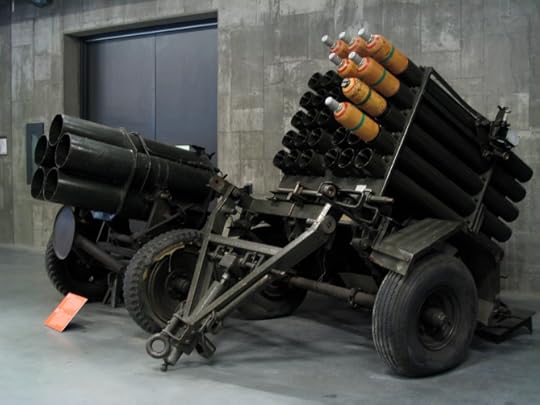 “Nebelwerfer and Land Mattress”. Licensed under CC BY-SA 2.5 via Wikimedia Commons – https://commons.wikimedia.org/wiki/Fi...
Support Units come in two flavors. One is Combat Support Units like Artillery or Pioneers (Engineers). The other is straight up support, or Construction Units. We won’t cover much on the Construction side for right now. But on the Combat side there’s a lot going on.
Assigning your Support is a matter of trade offs. Support units that remain at the Corps (XXX) level are assigned as the Corp Commander sees fit. However if you decide you know better, you can assign a Support Unit directly to a Division (XX). Then it is guaranteed that they participate in combat, but, and here’s the kicker, the other Divisions in that Corps don’t have access to that support unit.
So if you leave that Stug Battalion at the Corps level they might participate in combat with any of the Divisions attached to that corps. 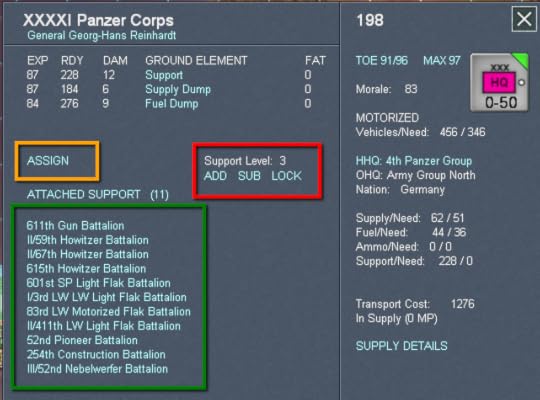 Here we have the XXXXI Panzer Corps.
First note the red box. This is your automated support level. The game will try and balance the HQ’s so that it has 3 of everything. 3 Artillery, 3 Anti-Air, etc. This can be fine, but sometimes you want to make sure a particular unit has heavier artillery. Then you will want to set the HQ to LOCKED. This prevents the AI from adjusting your fine tuning.
The yellow box allows you to assign more Support Units from the next higher HQ. In our case, we can take support units from the 4th Panzer Group and directly assign them to the XXXXI Panzer Corps. Then, in turn, we could send those units direct to the Divisions. Note, your artillery is assigned to Corps and higher, not direct to Divisions.
Lastly the green box shows us what units are assigned to this unit. We’ve got a lot of Artillery here. The Pioneers are critical for reducing fortifications. How to assign them is a matter of choice. But here’s the critical part:
That HQ must be within 5 hexes in order to provide that support.
Not only is the 5 hexes critical for supply, but also for providing artillery. When you move your Panzers up, move up the HQ at the same time and then attack. Now you’ll have all of that artillery with you! If you leapfrog up your armor first, then move up the HQ later you are missing out on a huge force multiplier.
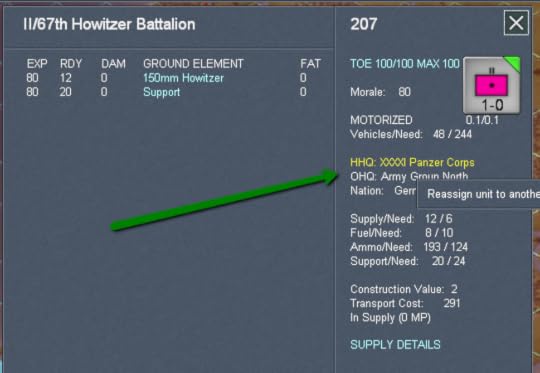 If you click on the Support Unit you get the unit details. One thing I’ll point out here is how to transfer HQ’s. Click where the Green Arrow is pointing and you can select another HQ. Got a need for Heavy Artillery in Leningrad? Transfer it out of one unit and into another.
How many units get committed from the HQ depends on a series of checks. At a max you can get 6, except in urban or city, where you get 18 support units. Now with every support unit committed it gets harder to commit more. This all comes down to the leader, along with who knows what other factors might impact. Fatigue, weather, supply, etc.
Which brings us back to assigning units direct. With those you are guaranteed to have them committed, but only with that unit.
Oh, and when you take it from the HQ and send it to the Division level, the HQ no longer can use that unit. The Division has exclusive use of it until you send it back. That’s the trade off. 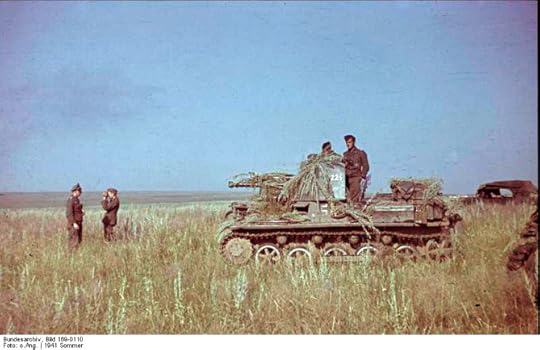 So when do you directly assign those Panzerjäger I? Who gets that Bicycle Recon Unit? (Yes, that’s a thing.)
That’s one of those things that you, the Commander, get to decide. That fine tuning can take a good strategy is really make it crack.
I like taking my Nebelwerfers and getting them with my Panzers. The Stugs, a self propelled attack gun, go with the mechanized infantry. The Panzerjagers go with infantry that might run into trouble. The pioneers get stuck with anyone hitting fortifications, or left at the Corps level.
As for AA, I like to stick a bit with my Panzers. They are most likely to run ahead of where the Luftwaffe can cover them. The rest gets interspersed throughout areas where the Luftwaffe is lacking.
In regards to Artillery, I like to mass it in the assaulting areas. But only to a certain degree. If I leave a zone without that support then they’ll suffer.
Your Flammpanzers, yah, they are quite an asset. Use them to hammer any tough pockets, especially cities.
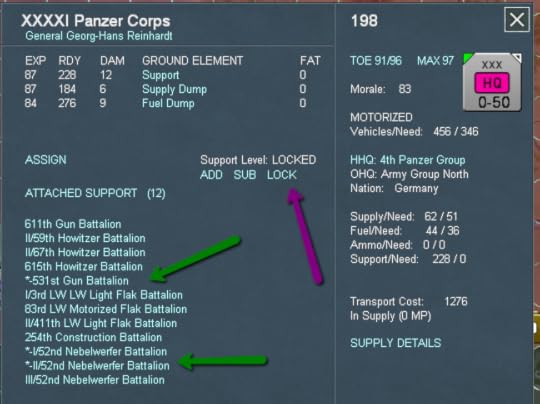 Here’s an example layout of a Panzer Division in 1941.
First note the stars, this means I just transferred those units. I can’t move them anywhere else for this turn. They will however be used in combat.
There’s a healthy smattering of AA, three Nebelwerfer Battalions, and five artillery battalions. For a normal battle that’s overkill, as we’ll only use a max of 6. If we fight in a city or Urban hex however, we can use 18. For this particular scenario, Road to Leningrad, my Panzers will hit Riga and Pskov quick like. So those extra artillery will come in handy.
If I had left it as it was my Panzers would lack the punch that they’d otherwise have.
Like many things in WitE, you can play just fine without dealing with it, or you can fine tune to your hearts content.
The post War in the East : Support Units appeared first on Casey Calouette.
August 2, 2015
War in the East : Aircraft Basics
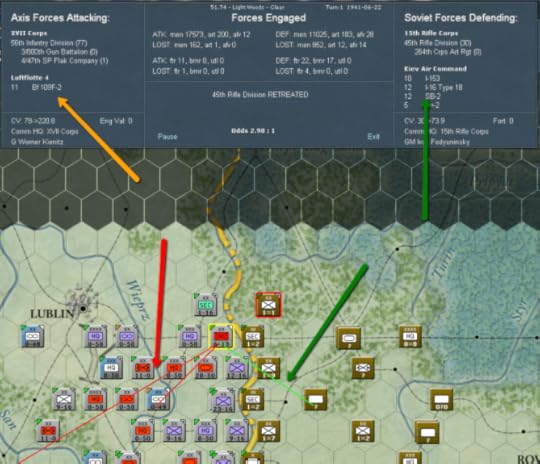
 Air combat works in a different way than most combat does in WitE. The first type is the air combat that comes when a ground unit attacks another ground unit. Your air units will attempt to support the ground attack. This includes intercepting enemy aircraft and also bombing the hostile units. In these cases we need to have available aircraft and air miles.
In the example above we see the yellow arrow pointing to the air units that helped out. In this case 11 BF-109’s. On the right, or Soviet side, we see they sent a whole bunch of stuff. We lost a single aircraft, they lost four fighters. Seeing as we didn’t send any bombers to help the Soviets didn’t suffer any ground losses from our aircraft.
Below is a red arrow, this shows which of our air bases sent aircraft. On the right is a green line, this is the defending aircraft. Note it’s coming from a question mark, all our units were able to report was the direction.
The second type of air combat is the stuff you select. Recon, Air Attack, Bomb Cities, Air Transport, and Air Transfer. This works in a completely and totally different way. Some of these modes allow for the AI to run it all, or for night missions to be selected. We’ll get into this first as it’s how most people expect air combat to work. 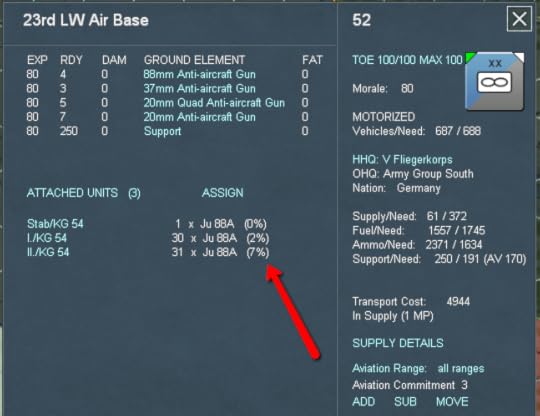 Air miles, the red arrow, are at the core of what your air units can do. This also takes morale into account as well. More missions, more miles.
Now missions are two things. The first is the manual missions you pick for them to fly, like Bomb Unit or Airfields. The second is the automatic missions flown in support of your combat units.
One big, huge, enormous thing to remember. Some missions MUST be flown with zero air miles on the unit. These are :
Bomb Ground UnitBomb CityBomb Airfield (Night)Air Transport (Night)Air Transport (for bombers)Air TransferMoving an airbase also adds air miles. In addition if you fly a bunch of missions the movement points will be reduced.
So if you want to bomb a city, do it immediately. Otherwise your units will rack up a few miles by supporting those Panzers. 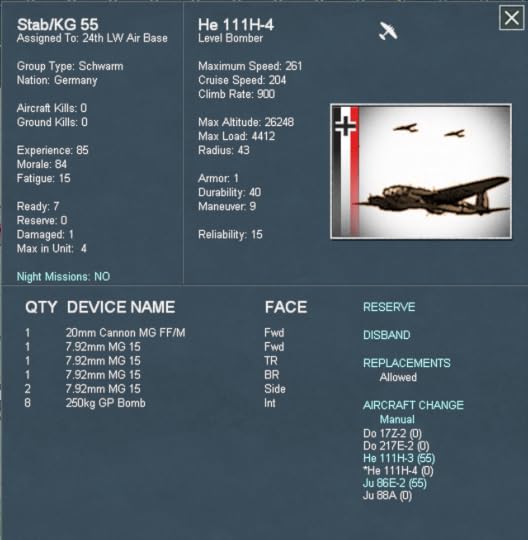 If you click the unit you’ll get more information. Group type is how large it is, Schwarm is a max of 4 aircraft.
You’ve got a bunch more info, along with the radius, or 43, that’s how far it can fly. One thing to remember, this bomber can fly farther than the fighters. So it’s entirely possibly to send your bombers into the waiting jaws of the defenders. You can also select if it will fly night missions or not here. 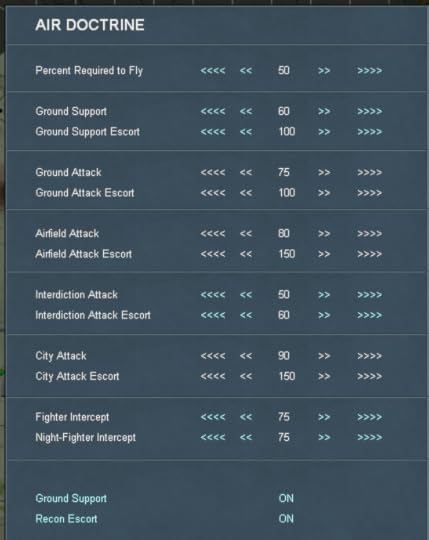 This is the air doctrine screen. It determines how many planes to send on a mission, and if a mission can be run or not.
Percent Required to Fly
How many planes in that unit must be able to fly. If you have a badly beat up air unit that’s below that percentage then no mission will happen.
Ground Support, Ground Attack, Airfield Attack, City Attack, Interdiction
How many planes are sent as a percentage of the optimal attack. 100% would be exactly how many planes the AI determines is needed for an optimal mission. If you set it at 20%, it will send only one fifth of what the AI has determined is optimal. The advantage is you get more support and attacks, but they might be less effective.
Escorts for all of the above missions
This is how many escorts are sent as a percentage of the bombers. If they send out 50 bombers and you have 50% set for escorts, then 25 fighters go out. If there aren’t enough fighters, the mission will not run.
Fighter Intercept
This is how many of your own fighters go out to intercept the enemy. The percentage is in relation to hostile fighters. If they send 100 planes and you’ve set Intercept to 50%, then you’ll send up 50 planes.
You can also turn off Ground Support and Recon Escort here too. 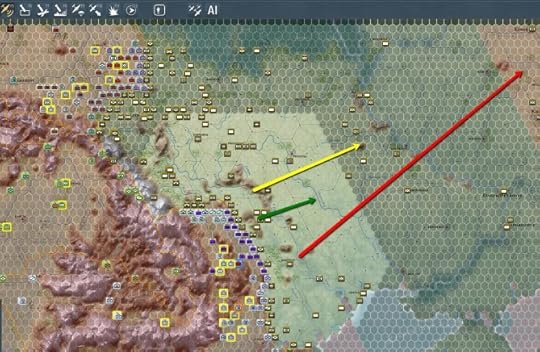 The first is Air Recon Mode, of F5.
We can run this as an AI mission, just click the AI Icon (a key). Or you right click on where you’d like the mission to look and the AI will decide which unit to send to check out that area.
It will show you units within 3 or 4 hexes with a detection level up to 4.
If you want more control then select an airbase and SHIFT-Right Click. You can also just Shift-Right Click without selecting an airbase and it’ll show everything in range. This shift-right click will be used again.
If you select an air unit with recon elements, and fighter support, you’ll see the clear hexes (green arrow). The grey area (yellow arrow) is the zone where your recon units can go without fighter escort. Lastly the red (red arrow) is beyond the reach of your recon. This same color scheme will pop up later. 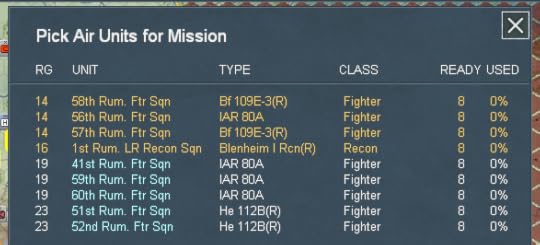
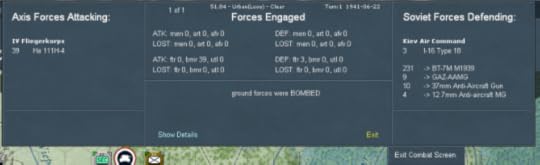 Next is Bomb Unit Mode or F6.
You can right click on a target, shift-right click and select the bombers, or select an airbase and then right, or shift-right click, to use bombers from that base.
This is level bombers, not close supports bombers. (Think big bombers, not Stukas).
In my experience it works really well on HQ units. I’ve heard mention on the Matrix Forums that this will greatly reduce the combat effectiveness of a unit on the next term but can’t find any info on it in the manual.
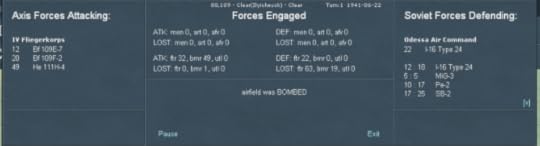 Next is Bomb Airfield Mode, F7.
You can run this in AI mode, and I usually do on the first turn. Yo get a huge bonus as the Axis and the Soviet air bases will suffer massive losses.
The same color coding, clear for fighter support, grey for no fighter escort but in range, and red for out of range applies. We can also right click for AI bomber selection, or use the shift-right click.
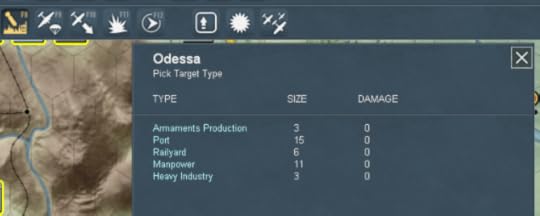 Bomb City mode is F8, and is different than the rest.
Here you can select a target in that city. Then once you’ve decided on a target, say the railyards, then you decide which units will go. Don’t expect this to be terribly effective.
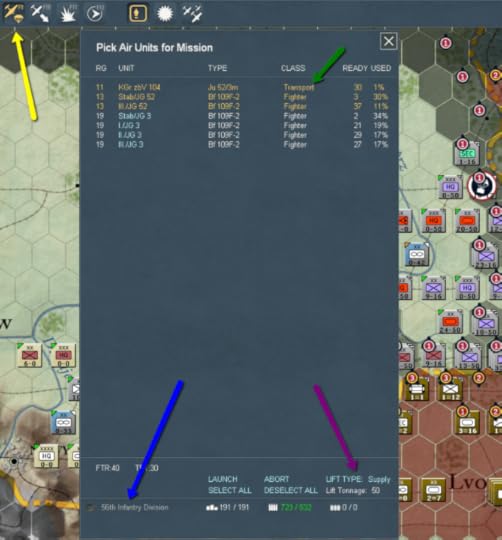 Air Transport Mode, F9, moves troops, supplies, or fuel.
You need zero air miles on your units to do this. Next, you can right click on a target, say a Panzer Division, and the AI will drop supplies. Or you can SHIFT-Right Click and select the details yourself. You’ll want to do this so you can ensure that your Panzers get what you think they need.
The green arrow points to the class, in this case our Transport. The blue arrow points at the target, we see that they have good supply and ammo. If this was a motorized unit you’d see the fuel icon too.
Just above we can select LIFT TYPE, fuel or supplies. Then to the left of that is LAUNCH. 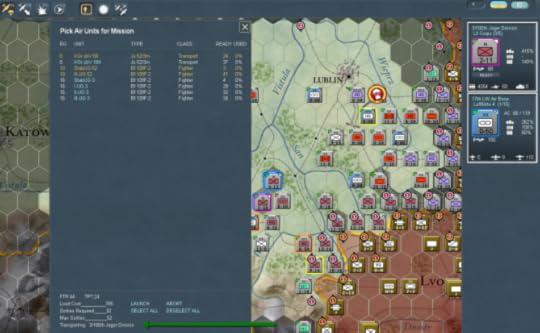 What about to move a unit using planes? Now it gets tricky.
First move your non-mechanized unit to an airfield with transports. Make sure those units are selected and you’re in Air Transport Mode. Then select the target destination airfield or the hex right next to it and SHIFT-LEFT CLICK.
Ok, you see that change? Shift LEFT click.
Your planes aren’t terribly big so you can’t move huge volumes of troops. Air Dropping Paratroops works in the same basic way. 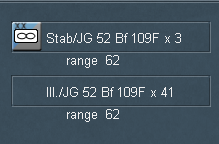
Finally is Air Transfer Mode, F10.
This lets you transfer a wing of aircraft from one Air Base to another. Left click the airbase you want them to come from, click on the empty space to the left of the Aircraft Type, then right click on the destination air base.
Air Combat itself, along with ground support, will have to endure Anti-Aircraft fire. Now if the defending HQ passes an initiative roll they may add AA support as well if they are within 5 hexes. Remember our turn length is one week long, so our air missions might be spread out over a few days.
What happens in the combat itself takes in a ton of factors. Morale, experience, terrain, weapons, weather, just like every other combat roll.
It’s an interesting system, and once you get the feel for it is pretty seamless. I much prefer it to ordering every single combat mission myself.
The post War in the East : Aircraft Basics appeared first on Casey Calouette.
July 28, 2015
War in the East : Supply Basics
In Road to Minsk, a 3 turn scenario, you don’t have to worry about supply at all. You can get a decisive Axis victory without ever thinking about it. But in the other Road to scenarios, and the full campaign, it becomes much more critical. But the good news, it’s not that bad.  The absolute basics. Keep your front line units within 5 hexes of their HQ’s. Keep the HQ as close to the railhead as possible. When you can’t do either those, airdrop supplies.
Now it’s more involved than that, but if you follow the rules above you’ll do OK in the shorter scenarios. Once winter strikes, or mud, or 1944, things become more interesting. Supply, especially for the Germans, is difficult. (As it was in reality) Supplies are produced on the homefront and transported via rail to the front lines. Your railhead, or the furthest point that you have a rail connection to home, is the most vital point on your entire front. You may also have supply via ports, beachhead, or air, but your primary source is from the rail connection.
From the railhead supplies are sent to your HQ units. This is direct, which means it doesn’t transit through Armies to Corps. It is from HQ direct to a unit. So for example, XX Corp HQ sends supplies to the Infantry Divisions attached to it. Where the 9th Army is the HQ of XX Corp it has no relation on supply. Though any unit directly attached to the 9th Army will draw supplies from the Army Group.
Once a supply is at a railhead or friendly city/urban hex they are sent out to the HQ’s. Sometimes, if a unit can’t get supply from the HQ, they will attempt it direct. This isn’t ideal and will lead to supply loss.
From the railhead the supplies are moved by truck to the HQ, and then by truck again to the units. Your motor pool is critical in this endeavour. If you’re motor pool is low you can’t move enough supplies even though you have them at the railhead. If you select a unit, then click on Supply Details you’ll see the screen above.
Highlighted in orange we see the Range to Rail (Hexes) and MP to Rail (Movement Points). You can do the same thing for the end combat unit.
VI Corps has a rail connection and is receiving supplies. An HQ needs to be within 25 hexes and 100 Movement Points. It will be still considered in supply if it meets MP but not hexes.
Their also must be enough Motor Pool Capacity, if there’s not then only a portion of the supply will make it to the HQ and eventually to the units. The 6th Infantry Division is attached to VI Corps but is not within range for supply.
The end unit must be within 5 hexes or 20 Movement Points. If it’s not the unit will attempt to gain supplies from a railhead or friendly city. This isn’t ideal and leads to reduced supplies.
In the orange box we see that it’s 8 hexes to HQ, and only 14 MP’s. No good, out of HQ supply. But it is within 13 hexes to a railhead. (They follow the same rules as an HQ for distance, 25 hex / 100 MP)
In red is Phase 1 Supply, or supply from HQ. It got nothing as it didn’t meet that criteria.
In the yellow box we see Phase 2, or supply from elsewhere. The unit only received a portion of the supplies that it needs. This models the fact that trucks have to drive over horrible roads and attempt to deliver supplies. Not good.
There is a distance modifier that you see above, the further the supplies must travel, the less you get. On top of that is an Axis rail penalty that is due to the distance that goods must travel by rail. The further the rail moves east, the less efficient it becomes. Each turn the HQ unit will gain supplies and send them out. But you can turn the HQ into a massive supply conduit, for an Admin Point cost. This will allow units in range to gain a massive supply buffer. Use this to prep motorized divisions for an assault.
The HQ will receive fuel and supplies equal to 100 times the Admin Point cost. The following turn the combat units will receive the disbursements and will be at, or near, maximum supply. They may still be fatigued though, so watch out.
This is tough on your supply network and on your Motor Pool. The further your HQ is from a railhead, the more vehicles it requires to transport. It takes the Mp to railhead * 100 vehicles from your motor. Of that count, 10% are considered destroyed. If you’re 50 MP from the railhead it’ll take 5,000 vehicles, 500 of which are considered gone.
For short games you probably won’t pay much attention to the motor pool, but in long games it is critical. You’ll see expert players watch this closely, I’ve read a few AAR’s where they called it in late 1943 because the Motor Pool was so low that the Axis player knew he didn’t have a chance to recover.
Other Supply MethodsYou can use Air Transport Mode (F9) to attempt a supply delivery by air. Just right click on the target and the aircraft will drop supplies. It likely won’t be enough to bring a Panzer Division to 100%, but it might be enough to squeeze out just a bit more.You’ll also have beachhead mode which allows supplies to be transferred via water. This only works if you have a friendly port on that body of water. Note that it isn’t as efficient as rail transport.Panzer ExampleIt’s likely the first time you research Supply will be when your Panzer Divisions suddenly run out of fuel.
In our example we’ll be at the very end of the supply chain, 24 hexes and 99 Movement Points from the railhead. Our HQ is following just behind the Panzer Divisions. We’ll assume a full motor pool.
So right off the bat we have 25 divided by 99 MP, to give us a modifier of 25% due to MP. Then we have a 10 divided by 24 Hex, to give us a modifier of 41%.
With ideal supply, only 25% gets through due to the Movement Points. Of that 25%, we can reduce it again by 41%.
We end up getting just 10% of our needed supplies at the end of that stretched out supply chain.
Moving your railhead is essential, and is the major limiting factor in your advance. Use your FBD units to repair and convert the rail lines as quickly as possible. They make pretty good time until they get through the Baltic Rail Zone. After that it costs 3 points to repair the rails instead of 1. 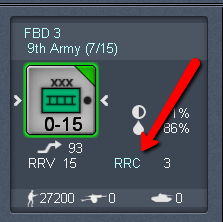 While it can be daunting Supply isn’t terribly difficult. There are other instances and cases related to supply but what you see here will keep you rolling. The system does a pretty good job modelling the difficulties that the Wehrmacht faced during Barbarossa. How you handle that situation is one of the interesting nuances to War in the East.
The post War in the East : Supply Basics appeared first on Casey Calouette.