
Carrie Bailey Allen's Blog, page 4
September 22, 2015
3 Common Qualities for Science Fiction Lovers
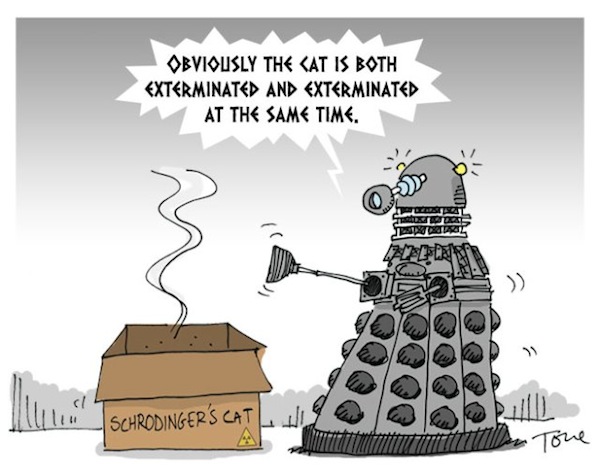 Does it matter how a Dalek would interpret Schrodinger's cat?
Well, yes, yes it does.general, it seems to hold true that truth is stranger than fiction. Example: what is as weird as the
I think everything else is tame in comparrison to the implications that matter itself might change to a particle or wave based on whether or not its being observed. By humans. With cameras.
Ju...


September 15, 2015
Why I Love My Misogynistic Dad
I could have gone without that experience. It was supposed to be about sailing, but he started it out with a scene where you could have replaced the woman with a coffee pot and lost nothing. She was just a mute receptacle.
Of course, that's not why I'm calling him a misogynist. I have a lifetime of observations to build that conclusion on.
For example...
My father has often enjoyed silencing his wife by raising a stern hand whenever she attem...
September 8, 2015
3 Things About Readers that Writers Forget
It’s hard enough to write a book, but as most authors know, selling it is a special problem. Getting it to large audiences where it can be discovered, like a library, is not as coordinated or difficult as many people imagine.
I’ve worked in libraries since I was fifteen and I have a library graduate degree. I’ve operated public, private, general, special and international libraries. I know seven automated library systems and eight classification systems. My job in libraries was often to match book to reader based on their preference and I had to know enough about people and enough about books to make a good connection.
Here’s what I know:
1. Reader interest is EVERYTHING
Good writers write good books that people don’t like… All. The. Time. And bad writers write bad books that readers HEART. That’s why the best seller lists are dominated by people from every background and every profession.
If you can communicate why your story meets an already existing interest without baffling people and communicate that to a librarian who makes the decisions, it will be added to the library. Book reviews will help back up the claim that the book meets a need, but ultimately, the librarian decides.
What doesn’t matter as much as most people think is the publisher or the writing technique. Of course, this only applies to situations where you directly speak with a local library or have other legitimate reason to speak with the person responsible for collection management. But it also applies to who wants to read the book.
2. Readers are much more critical of well-written books.
An amateur effort in writing will enjoy positive encouragement typically reserved for students and small children. Few people want to the be reason a writer they know personally quits, but as soon as the writers pass the threshold from amateur to professional that changes.
People don’t feel bad about knocking down better work. They assume the writer doesn’t need coddling and they tend to engage solely with the content on a personal level. They didn’t like it. It’s not their style. They don’t relate to the world view. It offended them. Maybe it’s a well-written book, but if its professional that just doesn’t matter.
Some people will avoid admitting why a book didn’t appeal to them personally by citing writing technique or professionalism in a review online, but people almost never make that claim in a library. You can be the Leondardo Da Vinci of writers and a lot of readers will say, “No thanks, I prefer Van Gogh.”
3. Books confirm people’s nature. They don’t change it.
Sorry! I’m not saying we as readers cannot see past our narrow views. But, as a former librarian, I can confirm that only a select group of people like to be actively challenged by a writer’s world view. Readers come to the reference desks looking for books that compliment their view of the world. Maybe expand it a little, but not too much.
Example: I have never had success giving a skateboarding teenager with multiple piercings a second chance Christian romance set in the Amish countryside.
Recommendations are tricky. I found that people coming to check out books with a friend or family member sent a lot of the same messages with the titles they selected. The book might help the other person understand them or show that person they are understood. The book will help them become the person they want them to be.
Although, at times, a recommendation is about what the person thinks of the potential reader.
Example: Male librarian recommends shopping themed chick lit to every woman who comes in, because he feels emasculated by his choice of profession and needs to feel that the scifi novels he personally likes only appeal to manly men.
I know bad reviews can hurt writers both personally and professionally, but I think it helps to take a step back from your own book and think like a librarian sometimes. I enjoy the company of a lot of people who hate the books I like to read. And I hate the books enjoyed by a lot of people I like.
Even though I’m a writer now, I still think of readers as patrons. If a person doesn’t enjoy my book, I can recommend someone else from my mental database of indie writers. I can try to match their feedback with a different style of work that fits them better than mine.
I never withdrew a book from a library collection based on one person’s opinion either and I never added a book based on one person’s request either. And, as a writer, I don’t make changes to my work based on the feedback from one person. Yet, people sometimes get really excited and want to actively participate in developing my work. I’ve been presented with unsolicited edits quite a few times as the person angled for a role as co-author. It’s really as flattering as it is insulting. I spent five years writing my first novel. Five pages of opinion does not a co-author make. Love you all, but I’m not restyling my post-apocalyptic work as a vampire novel or political manifesto.
However, all feedback is precious to me. If I believe a person is a legitimate reader interested in my genre and not person trying to push me to write an entirely different genre, then I collect every word they share, combine them with the other feedback I get and wait for themes to emerge.
Clark Brooks #1 Fan
Maybe I still think like a librarian, but connecting with interested readers is the best part of writing.
[image error]
3 Insights on Book Reviews from a Librarian
Have you seen the ratings fiasco on Amazon for Chuck Wendig's Aftermath? The #1 selling author is used to 4.5 stars and suddenly he's getting a 2.5 star rating. However, it's probably selling a lot more copies, because of the negative ratings.
Is it a smear campaign? A dark anti-Chuck conspiracy? Or is it just not what Star Wars fans want in their genre? Or perhaps it really just has a weak plot with cl...
August 31, 2015
Pandemics, Preparation and Zombies
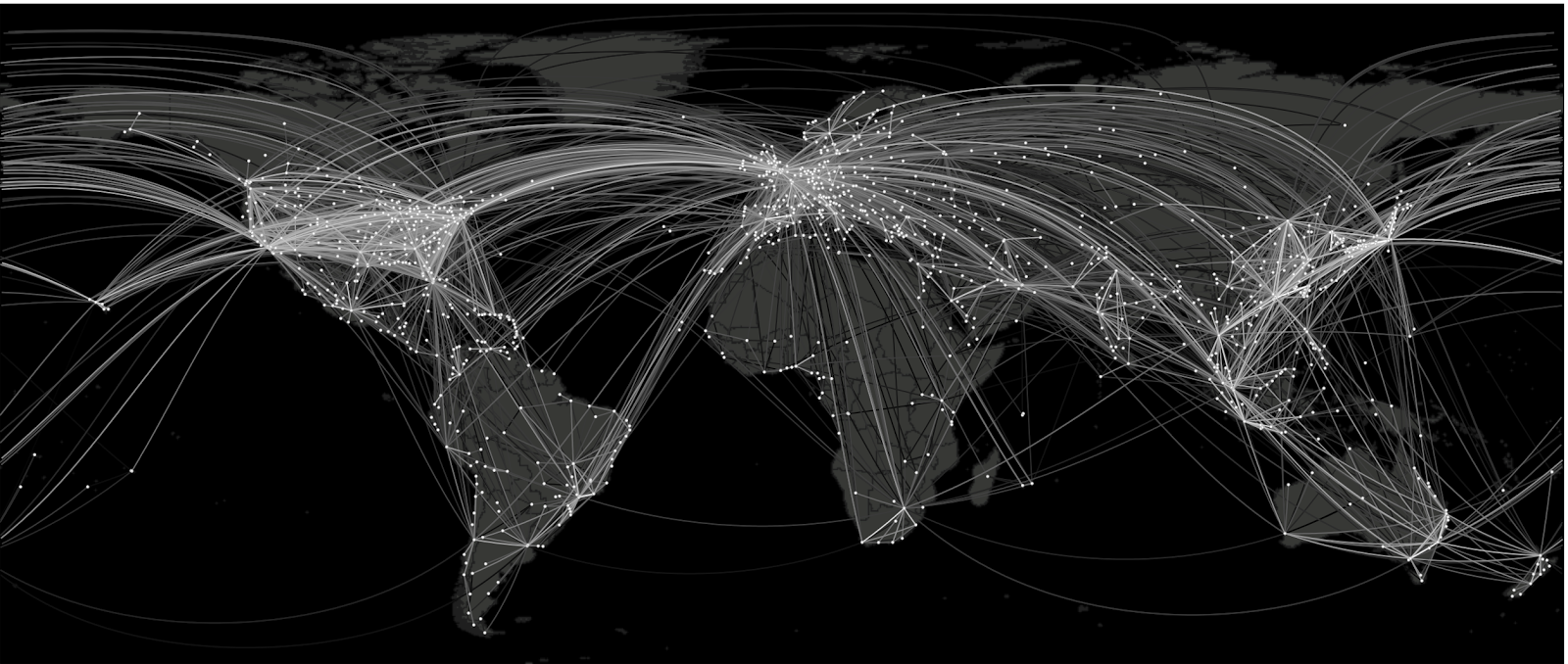 One of my proudest moments in writing-related research was the day the president of the World Health Organization tweeted me about H7N9. My friends and family were all taking a little break from answering my calls so I could update them on the latest snippets of data regarding the avian flu that I had translated from Chinese blogs. My obsession had me posting details about the might-have-been pandemic 24 hours before the WHO regarded them as official and rendered me useless in a conversation...
Pandemics, Preparation and Zombies
Can you fault a writer for having a vivid imagination?
I’m not comfortable with the horror of pandemics. The suffering and the death do not appeal to me on some morbid level of fascination common among the proudly twisted writers that create gory disease scenes to evoke panic and fear, which is fine if that’s your thing. But, it helps distance us from the inevitability of the threat and the politics of preparation.
And that is a very bad thing.
[image error]
Some outbreaks of disease can be regionally contained, because they are not transmitted from one person to another through the air. Malaria is contracted through mosquito bites. Cholera infects people who drink contaminated water. Small pox, while considered eradicated, could be spread by body fluid contact and being coughed on.
The black death and the various deadly flus have proven more virulent, but while we think of the bubonic plague as particularly deadly, it’s easier to forget how the influenza viruses morph into new strains. Take a strain with a high mortality rate and put it in a hospital with a strain that is highly contagious and life as we know it is over.
That may sound really dramatic, but it’s happened before and we’re not ready if it happens again.
Maybe that’s why we worry so much about zombies. You can shoot them. You can burn them. You can cut off their head with a chainsaw. Everyone has probably heard that it’s not a matter of if there will be another pandemic, but when it will happen. That’s a hard thing to face when you know globalization spreads everything, especially disease, around faster.
If you had to choose between being attacked by zombies or an influenza virus with no available vaccine, which would be easier to fight?
Zombies. And you’d feel safer fighting them, because you could see them. The reality of a pandemic is much less about bad ass fighting techniques and much more about logistics and quarantines.
What you need for the Zombie Apocalypse:
1. Weapons
2. Armor
3. Slower moving friends
What you need for a pandemic:
1. Shelter
2. Three months nonperishable food supply
3. Water
4. Stockpile of medications
5. N95 masks
6. Dish soap and bleach
7. Water filters
8. Safety goggles
9. Lots of plastic medical supplies
10. AM/FM radio
11. Coffee
Unlike zombies, people carrying the deadly influence virus will look like reasonable friendly people. And when a pandemic erupts, they’re going to want you to carry on with your normal life. Go to school. Go to work. Go shopping for groceries. But, they could kill you and everyone you love without even coughing. With person to person transmission, the flu would likely spread worldwide in three weeks.
People who have the ability to create a self-imposed quarantine early on and can maintain it longer will survive though few have the rural retreat and 3 to 18 months resources to outlast the entire threat. And I suspect that most people will have a family member that needs a prescription drug which can’t be stockpiled. Meaning entire families could contract the flu and die, because one person attempts to get a regulated medication for someone dependent on it.
During the plague that killed 30-60% of Europeans, healthy people often roamed the streets drunk, riotous and indulging in everything they could as if it were their last moment on earth. And this was a time when hand held cannons were just beginning to be introduced. What if they had guns manufactured on an industrial scale? No matter what your position on gun control, it’s hard to imagine that all the reckless jerks with guns are going to behave while the hospitals overcrowd, the police force is all out sick and they can’t get an energy drink from the corner shop. But, yet you have one.
Most of us expect it to be grim, because of history tells us to expect the worst. More people died from the 1918 Spanish Influenza pandemic than in World War I. The word pandemic itself is derived from the greek words for “all” and “people,” because whether or not a person survives, all people are affected.
But, if you can think about pandemics without making the leap from the scientific curiosities directly to World War III, in between you’ll find the real politics. Vaccinations. Government. Medicine. Business. It’s nothing like preparing for a hurricane or earthquake.
Communities will set up refuges to coordinate resources and care for the sick. People will volunteer to provide care and many will die doing so. Some businesses will close for good while workers who can telecommute will benefit. Miracle cures will be sold everywhere despite the fact that none of them actually work.
I suspect I’d be one of the people who joins the Red Cross and gets sick the first week. Unlike the zombie apocalypse, there would be no easy way to conduct a life surrounded by so much death. Seriously. It would be easier to run away from zombies. Every one for themselves. But, during a pandemic, most of us couldn’t and wouldn’t grab a gun and go full barbaric.
But, then again, maybe people have changed.
August 24, 2015
Meeting Readers
Don Asked:
Was wondering if you advise the use of my existing profiles [to reach readers] or if it is best to start from scratch?
And so I said:
I have a lot to say on that, because the strategy an author uses depends on ma...
August 17, 2015
My 3 Rules to Finish a Novel Faster
It took me five years to write my first book. Not this time.
After three months, I'm halfway finished with my second novel.
No one can make a career writing novels if they publish only twice every decade. In fact, some people will claim that you need to publish every 90 days in order to stay ahead of the Amazon ranking systems. Write short stories, novellas AND novels?
 Plot Map for the second book of the Immortal
Coffee s...
My 3 Rules to Finish a Novel Faster
I started writing in 2009 and I finished my first full length novel in 2015.
It took me five years to write my first book. Not this time.
After three months, I’m halfway finished with my second novel.
No one can make a career writing novels if they publish only twice every decade. In fact, some people will claim that you need to publish every 90 days in order to stay ahead of the Amazon ranking systems. Write short stories, novellas AND novels?
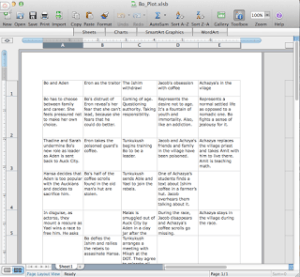
Plot for the second book of the Immortal
Coffee series
I wholeheartedly endorse whatever works for other authors, but right now, my objective is to write books.
Here’s what I’ve learned:
1. Plotting vs. Pantsing
Some writers refer to those who plot as plotters and those who just charge forth on their keyboards, pantsers. I started a pantser and ended up a plotter, because I get better momentum and speed from doing the bulk of the creative plot work before I start.
I have one major theme for the story that focuses on the main character, which is accompanied by subplots involving the other characters. I keep them organized by stages on a spreadsheet. And even as I write the second book, I’m collecting ideas for the third book. But, for me, I’m finding I get where I’m going faster if I have a “map.”
2. Do not revise until it you reach “the end”
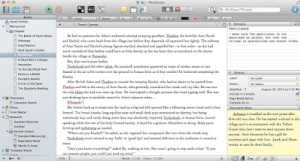
After trying other software, I am using Scrivner Upper Right Corner: Pending revision notes Lower Right Corner: Chapter Synopsis
I can account for two to three years of my time on the first novel being wasted on early OBSESSIVE revisions. At just about the four chapter mark, I would go back and change things. I added details and foreshadowed, but mostly I just drowned in doubt about it all.
As I revised, the direction of the novel often changed. I changed names. I changed characters. It became a habit to redo everything. I lost count on revising the first chapters after the 11th overhaul and I don’t even want to think about how many times I rewrote the first page.
On the second book, instead of making sweeping changes, I collect notes on what will need to be added or changed during revisions. I keep a list for each chapter and a synopsis so that I don’t go reading the chapters and find myself tempted to revise before I know exactly how it all ends.
3. Focus each draft on increasingly less critical elements of the story
While writing my first novel, I got sidetracked for months at a time inventing details that demanded changes in other parts of the story. I kept meticulous notes on characters, locations, histories and elements of the various cultures. Most of the backstory was not featured in the book, because I wanted to avoid the dreaded information dump, the long sections devoid of action and advancement, just a whirlpools of “neat” ideas that make most of us close the book.
Backstory, however, is essential to maintaining consistency and developing an immersive world. Readers may not have all the details, but they know they’re there, because the actions and interactions ring true to what causes them.
While writing my first book, I found creating draft after draft focusing on certain aspect at each pass though often starting over to work on a different one. To speed up the process of revising, I’ve categorized what I did during the first novel and made a schedule for the second novel based on the degree of changes each type of revision required:
First Draft: Action + Conversation
Second Draft: Foreshadowing + Consistency + Pacing
Third Draft: Character and scene enrichment
Fourth Draft: Fancy Language + Intellectualisms + Sensory data
As an inexperienced writer, I often found myself rushing to write the non-essential parts of the story. I felt they were what separated good books from boring ones, but what I didn’t realize was that I was going to end up deleting 90% of my clever wallpapering. If I had to make a major structural change, they had to go.
I regularly copied and saved them in other files just incase I could work it back in at another point in the story, but at the point I really got serious about writing, most were abandoned.
August 12, 2015
Writing a Female Protagonist Who is a Crappy Leader
It often seems if I want to see a really powerful woman in fiction, I have to look at the villains Those women command. They have the respect. They have followers. But, they're selfish to a fault, because they're bad guys.
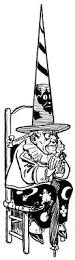 The original
Wicked Witch
of the WestI mean think about it. If you had a...


![[image error]](http://3.bp.blogspot.com/-Hv3j_kZuSSI/Ve7_1AwRR9I/AAAAAAAABrE/ZqA4SbTXWeo/s1600/Aftermath.jpg)
![[image error]](http://3.bp.blogspot.com/-vONCFvTjT2o/VeRFevCgR2I/AAAAAAAABqI/flavbmWY6kA/s1600/bird_flu_2.jpg)