Carrie Bailey Allen's Blog, page 2
June 20, 2016
On Being Happy and #OwnYourOwn
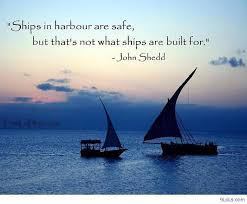
I got a card from my dad’s girlfriend today, a simple blue hue with a line of sailing ships.
A few weeks ago, I had sent my father a handful of Chinese paintbrushes. I’d bought fifty-seven and decided I needed to share the wealth. It took me a month to choose the ones I would send him as I worried his eyesight might have began to fail and they would not be used. My father’s style has always been strong on composition and weak on proportions with distorted hands, awkwardly set noses and squat lines. The colors vary, but the palette always seemed dark and murky, over-mixed, over dramatic as if it were attempting to capture an audience by direct visual assault.
After reading the card, I closed it and realized the simple blue drawing was the docks in Portland where my father has been keeping his two sail boats. I didn’t recognize it as his work. So cheerful. So serene. Even the sea lacked the turbulance I had come to associate with his inner world. Many people had described his life in Dakota running around the reservations in the sixties and seventies, angry and drunk, looking for solutions to the unfairness of life through the American Indian Movement, a marriage that didn’t last, in work he couldn’t maintain. He was a cursed man back then, but now, here he was joyfully painting the docks in Oregon.
Mary, his girlfriend, had enclosed photos of his other paintings. The interior of his boat. Sails. Blue skies. Happiness.
The man I got to know as a young adult was not the man my mother said she knew years before. When her second husband dragged me down the wooden stairs by my arm and slapped my face over and over, I was eleven years old. He demanded to know if I thought I was abused. I had not made up my mind until that moment. I said yes. And he hit me. I said no and he hit me again. It kept going like that for awhile. He was huge. He screamed in my face as I walked across the living room to the front door. He told me my father was an asshole. I wasn’t angry. I was sad that I couldn’t defend a man I didn’t know. My stepfather had never met him either, but he knew my father did not pay the $75.00 per month for the support of my sister and I. Something he wanted to take from our skin.
Whatever the man was like, I figured he could not be much worse than my stepfather. I had seen his paintings of old ships tilted in dark waters that raised up alongside toward the slightly titled mast. Raised by the ocean, I knew the waters never looked so blue and brown at the same time. The ocean was gray or green or blue, but one should never take a pigment like raw umber straight from the tube and set it against a navy toned mixture.
As soon as I could drive, I came to his house demanding to know who he was and ready to show him that I’d exceeded his skill at art, his educational achievements – which were nil, and planned a decent life for myself – no thanks to him. The old man listened, smoked his pipe and started debating philosophy. It worked. I came back. Again and again. All doubts that I was his daughter wafted away with the scent of tobacco. He told me stories of life on the plains that others had told him. I had heard some of them from my grandmother, they were stories of our ancestors, but I had never been old enough to recognize that the animals were metaphors like Aesop’s fables. Teachers read these stories to children. Animism. But the animals that talked in their stories with vibrant drawings were never animals that taught the lessons a specific individual needed at that moment, tailored and reworked from memory for the present. It was as if I only seen snake skins and never snakes.
I found him easy to forgive.
Mary always hovered around him with lunch or ready to interrupt if he was overwhelmed by the conversations with his estranged daughter. She focused him. Her mother had come to the states from Northern India and met her father on a reservation in California. She appeared to be the only person in the world with whom he was entirely vulnerable, although his version of how their relationship worked sounded archaic, mysognistic and left the woman’s eyes rolling where he could not see. They separated for a while when I was in my twenties, but she often came around during that time and they reunited within a year or two, resuming their very simple life together. He asked me once while she was away if he should take her back. I believe he would have found a reason, but he needed to know I would not respect him less. I think I respected him more.
I have often wondered how a person so vilified by my mother and so destructive in his youth could find so much peace in the second half of his life. It’s in his paintings, his voice, his letters and on his face. The calm seas. The cheerful primary colors. I doubt he even used a tube of brown paint on the card I held.
I suppose what I learned from my father about happiness is that it has nothing to do with the material world. It cannot be found in advancing up the ladders of social hierarchies. It’s not in a bottle. It doesn’t come with success or prosperity or any kind, although happiness can precede success and financial stability. Fairness and equality does not create an environment of happiness. No matter how much faith we put in the political process, it cannot change our state of mind. Happiness begins inside and radiates outward. Friends cannot make us happy. It isn’t given or received by others. Although happiness often accompanies love, love is also attracted to happiness, making it impossible to tell which actually comes first to a person’s life. Sometimes, we can’t be happy until we reject people we love and turn away the needs of others we cannot meet.
I think my father found happiness more easily than other people, because he always was a bit contrary and naturally rejected popular wisdom and the status quo.
Popular wisdom will tell you that meaningful relationships are the foundation of mental health, but they never tell you that it’s okay to just walk away from people who are bringing you down or generally reject the parts of society that aren’t working for you. The definition of mental health isn’t being happy, but more like not being so unhappy that you burden other people with it. Those are some exceptionally low standards.
Today, thirteen percent of Americans are on anti-depressants. And I personally suspect the medical community knows as little about helping people find happiness as they do about turning the tide on the obesity epidemic. Science, which I love but do not reduce to dogma, can give us facts gleaned from studies of multiple variables in people’s lives that coexist with happiness, but they do not easily account for the complexity of our consciousness or the murky social world where the filters of our perception and the corrosion of stored and retrieved memories confuse the process of understanding our own emotional experiences.
We know the brain is matter and that thoughts and feelings have chemical and electrical processes, but you cannot find happiness during an autopsy and the complex consciousness that accompanies it is similarly missing in the physical body when its alive. Western thought has not been able to explain this phenomena for many centuries, although the new insight in physics that the world itself is like a hologram, echoes many non-Western views about reality that help our consciousness make more sense.
Earlier this year, I gave up trying to reconcile with my more difficult family members and protect what happiness I could create in my life. I had sought therapy for the process like a good citizen, but I found myself directed to accept mistreatment from other people. I’ve heard so many people subtly imply that their ability to get along with an exe for the sake of their kids or reconcile with a difficult family member or manage their jealousy with an unfaithful partner or cope with an abusive boss is proof that they are mature and well adjusted people. The message is always the same. The problem is not how people treat you, but how you well you handle it. Having worked in schools, I was familiar with the process, because I’d seen the children who reacted most strongly to bullying disciplined. The instigators were only noticed if they failed to cover up their behavior with proper repentance or general subterfuge.
I told my therapist I was satisfied. I’d started therapy to help with a personal crisis over a year before, but he threw a tantrum and yelled at me for firing him. In retrospect, I should have expected it. People encourage quiet suffering and praise us for denying pain, because it keeps the boat from rocking. It feels safe even if you’re slowly sinking. Deny it. Your up to your ankles in sea water. Grab a bucket and start bailing. Don’t swim. You don’t know if you can swim. Don’t even look at the water. Don’t rock the boat.
If there is one thing I learned from my father about how he went from turbulence to inner peace, it’s that you have to live bravely and not fear rocking a sinking boat. It seems so obvious, but do we trust ourselves to know when it’s time to jump?
I have been ridiculously pleased with my life for the last three months. I let go of everything that didn’t work for me including the idea that I could construct happiness by following rules and making other people happy. I headed directly into conflict through uncertain waters. Yes, I have not finished with the sea metaphors. I navigated poorly. I capsized. I weathered a few storms. I believed in my destination. I arrived.
No permission. No approval. Nothing changed, but everything is better.
If happiness is your destination, does it matter as much what else you find there?


February 9, 2016
Post apocalyptic or Post-apocalyptic or Postapocalyptic?
I’m going to make an argument for doing the unthinkable. I’m going to suggest something so hideous and so horrible that some of you will stop reading this post and immediately rush to twitter to tell me how wrong I am.
I am prepared.
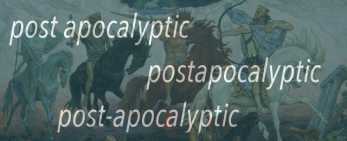
Consider for a moment that “post apocalyptic” does not require a hyphen. I know! It does, but what if really, it doesn’t? What if writing “post apocalyptic” or “postapocalyptic” will not bring on the apocalypse? What if the hyphen is not required? What if four distinctly colored horses and four personifications of factors of social collapse will not suddenly appear, travel to your house and rush inside to punish you for your wicked wicked ways?
I understand why we hyphen words. We are supposed hyphen “two or more words that come before a noun and act as a single idea.” It’s one of the rules. Another rule is to “only hyphen words when it serves a purpose.”
I know what some of you are thinking.
“Post” is a prefix. Those rules don’t apply. It could be “postapocalyptic” but for some reason it’s not. Why not? Because, rules. A system of rules we need. We can’t just write “post” and not connect it to “apocalyptic” without a hyphen. It’s a prefix! It is not an independent word and anyone who doesn’t understand should have their computers taken away.
Yeah, okay, but what about their phones? Have you considered how tedious it can be to write “post-apocalyptic” fiction half a dozen times when you’re blogging about “post-apocalyptic” fiction while traveling? No, you only care about the rules.
Search engines can read “post apocalyptic” as “post-apocalyptic” and “postapocalyptic,” IF they are programmed to make that distinction, because it is a simple one. The hyphen does not change how we interpret the meaning.
So, what if the only reason to hyphen “post-apocalyptic” is because we reject the post-as-a-preposition argument? Truly desperate people sometimes attempt to classify “post” in this context as preposition just to avoid the hyphen.
They argue that “post” indicates a position in time just like the words “before” and “during.” It’s a valiant attempt to avoid switching screens from letters to symbols, but could we really substitute it for an actual preposition?
“What are you doing post you finish your writing this morning?”
“Did you want coffee during or post the movie?”
It’s post modern grammar! Yay for grammar deconstruction. Now, no one can be sure what to write.
No, it just doesn’t work and it doesn’t rule out “postapocalyptic” as the obvious evolution of the term for common use. In fact, I have noticed – many times – that my spell check doesn’t recognize “postapocalyptic” without a space. And isn’t that the real reason people cling to the hyphen? It can’t be “post apocalyptic,” because prefixes AND who can tolerate the red underline? A whole document with underlines, even if correct, pain some writers.
Believe it or not hyphen-lovers, but “postapocalyptic” is popping up all over more reputable publications for a good reason. It’s indisputably more justifiable than “post apocalyptic” or “post-apocalyptic” given the almighty rules of grammar and the increased use of the term.
And I’m sure if you read this far, the logic behind dropping the hyphen is getting more clear. But, I believe it’s as much of a mistake as starting a sentence with a conjunction. Which I love. But, let’s discuss the rise of “postapocalyptic” as the most correct way to write what started as “post-apocalyptic.”
Not all search engines on all websites are created and maintained as meticulously as Google or Bing. In many instances, word substitutions have to be established. That applies to automated library systems, online databases, book vendors, sites for movie reviews… many online resources simply have not been programmed to recognize that “post apocalyptic” = “postapocalyptic” = “post-apocalyptic.” Even if it is possible, site administrators may have higher priorities than sorting out the millions of interesting details of communication. Or worse, they may even assume the substitution has been established when it hasn’t.
Yet, does the term “postapocalyptic” differ in use from the apocalyptic? NOT ENOUGH. Trust me. I write books that take place 500 years after the apocalypse. I’ve been told I should call them dystopian fiction, because too many people feel apocalyptic fiction starts 5 mins before the end of the world and “post-apocalyptic” fiction starts 5 mins post. And they do so, because “postapocalyptic” sounds more smart. More mysterious. It’s deeper. Ten minutes of profundity. In sum, people search for “postapocalyptic” books when they actually want “apocalyptic” work.
Though no rules of grammar can support it, I typically use “post apocalyptic” rather than the spaceless and hyphened alternatives. Though offensive and unjustifiable, it is the most technologically compatible expression of the term as it accommodates the greatest number of fools. Also, it appeals to rebellious, artistic side.
I believe the rules of grammar should adjust to accommodate computational linguistics, laziness and sloth. As the generation that never learned cursive matures, we need to create new rules to justify typing “post apocalyptic” rather than petitioning our software writers to remove the red lines.
Surely if a species does not adapt, it’s apt to perish in a blur of famine, pestilence, war and death, right? So, let’s consider the unthinkable. Adopt one main rule:
The primary function of grammar is to improve communication.
Should we not consider how people communicate? Do we not communicate with the computer as well as through them?
We can say no to a hyphen and leave the space. We don’t have to spell “knight” with letters wholly and totally divorced from being able to read it aloud. We can make our language make sense. We are free to use our language for communication and not arbitrarily follow rules for the sake of rules…
Or not…
January 26, 2016
9 Parts of Speech and the F-Word
Originally written as homage to the nine parts of speech for National Punctuation Day, this post has been brought out of the archives due to popular demand.
Warning: while in the pursuit of education, we sometimes fall short of good taste as in the case of this post wherein one expletive has been explored in its various manifestations within the context of English language usage. From the Peevish Penman archives 2010.
Indeed, some people weren’t paying attention during grammar school and missed their opportunity to learn the nine parts of speech. Many of them were busy hurling expletives at their instructors or paying attention to what the members of the opposite sex were occupied doing instead. In order to remedy these gaps, these vast chasms in their educational attainment, one of the Peevish Penman editors has put together a lesson plan catering to their diverse interests.
On a related note, we will also be proving definitively that one word in the English dictionary can in fact be used to fill each and every one of the nine parts of speech and that word is fuck.
NOUNS:
A noun is a word used to name something: a person/animal, a place, a thing, or an idea. For example: What a fucker. The word fucker is the noun. There are many different types of nouns. Nouns can be singular or plural.
for fuck’s sake vs. stupid fucks
In this example, when we ask the question for whose sake the answer is for fuck, which denotes a single individual rather than many as in many stupid fucks. Nouns can be common or proper.
What a fuck vs. He is the Fuck of all fucks
Proper nouns are capitalized as you can observe. Nouns can also be concrete or abstract. A dumb fuck would an example of a concrete noun, because the noun in question is a tangible person with a physical existence whereas the word fuck in the question who the fuck does not relate to any material object of a known size shape or quantity and is therefore abstract as an idea like justice or perspicacity.
Nouns can also be gerunds, which generally end in “ing.” Please note that this applies only when the word fills the role of a noun and not “ing” verbs, which are often preceded by the word am. In this example the word fucking functions clearly as a noun: Fucking is fucking fine. And here it does NOT: He/she is fucking.
PRONOUNS:
Another important part of speech is the pronoun. They are words that replace nouns and eliminate the need for repetition. The most common way to employ the word fuck as a pronoun is by determining which noun is being replaced and adding the word that in front of fuck.
In the sentence John went to the bakery and bought a loaf of bread, we simply have to replace John with a word. He went to the bakery… is the most common choice of pronoun, but as our language shifts to reflect the changing times it is becoming increasingly more common to see the word he passed over in favor of the following example:
That fuck went to the bakery and bought a loaf of bread.
In this situation the pronoun is a personal pronoun that replaces the subject of the sentence. Personal pronouns may be subjects, objects, or possessives. It is also a demonstrative pronoun because it indicates a noun.
Q: Which fuck?
A: That fuck.
Reflexive pronouns name a receiver of an action who is identical to the doer of the action. One example of a sentence without the use of a pronoun would be Jennifer walked her dog all by Jennifer’s self today. This repetition is cumbersome and problematic, but easily solved with a reflexive pronoun. Indeed it’s more effectively expressed by substituting Jennifer’s self with a reflexive pronoun such as herself or by saying:
Jennifer walked her dog all by her own fucking self today.
Indefinite Pronouns refer to non-specific persons and things as in: Bruce and Sonali kissed one a-fucking nother.
Interrogative pronouns introduce questions such as: Who the fuck? Which fuck? What fucker? How the fuck? Whose fucking? To whom the fuck?
It can, of course, be argued that these examples of interrogative pronouns do not employ the word fuck in a distinct and necessary manner; however the fact that each statement can and does regularly stand alone as a question proves its independence from other parts of speech. Each forms a complete question requires no other words to make sense and solicit a sensical response. Even more, in today’s language use, it is common to forgo the formal distinctions between these previous examples for an all encompassing:
Fuuuuuuuck?!
Often used when someone wants the answer to the question, but knows they’re not going to get it. In this case it is most appropriate to draw out the “u” sound for emphasis that it is not an interjection, another important but distinct part of speech.
Relative pronouns introduce dependent clauses and refers to a person or thing already mentioned in the sentence (i.e. the antecedent). e.g whoever the fuck, whomever the fuck, which fucking, that fuck…. The concept can be further applied for this sort of pronoun.
ADJECTIVES:
An adjective modifies (describes) a noun or pronoun.
What a fucking fuck.
They can form comparisons, normally preceded by more or be used to form superlatives, commonly expressed with the word most as in:
That was more fucked up than anything I’ve ever seen.
That was the most fucked up thing I have ever seen.
VERBS:
Verbs generally express action or a state of being. There are several classifications for verbs- action verbs,/linking verbs, main verbs/auxiliary verbs, transitive/intransitive and phrasal verbs. Probably the word fuck began as a verb; although, the etymology of the word has been debated and somewhat unclear as writers, editors, and publishers neglected using the word prior to the advent of the internet.
Main verbs stand alone as in: Fuck him/her.
The verb tense in the previous sentence is called imperative and expresses a command. Auxiliary verbs, also called helping verbs, serve as support to the main verb.
My ex-boyfriend just fucking draws all day.
Verbs can be transitive or intransitive. Transitive Verbs require a direct object in order to make sense to the listener or reader: Hassan fucks up. Means nothing without an object such as everything: Hassan fucks up everything.
Intransitive Verbs do not need direct objects to make them meaningful. For example: Sarah fucks. In this case we do not need any clarification as to what Sarah fucks in order to ascertain that she is not chaste.
ADVERBS:
An adverb is a word that modifies an action verb, an adjective or another adverb.
He/she is fucking fucked.
In this case fucked is the noun, which fucking modifies.
Relative adverbs introduce questions and dependent adverbial clauses. They answer the questions fuck when? and fuck where?
Fuck when I had to go get my car fixed…
Again it is important to distinguish between the usage in the previous sentence and when it is used as an interjection. The way we can tell that fuck is not being used as an interjection depends on a combination of the speed at which the person uses the word and punctuation. The same sentence punctuated differently would transform fuck into an interjection: Fuck! When I had to go get my car fixed… This sentence reads differently and is pronounced differently, because the word fuck functions differently.
CONJUNCTIONS:
There are seven coordinating conjunctions: For fucking, And fucking, nor fucking, but fucking, or fucking, yet fucking, so fucking.
Keisha eats ham sandwiches but fucking Mike prefers tuna.
Without the words but fucking, the sentences would be separated as: Keisha eats ham sandwiches. Mike prefers tuna.
In this case fucking could precede Mike as an adjective that describes him, but it does not have to do so. Always consider the writer or speaker’s intent. If fucking Mike is not something the speaker would normally use in their expressions but but fucking is a common feature, the word fuck has most certainly been employed by the person to join two sentences and therefore formed and integral part of a conjunction.
Correlative conjunctions also join ideas, but they work in pairs. They are: Both fucking…and fucking, neither…fucking nor, fucking whether…or, either fucking…or, not fucking only…but fucking also.
PREPOSITIONS:
Prepositions are words that, like conjunctions, connect a noun or pronoun to another word in a sentence. The easiest way to determine whether or not a word is a preposition is with the phrase:
Anywhere a mouse can go…
But more often we compile lists to gain a clearer view of what words function together as prepositions. Some common prepositions: About, Before, Down, Into, Through, Above, Behind, During, Like, To, Across, Below, Except, Of, Toward, After, Beneath, For, Off, Under, Among, Beside, From, On, Up, Around, Between, In, Over, With, At, By, Instead of, Since, Without, and Fuck.
Q: So, where’s the mouse?
A: Fuck if I know.
ARTICLES:
Articles are the, a, an, and fuck.
As you can see the article the is virtually interchangeable with the word fuck:
The face sees its reflection in the mirror.
Fuck face sees its reflection in the mirror.
INTERJECTIONS:
Interjections are words used to express emotional states. They can usually be found in narrative writing, interviews, and in spoken English. They can stand alone. As we’ve previously alluded that would be:
Fucking awesome!
Here’s a poem to help you remember them all:
THE NINE PARTS FUCKS OF SPEECH
Three little words fucks you often see,
Are articles– a, an, and the.
A noun‘s the name of anything
As school, garden, hoop fuck, or swing.
An Fucking adjectives tell the kind of noun-
Great, small, pretty, white, or brown.
Instead of nouns the pronouns stand-
Her head, his face, your arm fuck, my hand.
Verbs tell of something to be done,
To read To fuck, sing, jump, or run.
How things are done fuck the adverbs tell,
As slowly, quickly, ill, fucked up, or well.
Conjunctions join words together,
As in men and fucking women, wind or fucking weather.
The prepositions stand before
A noun, as at or through the the fucking door.
The interjection shows fucking shows surprise,
As ah FUCK! How fucking pretty- Oh FUCK! how wise.
The whole fucks are called fucked nine parts fucks of speech fuck,
Which Fuck reading fucking, writing fucking, speaking fucking teach fuck.
January 25, 2016
Pros and Cons of Professionalism
One month of my life has disappeared while I combined blogs and websites into this new and improved model. Much coffee has been consumed. Yes, I decided to clear out my writing folders and it didn’t end until I had a basic understanding of php and sql. That’s right. I’m finally hosting my own website.
Web design inspires me. It reminds me of the pre-internet era computer users who feared the awesome power of buttons. We don’t feel that way now. And that’s sad, because I can’t justify to my non-website designing friends why I haven’t been available and why my site looks more basic while I was avoiding everyone.
My abilities as a writer could not keep up with my ambitions since I published my first novel last year. I needed to assess my strengths and weaknesses. So, I wrote out a business plan. Some conclusions came quick and obvious. Others felt as I had finally noticed the house was on fire.
I needed to hire a proof-reader. I cannot see tpyos. And I needed to simplify my strategy to find readers with social media. Too many accounts. Fortunately, good editors work for reasonable rates.
And I needed a mobile site where I could sell work with few steps and less Amazon. Re-investing my writing income makes sense. Giving everything I earned to GoDaddy just for a website where I can use my favicon. Some bitterness there.
Fortunately, I identified many areas where I could reach a higher level of professionalism on my own and web design was it. And I can collaborate with artists without learning, buying or illegally downloading glorious, but incredibly expensive software.
PROS of being more professional
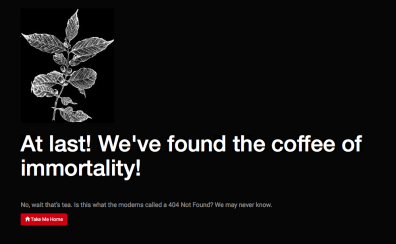
I can make neat 404 pages (and love the simplicity of not trying to use godaddy and blogger at the same pointless time? Yes).
404 Page
My control over my site is limited by my ability to code it. Wahahahaaha!
Money I might have spent on something I can do, like website maintenance, is invested on aspects of writing that I hate, like proof-reading.
I can sell my books online directly from my website. Well, soon I can. Right now, I can link directly my files as I do for a free copy of the Reptilian Guide.
And I can finally start organizing a choose your own adventure style book with pixel graphics and chiptunes that will make your eyes AND ears weep.
CONS
I just spent one month not writing OR editing.
I am still working on figuring out where to put the missing containers.
I kind of miss Blogger. My final heroic effort to save our relationship ended with me installing bootstrap on classic Blogger. And then, I just walked away.
This level of commitment to a specific genre, world and set of characters feels good, but scary.
However,
Finding focus with my coffee novels outweighs the investment. I often talk about minimalism and how it improves my life, but it’s just too true like using a push mower to cut an overgrown field and then revealing a fully functional motorized unit with a seat warmer and full tank of petrol. Reducing can be tedious and terrible. Sure.
But,
As this is my first post on WordPress and my first blog post from my own site, I just want to say that I’m excited again about writing. Like falling in love. I’m even ENJOYING the edits on my second novel and incredibly relieved to know someone else will stress over tidying the final product. Good decision on my part.
Maybe it would be easier if I didn’t want to create the best possible reading experience. Maybe I’m still too artist and not enough businessman. Maybe I shouldn’t be as committed to self-publishing as I am to writing. Maybe to a lot of things.
But,
Right now, these pros do outweigh the cons and I’m still enjoying all of it.
January 20, 2016
Publish VS Self-Publish: Know Before You Start
Anyone can learn to write using MS Word or Scrivener. And anyone can learn to format and create ebooks and order printed copies, which means anyone can publish you. We should be talking in terms of a continuum of publication options between the two tired standards o...
Publish VS Self-Publish
You write a book. You have options. Most people categorize those options as either finding someone to publish their book for them or doing it themselves. But, if we unravel the mystery of publishing in 2016, it’s much more complex.
Anyone can learn to write using MS Word or Scrivener. And anyone can learn to format and create ebooks and order printed copies, which means anyone can publish you. We should be talking in terms of a continuum of publication options between the two tired standards of publishing past.
1. Traditional Publishing
Convince an agent to represent your book to one of the major publishers who will love it, create it and distribute it if it ever finds its way to the top of their slushpile. Although this sounds like a fool proof plan for fame and fortune to some, the vast and expansive majority of first time authors who are published by the few major publishers are not able to support themselves from one book. But, the professionalism of their finished product is high and the bragging rights last a lifetime.
It’s something to think about for most writers.
2. 100% Self-Publishing
You take your files and turn them into ebook files. It’s quite simple. If you can save your work as a word document or a PDF, you can upload it into a file converter. I don’t mean you can make it look good with a file converter, but you can create ebook files with minimal button clicking involved. To get more professional, get writers find apps like Sigil, and make great friends with all their features.
You edit. You format. You make the cover. You ask each person you meet individually if they will read it. If you have no money to invest in developing your work, this may be the only way to start, but your weakness in design or marketing or whatever area will show.
3. Small Press
I’ve met quite a few people who believe that all self-published books earn less than 100 USD. And that may be true for the writers who couldn’t find a publisher and decided to self-publish as a second option. BECAUSE… if you want someone else to publish you, you will find someone to publish you, UNLESS your work is to the readers what gum on the bottom of a shoe is to a pterodactyl.
A small press is any press operating with a budget less than 50 million USD annually. That can be a retiree at his home computer in the country working on dial-up or a successful and growing business that turns out quality niche works.
4. Somewhat Self-Publishing
100% Self-Publishing sounds romantic and all rebel against the system, but DO NOT think for one minute that readers do not judge your book by its cover. Unless they LIKE the cover or hear something good about it from someone they trust, the book IS the cover.
And if you’re like me, who uploaded and formatted a draft of my first book without noticing, who may need a professional editor or at least, a professional proofreader. Or you may need help with marketing and website design. Somewhat Self-Publishing is when you have learned your strengths and weakness and decided to pay other people to ensure your work reaches a professional standard.
It is my firm belief that no one should self-publish, because they failed to find a publisher.
And in the end, there is only one true path to success as a writer no matter what route you choose.
Write! Write! Write!
Like every successful businessman, any writer with enough determination will eventually be able to connect a product to the people who want to pay them for it.
I’ve personally never submitted my novels for publication by a small press or a major publisher. I considered it, but the thought decreased my passion for writing. I want to self-publish just as my grandfather did the year I was born. He bought an old printing press and made copies of his writing by setting each letter of each page by hand.
It is a romantic ideal for me, but I also have aspirations to publish other people’s work. I dream of thermal binders and a warehouse of shelving to stock an inventory of warm comfortable escapist scifi.
Yes, it’s good to dream, but it’s even better when you have a plan to go with it.
January 12, 2016
Genesis: A Post-Apocalyptic Version
I decided my Immortal Coffee novels needed a dogmatic narrative that served as a quasi-scientific creation story to tell their kids in the aftermath of the apocalypse. It had to record knowledge that would be have largely been lost while interpreting it with the values of the culture that survived.
Usually I just keep things like this in my back story notes, but a lot of people contributed its development and I'd love to hear any feedback or reflections.
Before the beginning, there was no...
3 Good Reasons to Follow and 3 Good Reasons Unfollow
After doing an inventory, I found about two thousand people who were dragging down my social media experience or simply not adding to it. So, I did a MASSIVE purge based on the following criteria:
1. You RETWEET with spammy hashtags - I can only see the cover o...
A Librarian's Perspective on Book Reviews
Have you seen the ratings fiasco on Amazon for Chuck Wendig's Aftermath? The #1 selling author is used to 4.5 stars and suddenly he's getting a 2.5 star rating. However, it's probably selling a lot more copies, because of the negative ratings.
Is it a smear campaign? A dark anti-Chuck conspiracy? Or is it just not what Star Wars fans want in their genre? Or perhaps it really just has a weak plot with cl...
The Author and The Persona
Earlier this year a guy I dated in college, asked me how to be popular. Online. He wanted lots and lots of people following him so he could look more important.
Naturally, he works in foreign affairs. He would never admit otherwise, but it wasn't so he could help other people. He's also been interested in art. He asked me how to do that, too.
I've never had answers to questions like these. I don't know anything about art. When I was younger, I thought good art was putting a dollar bill on the e...