
Tim Hawken's Blog, page 6
April 30, 2018
Books, Beers & Boobies
As part of the launch of If Kisses Cured Cancer I'm doing a series of events to help raise money for Love Your Sister.
If you're in West Australia, Victoria, or Queensland, there's a night coming to a location near you this May. Here is the poster for the tour.
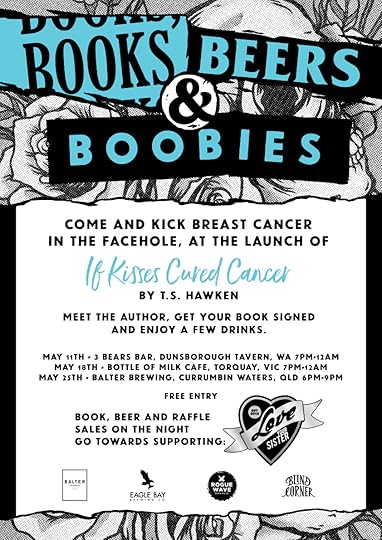
Drink sales on the nights will go towards Love Your Sister thanks to the generous support of Balter Brewing, Eagle Bay Brewing, Rogue Wave Brewing and Blind Corner Wines. There will also be some epic raffle prizes up for grabs at each event thanks to Quiksilver, Rip Curl, Billabong, Audiofly Headphones and Platter Co by Jade.
Hope to see you there for a beer!
Tim


April 20, 2018
Behind The Scenes of a Book Cover

I was standing on a clifftop watching the sunrise, holding Stacey’s hand. Her husband watched us from a distance.
It was the first photo shoot I’d ever had to do, so was quite nervous.
“It’s really weird holding someone’s hand who’s not your partner,” Stacey commented.
“I know,” I replied. “Imagine if you had to do porn.”
I think that made her uncomfortable. I seem to have a knack for making awkward situations even more so. Maybe I just should have said: “imagine if you had to do a kissing scene.” In hindsight, that would have been a better call.
We were standing on the cliff to get an image for my latest novel If Kisses Cured Cancer. Funnily enough, when thinking of what should go on the cover, the designer Sarah and I did talk about an image of two lovers kissing. That's the standard 'love story' cover that tells readers what they're getting themselves into at a glance. Instead, we decided to twist things and have two people holding hands, looking into a sunrise. To add some further quirk, the girl would be in a hospital gown, which both reflected the plot and would make people look closer to check what she was wearing. When trying to figure out people who had the body type and hair colour of the lead female character, Sarah had suggested Stacey. We had worked together before in regular jobs at Bellroy. A lightbulb went off. She was the perfect fit. So, I called her up after about a year of no contact and asked: “hey, want to come and hold my hand at 5.30am this Friday?” She’s a good sport, so agreed.
We were very lucky that morning. The sunrise was incredible. I’d scouted a location at Bird Rock the day before with Eliza Selkirk, the photographer. It perfectly suited the feel of the book — coastal, overlooking the ocean above a steep cliff drop. One problem that morning was that it was cold. I was shivering in jeans and a loose t-shirt. Poor Stacey had to wear the hospital gown and stand in bare feet on the dewy grass. Instead of complaining, we caught up. We chatted about her kids, my kids, this new book I’d been working on. Then, talk turned to holding hands. How finger grip was important and how we couldn’t get our thumbs right.

The photographer kept telling us off because it didn’t look natural. It didn’t feel natural either. We needed to relax. The stunning sunrise was enough to divert our attention on more important things, so we finally got the shot we were after.
After the shoot we all headed to a nearby cafe for breakfast to warm up. Stacey felt bad when I sprung for her and her family's food. I'm not sure why. She'd just gotten up before dawn and driven them down the coast to do a massive favour for me. What's a couple of slices of fruit toast and some coffee, when you've just awkwardly held someone's hand and heard them draw ridiculous comparisons to the adult film industry? I'm lucky she didn't want lobster-stuffed breakfast burritos.
After that, I went through the photos at Eliza's house and sorted through the hundred-odd shots she had taken. The problem was that they were all amazing. We whittled them down to the top 50 and let Sarah take her pick of pics. Sarah worked her design magic, laid on the title and supporting blurb on top and generally made things look awesome. Here's a look at how it turned out...
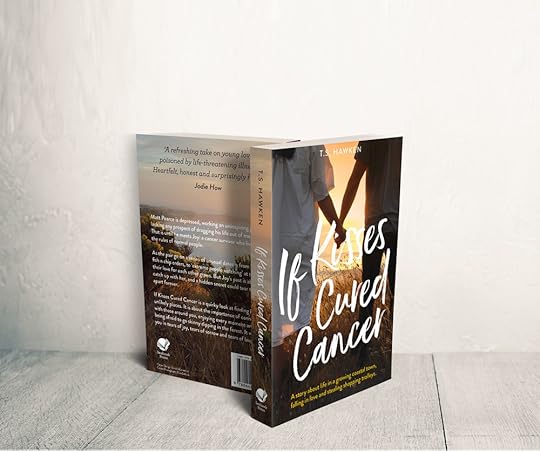
If Kisses Cured Cancer: a story about life in a growing coastal town, falling in love and stealing shopping trolleys.
I’ve thought a lot about holding hands since then. Even though I would consider Stacey and I friends, we couldn’t get it right. Was it a lack of chemistry? Was it nervousness? Was it just our hands physically didn’t connect properly? I tend to think it was the nervousness. You need to be comfortable to be able to undertake such a natural action. When I think back to the first time I held my wife’s hand (in the dark of a movie theatre during our first date) we couldn’t get it right either. It took practice. We needed to get used to each other. Now we nail it — perfect grip, relaxed fingers intertwined like they belong together. It speaks volumes about how we feel in the other’s presence.
I now wonder if cultivating a practice of holding other people’s hands would help with regular human bonding. If pushing outside our comfort zones in that way would have flow-on effects into other parts of our lives, growing confidence to try other scary but important things. People have cuddling parties, so why not hand-holding parties too? No sex, or chance of romance involved. Just a chance to get comfortable in your own skin, with the feeling of someone else’s against yours. A chance to practice not saying silly things in awkward situations. It might be a simple, if initially uncomfortable, way of finding confidence in unusual situations.
If you hear of one, sign me up.
-------
To get your own copy of If Kisses Cured Cancer head here.
You can also get extra content about the making of the book (and special deals for the release) by signing up to my newsletter here.
April 15, 2018
The Inspiration Behind If Kisses Cured Cancer
They say your best work comes when you write what you know. So, when it came to penning my latest book, I made the decision to weave in two things I have lived and breathed for quite some time. The first is what it's like to love someone who has a terminal illness. Those raw ups and downs and intimate emotions that hammer through your body - the fear and anxiety, but also the deep sense of closeness and connection. The second is what it's like to grow up in a small coastal town. I've spent my entire life living in different beach havens, from Mount Maunganui in New Zealand, to Torquay and Dunsborough in Australia. Each of these places have their different peculiarities, but what's more striking is how similar they are in certain ways. This article gives a behind the scenes look at some of the ways I've threaded each theme throughout If Kisses Cured Cancer.
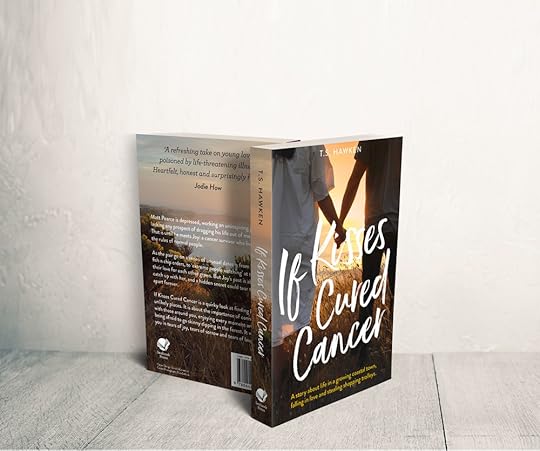
If Kisses Cured Cancer: A story about life in a growing coastal town, falling in love and stealing shopping trolleys.
Being In Love With Someone Who Has Cancer
It's tough loving someone who might die at any time. Harder still for the actual person. That's the most succinct way I can put it. But, obviously, there is so much more nuance to a relationship with someone who is battling this disease. I've written about the experience here, here, here, here, here and here and still haven't been able to properly articulate things. Fiction has the benefit of being able to explore the topic more broadly, using specifics of course, but also working through scenarios that I haven't had to go through personally, yet have seen variations of with friends.
The thing that I've found most striking throughout the last decade isn't the hardship you go through either. It doesn't take a whole lot of imagination to think about how you'd feel if your partner was diagnosed with the big C. It's more about the strange silver linings - like how the important things in life come into laser-sharp focus, how you become more determined than ever to lead a life you're excited about, or how you forgive each other a thousand little things that before would have pissed you off no end. There are also the random things you think day-to-day that you'd never say aloud, but somehow feel okay to put into a fiction book under the 'disguise' of a character's ravings...

And then there are the thoughts about the afterlife. If you've read any of my other books, it would be no surprise that I've given a lot of imaginative thought to Heaven and Hell. But, when thinking about it really seriously, it's a hard thing to grasp. A big part of me thinks that when you die that's it. It's just over. But that's a really hard concept to come to terms with, mostly because you just can't imagine what it would be like not to feel. Not even picturing it as a neverending sleep does the idea any justice for me.

So, you'll find a few wonderings scattered through the book, that I hope are interesting and spark a chain of contemplation in your own quiet moments. I firmly believe that thinking about and confronting the idea of death is very, very good for the soul. It helps you live with more intention. There are other things too, but it would take a whole book to explain, and you're better off reading about it a novel aimed at entertainment than a ridiculous 90,000-word blog post.
Which brings me to the other key part of inspiration for If Kisses Cured Cancer...
GROWING UP IN A SMALL COASTAL TOWN
It's like I've spent my life moving from big towns to small towns, that then get too big to be called small any more. They've all gone through the growth process of being quaint tourist destinations, to places that are packed with people year round. And, while each one is unique in its own way, there are characters and patterns you see everywhere. All of the locals have a love/hate relationship with the 'touros' who fuel the economy of their hamlet. Everywhere has an old woman or man that has the best rose garden in town. Everywhere has a fish n chippery that's packed on Friday nights. Everywhere has an old tip, or swampland, or dusty old farm that has been converted into the hottest new estate development in town. Everywhere has a pub that started out serving fisherman's baskets and chicken parmas, then eventually turned to making fancy dishes like 'lamb-shank medley with red-wine jus'. (What the fuck is 'jus' anyway? Just call it sauce and dispense with the pretense).

The town in If Kisses Cured Cancer is called Ocean Heads. Those from the Surfcoast in Victoria will quite easily spot the name as an amalgamation of Ocean Grove and Barwon Heads, which are both just down the coast from Torquay. The blend is my way of saying "this isn't Torquay". It's not any one town. It's a mix of many and it's own special place in one. Of course, if you read closely you'll find a few corners with striking similarities to my old stomping grounds. The cover image was even taken around the corner from my parent's house at Bird Rock.
If you'd like to dive into the world of Ocean Heads and get an inside look at the relationship between locals Matt and Joy, you can preorder your own copy on Amazon here.
If you'd like to get some exclusive content around the release (like this article) then sign up to my newsletter.
December 10, 2017
Inside Pacsafe's Brand Story (Or, A Bag Full Of Yarns)
Early this year I was contacted by bag brand Pacsafe about delving into their history and articulating a brand story for them. With their 20th anniversary just around the corner, it was a great time to revisit how things began, uncover war stories from the 'startup days' and pull together something short, yet heartfelt, that spoke about their two decades of delivering anti-theft travel solutions to the world.
Considering their two founders, Rob and Magnus, are both total characters, it was a really cool project. I flew up to Hong Kong to meet them, shared a few too many red wines and poured through their archives together.

The hardest part of having such rich source material is having to chop things out. For example, in the spirit of brevity, I had to ditch the fact that Rob and Magnus worked on superyachts together. That their first gig involved taking watch during the graveyard shift, and they somehow found a secret bilge storage full of beer. Every night, they did their 'duty' as sentinels over the inky waters of the Mediterranean, knocking back a few cold ones. Just before the trip finished, they shared what was left of the stash with the rest of the crew - a total of 3 beers. I also cut out that in the early days, their filing cabinet got really bottom heavy, because everything was being filed under T for "The" (the invoices, the orders, the patents).
The first draft came out as pretty generic (as first drafts often do). As far as brand stories go, this is normally a way for me to simply get my ideas in order, make sure I've got the facts straight, and ensure I'm keeping all the 'good stuff'.
After that, it was about taking a basic 'Pacsafe started in 1998, yada yada yada, into a piece with some more punch to it'. Inspired by a really cool brand piece I had seen by Yeti (whose overall copywriting is top notch by the way), I turned Pacsafe's story into an open letter from the founders.
Here's what came out the other end...
PacsafeThe original in anti-theft carry solutions
We’ve spent most of our lives traveling the world and seeking out adventure. Trekking through
Asia, hitchhiking through Europe and sailing high seas.
We’ve felt the thrill of coming across secret alleys in bustling cities, the joy of having that first
bite of a local delicacy, and the awe of standing among ancient ruins.
We’ve also felt the heartbreak of having our passports stolen, the discomfort of trying to sleep
on top of our backpacks to keep them safe, and the anxiety of crossing a sketchy border with
every dollar we own in our pockets.
While some people think the threat of getting ripped off is all part of the adventure, we always knew there had to be a better way. That by taking some extra security with you,
you would enjoy the ride even more. You might even push further out of your comfort zone to experience something new. Something life changing.
That's why in 1998 we started Pacsafe, with a vision to help travelers embrace life's adventures.
For us, the biggest reward is seeing a Pacsafe bag on someone’s back in a customs queue,
or a tote slung over somebody’s shoulder as they navigate a packed city street. We like to think that some of the bounce in their step comes from knowing their gear is secured.
One question we like to ask people that continues to inspire our own journey:
Where is your next adventure taking you?
We’d love Pacsafe to come along for the ride. Safe Travels!
Pacsafe Founders
Rob Schlipper & Magnus McGlashan
-------
To learn more about how I helped Balter Brewing create a fun, yet professional brand voice, head to this post for more insights into the process of copywriting.
November 21, 2017
Inside the Copywriting of Balter (Or, Opening a Can Of Words).
Balter Brewery is known for winning multiple awards for its beers and packaging designs. Everything they do, from product planning to marketing execution, is well thought out, and delivered in a way that feels natural. That kind of combination takes a lot of skill and a bloody lot of hard work. The mastermind behind much of this is Balter's creative director Stirling Howland (although he'd be the first to say it's really the team that makes it happen).
I was fortunate to work with Stirling way back when we were both cutting our teeth at surf brand Billabong. When Balter very first started, he reached out to see if I'd like to have a hand in helping with their copywriting and creating their brand 'voice'. I jumped at the chance. Stirling's aim was to try to bring across the multitude of interesting personalities that made up Balter in a cohesive way. So, together we decided the tone should sound like that friend you have who is super passionate and knowledgeable about what they do, yet still loves to have a laugh and doesn't take themselves too seriously. For me, that concept is best articulated in their beer descriptions.
Here's an example from their IPA.
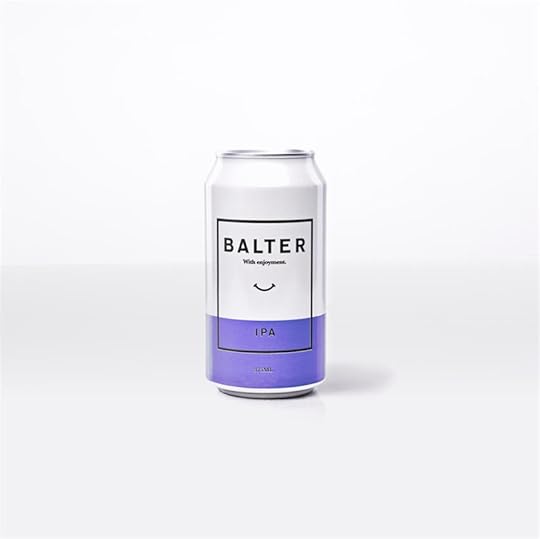
IPA
Drinking this IPA is like frolicking naked through a spring forest, then dive bombing off a mandarin-scented waterfall. We’re not even kidding. Its clean hoppy base offers a relentless, yet refined bitterness complemented by pine and citrus aromatics. Here’s cheers to a big refresher after a hard-won day.
The breakdown of how these descriptors are written comes in three parts:
1. An intro that grabs the attention and is a bit of fun.
Drinking this IPA is like frolicking naked through a spring forest, then dive bombing off a mandarin-scented waterfall. We’re not even kidding.
2. Some tasting notes in beer geek language (I always get these from their Head Brewer, Scott, and then tinker with them a bit to make it all fit in).
Its clean hoppy base offers a relentless, yet refined bitterness complemented by pine and citrus aromatics.
3. A call to action that doesn't really sound like a call to action.
Here’s cheers to a big refresher after a hard-won day.
That combo allows some personality that hopefully makes people want to share what they've just read. Yet, it still shows that Balter knows beer, without coming across as a dickish expert.
Here is my favourite beer descriptor that I've done for them. See if you can tease out how that same format applies to this one:

Black Metal Disco
Like thrash being played on the jazz flute, this stout may seem vicious, but its sweet notes make light in the dark of night. The roasted barley and subtle hops mix deliver espresso, chocolate, and vanilla aromas, all wrapped in a creamy mouthfeel and satisfyingly dry finish. Throw out your preconceived notions of what’s possible, strap on your mirror ball helmet and dive into club sweet stout. This is Black Metal Disco.
I'm lucky enough to continually be involved with most of Balter's copy, although their social media genius is all in-house. To check out more on Balter, and read other samples of their copywriting, head to their website here.
What Book Reviews Are Really For

Some publishers and authors think book reviews are there to help them sell books.
Some reviewers think they are there to either make them look smart, or feel powerful when they rip a writer’s work to pieces.
But, put simply: book reviews are there to help readers find books they will like.That’s it.
Spoilers, flame outs, or claiming “this is the best book ever” aren’t particularly helpful. When I’m on Amazon I generally bypass the 5-star and 1-star reviews altogether. The more thoughtful ones are normally in the 3-star or 4-star section. They tell you what’s good about the book, what could have been better, and let you know other titles the story is similar too. The phrase “If you liked x, then you’ll like this…” is one of my favourites.
As an author, I’ve come to consider these the ‘real’ reviews and would much rather receive something considered, than a throwaway line either blowing smoke, or setting my work on fire. As a reader, these kinds of reviews are an insight into which titles I’m happy to take a chance on and dedicate some precious time to.
Next time you’re writing a review, keep the humble reader in mind. As with any form of public writing, it’s about the audience first and you a very distant second.
— — — —
To receive a FREE digital copy of the first book in the Hellbound Trilogy, as well as writerly updates and other joy in your inbox, sign up here.
October 4, 2017
Scifi Horror, Australian History and the Craft Beer Movement
As I write this, I'm sipping a tasty craft beer and thinking, man, how good is beer?! I'm not sure if I'm genetically predisposed to liking it as an Australian, or if it truly is the most glorious drink on earth.
Here are three other things I've been loving this month and think you might enjoy too...
1. Rick and Morty - If you haven't seen this show, it's like HP Lovecraft had a brainstorm with Bill Hicks and someone captured the results as a twisted cartoon. Part cosmic horror, part satirical insight into life it will take you from "oh man, that's deep" to "I just laughed so hard there's now a poo in my pants". The season 3 finale airs this week on Adult Swim's website (link above), or you can watch on Netflix.
2. Girt and True Girt by David Hunt - Finally, someone made Australian history not only digestible but totally entertaining. Born from the Rum, Rebels and Ratbags podcast, these two cracking books uncover forgotten Aussie heroes like MaryMcLoghlin, transported for the crime of “felony of sock”, and Trim the cat, who beat a French monkey to become the first animal to circumnavigate Australia. A must read (or listen on Audible).
3. How I Built This Podcast - A friend and subscriber to this newsletter put me onto this one (thanks Louie!). A really cool look into how founders, inventors, and creatives made their dreams into reality. Two of my favourites include the one about Lonely Planet's rise to success and also how Jim Koch kickstarted America's craft beer movement with his Samuel Adams brew. Crack a tin and put it on.
If you have any craft beers to recommend (or something else), ping your faves my way by replying to this email. At the moment Pirate Life's NZ Pale Ale, Balter's XPA and Colonial's Small Ale are ones featuring most in the garage fridge.
Until November... Cheers!
Tim
October 1, 2017
The Fundamentals of Copywriting

Photo by Aaron Burden on Unsplash
Over the last few years I have been making a decent living as a copywriter, working freelance for brands like lululemon, Bellroy, Pacsafe, Balter, and more. The best thing about working with a variety of clients is having access to an array of talented people you can learn from - from creative directors, to brand managers, to social media strategists. Each has a different point of view, and each has at least one great insight you can take away into your future work.
For those interested in honing their own copywriting skills, here are some fundamentals I’ve learned along the way to help make sure you’re delivering copy that engages, keeps your customers happy and, most importantly, converts.
Start with why.If you’re familiar with the work of Simon Sinek, you’ll be familiar with his concept of start with why. If you’re not, basically stated Sinek proposes that:
“People don’t buy what you do, they buy why you do it”.
For example, Formula 1 isn’t about fast cars, it’s about thrilling entertainment. Nike aren’t about shoes, they’re about enabling people to stay active.

ALWAYS start by asking your client this question. Why does this product exist? Why does this brand exist? Why do you get out of bed in the morning? Get to the heart of what you’re trying to communicate and it makes the details easier.
2. Figure out the ‘Super Mario’ moment.
Extending the “start with why” idea, people don’t by a product, they buy what it allows them to do. Here’s a graphic that shows what I mean:

Head to User Onboard to see their original post about this.
The textbook example of this is that when mp3-player makers like Sony and Panasonic were talking about gigabit memories and processing speeds, Apple came out with the iPod tag of “1000 songs in your pocket”. That’s a hell of a lot more powerful than a list of features. It focusses on the overall benefit.
This ‘features vs benefits’ idea now sits at the core of a lot of marketing strategies. But, it can still be hard to really get your head around for certain products or services. Using the above graphic often helps you to imagine that goal you’re trying to communicate. If not, the next tip also helps frame things.
3. Think about benefits as “outcomes” .
If you’re having trouble getting that Super Mario ‘benefit’, frame it as an outcome. Ask yourself: what would life look like after I used this? How would I be better? How would that make me feel? If you can answer these questions it becomes much easier to figure out how to articulate what a product or service does to help the user.
*This tip came from a great ecomm podcast you can find here . There are some other solid takeouts in there about copywriting as well. Queue it up on your playlist.
4. Think about how the user will be feeling when they read your copy.
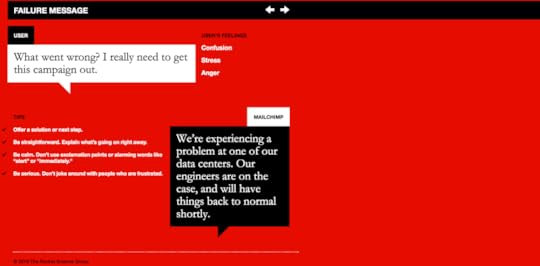
Often the best copywriting is emotional, rather than rational. And, it’s easier to evoke (or change) emotion if you try to picture how the end reader is feeling before they come across your message. MailChimp have an amazing template that lays out their approach on this that should be required reading for any copywriter. You can find it here. Below is a snapshot that shows what it’s all about.
5. Remember that “nobody wants to read your shit”.
Bestselling author and ex-advertising creative Steven Pressfield calls this the #1 piece of career advice he ever received. To quote him directly:
“When you understand that nobody wants to read your shit, your mind becomes powerfully concentrated. You begin to understand that writing/reading is, above all, a transaction. The reader donates his time and attention, which are supremely valuable commodities. In return, you the writer, must give him something worthy of his gift to you.”
The fact that nobody wants to read what you’ve written is amplified when it comes to marketing copy as well. Nobody wants to be ‘sold’ anything. They want to be engaged, they want you to help make their life better, they want a message that resonates.
So, when you’re writing about something, at a minimum make it painless — short and easy to read. If you can, make it funny, make it interesting, make it pleasurable, and for god’s sake make it honest. If your reader walks away with a wow or a smile, you’ve done your job (almost).
6. Always end with a call to action.
Imagine you see a hottie in a bar, somehow manage to get his attention, back that up with an engaging conversion and then walk away without giving him your number. Or her. Your choice. Either way, you just blew it. Always, always end with how they can take the relationship to the next level. Remember that it’s always a relationship too, no matter what you’re writing about. Don’t try to convince someone to buy something they don’t need, or don’t want. Be generous, be helpful and you’ll have lifelong clients that love what you do, because you make their life better.
With that in mind, for more on copywriting (plus the occasional foray into fiction), sign up to my newsletter here. To say thanks, I’ll send you a free digital copy of my novel Hellbound.
September 19, 2017
Philosophy, Blues and The Handmaid's Tale

Each month I send out a newsletter with some gems I've recently been loving and think you might too. Here's the hit for September for your thirsty eyeballs.
TV
The Handmaid's Tale - Based on the speculative fiction masterpiece by Margaret Atwood, this screen adaptation is some of the best TV you'll ever see. Well-scripted, beautifully-shot and hard hitting. I'd be surprised if this show doesn't take home most of the Emmy and Golden Globe awards this season. Check out the trailer, or look it up on Hulu in Nth America, SBS in Australia, or Channel 4 in the UK.
Philosophy Podcasts
It's no secret that I'm a bit of a philosophy geek. Recently, I've been soaking my mind fix in through my ear holes. Here are two podcasts I've found to be great:
Very Bad Wizards - Imagine what talk might be like in the naughty corner at a philosophy conference and you have an idea of what this is like. I recommend starting with episode's 1 and 2. They're great, without the first episode awkwardness you might expect.
Philosophy Bites - A bit more serious, but also much shorter. These 15-20 minute 'bite-sized' episodes are interviews with the world's leading philosophers on their pet topics. I found Philip Schofield's talk on Jeremy Bentham's utilitarianism to be an interesting starting point.
Psychedelic Rock
I've been listening to a bit of psychedelic rock/blues lately. Here are two bands that caught my ear...
DeWolff - Almost like a cross between Led Zeppelin and MGMT, this Dutch Trio are well worth a cheeky peek.
The Flying Eyes - The link to the left is a forward listen to their new album, due to launch later this month. If you check out some of their old stuff (like the song Lay With Me) you'd be forgiven for thinking the singer is the love child of Jim Morrison and Glenn Danzig. Obviously, Danzig was the Mother.
To receive these in your inbox every month, simply sign up here.
June 23, 2017
A Partner's Side To Cancer

Just eight months after my partner and I exchanged wedding vows she was diagnosed with terminal brain cancer. That has meant the "in sickness" portion of the commitment has been put to the test more than the "in health" side. Worse, "Til death do us part" is always lurking in the shadows.
While a lot of my energy has gone into supporting Tara through this ordeal, often her concern is directed at me. Caring for someone going through cancer treatment can be almost as tough as going through the treatment yourself. And, while everyone is quick to ask how the patient is doing, relief for someone's partner is rarely the first thing people think about.
After walking this ugly catwalk for almost seven years, and speaking with other husbands and wives of cancer fighters about what they're going through, I've learned a few things to help make it easier. This post is a chance to share that knowledge and hopefully shine some light on a lesser talked about side of cancer. Here are a few things to remember in no particular order.
YOU'RE NOT ALONE IN YOUR WEIRD THOUGHTS
I don't want to be a single parent. How will I cope? How long should I wait until I put up my Tinder profile?
You'll think a lot of strange, horrific, and sometimes funny things when faced with the potential death of a loved one. Anytime I'm left with our boys for the day I think to myself just how much it would suck a rotten mango to help them grow up on my own. It's normal to feel like that. Sometimes I find myself wondering what it would be like to start dating again, and whether I'll still be attractive enough to get attention from the female sex. That's a normal thing to think. Immediately after that, I feel guilty about thinking about dating again, or even contemplating Tara dying since she's well and truly alive and fighting hard to stay that way. That's a normal thing to feel. I sometimes fantasise about living in an all-boy house where we can leave the toilet seat up without fear of reprisal. That's normal too, maybe. All of those silly, dark, absurd and even sometimes happy things you think and feel are normal. Don't feel like you're alone, or are going cracked in the coconut because sometimes your thoughts get ahead of you. If they're really bugging you, seek out someone to talk about it, whether that's with your partner, friends, or a counsellor.
SCHEDULE TIME TO DO SOMETHING FOR YOU
This is a massive one. The amount of stress that piles up during times like this needs to be released somewhere. You have the choice of it coming out via a breakdown in the fruit and veg section of the supermarket, because there are no ripe avocados, or in a soul-cleansing surf in the ocean. It doesn't matter what your unwinding activity of choice is; it could be drinks with the boys or girls, shopping, playing sport, who cares. The point is to step away from the routine of looking after your partner and/or kids for a short time and simply enjoy living. A couple of 'fun' hours a week will see you through all of those longer, harder ones. I promise.
ACCEPT HELP FROM OTHERS
At first my big fat ego was like "nah, I got this", and I was trying to avoid asking for support from family and friends. And then I said to myself, "Tim, stop being a dick. People want to help you. It helps them feel better and gives them a sense of control too. Do those people, and yourself, a favour and accept their help already." Insert your name into the above and say it out loud if you have to. Even if it's just letting someone babysit the kids for a few hours while you get out of the house, or allowing a few meals to be cooked for you here and there. It all takes the pressure off and people will see how grateful you are, even it you can't express it properly.
TAKE MATTERS INTO YOUR OWN HANDS WHEN IT COMES TO SEX
While Tara's libido was mostly in tatters during her treatment, mine was alive and well. It sucks. Knowing how sick your partner is feeling makes you feel like a grade-A creep even thinking about propositioning them for a romp in the sheets. Rather than burst a gasket, or get itchy feet and look beyond our relationship for relief, I simply took matters into my own hands... literally. Masturbating quickly and efficiently might be about as satisfying as eating a piece of dry toast for dinner, but I'd rather be a wanker than a cheater any day of the week. There I said it. If you're really struggling, talk to your partner about it too. He or she might be feeling the same way and not want to bring it up, because 'sex' seems like the last thing either of you should be worrying about. But, it matters, so don't just try to ignore it.
BE WILLING TO HAVE UNCOMFORTABLE CONVERSATIONS
Following on from the above, there are plenty of other awkward things you should be talking about together. Making arrangements for both of your wills should be the main priority. Knowing what each of you would do if the other was on life support is another. What do you want out of a funeral? What kind of pain medication will, or won't you take? The list is long. Be willing to allow your partner to discuss things they're worrying about too. Tara has openly talked with about me moving on if the worst were to happen. I didn't want to hear it, but we had a chat about it in the end. The verdict - She's not dying. Ever. Especially not before me. Seriously, though, the 'moving on' issue is more common that you think. Here's an example of one journalist suffering from cancer who wrote an open letter in the New York Times, urging prospective new partners to marry her husband. The point is, don't let things you care about, or should be talking about, stay silent in your minds. Put them out on the table and you'll both feel better for it.
BE POSITIVE. IT MATTERS.
A lot of what I've written above makes it sound like the entire last year and a half of treatment has been all doom and gloom. In truth, we've still managed lots of beautiful moments together with our family and friends. None of that is possible if you're not keeping your chin up and maintaining a positive outlook. Staying positive rubs off on each other as well. If one of you is down the other one can be there to pick things up. In general, it makes for a much, much happier household. There is also plenty of evidence out there that shows how positivity can be beneficial to you health. If there's ever a time when your body, mind and soul need that extra kick, now is it. It can be hard, for sure. But when you catch yourself having a whinge, stop, reset and try to find something worth smiling about instead.
CRY IF YOU WANT TO
On the flip side of being positive every single moment of the day, sometimes you just need to let things out and have a good old-fashioned cry. I know that men aren't supposed to let their emotions show, and, a lot of the time I try to hold it together during especially hard moments for Tara, so she has a steady rock to hold onto. But, those little ducts in the corner of your eye sockets are there for a reason. A bit of salty discharge isn't the only thing they let out. They also release grief, hurt, anger and sorrow. Let those little badboys do their job once in a while and everything will feel much lighter. The other weird thing is that Tara reckons she often feels better when she sees me cry, because it makes her feel normal for tearing up all the time. So, be normal. Be a crier.
TREAT THEM LIKE A PARTNER, NOT A PATIENT
At first I thought Tara was being weird, not wanting to be looked after all the time. If I get so much as a sore throat, I want to be bundled into bed, brought cups of tea and be given foot rubs every hour on the hour. But, she didn't like everything being done for her and me taking care of all of the details. I thought I was doing the right thing, letting her concentrate on healing instead of the mundane day-to-day chores of making the household work. But, she just wanted to be Tara. Not Tara 'the cancer patient'. As time went on, we made sure she was doing all of the usual things she normally does. Empowering her to be independent, to work and take care of herself (and me and the kids when it was needed) really helped with her self-confidence and general wellbeing. Tara hears it from other cancer fighters all the time too, "why can't they just let me be me!". Sure, give them the special treatment when it's needed. But, by and large remove the cotton wool and let them live their lives, instead of just trying not to die.
Obviously the above is not an exhaustive list. There are plenty of little and big things you can do every day to make sure you make it through a cancer diagnosis - partner and patient. The main thing to remember is to look after yourself. If you fall sick as well, then there will be no one to hold down the fort. If that means doing things for you, taking a break every now and then, or just being a bit more thoughtful about your approach, then do it.
The darkest nights have the brightest stars and there have been moments during the last seven years that have been pure joy despite (or maybe because of) our situation. Find those stars, cling to them. Cling to each other. Take the time to live. In the end, people and the moments we have together is all that is worth anything.
-----
*I've started a small newsletter for anyone who wants to receive updates and tips like this when it comes to cancer. If you sign up, you'll first receive the Guide To Alternative Cancer Therapy I wrote with Tara, to help steer through that part of this world. Click here to join the list.


