
David W. Robinson's Blog: Always Writing, page 59
April 10, 2012
J is for Joe Murray

Running the Lazy Luncheonette is Joe's life. Running the Sanford Third Age Club is his community calling. But his passion is solving mysteries and crimes.
The central character of the Sanford 3rd Age Club Mysteries, Joe is a post-war baby boomer, born sometime in the mid 1950s. Although many improvements had been made to living standards, it was still a time of great austerity. In the mining towns of Northern England the men worked long hours for low pay, still waiting for the promised land the government had guaranteed them for their war effort. As boy, Joe knew he would never have to go down the mines; he was guaranteed employment in his father's café. But that did not mean he would have an easy or cushy life. He would be out of bed by five thirty every morning, and he would work until well into the afternoon.
Always intelligent and sharp witted, Joe found escape from the drudgery of real life in the novels of Agatha Christie, Margaret Allingham, Dorothy L Sayers and, of course, Sir Arthur Conan Doyle. He became a great fan of Poirot, Wimsey, Campion, and he marvelled at Holmes' powers of observation and deduction.
Until he finally left school, Joe borrowed his books from the library. As a teenager, with wages in his pocket, he would cut along to Sanford Market and buy books from the Exchange Stall. Paying two shillings for a secondhand paperback, he would get a shilling back when he returned the book. Joe never pocketed the shilling. Instead he invested in fresh reading matter.
Determined to emulate his great fictional heroes, Joe trained himself to observe others, and he had to ideal environment to develop his skills: the Lazy Luncheonette. A working man's café in the midst of a busy retail area, it fed a wide variety of folk, many of them regulars, just as many passing-by.
He realised that people were creatures of habit and at first his observations and deductions were the easy kind. The miner turning out in his second-best suit, hands clean, face scrubbed, had some kind of appointment; maybe a court appearance, or hospital check-up. The woman who usually turned out in a wraparound overall, but instead showed up wearing a frock and cardigan, was likewise not going to or coming from work.
As his powers developed, Joe made deeper deductions. The scrubbed fingernails of the mechanic, and the straight seams of the shop assistant's stockings told him this was someone with a date. The middle-aged chap suddenly carrying a stick and switching from pork chops to a chicken salad, was probably suffering from gout.
He was delighted to learn than more often than not, his deductions were spot on, and from there, it was only one short step to solving the minor and later, major crimes that would gain him the reputation as Sanford's finest sleuth.
He married fairly late in life, at the age of 37, and it was partnership doomed from the word go. Alison, his wife, made efforts to change him, without success, and they gradually drifted into that vacuum which precedes an amicable separation. They finally divorced some time after the Millennium. Alison moved to the Canary Islands and Joe returned to his singular life, with the three Cs support: The cafe, the club and the crimes.
***
The Filey Connection, first of the Sanford 3rd Age Club Mysteries, from Crooked {Cat} Books is available for the Kindle from Amazon UK and Amazon Worldwide and in all other formats from Smashwords


I is for Investigation

I'm sure the police have procedures in place for investigation serious crimes. I'm also sure their success rate is much higher than some commentators (particularly politicians with axes to grind) would have us believe. End of rant against politicians… for this post at least.
My experience of investigations is limited to engines, gas boilers (a long time ago) and other machinery which breaks down with alarming frequency in this cheap and nasty world we live in. End of rant against modern life… for this post at least.
I have absolutely no clue how to go about investigating a murder, so as usual, I have to make it up as I go along.
The start point for Joe's investigations is never 'whodunit' but 'who was it done to': the victim. Forensic science tells the police a lot about the victim; when did he last eat, and what did he have, what time did he die, did he have sex before he was killed, had he washed, showered, shaved. What it can't tell them is why the killer struck. The victim alone probably knows why, but he can to longer speak, so it's vital to learn as much as you can about him, and you do that by speaking to the people who knew him.
Is this the way the police work, too? Probably. From it, Joe can then work out the likely motive and the likely killer.
So where do Joe's inquiries differ from those of the police? Joe relies not on science but his ability to spot tiny inconsistencies in the facts. How long would it take the police to work out that Eddie's fishing basket made no sense? (The Filey Connection) Joe, who has spent all his life in catering, noticed it in seconds. Most bosses would have rapped Stephen Atherton's knuckles for putting his arm around Carla (The Tanzanite Manoeuvre, one of the Tales from the STAC Casebook). To Joe it signified something totally different. Who but Joe could have worked out Jennifer's password from a necklace? (A Murder for Christmas).
These then are the hallmarks of Joe's special investigative style. He gets it wrong as often as he gets it right, but somewhere along the line, he makes all the right connections and gets his man… or woman… or both.
***
The Filey Connection, first of the Sanford 3rd Age Club Mysteries, from Crooked {Cat} Books is available for the Kindle from Amazon UK and Amazon Worldwide and in all other formats from Smashwords
April 9, 2012
H is for Home
Many people say, "I enjoy travelling." I say it myself. But it's not true. I enjoy arriving.
Her Indoors and I have just had a weekend away in Weston-super-Mare, down in sunny Somerset. But it wasn't sunny. Most of the time it was cloudy, raining, and contrary to the weather forecast, perishing cold.
For a change, we went by bus. Sound plan. It allowed me to switch off and relax. Not so. The bus was comfortable enough, but a combination or arthritis and diabetes meant I could do anything but relax. Because of drivers' hours regulations, whereby our driver had to take a break on the way down, various traffic jams and accidents along the way, the journey took slightly under six hours. It was Good Friday so there was a sense of inevitability about these things, but if I had gone by car, I would have set off earlier and probably done it less than four hours.
The hotel was fine, although the room was a little cramped, and I question its claim to be a five-minute walk from the town centre. You could walk it in five minutes if you were on a bus walking up and down the aisle while the driver took five minutes getting to the town centre. Failing that, it took me almost twenty minutes to limp to there.
We spent Saturday in Bath. No, madam in Bath, not in the bath. It's a fine Roman city, a wonderful place to visit, but not on a Saturday afternoon when it's pissing down. We took a guided tour by bus and enjoyed a brilliant presentation by our Blue Badge Tourist Guide Tony Murphy. I was annoyed because I forgot the opening lines of Shakespeare's Richard III, which was puzzling considering the winter of discontent this son of York(shire) has just come through, but I was mollified by some good pictures of Royal Crescent.

Yesterday, we climbed back on the bus for the journey home. Another six hours of agony, compounded this time by one or two agonising gastric problems, with which we're quite familiar, but which are totally intractable on a bus.
The one thing I will say in favour of this weekend. It's given me plenty of material for another Sanford 3rd Age Club Mystery. If I found plenty to gripe about, what will Joe make of the Hanged Photographer of Weston-super-Mare?
And so to H for Home. Having got back, I know how Joe feels when the club are coming back to Sanford and he's within sight of The Lazy Luncheonette. I don't enjoy travelling, I enjoy arriving, and this time, I enjoyed arriving home.
***
The Filey Connection, first of the Sanford 3rd Age Club Mysteries, from Crooked {Cat} Books is available for the Kindle from Amazon UK and Amazon Worldwide and in all other formats from Smashwords
April 8, 2012
H is for Hotel

For most of the Sanford 3rd Age Club Mysteries we find the club members staying in hotels. If you think about it, this is quite logical since the basic premise of the series is to encounter the mysteries anywhere and everywhere but Sanford, a West Yorkshire town which doesn't exist, in direct contrast to the other locations which do exist.
Obviously, I can't use real hotels, although when I first came up with the concept, I did consider contacting a hotel group and coming to an arrangement with them. I decided against it, first because not all the tales are set in hotels, and secondly, they would have wanted a say in the story.
Fortunately, Her Indoors and I have a large and varied experience of hotels, all over Europe. I've stayed in dosshouses where your 'room' was a bed in its own little cubicle, and other places where you could lay in bed and listen to the couple next door having sex. We stayed in a place in Scarborough which reminded me of the Bates' house in Psycho, and we stayed in a €100-per-night, four star joint near Amsterdam where the Dutch national football team were crashing for the night. The missus disappeared for a sauna in that place and came back looking quite pleased. I often wondered whether she shared it with a few pro footballers.
In the middle to upper end bracket, these places have certain elements in common. They all have a decent bar, an excellent dining room and they usually have a function room where Joe can put on his 60s and 70s discos.
And they're all the same when you amble along the richly carpeted corridors: quiet as the grave. The perfect place for a murder or two.
***
The Filey Connection, first of the Sanford 3rd Age Club Mysteries, from Crooked {Cat} Books is available for the Kindle from Amazon UK and Amazon Worldwide and in all other formats from Smashwords
April 7, 2012
G is for Geriatrics

I've said it before, I'll say it again; The Sanford 3rd Age Club members are NOT geriatrics. They may be middle-aged, third-aged, but they are not on their last legs.
People have different attitudes to age. To some, younger people, once you get past 35, that's it, you're in your dotage and ready to shuffle off the mortal coil. In the eyes of more mature individuals, once you retire, it's time to start living. Some try to hide their age, even from themselves, others, like me, revel in it. I'm 62, and at last I can behave as outrageously as I like without giving a rat's fart what others think. (If the truth be told, I've never given much of a toss what others thought of me, now I don't give a toss at all.)
Brenda sums it up nicely in The Filey Connection: when described as a 'randy old widow,' she responds, "I am not old."
Some say I took a bit of liberty with the term, Sanford 3rd Age Club. These people say third age is a time of retirement. Others agree with me that it runs from about the age of fifty up until the day the Grim Reaper comes to call, so I felt comfortable with the Sanford 3rd Age Club as a mob of over-fifties determined to squeeze every last drop of pleasure from life before they clock off.
Even amongst the third-agers, there are different approaches. Les Tanner and Sylvia Goodson maintain a discreet distance in public, even though every man and his dog knows they're at it like rabbits when they get the chance, Alec and Julia Staines have been married more years than anyone cares to remember, but they're first to hang the 'do not disturb sign' on the hotel door when the club are on one of their famous outings.
They all have one thing in common with their creator (me). They've successfully worked out that if life is a game of two halves, they're well into the second period and it's time to stop worrying and start living. That's why you find the disco floor packed, it's why you find them clogging up the bar, and it's why you find the hotel dining hall looked like it's been raped after they've had breakfast.
They all have their individual attitudes, their personal concerns, but at the same time, they're all out for a good time.
Third-agers? I love 'em.
***
The Filey Connection, first of the Sanford 3rd Age Club Mysteries, from Crooked {Cat} Books is available for the Kindle from Amazon UK and Amazon Worldwide and in all other formats from Smashwords
April 5, 2012
F is for Filey Connection, The

The very first Sanford 3rd Age Club Mystery was entitled A Death at the Seaside, and it was set in the Filey/Scarborough area of the Yorkshire coast.
In many ways, it was experimental. I'd written plenty of mystery novels and my fair share of detective works, too, but they were all hard-boiled, no punches pulled, type titles. They tended to be (still are) very gritty, dour works, clothed in an atmosphere of gloom. I decided I needed a change and a rest from them, and I came up with the Sanford 3rd Age Club.
Despite having read this kind of thing since childhood, I'd never properly analysed them, and I elected not to bother now. Instead, I hit the keyboard and a month or two later, there was A Death at the Seaside, available on the Kindle.
All the elements were there, but it was short; barely 25,000 words. The follow up, An Heir to Murder wasn't much longer. It was then that I decided I'd better look at other examples, and analyse them properly. So I began buying cosy crimes from my local bookshops, and in every case, I read them twice. Once for the pure enjoyment, the second time to analyse how the author had got so much mileage from the story.
By the time I put out A Halloween Homicide, I was getting somewhere near, and the series finally came of age with A Murder for Christmas, which reached the magical 80,000 words.
So what was the big secret? In a nutshell, it's more murders and plenty of suspects. Chuck in a few red herrings, let's have a little subplot going if we want, and the whole kit and caboodle springs to full-length life.
In January this year, when Crooked {Cat} Publishing offered me a contract, I pulled A Death at the Seaside and An Heir to Murder and merged the story of A Death at the Seaside with elements of An Heir to Murder. That became The Filey Connection.

Even now, at about 70,000 words, it's a little shy of the target, but the necessary elements are all in there: suspects, murders and the inevitable red herrings.
This is not to say you can write detective novels to a formula. You can't, and you shouldn't even try. Every story has a unique background, its own unique murder and suspects, and the mean by which the perpetrator is nabbed should be original to each and every tale.
The only common element is the cast of characters, and, of course, Joe's famous hand-rolled cigarettes.
***
The Filey Connection, first of the Sanford 3rd Age Club Mysteries, from Crooked {Cat} Books is available for the Kindle from Amazon UK and Amazon Worldwide and in all other formats from Smashwords
F is for Frances Di Plino
Have you ever noticed how when you write something, a book, a short story, even a begging letter to a lottery winner, someone, somewhere writes something similar but way better.
It keeps on happening to me. I wrote The Handshaker, one of the strongest and best pieces of work I've ever turned out. Then Frances di Plino turned up with Bad Moon Rising and blew it out the water.
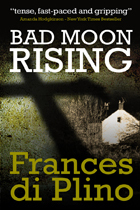
Exaggeration is the hallmark of any grumbler, and the truth is, while both The Handshaker and Bad Moon Rising employ crazed sex killers, the resemblance probably ends there. BMR follows a more orthodox, albeit thrilling and disturbing investigative trail, while The Handshaker is more involved in riddles and a personal quest for Alex Croft.
Franny and I are old friends, but under her real name, which is a closely guarded secret. It's Lorraine Mace. (That'll teach her to write better books than me.)
Lorraine (I think I prefer Franny) is a professional writer. A tutor for the Writer's Bureau, with a monthly column in Writing Magazine, this girl knows her way around the writosphere. If it's worth knowing, Lorraine knows it, and if she doesn't know it, it's probably not worth knowing.
For her to write psychological thrillers, therefore, is grossly unfair on the rest of us hacks, but I knew what was coming. I read early drafts of this book and I knew it was a winner. So there's only one person to blame if my novel isn't as good. Frances di Plino, obviously.
You can find Lorraine's website here and Franny's here and you can pick up a copy of Bad Moon Rising via the Crooked Cat website.
You won't regret it.
F is for Fantastic Savings
Just a quick plug before I bugger off to Weston-super-Mare for the weekend.
Crooked {Cat} Publishing are having an Easter sale.
Rose Mclelland's The Break Up Test is launched today, so that's not included in the sale, but all other titles are.
The Filey Connection usually retails at £2.75, but for this weekend, you can download it for £1.54 (I think the fourpence may be VAT.)
So dash on over to your nearest Amazon bookmark or click the links and download your Crooked {Cat} Publishing titles while they're dirt cheap.
E is also for Easter
I don't subscribe to any religion, so for me Easter means the end of winter… but you wouldn't have thought so looking outside our front door yesterday.

In the Robinson household, it's also traditionally the time when we have our first weekend break, and this year is no exception. Having braved the perils of a sweltering Tenerife back in January, Her Indoors and yours truly are on the road again tomorrow morning, making for sunny Weston-Super-Mare down in Zummerzet.
We've been before and soon after the last time we were there, the pier burned down. I swear I put that cigarette out.
This time, we're going by coach, which saves me hours of cursing and screaming at other drivers. I can leave it all to our chauffeur while I take a nap or immerse myself in the complexities of Libby Serjeant's escapades.
I'll have the trusty camera with me and I expect to return on Sunday armed with pischers of Weston and Bath (where we're going on Saturday) and enough horror stories of holidaying with the Robinsons to keep me going for another three months.
In the meantime, scheduling on my blog appears to work as and when it feels like it, so although I shall be here to post the F's early tomorrow morning, G may not appear until I get back on Sunday.
So while I'm gone, be good. If you can't be good, be careful. If you can't be careful, put a coat of creosote on the back fence: it'll help keep your tiny mind occupied.
April 4, 2012
E is for Entertainment

It's some years ago now, but a reviewer critiqued my novel, The Handshaker by saying it was a load of tripe. He knew. He was a psychologist. I didn't pick up the argument. I never do. He's perfectly entitled to his opinion and I wouldn't argue the psychological merits or otherwise of The Handshaker. How could I? I'm not a psychologist.
In my defence, however, I never said The Handshaker was based on reality. I said the catalyst for the tale was a crime committed in Germany 80 years ago. That wasn't to say that the account I have of the crime was accurate. Although it should be. It was written by a respected psychiatrist.
Amongst the aspects my irritated psychologist reviewer missed was the entertainment value of the story.
It's not a true story. It's an invention of my mind. It is a fiction and like any novel, it is supposed to mirror real life with all the boring bits (i.e. most of it) taken out. Most readers think The Handshaker does that rather well. They view it as an entertaining read.
If I were to apply the realities of life to the Sanford 3rd Age Club Mysteries, I'd have some really short books, and they'd be travelogues, not detective mysteries.
Ask yourself how many senior police officers would let Joe Murray, Sheila Riley and Brenda Jump anywhere near their investigations of a major crime like murder. If the answer is greater than zero, I demand a rebate on my taxes. In real life, professional police officers handle these matters and so they should.
But where's the fun in letting boring old plod deal with it? Where's the entertainment value in a fingertip search of the road where the murder took place? There isn't any. Or if there is, I need to reappraise my idea of entertainment.
So the cops allow Joe to help them out, and I can have fun with my gang of middle-aged rockers from Sanford.
If you view the Sanford 3rd Age Club Mysteries as a genuine reflection of real life, then you should get out a little more. The rationale is wafer thin, but in the context of the cosy crime, the amateur sleuth it's all perfectly acceptable because it is entertainment.
***
The Filey Connection, first of the Sanford 3rd Age Club Mysteries, from Crooked {Cat} Books is available for the Kindle from Amazon UK and Amazon Worldwide and in all other formats from Smashwords
Always Writing

- David W. Robinson's profile
- 51 followers

