
John R. Fultz's Blog, page 70
August 2, 2012
THE COSMIC EYE: Summer Readings VI
 Topping off my summer-long Corben celebration, I’ve just completed reading CREEPY PRESENTS RICHARD CORBEN. This is a gorgeous and hefty tome that collects all of Corben’s work from the classic CREEPY and EERIE horror magazines. The gruesome tales presented here come from a prolific period that spanned 1970 to 1982.
Not only can you see the evolution of a great master in these tales, you can also literally see Corben re-defining what color comics could look like. This was well before computer coloring came along, and Corben blew the minds of comics readers in a way that the Beatles’ SGT. PEPPERS must have blown away music fans a few years earlier.
The tales themselves are solid horror gems, with the flavors of high fantasy and science fiction recurring throughout. In black-and-white, or in color, Corben is a force to be reckoned with, even in this early phase of his career. CREEPY and EERIE were the only places that stories of this nature could be printed for many years. Coming out of the 60s, when the magazines mainly featured takes on traditional horror tropes like vampires, werewolves, ghosts, and zombies, these 70s tales often stretched the boundaries of comics storytelling in interesting new ways.
The 70s was a time when comics writers were beginning to weave social commentary and socio-political themes into their comics. Nowhere is this more evident in these tales by Corben and his many collaborators. There are some really nice pieces written by Jan Strnad and Bruce Jones, as well as several names that are less well known.
 This collection is intended to showcase Richard Corben’s work from the period, but it ends up being pretty close to something like a BEST OF CREEPY & EERIE. The reason being that Corben was on the cutting edge of the medium, both artistically and thematically.
Out of all these great tales, I think my favorite is “The Hero Within,” where a young boy locked in a basement by his abusive foster-parent escapes into a world of fantasy by focusing on a weird stone he finds there. The story has an amazing fantasy sequence that must have truly amazed readers back in the 70s, and it reminds me of Corben’s own DEN somewhat. The “hero” battles giant lizards, roams a weird wasteland, and rescues a damsel in distress, only to be returned to his own brutal reality for a decidedly unhappy ending.
The horror stories of this era pulled no punches; at times I was shocked by the sheer grimness of certain tales. But there is also a lot of the famous CREEPY/EERIE dark humor here. All in all, the hardcore horror and dark humor are balanced well, and Corben’s amazing artwork makes it all look incredible.
It’s nice that CREEPY has released this collection of Corben works because otherwise all these great stories would be scattered over twelve years’ worth of archive volumes. If you’re thinking of checking out any of the CREEPY or EERIE archives (which I high recommend), then CREEPY PRESENTS RICHARD CORBEN is a great way to “sample” some of the very best that these legendary books had to offer.
You can’t go wrong with Corben.


July 31, 2012
Five Months to SEVEN KINGS
SEVEN KINGS, the second book of the Shaper Trilogy, is only five months away…


July 27, 2012
Cosmic Thoughts: IX
“All that we see or seem is but a dream within a dream.” –Poe

Artwork by the great Michael Whelan


July 26, 2012
THE COSMIC EYE: Summer Readings V
 Big John Buscema was one of the greatest comics artists to ever take pencil in hand. He was recruited by Stan Lee at Marvel to replace the great Jack “King” Kirby on several main titles in the late sixties, but Buscema really leaped above the King’s shadow when he did the immortal SILVER SURFER series, turning that character from a second-stringer into one of Marvel’s most unforgettable heroes.
Buscema, however, never really enjoyed drawing superheroes. He found his true purpose in comics when he took over drawing CONAN THE BARBARIAN after Barry Windsor-Smith departed in the early 70s (after an amazing run that brought Robert E. Howard’s pulp character a whole new audience). I’m sure that nobody believed at the time that anyone could ever eclipse BWS’s run on the CONAN title, but if anybody ever did it was definitely John Buscema. He did more issues of CONAN THE BARBARIAN than anybody else, and he also did an unbelievable number of issues of THE SAVAGE SWORD OF CONAN, the black-and-white mature readers magazine that followed the uber-success of the color CONAN comic.
Both of these CONAN books are marked by spectacular runs, mostly written by Roy Thomas and illustrated by John Buscema with his great inking partner Ernie Chan. When I was a very picky lad growing up on comics, I was a huge fan of John Buscema’s work, but like the artist himself I was incredibly hard to please when it came to inkers. There were only three artists whose inks really “worked” over Buscema’s gorgeous pencils: Ernie Chan, Tony DeZuniga, and Alfredo Alcala.
 Thanks to Dark Horse comics, the entire runs of CONAN and SAVAGE SWORD are being collected in terrific trade paperback collections. I have the first dozen volumes or so of each of them. They read much better than the old fading, yellowed, dog-eared comics that I used to have. However, recently I re-discovered another great CONAN series that Buscema did (with Roy Thomas), and thanks again to Dark Horse it is being preserved with the same loving tpb treament.
KING CONAN was a spin-off from the main CONAN book, and it featured tales from the barbarian’s latter years as the King of Aquilonia. I had quite a few issues of the series as a kid, and now I’ve gotten my hands on the first two volumes of the collected series from DH. This summer I’ve been enjoying my return to the Hyborian Age with these great collections. They are every bit as pleasing to the eye as the CONAN THE BARBARIAN runs featuring Buscema and Chan. There are also a couple of great issues inked by Danny Bulanadi, wherein Conan finally settles the score with his arch enemy, the evil sorcerer Thoth-Amon.
The biggest difference between the main CONAN THE BARBARIAN book and KING CONAN (besides the fact that Conan is the king of Hyboria’s mightiest nation), is the presence of his son Conn. Yes, Conan the Cimmerian is both a father and a husband (he married Queen Zenobia, whom he rescued in one of the CONAN annuals). You might think being domesticated would make for some boring Conan tales–yet nothing could be farther from the truth.
 For one thing, Conan wasn’t your typical monarch. He would never send his soldiers out to fight a war unless he was in their midst, leading them to victory against Zingaran rebels or Stygian wizards. It was hard to keep Conan on the throne–as a man of action he was alwasy running off to settle a score, or rescue his kidnapped son–or kidnapped queen. Also, there were endless plots featuring subversives who wanted to remove the barbarian usurper from the Aqulilonian throne. Conan was the king of a civilized realm, but this was still the Hyborian Age–an age of savage violence and lurking menace.
Another trait that drove Conan’s advisors and generals a bit mad was his propensity to take his 13-year-old son on adventures with him. Conan wanted to be sure his heir didn’t grow up as a coddled, pampered city-boy. He wanted Conn to be every bit as tough and experienced as his northern upbringing in Cimmeria had made him. And Conn was not one to disappoint. In the final conflict with Thoth-Amon it is Conn who is Conan’s ace-in-the-hole. The presence of “Conan Jr.” doesn’t slow down these stories, but actually adds to their charm.
As a 12-year-old reading these stories, I remember how I used to identify with Conn. What boy doesn’t want a father who is the mightiest warrior the world has ever seen, and who drags him across the world on one adventure after another? Roy Thomas did a great job of fleshing out the Conan character–who was now in his fifties but still a formidable swordsman–and giving him a depth that went far beyond the barbaric simplicity of his youth. Conan is the kind of king you’d want if you were a Hyborian peasant: He is just, mighty, and has a way of cutting right through the silliness of courtly ettiquete. He even makes sure his people aren’t over-taxed, though he leaves most of that boring stuff to his queen. Yes, Conan in this light could even be considered a feminist, letting his queen do most of the actual ruling of the kingdom while he runs off to slice up evil-doers and demon-gods.
 Buscema’s work is phenomenal, as usual. The first volume is the best of the two, but only because Roy Thomas left Marvel in ’82, so that the last two issues of the collection were done without him. Not that the great Doug Moench didn’t do a good job taking over, but there is only one Roy Thomas, and he had been the “voice” of the Conan comics for well over a decade.
I highly recommend THE CHRONICLES OF KING CONAN volumes 1 & 2, which sits perfectly with my glowing recommendations for THE CHRONICLES OF CONAN volumes 1-13 and the SAVAGE SWORD OF CONAN volumes 1-5.
This is the really, really good stuff. If you love fantastic comic art, sword-and-sorcery, and/or epic fantasy, don’t miss it. (Nevermind that last CONAN movie; the books remain unharmed.) If you’ve never read any of Howard’s original Conan tales, these comics will do for you what they did for me decades ago: Send you to the bookstore or library on a quest to find the source material. Luckily, all of Howard’s CONAN tales are widely available thanks to constant reprints and new editions.
All of these Dark Horse collections of the classic Marvel runs are testaments to the great lives and works of Big John Buscema and Ernie Chan (among others).
If Conan was a King among Men, these guys were Emperors among Artists.


July 23, 2012
THE COSMIC EYE: Summer Readings IV
 The deeper I get into writing a novel, the more actual time I spend writing. That means I spend less hours reading and more hours at the keyboard. I’m still reading Tanith Lee’s THE BIRTHGRAVE, but my progress on it has slowed to a crawl as I’ve been writing way more than reading. Still, I need to keep my inspirational batteries charged, so to speak.
That’s where graphic novels and comics come in…
First up, Jack Kirby’s THE ETERNALS. This series was the last great book Jack Kirby did when he returned to Marvel Comics in the mid-70s. A few years ago I managed to assemble a complete 19-issue collection of THE ETERNALS, but they were unfortunately left behind when I moved from SoCal to NorCal in 2007. However, I recently replaced them with the much superior ETERNALS two-volume collection released by Marvel in 2008.The colors are brilliantly restored and I found my re-read of the series much better than my old, faded, yellowed copies of the original comics.
 Jack Kirby was indeed the King of Comics, and my favorite work is his 70s comics. THE ETERNALS was something I stumbled across in the late 70s as a young lad–I picked up a coverless copy of ETERNALS #3 somewhere. Years later I rediscovered it in my collection and it set me on the path toward acquiring the whole series. All of Kirby’s brilliance is on display in this tour de force of imagination. Nobody did the High Concept Book like Jack Kirby.
Instead of a supergroup of six or seven superpowered characters, Kirby gave us an entire RACE of them in the Eternals, immortal beings who have lived among humanity since prehistoric times, hiding in the cracks of our histories and legends, living on remote mountaintops and working miracles. At the same time he gave us their opposites, the twisted, warlike Deviants, who were also born of the same humble origins as Humans and Deviants, but were genetically unstable monsters.
 Best of all, Kirby gave us the Celestials. These “Space Gods” were inspired by the Incan legends and carvings of space travellers of legend. They were towering titans of unimaginable power who had visited the earth three times before. The first time they had messed with hominid DNA to create the triple race of Human, Eternal, and Deviant. The second time they came to destroy the empire the Deviants had created, effectively freeing humanity from enslavement by their Deviant masters and sinking the lost continent of Lemuria. In the first issue of THE ETERNALS (published in 1976), these Celestials return to earth. The mission of this Fourth Host? To monitor mankind for 50 years and then decide if it deserves to exist or be utterly destroyed!
This series was exceptional for many reasons, and Kirby was once again breaking the “rules” of comics. The story rotated between a huge cast of Eternals and Deviants and Humans and Space Gods; there was no true central character. The stories were not meant to be part of the existing Marvel Universe, but eventually they were retconned into it. The Deviants weren’t single-minded villains, but complex beings with the potential to be as deep and heroic as Eternals or Deviants.
Among all the great ideas unveiled in THE ETERNALS, my favorite was the Uni-Mind. When all the Eternals of the world united, their atoms and minds combined into a single entity that looked like a giant brain and floated into the cosmos to solve unsolvable problems. The cover of issue #12 features the Uni-Mind and it’s one of my all-time favorite comic book covers.
 Kirby was firing on all cylinders here. The art is mind-blowing, the concepts are truly cosmic, and the action is practically nonstop. It’s too bad THE ETERNALS only lasted for 19 issues, but even so these concepts invested the Marvel Universe in the same way Kirby’s New Gods had invested the DC Universe. THE ETERNALS became lynchpins in the Marvel world, and they’ve never stopped appearing in Marvel comics.
Most recently Neil Gaiman delivered a great take on Kirby’s most celestial creations. Jack Kirby’s imagination continues to rock the Marvel Universe nearly twenty years after his passing.Yet there’s nothing like Kirby’s original series, especially when it’s presented in such a quality format as these two volumes. THE ETERNALS is the kind of comic you’ll want pull out and re-read ever year or two. You can almost hear the crackle of cosmic energies as you turn the pages.

In the next post, I’ll talk about another two-volume collection of classic comics goodness that I’ve been enjoying: Dark Horse’s reprints of Marvel’s KING CONAN, illustrated by the great John Buscema (and various inkers including the great Ernie Chan).


July 11, 2012
THE COSMIC EYE: Summer Readings III
 Wow.
Wow.
Today I read what might be the most gorgeously painted graphic novel I’ve ever seen:
NEW TALES OF THE ARABIAN NIGHTS
by Richard Corben and Jan Strnad.
This story originally ran in serial form in the pages of HEAVY METAL magazine in the late 70s, then was collected into graphic novel form in 1979. I’ve posted about Corben’s other great works, but I think NEW TALES OF THE ARABIAN NIGHTS might be the “crown jewel” of his long and distinguished career.
 The book is full of lush, colorful illustrations that bring the world of Shahrazad and Sindbad to life with a spectacular sense of reality. Fantasy has never looked so real. Corben’s gift for blending realistic figures and backgrounds with fantastic elements is nowhere more evident than in this book. Sadly, it’s been out of print for decades.
I’ve been on a mission this summer to fill in the gaps in my Corben collection, and thanks to the miracle of eBay, I found a used, slightly battered copy of NEW TALES for about 15 bucks. However, like-new copies are going for upwards of 50 dollars. Despite its beaten cover, my copy’s interiors are in great shape–this was quite a lucky find. A diamond in the rough, to use the old metaphor.
 The story tells “The Last Voyage of Sindbad” and features Shahrazad herself telling a story within a story within a story. Corben’s artwork brings to life the opulence of golden palaces, the glitter of heaped treasures, and the glorious, mythic Arabia of the ancient world. There are Jinn, Ifrits, undead warriors on bat-winged horses, sword battles, dragons, a flying galleon, a man-eating Ogre, and a floating city of decadent sorcery. There’s really nothing like it.
If you’ve ever read the classic issue of SANDMAN (#50) where P. Craig Russell illustrates a tale of ancient Baghdad, you have caught a glimpse of this Arabian splendor. Yet Corben’s work is fully painted and verges on the three-dimensional, immersing the reader in an adventure that is a tale for the ages.
It’s amazing that NEW TALES OF THE ARABIAN NIGHTS has never been reprinted since its release from HEAVY METAL books in ’79. This is a towering work of graphic storytelling that deserves to be enjoyed by modern audiences. Yes, there is Corben’s trademark eroticism, but it’s far less tame than the rampant nudity of DEN or JEREMY BROOD. Corben’s women (and leading men) are idealized version of beauty, i.e. exactly what you want to see in a sweeping, epic fantasy adventure.
 The colors here are simply out of this world–they have to be seen to be believed. (Click on any of these images for a larger version.) It seems to me that artists don’t color in such a broad palette anymore–NEW TALES is like a huge, heaping pile of gold and jewels, gleaming in all the colors of the rainbow and the subtle shades in between. From the green, rotting flesh of corpse-warriors to the red-gold skies above the Land of the Jinn to the blue waters of a moonlight ocean, Corben never ceases to amaze in these pages.
In his introduction to the volume, Harlan Ellison writes: “This is Corben at his consummate best…[Corben and Strnad] have have struck to the burning core of the myth of desire that fires the wild child in all of us…Never before, and perhaps never again, will they create something so universal and so rich with the scent of permanence. They have given us Sindbad, in all his wonder and wildness.”
I certainly can’t say it any better than that. For any fan of Corben’s work, or for those who want to find out what all the fuss is about, this is THE book to get.
And if you have to pay 50 or 60 bucks for it, don’t hesitate. It’s worth every penny and more.
How can one put a price on such a lovely dream?
I am so ready for my pre-ordered copy of the new CREEPY PRESENTS RICHARD CORBEN collection. Should be here by next week…


July 10, 2012
THE BOOK OF CTHULHU II

Click to enlarge
This October is going to be extra-creepy…
THE BOOK OF CTHULHU II arrives from Night Shade Books on October 16. I am thrilled to have my story “This Is How the World Ends” among the contents, along with 23 other stories by such luminaries as Neil Gaiman, Laird Barron, Michael Chabon, Caitlin R. Kiernan, W.H. Pugmire, Fritz Leiber, and many other talented folks.
The first BOOK OF CTHULHU came out last year to stellar reviews and was called “the ultimate Cthulhu anthology.” So this second volume is bound to deliver the horror goods.
Here is the complete table of contents:
“Shoggoth’s Old Peculiar” by Neil Gaiman
“Nor the Demons Down Under the Sea (1957)” by Caitlín R. Kiernan
“This Is How the World Ends” by John R. Fultz
“The Drowning at Lake Henpin” by Paul Tobin
“The Ocean and All Its Devices” by William Browning Spencer
“Take Your Daughters to Work” by Livia Llewellyn
“The Big Fish” by Kim Newman
“Rapture of the Deep” by Cody Goodfellow
“Once More from the Top” by A. Scott Glancy
“Hour of the Tortoise” by Molly Tanzer
“I Only Am Escaped Alone to Tell Thee” by Christopher Reynaga
“Objects from the Gilman-Waite Collection” by Ann K. Schwader
“Of Melei, of Ulthar” by Gord Sellar
“A Gentleman from Mexico” by Mark Samuels
“The Hands that Reek and Smoke” by W. H. Pugmire
“Akropolis” by Matt Wallace
“Boojum” by Elizabeth Bear and Sarah Monette
“The Nyarlathotep Event” by Jonathan Wood
“The Black Brat of Dunwich” by Stanley C. Sargent
“The Terror from the Depths” by Fritz Leiber
“Black Hill” by Orrin Grey
“The God of Dark Laughter” by Michael Chabon
“Sticks” by Karl Edward Wagner
“Hand of Glory” by Laird Barron


July 8, 2012
Six Months to SEVEN KINGS
Hear that distant thunder?
The second volume in the Books of the Shaper trilogy
is now only six months from worldwide release.
SEVEN KINGS drops in January 2013.

Richard Anderson’s blood-curdling cover for SEVEN KINGS.
(Yes, that is a Giant-King with a battle axe.)


July 5, 2012
THE COSMIC EYE: Summer Readings II

The great Esteban Maroto did this magnificent painting of THE BIRTHGRAVE’s heroine for the German translation of the book.
Summer rolls on, and so do the books! Today I’m going to focus on a book that I’m right in the middle of reading: Tanith Lee’s
THE BIRTHGRAVE.
First published in 1975, it was Lee’s first “adult fantasy” novel, which is a fascinating term that doesn’t get used anymore by publishers and marketing. When you say “adult fantasy” to the average person today they think you’re talking about some kind of pornography. But in the 60s and 70s the term was widely used to indicate works of fantasy that were not children’s books. I guess the term was replaced by “Mature Readers”–or maybe we just grew out of the need to be so specific about the content of fantasy books.
Lee had published a children’s book before THE BIRTHGRAVE, but this was her official debut as a writer of fantasy for adults. You can tell the original publisher (DAW) knew they had discovered something special because this text appeared above the title “To rank with LeGuin, Brackett, Norton, here is…Tanith Lee.” Even as a first-time novelist, she was lightning in a bottle.

Cover by John Kaiine for the awesome new Norilana/TaLeKa edition
THE BIRTHGRAVE is a compelling novel of magic and adventure that showcases the emergence of one of fantasy’s true giants. Tanith Lee has been among my all-time favorite authors since I discovered DEATH’S MASTER in a used bookstore back in the late 80s. That sent me scrambling to acquire the entire TALES FROM THE FLAT EARTH series (of which DM is the second book). I had no idea at the time that she had written a previous trilogy that began with THE BIRTHGRAVE only a few short years before penning the first Flat Earth novel (NIGHT’S MASTER). Now, thanks to the great Vera Nazarian and the TaLeKa imprint of her wonderful Norilana Books, THE BIRTHGRAVE has been re-released in a gorgeous hardcover version.
The striking cover of the new edition is by John Kaiine, Lee’s husband, and the interior includes artwork by the author herself. As much as I love this cover, the exotic imagery and superb visuals of Lee’s prose (even at this formative stage in her career) had me searching out the covers of previous editions. Boy, did I hit the motherload. There were terrific covers by artists such as Ken Kelley, George Barr, and Peter A. Jones, as well as many others. But my favorite image of them all comes from (of all things) the German translation of the novel—a painting of the protagonist by the great Esteban Maroto.
You can tell Maroto did his best to create a fully realized vision of the book’s nameless heroine, who wakes up inside an erupting volcano and slowly rediscovers her past as she travels a world of savage tribes, decadent cities, and the ruins of a vast empire of sorcery. When Lee writes in the sword-and-sorcery mode, she is unashamed and totally committed to it. There is dark magic, demonic forces, cruel sorcerers, lost races, bloodthirsty barbarians, swordplay, romance, and everything else you could want from a fantastic adventure.

Cover by Peter A. Jones from a 1985 edition
Lee’s prose is so gorgeous I often have to stop reading just to re-read a passage and dissect its construction (it’s the writer in me obsessing over marvelous language). Yet the narrative moves and flows, never dragging. The amnesiac protagonist is possessed of miraculous sorcery that seems as natural to her as breathing, and like many of Lee’s books the male/female relationship of the lead characters is complex, paradoxical, and visceral. These characters are DEEP, with many layers. Even Darak, the savage bandit-lord who alternately loves and hates the heroine, cannot be fit into the stereotypical “noble barbarian” role.
Lee’s understanding of psychology and her insight into the human soul, are as important to the story as the battles, spells, and magical visions that make it so mesmerizing. Publisher’s Weekly said the novel’s protagonist was “…as tough as Conan the Barbarian but more convincing.” Take a look at Maroto’s painting (above) and you can see that. I must add that there is far more sorcery and magic here than in any Conan tale, but there is enough swashbuckling and sword-swinging to satisfy fans of the famous Cimmerian as well. This was the mid-70s, afterall, a golden age for sword and sorcery if there ever was one. Yet believe me when I say that this story is a timeless experience, as fresh today as when it was written. Lee is one of the few authors whose work never goes out of style for discriminating fantasy readers.

Cover by Ken Kelly (year unknown)
What usually happens to me when I read a Tanith Lee novel is happening again: I find myself reading slower and slower in order to prolong the experience that is giving me so much pleasure. There are only a few other authors who hit me this way: Clark Ashton Smith, Lord Dunsany, and Tolkien are the best examples. She really is that good, which is probably why she has been called one of Fantasy’s Grandmasters, as well as the Princess Royal of Fantasy. Put simply, Lee is a master storyteller in the best sense of the word, and THE BIRTHGRAVE is immensely inspiring because it was the beginning of a career that would rock the foundation of the fantasy genre. I should add there that the book was nominated for a Nebula the year it came out.
I am so very grateful to Norilana Press for re-releasing not only this true classic of fantasy, but many other volumes of Lee’s out of print works. (I made sure to snap up the first three FLAT EARTH hardcover editions as they were released over the past two or three years.) The next two books in the BIRTHGRAVE Trilogy will also be released by Norilana: VAZKOR, SON OF VAZKOR and QUEST FOR THE WHITE WITCH. (Can’t wait!) There will also be more FLAT EARTH books, including a brand-new one eventually.
I encourage everybody reading this to check out Norliana’s TaLeKa page to see all the fantastic Tanith Lee books they have available, as well as their ambitious list of Forthcoming Titles: http://www.norilana.com/norilana-taleka.htm#current


June 24, 2012
THE COSMIC EYE: Summer Readings I

IMAGE: “Cosmic Vision” by `dinyctis @ deviantART
Ah, summertime!
The time when this weary teacher gets to kick back, recharge his batteries, and do two things in abundance that are severely limited during the teaching year: Read whatever I want and WRITE, WRITE, WRITE.
I’m working on SEVEN SORCERERS, the Third Book of the Shaper, but I’m also reading as much as I can, something I do every summer. When mid-August hits, I’m back into the world of essays, papers, lesson plans, and projects.
Teaching is as exhausting as it is rewarding. I love the job, but it can be all-consuming if you let it. During the school year there is precious little time left for reading the books in my “To-Read” pile, or for writing the novels and stories that have been swimming in my head for months (or years). That’s why summer is my Reading and Writing season.
It’s also easier for me to keep this blog regularly updated during the summer. So I thought: What better way to do that than to post a Reading Log–a look at the stuff I’ve been reading and my thoughts on them. Not necessarily comprehensive reviews, just a peek into my world with some thoughts on the books I’m enjoying this summer. I promise no spoilers, no long-winded plot summaries, and no B.S. Let’s do it!
THE CRONING by Laird Barron
The first book I read this season was Laird Barron’s debut novel THE CRONING, a tale of cosmic horror that I’ve been waiting about three years for. Laird is hailed far and wide as one of the best horror writers working today—and with good reason—he’s one of the only people whose work actually frightens me. More than once his stories have had me sleeping with the light on, or given me creeptacular nightmares. I guess I’m a glutton for punishment, because I keep coming back for more.
THE CRONING delivers the creeping cosmic horror that makes Laird’s work so widely acclaimed. It is the very definition of a “page-turner.” He steeps the reader in such realistic sensory detail and such fully-realized characterizations that when the horror lurking beneath mundane reality rears its grotesque head, it is all the more terrifying. Laird’s work is often described as “Lovecraftian”–some have even called him “the new H.P. Lovecraft”–because the philosophy that permeates his dark tales of fragile humanity on the verge of abysmal revelations derives from Lovecraft’s own body of work. But Laird takes that philosophy—”cosmic horror”—and makes it his own.
Vast beings from beyond space and time seek entry to our world through black magic and ancient cults; extraterrestrial beings lurk between the stars hungry for warm flesh to rend and devour; human consciousness is an illusion that hides the reality of celestial horrors the likes of which our minds cannot truly grasp; our consensual reality is a lie mean to be shattered by those Terrible Things that lay in wait beyond our nightmares. All of this merely scratches the surface of THE CRONING, and none of it would matter if Laird didn’t create such enjoyable (or terrifying) and realistic characters to inhabit his fiction.
The book culminates in a sanity-shattering climax, but along the way it builds gradually toward madness with tantalizing glimpses of the otherworldly horrors that drive certain elements of humanity to worship and grovel before their dark majesty. This book is also notable for how it plays with time, beginning somewhere in “Antiquity” and ending in the modern age, but skipping around in between—flashing backwards and forwards–to create a strange fugue of warped reality and deranged senses. The alien and inhuman forces that infest the world are not bound to the dictates of linear time as we are, and neither is the narrative Laird Barron weaves so skillfully about his reader. There is also a statement here about the inherent power and potential cruelty of the Female, but interpreting that is best left up to the individual. Suffice to say that THE CRONING is a must-read for any serious horror fans, as well as anyone who simply loves a good scare.
 MUTANT WORLD & SON OF MUTANT WORLD
by Richard Corben and Jan Strnad
Richard Corben is a legendary artist who began as an underground sensation and today enjoys high-profile work with Marvel, Dark Horse, and other mainstream comics publishers. He has done some amazing HELLBOY tales, some HULK and CAGE, even an adaptation of classic horror novel THE HOUSE ON THE BORDERLAND for DC’s VERTIGO imprint. Yet there is nothing as terrific as Corben turned loose on his own unique creations. The best-known of these is probably DEN (a multi-volume masterpiece of adult fantasy that was born in the pages of the original HEAVY METAL); I already blogged about BLOODSTAR in a previous post; and his scads of tales for the classic CREEPY and EERIE magazines are being collected in a gorgeous new hardcover called CREEPY PRESENTS RICHARD CORBEN. His brilliant Dark Horse comic RAGEMOOR just ended its four-issue run and I can’t recommend it highly enough. However, MUTANT WORLD and its sequel SON OF MUTANT world are lesser-known masterworks that I was lucky enough to acquire recently thanks to the magic of eBay.
MUTANT WORLD is a short graphic novel (released in 1982) written in collaboration with Jan Strnad, who is perhaps Corben’s best writing partner (they’ve also collaborated on JEREMY BROOD and RAGEMOOR, et. al.). The two have an amazing chemistry and their sense of dark humor and savage irony shows through in all their shared projects. MW is a post-apocalypse tale of warped humanity trying to survive in the ruins of crumbled cities. The most prevalent theme in the book is the search for food that isn’t poison, radioactive, or able to kill you before you eat it.
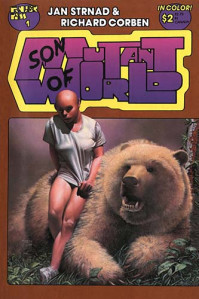
The protagonist is a brawny mutant named Dimento who is dumber than a box of rocks, but not cruel in a vicious way as are most of the survivors he must contend against. Corben’s art is fantastic as always, in full color for the duration of the MW graphic novel, and there is plenty of violence as you would expect from a tale of post-apocalyptic survival. Strnad takes the raw elements of Corben’s creation and weaves them into a tale of underground scientists trying to clone a new breed of humanity adapted to survival in the MUTANT WORLD. You can’t help but root for Dimento as he stumbles into one terrible situation after another and tries to save a beautiful young woman from depraved mutant predators.
This grim tale ends with an ironic twist and a glimmer of hope. In 1990 Corben and Strnad returned to this world and released a five-issue comic series entitled SON OF MUTANT WORLD. Each issue features 12 pages of the title series and various back-up stories. At 60 pages, SoMW is nearly as long as the original and it is even more satisfying. Twenty or thirty years have passed in Mutant World, and the protagonist is now Dimenta, daughter of Dimento and a human clone escaped from a scientific enclave. Another character from the first book, Max, who escaped from the same enclave with another clone, founded a peaceful society that is threatened by the mutant hordes of a skull-faced barbarian called Mudhead. Due to financial hardships, only the first two of the five installments are in color—the last 36 pages are in black-and-white. However, it says a lot about the quality of the art and story that losing the color doesn’t diminish the reading experience in any significant way. Corben’s art is so spectacular, it transcends the loss of color.
 SON OF MUTANT WORLD is actually better than its predecessor, perhaps because artist and writer both have another eight years of experience under their belts–or because they had developed these ideas for enriching the story over those years. In any case, we have brain-sucking plants, a pedal-propelled dirigible with a two-headed mutant bird, a massive grizzly bear with near-human intelligence, a gun-toting father-and-son team of survivalists, and a wide array of hideous, savage mutants ready to tear down the last bastion of civilization. There is a real depth of emotion here that is magnified by the dark setting, unlike the first MW where black humor and irony were the chief effects. I found myself rooting for Dimenta, her boyfriend Herschel, and the depressed Max; the reader’s investment in these characters is much deeper than in the original MW, which was steeped in savage nihilism.
Finding a copy of MUTANT WORLD and all five issues of SON OF MUTANT WORLD can be a challenge these days. However, eBay, Amazon, and online comics retailers are the best places to check. The bottom line is this: SON OF MUTANT WORLD is a thrilling classic that can only be fully appreciated by reading MUTANT WORLD first. The payoff is immensely satisfying after wading through such a dark world; but even when it’s dark, it’s completely gorgeous thanks to Corben’s spectacular art skills, color or no color. Some publisher really needs to collect MW and SoMW into a single volume—but don’t wait for that day to experience some of Corben’s best work.
 THE HUNDRED THOUSAND KINGDOMS
by N. K. Nemisin
Okay, first let me say that I know everybody and his brother read this book a year or two ago. N.K. Jemisin’s debut novel was nominated for a World Fantasy Award last year and everybody was talking about how incredible it is. What can I say? I’m behind the times—but I was lucky enough to acquire a copy of this book at last year’s WFC and I’ve been waiting for the chance to read it and see what all the fuss is about. Well, it’s summertime!
Boy, am I glad I got ahold of this one. THE HUNDRED THOUSAND KINGDOMS is not only a terrific debut novel, it’s simply a terrific novel. Period.
Jemisin combines epic feats of imagination, cosmic consciousness, and world-shattering magic with a murder mystery, a tale of ancient myth, and a revenge epic. I’ve heard so many people say that you have to keep a “less is more” approach when it comes to using magic and sorcery in fantasy fiction. “Bah!” is my usual response. In THE HUNDRED THOUSAND KINGDOMS N. K. Jemisin defies the idea that “less is more” and she delivers real human drama while evoking sorceries and magical wonders the likes of which are rarely seen in today’s fantasy fiction. She is not afraid to blow your freakin’ mind, and I loved it.
The book keeps you guessing about many of its plot twists and mysteries, sometimes to the point of frustration, but that’s part of its charm. Jemisin counts Tanith Lee among her influences, and the lush, lyrical style in which she writes (as well as her mythic sensibilities) are reminiscent of Lee’s best works. Jemisin’s characters are so very human—even the all-powerful gods of the story—you can’t help but identify with them. They are tragic, vengeful, sorrowful, beautiful, cruel, terrible, and everything else that makes human beings such wonderful contradictions. Part of the story’s underpinnings are the similarities between gods and mortals; often they are more important and perhaps more dangerous than the differences between the two.
The sheer scale of imagination in THE HUNDRED THOUSAND KINGDOMS is staggering, as is the author’s grasp of the human condition. Told from a strongly female point-of-view, the story makes important statements about the nature of mortality, love, jealousy, power, and forgiveness. It’s also amazing how Jemisin never gets bogged down in the details of imagery, but keeps her prose moving with fluid, simple descriptions of even the most breathtaking elements and settings. At certain points I wanted to pick up the book, climb onto my roof and shout: “THIS is how you write a fantasy, people!!!” But my neighbors would have only called the cops and had me committed. I’ll save my ravings for the next WFC. :)
Two more books in the INHERITANCE Trilogy are already available, and it will be interesting to see where Jemisin takes her mortalized gods and immortalized humans in future installments. I may not be able to read them right away, but there’s no doubt that I will return to this series. Meanwhile, this unstoppable author has already released another series, a duology called THE DREAMBLOOD.
Talk about being prolific! She’s writing these fantastic books way faster than I can read them!
But I’m perfectly okay with that.



