
Rachel Alexander's Blog, page 442
February 10, 2016
charlesoberonn:
charlesoberonn:
Apparently the current proposed name of the hypothetical ninth...
Apparently the current proposed name of the hypothetical ninth planet is Persephone which is such a good name I’m mad I didn’t think of it.
Allow me to explain why it’s such a great name:
It pays homage to Pluto, previously known as the ninth planet, since Persephone was Pluto/Hades’s wife in Greek Mythology
It helps make up for the gender inequality in the names of planets, since Venus is the only other planet named after a woman
If it exists, it’d be the coldest planet in the Solar System, and in Greek Mythology, it was Persephone’s time spent in the underworld that caused winter


February 9, 2016




February 8, 2016
February 7, 2016
"Can the sun find its match in anything but the moon? Can the heavens lose interest in the earth? Can..."
- Rachel Alexander (KataChthonia), Receiver of Many (via sarahs-delights)

kata-chthonia:
tumblr.com/kata-chthonia is now kata-chthonia.com

whattheclucksharon:
a-gnosis:
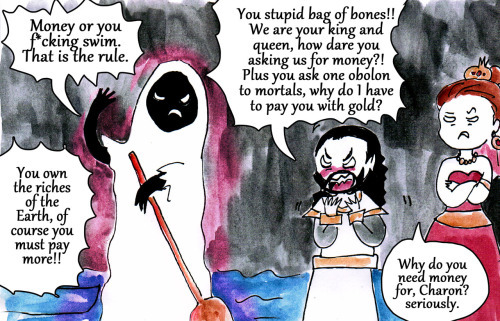
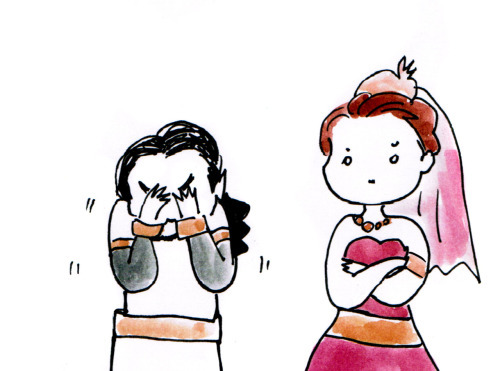
Since we were talking about this...

Since we were talking about this dialogue in Lucian’s Dialogues of the Dead the other day, I just couldn’t resist to draw this. ^^
Oh my gods ❤️
accusativeofexclamation:
kitienen:
I’m still really quite upset that Theoi is not as accurate as I...
I’m still really quite upset that Theoi is not as accurate as I always relied on it being. Or, rather, that the sources that Theoi uses that are not primary sources sometimes have inaccuracies in them.
Case in point: Theoi has a list of epithets on Artemis’ page that are taken from the Dictionary of Greek and Roman Biography and Mythology. Let’s take a look at one that vexed me this week.
MELISSA (Melissa), a surname of Artemis as the goddess of the moon, in which capacity she alleviates the suffering of women in childbed. (Porphyr. De Antr. Nymp,. p. 261.)
Source: Dictionary of Greek and Roman Biography and Mythology.However, I know from writing The Beeoi that ‘Melissa’ literally means ‘bee’.
μέλισσα 1 μέλι
I.a bee, Lat. apis, Hom., etc.
2.one of the priestesses of Delphi, Pind.II.= μέλι, honey, Soph.
Source:
Henry George Liddell, Robert Scott, An Intermediate Greek-English LexiconWhere does ‘bee’ fit into goddess of the moon? I wasn’t necessarily arguing, but I decided to check the source of that epithet. That brought me to De antro nympharum by Porphyrius.
Quin & mulieres Cereris facerdotes, tanquam inferorum Deæ Antistites, olim apellatæ funt apes, & filia ejus Proserpina mellita. Præterea Luna generationis regina, apis nomenclaturam apud priscos habebat, Sed alia quoque ratione: invehitur enim tauro, & exaltatio Lunaæ taurus Est. Apes vero e bubus procreantur, inde.
Unless you know a language related to Latin or Latin itself, that’s going to be a bit difficult to read, so let’s find a translation:
8. The priestesses of Ceres, also, as being initiated into the mysteries of the terrene Goddess, were called by the ancients bees; and Proserpine herself was denominated by |24 them honied. The moon, likewise, who presides over generation, was called by them a bee, and also a bull. And Taurus is the exaltation of the moon. But bees are ox-begotten.Basically it said “The moon [Artemis] was called by the ancients a bee and also a bull.”
This was even more confusing.
How does the definition of the epithet given by the Dictionary of Greek and Roman Biography and Mythology?Poryphrius called Artemis the moon, yes, but he didn’t state that the epithet of Melissa referred to her as goddess of the moon. He just said that she, going by the name of the Moon/Luna (probably Artemis-Selene, if you want to be specific) was also called ‘bee’, which would be Melissa in Greek.
My best guess as to what happened? The secondary source misinterpreted what Porphyrius was saying and drew conclusions that didn’t match the meaning of the epithet itself.
Lesson learned: always check the sources of your sources.What that’s actually saying is this:
Porphyrius: Priestesses of Demeter (Ceres via interpretatio Romana) were called Bees.
Porphyrius: These priestesses also referred to Persephone as The Honied One.
Porphyrius: These priestesses also called the moon a Bee because a) bees are associated with creation of life and honey, which never goes bad, is associated with immortality; and b) because the moon never dies but always returns, and is associated with cycles of crop generation as well as cycles of life.
(Porphyrius’ side note regarding bulls: there was an old belief that bees were born magically out of bovine carcasses, because bees tended to make hives in those carcasses and sometimes humans jump to conclusions. So bulls give birth to bees. Astrologically, the sign Taurus is the constellation in which the Moon is exalted. So bulls, and deities associated with bulls, automatically have bee, and therefore lunar, associations.)
Not Porphyrius: we know that Artemis was given the epithet “Melissa,” meaning “bee,” in various iterations of Her cultus.
By associative property: Artemis has connections, via bees, to the moon, and via the moon, to the bulls that give “birth” to the bees, AND, via bees and bulls and the moon, to the creation of new life.Ancient religion is fucking amazing!


