Jamie Greening's Blog, page 17
October 4, 2021
My Big Fat Greek Vacation
Greenbean went to Greece, and it was amazing.
Mrs. Greenbean and I spent the better part of September in Greece with two of our friends. It was wonderful and I highly recommend going. But go before your knees and lungs give out, because the entire country is uphill both ways. The mainland is affordable, and if you do what we did and buy food in markets and eat a lot of meals on benches or on the balcony of your hotel, you can save euros. Let me take our trip in big categories. I’ll start with the places we visited.
PlacesWe landed in Athens on a Tuesday morning and spent that exhausting day walking around. Our hotel was in the Plaka neighborhood, which is near The Acropolis. On that day, we walked around Hadrian’s Arch and the ruins of Olympian Zeus. We were too tired to really know what we were doing. Our plan for fighting jet lag was to stay awake, eat an early supper, and go to bed. It worked for the most part.
 The day we landed I found the Acropolis. Imagine how awful I smell. Just imagine.
The next three days we spent in Athens visiting The Parthenon, Mars Hill, the Roman Agora, the Ancient Agora including the Temple of Hephaestus, The National Archaeological Museum, and a few other sights. Athens is a very enjoyable city, but the neighborhoods change suddenly and dramatically. My favorite part had to be visiting Mars Hill. To stand in that spot where Paul preached, with the Acropolis behind him and the city below, frames that famous sermon in Acts in a way my imagination could never grab.
We rented a car and traveled to Delphi. It was far more alpine than I expected. The remoteness of the Temple of Apollo highlights the effort and intention exerted by the ancients to visit the oracle. We only spent the day there, and drove on to Kalambaka where we visited the impressive monasteries of Meteora. Monks have lived on those rocks for over a thousand years. We visited it on a Sunday, and I lit the candles, wrote my prayers, and contemplated the call of Christ and the odd interpretation of the gospel that moves men and women to remove themselves from the world Christ died for. I do not understand that impulse nor do I agree with that mode of ministry, but I am in awe of their devotion and discipline.
 Me sitting on Mars Hill. Notice the Parthenon/Acropolis behind me. When Paul preached here,
 the Parthenon was already 500 years old.
 The famous Lion’s Gate at Mycenae. So large, the ancients believed it was built by cyclops.
 We drove down across the peninsula to the Peloponnese and spent two nights in Patras. It is a very young town full of life and energy. We used that as a base of operations for visiting Olympia and Mycenae. Both were impressive. We made our way south to Nafplion, which is a delightful seaside resort where we ate too much gelato and I bought a pair of leather sandals made right there on sight.
 The Grand Meteora Monastery. There were six of them, we climbed up and visited four.
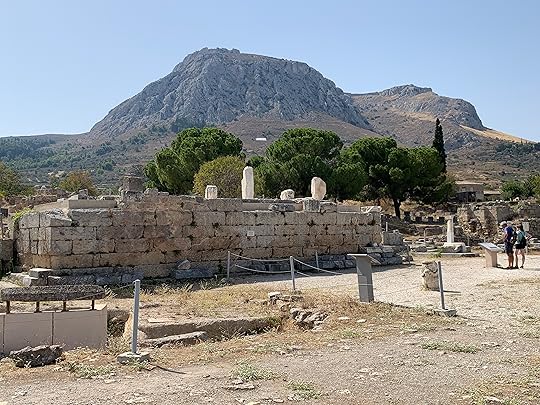
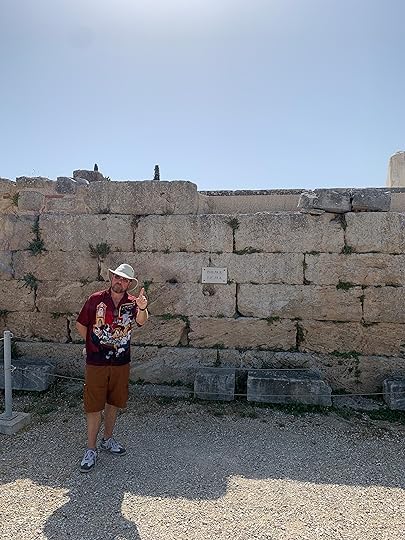
 On our way back to Athens we visited the ancient city of Corinth and I was able to see with my eye the bema seat mentioned in Acts where Gallio judged the Apostle Paul. Again, standing here, and knowing that right behind (or in front, depending on perspective) was the giant temple of Apollo. The museum there was good, with pieces of ancient, Hellenic, and Roman origin. The picture below is me standing in front of the Bema and a zoomed out shot for size. It was definitely built to overwhelm whoever was standing in Rome’s judgment.
We returned the car at the airport and stayed at a miserable hotel at the airport before flying the next morning to Santorini. We stayed in Santorini four nights and five days. We cruised out at sunset and ate shrimp and swam in the Aegean, we cruised again to the volcano and climbed up the summit, swam, and ate at a very rustic fishing village, walked the seven mile hike around the rim, visited the Ancient Theran Museum which is amazing, swam at Red Beach, which takes a lot of dangerous pathfinding to get to. Santorini does not have good beaches. I am completely convinced, after visiting the island, that Santorini and the disappearance of the Theran people three and a half millennia ago is the root of the Atlantis myth.
We flew back to Athens and spent one final day shopping in the Monastiraki neighborhood, which is basically a giant flea market.
 These blue domed white church buildings are all over Santorini. I estimate about six billion of them.
 This one is in Oia, which we walked seven miles and crossed Mordor to get to. FOOD
You know me, and food is an important part of any experience. I ate very well in Greece. I love the Greek salad — a salad without lettuce! They serve the feta cheese on top in a slice, not crumbled the way Americans do. Soulaki is a staple, and is basically just a k-bob. They grill mushrooms and serve a saganaki dish which is like a fried cheese. Very very good. Every meal seems to include tzatziki which is a yogurt mixed with cucumber and other spices. It is delicious with pita bread.
And the kalamata olives! I could eat my weight in those.
The seafood was so abundant and delightful. We ate calamari, octopus, and sea bass. On Santorini I ate a pandora fish, which I’d never done before. Also, they put French fries with everything, but do not put ketchup on the table. We asked for ketchup at one place, and what we got was not ketchup. I am still uncertain of what exactly it was, but it was good.
 The leftover fish after our last dinner on Santorini
The only thing that was not good was the coffee. They push a lot of Nescafe in Greece. A Greek Coffee, as best I can tell, is just about a half a cup of Nescafe and hot water, unstirred. In the afternoons they serve a caffe freddo, which is iced coffee with milk. Its not awful, but its not that good either.
The water is fine to drink. No need to waste euros on bottled water.
The best food we had was at restaurant called Paramithi in Kalambaka. Kalambaka is very rural, rustic, and about a billion miles away culturally from Athens or Santorini. The food was fresh made just a few feet away, local, and a man who looked a little like Anthony Quinn in Zorba played Greek tavern tunes on his stringed instrument.
With the exception of a couple of breakfasts locations, every meal we ate was outside. I do not think this was COVID-19 protocol, for the buildings were structured this way. The Greeks eat outside. It is just what they do. It felt so wonderful.
We saw one McDonald’s the whole time we were there, and that was on Santorini. Other than that, I didn’t see any fast food restaurants. I saw tons of people, not tourists but Greeks, sitting in those wonderful cafes and taverns outside. It is not a bad way to live. I loved the Greek diet, and the times they eat — lunch around 2PM and a really late supper around 9PM.
PeopleThere is not much to write here, other than to praise the Greek people as wonderful souls. Every one we met was kind, generous, and very understanding and helpful. They were also talkative. They love their country and their culture, and are proud to share it with you. It seemed to me they loved the fact people from other countries value their history, culture, and heritage.
Just about everyone we met had some working knowledge of English, and most of the signs are written in Greek and English. Language and communication was never a problem. Many of the people we met had lived for a while in either The United States or England. Some used us to practice their English — especially in Patras where they don’t get many American tourists. Some will want to tell you about their region, and one man pulled up a chair and wanted to talk to us about the San Antonio Spurs and Houston Rockets, because he was a big NBA basketball fan.
The only words in Greek you need to know is ef-charisto — a variation of the New Testament word eucharisto, which means thank you. The other is parakalo, which means both thank you and please. That too is a New Testament word. W.C. means water closet, which is the bathroom. Most are clean with a women and men’s side but a public hand washing sink outside both.
The Greek people are hard workers. They hustle for business and to make the customer happy. I never encountered any kind of snobbery or laziness.
The people in Athens dress very casually — t-shirts, jeans, and comfortable shoes. They dressed a little more formally in Patras and Nafplion. On Santorini everyone dressed up quite a bit. The narcissism was on full display there with selfies and people getting the perfect social media picture. Lots of fancy dresses. Also lots of skin. People dress very modestly on the mainland, but on Santorini it is scandalous.
The tourists we met were mostly good as well. We saw a Russian man propose to his fiancé at the top of the Acropolis, cruised the caldera with a Nigerian/Brit, talked about business with a pub owner from Manitoba, Canada, and swam with a couple from Long Beach, California. We heard lots of people speaking German, many Russians, and a lot of Americans and Brits. There are more Americans on Santorini than Greeks, I think.
A couple of fashion notes. The only long beards I saw was from the Greek Orthodox priests. Most of the men had a kind of five o’clock shadow beard and a heavier mustache, but not like a Magnum P.I. mustache. And because it is me, I was noticing the watches people wore. The Greek people have not adopted the smartwatch. They all had nice analog watches that matched what they were wearing. Only tourists wore hats.
The people who ran the museums were the meanest we saw. They kept blowing whistles at us. We were those people. We may have touched things we weren’t supposed to. And by touch I mean walked around in closed off areas. Maybe.
 Our last meal in Athens before we came home.COVID-19
This trip was taken in the midst of the rise of the Delta Variant of COVID-19. When we planned it, we figured the pandemic would be behind us. We were wrong. There were three major inconveniences to us in this regard. The first was wearing a mask on the airplane. Crossing the Atlantic and changing planes in Chicago meant wearing that mask for about twenty-four hours nonstop. That was pretty rough, not for my mouth or nose but my ears. The second was the required COVID-19 test to get back. I confess I was a little anxious as we all stood outside the pharmacy on Santorini waiting for our results. The third was that we had to show our vaccination card to get into most of the museums and archaeological sites. These were minor inconveniences, though, and did not hinder the enjoyment of the trip.
For the travel parts, the American Airlines Verifly App made it very easy. Once the airline cleared us on the App, it was just normal passport issues at customs. Here is a protip — don’t smile at the customs officers when they check your passport picture. They don’t like that.
Greece takes masks seriously, and anything indoors you have to mask up, and most of the shops, not restaurants because they are outdoors, but the shops, markets, banks, and post offices have limits on how many can be inside at one time — usually only three or four people. But once you get into the rhythm, it wasn’t that big of a problem. Again, only the long air travel seemed to be burdensome.
Misclleaneous ItemsIf I ever go back, I want to visit Mykonos, Crete, and Rhodes, perhaps Thessaloniki and Philippi. The world is big and there are lots of places I want to visit, so I don’t know if ever I will make it back, but if I do, I know I will have a good time.
How expensive is it? It could be done a lot cheaper than we did it, but it is cheaper than Disney World. I know that from experience. Disney is about five or six days, and for less money we spent nineteen days in Greece.
The flight is about nine and half hours from Chicago going and ten and half coming back. I crossed several things off my bucket list on this trip, and one of these was flying on the 787 Dreamliner. Great airplane. Also, if you can leave from an airport other than O’hare, do it. That place is a dump. We traveled on RyanAir to Santorini, and that was just fine — they flew these nice Boeing 737s. You can see just how dotted the Aegean is with islands as you make the thirty minute flight.
There is a whole lot more I could say, but this post is already far too long.
SummaryGo to Greece. Take cash — and I mean euros — because lots of places don’t do cards. Bring good walking shoes. Eat delicious food. Take pictures. Talk to people. Swim in the sea.


August 25, 2021
Book Review: Howdy Pilgrim, a Review of Jesus and John Wayne
Okay, I couldn’t resist putting a John Wayneism in the title for my review of “Jesus and John Wayne”.
Please forgive me.

The book is 305 pages, paperback, written by Kristin Kobes Du Mez. She has done good historical work, documented her sources, and covered the time period in a chronological way that I appreciate. There are sixteen chapters, and each chapter is thematic around a basic idea related to the rise of evangelicalism in the United States since the turn of the twentieth century.
Let me begin by addressing the salacious title. This book is not about Jesus. Actually, there is very little about Jesus in it. It is also not about John Wayne. There are a few scatterings about John Wayne and his politics and how it influenced his later movies, especially films like The Green Berets, but if you buy this book thinking there will be a lot of stories about The Duke in it and how he relates to Jesus, then you’ll be disappointed.
This book is about one thing, and one thing only — it seeks to describe and explain the emergence of toxic masculinity, or the patriarchy, within evangelicalism. The subtext of the book is that we are to believe the way evangelicals embraced former president Donald Trump in 2016 is a direct result of that toxic masculinity which had been carefully nurtured by key leaders for at least seventy years. If you want a book that is all about Donald Trump and his relationship with Christ-followers, this book is not that book, as he only occupies pages on the periphery, the beginning and the end. This book is more about the mindset of evangelicals rather than the politics of President Trump.
Du Mez believes evangelicals embraced Trump precisely because he was a testosterone-filled alpha male who put women and his enemies in their place, and that is what they had come to expect from strong leaders. As such, I think she comes up short of proving her argument en toto. She may be right, but I think she overplays the masculinity politics just a tad and underplays the genuine concern many Christians have about issues like abortion, the Supreme Court, and immigration. I don’t write this to defend those positions, but I don’t think it is just the issue of Trump filling the idealized image Christians have of a strong man. I admire her attempt though, because I have often struggled to understand exactly how a New Yorker who built an empire of casinos, had a penchant for pornography, was guilty of womanizing, said his favorite pastor was Norman Vincent Peale (a man evangelicals absolutely couldn’t stand), and cursed so much in public became the darling of Southern Christians. I am less than satisfied with her explanation, but I admire the attempt.
What I like about this book is the thoroughness. It is so thorough at times you feel like it is repetitive. Du Mez can sometimes belabor the point, but that is just good historical footwork. In doing this work she weaves a coherent narrative of evangelical thought from Billy Graham’s famous Los Angeles crusade to Bill Gothard to Phyllis Schlafly to Tim and Beverly LaHaye to Oliver North to John Piper to Mark Driscoll, covering all points in-between. She glosses over a lot of years and personalities, but the way she paints the picture it was one successive leader after another reenforcing gender stereotypes and tropes into the hearts and mental pictures of Christians.
If I were to say there is one particular target for Du Mez, it is not Donald Trump, but James Dobson. She spares no energy in attaching him and his organization, Focus On The Family, to every bad thought or bad idea or bad person. She really, really, really, really does not like him. Yet, it is hard to find anyone she is flattered with. The book is a virtual compendium on the agenda, style, and problems of key Christian leaders — and most of them are in my library — the ones mentioned above, plus folks like Wayne Grudem, Stu Weber, Bill Hybels, Rick Warren and Tim Keller.
Her critique is needed. There is much in the way of abuse, politics, agenda, and just plain-old-fashioned power grabs that have marred and scarred churches in America. This is an issue of repentance and of change. Do not read her book if you don’t want to argue with her a little bit, and do not read her book if you only read things that conform to your preconceived notions.
I agree with many of her assertions. For example, I think she is right when she highlights how complementarianism has been used by abusive personalities for their own gratification. As an egalitarian, I can completely join in on that perspective. However, not all complementarians are abusive, and the vast majority of them I know are good, honest, wonderful Christ-followers who are seeking to follow the Bible as they understand it. To paint them all with that broad brush of abuse or manipulation is going too far. Egalitarians can be just as guilty of abuse, as the sad situation with Hybels exemplifies.
But my criticism on this front is a minor issue because the church deserves this kind of evaluation from a skilled set of eyes willing to go through the actual historical record. She has the receipts, so to speak, on something I’ve said often but without the data, just more of a gut feeling — and that is this — when we look at what the last seventy years of church life has produced, biblically illiterate people who call themselves Christian, sex scandal after sex scandal, spiritually weak churches, church leaders obsessed with marketshare and media, and then put the cherry on top of a loss of credibility with just about everyone then I ask the honest question, why would we continue to follow any pattern in church life that has been handed down to us? If we are to have healthy Jesus-focused congregations in the future these congregations must break the paradigms that have produced so much poison. Taking away the power of celebrity pastors to et the agenda is one place to start. Another is to reject the idea that growing a big church is somehow the goal. Another is to reject power-players and bullies within local churches. And another, which this current volume aligns with, is the empowering of women to fully exercise ministry gifts. I mean, come on, men have made a pretty big mess of things. Maybe it will take godly women leaders to clean it up.
I recommend this book if for no other reason than we all need to be exposed to our own history.
August 18, 2021
A Prayer For The First Day of School 2021
Dear Lord, the buses are running and the backpacks are filled, lunches are made and pencils are sharpened. In many ways it feels normal, and so I make the normal prayers.
I pray for children to learn, about words, worlds, bugs, and books but also learn about themselves and to grow as people. May kindergarteners make messes and laugh, and fifth graders run too fast and hard, and eight graders finds a way to not be awkward when their body shouts awkwardness, and may eleventh graders dream of changing the world.
Let these children make friends — good friends. Allow them to discover what their own passions are and what the right avenue of expression is. Let them make mistakes, then be gently corrected by a firm, but kind hand.
I pray for parents. Some are sending their children off for the first time, and some for the last time. Being a parent is the hardest work in the world, Lord, and I ask that you give these parents a special dispensation of grace.
We also pray for teachers — bless them for their heroic work. Let it be a fulfillment for them of their own true vocation. We ask that bus drivers, cafeteria workers, custodians, and administration personnel all have years which are meaningful and significant, and that you will let their work be a blessing and not a frustration.
Our schools do so much more than teach, Lord, and as we have put this burden on that system, we ask that you help us to make it work. Allow the school to make certain every child has plenty of food to eat. If there are children who are being hurt or abused, allow justice to prevail. If a child needs special help with development or mental health, then let it be discovered and assessed in a helpful way.
So, Lord, these are the normal prayers. But we do not live in normal times. We live in COVID. This is our third year with this disease. I thank you for last year, that our school did a phenomenal job, but this year brings new fears, new variants, new rules. Protect our children and teachers, and Father I ask that soon a vaccine for children will emerge to take this pressure off, and to help us safeguard our most precious resource — the future.
There are other things we worry about, Father, and we bring these before you as well. Protect our children from bullets and evil people. Protect them from bad ideas, from the wolves who sneak in among the sheep and exploit trust and pervert innocence. Protect them from the poison that is seeping through our culture, poisons like division, politics, hate, and lies.
O Lord, we believe that you have given us children as a gift. We want to treat them that way, as a wonderful gift that confirms your blessing and that also teaches us about how we relate to you, as children who are always learning. Show each of us our part to play as parents, grandparents, neighbors, and friends.
May 2021, with all its challenges, be the greatest school year ever for our children and those who love them.
In the name of Jesus Christ our Lord, in the power of the Holy Spirit. Amen.
July 7, 2021
Pastoral Ministries And COVID-19
One of the aspects of pastoral ministries I take very seriously is the hospital visit. I know a lot of pastors do not do those any more, but I still think it is important. For most of my twenty five years of ministry, this has two phases. One phase is someone in a room, and in that room and it is just as you would expect, like a regular hospital visit. The biggest challenges in these situation are 1) getting them to turn the television down 2) finding a place to sit 3) not interfering with the medical folks coming and going. It is always important to remember, pastorally, you are on their turf when in the hospital and you must accommodate whatever they have going on.
The second phase of this, is what I think is the most important, and that is pre-op. I have never had any problem walking to the front desk, saying I am so-and so’s pastor, then calling down to get clearance from the patient, and then they walk me down — usually to the last stop before the patient goes in. It is in this setting that I read a little scripture, talk about eternal things, anoint them with oil, and then pray with them for a successful surgery, wisdom for the doctor, a speedy recovery, and no long term problems. The greatest challenges to this was 1) arriving at just the right time, 2) not staying too long, and 3) finding your way back out when finished because those places are a maze.
COVID-19 changed all of that.
I remember the visit I was trying to make the very day they changed the policies at one of our local hospitals and was denied access. I did leave behind a little “prayer bear” from one of our ministries that I take to patients in the hospital.
 One of our little prayer bears
For over a year now, hospital visits have been prohibited across the board. In this in between time I have prayed on the phone with a lot of people and visited them in their yard the night before, all masked up and often wearing gloves. Sometimes people prefer to come by my study at church — it feels a little more official, I think for some folks.
Now, though, some hospitals are opening up, our local hospital is, for the Phase One kind of visit. I’ve been able to see people in their rooms the last three or four weeks and that is very nice. It feels almost normal.
The Phrase Two type, though, still seems out-of-reach. I was reminded of this yesterday when we called a hospital to find out if I would be able to do that and was told “You can pray in the lobby before the patient checks in.”
What I am wondering is, as a spiritual guide, if the hospitals will ever open this back up to us as a possibility. I feel like there is a good chance they will not, which is unfortunate. It deprives people of faith of a holistic approach to their well-being.
What I am working through is how this change will combine and steamroll with the rapidly increasing trend toward sending people home the same day of their procedure. More and more surgeries are ‘day surgeries’ or perhaps ‘overnight’ surgeries. The window of opportunity for seeing someone in the hospital has been shrinking steadily. When I first started pastoring in the mid-90s, if a woman had a hysterectomy she was often in the hospital fo a week. Now she is home that afternoon. Back surgeries were usually long stays, but now they schedule them at 6AM and have the patients out the for by four.
I am not complaining about this from a medical perspective — although we all know these rushed times are the result of insurance and not healthcare — but instead my concern is how do you do meaningful hospital ministry in these accelerated programs when COVID-19 protocols are in play? The answer will probably involve some kind of hybrid approach that involves the night before the surgery prayer in home, Sunday at church prayer, video-calling people in the hospital, and the incredibly rare opportunities to hold someones hadn’t, touch their forehead, and pray with them.
What I refuse to do is surrender the playing field, so to speak, and walk away from the sick, the hurting, and the afflicted. As things change, we who give pastoral care will have to work hard to stick our nosey little face in and ask the questions like, “If your surgery doesn’t work out the way we are hopeful it will, are you ready for eternity? Have you told the people you love all the things you need to tell them? What is your biggest fear going into this? How is your relationship with Jesus?” What is more, those we minister too will have to help us, because we’re navigating waters that are fresh and new to us and are contrary to both our training and our temperament.
June 23, 2021
Baptism: Three Possible Futures
Not that baptism only has three futures, but I see three possibilities.
I’ve been thinking of this important Christian practice a lot lately as I’ve recently finished up a six weeks small group class that has covered the biblical material, origins, history, practice, and theology of baptism. In the last session I talked about contemporary issues, and among those was a speculation of where baptism may be heading in modern American culture. What I see is not all that great.
Future One–People Are Getting Baptize All The Time
Many Christian groups, particular those with an Arminian disposition, may have people who feel they’ve lost their way and come back to faith in Christ and want to celebrate this with getting baptized again. Other traditions, like my own Baptist heritage, has begun to view baptism as an almost expected double or triple experience. It is not uncommon for people to have been baptized as a child, then again as a teenager or in their 20s, and then finally when they join a new church that has a different practice. None of these things in itself might lead us to this new future of everyone getting baptized all the time, but combine it with the idea of using baptism to cleanse a conscience after a traumatic event or a startling life change, and it is not hard to see the idea of baptism as a symbol of renewal of Christian faith that might be repeated multiple times a year as Holy Communion is celebrated.
Future Two–No One Is Getting Baptized
Another variation is one in which the act of baptism has been ‘metaphored’ away into something that represents a decision to follow Jesus as Lord but the symbolic representation of the water has been removed as an artifact of a pre-enlightened world. This move would certainly be welcome to the large mega-church movement which are functionally non-denominational in their affinity appeal to ideology and style rather than theology or heritage. It is easier to move people without the trouble of water.
Before you object to this as an impossibility, consider this has already happened in most places with the concept of anointing with oil for prayer and healing. Whereas our foremothers and forefathers would have likely seen and participated in such moments of symbolic action, today’s Christ followers rarely if ever experience it.
Future Three–Everyone Is Getting Baptized
No, not because everyone is become a follower of Jesus, but because baptism has been secularized and no longer is rooted in faith in Jesus. In this concept, the world co-opts the baptismal font as a statement of cleansing or renewal in a psychological or emotional sense but no need to bother with faith or theology. The best example of this having already occurred is the cross. People adorn their bodies with a cross who have no faith in Jesus at all. Indeed, the government designates the cross as a secular symbol (click here for Greenbeans outstanding ‘The Cross Is Not A Secular Symbol’) that means death or cemetery. Can you see a future in which people are baptized after a bad day, a breakup with their boyfriend, or quit a job, or smoking? Sadly I can see backyard pool parties in which people promise to be loyal to themselves and to serve the better good as citizens of the world an some other bilge about the heart wants what the heart wants, then a good friend baptizes them and everyone sings a John Lennon song.
Each of these futures is horrific to me.
June 7, 2021
In Memoriam: My Mother
My mother believed funerals were barbaric. She said so to me on many occasions. There was something about it she thought morbid — people talking about the dead in ways they never talked about the dead when they were alive. She also hated the pretense and ceremony of a funeral.
I disagreed with her on the importance of funerals, for I think they are important, but she hated them.
Saturday we had hers.
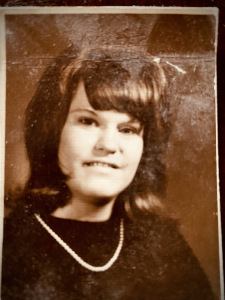 Joyce Stinnett Greening
Age Unknown
It was actually more of a memorial. My sister and I had talked with her about her wishes, and she waffled a bit for a long time about where to put her ashes — part of her wanted to be put in Arkansas where she was born and spent a lot of time, and then part of her wanted to be put on the old farm in Hughes Springs, Texas.
In the end, she chose the farm.
We gathered on the concrete slab that was once the back porch. In this picture below I am standing approximately where “Laura” was — Laura was the giant freezer we kept the ice cream in. Yes, the freezers had names. Mom named them. The other was “Granny”. Granny held the meat and frozen vegetables from the garden.
The house is gone too. We had to demolish it when it collapsed under the weight of a storm and the trees. The only thing left are the sheds (yes, plural for my father loved to build sheds) and the wooden porch he constructed.
We held a brief service with some traditional elements, and several people spoke and told stories. There were about thirty people there. All of them were either family, neighbors, or those who had been neighbors. I read the 23rd Psalm and Jill played the songs from Spotify mom wanted played at her funeral — “Heavenly Sunlight” and “Spirit in the Sky.” So, the Gaithers AND Norman Greenbaum played mom’s funeral — which should be enough to keep it from being barbaric.
At the conclusion we put her ashes in a Folgers coffee can along with her last pack of cigarettes, a lighter, and Oreo cookies then planted it in the garden she tended. The flowers still grow, wild and bold, scratching out life from the cruel world and blooming just like my mother did.
Mom taught me a lot of things in life — how to treat most any wound or ailment with mayonnaise, coal oil, butter, tobacco juice (spit), horse linament, and monkey blood. If you do not know what monkey blood is, you have not lived a full life. She also was fond of melting down Vicks Vapor Rub in a spoon and making me drink it. You can imagine my shock when as an adult treating my own children I finally read the label where it says “DO NOT CONSUME”. Aside form hillbilly first aid, she also taught me lessons about life, family, and priorities, and one of those lessons was hospitality. Over the years many different people lived with us or spent a long amount of time with us. Mom never turned people away.
On a fun note, she also taught me to cook. Mom was an outstanding cook and she did so with inferior tools. Some of my favorite dishes I learned from her:
Banana Pudding — her recipe takes many eggs and real “Nilla” Wafers. She was a devoted consumer of name brand products. Chicken and Dressing — every year I called her the Monday before Thanksgiving just to double-check my big dish. Goulash — I thought my mom invented that until I learned it was actually Hungarian. SOS — “Stuff on a shingle” she learned this from her mother, and she made it with hamburger meat but I prefer sausage. Its basically just gravy and toast. But the gravy has to be brown gravy. It has to be. Beef Stew — She made great beef stew, and I learned from her that you eat the meat last after you’ve eaten everything else.A few fun facts about my mother:
Her favorite movie was Aliens. The second one, with the space marines. She liked the first one, but the second was her jam. She liked movies with strong female leads.Although she was a great cook, she didn’t really eat much of what she cooked. She preferred snacks. The snacks would come in phases — she’d obsess about Skittles then one day suddenly move on to Fig Newtons. Her last obsession was Oreos. True to her Arkansas roots, she did not appreciate having to wear shoes, and her favorite clothing was a moo moo. Paranoia was her default reaction to just about anything. “They” were watching, and “them” was the persistent problem.She hoarded light bulbs, certain the day would come when no human being would be able to buy one. Also fun fact, she referred to them all in one word without the L sound in bulb, ‘litebubs’. Mom was an avid reader, often reading a book several times over. Our home was very small and she knew I was a reader too, so she hid the books I shouldn’t be reading under the bathroom sink. I was about nine when I found Truman Capote’s ‘In Cold Blood’. I read it from cover to cover. She wasn’t a very good driver. In fact, she terrified me behind the wheel. She had many aliases. The first one I remember is “Aunt Jo” from my cousins. I never knew if my Aunt Sylvia named her that, or if at one time she preferred to be called “Jo”. I guess it is a mystery. Later she was “Mama Jo” to children she babysat. My father called her Scrooge — I have no idea why. Eventually she became Nina–everyone called her Nina Greening whether she was their grandmother or not. Colby, her first grandchild, named her that. It fit.I will miss her so very much, and words cannot do her lifetime justice. She’d lived a hard life, and continued to fight the heart condition that left her so sick for nearly twenty years. There was once, when I was a very young child, when things were not very good–by not good I mean they repossessed our vacuum cleaner, turned off our propane, the phone was disconnected, and only eating what we raised or killed–in that time I remember asking her, “Will we make it?” and she responded, “We have to.” It is that gritty determination that she bestowed upon me that I am most thankful for.
Now for some pictures: Mrs. Greenbean took these. You can see the ground was wet and muddy, and rain threatened the whole time. Nature is beginning to reclaim the yard, and it has already reclaimed most of the fields.
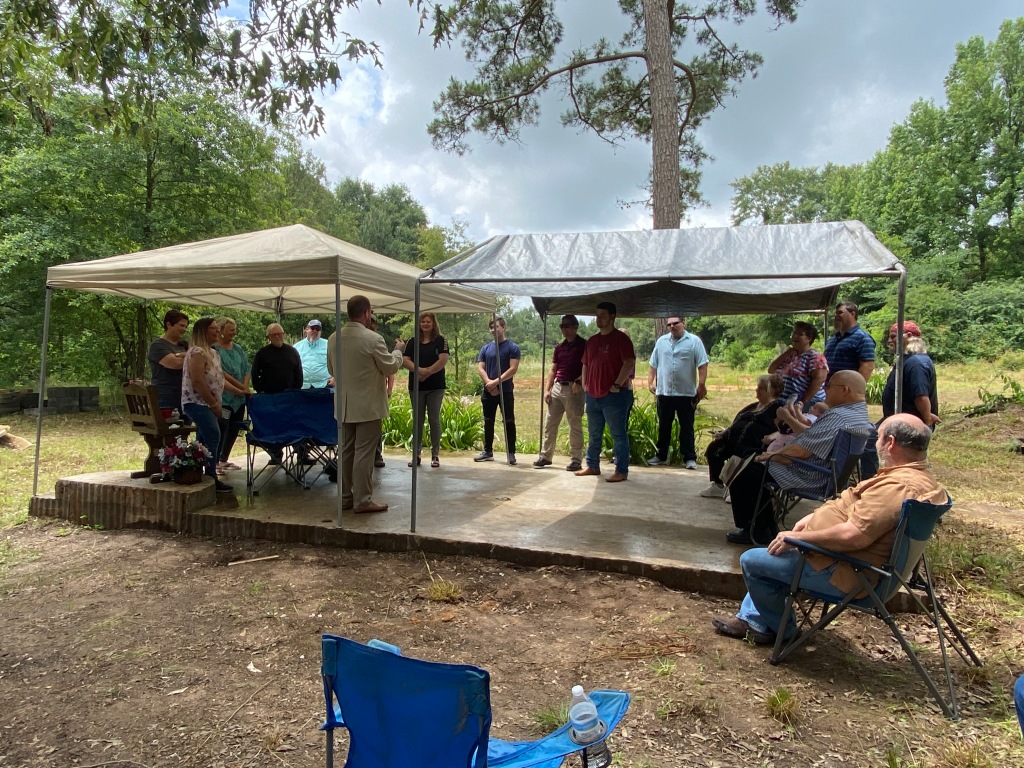 The slab where we gathered. More people are behind the picture than in front.
 The blue chair is where my bedroom was growing up.
 My sister, Jill, and I in mom’s garden. Mom is in the coffee can, along with her smokes.
 Mom’s grandchildren: My nephews Zach Asbury and Colby Guin
 along with my daughters Belle Greening and Phoebe Greening
 Mom’s side of the family — back row left is Richard Fowler, his wife is Tina in the pink shirt front row, Back row is Jill, then Tricia Foster, her mother is Claudette Wakefield in the front row left, me in the back, and Tim Smith in the hat.
 Jill and I with one of our step-sisters, Paula Greer.
 Mom loved her neighbors — in the middle are Bobby and Darlene Stewart,
 flanked by Tracey (in the hat) and Janelle Dunnington
 The porch stills stands
April 19, 2021
Best Picture 2021 — A Great Batch of Movies
Movies have been weird this year. I haven’t seen a single nominee on the big screen because . . . COVID-19. Instead, I’ve watched them at home, which has been cheaper, easier, and more convenient. However, it doesn’t quite feel the same. Nevertheless, in typical Greenbean fashion, let me present to you my summation and prediction for best picture. Let’s take them in alphabetical order.

The Father — Tear jerker, great performance by Anthony Hopkins, but the only award this French rehash will win is editing (which may be the only sure bet this year). The editing is actually the key to understanding this film, and figuring out when Oliva Colman is wearing that blue shirt.
Judas And The Black Messiah — One of two films set in Chicago in the late 1960s. The story is amazing, and the acting is brilliant. This movie has a better than average chance of winning, particularly because of the subject material’s relevancy. I really liked this movie.
Mank — Well told story about old Hollywood using techniques and pacing that is reminiscent of the old stories themselves. Pro Tip: watch Citizen Kane BEFORE you watch Mank. Oldman will win best actor because Hollywood loves Hollywood more than anything except money and it will probably win cinematography, but Mank can’t win best picture. It is a great movie, but not up to snuff with some of these other films.
Minari — I am sentimental about this movie. It reminds me so much of my own childhood — right down to the barn burning and kids riding the van to church. This movie has a very good chance of winning. Brilliant acting, pacing, and it may well be the best overall storytelling we’ve seen in an Oscar nominee in a long time.
Nomadland — This is the weakest of the movies nominated. It is still a fine film, and I particularly loved the homage to the West as my family has been to so many of the places visited. Specifically thrilling for us was Wall Drug. I just found it a little simplistic. Felt much more like a documentary.
Promising Young Woman — This movie has a better than average chance of winning. Brilliant, thrilling, riveting, and heart breaking. Again, the subject matter is very contemporary, but Carey Mulligan is a powerhouse in this movie making the most of every word she says and every glare she gives. I think Mulligan wins (Mrs. Greenbean thinks Andra Day wins) best actress, and this movie may be an upset winner.
Sound of Metal — Mrs. Greenbean loved this movie. It is a well told tale with riveting characters you care about. The story of a person losing his hearing and how he copes and the folks who help him is the stuff of real life. This movie, along with Promising Young Woman, is one of those that stays with you long after you’ve watched it.
The Trial of the Chicago 7 — I loved this movie. The Aaron Sorkin script will win best original screenplay and Sacha Baron Cohen may steal a best supporting actor Oscar, because Oscar has set up Judas And The Black Messiah actors to fail by nominating Kaluuya and Stanfield in this category, thus splitting that vote. If you love political drama, this your movie. Such a wonderful ensemble cast, especially the always riveting Mark Rylance who, in a different less crowded year, would have been nominated for best supporting actor.

I really did like all of these movies and could make a case for each one winning the Oscar, so I will not be mad at all this year (I’m looking at you, Birdman and The Shape of Water). But if I were picking, I would pick Minari, and I think Minari will win. After Parasite, Koreans are on a streak.
A couple of auxiliary notes. First, with the exception of Frances McDormand’s naked skinny dipping, there was no nudity or sexually explicit scenes in any of these movies. The language in all of them was harsh, Minari being tamer than the rest, but the absence of nudity was a very pleasant surprise. I hope it is a harbinger of things to come. Even McDormand’s scene was more of a hippy dippy moment and not designed to be sensual.
Second, I always like to find themes in the movies to see where Oscar’s head is, or where Hollywood’s is. A surprising one emerged: community. Each movie emphasizes the strength of a community that holds us together. It is very prominent in Metal as the real heroes are the deaf community who also are Christ followers. But Promising has the subset of med school students, Chicago 7 is protesters, Nomadland is the community of nomads, Minari is the immigrant community, Mank is that small Hollywood cloister of olden times, Judas is the Black Panthers, and The Father is literally a family. it doesn’t take a rocket scientists to point out that in the world of COVID-19, those tight communities and being together tends to tug at our heartstrings a little more.
If things allow, I’ll be back later with more Oscar predictions. It is a very good batch of movies this year. Very good.
March 11, 2021
A Year of STUPID COVID
That is what we call it in the office here at church. Stupid COVID.
Today (March 11) seems to be the day we as a nation are marking the one year awareness of C-19. As a caveat, I would like to say I distinctly remember being aware of it by late January and all through February. I think what we are remembering is when people recognized how serious it was with the cancellation of NBA games and the public announcement that Tom Hanks and Rita Wilson tested positive for COVID-19.
I know when I took it seriously — it was March 4 when Sony MGM announced they were postponing the release of No Time To Die, the newest James Bond film and probably Daniel Craig’s last turn as 007. I remember my thought process very clearly — studios are designed to make money, and if they see the risk of releasing it in April then this must be quite the problem. The second real stand-up moment for me was March 13 when the NCAA announced it was cancelling the annual basketball tournament. March Madness is a huge money maker for these colleges. Cancelling it was serious. The best way to judge what people really think and feel is to follow the money. These two cancellations were demonstrable that people were afraid enough to throw money away.
At present, a year down the line, I am very optimistic about the future. It seems like the vaccines are working. Case numbers are down. People are rolling up their sleeves. I am very hopeful that by May or June we can be back to something like normal.
Since everyone else is dong it, let me make some observations about the past year.
I am very impressed with the vast majority of Americans in general, people in my community in specific, and our church in the extreme. Most of us have gone above and beyond to help others, to take precautions, and to support the decisions that needed to be made.At the same time, the number of people who flippantly put other people’s health in jeopardy and show no concern for their neighbor disgusts me. COVID-19 has showed us who people really are and what they value. The pandemic has already changed us and how we interact. I’m pretty sure for the rest of my life when I fly or am in a crowded space, I will put on a mask. I know it has changed government and our expectations of it. It has also changed church. I don’t know if we will ever be completely comfortable in a potluck or really crowded classrooms ever again. Let me speak about that government business for a second. For a variety of reasons, the pandemic demonstrated we were not ready for it. It was humbling for our nation, which is okay. Pride is a sin, and recognizing weaknesses is an important part of growth. My fear is there will be an overreaction in the other direction which will be too much reliance upon government to solve every personal issue. Wisdom will find that sweet spot of competency and preparedness. Still on the government bit — I fully support the COVID relief bill which just passed through Congress. However, we need to start thinking right now of how we are going to pay for it. My recommendation is we tax hard and fast the tech industry, particularly digital communications. These were the platforms that made a killing during COVID-19 because we all had to use their products. While restaurants and airlines and cruise ships and cinemas and concerts were closed Amazon was making mad bank. We should tax them specifically for recovery. After that, something like a 1% added income tax for everyone until the national debt is paid. That’s my big idea.The most valuable workers in our nation are medical workers, grocery store workers, truck drivers, childcare/education workers, and of course police officers. When the pandemic hit, these were the people we needed the most to keep us fed, supplied, and safe. How many parents now realize the work their school does for their children? All of us, I bet. I would like for our pay structures to reflect this. I’m not against athletes, entertainers, and CEO’s making as much money as they can negotiate for, but I am against the pathetic salary structure of people we so desperately need. We will have the money to do this, because pent up demand is going to set the worldwide economy on soaring heights. Soaring. Our church faired very well through this and I adamantly believe our church is the greatest church in the world. We took a super-cautious approach from the beginning. Nevertheless, I will freely admit it has been the hardest year of ministry I have ever experienced. It has taken a toll on my soul. Some of it is the amount of work we had to do to reinvent almost everything we did in order to maintain ministry, but most of it is the very negative, hateful, and personal attacks people have made. The number of people who have hurt me is very small, but the cuts are deep because they are relational. As to church in general, I think the church in American, at least, coming out of this will be smaller, poorer, but stronger. Some people who got out of the habit or who have filled the gap with other things, will never come back. Some folks who are angry at cautious protocols will stop giving. That’s okay, but the Lord is always using the ebb and flow of life to separate the wheat and the chaff. I am thankful for Zoom and Facebook Live because it has helped us stay in touch and connected. However, we have learned in the pandemic that remote learning and digital classrooms are a poor substitute for in-person instruction. This is true of schools and churches where learning is key. My perception is these technologies will be helpful in the business world because transformation and learning is not the goal, but information exchanges. Many people who learned to work from home will never return full-time to an office environment. Many people who used to travel for work will see their travel diminished as they’ve learned to do it from home via conference call. This will change the workplace and our culture, particularly parenting. What we have to do is remember that until the modern world, this was normal. Everyone worked from home before the Industrial Revolution. We are not out of this yet. In Texas, 202 people died yesterday from COVID-19 and 1,477 in the United States. We need to keep vigilance until we have the necessary 70-80% of the population vaccinated. That means masks, distance, hand sanitizer, and caution until at least mid-April. The weather here is getting better, so we are moving our worship services outside again in two weeks. Why? Because it is safer. Ignore the politicians and instead remember the words of Jesus and love your neighbor. Don’t be selfish and don’t give into the fatigue. Now is the time to stay vigilant. Don’t be afraid, but exercise love and self-control.February 11, 2021
The Greatest: Part IV
“Once more unto the breach, dear friends, once more,” we focus upon The Greatest. We’ve done general stuff, fictional characters, food and now today: products.
 Takes a lickin’, keeps on tickin’
This is my list — but I love seeing yours because it is fun to share our #opinions.
pencil — Blackwing Palominoblue jeans — Levifootwear — Nikewristwatch — Timexauto — Ford Explorercomputer — Macintoshhat — Tilleycleaning product — Pine Sollip balm — Carmexspeaker — BoseHonorable Mention: Ticondergoa #2, Eddie Bauer, Vans Off The Wall, Justin, Citizen, Rolex, Nissan Altima, Ford Mustang, Dell, Stetson, Tommy Bahama, Arm and Hammer, Chapstick, and JBL.
February 10, 2021
The Greatest: Part III

Tom Brady’s seventh Super Bowl win has sparked lots of conversation about the greatest of all time (GOAT). I riffed on that Monday and Tuesday, (click here and here) and thought I’d keep at it today with The Greatest Foods. The most enjoyable part of this process for me has been seeing other people’s lists and then bantering a bit, because these are all just #opinions.
cereal — Corn Flakescut of meat — ribeyenut — pecansliced bread — Mrs. Baird’sfruit — peachbeverage — French pressed Italian roastsandwich — pimento cheesedessert — banana puddingdish in a bowl — chilifried food — chicken fried steakHonorable Mentions: Cap’n Crunch, Frosted Mini Wheats, tenderloin, peanut, pistachio, Wonder Bread, watermelon, banana, Topo Chico, Earl Gray, tomato and cheese, Rueben, pecan pie, oatmeal raisin cookies, lobster bisque, pho, fried chicken, fried catfish.