Jamie Greening's Blog, page 11
August 31, 2022
Forklift Fondue
Joseph Courtemanche brings some serious, ‘People should have Labor Day Off’ vibe with today’s Fondue Writers Club story, ‘The Horns Of A Dilemma.’ What I like best about it is the intricate detail he gives about the malfunctioning of the forklift. In the warehouses I’ve worked in before, I’ve never had clearance to operate one, but boy have I seen a lot of old, beat-up forklifts barely make it through.
Click on the number zero in the image below to read Joseph’s story — and again, as always with Santa Joe, I remind you to not be afraid of the image on his blog. He is a very kind, sweet, and gentle man. Except, apparently, when he is called in to work on Labor Day.


August 30, 2022
You Must Work For Your Fondue
Those cheesy writers are up to it again. This time we are bringing you ‘Labor Day’ themed stories. This will likely be our last go at it for a while, as we are collecting these into a delicious Fondue book of holiday stories for you to enjoy. You’ll be hearing more about that, later.
For now, I get to go first. My story is a little bit dystopian, but I feel like it is more in the genre of what I call retro sci-fi. I don’t think that is an actual genre, but it should be. (Click here for more about retro sci-fi). I hope you enjoy the story, and have a great Labor Day holiday. More wonderful stories to come this week from my partners in cheese.
The Labor Day
For the Fondue Writer’s Club
The first Monday of September shall be The Labor Day for all citizens – The Founders, Article Nine, Paragraph One.
‘I hate Labor Day,’ Keeter said.
‘I agree,’ Scranter yelled to be heard over the screaming klaxon. Flashing red lights demanded everyone rise from their bunks. The last thing they wanted to do was get out of bed, but duty called.
Scranter ripped off her night shirt and pulled a uniform over her head. Keeter did the same with his, dropping his dirty bed clothes onto the ground. He spit on them. ‘Just think, someone’s job today will be to clean this place.’
By the time the alarm stopped they were all dressed and ready to discover their assigned tasks. The two childhood friends took their spots in the single-file line with the other twenty-eight people in their dorm room. They each took their three nutritional pills and drank down the mandatory six ounces of water. They would get six ounces of water again at noon and one more dose in the middle of the afternoon, which would have to last them until midnight, when the day was officially over.
Keeter drank his water and said, ‘I heard back in the old days they used to make you start at midnight and labor a full twenty-four hours,’ he threw his paper cup into the dissolver, ‘but that was before the reforms.’
‘I doubt any of that is true,’ Scranter said. ‘Doesn’t really seem possible to work for a whole twenty-four hours without rest.’
A man who was three people ahead of them in line for assignments turned his head, ‘It is absolutely true. My grandfather told me that was the way it was in some parts of the continent even during his lifetime, when he was young.’
Scranter shook her head, ‘I’ll need more verification than that. Who knows how soft your old grandpa might be in the head.’
The man ahead of them let it go. They were all still fighting off sleep, so none of them had the energy for an argument over ancient history.
‘Do you think we’ll get assigned to the same project again this year?’ Keeter asked the question not knowing whether he wanted it to be so or not.
Scranter tilted her head and smiled, ‘we’ve been assigned to work on the same detail since we came of age. The jobs changed, but we were always in it together whether it was teaching children to walk, cleaning up the park, repairing programming circuits, or even that year we did medical work together. There is a hiccup in the AI. We were born within one minute of each other in the same hospital to women who had the same first name.’ Scranter drank the last of her water and pointed forward as the assignment kiosk was only three people ahead of them. ‘That is why we were assigned the same teachers, the same programs, and the same mentors. They think we are the same person.’
‘I guess,’ Keeter said, ‘it is a good thing we now live in different cities and only have to deal with that kind of mishap once a year on Labor Day.’
Scranter scrowled, ‘Yeah, but if we die on the same day, it might just bring down the whole system because it will not realize the need to dig two graves.’
The man three places ahead of them shouted when he got his assignment. ‘Communications Array Eleven! I hate stairs and ladders.’
Keeter ran his arm over the ID reader. His assignment displayed on the screen and the information beamed into his cerebral implant. Scranter did the same, then they both said the same thing: ‘Irrigation Station Four’
***
Irrigation Station Four was located three miles outside of town. Six others from their dorm were assigned to the same project and they all rode the bicycles together on the biway. Keeter cursed aloud, ‘I hate this place. I am so glad I got away from here. And I hate being forced to come back here every year for this, this’ he stammered, ‘this … this— stupid, archaic, useless Labor Day.’
Scranter didn’t say anything. Keeter made the same proclamation every year and she’d learned to ignore it. She had chosen to never leave. She and her husband enjoyed the small-town life. Truthfully, she resented that the law made everyone return to their birthplace for Labor Day. She held out hope someday they would reform the Founder’s dictate, although she understood why it was law. The Founders built their world out of the ruins of a people who had become disconnected from their roots. They thought a yearly return to their birthplace would help. Her experience showed her it only created unpleasant feelings in some people. The world was filled with people who felt as Keeter did, and someday she worried they might do something unfortunate to upset the peace. Aside from Labor Day, their lives were nearly utopian. She’d read enough history to know how awful things had truly been in the past. She wondered if Keeter had ever read a book.
The sun was just coming up over the towers on the eastern horizon. The side of the road was littered with the dormant machinery of everyday life. Frozen in place where it was and doing what it did when the time came.
They were on their own today, destined to do the work laid out before them.
The six workers arrived at the station exhausted, tired before they ever began. It was tempting to sit idle and kill the time, but that was a dangerous gamble. Last year, a team at Warehouse Block Nine had done that, and the AI determined an example was needed, and therefore it summarily executed all of them. There were rumors of more and more executions in the past three years as the new generation of people were less enthusiastic about their civic obligation.
She had a life and hopes for a family, and she wasn’t taking any chances.
All eight of them dismounted their rides and went straight to the instruction kiosk to read the specs:
Seventy-five feet of pipe must be laid between Valve Seven and Pump Three. This pipe is necessary to irrigate the grain for twenty percent of next year’s crop. The pipe is in Holding Bin Two. The trench should be dug two feet deep and straight. If the project finishes early, this crew may return to their dormitory, having completed their Labor Day requirement. If the project remains unfinished, this crew and its family will receive twenty percent less in their personal grain allotment for the coming year. The tools necessary are located at Valve Seven. Good luck.
They had all been taught in school their first action should be to elect a Site Leader. Usually someone volunteered, and true to form Stacenda did. ‘I was assigned irrigation work last year, so I know what to do,’ she said. They all unanimously agreed to appoint her the foreperson. She asked Keeter and Scranter to use the dolly and lay the pipe out alongside the path which she would mark. Stacenda told one of the older crew, a man in his early sixties, to use the paint and mark the straight line for the ditch. The others were told to get shovels and start digging the ditch.
By noon they were all digging. Their bright blue uniforms were wet with sweat from the hot sun. Dirt gathered around their knees and feet, and the five golden stars representing the Five Founders were stained with honest toil. Stacenda called out to the group, ‘It’s midday. Time for our water break.’
The group moaned with soreness as they walked back to the instruction kiosk. Stacenda waved her ID in front of it and the bottom opened to reveal eight containers of water. ‘Sip it slowly,’ Stacenda said. Then she followed it with, ‘and make sure to take a bathroom break now. Your supplemental pills will be kicking in. Everyone should pee. We don’t want any medical emergencies.’
Keeter said, ‘If we keep at this pace, we’ll be done by three or four.’
‘We can’t keep this pace,’ Stacenda said. ‘I think more like five or six, which is good. We’ll be back before dark. You guys are doing a great job.’
The old man in his sixties wiped his eyes. ‘You know, I missed the exemption cutoff by only six weeks.’
‘Tough break,’ Scranter said. ‘But this is your last one. I am happy for you.’
‘Maybe,’ The old man said. ‘But my grandfather told me in the old book it says that human beings were commanded to work the earth by the sweat of the brow. I guess The Founders agreed with that.’
‘The old book is stupid,’ Keeter said. ‘This is no way to live.’
A young woman said, ‘I always feel more alive on Labor Day than any other day of the year. This seems more real than anything else.’
‘Whatever,’ Keeter said.
Water break ended, and they all headed back to the trench.
***
By two in the afternoon the ditch was dug. Stacenda ordered a break while she and a woman named Lynden retrieved the glue and the wrenches. She then gave them a brief lesson on how to glue the threads and screw the pipe together. ‘We have to make it good, with no leaks. If we don’t do it right, we will all get a visit from the Overseers which will not be pleasant. You all know the consequences for failure.’
They decided half the group would start by the pump and the other by the valve so as to then meet each other in the middle. This work went quickly, and by four o’clock they were nearly finished. Smiles began to flash and playful banter began, the kind of talk that happens when the tension of work is nearly complete, the kind of talk people make when relief is at hand.
At the middle point of the trench, where two sections of completed pipe came together, there was a rise in the ditch that had been overlooked. It was a solid piece of basalt in the topsoil. Though small, it was a part of a larger outcropping that wouldn’t give way by digging. ‘We will have to use the pick-axe.’ Stacenda said.
The old man went to the tool bin and grabbed the tool. When he returned, he said, ‘I saw one of these used years ago on a Labor Day in the lithium quarries. I think I know how to use it.’
He swung at the basalt twice, and each time it bounced off without effect.
Keeter, who had been sitting down to rest, stood up. ‘Let me take a whack.’
Scranter stood beside him, ‘I have to see this,’ she said.
He took the tool and reared back and swung it wildly, tipping over as he did. The sharp point shattered the rock, but he fell over on top of it and the point found the soft part of his face and jabbed into his skull. Scranter toppled over as Keeter’s feet swept under hers, and she fell onto the pipe and smashed her head against the basalt.
Scranter moaned. ‘I can’t see,’ she said. Her body twitched and then she died, too.
It happened so fast the other six people didn’t have time to respond.
***
Stacenda and Lynden dragged the bodies out of the ditch.
‘We all know the law.’
The old man looked up to the sky and said, ‘From dust we came. To dust we shall return.’ Then he turned back to Stacenda. ‘Indeed, the law is clear. We must finish the work and then make certain the dead are brought back to the place where we began. They cannot be left behind.’
Stacenda nodded. ‘That’s right. I hate to be mean, but if we don’t want to end up punished, or worse, we needed to check that ditch.’
Lynden had already jumped into the ditch. ‘Keeter’s last swing did the trick. It broke the rock enough to get the pipe laid.’ She grabbed the glue and connected the last joint. They finished covering the ditch just as the sun fell behind the skyscrapers in town.
Stacenda confirmed completion of the project at the kiosk.
‘How are we going to get them back?’ Lynden said.
The old man said, ‘I was thinking of that while we covered the ditch. I think our only option, the easiest option, is to tie them to the shovels, then tie the shovels to the bicyles and drag them back.’
‘Shouldn’t we carry them,’ one of the other men said. ‘Dragging them seems barbaric.’
‘Labor Day is barbaric,’ said the old. ‘We could carry them back, but I’m not certain any of us have that much left in us. I doubt we’d make it back before midnight.’
Lynden spoke up, ‘Article Nine, Paragraph Seven: All Laborers must return to the place of departure by midnight or a second Labor Day will be levied against them the following day.’
‘We know the law,’ Stacenda said. Then she realized her tone was harsh. ‘But thanks for reminding us.’ She put her hand on Lynden’s shoulder, ‘You’ll make a fine leader someday.’ She turned to the old man. ‘You’re right. Let’s get to it.’
They tore the sleeves off their uniforms and used them to tie the lifeless bodies of Scranter and Keeter to the shovels, and then to the axels of two of the bicycles. The six survivors each took one mile each of pulling the corpses. They arrived back to the dorm with two hours left of Labor Day.
Most of the laborers had returned, and the common area was nearly filled with people. They put Scranter and Keeter on the floor in the middle, where four other dead bodies lay. A man sat beside them. ‘I was the team leader. They died before we ever started. There were ten of us. We were supposed to replace a power box on Communications Array Eleven. We were about fifty feet up on the ladder and one of them slipped, fell, and knocked the other three off.’
***
At midnight, the hum of everyday life returned. The machines, robots, and computers that did all the work in the world came back to life. Six carts emerged as if from nowhere, and picked up the bodies and carried them off. Food and water dispensers came online. Parched people began to refresh their bodies with water and other beverages and delicacies. Medical robots began sewing up gashes and wounds, dispensed medicine, and the machines on the side of the road roared to complete their deliveries. Air cargo took flight. Entertainment devices came alive. Millions upon millions of automated equipment, computers, and service bots took over so that human beings could again slide into the delusional comfort of an existence where all work, including thinking and planning, was done by machines.
Everything returned to normal. The Labor Day was fulfilled. For the next three-hundred and sixty-four days no one would labor or toil. The machines of society would do it all, and then The Labor Day would come again.
July 27, 2022
Patience/Fruit of the Spirit
What do you call people who are waiting outside a doctor’s office? Those people who are forced to ignore outdated magazines, look at bad artwork on the wall, and who look up like hungry people at a restaurant when the server comes by with a tray every time the door opens and someone steps out?
These people are called patients.
This kind of patient is different than patience, which is a virtue, but they do seem to live in the same word family. The funny thing is those who are called ‘patients’ are really ‘impatients’ if the truth were known. We are all impatient about getting behind that door to be poked, prodded, and interrogated about our bodily functions. We are impatient to know if we are sick. Are we getting better? Do we need a prescription? Is it catchy? Is it COVID-19? Do I need to see a specialists where I’ll have to sit in more rooms filled with impatients?
And what do we call these rooms filled with impatients? Waiting rooms. Of course we do. Because impatients are always waiting.
Patience is the fourth listed Fruit of the Spirit (Galatians 5:22-23), but it is the first in the second group of three, thereby we should understand it as the guiding line for this second trio.
Love/joy/peace – general overall characteristics
patience/ kindness/goodness – focus on other people
faithfulness/gentleness/self-control – focus on our habits and discipline
Patience is the first of this second trio, and this second tier is mostly about how we relate to other people. Are we patient with people? Are we kind to others? Do we do good things to others or for others? These three represent the gooey middle of the Fruit of the Spirit.
Patience is, for reasons I can’t quite understand, deemed by many people who follow Jesus as optional. We do the same thing with gentleness, I think. We act as though some people just don’t have gentle dispositions or they are not patient people and that is just okay because we’re all different. Hogwash. The Holy Spirit transforms us into the image of Christ, so we all should be moving further down the line toward patience and gentleness whether we were born with those dispositions or not.
The Biblical material for patience is spectacular. The Psalms affirm over and over again that we ought to ‘wait for the Lord.’ The Lord is the doctor and we are the impatients. Psalm 37 is the clearest:
Be still before the Lord and wait patiently for him; fret not yourself over the one who prospers in his way; over the man who carries out evil devices! Refrain from anger and forsake wrath! Fret not yourself; it tends only to evil. For the evildoers shall be cut off, but those who wait for the Lord shall inherit the land.
Psalm 37:7-8
In this passage we are encouraged to wait for the Lord’s justice instead of becoming angry or bitter when evil people prosper.
Patience is a product of spiritual growth, a Fruit of the Spirit. As such, we should pray for greater patience. This is contradictory to what many of us, including me, were taught as a child or as a new Christ-follower. We were taught that if we prayed for patience, the Lord would send trials and tribulations into our lives (James 1:3) to develope that prayed-for-patience. Ergo, you don’t want to have a trial filled life with woes and tribulations, so don’t pray for patience. Better to be impatient, they would say, than to suffer.
A better image, though, should come from the parable of the soils. Jesus talks about seed being sown. Some falls on the path or rock, and some gets swallowed up by the birds and others get choked by the weeds, and of course the sun scorches some. But some of the seed, which is symbolic of those who follow the Lord, falls on good soil and grows and produces fruit. The Lord then explains:
As for that in the good soil, they are those who, hearing the word, hold if fast in an honest and good heart, and bear fruit with patience.
Luke 8:15
There are many synonyms for patience in English. Longsuffering. Forbearance. Restraint. Endurance. Calmness. Tolerance. These are all good words. The New Testament word is a compound from ‘macro’ and ‘thumia’, macrothumia – or μακροθυμία to be precise. Macro means big, as in the big picture. We find it in such words as macro-economics. It is usually the opposite of micro — when you go off in the little details.
Thumia is anger. In Galatians 5 you see the word used in verse 20 as one of the works of the flesh. Anger is a hot headed loudmouth temper tantrum, whereas patience, macrothumia, is a long slow burn. It takes a long time to reach boiling temperatures when you are patient.
Developing patience is vital to drawing closer to God and be made in the image of Jesus. You may need to work on this important attribute if you find yourself bogged down with:
Incomplete projectsLack of thoroughnessPeople are always saying ‘slow down’ or ‘wait’ to youYou get irritated when people are lateYou burn the roof of your mouth on hot food because you’re too impatient to wait for it to cool off.Patience makes life better, but the process of developing it is painful as we deny our impulses, work on our pacing, and refuse to let the moment dictate our response. Don’t be an angry hothead, be patient. Don’t be impulsive, be patient. Don’t be reactionary, be patient. Wait on the Lord.
July 13, 2022
Peace/Fruit of the Spirit
There are nine fruit of the Spirit, and in my view, these nine are grouped into three groups of three. The first grouping is love, joy, and peace. They are not so much checklists or even ideas as much as they are states of mind.
For thoughts on love, click here. For thoughts on joy, click here.
The opening trio finishes with peace. Peace is elusive, although we all want it, very few people would say he or she has achieved peace. The words we usually describe are ‘striving for’ or ‘looking for’ or ‘working towards’ or maybe ‘in search of’ peace. Peace is something we are all eagerly desiring, but very few of us ever actually achieve it.
But we try. We try very hard. We try to achieve peace through security. This is true of nations with their armies and weapons, but also of people with firearms. Peace is often the intangible good being sold by insurance companies, financial investors, home security companies, and health care experts. Security, they say, gives you a peace of mind.
But it doesn’t.
We also try to achieve peace through relationships. We mistakenly believe if find just the right spouse and raise our children just right or have the best friends ever then we can have peace. The problem is, relationships often rob us of peace because, as I’ve learned with my children, I’ve not had decent night’s sleep since they were born because I’m constantly worried about them. My mind is overtaken by concerns about whether or not they are eating, are they okay, are they emotionally healthy, do they have enough money, and are they pooping regularly? The relationship can give us love and joy, but peace is not found there.
We also try to find peace through techniques such as yoga, meditation, long walks in the woods, or mantras. I find these to be meaningful, but not long lasting. Peace can be attained on the trail or in the moment of tranquility, but then when the moment is gone or the trail is complete, all the nagging comes back.
Some people seek peace through revenge. This is folly, a folly so evident I hope most of us intuitively know it to be a bad idea.
Humanity, on its, own, cannot achieve peace of any lasting significancy. The best we can hope for are temporary warm feelings or fuzzies we cobble together between the anxieties of existence. But that is okay, because the good news of the gospel is that Jesus gives us peace. Humans can’t achieve it, because Jesus has given it to us as a gift. It is akin to salvation in that we either accept it as a gift, or we reject it as unwanted grace.
And the peace of God, which surpasses all understanding, will hard your hearts and your minds in Christ Jesus.
Philippians 4:7
Peace I leave with you; my peace I give to you. Not as the world gives do I give to you. Let not your hearts be troubled, neither let them be afraid . . . I have said these things to you, that in me you may have peace. in the world you will have tribulation. But take heart; I have overcome the world.
John 14:27, 16:33
Therefore, since we have been justified by faith, we have peace with God through our Lord Jesus Christ.
Romans 5:1
If we revisit the ways we try to gain peace in our own way of thinking but insert instead of our own will the ministry of Jesus, then we find the true secret to lasting, meaningful peace. Jesus is our security. We are eternally secure in him, and we are provisionally secure now in that he is with us and working through us. Jesus is the key relationship. He will never leave us or forsake us, and he has empowered us with the Holy Spirit to be a blessing to all of our relationships. He is our meditation, our mantra, our pathway, and bliss. He is also the bringer of justice, which removes from us the need to fixate or seek revenge.
The Old Testament word for peace is shalom and the New Testament is irene. In the context of the Bible, they mean wholeness, completeness, and wellbeing. I find English synonyms for peace instructive. Accord and concord are about doing things with the heart — by the heart and with the heart. Peace comes from the heart. Harmony is another synonym, and I find it fascinating that is a musical term. Peace comes when all the elements of our life blend together rather than screeching in dissonance or discord.
Perhaps the key synonym used in the New Testament is reconciliation. We are reconciled to God, and we have a ministry of reconciliation. Perhaps that is why Jesus said, ‘blessed are the peacemakers.’ This peacemaking is with other people, for certain, but pastorally I find the key places of discordance in our lives is conflict with our past, the choices and events that have occurred, and our future, the idea about what will come to be. We must make peace with our past rather than relive over and over again what cannot be undone. We must also make peace with our future, because it is in the hands of God. Both of these elements of time pivot around security and trust in God, his provision for justice, relationship, and contentment.
July 2, 2022
Typhoid Mary Fourth of Fondue
I’d be lying if I didn’t say I anticipated the end of Kathy Kexel’s story. But, that didn’t make it any less satisfying. Indeed, it made it more so.
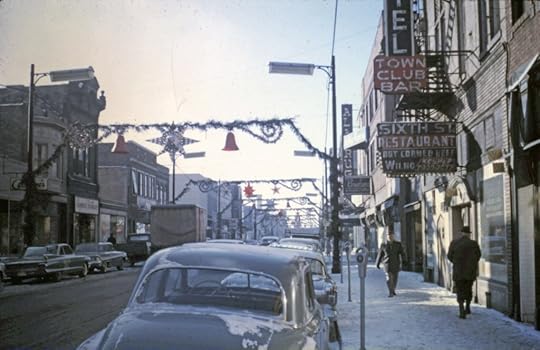
This is the end of our Fourth of July themed free stories, and we appropriately finish with remembrances of that by-gone day when things were simpler and six-year-olds could sneak out of the house and spend all day in town and apparently no one would ever realize it, which is a good metaphor for the Fondue Writer’s Club.
Click on the picture of Racine, Wisconsin in the early 1960s at what looks to be Christmastime to read ‘Parade Day’.
July 1, 2022
Lab Test Fondue
In college I took a psychology course, and one of the requirements was to ‘volunteer’ for graduate students’ lab tests. We had to do three, and each time after you finished up the student would tell you what they were really testing for, and it was never what you were told up front.
Rob Cely’s parable about conformity reminds me of those tests.
I found the story emotionally raw, in a good way, as it brings issues of opinion, division, race, corporate greed, and COVID all into one tale that lingers on you for a while, the way Cheetos’ dust stays on your fingers. And shirt. And beard.
Click on the ‘sketchy’ looking guy in the white lab coat to read ‘Potato Chip Tyranny’, another great free story in the Fondue Writer’s Club ongoing quest to provide you with holiday related entertainment.

The God Bless America Fondue
Derek Elkins has hidden a civic’s lesson deep within some of the most amazing hyperbole I’ve ever seen. I think you should read it, if for no other reason to see how he got, ‘a battleship named S.S. mom’ and an, ‘army of pecan farmers and boiled peanut eaters’ all in the same story with compositional fallacy AND Denzel Washington.
And don’t forget the names. No one names characters like Elkins. No one. Those are worth the price of admission (which is free, by the way,) alone.
It is something to behold.
Click on the picture of the late Bob Dole to read “Defending A Flag.”

June 29, 2022
I’m Not Crying You’re Crying Fondue
I don’t know what it is about Joe Shaw, but he has the uncanny knack of taking simple moments and exploding them into gut wrenching emotion. Today the Fourth of July Parade turns into a life changing moment of personal liberty. Click on the retro merchandise of a Return of the Jedi speeder bicycle to read ‘The Parade’.
More Fourth of July stories from the Fondue Writer’s Club are coming throughout the week, so be looking for them.

June 27, 2022
Joy/Fruit of the Spirit
Joy is the second of the nine fruit of the Spirit.
I once knew a woman whose name was Joy. That name gets a lot of sympathy from me because my mother’s name was Joyce, which is pretty much the same thing. This particular woman, though, was named Joy and she told me her father named her that because he wanted her to remember the order of her priorities should always be Jesus — Others — Yourself. J O Y.
I loved that so much that I tried to imagine something with my name like that because it starts with J, too. The best I came up with ever was Jesus – Angels – Mechanics – Inuits – Exercise — J A M I E.
That doesn’t have the same ring, so maybe we’ll just focus on joy. There are a lot of challenges to joy in our modern age that feel unique to contemporary life. Overt politicization of everything, violence, discord in families, churches, and schools, pressure, long work-weeks, and a general feeling of insignificance. the Bible indicates these are really nothing new, though, because the Scriptures seem to address it so often, remind us to rejoice, teaching about when joy is available, and promising joy. The need for joy is not new, we just need to listen better to the ancient guidance of the Holy Bible.
1 Thessalonians 5:16-18 — ‘Rejoice always, pray continually, give thanks in all circumstances; for this is God’s will for you in Messiah Jesus.’ Joy is connected to thanksgiving and prayer. These are all spiritual activities, because joy doesn’t come from wordly pursuits. Romans 12:12 — ‘Be joyful in hope, patient in affliction, faithful in prayer.’ Hope is future minded, which is what joy is focused on as well. My joy is not grounded in the temporary, but in the eternal. Habakkuk 3:17-18 — ‘Though the fig tree does not bud and there are no grapes on the vines, though the olive crop fails and the fields produce no food, though there are no sheep in the pen and no cattle in the stalls, yet I will rejoice in the Lord, I will be joyful in God my savior.’ This is a long quotation that I love dearly. Even if all the material blessings of the world evaporate, joy is possible because it comes from the Lord and not from wealth or prosperity. Romans 12:15 — ‘Rejoice with those who rejoice; mourn with those who mourn.’ This passage reminds me of Ecclesiastes 3, as there is a time to mourn and a time to rejoice. Knowing the difference is wisdom. Sharing with those going through it is empathy and, thereby, Christ-likeness. John 15:11 — ‘I have told you this so that my joy may be in you and that your joy may be complete.’ The word here ‘complete’ indicates whole, fulfilled, and total. It is not a partial joy or temporary bliss. it is perfected joy.Nehemiah 8:10 — ‘Go and enjoy choice food and sweet drinks, and send some to those who have nothing prepared. This day is holy to our Lord. Do not grieve, for the joy of the Lord is your strength.’ The people were weeping when they heard the word of the Lord because they realized their sin and inadequacies. But that is the wrong response. The right response is joy and celebration. Joy is inextricably connected to grace and that is the source of strength that keeps us going.Psalm 30:5 — ‘For his anger lasts only a moment, but his favor lasts a lifetime; weeping may stay for a night, but rejoicing comes in the morning.’ Chastisement is real, but it is not lasting. The sun is always on the on its way up. James 1:2 — ‘Consider it pure joy, my brothers and sisters, whenever you face trials of many kinds.’ The trial you are going through right now is actually something we should think of as a joy. It is hard, but important to reorient our thinking this way. Psalm 126:5-6 — ‘Those who so with tears will reap with songs of joy. Those who go out weeping, carrying seed to sow, will return with songs of joy, carrying sheaves with them.’ Agricultural language of harvesting and reaping fascinate me. You reap what you sow, and this is true emotionally as well.There are three specific truths emerging from this varied collection of scripture verses. First, Christian joy exists in the midst of suffering. Second, joy is rooted in the Lord and is a spiritual exercise. Third, joy, the New Testament, has the same root word as grace — they are closely connected.
In the listing of the fruit of the Spirit, there is no listing for hope. Joy is the root of hope, so it was best understood as the precondition for hope and should be thus linked.
At an experiential level, I have found several things can help when I have lost the feeling of joy. The first of course, is prayer and spiritual focus. Prayer, worship, Bible reading, and service all help me recover my sense of joy. It also helps to maybe listen to music. Music always sets the mood. Work does too — accomplishing something helps restore joy. Talking with people, changes in routine, and spontaneous celebrations all helps us rekindle feelings of joy when it is far from us.
There is much more I could write about this topic — particularly the false dichotomy of happiness and joy or on the problem of joy-killers. But for for now, let’s leave this here.
Library Rendezvous Fondue
The Fondue Writer’s Club is at it again, this time with Independence Day themed stories.
My favorite of these is when the writers take the theme and then zag as everyone else is zigging. That is what our hopeless romantic Paul Bennett does with today’s story, Independence Day, a delicious twist on the theme. Paul’s great strength is his use of mental word pictures — drops of water, olive skin, hesitation and doubt — all of these come to life in his stories.
Click on the tissue coming out of the ‘library’ below to read his wonderful stories. More will come later this week all the way through to The Fourth of July! Enjoy