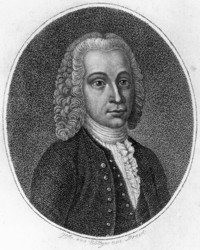
Swedish astronomer Anders Celsius in 1742 devised the centigrade thermometer.
This physicist and mathematician from 1730 served as professor at Uppsala University. In 1730, Celsius published the Nova Methodus distantiam solis a terra determinandi (New Method for Determining the Distance from the Earth to the Sun). His research also involved the study of auroral phenomena with Olof Hiorter, his assistant, and he first suggested a connection between the aurora borealis and changes in the magnetic field of the Earth. He observed the variations of a compass needle and found that larger deflections correlated with stronger auroral activity.
From 1716, he and other persons made 316 observations of the aurora borealis to 1732. At NurembergSwedish astronomer Anders Celsius in 1742 devised the centigrade thermometer.
This physicist and mathematician from 1730 served as professor at Uppsala University. In 1730, Celsius published the Nova Methodus distantiam solis a terra determinandi (New Method for Determining the Distance from the Earth to the Sun). His research also involved the study of auroral phenomena with Olof Hiorter, his assistant, and he first suggested a connection between the aurora borealis and changes in the magnetic field of the Earth. He observed the variations of a compass needle and found that larger deflections correlated with stronger auroral activity.
From 1716, he and other persons made 316 observations of the aurora borealis to 1732. At Nuremberg in 1733, he published a collection of his auroral observations.
From 1732, he traveled and visited notable observatories. Anders Celsius traveled frequently in the early 1730s to Germany, Italy and France; he then visited most of the major European observatories. In Paris, he advocated the measurement of an arc of the meridian in Lapland.
He visited notable observatories in Germany, Italy and France to 1735.
In 1736, he participated in the expedition that Pierre Louis Maupertuis led and the French academy of sciences organized for that purpose to measure a degree of latitude. The aim of the expedition measured the length of a degree along a meridian, close to the pole, and compared the result with a similar expedition to Peru, today in Ecuador, near the equator. The expeditions confirmed theory of Isaac Newton on the ellipsoid shape, flattened at the poles of the earth.
Celsius succeeded in the request and founded the astronomical observatory of Uppsala in 1741. The most modern instrumental technology, purchased during his long voyage abroad, equipped the observatory of the period.
In astronomy, Celsius began a series of observations, using colored glass plates, to record the magnitude, a measure of brightness, of certain stars. He thus first attempted to measure the intensity of starlight with a tool, rather than the human eye. He made observations of eclipses and various astronomical objects and used his own photometric system to publish catalogs of carefully determined magnitudes for three hundred stars with mean error of 0.4 units of magnitude.
Celsius in 1742 proposed the temperature scale that bears his name. He first performed and published careful experiments, aiming at the definition of an international temperature scale on scientific grounds. In his paper "Observations of two persistent degrees on a thermometer," he reports on experiments to check independence of the freezing point on latitude and atmospheric pressure. ...more