
Ian Sales's Blog, page 2
December 22, 2012
First Review of Apollo Quartet 2
The first review of Apollo Quartet 2 The Eye With Which The Universe Beholds Itself has appeared online at upcoming4.me. They liked Adrift on the Sea of the Rains (“our favorite science fiction novella of this year”), and it seems they like this one too:
… once more amazing stuff from Ian Sales and we would go so far to say that The Eye With Which The Universe Beholds Itself will likely be a contender for the best novella published in 2013.
The full review is here.
The Eye With Which The Universe Beholds Itself will be available for purchase from the Whippleshield Books online shop, and on Kindle from Amazon, in January 2013.
… once more amazing stuff from Ian Sales and we would go so far to say that The Eye With Which The Universe Beholds Itself will likely be a contender for the best novella published in 2013.
The full review is here.
The Eye With Which The Universe Beholds Itself will be available for purchase from the Whippleshield Books online shop, and on Kindle from Amazon, in January 2013.


October 4, 2012
Apollo Quartet Book 2 cover art released
The publication date of the second book of the Apollo Quartet, The Eye With Which The Universe Beholds Itself, is about a month or so away. I was hoping to have the book ready sooner, but it didn’t work out that way. That’s what happens when something turns out to be more ambitious than originally envisaged.
However, the cover art is now ready. And here it is:
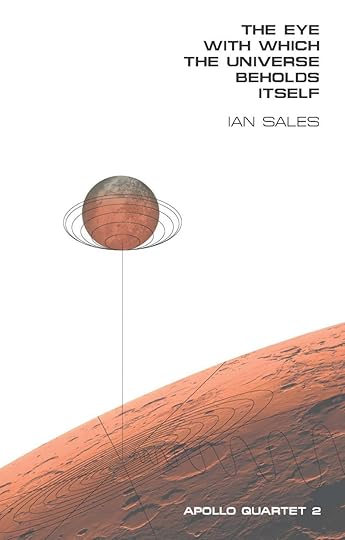
Yes, the cover does sort of represent the plot of The Eye With Which The Universe Beholds Itself. Yes, that is Mars. And yes, when the quartet is completed all four books will look very fine indeed on your book-shelf – in a signed numbered hardback, limited to 75 copies; or in paperback. There will, of course, also be an ebook edition, in MOBI and EPUB, and available on Amazon for Kindle.
However, the cover art is now ready. And here it is:
Yes, the cover does sort of represent the plot of The Eye With Which The Universe Beholds Itself. Yes, that is Mars. And yes, when the quartet is completed all four books will look very fine indeed on your book-shelf – in a signed numbered hardback, limited to 75 copies; or in paperback. There will, of course, also be an ebook edition, in MOBI and EPUB, and available on Amazon for Kindle.
September 7, 2012
Whoosh
I was hoping to have a final draft of Apollo Quartet 2: The Eye With Which The Universe Beholds Itself out to my beta readers by the end of August, but the novella is proving more work than I'd originally anticipated. So I've not even finished the first draft. Which means the finished article - hardback, paperback, ebook - is unlikely to hit the shelves at the end of September as originally planned. It's my own fault, of course. However, I'm not anticipating missing the deadline by much - a month, perhaps.
So as an apology, and to keep you keen, here's a flash fiction piece I wrote back in 2009 to celebrate the fortieth anniversary of the Apollo 11 lunar landing. It was originally published on my Space Books blog, but I think it serves another airing. Enjoy.
The Old Man of the Sea of Dreams
“Radar lights are out.”
“That’s a Verb 57?”
Capcom confirms, “You’re go for a Verb 57.”
LMP Gerald P Carr punches it in on the DSKY. The computer will now accept data from the landing radar.
“Descent rate 70 feet per second… passing through 36 thousand… pitch 72…”
Carr reads out the LM’s altitude and descent rate, while Commander Stuart Roosa, USAF, flies the spacecraft. Moments later, Houston signs off as the LM crosses the lunar terminator —
Apollo 20, the first mission to visit the dark side of the Moon.
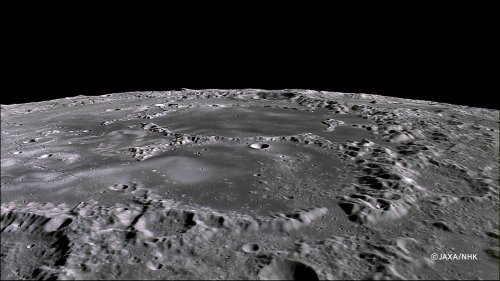
The LM approaches the Mare Ingenii, a lava-flooded crater. It looks like a real sea. Except it’s grey, a flat featureless grey like an under-exposed black and white photograph. A collapsed rim resembles two fjords. Carr can imagine a fishing port at the shore, a cluster of monochrome houses, with a monochrome jetty and little monochrome dories. Carr is USMC, he knows boats.
“Okay at 20,000,” Carr says. “Computer and PNGS on the button. 1:20 to pitchover.”
He feeds flight data to Roosa. They pitch over and begin to descend vertically.
“Ready for touchdown.”
“20 feet… 10 feet… contact.”
Silence.
Not even a vibration through his boots. Carr feels a moment of vertigo, the moonscape visible through the window tips one way then the other. He blows out noisily; it’s enough to break the spell.
He says, “Engine stop, engine arm, command override off, PNGS on auto.”
Roosa says the magic words, but Houston can’t hear them:
“Centaurus has landed.”
Both astronauts want to go out onto the lunar surface, but they’re not scheduled for EVA for another three hours. First is a rest period, but they’re too keyed-up to sleep.
“What they used to call this?” Carr asks.
“Mare Desiderii.”
“Sea of…” His Latin isn’t up to it.
“Sea of Dreams. But it’s not a mare. Except this bit, so they called it Sea of Cleverness. Ironic, huh?”
“I guess.” Carr is not big on irony. He’s a marine.
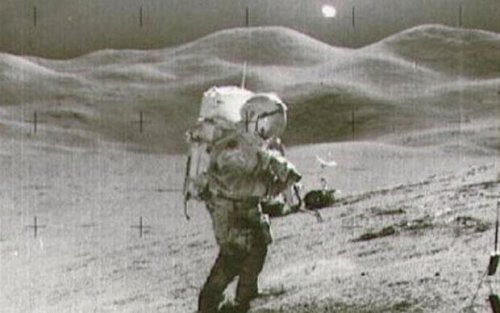
“What’s that?”
Roosa bounces round to face Carr. “What’s what?”
“I saw something flash.” Carr points north-east. The rim of Thomson there is broken, forming inlets into the “sea” of the crater’s floor.
“A flash? Like a reflection off a mineral?”
“Yeah, maybe.”
“Worth checking out.” It’s some 12 kilometres away, so about an hour on the LRV.
The CSM is overhead, so Roosa tells CMP Paul Weitz their plan. He can inform Houston when he orbits back to the near-side.
“Be careful,” says Weitz.
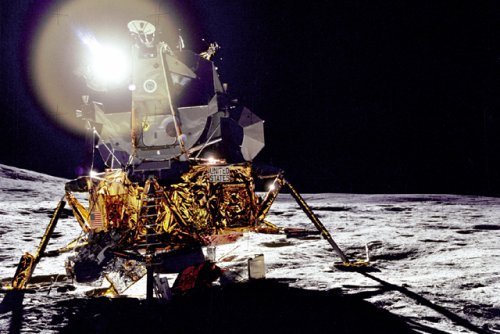
Roosa acknowledges. He turns to look at the LM — bright silver, with its golden skirt. He got to come here, he marvels. Three days on the dark side. He made a first, he’s going down in the history books.
Like Neil Armstrong.
The floor of Thomson could have been made for the LRV, the going is so smooth. Roosa pushes the T-bar forward, and the speedometer needle creeps up to 15 kph.
“Boy,” says Carr, “we’re really motoring here.”
“Yeah. Who needs a Corvette?”
Carr directs Roosa to where he saw the flash. Roosa nudges the T-bar and the LRV arcs to the right.
Ahead, something sparkles. Sunlight spilling over the horizon makes the lunar surface a place of black shadows and grey twilight. But there’s something bright hiding in a fold in the tumbled-down rim.
From a kilometre away, it’s hard to tell what it is, though vision is sharp in the vacuum. Carr squints and makes out a suggestion of…
… something regular?
“You think it might be a Luna? One of those Russian probes?”
No, it’s too big. Carr has seen photos of the Luna probes: they looked like boilers on legs, like some robot from a 1950s B-movie.
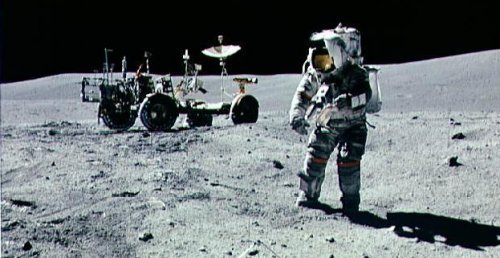
The LRV slows to a stop. Roosa sits and stares at the object in the shadows. It’s a spacecraft. It lies crumpled against the slope, broken-backed, its engine bell towards them.
They disembark, and Roosa approaches the crashed spacecraft slowly. Is it alien? He’s heard of UFOs, of lights buzzing planes; but he doesn’t subscribe.
He can see the upper half of the craft. It looks familiar.
“Holy shit,” he says. “You’re not gonna believe this.”
It’s obvious now. Roosa can see exactly what it is:
A Mercury capsule.
Just like the ones flown by Al, John, Gus, the Original Seven. He can see the words “United States” on its side.
“Jesus,” says Carr. “How the hell did that get here?”
Roosa moves up the slope. The capsule looks undamaged. He’s close enough to see the hatch… and the curve of a helmet within.
“Stay back,” he warns.
There’s no movement, but it pays to be cautious. His breath is louder than the PLSS fans. The hatch is cracked open a few inches. He hauls it up.
Inside, belted into the single seat, sits a figure in a silver pressure suit. His head is slumped forward, hiding his face.
“No way is Houston going to believe this.”
The dead astronaut has the Star and Stripes on his shoulder. It’s impossible.
Roosa reaches in and shifts the body. Now he can see the nametag:
“Kincheloe.”
The only Kincheloe he knows of died back in 1958, killed at Edwards when his F-104 augered in. Could it be the same man? Maybe they faked his crash, maybe they sent him here instead.
“Jesus,” says Carr. “I found a flag stuck on a pole here.”
“Stars and Stripes?” asks Roosa. He’s still staring at the dead astronaut.
“Yeah.”
Roosa steps back from the capsule. He looks down at his feet, and sees his bootprints. They’ll last a million years. He sees more bootprints, not his. Kincheloe survived the crash.
“Know what this is?” Roosa remembers now. “I heard about it back at Edwards. Project Pilgrim. A one-way shot to the Moon.”
They actually went and did it. They sent a man to the Moon on a one-way ticket. He planted a flag here, then he died.
“Neil will be pissed,” Roosa says.
So as an apology, and to keep you keen, here's a flash fiction piece I wrote back in 2009 to celebrate the fortieth anniversary of the Apollo 11 lunar landing. It was originally published on my Space Books blog, but I think it serves another airing. Enjoy.
The Old Man of the Sea of Dreams
“Radar lights are out.”
“That’s a Verb 57?”
Capcom confirms, “You’re go for a Verb 57.”
LMP Gerald P Carr punches it in on the DSKY. The computer will now accept data from the landing radar.
“Descent rate 70 feet per second… passing through 36 thousand… pitch 72…”
Carr reads out the LM’s altitude and descent rate, while Commander Stuart Roosa, USAF, flies the spacecraft. Moments later, Houston signs off as the LM crosses the lunar terminator —
Apollo 20, the first mission to visit the dark side of the Moon.
The LM approaches the Mare Ingenii, a lava-flooded crater. It looks like a real sea. Except it’s grey, a flat featureless grey like an under-exposed black and white photograph. A collapsed rim resembles two fjords. Carr can imagine a fishing port at the shore, a cluster of monochrome houses, with a monochrome jetty and little monochrome dories. Carr is USMC, he knows boats.
“Okay at 20,000,” Carr says. “Computer and PNGS on the button. 1:20 to pitchover.”
He feeds flight data to Roosa. They pitch over and begin to descend vertically.
“Ready for touchdown.”
“20 feet… 10 feet… contact.”
Silence.
Not even a vibration through his boots. Carr feels a moment of vertigo, the moonscape visible through the window tips one way then the other. He blows out noisily; it’s enough to break the spell.
He says, “Engine stop, engine arm, command override off, PNGS on auto.”
Roosa says the magic words, but Houston can’t hear them:
“Centaurus has landed.”

Both astronauts want to go out onto the lunar surface, but they’re not scheduled for EVA for another three hours. First is a rest period, but they’re too keyed-up to sleep.
“What they used to call this?” Carr asks.
“Mare Desiderii.”
“Sea of…” His Latin isn’t up to it.
“Sea of Dreams. But it’s not a mare. Except this bit, so they called it Sea of Cleverness. Ironic, huh?”
“I guess.” Carr is not big on irony. He’s a marine.

“What’s that?”
Roosa bounces round to face Carr. “What’s what?”
“I saw something flash.” Carr points north-east. The rim of Thomson there is broken, forming inlets into the “sea” of the crater’s floor.
“A flash? Like a reflection off a mineral?”
“Yeah, maybe.”
“Worth checking out.” It’s some 12 kilometres away, so about an hour on the LRV.
The CSM is overhead, so Roosa tells CMP Paul Weitz their plan. He can inform Houston when he orbits back to the near-side.
“Be careful,” says Weitz.
Roosa acknowledges. He turns to look at the LM — bright silver, with its golden skirt. He got to come here, he marvels. Three days on the dark side. He made a first, he’s going down in the history books.
Like Neil Armstrong.

The floor of Thomson could have been made for the LRV, the going is so smooth. Roosa pushes the T-bar forward, and the speedometer needle creeps up to 15 kph.
“Boy,” says Carr, “we’re really motoring here.”
“Yeah. Who needs a Corvette?”
Carr directs Roosa to where he saw the flash. Roosa nudges the T-bar and the LRV arcs to the right.
Ahead, something sparkles. Sunlight spilling over the horizon makes the lunar surface a place of black shadows and grey twilight. But there’s something bright hiding in a fold in the tumbled-down rim.
From a kilometre away, it’s hard to tell what it is, though vision is sharp in the vacuum. Carr squints and makes out a suggestion of…
… something regular?
“You think it might be a Luna? One of those Russian probes?”
No, it’s too big. Carr has seen photos of the Luna probes: they looked like boilers on legs, like some robot from a 1950s B-movie.

The LRV slows to a stop. Roosa sits and stares at the object in the shadows. It’s a spacecraft. It lies crumpled against the slope, broken-backed, its engine bell towards them.
They disembark, and Roosa approaches the crashed spacecraft slowly. Is it alien? He’s heard of UFOs, of lights buzzing planes; but he doesn’t subscribe.
He can see the upper half of the craft. It looks familiar.
“Holy shit,” he says. “You’re not gonna believe this.”
It’s obvious now. Roosa can see exactly what it is:
A Mercury capsule.
Just like the ones flown by Al, John, Gus, the Original Seven. He can see the words “United States” on its side.
“Jesus,” says Carr. “How the hell did that get here?”
Roosa moves up the slope. The capsule looks undamaged. He’s close enough to see the hatch… and the curve of a helmet within.
“Stay back,” he warns.
There’s no movement, but it pays to be cautious. His breath is louder than the PLSS fans. The hatch is cracked open a few inches. He hauls it up.
Inside, belted into the single seat, sits a figure in a silver pressure suit. His head is slumped forward, hiding his face.
“No way is Houston going to believe this.”
The dead astronaut has the Star and Stripes on his shoulder. It’s impossible.
Roosa reaches in and shifts the body. Now he can see the nametag:
“Kincheloe.”
The only Kincheloe he knows of died back in 1958, killed at Edwards when his F-104 augered in. Could it be the same man? Maybe they faked his crash, maybe they sent him here instead.
“Jesus,” says Carr. “I found a flag stuck on a pole here.”
“Stars and Stripes?” asks Roosa. He’s still staring at the dead astronaut.
“Yeah.”
Roosa steps back from the capsule. He looks down at his feet, and sees his bootprints. They’ll last a million years. He sees more bootprints, not his. Kincheloe survived the crash.
“Know what this is?” Roosa remembers now. “I heard about it back at Edwards. Project Pilgrim. A one-way shot to the Moon.”
They actually went and did it. They sent a man to the Moon on a one-way ticket. He planted a flag here, then he died.
“Neil will be pissed,” Roosa says.
August 27, 2012
Adrift on the Sea of Rains reviews
The number of reviews of Adrift on the Sea of Rains that have appeared online has, I freely admit, astonished me. And all those reviews have been positive, which is even more astonishing. It certainly validates my decision to publish the book myself, though it does increase the pressure on me for the second book of the Apollo Quartet...
Anyway, I thought I'd post links to all the reviews that have appeared so far:
Weirdmage's Reviews
Val's Random Comments
Benjamin Judge
The British Fantasy Society
Global Junkie
SF Signal
Paper Knife
Alt Hist
The Automatic Cat
Glen Mehn
Jack Deighton
Michael J Martineck
Science Fiction 365
Dylan Fox
Tony's Thoughts
Solar Bridge
To the Last Word
The Singularity Sucks
Lavie Tidhar
Upcoming4.me
Anyway, I thought I'd post links to all the reviews that have appeared so far:
Weirdmage's Reviews
Val's Random Comments
Benjamin Judge
The British Fantasy Society
Global Junkie
SF Signal
Paper Knife
Alt Hist
The Automatic Cat
Glen Mehn
Jack Deighton
Michael J Martineck
Science Fiction 365
Dylan Fox
Tony's Thoughts
Solar Bridge
To the Last Word
The Singularity Sucks
Lavie Tidhar
Upcoming4.me
August 8, 2012
Whippleshield updates
Whippleshield Books continues in its mission to take over the world, although at its current rate this may take a millennium or two. At present, I could probably afford a couple of pebbles from the beach on the desert island where I plan to build my secret hideout in an inactive volcano...
Book two of the Apollo Quartet, The Eye With Which The Universe Beholds Itself, is coming along. Back at the beginning of July, I posted a blurb on the Whippleshield Books blog here. And at the beginning of this month, I posted the first 500 words as a teaser - see here. This book is turning out to be a bit more ambitious than Adrift on the Sea of Rains. I've yet to decide if that's good or bad, but it's certainly resulted in more research than I'd expected.
Book three might be titled Then Will The Great Ocean Wash Deep (Above My Head For Ever). It's a bit unwieldy, even without the part in brackets, so it could change. For the record it's from a Homeric Hymn to Apollo. And it does sort of fit the plot. I've not started writing it yet, but I like to have a title as a focus for when I do begin. Even if I decide on a different title later...
The title for book four, however, is definitely fixed. It will be All That Outer Space Allows. One of my favourite films is Douglas Sirk's All That Heaven Allows, which is why I chose it. At least it's not a Lowryesque title like books two and three.
I have also published the first in what I hope will be a series of extremely limited chapbooks. The story Wunderwaffe was originally published in the e-anthology Vivisepulture published by Anarchy Books, and was described by Pornokitsch as "exceptional". There are only a dozen copies available. Or rather, there were. I've sold some already. If you want one, get in there now.
Book two of the Apollo Quartet, The Eye With Which The Universe Beholds Itself, is coming along. Back at the beginning of July, I posted a blurb on the Whippleshield Books blog here. And at the beginning of this month, I posted the first 500 words as a teaser - see here. This book is turning out to be a bit more ambitious than Adrift on the Sea of Rains. I've yet to decide if that's good or bad, but it's certainly resulted in more research than I'd expected.
Book three might be titled Then Will The Great Ocean Wash Deep (Above My Head For Ever). It's a bit unwieldy, even without the part in brackets, so it could change. For the record it's from a Homeric Hymn to Apollo. And it does sort of fit the plot. I've not started writing it yet, but I like to have a title as a focus for when I do begin. Even if I decide on a different title later...
The title for book four, however, is definitely fixed. It will be All That Outer Space Allows. One of my favourite films is Douglas Sirk's All That Heaven Allows, which is why I chose it. At least it's not a Lowryesque title like books two and three.
I have also published the first in what I hope will be a series of extremely limited chapbooks. The story Wunderwaffe was originally published in the e-anthology Vivisepulture published by Anarchy Books, and was described by Pornokitsch as "exceptional". There are only a dozen copies available. Or rather, there were. I've sold some already. If you want one, get in there now.
July 26, 2012
Science fiction traces
I firmly believe that a reading diet of only genre fiction is bad for you. It's the equivalent of trying to live off junk food. For a writer, it's even worse, perhaps even dangerous - certainly, it's detrimental to their career. I used to break up my consumption of genre with modern literary fiction novels, though I've increasingly found I much prefer postwar fiction, especially British - Lawrence Durrell, Malcolm Lowry, Paul Scott, and the like. But I do still read some of the better-known modern literary fiction authors, even if their novels have proven somewhat samey in recent years.
One of those literary fiction novelists is Sebastian Faulks. I recently finished his Human Traces (2005), which is about the early years of psychiatry. Sort of. It begins in 1876, with the introduction as boys of its two main characters, Jacques Rebière in France and Thomas Midwinter in England. The two meet when in their early twenties, become great friends, qualify in medicine, and open a sanatorium in southern Austria. Later, the two disagree over the direction the nascent science of psychiatry should take, beginning a feud which only ends after the First World War.

Human Traces is historical fiction. Its characters are invented but a number of real historical figures make appearances. It is about a variety of mental conditions, their historical diagnoses, and what we now know them to be. (Most asylums in the nineteenth century, for example, were filled with syphilis victims.) But Human Traces also contains at its core a very science-fictional idea.
Some three-quarters of the way through the book, Midwinter proposes a theory to explain why some people hear voices. It is his theory that psychosis is inextricably linked to self-awareness, and that it is the advent of self-awareness which created human beings. Early humans, he contends, heard voices as a matter of routine. In a speech given at his sanatorium, he outlines his theory:
This theory had been inspired by a number of things - not the least of which was Midwinter himself hearing voices when younger - but it was on an expedition to Africa that it began to gel:
Midwinter contents that language was not a development of self-awareness, that self-awareness did not lead to civilisation; but that language and civilisation both came into being before humanity had consciousness. It was only the development of writing which led to self-awareness. He references a number of mythologies in proof - the Ancient Greeks in conversation with their gods, God speaking to Abraham in the Bible, and so on...
It's not a conceit which sits well as the core of a realist novel. Nor is it one which really stands up all that well to scrutiny. It's an interesting idea, certainly, but perhaps better suited to the sort of thought experiment for which science fiction is best suited. We know that writing developed in Mesopotamia around 8000 BCE. It has been estimated that Abraham lived around 1800 BCE, and the Greek pantheon has been traced back to sixth century BCE Greece. So writing had been around for several millennia before the examples Midwinter gives to demonstrate his thesis. And for those thousands of years, if his theory is correct, humanity had not been wholly self-aware...
It doesn't really work. The weight of history stands against it. However, it would make for an interesting creation myth for a fantasy novel; or, perhaps, first contact could be the trigger from one state to the other for an alien race in a science fiction novel. Aliens of differing degrees, or variable degrees, of self-awareness have been used in sf before - in Peter Watt's Blindsight, the aliens are not conscious; in the GDW role-playing game 2300AD, one of the alien races increased their intelligence from normally very low levels as their fight/flight reaction.
Having said all that, there's perhaps an interesting idea to explore at the intersection of Midwinter's theory and the City Burners. Between 1200 and 1150 BCE, the Late Bronze Age civilisations around the Eastern Mediterranean collapsed. From what little documentary evidence that has been found, raiders from the sea - known as the Sea Peoples or the City Burners - invaded a number of city-states and destroyed them, propelling civilisation back to illiteracy. Imagine if those Sea Peoples had been Midwinter's unconscious humans, driven by the voices in their heads to destroy those civilisations who, through the widespread use of writing, could no longer hear the voices...
There's a novel in there somewhere, if someone wants to write it.
One of those literary fiction novelists is Sebastian Faulks. I recently finished his Human Traces (2005), which is about the early years of psychiatry. Sort of. It begins in 1876, with the introduction as boys of its two main characters, Jacques Rebière in France and Thomas Midwinter in England. The two meet when in their early twenties, become great friends, qualify in medicine, and open a sanatorium in southern Austria. Later, the two disagree over the direction the nascent science of psychiatry should take, beginning a feud which only ends after the First World War.

Human Traces is historical fiction. Its characters are invented but a number of real historical figures make appearances. It is about a variety of mental conditions, their historical diagnoses, and what we now know them to be. (Most asylums in the nineteenth century, for example, were filled with syphilis victims.) But Human Traces also contains at its core a very science-fictional idea.
Some three-quarters of the way through the book, Midwinter proposes a theory to explain why some people hear voices. It is his theory that psychosis is inextricably linked to self-awareness, and that it is the advent of self-awareness which created human beings. Early humans, he contends, heard voices as a matter of routine. In a speech given at his sanatorium, he outlines his theory:
... of how man, after he had learned language, had been able to conjure instructive voices in his head; and of how, after the invention of writing and under the influence of huge population upheavals, the ability to summon such voices had become rarer. (p 497)
This theory had been inspired by a number of things - not the least of which was Midwinter himself hearing voices when younger - but it was on an expedition to Africa that it began to gel:
But how could men without consciousness - a modern sense of time, and cause and other people - have done this? Picture your shepherd far away in the hills with no sense that he is a man, no idea of time in which he can visualise himself and his situation... How does he know he must keep tending his sheep? Why does he not forget what he is meant to do - as an ape would forget? Because under the anxiety of solitude, under the pressure of fear, he releases chemicals in his brain that cause not sweating palms, or racing heart, though perhaps those as well - but the voiced instructions of his king. He hallucinates a voice that tells him what to do. (p 450)
Midwinter contents that language was not a development of self-awareness, that self-awareness did not lead to civilisation; but that language and civilisation both came into being before humanity had consciousness. It was only the development of writing which led to self-awareness. He references a number of mythologies in proof - the Ancient Greeks in conversation with their gods, God speaking to Abraham in the Bible, and so on...
It's not a conceit which sits well as the core of a realist novel. Nor is it one which really stands up all that well to scrutiny. It's an interesting idea, certainly, but perhaps better suited to the sort of thought experiment for which science fiction is best suited. We know that writing developed in Mesopotamia around 8000 BCE. It has been estimated that Abraham lived around 1800 BCE, and the Greek pantheon has been traced back to sixth century BCE Greece. So writing had been around for several millennia before the examples Midwinter gives to demonstrate his thesis. And for those thousands of years, if his theory is correct, humanity had not been wholly self-aware...
It doesn't really work. The weight of history stands against it. However, it would make for an interesting creation myth for a fantasy novel; or, perhaps, first contact could be the trigger from one state to the other for an alien race in a science fiction novel. Aliens of differing degrees, or variable degrees, of self-awareness have been used in sf before - in Peter Watt's Blindsight, the aliens are not conscious; in the GDW role-playing game 2300AD, one of the alien races increased their intelligence from normally very low levels as their fight/flight reaction.
Having said all that, there's perhaps an interesting idea to explore at the intersection of Midwinter's theory and the City Burners. Between 1200 and 1150 BCE, the Late Bronze Age civilisations around the Eastern Mediterranean collapsed. From what little documentary evidence that has been found, raiders from the sea - known as the Sea Peoples or the City Burners - invaded a number of city-states and destroyed them, propelling civilisation back to illiteracy. Imagine if those Sea Peoples had been Midwinter's unconscious humans, driven by the voices in their heads to destroy those civilisations who, through the widespread use of writing, could no longer hear the voices...
There's a novel in there somewhere, if someone wants to write it.
July 23, 2012
The numbers game:addenda
Colum's comment on my previous post, The numbers game, prompted me to wonder how quickly I've placed stories - ie, how many submissions has it taken for each story I've written before I've sold it. So I went back to my trusty spreadsheet, wrangled some numbers and produced this neat little bar chart:
A couple of the stories I sold to the first place I submitted them were written specifically for anthologies. The ones which took seven or eight goes are the older stories... which does suggest I'm getting better at this lark.
Having said all that, I've yet to sell stories to any of the big venues, such as Interzone, Strange Horizons, Clarkesworld, or the Big Three US paper mags (though I'm not especially bothered about submitting to the last).

A couple of the stories I sold to the first place I submitted them were written specifically for anthologies. The ones which took seven or eight goes are the older stories... which does suggest I'm getting better at this lark.
Having said all that, I've yet to sell stories to any of the big venues, such as Interzone, Strange Horizons, Clarkesworld, or the Big Three US paper mags (though I'm not especially bothered about submitting to the last).
July 20, 2012
The numbers game
I was thinking yesterday about how much I hate writing first drafts. I much prefer rewriting. Once I've got the bones of the story down on paper, I have something to shape - and it's that process I enjoy doing. And this got me thinking about how many stories I've started but never finished. So I went digging through my various spreadsheets and lists of submissions, and I managed to cobble some numbers together...
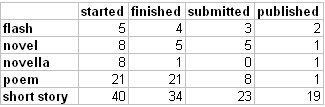
This may make me look quite prolific, but I'm a complete dilettante compared to some people I know. There are those who have submitted in one year more stories than I've ever actually finished. These numbers incidentally are mostly for the past few years. I did write and submit some short stories during the early 1990s, but my records from then are patchy so I've not included them. I spent much of that decade focusing on writing novels - which landed me an agent in 2005. It was only in 2008 that I started seriously writing and submitting short fiction, and year or so after that I tried my hand at poetry.
I seem to be much better at starting novellas than I am at finishing them - the only completed one is Adrift on the Sea of Rains, which I published through Whippleshield Books. Most of my poems I've posted on sferse, but I've only tried submitting a handful (without much success, it has to be said). And, while I've finished five novels, I've only submitted two complete ones to my agent; the remaining three were proposals. The above figures do not include the short stories, novellas or novels I plan at some point to have a go at but presently have nothing more than a one-line description in my ideas book.
The past six to nine months I've been focusing on Rocket Science, Adrift on the Sea of Rains and The Eye With Which The Universe Beholds Itself, so I've not had much chance to write any new short stories, or even finish off any of those I'd previously started. I really need to get back into that. So, of course, only a couple of days ago I had a good idea for a novel and I want to get some of that down on paper...
This may make me look quite prolific, but I'm a complete dilettante compared to some people I know. There are those who have submitted in one year more stories than I've ever actually finished. These numbers incidentally are mostly for the past few years. I did write and submit some short stories during the early 1990s, but my records from then are patchy so I've not included them. I spent much of that decade focusing on writing novels - which landed me an agent in 2005. It was only in 2008 that I started seriously writing and submitting short fiction, and year or so after that I tried my hand at poetry.
I seem to be much better at starting novellas than I am at finishing them - the only completed one is Adrift on the Sea of Rains, which I published through Whippleshield Books. Most of my poems I've posted on sferse, but I've only tried submitting a handful (without much success, it has to be said). And, while I've finished five novels, I've only submitted two complete ones to my agent; the remaining three were proposals. The above figures do not include the short stories, novellas or novels I plan at some point to have a go at but presently have nothing more than a one-line description in my ideas book.
The past six to nine months I've been focusing on Rocket Science, Adrift on the Sea of Rains and The Eye With Which The Universe Beholds Itself, so I've not had much chance to write any new short stories, or even finish off any of those I'd previously started. I really need to get back into that. So, of course, only a couple of days ago I had a good idea for a novel and I want to get some of that down on paper...
July 17, 2012
Meme 101
Meme! I got this from Andrew Wheeler who got it from James Nicoll who got it from Martine Wisse, who took it from Science Fiction: The 101 Best Novels 1985-2010 by Damien Broderick and Paul di Filippo.
Bold if you own it, italics if you've read it,strikethrough if you think it doesn't belong on this list...
The Handmaid’s Tale, Margaret Atwood (1985)
Ender’s Game, Orson Scott Card (1985)
Radio Free Albemuth, Philip K Dick (1985)
Always Coming Home, Ursula K Le Guin (1985)
This Is the Way the World Ends, James Morrow (1985)
Galápagos, Kurt Vonnegut (1985)
The Falling Woman, Pat Murphy (1986)
The Shore of Women, Pamela Sargent (1986)
A Door Into Ocean, Joan Slonczewski (1986)
Soldiers of Paradise , Paul Park (1987) (an excellent novel, but Coelestis is better)
Life During Wartime , Lucius Shepard (1987)
The Sea and Summer , George Turner (1987)
Cyteen , CJ Cherryh (1988)
Neverness, David Zindell (1988)
The Steerswoman , Rosemary Kirstein (1989)
Grass , Sheri S Tepper (1989)
Use of Weapons , Iain M Banks (1990)
Queen of Angels, Greg Bear (1990)
Barrayar, Lois McMaster Bujold (1991)
Synners , Pat Cadigan (1991)
Sarah Canary , Karen Joy Fowler (1991)
White Queen , Gwyneth Jones (1991)
Eternal Light , Paul McAuley (1991)
Stations of the Tide , Michael Swanwick (1991)
Timelike Infinity , Stephen Baxter (1992)
Dead Girls , Richard Calder (1992)
Jumper, Steven Gould (1992)
China Mountain Zhang, Maureen F McHugh (1992)
Red Mars , Kim Stanley Robinson (1992)
A Fire Upon the Deep , Vernor Vinge (1992)
Aristoi, Walter Jon Williams (1992)
Doomsday Book, Connie Willis (1992)
Parable of the Sower, Octavia Butler (1993)
Ammonite, Nicola Griffith (1993)
Chimera, Mary Rosenblum (1993)
Nightside the Long Sun , Gene Wolfe (1993)
Brittle Innings, Michael Bishop (1994)
Permutation City, Greg Egan (1994)
Blood, Michael Moorcock (1994)
Mother of Storms, John Barnes (1995)
Sailing Bright Eternity, Gregory Benford (1995)
Galatea 2.2, Richard Powers (1995)
The Diamond Age, Neal Stephenson (1995)
The Transmigration of Souls , William Barton (1996)
The Fortunate Fall, Raphael Carter (1996)
The Sparrow/Children of God , Mary Doria Russell (1996/1998)
Holy Fire , Bruce Sterling (1996)
Night Lamp , Jack Vance (1996) (really? This is not very good)
In the Garden of Iden, Kage Baker (1997)
Forever Peace, Joe Haldeman (1997)
Glimmering, Elizabeth Hand (1997)
As She Climbed Across the Table, Jonathan Lethem (1997)
The Cassini Division , Ken MacLeod (1998)
Bloom, Wil McCarthy (1998)
Vast, Linda Nagata (1998)
The Golden Globe , John Varley (1998)
Headlong , Simon Ings (1999)
Cave of Stars, George Zebrowski (1999)
Genesis, Poul Anderson (2000)
Super-Cannes , JG Ballard (2000)
Under the Skin, Michel Faber (2000) (I really disliked this)
Perdido Street Station , China Miéville (2000)
Distance Haze, Jamil Nasir (2000)
Revelation Space trilogy , Alastair Reynolds (2000)
Salt, Adam Roberts (2000) (not his best, by a long shot)
Ventus, Karl Schroeder (2001)
The Cassandra Complex, Brian Stableford (2001)
Light , M John Harrison (2002)
Altered Carbon, Richard Morgan (2002)
The Separation , Christopher Priest (2002)
The Golden Age, John C Wright (2002)
The Time Traveler’s Wife, Audrey Niffenegger (2003)
Natural History , Justina Robson (2003)
The Labyrinth Key/Spears of God, Howard V Hendrix (2004/2006)
River of Gods, Ian McDonald (2004)
The Plot Against America, Philip Roth (2004)
Never Let Me Go, Kazuo Ishiguro (2005)
The House of Storms, Ian R MacLeod (2005)
Counting Heads, David Marusek (2005)
Air (Or, Have Not Have), Geoff Ryman (2005)
Accelerando, Charles Stross (2005)
Spin, Robert Charles Wilson (2005)
My Dirty Little Book of Stolen Time, Liz Jensen (2006) (The Rapture may be better)
The Road , Cormac McCarthy (2006)
Temeraire /His Majesty’s Dragon, Naomi Novik (2006)
Blindsight , Peter Watts (2006)
HARM, Brian Aldiss (2007)
The Yiddish Policemen’s Union , Michael Chabon (2007)
The Secret City,Carol Emshwiller (2007)
In War Times, Kathleen Ann Goonan (2007)
Postsingular, Rudy Rucker (2007)
Shadow of the Scorpion, Neal Asher (2008)
The Hunger Games trilogy, Suzanne Collins (2008-2010)
Little Brother, Cory Doctorow (2008)
The Alchemy of Stone, Ekaterina Sedia (2008)
The Windup Girl, Paolo Bacigalupi (2009)
Steal Across the Sky, Nancy Kress (2009)
Boneshaker, Cherie Priest (2009)
Zoo City , Lauren Beukes (2010)
Zero History, William Gibson (2010)
The Quantum Thief, Hannu Rajaniemi (2010)
I make that 51 read, 33 owned, and 5 owned but not yet read. Not a bad showing. There are some good books on the list, but some feel as if they were picked because they were by a writer they wanted on the list and it was the only title published after 1985. There are certainly a few I don't think belong on the list - and not just the ones I've struck through. Boneshaker, surely, is steampunk, not sf (are we still claiming steampunk is part of sf? do we really want to?). And the Noviks? Fantasy, yes? Also, the Collins trilogy is YA - the only YA on the list, I think.
It's axiomatic that any such list will be questionable to some extent, though I do think this one is better than most. For one thing, it actually features books I've not read but would like to. There are also 32 women on the list, which is more than lists of this sort manage (though it could probably do better).
Bold if you own it, italics if you've read it,
The Handmaid’s Tale, Margaret Atwood (1985)
Radio Free Albemuth, Philip K Dick (1985)
Always Coming Home, Ursula K Le Guin (1985)
This Is the Way the World Ends, James Morrow (1985)
Galápagos, Kurt Vonnegut (1985)
The Falling Woman, Pat Murphy (1986)
The Shore of Women, Pamela Sargent (1986)
A Door Into Ocean, Joan Slonczewski (1986)
Soldiers of Paradise , Paul Park (1987) (an excellent novel, but Coelestis is better)
Life During Wartime , Lucius Shepard (1987)
The Sea and Summer , George Turner (1987)
Cyteen , CJ Cherryh (1988)
Neverness, David Zindell (1988)
The Steerswoman , Rosemary Kirstein (1989)
Grass , Sheri S Tepper (1989)
Use of Weapons , Iain M Banks (1990)
Queen of Angels, Greg Bear (1990)
Barrayar, Lois McMaster Bujold (1991)
Synners , Pat Cadigan (1991)
Sarah Canary , Karen Joy Fowler (1991)
White Queen , Gwyneth Jones (1991)
Eternal Light , Paul McAuley (1991)
Stations of the Tide , Michael Swanwick (1991)
Timelike Infinity , Stephen Baxter (1992)
Dead Girls , Richard Calder (1992)
Jumper, Steven Gould (1992)
China Mountain Zhang, Maureen F McHugh (1992)
Red Mars , Kim Stanley Robinson (1992)
A Fire Upon the Deep , Vernor Vinge (1992)
Aristoi, Walter Jon Williams (1992)
Doomsday Book, Connie Willis (1992)
Parable of the Sower, Octavia Butler (1993)
Ammonite, Nicola Griffith (1993)
Chimera, Mary Rosenblum (1993)
Nightside the Long Sun , Gene Wolfe (1993)
Brittle Innings, Michael Bishop (1994)
Permutation City, Greg Egan (1994)
Blood, Michael Moorcock (1994)
Mother of Storms, John Barnes (1995)
Sailing Bright Eternity, Gregory Benford (1995)
Galatea 2.2, Richard Powers (1995)
The Diamond Age, Neal Stephenson (1995)
The Transmigration of Souls , William Barton (1996)
The Fortunate Fall, Raphael Carter (1996)
The Sparrow/Children of God , Mary Doria Russell (1996/1998)
Holy Fire , Bruce Sterling (1996)
Night Lamp , Jack Vance (1996) (really? This is not very good)
In the Garden of Iden, Kage Baker (1997)
Forever Peace, Joe Haldeman (1997)
Glimmering, Elizabeth Hand (1997)
As She Climbed Across the Table, Jonathan Lethem (1997)
The Cassini Division , Ken MacLeod (1998)
Bloom, Wil McCarthy (1998)
Vast, Linda Nagata (1998)
The Golden Globe , John Varley (1998)
Headlong , Simon Ings (1999)
Cave of Stars, George Zebrowski (1999)
Genesis, Poul Anderson (2000)
Super-Cannes , JG Ballard (2000)
Under the Skin, Michel Faber (2000) (I really disliked this)
Perdido Street Station , China Miéville (2000)
Distance Haze, Jamil Nasir (2000)
Revelation Space trilogy , Alastair Reynolds (2000)
Salt, Adam Roberts (2000) (not his best, by a long shot)
Ventus, Karl Schroeder (2001)
The Cassandra Complex, Brian Stableford (2001)
Light , M John Harrison (2002)
Altered Carbon, Richard Morgan (2002)
The Separation , Christopher Priest (2002)
The Time Traveler’s Wife, Audrey Niffenegger (2003)
Natural History , Justina Robson (2003)
The Labyrinth Key/Spears of God, Howard V Hendrix (2004/2006)
River of Gods, Ian McDonald (2004)
The Plot Against America, Philip Roth (2004)
Never Let Me Go, Kazuo Ishiguro (2005)
The House of Storms, Ian R MacLeod (2005)
Counting Heads, David Marusek (2005)
Air (Or, Have Not Have), Geoff Ryman (2005)
Accelerando, Charles Stross (2005)
Spin, Robert Charles Wilson (2005)
My Dirty Little Book of Stolen Time, Liz Jensen (2006) (The Rapture may be better)
The Road , Cormac McCarthy (2006)
Temeraire /His Majesty’s Dragon, Naomi Novik (2006)
Blindsight , Peter Watts (2006)
HARM, Brian Aldiss (2007)
The Yiddish Policemen’s Union , Michael Chabon (2007)
The Secret City,Carol Emshwiller (2007)
In War Times, Kathleen Ann Goonan (2007)
Postsingular, Rudy Rucker (2007)
The Hunger Games trilogy, Suzanne Collins (2008-2010)
Little Brother, Cory Doctorow (2008)
The Alchemy of Stone, Ekaterina Sedia (2008)
The Windup Girl, Paolo Bacigalupi (2009)
Steal Across the Sky, Nancy Kress (2009)
Boneshaker, Cherie Priest (2009)
Zoo City , Lauren Beukes (2010)
Zero History, William Gibson (2010)
The Quantum Thief, Hannu Rajaniemi (2010)
I make that 51 read, 33 owned, and 5 owned but not yet read. Not a bad showing. There are some good books on the list, but some feel as if they were picked because they were by a writer they wanted on the list and it was the only title published after 1985. There are certainly a few I don't think belong on the list - and not just the ones I've struck through. Boneshaker, surely, is steampunk, not sf (are we still claiming steampunk is part of sf? do we really want to?). And the Noviks? Fantasy, yes? Also, the Collins trilogy is YA - the only YA on the list, I think.
It's axiomatic that any such list will be questionable to some extent, though I do think this one is better than most. For one thing, it actually features books I've not read but would like to. There are also 32 women on the list, which is more than lists of this sort manage (though it could probably do better).
July 5, 2012
SF Signal reviews Adrift on the Sea of Rains
Paul Weimer reviews
Adrift on the Sea of Rains
for SF Signal, and summarises his review as:
PROS: Excellent use of space science; doesn’t overstay its welcome; solid prose.
CONS: An ending that feels a bit forced even given its symbolic power.
VERDICT: Interesting premise with solid, if not quite perfect, execution.
See the full review here
PROS: Excellent use of space science; doesn’t overstay its welcome; solid prose.
CONS: An ending that feels a bit forced even given its symbolic power.
VERDICT: Interesting premise with solid, if not quite perfect, execution.
See the full review here
Ian Sales's Blog

- Ian Sales's profile
- 86 followers
Ian Sales isn't a Goodreads Author
(yet),
but they
do have a blog,
so here are some recent posts imported from
their feed.

