
Magen Cubed's Blog, page 39
December 3, 2011
An open and honest discourse about smut

A little known fact about me — besides me always putting my left shoe on first, and occasionally forgetting which side of the road to drive on — is that I am, in no uncertain terms, a pretty prolific erotica author. Wait, on second thought, scratch that. Erotica sounds too fancy. Instead, I'll just say I love smut. Like, a whole lot. I'm a smut connoisseur. I'm a rip-roarin' smut enthusiast. I smut therefore I am. Etc, etc.
I've written hundreds of pages of erotica over the years, from the tame to the tawdry, the quick to the dirty, the romantic to the downright nasty. Male/female, male/male, female/female, and any other combination you can think of. And, from what I've been told by the small but enthusiastic readership I've cultivated online, I'm pretty good at it. (The inbox full of colorful, and occasionally TMI, feedback is proof of that, I think.) It's something I do for fun, when I'm bored or taking a break from other, larger projects. It's a hobby, really, for my own amusement. Some of it's been published, most of it hasn't, and that's okay. Still everybody always asks me, as they have for years many now, "Why don't you just write erotica? I bet you'd sell a ton of books."
Standing in the kitchen the other day, my mother (who doesn't read any of that stuff, but was curious nonetheless) asked me the same thing.
My answer, just as it always is, was a shrug and some awkward feet-shuffling. "I don't know," I said. "I don't have any good ideas."
Because, well. I don't actually have any good ideas.
This isn't to say that I don't have ideas. (I have plenty of ideas, don't you worry.) They're just nothing to write home about. These aren't stories I'd feel okay adding to my larger body of work. They're fun, but they're not particularly smart or meaningful. This is a small sample of what I'm talking about, featuring a few characters by the names of Hillel Alves and Elliot Townshend. (Don't worry, it's relatively tame.)
Hillel likes fucking on countertops. Just in the mornings while the coffee's brewing, because he's wittiest after nine o'clock and Elliot doesn't like to say No. The sunlight coming through the kitchen window above the sink warms the smooth ceramic tiles under Elliot's bare legs when he wraps them around Hillel's waist, pulls his hair and sighs. He likes fucking Elliot slowly in the back of his car on the street at night and on top of the duvet with the lights still on. Their clothes only halfway off, tugged open, out of place, when Elliot's twisting on his belly to rub his cheek against the pillow or the upholstery and close his eyes, Yes yes yes.
More often than he likes to admit, Hillel likes fucking against the wall by the bedroom door, when they haven't the mind to make it all the way inside. He likes it, because Elliot likes the way Hillel grips his hips to fuck him and pulls on his hair to kiss him, and what Elliot likes makes Hillel's balls tighten in a start. And if he's too rough or too hard or too this-and-that, Elliot says nothing of it. He never does, and Hillel finds he likes that too.
Elliot likes to let himself be opened up. Pulled apart in pieces of a larger whole, rearranged like doll limbs on carpet or in cotton sheets, pressed to cold shower tile or against the leather of the backseat. All elbows and knobby knees, pink on his cheeks and lips and little swipe of a tongue, skinny, ball-jointed and wet to kiss. He likes sex like it's a missing part of him that he dropped on the sidewalk along the way, and Hillel likes that about Elliot. Pulling it inside of himself and folding it in, letting it fill him, reassemble him, making him into something that's bright and hot and needy. There's something a little beautiful about it.
Nice, right? Could I put a novella out about that? A novel, maybe? Even a short story collection? Probably not. I'm tempted, sure, because I love all my characters. I love the way they are and the things they do, and the way I've wound them up like toy soldiers and sent them off on stupid sexual escapades for my own amusement. (Anybody who follows me on Tumblr is probably well-aware of the hijinks Casey and Joel get up to outside the novel.) I love everything about writing this stuff, and I do enjoy sharing it with people, even in the limited capacity that I still do post it publicly. But erotica, god bless it, just doesn't have the same draw that horror does for me. With horror, I feel like I'm telling a good story that I can proud of. I feel like I'm doing something, exploring topics important to me. With erotica, I'm just having a good time. I don't feel like I'm actually doing anything, and certainly nothing worthy of deeper exploration.
Is enjoyment alone a good enough reason to try to put together a body of work? Should it be shared just because I had a good laugh writing it? Would anybody want to even read it if I did share it? I don't know yet. It doesn't mean I'll stop writing anytime soon, though. Don't worry about that. What, if anything, I end up doing with it still remains to be seen.


November 26, 2011
Serialized: A Return to Short-Form
Everybody wants to talk to me about serials these days.
It's being discussed blogs and forums, on Twitters and Facebook pages. A lot of authors are changing gears, from the standard novel to the time-tested serial, releasing stories in groups of serialized novellas or just one chapter at a time. Like Charles Dickens used to do it. Just like comic book writers and television shows do it today. We're all going digital, a little bit every day. Embracing the short-form over the long, and releasing it on our own time-tables, our own schedules online rather than squeezing stories into novels and begging for a three-book contract.
I, for one, think it's a very good thing.
The return to short-form seems to be a wholly organic movement. It's the idea popping into the heads of authors all over, from the well-known novelist to the nameless indie author on the street. That's what I like about it. It's writers releasing their work in the format that they prefer, by their own bootstraps and without having to go through agents and editors. The work is being put out in a way that gives writers more control and more interaction with their readers, opening up the relationship between the creators of content and the consumers of content. (I think that's the part I like the most, really.) There's little market in traditional publishing for serializations anymore, but that's not stopping anybody. That's the revolution at work.
For much of the 20th century authors were preoccupied with the novel, the status of the novel and the novelist. You often gained a readership from writing novels rather than short stories or novellas, cultivating a brand for yourself in long works that you had a hard time in doing in short-form. Now it seems that authors today finally learned a lesson from television. That was another thing authors of the 20th century were preoccupied with: The death of books at the hands of television. I won't argue the merits of television with you, because that's neither here nor there. What I will say is that, in my own experience, television has always been a source of inspiration.
Growing up I took literature hand-in-hand with television. Some of my favorite writers of all time — Ben Edlund, Bryan Fuller, Alan Ball, Jackson Publick and Doc Hammer — write for television. I always read — Stephen King, Arthur Conan Doyle, Homer, Shakespeare, Frank Herbert, Roald Dohl, William Gibson — but it didn't mean that I liked television any less. Because television, love it or hate it, is the serial in its most potent form. Every week viewers follow the lives of their favorite characters, from comedies to dramas, horror to science fiction, sitting on the edges of their seats for the next story. The next twist. Sometimes the stories are smart and well-written, and sometimes they're not. What matters is that the formula works. It keeps people hooked and engaged, and coming back week after week, season after season. It keeps people talking. What writer wouldn't want to try his or her hand at that?
This doesn't mean that the traditional novel is dead, or that it has no place in the 21st century. There's nothing wrong with the medium and it's not going away. People will always want to write traditional novels, and so people will always want to read them. It just seems that the authors are the ones that are changing, evolving like their stories to fit the times. Readers seem to be responding to that, even if traditional publishing doesn't have any room for it yet. And it's going to be interesting to watch these changes unfold, if nothing else.
November 24, 2011
Giving thanks, and other things
As a rule, I don't give a crap about holiday posts. I don't give a crap about the holidays, either, for that matter. Having a grab-bag nuclear family of agnostics, atheists, amateur historians and military veterans, and no interest in dealing with my vaguely bipolar extended family tree, all of my holidays tended to be very pragmatic and low-key. But somehow I came out of this year alive, which is a mystery even to me, so I am thankful even if I don't observe with the usual bells and whistles.
Today I'm thankful for:
My wits that keep me afloat.
My girlfriend that keeps me sane.
My taste for the weird that keeps me writing.
Those who keep me going, even when I'm kicking and screaming.
What are you thankful for?
November 18, 2011
These slings and arrows
Let me start off by saying that I don't usually post about my personal life and thoughts in such great detail. This space is usually reserved for my ramblings about writing, publishing and bad television. When I first posted this is my private blog, I received such a positive response, from people on every end of the spectrum. I thought I could share it here. Maybe my wandering thoughts could do somebody else some good, too.
I'm at this very strange point in terms of sexuality. It's kind of hard to explain, but I think I've got my finger on it.
I've spent most of my life dodging identifiers because A) I don't have time for that, B) I didn't want anybody in my pants much of the time, and C) my world view, though fairly well-informed for a dipshit young person, was still hindered by my surroundings. To be more specific, I lived and worked in a somewhat backwards city, in a somewhat backwards state, in a somewhat backwards country, on a somewhat backwards planet. Every time I attempted to express thoughts or feelings that didn't end with me on my back having children for some as-of-yet faceless and nameless (but unavoidable) husband, I received a gentle pat on the head and a casual "Oh, you'll grow out of it." I was never outright ostracized or discriminated against, but people literally just didn't believe me. I was too young. I was confused. I would figure it out eventually.
So for most of my turbulent adolescence, I took my lumps, shut my mouth, and just accepted that someday, somewhere, at some point in time, I would have to be in a relationship with a man. But I really, really didn't want to. As not to say that men aren't lovely, and funny, and rational, and generally useful and productive members of society. And a lot of them, god help me, are really sexy. (Do I need to write an essay on my current favorites, Misha Collins, Norman Reedus and Mark A. Sheppard? No? Would you like me to anyway?) But as sexy as they can be, I didn't want one anywhere near me without his pants on. In fact, the only time a naked men in my presence would be a Good Thing would be if he had a friend with him. Especially if they were naked together, and doing fun things to each other. That is the beginning and the end of my interest in men. The older I got, going into college and working life, I came to understand that. I wasn't interested in having sex with much of anybody, but I knew I didn't want to have sex with men.
The reality was, I couldn't bear the thought of being in a relationship with a man. Or trying to, or just even coming close to it. I tried, because I felt I had to. I felt compelled, like it was a requirement in order to move through society with any level of credibility. After all, dating was the one thing I had not conquered, this last mountain I had yet to climb. Everybody followed me around in a chorus of sad sounds and eyes hemorrhaging empathy for poor little Magen. Poor single Magen. Magen the Loner. Magen the Virgin, like I was some kind of patron saint of virtue. I would find him one day, they kept saying. Then it would be even more special, all these slings and arrows I had endured for so long, because I had waited.
And isn't that the worst conversation in the world to be having? Huddled around the hostess stand in a crowded restaurant on a Saturday night, with the entire waitstaff giving you the shiny eyes because of your bright romantic heterosexual future. I couldn't bear to tell them the idea of kissing a guy made me gag. I didn't want to have to explain myself anymore. So I just nodded and said, Sure. Of course. Romantic. And so I plowed ahead in my unfortunate heterosexual misadventures, like a dog chasing a car. I didn't know what I wanted, or what I would do if I ever got it. This brought me a lot of fear and pain. I had (and still have) social anxiety, never quite having sure footing in most situations with other people, and those close to me often preyed upon that.
They foisted me onto strangers at bars, and chased me out into the dating scene. I was often sneered at by other women who thought me stupid or melodramatic for reacting badly to men's advances, even when they were horribly inappropriate and threatening. I was once brought unwittingly into a threesome by a friend in order to impress this redneck loser she liked. (I obviously didn't go along with it, and sat in the corner with full-on Bitch-Face until I got a ride home. Not a good time was had by anyone that night.) I even had a coworker try to auction my number off to her table in order to get a better tip. She was so shocked that I didn't want my number sold off to strange men so she can get an extra $10. I should've been cool with it. I should've been cool with all of this shit that people put me through. Because, hey, I was heavy. Any attention from a man, even an intimidating man, or a strange man, or a drunk man, should have been met with reverence. I was lucky I could get any man to stoop so low, right?
Ultimately, men made me feel cheap. Used. Every encounter, no matter how brief and PG-rated, left me feeling like I had handed over a part of myself to them. I was unfaithful to myself, but I had no choice. This was my part to play. This was what I had to endure to get the looks and the sneers and the head-patting to stop. I was a woman, I was told. This is what is expected of me. Men have rights to me, I just have to accept that. Accept what they want from me, and what they want to do to me, and how they choose to treat me, and be grateful for it. I was never attacked, or groped, or stalked, but I still felt under fire.
Every time a man asked for my number or tried to chat me up, I felt threatened. I felt angry. I felt trapped. So I told everybody I didn't want sex, and didn't want companionship, and I didn't want anybody. I just wanted to be left alone. So I told everybody I was asexual. That's a cheap-shot to anybody who is asexual, and I understand that now. But it was either that or be forced into situations where I felt threatened, so I chose to hide. I hid so long, and felt so angry, so used, so afraid, that I started to believe it. I would die alone, and that was okay. It had to be. Even when I wanted companionship, and I felt like I was finally in a place where sex could be an option, I told myself no. You don't get to have that. There's something broken inside you that makes you the way you are, hateful and afraid. So it just has to be this way.
It never even really occurred to me that I just wanted to date women.
It wasn't an option, really, in my mind. I liked women. I was attracted to them. I even felt safe with the notion of having a relationship with one. Sex, my greatest enemy, seemed less scary and more natural, more honest, more real when I thought of having it with another woman. But with my family and my friends, and my lot in life, it never seemed like I had a choice. Eventually I stopped telling people I was asexual and just told them I was bisexual. Again, not really an appropriate use of the term in my case, but it just seemed easier. It meant I had options, at least. After a while, I was just queer. No identification card needed. It worked well enough.
Somewhere along the way, in my early 20s when I was avoiding relationships and trying to get through my life without exploding, a lot of stupid things happened. A friend of mine decided I was her girlfriend and we were dating without, you know, consulting me of her intentions. That was probably the most awkward thing I've experienced, to be honest. To this day she swears we're no longer friends because I rejected her for being a lesbian. Go figure that one out. I later began a relationship with my first girlfriend, who had been my best friend for a number of years. That, too, ended in a bright flash of pain and stupidity. If I was a raw nerve, screwed up by bad friends and betrayals, she was an open wound, using me as an emotional crutch and isolating me from others to keep me close and make her feel better. She and I are no longer friends either. Again, I decided I was going to die alone and left it at that.
In October 2010, I ended up with Melissa, through a series of events, most of which involved a lot of stumbling and me talking out of my ass. We're still together. And I mean, together-together. I love her, so much that it actually kind of perplexes me sometimes. I feel safe with her, and I don't feel safe with anyone. Just being close to her, and hearing her voice, and sleeping next to her, makes me happy. The idea of developing the sexual component in our relationship (which is difficult to achieve right now, given our living arrangements for the time being) feels natural and welcomed and right, when in my life before nothing about sex ever seemed like it could ever be okay. A lot of things surrounding our relationship make it difficult right now, from family to geography to financial problems, but it isn't work. It just is.
It must sound completely lame to be 25, finally have your first real relationship, and figure out that you're a lesbian. But, hey, that's me. Always the last one to get the memo. At least I got it this time.
November 11, 2011
Coming soon from Dark Continents Publishing

Are you tired of listening to me try to sell you stuff? No? Well, good. Because I have more stuff.
From Dark Continents Publishing comes their anticipated anthology Phobophobia, an alphabet of phobia-themed terror. Edited by Dean M. Drinkel with gorgeous cover art by James Powell, it features my short story, Y is for Ymophobia, about the fear of paradoxes and my character Elias Paulson. Elias is a physicist working on the unifying theory between Quantum Mechanics and General Relativity, and lately he's been seeing things in mirrors. Life is about to get very difficult for Elias.
At a French café on 5th Street I stopped, scratched my chin and saw nothing. A man stopped beside me. I didn't bother to look at him, but for a glance at his cheap black suit in the corner of my eye.
"This weather." He folded a newspaper over twice and tucked it under his arm.
"Yes," I said with faked interest. "What about it?"
"Looks a bit dark, doesn't it?"
I glanced up at the clear sky, then back at him. The man was pale, bland in the face under his wide-brimmed hat. He smiled. Uneasy, I turned again to the shop window and saw his reflection there. It was distorted, gaunt and made of steep ridges, eyes black and mouth bony. He smiled there too and I walked away without looking back, avoiding reflections at every step.
Sound good? I thought so. For release information and a full table of contents, see the DCP blog. And if you're interested, DCP has also created a Zazzle.com page full of Phobophobia goodies for your viewing pleasure.
November 9, 2011
Lacking Social Graces
I am, without a doubt, a fairly disagreeable person in the realm of writer-types.
I don't like the cute names people come up with to call themselves. (Wordsmith, for example, or Ink-Slinger. Really?) I don't like touchy-feely inspirational writing quotes, about how sitting on your ass in front of your laptop is doing the world a great and noble service. (I mean, if you're like, a Nobel Prize winning humanitarian or something, I guess it's okay. Otherwise, I really don't care about Great Aunt Milly's feelings on writing.) I don't like when people talk about writing in terms of providing nourishment for the hungry soul, because your seventeenth novel about psychic cat detectives or vampires holding hands is going to be such a game-changer. I don't like the dewy-eyed, hands-to-the-heavens, Hallmark greeting card way a lot of writers talk about writing. Like it's this magical spiritual journey of Blah Blah to Blah Blah Mountain in order to bathe in the cool clear waters of Blah Blah Lake and feel like we're all special snowflakes for putting pen to paper.
I really, really don't like National Author's Day.
Really. I don't.
I guess my issue is that writing, in general, kind of sucks. It's frustrating. It's painstaking. It takes years of time and effort and patience. It makes your ass numb and your back hurt, and your fingers are likely to fall off somewhere along the way. It eats up most (if not all) your free-time. For most people, it doesn't pay, and for many others, it doesn't pan out at all. Most of us would be better off if we'd gone into accounting or plumbing or something. But we all do it, because we're compelled to. Or we're all crazy. It could be that we're all crazy. And sitting around in circles and holding hands and feeling our feelings and talking about writing like it's this super special secret club that only the truly brilliant among us can even attempt to gain access to — that's obnoxious. And self-congratulating. And kind of like a weird form of public masturbation. And it doesn't make us special unique snowflakes. It just makes us writers.
I'm not saying you can't enjoy it, or be proud of it. You can, and you should, on both accounts. You're doing something you love because you love it, and that's important. Just, you know, don't be a jerk about it all the time.
(Also, I've noticed that, by and large, the people who sit around talking about writing the most usually have no free-time to write anything for themselves. Maybe that's not such a bad thing after all.)
November 7, 2011
An Open Letter to Rob Zombie

You don't know me and we've never met. As I've stated before, I like to go out of my way to avoid meeting cool people, for a whole slew of reasons I won't go into here. I did go to see you at a Dallas show in 2009, which was pretty amazing. (I was in the back, super-blonde at the time in a Total Skull t-shirt, flanked by a rockabilly guy and a post-apoc skater-punk respectively.) Anyway, there's just something I've been meaning to say.
I came up listening to White Zombie, sitting in backseats as a small child with the music coming out of the tinny speakers of my parent's Volkswagen. I literally grew up on hard rock of all stripes, from Alice in Chains to Alice Cooper, Soundgarden to Metallica, and of course, Ozzy Osbourne. By the time I was thirteen and knee-deep in my pissed-off adolescent rebellion, your solo stuff was providing the soundtrack to the many afternoons I spent in my room with the radio on 11, hating everything. Because your music was fun at a time when I wasn't really having a lot of it. I had been uprooted from my hometown of many years, taken away from my childhood friends to move to Florida. I never exactly adjusted to Florida, and the childhood friends — well, they all moved on without me. It wasn't a really great time.
I eventually got over hating everything (well, for the most part) and I eventually hit a weird indie phase where I gave up listening to metal entirely. Gross, I know. Even for it, I never threw your albums out. I never stopped listening, and following tour dates, and salivating over posters in the mall after I'd already boxed my collection of metal wall posters. (It sounds so silly, I know.) My life went to Hell and back during this time. I moved back to Texas and to my friends, who were really kind of over our friendship without doing me the favor of letting me know about it, but that's neither here nor there.
A lot of other things happened then, too. I got into writing pretty heavily between fourteen and sixteen, publishing stuff on little mailing lists and fiction archives run by online acquaintances. I was making my first hesitant plans to go into writing comics and short fiction, and trying to explain to my father that there was no money in it but I wanted to do it anyway. (He still doesn't get it, but I think that's true of most dads.) Even for it, I still hung on to your music, and listened to it all the time, especially when I was writing. Living Dead Girl was the name of my original blog, back in the early days of Deadjournal and Livejournal, and isn't that an embarrassing blast-from-the-past. It's still one of my favorite songs.
Anyway, what I really want to say is that when you got into making films, I was there. I was all about that. Granted, it took a few viewings of House of a Thousand Corpses to really get it. (Like I said before, I was in a stupid phase.) Once I did get it, I loved it. I loved everything about it, from the characters to the sets to the score. I love the costumes and the props and the bat-shit insanity of the Firefly clan. Then The Devil's Rejects came out, and I found myself completely speechless on the couch after the movie was over. I had my first inkling that horror can be elevated to new levels when filmmakers give a damn. That you can tell a western in the same breath that you can tell a gritty horror film. That a movie can be uncomfortable and hard to watch, but still fun and engaging. I was learning that your heroes can be villains and your villains can be heroes, and everyone can destroy each other in such terrible ways that you don't know who to root for anymore. Most of all, as a young writer, it helped me see that this was often a good thing. You helped me really get back into horror.
Naturally, when I heard you were remaking John Carpenter's Halloween, I was thrilled. Now, for a lot of people the jury's still out on that one. That the movie went too far in some ways, and was too much a conservative remake in others. That it was too Zombie, or not Zombie enough. I have my own thoughts on that topic, but I won't go into that now. However, when you did Halloween II, I think you kind of changed my life. People still argue over the psychology of the film, over the White Horse references, the threads of psychosis running through the Myers family. They can hate it all the want, I really don't care. Everything in the imagery of that film, the tone, the cinematography, the scars on Laurie's face and her rage towards every reminder of Michael Myers and Halloween — it's why I write horror the way I do today.
If I'm being 100% honest here, it's probably one of the reasons I wrote my novel at all. I won't lie: I thought of Sheri Moon in her flowing gowns the entire time I was crafting Casey's relationship with his mother. I held that image in mind, that eerie sadness and cold determination, in the dream sequences that constitute Casey and Christine's only tethers today. I thought back to the glass casket and the white horse, and the emptiness of a child trying to pull his family back together. I wanted to tell a story about a victim of a horror story in his own right, the rage he must feel and how it still scarred him. I'm so attracted to that self-loathing and fear lesser writers often skip over in the happy "One Year Later" montage, showing survivors who are only vaguely bothered by the violence and terror they've so recently suffered. In Flesh Trap, I wanted to tell a story about how one horror can affect the lives of everyone in its way. How it can engulf and destroy decades later, sucking in everybody that gets close enough to that original, terrible, pain. Because, hey, you can't get through life without scars.
Halloween II helped crystallize these images in mind, and made me think harder and faster on my feet on ways to make these themes my own. Obviously your films and my stories are miles away from each other in terms of content and execution, tone and style. I'm not patting myself on the back here for following cues. I just wanted to say that these things have been very important to me over the years, and have helped shaped me into the writer and the person I am today. I enjoy your smart and thoughtful horror, Rob Zombie, as well as your gore and exploitation. You've taught me that you can have the best of both worlds, and you can still have something fun and engaging at the end of the day.
So, there you go.
November 2, 2011
Halloween 2011
How did I spend Halloween? Oh, you know, the usual. Covered in blood, having a tea party with some close friends, and scaring the crap out of small neighborhood children. (Everybody thought I was a mannequin, until I turned my head to do the Long Creepy Stare. How the hilarity ensued.)
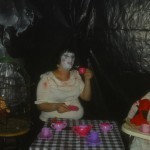
[image error]
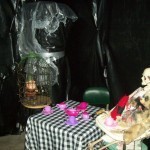
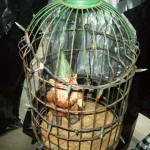
What were you up to?
October 31, 2011
A sentimental writer's Halloween
[image error]
It was sometime before midnight, I think. I was sitting in an old bar somewhere in downtown Fort Worth, surrounded by older men singing songs. I was in a sailor's costume and my friend was there too, a poor man's Alex DeLarge. I'd just recently broken up with my then-girlfriend and maybe I was a little drunk (but not that drunk, give me some credit) and my friend, she kept offering to "hook me up" with people at the bar. I wasn't impressed.
"I'm a great wingman," she kept saying. "Just point somebody out and I'll work my magic."
I didn't care. I didn't want magic. I just wanted to go out after work, maybe wander around town a bit in a silly sailor's costume. It's allowed, right? Can't a girl just sit in an old bar with her friend, and drink a beer, and listen to old men sing songs? It was Halloween, and I just wanted to forget for one night.
It was definitely just before midnight. You kept texting me. I kept texting you back. I knew you were on the other side of the country, dressed as a zombie-girl with a Y-incision and a skimpy dress at a party with friends. We were both with friends, in bars and clubs, in major cities on Halloween. We were out with others and only talking to each other. It seemed important at the time.
Then you called me, or maybe I called you. I don't remember. It was loud, I know that much, shouting to hear and be heard over music and singing. We didn't talk long, maybe five or ten minutes, about whatever comes after nothing. The Sailor and The Zombie-Girl. I had butterflies in my stomach, and it was hard to say why. Eventually my friend, who had gone to the ladies room, came back and took up her seat next to me at the bar. I hung up. You went back to dancing.
I had a stupid look on my face.
I felt happy.
"What was that all about?" my friend asked.
"Oh," I said and put my phone away. "It's my friend Melissa."
"You've been talking to her all night," my friend said, only half-accusing.
"Yeah, well. I think she has a bit of a lesbian crush on me." Which was true, I knew it. It just didn't really bother me before.
Then somewhere along the way, it really didn't bother me at all.
"Yeah, I'd say so," my friend said with an eye-roll.
(This might be part of the reason we're not friends anymore.)
"But I'm okay with it," I said, like nothing happened.
But somehow, on opposite sides of the country, in crowds of people in costumes, something had happened. Something kind of like magic, like conjuring ghosts or reading tea leaves. You become more important to me than I was at the time willing to admit, and to this day have trouble conveying with stupid words and clumsy hands. And as I sit here on Halloween writing this out, I find it difficult to look at the day the same way again.
You changed my life, Melissa Dominic.
I expect to see you in it next Halloween, too.
October 29, 2011
International Horror: America v. The World
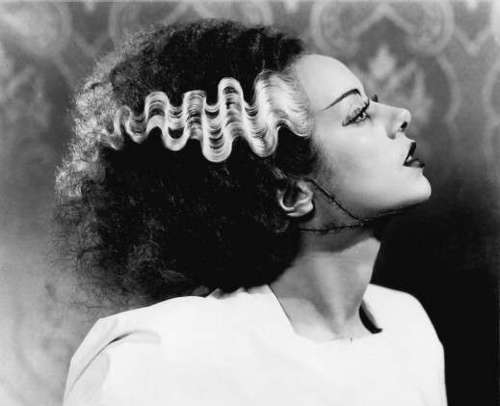
Filmmaker and friend-of-the-blog Edwin Pagán of Latin Horror was recently featured in Chicago-based newspaper ExtraNews. In a nice little write-up, Edwin discussed Latin horror, and the differences between American horror and the international horror world at large. This part, in particular, I found interesting:
How do you define Latin horror?
I think in a territorial sense we are still coming to terms with what it is. The major element is – and I think [filmmaker] Guillermo del Toro said it best – American horror attempts to destroy the physical and Latin horror is all about destroying the mind and the soul. It's more about the suspense and the scare factor. It's more of a slow boil than American horror. Latin horror goes back to the basics. It's similar to Japanese horror in some degree.
He brings up an interesting point. American horror, I find, can be a little limiting. This isn't true of every writer and filmmaker, but, by and large, there are standards and practices that we in the genre lean on heavily. We follow familiar formulas, familiar tropes, find ourselves preoccupied with familiar topics. To do anything else, unless done spectacularly well to a chorus of dollar signs and critical acclaim, can be a huge risk. This can be said of any culture's horror, but American horror is very set in its ways, sacrificing a lot of the thoughtfulness and heart that I see in films from other countries for gore and thrills. The stalk/torture/kill formula is a theme alive and well today, especially in the wake of the so-called Torture Porn revival of the last decade, and something I'd say most horror writers I encounter use above all else.
In America, we don't have monsters, per se. Sure, we have Dracula and the Wolf-Man, but we also have Jason Voorhees and Michael Myers, Leatherface and Freddy Krueger. We have figures. Our horror narrative is filled with an abundance of masked or disfigured villains, with their scary arsenal of weapons, gutting innocent passers-by and bringing down a morality-based sense of terror on teenagers who engage in underage drinking and premarital sex. The victims usually have it coming to some extent or another, as filmmakers would lead us to believe, through some attitude or action that the viewers are predisposed to rejecting. So when we sit in the dark to watch these movies, we're waiting to see people get chased down and cut in half, rather than watch our heroes defeat these monsters.
There's something a little scary about that American ideal of horror.
You know who my favorite horror figure is? Pinhead. I love me some Pinhead. He's a constantly evolving character, an existential explorer plumbing the depths of human suffering and experience. He goes from having no moral position on the behavior of characters to finding himself in the role of the judge, jury and executioner. However, the people he sits in judgment of have walked into the traps, especially in the later films, led there by the horrors of their own nature. It becomes a story about human psychology rather than a gory morality tale. That, I find, to be a truly interesting avenue of storytelling. But he isn't even an American concept and figure, so what does that say about me?
(Please do not mention Hellraiser: Revelations to me. I have not seen it and I have no interest in seeing it. The cover alone made me want to throw up.)
Until the last few years, there has been a distinct lack of interest in psychology and storytelling in mainstream American horror. That can be rather limiting in terms of what can be accomplished, and what is encouraged. Is this a particularly awful thing? Not necessarily. As I said, there are familiar tropes in every genre, and from every culture. There are tropes in Latin horror as well as Japanese horror with how they approach their storytelling, and I'm sure somewhere in the world somebody else is writing a blog post about their national horror output. But American horror can confine itself, painting itself into a corner of How It Ought to Be Done with a big red brush and calling it a day. It would be nice to see more writers and filmmakers take cues from other cultures and investigate other ways to tell stories, rather than just remaking (and/or stealing) other films and passing it off as progress in the genre.
Let's all just be one gory international family, okay?


