
Stephen Metcalfe's Blog, page 5
March 15, 2023
ATTACHMENT PATTERNS – RELEASE DATE APRIL 28, 2023
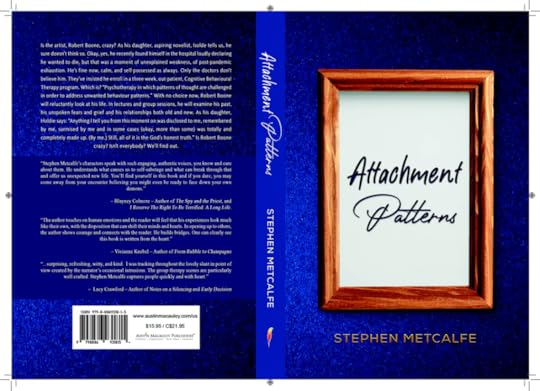
ATTACHMENT PATTERNS – – MORE TO COME!!
Is the artist, Robert Boone, crazy? As his daughter, 24-year-old aspiring novelist, Isolde Boone (Holdie), tells us, he sure doesn’t think so. Okay, yes, he recently found himself in the hospital loudly declaring he wanted to die. But that was a glitch, a moment of unexplained weakness, of post-pandemic exhaustion. He says he’s fine now, calm, stoic and self-possessed as always. Only the doctors don’t believe him. They’ve insisted he enroll in a three week, out-patient, Cognitive Behavioral Therapy program. Which is? A type of psychotherapy in which negative patterns of thought are challenged to address unwanted behavior patterns and mood disorders. Oh, great. Just what he needs. No way. But then, lo and behold, daughter, Holdie, his best friend and agent, Carter Hurley, and his long-time housekeeper, Marisol – three people he loves and trusts – insist he follow through with it. Or else. With no choice now, Robert Boone will reluctantly look at his life. He will have to listen to what he considers nonsensical lectures, and he will have to consider the lives and issues of his fellow group members. Over three weeks of confession, tears and, yes, humor, Robert Boone’s past, his work, his unspoken fears and grief and his relationships both old and new will all be brought to the surface through his daughter’s voice. As Holdie says: “It goes without saying that anything I’ve told you so far and will tell you from this moment on was disclosed to me, confided in me, remembered by me, surmised by me and in some cases (okay, more than some) totally and completely made up. (By me.) Still, all of it is the God’s truth.” Is Robert Boone crazy? In the current world, isn’t everybody? We’ll find out.


January 19, 2023
On Attachment Patterns
My new novel, Attachment Patterns (pre-order now available on Amazon), is loosely based on what you might call a “life adventure” that took place some seven years ago. I was doing work with a therapist at the time, exploring and trying to gain insight into some of the issues that consistently confound me and I found myself reading about Cognitive Behavioral Therapy – psychotherapy in which negative patterns of thought are challenged in order to address unwanted behavior patterns and mood disorders. Further research found, lo’ and behold, that a nearby clinic offered a three week, 8:30 to 12 noon, out-patient program in COG and, would wonders never cease, the program was covered by health insurance which – as our protagonist points out – seemed rather crazy on their part. What did I have to lose? I signed up and I went.
The program was divided into two parts. The first part was in a lecture hall where various topics were addressed by different therapists. One morning it might be on depression, the next it might be on core beliefs, the next on emotional regulation. Tools and procedures were discussed, literature and worksheets were referenced. It was like being in a classroom – a teacher at the lectern, students intently taking notes. The lecture was followed by a group meeting consisting of about half a dozen participants. In group, individual issues and concerns were addressed and feedback was provided by the group’s therapists and by one’s fellow group members. It could be emotional, it could be uncomfortable, it could be funny, it could be enlightening. At 12:30 pm it was all over and you went home.
It was in the second week of lectures when something odd started to happen. The therapist/lecturer would be addressing a serious subject and all of a sudden, a voice in my head started – no other way to put it – “talking back”. Call it rebuttle, call it psycological protection through casual sarcasm, but suddenly one part of me was still the serious student and another part of me was now the knucklehead who wasn’t sure he wanted to take these morbid, mental health issues to heart and was happy to say so – to me. I found the voice so odd and entertaining, I started writing down the asides and comebacks as much as the lecture notes. As for the group meetings, I remember going through most of them with my mask on, the one I wear in public – somewhat outgoing, seemingly confident, doing just fine, thank you, ma’am, totally underplaying the issues that can effect my daily life.
In retrospect, I now know I did myself a disservice. Was Cognitive Behavioral Therapy a success for me? Helpful, perhaps but no, not really. I didn’t hold on to it long enough. (It takes work, dang your eyes!) However… the voice it inspired in me eventually became the inspiration for a novel. Attachment Patterns is about a middle aged man reluctantly going through a three and half week COG program. Written from the point of view of his aspiring novelist daughter, it details his past and present, his heartbreaks and his triumphs, ultimately taking him to a place of greater self-understanding. I’d like to think that in some ways it also addresses the acute mental health concerns in our modern society. A small excerpt of the novel is below. More to come.
difficult people
It was Tuesday, the second morning of Cog, and in group, my father had shared his depression and anxiety levels. He’d decided to raise them both to a six, which was the high end of mild, so as to avoid questions from his fellow group members, all of whom seemed to be in their forties, fifties and in the case of the despondent, unshaven man, the nineties. This meant that they all thought that the future was hopeless, they were expecting to be punished or infected, were blaming themselves for their faults (and infections), had lost interest in people, were terrified with the state of the world, weren’t sleeping well and were suffering from various levels of constipation.
The only things Dad had identified with was a nervous stomach and a loss of interest in people, but since he had never had any real interest in people (other than the chosen few) and because, once again, he hadn’t had time for his usual leisurely morning sit on the toilet, these didn’t count.
He had also been forced to share his “Grapes”. This was an acronym for Gentle with Self, Relaxation, Accomplishment, Pleasure, Exercise and Social. Grapes, Dad was told, were a very useful tool in maintaining emotional regulation and planning one’s day. Three out of the six had him flummoxed. Accomplishment? He would work, of course. (Whether he accomplished anything or not, well, that had been debatable for a while now.) Exercise? He did that most every day as well. He ran, he lifted, he rowed on machines. It kept him – (Oops, dare we use this word?) – sane. More important, it also allowed him to eat pretty much whatever he pleased. Case in point. For dinner, that night, he was already contemplating a roast chicken Provencal accompanied by a fresh green salad and a nice Cotes de Rhone. But relax. Who could relax? (Relax does not run in this family.) Oh, but then Dad consulted the list on the back of the sheet and saw that reminding himself to relax would suffice. Fine, he could do that. Four down. As to Gentle With Self, the list suggested things like self-forgiveness, self-encouragement and self-help books. (If all else fails, I plan on writing one someday.) No, Dad went further into the list and settled for drinking enough water daily. Good for him, one to go. Social. That was the tough nut to crack. By habit and inclination, he was not social. Attend a http://www.meetup.com group? What was that? (I could have told him.) Whatever it was, it was not going to happen. Go to a social event through church? No, he didn’t think he’d like a church social. (And I doubt a church social would have liked him.) Talking to another group member on break seemed the best idea. It would have to be tomorrow after the lecture and hopefully he’d forget about it by then. If he came back at all.
Dad sighed.
The subject of the morning lecture had been Coping With Difficult People and it hadn’t been helpful. The lecturer, yet another young woman, this one wearing librarian glasses, had explained that there were any number of kinds of difficult people, a fact he already knew. It amounted to this. The passive person is the person who avoids conflict but won’t forget about it. (One of my first boyfriends.) The aggressive person is the person who seeks to control the situation with volume, passion and intensity. (Hello!) The passive-aggressive person is a person who won’t engage in conflict but leaves you no doubt you’re going to pay for it. (My last boyfriend). The thwarter is the person who has the uncanny ability to frustrate or upset you even when you know you’re right. (Mom). The stubborn person is the individual so obstinate, they won’t be swayed by a tsunami. (Dad, unless the tsunami is me). And finally – the judgmental person, the complainer and the victim. These are people who will admit you’re right but add that it isn’t fair and they’re helpless to do anything about it. (My college roommates freshman year and good riddance.)
This was all old information as Dad had long ago come to the conclusion that people were argumentative, incoherent and best to be avoided, which was why he was having a problem filling in the social block on his Grapes sheet.
December 2, 2022
Christmas Words
From the stage play, MR. AND MRS. KLAUS
Santa Claus enters. KRIS KRINGLE is in full regalia – not the chubby Santa of coke commercials but rather a regal and kingly Father Christmas, a winter warrior in long cape and brocaded vest and crown-like cap.
KRIS: Well? What do you think?
MARTHA: You are so handsome. I’m almost of a mind not let you go.
KRIS: Ho-ho! Now then! December 24th. The sleigh is being loaded. It’s brash is polished, it’s leather shined. The rain deer have been curried and brushed. I’m dressed and ready to go. Polypropylene. So much for woolen underwear. It’s been quite a year. It almost did me in. In this modern world of clamoring, clapping, conglomerates that view generosity of spirit as a corporate slogan and little else; in this world where commerce take precedence over charity and profit is more important than people, it has become far too easy to feel that the giving and receiving of a simple Christmas gift is pedestrian. That Christmas is a chore more than a blessing. It was not always like this. In the beginning, Christmas was a candle lit against the gathering darkness. There were monsters in the world and as the days grew shorter and colder, it was far too easy to hear their cries. The gathering together, the celebration, the sharing, the community of Christmas, was a way of reaffirming hope in the face of that darkness. A way of saying, we are all in this together and if we hold hands, the light will come again. Well, I say now to all for all to hear, that there are still monsters in this world – dragons, yes! – far greater and more powerful than any first imagined. And it is far too easy to feel resigned and helpless in the face of their fiery breath. I say the need for the spirit of Christmas has never been greater. That in a world where we know too much and believe too little, the ability to pretend that even for a day there is such a thing as Santa Claus is more important than ever before. I am Santa Claus. Now and forever. But so are you and so are you and so are you. So are you all. You must be. Each and every day of the year.
MARTHA: Kris. It’s time.
KRIS: I could never have done any of this without you.
MARTHA: I’ll wait up.
KRIS: Peace on Earth. Good will towards men.
KRIS EXITS.
MARTHA: It’s time now, it’s time! Can you see him? He climbs into the sleigh. Like a crimson king, he takes the reigns in hand. His beard is like snow! The doors open wide and the cold air rushes in. It’s clear tonight. I see stars. They are as beautiful as the eyes of God.
We hear the crack of a whip, then his voice:
KRIS: Now Dasher, now Dancer, now Prancer, now Vixen, now Comet, now Cupid, now Donner and Blitzen! To the top of the porch, to the top of the wall, now dash away, dash away, dash away all!
MARTHA: And I heard him exclaim ‘er he drove out of sight. Happy Christmas to all. And to all a Good night.
November 29, 2022
Poem Hunter
As is often the case (and I’m good at it), I have done something wrong headed, blind and/or stupid. Probably all four. That I have unsuspectingly done this makes no difference. I am dealing with the consequences. What have I done, you ask? I have inadvertently and unknowingly gotten myself on an internet mailing list. Every day, sometimes twice, an e-mail winds up in my mailbox. It is from Poem Hunter.com. When opened it will reveal a “classic” poem for my reading pleasure. Which means I will have to read it. And digest it. And as often as not, too often in fact, not enjoy it.
Why do I not put Poem Hunter.com on my junk mail list? Because I am, by profession and fate, a writer. As ridiculous as it sounds, I have, at times, even taught writing which is like a clown teaching someone to drive funny cars. As a writer and a “teacher” I feel I should like poetry.
(As the lovely wife always tells me, there are no shoulds. This is usually before she asks me to do something I don’t wish to do. It’s sort of like saying, “you don’t have to do this, but…..”)
This morning I got hit with this.
Will Our Love Succeed?
I know deep down you’re good
That much is understood
Honest and hard working
I’m proud to wear your ring
But my heart does not sing
You still bring me flowers
I know what’s yours is ours
You have never said no
Even when it’s for show
But you don’t make me glow
You let me have my way
Yesterday and today
Trying to make it right
Each and every night
But I don’t feel delight
You’re there when I need you
You are solid and true
Everything that I need
You always take the lead
But will our love succeed?
Right, night, you, true, need, lead? Well, yes, of course – poems are supposed to rhyme, aren’t they.
Yesterday begat this:
Five Ways To Kill A Man
There are many cumbersome ways to kill a man. You can make him carry a plank of wood to the top of a hill and nail him to it. To do this properly you require a crowd of people wearing sandals, a cock that crows, a cloak to dissect, a sponge, some vinegar and one man to hammer the nails home.
Or you can take a length of steel, shaped and chased in a traditional way, and attempt to pierce the metal cage he wears. But for this you need white horses, English trees, men with bows and arrows, at least two flags, a prince, and a castle to hold your banquet in.
Dispensing with nobility, you may, if the wind blows, blow gas at him. But then you need a mile of mud sliced through with ditches, not to mention black boots, bomb craters, more mud, a plague of rats, a dozen songs and some round hats made of steel.
In an age of aeroplanes, you may fly miles above your victim and dispose of him by pressing one small switch. All you then require is an ocean to separate you, two systems of government, a nation’s scientists, several factories, a psychopath and land that no-one needs for several years.
These are, as I began, cumbersome ways to kill a man. Simpler, direct, and much more neat is to see that he is living somewhere in the middle of the twentieth century, and leave him there.
Hmmm. What to make of this. Jesus, an English Knight, World War I and the atomic bomb. The middle of the twentieth century – that would be 1950. Yes, I suppose the adventures of Ozzie and Harriet and the cumbersome three martini lunch could kill you. If I’m not mistaken this is called dramatic irony.
I would suggest this is not so much a poem as it is a treatment for a multi-part Netflix series. Blackadder with no sense of humor. Just add vampires.
As did this poet:
A Desperate Cry
God’s creation
Blessed to be born in this world
We all may feel that’s the truth
Until I read this-
An abandoned baby
Malnourished, hardly an year old
Famine struck
Skin and bone
No food to feed
No water to have
Stranded alone in barren land
Helpless eyes staring straight
Standing legs more like a bamboo stick
Cerebral neurons popping out
Veins struggling to carry weak blood
Oh God! Nothing more I can add…
My heart is not strong enough
To read the rest-
A vampire vulture
Sitting beside and
Looking eager to end its hunger!
I pray! Save these innocents!
Let this never happen again!
Hmm. I’m suddenly reminded of a stint thirty-some years ago at Actors Theater of Louisville where one night in bar, a young woman got up and announced that she and a friend were going to do an “improvised dramatic reading” with accompaniment on bongo drums. As I’m very much for the soul expressing itself, I quickly ordered a triple boilermaker. I told the waitress to “keep them coming”.
I should mention that I have my tried own hand at writing poetry. In college. At the behest of a teacher. He said all poets are mad. Being mad, I decided to write some poems. I actually saved some of them to remind myself that there is such a thing as humility. This is an example.
(Please note how in all “good” poetry, a simple sentence is broken up into multiple lines. I think this is to suggest abstract thinking. Or perhaps to disguise the fact that what is in truth a simple paragraph, is in fact, a poem.)
The Frost Giants Rolled Out of Jottenheim
Pissed as hell and struggling with each other
Screaming their asses off.
My mother,
Danish in descent
With the Viking spirit of a Spaniard,
Issued small craft warnings and declared the harbor closed.
As she headed to bed to ride out the storm
Thor and I,
Hammers in hand,
Ventured forth, red beards wrapped angrily around our necks,
To show the multi-headed invaders we weren’t afraid.
They obviously weren’t impressed.
They laughed so hard they shook themselves into little pieces
Which they unceremoniously dumped on our heads,
The cold blooded bastards.
Thor and I,
Somewhat embarrassed at our poor showing,
Trucked back over the bridge to Valhalla
To get righteously drunk on mead
The feasting and the boasting got so riotous,
We woke my mother up.
That was a real twilight of the Gods.
Ah, the wit. Oh, the archetypal, mythological references. I’m sending it to The New Yorker. Okay. Serious. (I hate serious but…) I leave you with this.
To the lovely wife who puts up with me (barely):
I do not love you as if you were a salt rose, or topaz
or the arrow of carnations the fire shoots off.
I love you as certain dark things are to be loved,
in secret, between the shadow and the soul.
I love you as the plant that never blooms
but carries in itself the light of hidden flowers;
thanks to your love a certain solid fragrance,
risen from the earth, lives darkly in my body.
I love you without knowing how, or when, or from where.
I love you straightforwardly, without complexities or pride;
So I love you because I know no other way
Than this: where I does not exist, nor you,
so close that your hand on my chest is my hand,
so close that your eyes close as I fall asleep.
———-Love Sonnet XVII by Pablo Neruda**
Sometimes you just have to like poetry.
November 14, 2022
HORRIBLY AWESOME, CHARMINGLY GRUESOME, ONE FOR THE AGES – OR NOT
As a writer, I have never been overly concerned with reviews. I remember my first play, Vikings, opening at the Manhattan Theatre Club in1981 in what was certainly a less than stellar production and the critic for the New York Times, Frank Rich, pretty much tearing both me and the theatre a new asshole for even thinking it should be on stage. And I sort of agreed with him. I called up my agent at the time, the chain smoking, Bronx voiced Esther Sherman and asked if she was doing okay. “I’m supposed to be asking you that,” she said. Oddly enough I was. I was in the arena, I was striving, doing my best. I felt – hey, I haven’t seen any of your plays done Off-Broadway lately. And finally, I was aware that if I was going to take good reviews seriously, I was going to have to take bad reviews seriously as well. No, better to ignore them all. Kidding but not really.
My next play, Strange Snow, also done at the Manhattan Theatre Club, was a wonderful experience. Standing ovations every night (which weren’t so standard back then). And yet, Frank Rich was tepid about it. And I discovered it didn’t really matter that much. Yes, a good review from him might have moved the play into a commercial production, but his lukewarm reaction didn’t take away my pride and sense of accomplishment in the work. It was my review that mattered. I’ve tried to make that the case ever since. I have to admit I’m a tough critic when it comes to my own work.
At the end of the day, reviews of plays (and films and books) are a matter of opinion and today word of mouth and social media spreads that opinion much better and faster than newspaper print. As a playwright, it took me awhile to realize it but plays are also very much dependent on the production. Classics can be turned into roast beef hash in the wrong hands. Plays you don’t like or think will work, sing when the right people get involved. At the end of the day, a playwright builds a house. Actors, directors and designers come in and paint the walls, install the carpets, buy the furniture and fill the refrigerator. They can turn a silk purse into a sow’s ear. They can turn a motel room into a penthouse suite. Case in point. My first play, Vikings, that was such a disappointment when done in New York? Two years later I saw a production of it at The Old Globe in San Diego. It was wonderful. It made me laugh. It made me cry. Who wrote that, I asked myself. And my last play, The Tragedy of the Commons, received mostly negative reviews for what I thought was a pretty good 2013 production in San Diego but then received great reviews – pick of the week! Yay! – for a pretty good 2014 production in LA. Go figure.
And if reviews have become increasingly irrelevant in the theatre, than I wonder what they mean in the film business where word of mouth, Twitter and Rotten Tomatoes are usually humming about a film before it’s even opened.
I can’t say I ever paid an enormous amount of attention to the reviews of any film I worked on. Part of this is because when a film is released a writer is often two projects on and another part of it is that so many things go into the success and failure of a film, it can be difficult to take reviews – good or bad – personally (that’s the director’s job).
As a screenwriter, I considered myself a working writer. As often as not I took the best jobs offered me. I didn’t do a lot of spec work – write original work on my own dime. It’s easy to say I did this because there were bills to pay, children to raise, and it was nice after years of just getting by in the theatre to be handsomely paid for my writing. Still, looking back, I wonder why I didn’t do more original work. The screenplays I’m proudest of are those that were pretty much started from scratch. Jacknife was based on my stage play, Strange Snow. Cousins was loosely based on a French film, Cousin-Cousine. The Old Boy, based on the play by A.R. Gurney, is a particular favorite. A foray into sci-fi – Jonah – got me a million meetings in LA. And Beautiful Joe, an original screenplay was produced in 1999. It starred the insane Sharon Stone and the terrific Billy Connelly and was helmed by a first time director named Stephen Metcalfe. It was taken away from said director in post-production and reedited by the producers into something unrecognizable. In the United States it went straight to video. Speaking of reviews:
“Beautiful Joe is a well-intentioned film, and that is nearly all that can be said for it. It tries to be both comedy and drama, but is comfortable as neither. Stone’s character is the standard beautiful-but-messed-up-woman-who-needs-rescuing who is for some mystifying reason is supposed to be appealing. And yes, of course she has a mute son who just might speak if only he had the right reason. Stone, who stretches herself here, is clearly eager to play a character: she mugs, she drawls, she wiggles, and she cries. Not a scrap of scenery escapes her gullet; at times her attempts at comedy actually become sort of upsetting. Ally McBeal’s Gil Bellows turns in a similarly inept and cartoonish “comic” performance. Beautiful Joe’s one saving grace is Connolly, who manages to rise above his fellow cast members and the bizarre editing to turn in a charming, dignified performance.”
This review was very difficult to ignore because I believed every word of it to be true. In fact, I actually liked this review because they didn’t mention the idiot who’d had the temerity to have directed the fiasco – me.
I find myself now on the other side of having had two novels published (The Tragic Age, St. Martin’s Press – March, 2015 – The Practical Navigator – 2017) with a third, Attachment Patterns, to be released in 2023. I’ve got to admit, I’ve found the release of a novel more daunting than I ever did the opening of a play or the premier of a movie. First of all, there’s the competition in an industry that doesn’t seem to quite know where it’s coming from or going to anymore. Plus, a trip to the local bookstore or a wander down internet-Amazon-lane, leaves me aghast at the sheer number of writers I’m familiar with and the even greater number of writers I’ve never heard of before. Is it my imagination or are each and every one of them New York Times best sellers? Regardless, they all seem as smart and talented as hell – something that can’t be said for a lot of screenwriters (or playwrights who, frankly, are of questionable intelligence for even attempting to be playwrights).
I find it daunting too, that a novelist has no one to share their failure (i.e.; blame) with – no actors, no directors, no producers. A novel is a house that you, the writer, were not only the architect and construction foreman on, you were the interior designer, painter and gardener, not to mention the director, actor and cinemaphotographer as well. And like a finished film, once a book’s out there, there are no do overs. It’s a done deal.
But here’s the good thing. It’s still my review that is most important to me. And I feel my three novels are pretty darn good; well written, vivid characters, entertaining, maybe even enlightening. Unless, that is, it’s a Monday. Or a Thursday. Or the eleventh hour on a Saturday. Or leap year. Or two in the morning and I didn’t like dinner. Or I’ve stunk at tennis that day. Or I’m reading something I really like and admire; something that I could never do. At times that like that, the sheer idiocy of what I’ve attempted assails me. It discourages me and deflates me and leaves me no choice to do anything but start work on the next project.
Why, you ask?
Because I enjoy it and wouldn’t do anything else.
“Success is stumbling from failure to failure with no loss of enthusiasm.” — Winston Churchill
October 26, 2022
On (Re)Writing Pretty Woman
To this day, people often ask me why my name doesn’t appear in the credits of the film, Pretty Woman, on which I did a lot of work. It’s a long story and it’s a short story. The long one first, at least as I remember it.
In the late eighties, Touchstone Picture acquired the rights to the screenplay, 3000, by J.F. Lawton. It was the dark, gritty, very realistic story of Vivian, a street prostitute, and Edward, a manipulative, amoral, wealthy businessman who hires Vivian’s services for a week. The best way to describe the tone of the screenplay is that it ends with Vivian emptying her suitcases of all the expensive clothes Edwards has bought for her and, screaming hysterically in the middle of Hollywood Boulevard, throwing them at his limo as he drives off into the sunset, never to see her again. It would have made a very interesting movie but it wasn’t the movie Disney/Touchstone wanted to make.
I don’t know who – it might have been David Hoberman or Donald DeLine but it was probably Jeffrey Katzenberg – but someone had the idea that 3000 could be a romantic-comedy. They were so sure of this they’d hired a director, Gary Marshall, and already had a lovely, young actress to play Vivian – Julia Roberts, who was coming off a wonderful film, Mystic Pizza, and who had recently wrapped Steel Magnolias. What they didn’t have yet was the script they wanted. (As Gary Marshall would say – “I haven’t found the funny.”) And so they were interviewing writers. A lot of writers. And I was one of them. And probably like all of them, I had read this script and thought – “how the hell is the story/relationship of a coke whore and a Machiavellian asshole supposed to be a romantic comedy?” And guess what? Thanks to my background in the theatre, I came up with an answer. When in doubt, steal.
“Pygmalion,” I said. “My Fair Lady.”
The room looked at me. Producers (one of them, the great Laura Ziskin), assistants, interns. Gary Marshall. You could see the light bulbs going off. Pygmalion is the story of a well-born professor of phonetics, Henry Higgins, who on a bet, takes Eliza Doolittle, a cockney flower girl from the streets, and turns her into a well-spoken lady. And in doing so, falls in love with her. Vivian would be Eliza Doolittle. Edward would be Henry Higgins.
“We’ll get back to you,” the room said.
They didn’t have to. They could have taken the idea and gone with someone else, a more prominent name. I think it says something about the integrity of the time that they didn’t.
They hired me.
In the movies, story is everything. It’s not for nothing that Robert McKee, the dean of screenwriting workshops, has a bestselling book called simply, Story. And with the structure and tone of Shaw’s Pygmalion and Lerner and Lowe’s My Fair Lady in mind, let’s face it, I had a pretty good story to work with. Still it was intimidating. It is easier to make something good out of something bad than to take something good and make it better. One thing it did was it allowed me to add characters – Colonel Pickering became the hotel concierge (played by Gary Marshall’s go to guy, Hector Elizondo). The young business exec who, to Edward’s dismay, falls in love with Vivian was Freddy Eynsford-Hill. I never could figure out an Alfred Doolittle – at one time I think I tried to make it a fellow streetwalker. The template also suggested new scenes and places. The LA polo grounds replaced Ascot races (“Rich people picking up dirt I can do funny!” said Gary Marshall) and the San Francisco Opera replaced My Fair Lady’s Embassy Ball.
I found it relatively easy to lighten the tone of the piece – to make the characters “likable” – which means, as an audience, identifying with them. I find writing dialogue sort of like an actor doing an improvisation – once I get the character’s voice in my head I follow him or her. I have a sense of where I want them to go but I don’t impose. I keep their motivations and objectives close at hand. A man is rich but he is unhappy. His life is empty. He yearns for something, he doesn’t know what. And now he finds it in such an unlikely place, he doesn’t recognize it. We identify with that. A young woman through reasons unknown is living on the edge. She desperately wants something better. We identify with that. They banter with one another. They surprise one another. They desire one another. They are taken with one another. He treats her with respect and affection. She both surprises him and delights him. We see it. We are pleased by it. We begin to root for them. There are obstacles, thrown at them by others and of their own making. We want desperately for them to overcome those obstacles. Why? Because essentially they are good people. Even though they are very different, with different backgrounds, like Henry Higgins and Eliza Doolittle, they are right together. They complete one another. He, in fact, needs her more than she needs him. Fairy tales are made of such things.
Favorite moment 1. When we first meet Vivian she is in thigh high boots, heavy make-up, carries, multi-colored condoms and wears, yes, a fake looking, brassy blonde wig. We love the fact that she can drive a Ferrari and he can’t. (She can do a lot of things, he can’t.) She is, however, a prostitute. Society teaches us to look down on women of the night. What to do about that? I think one of the most important moments of the film – and I’ll take credit for it – is when Vivian takes off the wig. In doing so, she transforms from a streetwalker into Julia Roberts. What else is there to say?
Favorite moment 2. At the San Francisco Opera, Edwards offers Vivian an open jewel case. In it is a magnificent necklace, one she is to wear for the evening. The sight of it moves her and leaves her breathless. Before the take (the moment when the director calls action), Gary Marshall asked Richard Gere (Edward) to snap the case shut as Julia Roberts (Vivian) reached for the necklace just to see her reaction. Gere did and startled, Julia Roberts stepped back, eyes wide and – began laughing. Neither actor broke character, neither broke the reality of the scene, both built on the moment. You sense Vivian’s trust of Edward and Edward’s growing adoration for her. And it was totally improvised. To me, it’s as amazing and honest a moment between two people as I’ve ever seen in a film.
The screenwriter, William Goldman (Butch Cassidy and The Sundance Kid), once wrote that if you have a good script and the right cast, the movie might work. A great cast can’t save a bad script and a bad cast will ruin a great script. Pretty Woman – a pretty good script if I do say so myself – worked because Julia Roberts and Richard Gere worked. And guess what? Richard Gere almost wasn’t in it.
Casting films is a crazy business. Career changing roles often come about by accident or happenstance, by offers being rejected by other actors first. Martin Sheen replaced Harvey Keitel on Apocalypse Now. Tom Selleck couldn’t get out of his commitment to Magnum PI to play Indiana Jones. John Travolta turned down the role of Forrest Gump. Sean Connery turned down the role of Gandalf in Peter Jackson’s Lord of the Rings.
And speaking of Sean Connery.
I was working on my first draft of Pretty Woman when it came down that he was who they were talking to about playing the role of Edward. First impression? They were taking the idea of Henry Higgins way too seriously. (Maybe Connery and Michelle Pfeiffer who, I later heard, was offered the role of Vivian before Julia.) At any rate, he passed.
I subsequently heard the pitch – there wasn’t the new draft quite yet – subsequently went to Robert Redford, Harrison Ford, Warren Beatty and Mickey Rourke (who in the 80’s, post Diner, post 9 ½ Weeks, pre-plastic surgery, would have been interesting). “Went” means it was discussed with their agents.
I turned the script in and it was well received. I even got a phone call from Disney president Jeffrey Katzenberg – “Great work. Talk soon. Gotta go.” – and even though Katzenberg was famous for making about a billion phone calls on his thirty minute drive home every night – he sat in his car, his secretary fired them in from the office – I was thrilled. A lot of people could learn from Katzenberg.
I began a second draft with notes – lots of notes. People always have notes. To sit in a studio script meeting and not have a note to give to the writer is like saying you’re not fit for anything in La-La Land but going for coffee. (My personal favorite – “I think we need to develop the characters more.” My second favorite – “I think we need to make the scene more magical.” WE.) Anyway, one day, while working away, sifting through notes, I got an excited phone call from the assistant to someone – “Al Pacino wants to do a reading of the script.”
Now I am often a huge Al Pacino fan. Godfather I & II. Scarecrow with Gene Hackman. Serpico. Dog Day Afternoon. The Basic Training of Pavlo Hummel (on Broadway). But I also think he can be guilty of chewing the scenery to bits and I’ve never seen him successfully pull off a romantic comedy – actually I think the only one he’s been in is Author, Author where he played – ouch – a playwright.
But we flew to New York and we read. Al Pacino, Julia Roberts (to me she was, like, er, uh, immediately tongue-glued-to-the-roof-of-my-mouth amazing and she hadn’t even read a word yet), Gary Marshal, (who somehow got stuck in a toilet stall for 20 minutes until his female assistant freed him – these things seemed to happen to him) and various New York based actors to play various roles. Al Pacino, dressed in black from head to toe, shirt open to his navel, was…. Al Pacino. Intense. Feral. Mercurial. Genius and wackjob, hubris and insecurity, in equal measure. The role of Edward, as written, did not flow trippingly from his tongue. Saliva flew (when Pacino did a play, the people in the first several rows needed umbrellas). The sense of connection between the two leads was questionable at best.
Hollywood Rule 7a. When in doubt, do a rewrite on the script. Rule 7b – When forward momentum on a project grinds to a halt, do a rewrite on the script – it creates a false sense of progress. Rule 7c – When offering the role to a “bankable” star or director, always tell them the script is a work in progress. “We’re working on a rewrite” and “any input you have would be invaluable” – meaning we’ll change it to what you want if you say you’ll do it.
So it came to pass that I was hired to do a “rewrite” just for Al Pacino. It was a vague assignment at best. I wasn’t changing the beats of the story or the objectives and motivations of the character. I was trying to incorporate an actor’s energy, his delivery, and his tics into the role – make a more comfortable fit. At any rate, just around the time I finished the draft, I got a call that Al Pacino had passed. He felt the role just wasn’t for him. I think he was right.
Being a screen writer is a funny thing. All in all, I did three, maybe four drafts of Pretty Woman. The title of the movie didn’t come into play until months and months later – somehow someone acquired the rights to the Roy Orbison song and I’m not sure what came first the song or the idea to use it. I would say I had sort of slipped away before that. There is really only so much a (re)writer can do. You start repeating yourself, second guessing yourself. In trying to address the endless notes, you lose your perspective and the originality you initially brought to the work. I had moved on to another writing project offered by Disney/Touchstone by the time Pretty Woman went into production. They had, yes, cast Richard Gere – “settled for him” – by then. His career was in a lull at that moment. He had gone from films like Days of Heaven to American Gigolo to An Officer and a Gentlemen to semi-disasters like Cotton Club and King David. They had also hired a wonderful writer, Barbara Benedict to help shape the role of Edward for him.
I guess you could say it all worked out in the end.
And now we go back to credit. When there are three or more writers on a film, credit on the film automatically goes to what is called arbitration. A panel of three WGA members (Writers Guild of America) sit down with the drafts of the script and statements from the writers detailing what they think is their contribution to the final draft and why they should receive credit. I’m sure they take individual scenes, character development and dialogue into account but as I understand it, at the end of the day they are focused on structure and story. It was my feeling that I contributed to all of the above. And that’s what I said. My written statement to the arbitration committee was something along the lines of – “I think the work I did on the script speaks for itself.”
I was an idiot.
I have learned in subsequent years that statements from writers on what they did to a script can go on forever. They take the script and give a detailed account of their perceived contribution to every page. They point out that C is a variation of B which is a variation of A which originally was my idea! I didn’t and I still don’t have the patience for it. Coming out of the theatre I also had this feeling that If I was ever rewritten, I would no longer feel complete ownership of my work. How can you claim credit for something that’s no longer completely yours? (The reality with a screenplay is that it’s never really yours. I’ve been on sets where things were changed, rewritten, made up and/or improvised at a moment’s notice.)
It’s my opinion that there should be a contributing writer credit. You have associate and executive producer credits given to those who never set foot in a meeting or onto a film set. In the end credits you have list of drivers, assistants to the assistants, location managers and the craft service people (caterers). No writers? Come on. Why isn’t there such a credit? Because sole credit brings a writer money in both bonus and, these days, residuals and it brings them future work. In the current system, a writer has every reason not to want to share. It’s disingenuous at best.
In the initial one sheet (poster) of Pretty Woman, the screenplay is by J.F. Lawton, Stephen Metcalfe and Barbara Benedict. I have a miniature version, given to me by Touchstone Pictures. In my opinion, that’s what it should have been, simple as that. Was I disappointed? Yes. But I got over it very quickly. And because my contribution to Pretty Woman was common knowledge in Hollywood, the phone didn’t stop ringing for many, many years.
The downside is that I was categorized as a writer of romantic comedies.
But that’s another story.
October 18, 2022
Notes on a Son
When my son was sixteen years old, he did the Shark Fest Swim. Alcatraz to the wharves of San Francisco. One and half miles in cold, turbulent, shark infested water. I shivered and quaked at the thought. A year later, he and his high school swim mates did The Catalina Relay. Twenty odd miles from Catalina Island to the Pacific Palisades, at least half of it in the dark. I still get seasick thinking about it. He certainly didn’t. He was in the water at dawn, surrounded by herds of dolphins. The boat captain said he’d never seen anything like it. Later that year, he and his fellow team members did a relay across the English Channel. Water temp – 54 degrees, no fins, no wetsuits, stinging jelly fish, heavy currents, and industrial freighters. It worked out that he was the swimmer who touched the shore of France, barely evading the embrace of an enthusiastic Frenchman, a celebration that would have disqualified the entire team. You’d think he might have shouted a warning, but he didn’t. He wouldn’t. My son – ocean swimmer, surfer, and eager skin diver – is on the autism spectrum and can have a difficult time talking to people, especially those babbling loudly and exuberantly in a foreign language. Thankfully he hurried up and onto the beach and disaster was averted. Such is life for those who don’t work like – quote-unquote – normal people. Success can be one step away from mishap. Normal people, even well-meaning ones, can throw you because they move and talk faster than those who measure twice – sometimes measure three or four times – and then carefully cut once.
In my novel, The Practical Navigator, the protagonists, Michael Hodge, is a single father dealing with the news that his son too, is on the spectrum. The boy, Jamie, is six and in many ways Michael’s experience reflects that of my wife and my own, some fifteen years ago. The initial shock at the diagnosis. The fear. The uncertainty. We hardly knew what autism meant and what we read seemed ominous. What do we do? Where do we go? How do we help him? We had no idea. But we slowly learned. We found people and services. We learned about occupational therapy. Speech therapy. Floor time exercises. All of this seemed to be in its infancy then. We had no idea if any of it was even helping. All we saw were challenges.
My son gravitated early on to the swimming pool. He loved the pressure of the water on his body. He liked going to the rock-climbing gym and because we were told it was good for his coordination, we went as often as we could. I enjoy tennis and golf and would take him with me when he’d let me. A favorite story. My son was about nine and we were playing an easy local track. On the first hole, he hit a short, straight drive and as he approached the ball, he pulled a lob wedge from his small bag of clubs. It was at least one hundred and fifty yards to the pin, fifty to clear a fairway bunker. “Wrong club, Bub,” I said. “Dad,” he said, “it’s my decision.” “You want to at least carry the bunker,” I insisted. “Dad,” he repeated, “it’s my decision.” I shrugged and watched as he hit the ball into the bunker. Four or five or six shots later, he was on the green, calmly putting out, when it hit me. “Dude, you do know you’re trying to get the ball into the hole in as few shots as possible?” He looked at me in surprise. “Really?” he said. “But – why? – it’s fun to hit the ball.” It’s something I’ve tried to remember on the golf course ever since.
My son’s elementary school was a warm and nurturing place. It was close to home, and he was surrounded by supportive teachers and typical peers. We supplemented his studies as best we could with aides and outside tutors. Looking back, we probably could have done better in the academic department. At the time it though, it seemed more important that he be comfortable, secure, and accepted for who he was and frankly, we had no idea where else to go. His first middle school experience was a disaster. It was a private school for “students who struggle” and it promised highly trained teachers and research-based learning strategies. After one unhappy, anxious, defeating semester with far too much time spent alone, sitting in the principal’s office because they didn’t know what to with him in class, we took him out. We explored public school options which increasingly seemed wrong for him. They gave little and they expected little of him. We were then lucky enough to find a district affiliated school in San Diego, a school where, we were told, there were “no labels, no excuses”, that it was “life on life’s terms” and the school motto was – is – “I will either find a way or make one.” Students mentored one another and when my son found himself in one-on-one situations with peers he wasn’t comfortable with it at first. He was expected to focus on a college bound course of academics and he struggled. Math was difficult but doable. Literature was a nightmare as my son doesn’t think in words, he thinks in pictures. When asked which foreign language he wished to study, he requested Tagalog, the national language of the Philippines. He was disappointed when told it wasn’t on the curriculum. He was asked to do culminating presentations on his course work, and they were mono-syllabic and he spent most of the time staring at the floor.
But three times a week he and his schoolmates swam. First in a YMCA pool, not far from school and then, when other members complained about the “weird kids”, in the ocean where the “weird kids” often scared the lifeguards half to death, hitting the high surf and swimming a mile out to sea at six-thirty in the morning, no one ever dreaming that in several years the “weird kids” would all be swimming the English Channel together.
Four years later, as he approaches the end of high school, my son still has his struggles with math and it’s doubtful he will ever be a literature major, but he has become a competent and dedicated student. Rather than Tagalog, which he has vowed to learn on his own, he opted for a semester of Spanish. And as for those presentations, he now gets up, looks everyone in the eye and speaks with confidence and authority. He talks about being a lifeguard, he talks about being a marine biologist, he talks about studying snakes and poison dart frogs. He talks about the kind of house he’ll have some day. He likes the idea of bright colors and round, Hobbit doors. With the help of a service dog, he’s achieved a level of independence. On weekend walks, he’s made friends in our small town. Local merchants. Wait staffs. The guys who play pickup basketball at the park on Saturday mornings and of course, the members of the local swim clubs. They all enjoy him, and they look out for him. My son has come to a place where he rejects any imposed limits that come with the label of autism spectrum, and I am so proud of him for it. And yet I worry. All I still see are the challenges. If the first hump to get over as a family was the initial diagnosis and the obstacles my son would face as a boy, a teenager and then a young man, the second one will be those he faces as an adult. It can be hard out there for everybody, but it can be especially hard for those that are considered – and again, it should be in quotes – “different”.
In a recent New York times piece, the columnist, David Brooks, points out that we, as individuals, “want to go off and create and explore and experiment with new ways of thinking and living. But we also want to be situated — embedded in loving families and enveloping communities, thriving within a healthy cultural infrastructure that provides us with values and goals.” Brooks says we look to create a contract with society through work and service and we look to create a covenant with our families, friends, and communities through love. Contract and covenant – my son wants both. Will there be a job for him studying poison dart frogs? Probably not. We have no idea yet what his calling – his contract with society – will be. More important, will there be relationships and a family – a covenant – not of origin, but of his own making? There are no courses or schools or programs for that, at least none of I’ve heard of. I do know my son is long on love.
I tell myself I’m not alone. I tell myself that all parents want the very best for their children, want them to be secure, happy, and fulfilled. I tell myself there are times when no parent has the right answers. I didn’t when my son was six and I don’t now that he’s twenty. I can only tell you this. At a recent fundraiser for autism awareness, my son had the opportunity to go up on stage and in front of several hundred people, he answered the questions put to him with confidence and authority. He talked about his swims, and he talked about his dog, and he talked about his school. And when asked what he wanted to do next, he smiled and replied – “Go to college, get a good job and marry a pretty girl.” The audience erupted in laughter and enthusiastic applause. I did too. Yes, I thought. From a young man’s mouth to God’s ear.
Written in 2017THE UPDATE
My son is now twenty-five years old. He works thirty hours a week at a local market, and he volunteers at the Scripps Institute of Oceanography here in La Jolla. He still hits the ocean several days a week, usually bodysurfing and he is a banjo player, a singer of songs. He still hungers for a “real” career but isn’t sure what that career will be as yet. More than that, he yearns for connection. With peers. With a romantic partner. It isn’t easy these days, we tell him, not for anyone, even quote-unquote normal people. But give it time. It will happen. Don’t lose hope.
October 11, 2022
Blocked
Writer’s Block: A condition in which a writer is either unable to produce new work or experiences a creative slowdown.
It should be so simple. I don’t know if it’s age, the anxieties, and uncertainties of the current times, but I have lost my ability to create. It’s never happened before. In a forty-odd career (odd is an understatement), I’ve written twenty-two stage plays, written or rewritten over thirty screenplays, created four TV pilots and in the last ten years have written five novels, three of them published, the other two continued works in progress. And now, I’m stuck. I have ideas, but they don’t coagulate. The words no longer flow. The voices that have always been ringing in my head are no longer speaking. What gives? Is this solitary endeavor finally getting to me? You go to your desk or table, you face the blank page or screen – the wall. There are no rules or schedule, no timeline, no co-workers. There is no one telling you what to do and what not to do (only your characters). There are good days when you become lost in your imagination. You take a step, and you follow Alice down the rabbit hole. You don’t come up for air. You blink, blink twice. Hours have passed. There are also days when you must work at it. You’re not exactly sure where you’re going. You’re doing it but you’re not sure if you’re doing it right. Still, you know you’re creating fuel for the fire, spices for the stew. It will be part of the mix that fuels the rocket ship when it takes off again. Oh, and really, you’re never alone. Your friends and co-workers are the people you’re creating and they’re constantly talking to you.
And now, this new routine. Looking at the page. Looking at my watch. Looking at the words. Clicking to the internet to check my email. Looking at my watch again. Minutes that seemed like hours have passed. Maybe I’ll get something to eat. Have I scheduled some tennis? Oh, thank goodness – a doctor’s appointment. Is it too early for a beer? I know, why don’t I shave my head! Big sigh. It’s like my brain needs a vacation from my desk and if I take it, it could be a long one. I’m not sure I’ll return.
Perhaps the problem is the things that once inspired me no longer hold water. I’m no longer interested in the theatre. The plays I see being produced don’t call out to me. Making an 8 o’clock start time seems like too much of an effort and an 11 o’clock curtain call is way past my bedtime. Besides, I always liked creating theatre more than seeing theatre anyway, and creating theatre, working on my plays with a director and actors in rehearsal, seeing them done in front of an audience, seems unlikely now. I am a sixty-nine-year-old, Caucasian male. I am an old voice, not a new one. I have been given the message more than once in the last few years that my time is over. I’m not complaining, mind you. The fact that I had a time at all is a lovely miracle. Still… it’s hard to be in love with something that isn’t in love with you.
I am no longer interested in movies. Amazing because there was a time when I rarely missed one. These days they don’t just bore me, they annoy me. They don’t seem to be about anything real. The majority are about special effects, not about real stories and people, at least not stories and people I recognize. I don’t respond to the actors. Social media has made too many nameless faces “stars”. Maybe it’s the movie business itself. The egos, the unfulfilled promises. I spent over twenty-five years working it. It left a bad taste.
I find it a struggle to read these days. If my own words bore me, other writer’s work seem to bore me even more. And besides, why bother with fiction when you have the daily news. War, politics, culture, finance, immigration, global warming, right versus left, left versus right, woke versus asleep, opinion and commentary, all splayed out for you under headline titles that would do the cover of a grade B mystery-thriller proud. I’m sorry to say that for me the news, unlike fiction, movies, and theatre, has become the drug that perpetuates craving and weakens self-control. It wakes up with me in the morning and nods off with me at night. Putting renditions of it on the page or watching it on a stage or screen has become unsettling. The real world is a shadow that makes it difficult to suspend disbelief and conflict, even imaginary conflict, is disturbing.
Excuses, excuses, excuses.
Truth be known I have never written about the world. From the very beginning I wrote about people. Or rather, somehow I created characters who wrote about themselves. I am not in search of inspiration, I am in search of voices. Voices that have a story to tell. Keep looking, keep listening, Stephen. The voices are out there. So is the laughter.
Simple as that.
June 13, 2016
Write Me Letters
WRITE ME LETTERS
(IT IS NOVEMBER, 1969
A HIGH SCHOOL CLASSROOM. DESKS. BLACKBOARD. A TEACHER'S DESK FRONT AND OFF TO THE SIDE.
IT'S LATE AFTERNOON. FAR DOWN THE HALL, A BELL RINGS.
JILLY O'BRIEN IS SITTING IN ONE OF THE FRONT DESKS, BOOKS IN FRONT OF HER. SHE LOOKS PALE, ALMOST FRIGHTENED. SOMEWHERE DOWN THE HALL A BELL RINGS.
SHE LOOKS UP AS A TEACHER, EDWARD COOK, ENTERS THE ROOM. HE STOPS, ALMOST SURPRISED TO SEE HER. SHE LOOKS AWAY, SEEMINGLY EMBARRASSED. HE STARES AT HER A MOMENT. HE MOVES TO THE DESK. THERE'S A PIECE OF PAPER ON IT. HE PICKS IT UP, LOOKS AT IT, PUTS IT DOWN. HE STARES AT JILLY FOR A MOMENT. SHE'S STARING AT THE DESK TOP.
COOK
Miss O'Brien -
JILLY
Yes!?
COOK
(a beat; amused)
I'm surprised to find you here.
JILLY
I'm... surprised to find myself here, Mr. Cook...
(a murmur)
...actually.
(COOK TAKES SOME BOOKS OUT OF HIS BRIEFCASE. JILLY WANTS TO SAY SOMETHING. ALMOST DOES. SHE THINKS BETTER OF IT. SHE RAISES HER HAND. RAISES IT HIGHER. HIGHER STILL. COOK FINALLY LOOKS UP. HE ALMOST SMILES.)
COOK
Yes?
JILLY
Mr. Cook? Is there anything I'm supposed to do?
COOK
Like what, bang out licence plates?
JILLY
What?
COOK
That's what prisoners do in prison. They make licence plates.
JILLY
Okay.
COOK
That was a joke, Miss O'Brien. I was making a joke. This isn't a prison. By the way, you don't have to raise your hand to speak. Not with me.
JILLY
Okay.
(COOK GLANCES AT HIS WATCH. HE MOVES TO THE DOOR, LOOKS OUT INTO THE HALL.)
JILLY
Mr. Cook?
COOK
Yes?
JILLY
What do I do.
COOK
Study. Read. Pick your nose. Sereptitiously of course.
JILLY
That's my punishment? Reading?
COOK
For a majority of students, Miss O'Brien, it's torture.
(COOK MOVES TO THE DOOR AGAIN, LOOKS OUT IN THE HALL)
COOK
(calling out)
Let's move it, Mr. Hackett. Three o'clock bell should be ringing just about...
(HE LOOKS AT HIS WATCH AS DAN HACKETT HURRIES IN. HACKETT IS ATHLETIC LOOKING, RELATIVELY CLEAN CUT.)
COOK
...now.
(SOMEWHERE DOWN THE HALL A BELL RINGS.)
COOK
Almost late, Mr. Hackett.
HACKETT
(out of breath)
My locker jammed. Then I had to drop some stuff off in my car.
COOK
Take a seat.
HACKETT
Mr. Cook? I was wondering. I'm missing football practice cause of this. And the homecoming game's a week from Thursday. So I was wondering. Can you let me go early? I think it would mean a lot to everyone involved.
COOK
Everyone?
HACKETT
Everyone on the football team.
COOK
What are you here for, Mr. Hackett?
HACKETT
I was late for second period. It wasn't my fault. My locker jammed. And I had to get some stuff from my car.
COOK
Take a seat, I'll think about.
HACKETT
I'd really appreciate it, Mr. Cook. As would the rest of the guys.
COOK
Guys?
HACKETT
On the team.
COOK
Mr. Hackett.
HACKETT
I can go?
COOK
You can sit.
(HACKETT TAKES A SEAT. HE HARDLY GLANCES AT JILLY. MR. COOK MOVES TO THE DESK, PICKS UP THE SHEET OF PAPER.)
COOK
Well... I don't suppose anyone has seen Frank D'Angelo?
HACKETT
(startled)
D'Angelo's here?
COOK
Excuse me?
HACKETT
D'Angelo has detention today?
COOK
It is my understanding that Mr. D'Angelo has detention every day. Have you seen him?
HACKETT
No!
COOK
Would you both excuse me for a moment, please.
HACKETT
You're gonna leave us?
COOK
I thought I might.
HACKETT
By ourselves?
COOK
Is there a problem, Mr. Hackett?
HACKETT
No... you're not going far, are you?
COOK
Define far.
HACKETT
Uh... beyond the sound of my voice?
COOK
Do some homework, Mr. Hackett. I'll be right back.
(HE EXITS. SILENCE.)
HACKETT
Shit. I'm dead, I'm dead.
(a moment)
What are you looking at?
JILLY
Nothing.
HACKETT
Mind your own business.
JILLY
Sorry.
HACKETT
My ass.
(pause)
Shit.
(pause)
I gotta get out of here.
(HE STARTS FOR THE DOOR. COOK ENTERS. HE CLOSES THE DOOR BEHIND HIM.)
COOK
Going someplace, Mr. Hackett?
HACKETT
No! Yes. I... Mr. Cook, I got football practice.
COOK
Should have thought of that before second period.
HACKETT
But the homecoming game's next Thursday.
COOK
It is now five after three, at quarter to four if all goes well, you can go to football practice, until then, sit down.
HACKETT
But it wasn't my fault. I was five minutes late. Not even. Miss Stegerwald's got this weird thing about attendance.
COOK
Mr. Hackett, another word and you'll be sitting here every day this week.
(HACKETT RELUCTANTLY SITS)
HACKETT
If... if I don't start next Thursday you better believe you'll be hearing from my Dad. And he's tight with the president of the school board.
COOK
Are you threatening me, Mr. Hackett?
HACKETT
If the shoe fits.
COOK
Keep talking Mr. Hackett. Maybe you can insert the shoe a little deeper.
(and then:)
Let's do some work, people.
(COOK SITS. PICKS UP ONE OF SEVERAL COPIES OF THE YALE SHAKESPEARE. HE BEGINS TO READ. SILENCE. AND SUDDENLY THERE'S A LIGHT RAPPING ON THE DOOR. A MOMENT. ANOTHER; SHAVE AND A HAIRCUT - TWO BITS. MR. COOK RISES, OPENS THE DOOR. FRANK D'ANGELO ENTERS. HE'S CARRYING A CAN OF COKE AND A COMIC BOOK.)
D'ANGELO
Hey, Mr. Cook! What, you got detention too?
COOK
In a manner of speaking. You're late, Mr. D'Angelo.
D'ANGELO
You want I should leave and return tomorrow?
COOK
Better late then never. If you please.
(HE HOLDS OUT A HAND FOR THE CAN OF COKE.)
D'ANGELO
Aw, that's nice of you.
(D'ANGELO FINISHES THE LAST GULP AND HANDS THE EMPTY CAN TO COOK.)
D'ANGELO
Keep the deposit.
COOK
Thank you. Take a seat, Mr. D'Angelo.
D'ANGELO
Hey, Mr. Cook, I liked your class today. I really did.
COOK
Really? What did you like about it?
D'ANGELO
Uh, well, uh... that thing you said about plays? That plays were meant to be heard, not read? I thought that was very interesting.
COOK
Really? How so.
D'ANGELO
How so. Uh... cause picking some guys to read it out loud that was - that was better. Not great, but better. I guess that's why you're the teacher and we're the students, huh?
COOK
Had you actually read the assignment, Frank?
D'ANGELO
The what?
COOK
The play? Henry IV?
D'ANGELO
Every word.
COOK
Really?
D'ANGELO
Well, I mean, you know, not every word.
COOK
Every other word.
D'ANGELO
Every... verb.
COOK
Enough to get the jist.
D'ANGELO
Exactly. I whatayacallit...
COOK
Skimmed?
D'ANGELO
And you know, Mr. Cook, even doing that, I had a hard time getting into it? I mean, in my opinion, this guy's plays -
COOK
Shakespeare.
D'ANGELO
Yeah. His plays are kind of boring, you know? I mean, everybody's talking, talking. You ask me, they talk too much. Oh, but that's why hearing it out loud was such a better thing. It killed a lot of class time.
COOK
Take a seat, Mr. D'Angelo.
D'ANGELO
Nice tie, by the way. I like your tie.
COOK
Mr. D'Angelo?
D'ANGELO
Yeah?
COOK
Don't push it.
D'ANGELO
Right.
(brandishing the comic book)
I brought homework.
COOK
Trade you.
D'ANGELO
Nah, s'okay.
COOK
That wasn't a request.
D'ANGELO
Oh. Sure. Got it.
(HE GIVES COOK THE COMIC BOOK, PICKS UP ONE OF THE SHAKESPEARES)
D'ANGELO
I didn't know you were such a fan of the Silver Surfer, Mr. Cook.
COOK
Start from page one. Perhaps you'll become a fan of Shakespeare's.
D'ANGELO
That's what I like about your class, Mr. Cook, you have this sense of humor.
(COOK BEGINS TO READ. D'ANGELO SITS AT A DESK. PAUSE. HE RAISES HIS HAND. KEEPS IT RAISED A LONG TIME. HE CLEARS HIS THROAT)
COOK
What is it now, Mr. D'Angelo?
D'ANGELO
I don't like this desk. You mind I sit at another desk?
COOK
I want you to be comfortable, Mr. D'Angelo, sit at another desk.
D'ANGELO
Thank you.
(HE RISES. HE SITS AT ANOTHER.)
D'ANGELO
Too soft.
(HE RISES. HE MOVES TO ANOTHER. SITS.)
D'ANGELO
Too hard.
(HE RISES. MOVES TO THE ONE NEXT TO HACKETT. HE SITS.)
COOK
Just right?
D'ANGELO
Perfect.
(ominously at Hackett)
Hey, pukeface. Happy to see me?
(HACKETT RISES)
HACKETT
Mr. Cook, can I go to the bathroom?
COOK
It can't wait till quarter to four?
HACKETT
No.
COOK
Mr. Hackett, I like to think I play straight with the students.
HACKETT
Uh-huh?
(a beat)
What's that mean?
COOK
It means by all means go to the lavatory.
(HACKETT STARTS FOR THE DOOR.)
COOK
But Mr. Hackett. If you're not back in five minutes, you'll be in detention until you graduate.
D'ANGELO
Hey! Is that fair or what?
(HACKETT RACES TO THE DOOR AND OUT.)
COOK
Miss O'Brien?
JILLY
Yes!?
COOK
What are you here for, Miss O'Brien?
JILLY
Me? Oh...
D'ANGELO
Mr. Cook, can I answer that?
COOK
I wasn't aware I was talking to you, Mr. D'Angelo.
D'ANGELO
Yeah, but what I have to say directly bears on the question at hand.
COOK
Really.
JILLY
No.
D'ANGELO
She's here cause of me.
JILLY
No.
D'ANGELO
Yeah. She is, Mr. Cook. You know Mr. Bishop?
COOK
How long is this going to take, Mr. D'Angelo?
D'ANGELO
Two seconds.
COOK
Go.
D'ANGELO
See, somehow - mistake - I got stuck in Mr. Bishop's -
(to Jilly)
What is it he teaches?
JILLY
Political science.
D'ANGELO
Right. With all the eggheads. Mistake.
COOK
You don't get along with eggheads?
D'ANGELO
I don't get along with Mr. Bishop. See, Mr. Bishop likes to debate? Well, I like to debate. But Mr. Bishop - I dunno, he's a conservative, I'm a liberal - Mr. Bishop doesn't value my opinion. Am I right or wrong?
JILLY
Am I... supposed to answer?
COOK
Please.
JILLY
... Mr. Bishop told him... if he ever opened his mouth in class again he'd have him killed.
D'ANGELO
On the first day! So this morning, Mr. Bishop goes, like, sure, bomb the north, bring the Communists to their knees and - silly me, right? - I couldn't keep my mouth shut. And I go, sure, easy for you to say, sitting in a class room on your fat, John Wayne-Howdy Pilgrim, bell shaped, acne covered butt. Well, I mean! The silence! Except for her.
(JILLY HAS HIDDEN HER FACE)
COOK
Miss O'Brien?
(JILLY IS SHAKING)
COOK
Miss O'Brien, are you all right? Jilly? Look at me.
(SHE RAISES HER HEAD. HER FACE IS TWISTED IN AGONY AS IF HE'S TRYING TO HOLD SOMETHING IN. AND THEN SHE CAN'T ANYMORE. SHE HOWLS. WITH LAUGHTER.
D'ANGELO
He gave her detention for laughing.
(SHE CAN HARDLY BREATH, SHE'S LAUGHING SO HARD. SHE PUTS HER FACE IN ARMS AND LAUGHS SOME MORE. SHE SUDDENLY STOPS HORRIFIED. SHE RAISES HER HAND.)
COOK
Yes?
JILLY
May I be excused to go to the ladies room?
COOK
Yes.
(JILLY RISES AND RUNS FROM THE ROOM. COOK SMILES TO HIMSELF. AND THEN:)
COOK
I take it you enjoy political debate, Mr. D'Angelo?
D'ANGELO
Huh? Oh... sometimes.
COOK
And what do you use to form the basis of your opinions?
D'ANGELO
Huh?
COOK
Where do you get your information?
D'ANGELO
I glance through the newspaper every now and then.
COOK
You say it's a mistake you're in a class with eggheads. My literature class has quite a few bright students and yet you're in it. Why is that?
D'ANGELO
Mistake.
COOK
You're passing.
D'ANGELO
Luck.
COOK
With even a little work, you'd be doing very well.
D'ANGELO
I got homework to do, Mr. Cook.
COOK
I've seen your Iowa tests, Frank.
D'ANGELO
My what?
COOK
Your aptitude tests. You're a smart young man. I don't know why you pretend not to be.
D'ANGELO
I don't pretend nothing, Mr. Cook. I am what I am. You got a car you want fixed? I'll fix it. You got the parts lying under your bed - I do - I'll build one for you, it'll run, good as from the factory. What I won't do is pretend I give a shit about something - scuse my French - I don't give a shit about.
COOK
And you don't give a - care - about school.
D'ANGELO
No.
COOK
That's a shame.
D'ANGELO
Can I speak frankly here?
COOK
I wish you would.
D'ANGELO
Okay. You know what's the shame, Mr. Cook, now that we're talking, about this place, school I mean? I'm not sure you're aware of this - no, actually I'm sure you are - they break you up, y'know, sometime early on, into categories. All the smart kids - no, excuse me, all the kids that got good grades get lumped together. They're A-1. All the kids that get pretty good grades, they get lumped together, B-2. The kids who get average grades, the C's, they get lumped together and so on down the line to the bottom of the barrel which is, I'm sure I don't have to tell you, the retards. How you think it made us feel, Mr. Cook, me and the other kids in "my lump", that first time we realized we were all one class above the retards? Or did you guys, not you personally, think we were too dumb to notice. We noticed. So do the retards. We knew that the kids in A-1 were supposed to go to college and the kids in D-4 - us - were pretty much a waste of your time. You want to talk about shame? That's the shame, Mr. Cook. The shame we felt.
COOK
You're not a waste of my time, Frank.
D'ANGELO
That's you. You're a okay guy. Maybe the exception. I'm older than a lot of these kids, y'know? I stayed back a lot. But it's not just age. Sometimes I think I was like, born older. You know what I mean?
COOK
Yes.
D'ANGELO
So you can understand it when I tell you I don't look up to teachers just cause they're older. Teachers go home at night and get up in the morning just like everybody else. They get plowed on the weekends and they try and get laid and they have no idea what's going on cause if they did, they wouldn't be wasting their time teaching.
COOK
I don't think I'm wasting my time, Frank.
D'ANGELO
Yeah, but Mr. Cook, like I said, you're the exception. You like books. You like, who's this guy, Shakespeare. What else you gonna do with your life? But most of these guys - Mr. Bishop, for example - if he wasn't a teacher, he'd be flipping burgers. I don't respect guys like that. And they don't like it.
(a moment)
Scuse me for saying so, I was under the impression you and Mr. Bishop were not exactly Cisco and Pancho either.
COOK
We... have differences of opinion.
D'ANGELO
Yeah, I've heard you got an opinion or two.
COOK
Really, what have you heard?
D'ANGELO
I dunno... that you, like, marched. Got arrested. I hear the school board's all hot about it.
COOK
It's funny. As teachers I always thought we tried to teach young people to be individuals, to look at the facts and draw their own conclusions. It has recently been put to my attention that there are right conclusions and wrong conclusions. It'll blow over.
D'ANGELO
How so?
COOK
Well, either I'm going to learn to keep my mouth shut or the school board's going to remember I've got a constitutional right to flap it. Mostly likely it'll be the former.
D'ANGELO
And that's okay with you?
COOK
This is high school, not a democracy.
D'ANGELO
For the keepers as well as the animals, huh, Mr. Cook?
COOK
No comment.
(THEY LOOK UP AS JILLY RETURNS.)
COOK
(gently)
Everything all right?
(JILLY BLUSHES RED. SHE NODS. SHE TAKES HER SEAT. COOK GLANCES AT HIS WATCH)
COOK
It would appear Mr. Hackett is determined to exceed his warrantee. Would you both excuse me for a moment.
D'ANGELO
Hey, you want, you could even go home, Mr. Cook. Believe me, I know the drill.
COOK
I'll be right back.
(HE EXITS. A MOMENT)
D'ANGELO
He's an okay guy. Know what I mean? Huh? Hey. Hello? Anybody home?
JILLY
We're not supposed to talk.
D'ANGELO
Oh, oh. Why?
JILLY
It's detention.
D'ANGELO
What are they gonna do, give it to us again?
(a moment)
Punishment's only punishment if you let it be punishment.
(a moment)
Be that way.
(a moment)
How come you still act like a new kid.
JILLY
I don't.
D'ANGELO
Yeah, you do. You been here now, what, two months, you act like you been here two weeks.
JILLY
What do I do?
D'ANGELO
You walk around, head down, you don't say a word to nobody. You shy? Huh? That it?
JILLY
Be quiet.
D'ANGELO
Oh-oh. She's getting tough on me.
JILLY
I'm not.
D'ANGELO
What are you then, stuck-up?
JILLY
No!
D'ANGLEO
I bet that's it. You think you're better than anyone else, don't you.
JILLY
Do people think that?
D'ANGELO
I don't know what people think. The worst. If it's the worst, that's what people think. Look, don't worry about it, I'm just, y'know... teasing you.
JILLY
Why?
D'ANGELO
Hey. Maybe I think you're a cutie.
(AND HE SITS THERE WATCHING AS:)
D'ANGELO
Oh-oh, she's turning red... purple...
JILLY
Stop!
D'ANGELO
Blue, green, off white!
(JILLY IS SILENT; CHEEKS BURNING. A MOMENT AND THEN, WITH REAL SYMPATHY)
D'ANGELO
It's not easy being a new kid, huh?
JILLY
I'm...
D'ANGLEO
What? Come on, what?
JILLY
Used to it.
D'ANGELO
Yeah? Why?
JILLY
We move a lot. My Dad, you know, he... we move.
D'ANGELO
Military?
JILLY
Sales.
D'ANGELO
Brutal.
JILLY
It is. Just when you sort of get around to finally knowing a few people? You leave. It's made my brother outgoing. He makes friends like that.
D'ANGELO
Who's your brother?
JILLY
He's in the six grade.
D'ANGELO
He's a stupid kid.
JILLY
Yeah, well, my mom says I should try to be more like him.
D'ANGELO
How so.
JILLY
She says I should just walk up to people and introduce myself.
D'ANGELO
She ought to try it.
JILLY
She could. She's, well...
D'ANGELO
What.
JILLY
Outgoing.
D'ANGELO
Who do you take after?
JILLY
My Dad.
D'ANGELO
He's not outgoing?
(JILLY SHAKES HER HEAD)
D'ANGELO
He must be a hell of a salesman.
JILLY
(an man's entire life in this one word)
No.
(a moment)
I tried it once. Being outgoing. At a school in Ohio. I walked up to some people and introduced myself. Hi. I'm... They looked at me like I was some sort of geek.
(A MOMENT)
D'ANGELO
I was a new kid once.
JILLY
You were?
D'ANGELO
Yeah. Second grade. My first day? We get an in-class assignment. They hand out small yellow paper with thin blue lines. I've never seen paper like this before. I'm used to large yellow paper with wide blue lines. What the hell, I say - be a man, ask no questions, dive in. The teacher comes over to check how I'm doing. What is this, she says, for all to hear. See, even though the lines were small, I was using my same old letters, the letters I'd been taught; my letters were big. Everyone elses, though I did not know this yet, were small. Small lines, small letters. One'd think this'd be an easy thing for the teacher to correct but apparently it was not. The teacher was outraged. Whatever did they teach you in the other school in this, your first two years of schooling, that you should write such letters! Tears came to my eyes. Snot to my nose. I was embarrassed that my letters were not right. Kids laughed. And well they should have.
JILLY
What did you do?
D'ANGELO
I popped the one sitting next to me, right in the
fuckin' mouth. I only wish now it had been the teacher.
(JILLY SMILES. SHE LOOKS AWAY, ALMOST EMBARRASSED THAT SHE SHOULD FIND THIS STORY AMUSING.)
JILLY
You can't go hitting people your whole life.
D'ANGELO
Why not?
JILLY
You're not supposed to.
D'ANGELO
Why not?
JILLY
Just... because.
D'ANGELO
See, I don't buy "just because". Now if you were to tell me I shouldn't hit people because sooner or later I'm going to meet somebody who hits back harder, that is something to consider.
JILLY
You will.
D'ANGELO
Maybe so.
(a moment)
Anyway, I've always suspected that the reason I've always had such a hard time in school is because I never made the proper transition period from big to small letters. It was too much for my feeble brain, I've never recovered.
(AND JILLY ALMOSTS SMILES. FRANK RETURNS THE SMILE, PLEASED.)
D'ANGELO
Hey, speaking of transitions, adolescence? Stop me if you've heard this one. You know the difference between girls and boys and adolescence?
JILLY
Is this dirty?
D'ANGELO
Hey, you could tell your mother this joke. Okay. Girls hit adolescence, it makes you crazy for a couple of years or so and then, like, you're women, right? But boys, we hit adolescence, the hormones kick in, we go crazy - you know what happens?
JILLY
What.
D'ANGELO
We never recover.
JILLY
(a smile; and then:)
How do you know? Maybe you haven't given yourself enough time yet.
(SHARP ANSWER. D'ANGELO SMILES.)
D'ANGELO
Good. That's good.
(HACKETT ENTERS. HE FREEZES AS HE REALIZES COOK ISN'T THERE.)
D'ANGELO
Well, well. Danny-boy.
HACKETT
Where's Mr. Cook?
D'ANGELO
Lookin' for you, kid. Just like me.
(HACKETT EXITS.)
D'ANGELO
(calling after him)
You can run but you can't hide, Danny!
(PAUSE. FRANK TURNS. JILLY IS LOOKING AT HIM. A MOMENT.)
D'ANGELO
What?
JILLY
I heard if you get in any more trouble they're going to expel you.
D'ANGELO
Yeah? Where'd you hear that?
JILLY
The cafeteria. Some teachers were talking.
D'ANGELO
About me? What else did they say?
JILLY
Nothing.
D'ANGELO
Yeah, they did. What? Come on, what?
JILLY
Good riddance.
D'ANGELO
(a moment)
I probably am. Going to get expelled. If it's not for fighting, it'll be for something.
JILLY
That doesn't bother you?
D'ANGELO
Big deal, I'll join the Marines.
JILLY
But you can't.
D'ANGELO
Why not?
JILLY
There's a war.
D'ANGELO
Yeah?
JILLY
And you'd go.
D'ANGELO
Kick some ass, why not.
JILLY
But in Mr. Bishop's class...
D'ANGELO
What.
JILLY
You sounded against the war.
D'ANGELO
Mostly I'm against Mr. Bishop.
JILLY
But you said -
D'ANGELO
Forget what I said. I don't even know what I said. Look, the only thing standing between me and the army is my quote-unquote, ha-ha, student status. I'm out of here, I'm as good as drafted. Better the Marines.
JILLY
Why?
D'ANGELO
I like their attitude.
JILLY
Wouldn't you be afraid?
(AN ANSWER IN FRANK'S SILENCE. AND THEN:)
D'ANGELO
So you got any friends yet or what?
(COOK AND HACKETT ENTER.)
HACKETT
I had to get something from my locker, Mr. Cook. Really.
COOK
Just where is your locker, Mr. Hackett?
HACKETT
Down the hall.
COOK
And so what were you doing on the other side of the school?
HACKETT
...what were you?
COOK
I'm a teacher, I'm everywhere. Sit, Mr. Hackett.
HACKETT
This isn't fair. I shouldn't even be here.
COOK
Mr. Hackett?
HACKETT
What.
COOK
Shut up.
(HACKETT SITS. A MOMENT. AND NOW D'ANGELO RAISES HIS HAND.)
COOK
Don't tell me, Mr. D'Angelo. Now you have to go to the bathroom.
D'ANGELO
You want to know the truth, I thought I'd skip down the hall, have a cigarette.
COOK
Five minutes. Go.
D'ANGELO
The clock is ticking, pukeface.
(D'ANGELO, STARING AT HACKETT AND WHISTLING, EXITS.)
COOK
Mr. Hackett, there seems to be a little animosity between you and Mr. D'Angelo.
HACKETT
He just wants to kill me, that's all.
COOK
Why.
HACKETT
... he was picking on some guys, I told him to stop it.
(and then:)
He sells drugs you know, Mr. Cook. Anybody wants to buy anything, they go to him. Even the cops know about it.
COOK
I was under the impression, the only thing illegal Mr. D'Angelo did was drive too fast.
HACKETT
Yeah, right. I know some guys, they bought some - I mean, I don't know them well but... D'Angelo said he'd get them some dope? Y'know, pot? Grass?
COOK
I know what marijuana is, Mr. Hackett.
HACKETT
Yeah, well, he sold them catnip or banana peels or something. Birdseed, I dunno. All I know is it made these guys really, like, puke their guts out. And then D'Angelo wouldn't give the money back. I mean, so it's like, not only is he a pusher, he's a cheat. You ask me, he shouldn't even be allowed to be here. I mean, he's probably in the john shooting up right now.
(A MOMENT. COOKS SIGHS.)
COOK
You'll both stay in your seats until I return, please.
(COOK EXITS. SILENCE.)
HACKETT
What are you looking at?
JILLY
Nothing. It's just...
HACKETT
Huh?
JILLY
... you didn't tell the truth..
HACKETT
What'd you say?
JILLY
He doesn't sell drugs. Even I know that.
HACKETT
You know shit.
JILLY
I know that marijuana doesn't look like birdseed.
HACKETT
Sure. Laugh. Everybody else has.
(and then:)
You ever tried it? The real stuff.
JILLY
No.
HACKETT
It's not bad. It made me laugh like an idiot. You know Roy Ferguson?
JILLY
I know who he is.
HACKETT
It made him totally paranoid, the big baby. You ask me, I'd rather beer anytime. You drink? Stupid question. You don't do shit, do you.
(SILENCE)
JILLY
Why are you afraid of him?
HACKETT
What?
JILLY
Why are you -
HACKETT
Am I talking to you?
JILLY
No.
HACKETT
This last summer we're at the Farm Shop, hanging out. You know, people come, park there, shoot the shit. D'Angelo's there in that stupid car of his, laying rubber in the parking lot like he's cool or something. He's parked, talking to some of his grease eddy friends, I dunno, they're comparing crankshafts or something. Some college guys come through in their car. They park. One of'm, Johnny Brock, he's a defensive tackle for Penn State, you wouldn't mess with him in your dreams, he's getting out of the car, he dings the door of the car next to him. D'Angelo tells him to watch it. I mean, it's not even his car. Brock tells him to go fuck himself. Next thing you know, they're into it. Brock should have wiped up the parking lot with him - he had D'Angelo by forty pounds. D'Angelo just about killed him. He just kept coming. I tell you, he puts a finger on me, I have friends. We'll get him.
(COOK ENTERS.)
COOK
I take it, Mr. D'Angelo has not returned.
HACKETT
He's probably split for the day, Mr. Cook. Can I go now too?
COOK
What is it about no you don't understand, Mr. Hackett, the "N" or the "O"?
(JILLY RAISES HER HAND)
COOK
Yes, Miss O'Brien.
JILLY
I don't think he'd leave without his... homework, Mr. Cook.
COOK
One on the board for, Miss O'Brien. The Silver Surfer. My god... now there's a remarkable figment of the imagination. A naked knight, not on horseback but of all things, a surfboard. This was a good issue.
HACKETT
Hah! You read comic books, Mr. Cook?
COOK
Mr. Hackett, after ten years of confiscating them, I qualify as an afficionado.
HACKETT
My parents say comic books are a waste of time.
COOK
They can be. But they can also deal with myth, heroes, sacred quests... even adolesence.
HACKETT
Comic books?
COOK
Yes, comic books. Think about it, Mr. Hackett. Spiderman - the first superhero with acne and sweaty palms. The Human Torch - a young man who bursts into flames everytime he gets excited. Talk about a dangerous date. Inhumans. X-men. Misfits, who's hidden, undetected gifts are both their blessing and their curse. Sounds like a teenager to me. Hidden powers. Secret identities. For of course, none of us are what we appear to be. As this particular hero wanders our planet he sees cruelty, war, hunger violence. He is hated and feared. Why? Because he is different. But always, just as he is about to despair, someone shows him one small act of kindness. Allows him one glimmer of hope for mankind. And for the Silver Surfer, that is enough. And if it's enough for him, than surely it is enough for us as well.
JILLY
That was really nice, Mr. Cook.
COOK
Thank you.
HACKETT
Hey, you're not gonna test us on this, are you?
COOK
What if I did, Mr. Hackett, what would you say?
HACKETT
About a stupid comic book?
COOK
Yes.
HACKETT
I dunno... he looks cool, girls like him... he can total any freak who gets in his face... I mean, you're always saying stuff in class, Mr. Cook. Making impassioned speeches. Life is this, life should be that, blah-blah-blah - life is, Mr. Cook. I mean, you wanna know what life is like, you ask me? Football. You're moving towards the goal line and somebody gets in your way? Knock'm on their ass. You want braggin rights? Win. Lose and nobody wants to know your problems. All you have to do is take one look at the history books to see it's survival of the fittest from the word go. And all this talking - oh, gee, I feel so sorry for all these poor people I don't even know - it's a lot of bull, you ask me. It's what you're supposed to say when you want chicks to think you're like, sensitive or this caring individual. I get totally sick of it, you want to know the truth. And I don't think I'm alone here. I think a lot of people totally agree with me. They're just afraid to be honest about it. You ask me.
COOK
I don't agree.
HACKETT
Oh, yeah? Well, unlike you, maybe I don't have any "secret identity" I need to feel ashamed about.
COOK
What's that supposed to mean, Mr. Hackett?
HACKETT
It means what it means.
COOK
Are we talking about the shoe fitting again?
HACKETT
I hear things.
COOK
That's right, your father is tight with the president of the school board.
HACKETT
You bet he is.
COOK
Mr. Hackett, go get a drink of water.
HACKETT
Huh?
COOK
You heard me, the drinking fountain's down the hall, go get a drink.
HACKETT
I'm not thirsty.
COOK
Mr. Hackett -
HACKETT
Okay, okay. Jeez. First you want me to stay, then go... make up your mind. I have football practice!
(HE STARTS TO EXIT. D'ANGELO ENTERS. THEY STARE AT ONE ANOTHER. HACKETT EXITS. D'ANGELO SITS. COOK SEEMS TO BE LOST IN SOMBER THOUGHT. HE MOVES TOWARDS THE WINDOW. HE STANDS A MOMENT; SIGHS. A MOMENT. HE TURNS.)
COOK
Mr. D'Angelo. Like a prodigal son, you have returned to us. I was beginning to have my doubts.
D'ANGELO
You're too nice, Mr. Cook. You give an inch, we take a mile.
COOK
And we can't have that, can we.
(HE MOVES TO THE DOOR.)
COOK
From now on, I'm going to be a raging tyrant. You'll hardly recognize me. Students will tremble at my very name.
(stepping out into the hallway)
Mr. Hackett - !?
(with resignation:)
- is once again off in search of his lost locker.
(a sigh)
I'll be right back.
(HE EXITS. PAUSE. JILLY RISES. MOVES UP FRONT TO THROW SOMETHING IN THE WASTEBASKET. HESITATES. AND THEN:)
JILLY
Not yet.
(D'ANGELO JUST LOOKS AT HER.)
JILLY
You asked if I'd made any friends. Not yet.
D'ANGELO
How long's it usually take?
JILLY
Sometimes I hate high school. Everywhere you go people seem to be part of a group. And there's always one group that's made up of all the popular kids. And unless you dress right or act right and are popular too, they don't let you in. So you end up with the other people who don't fit in. Which wouldn't be bad except we all know we don't. And sometimes I think we resent each other for it.
(and then:)
I make friends. Sometimes it takes a while but... usually I make one friend. One good friend. That's all it takes. And we stay in touch too. I write letters all the time. I like writing letters.
D'ANGELO
You want to be friends?
JILLY
What?
D'ANGELO
Friends.
JILLY
You and me?
D'ANGELO
Unless you want to, like, go steady instead.
(JILLY STARTS BACK TO HER SEAT. D'ANGELO PUSHES HIS DESK INTO HER WAY.)
D'ANGELO
What. What'd I say?
JILLY
Why are you making fun of me?
D'ANGELO
I couldn't be more serious. You want to go out sometime?
JILLY
No!
D'ANGELO
Oh, you get so many offers, huh?
JILLY
No.
D'ANGELO
Don't tell me. I'm not your type.
JILLY
I'm... not yours.
D'ANGELO
How do you know that?
JILLY
I just... I do.
D'ANGELO
You seen me with all these girls, you know what my type is, huh?
JILLY
No, but -
D'ANGELO
Again but. But what. What girls you seen me with, you know anything about my type.
JILLY
I assume -
D'ANGELO
(rising)
Oh, you assume, huh?
JILLY
Let me talk!
D'ANGELO
Uh-uh. I'm talkin'. Let me tell you something. Don't assume nothin'. So what's my type? I didn't know I had one.
JILLY
... you know...
D'ANGELO
No.
JILLY
... mature girls.
D'ANGELO
Mature.
JILLY
Girls that... have experience.
D'ANGELO
You're saying I go out with sluts.
JILLY
No!
D'ANGELO
I'm only interested in girls who put out -
JILLY
I didn't mean -
D'ANGELO
- and you, "a nice girl", you'd be scared to death to go out with a guy like me. Terrified of my, uh, expectations.
JILLY
I don't know anything about you.
(AND SHE TURNS AWAY FROM HIM AND SITS IN THE CLOSEST DESK)
D'ANGELO
No, you don't. But you're right. I wouldn't know what do with a nice girl.
(a moment)
The movies maybe. You like the movies?
JILLY
I like the movies.
D'ANGELO
Me too. Buy some popcorn, some juju beads, a coke maybe. Sit down front, laugh at the good parts. Nahh... forget it, we wouldn't laugh at the same things. Who you think's funny?
JILLY
I don't know.
D'ANGELO'
You don't know. You like Laugh-In? Ruth Buzzie, Henry Gibson, Artie what's his face -
(a German accent)
- "very interesting". You laugh at that?
JILLY
Yes.
D'ANGELO
Boy, are you dumb!
(quickly; as her face falls)
I'm kiddin', I'm kiddin'! I laugh at that too. So maybe we would. Laugh together.
(a moment)
After the movies... if we were, like, forced... maybe The Farmshop. Buy you an ice cream sundae. Wouldn't the jocks and their girlfriends - Hackett here - laugh seeing me with you, huh? Whoa, but then it's hit them - she must put out. I wonder what she's doing next Saturday night.
JILLY
That's not funny.
D'ANGELO
Come on, you know you don't put out. You're a nice girl. That's why you'd never go out with me.
(a moment)
But if you did, here's what we'd do. My old man's joint. You ever been there?
JILLY
He makes pizza.
D'ANGELO
No. He doesn't make pizza. He makes great pizza. He makes the whatayacallit, the Cistern Chapel of pizza. He's an artist, my father. A large with the works. Saturday night, he's working. Talk your ear off the whole time. Whoa, Frank, where'd you meet this girl? Jesus, what's she doin' with you. More important, what's she doin' Sunday dinner, Christ, bring her over, make your poor mother's week.
JILLY
He'd like me?
D'ANGELO
You kidding? He would only like, thank Holy Mary Mother a God, I should ever...
(a moment)
Yeah. Yeah, he'd like you.
JILLY
What... what would we do next.
D'ANGELO
Oh, so now you're interested?
JILLY
I've never been out on a real date.
D'ANGELO
Maybe a drive. Listen to some tunes on the radio. Cruisin', y'know? Maybe you sit close, I put my hand on your knee. Just restin' it there. No getting fresh, try and jump your bones in the back seat, none a that. Not a nice girl. Like you.
JILLY
You know, nice girls...
D'ANGELO
What.
JILLY
They do things like that.
D'ANGELO
What things? Come on, what are you saying.
JILLY
... kiss.
D'ANGELO
Oh, is that what they do? You're kidding. No! Nice girls?
JILLY
(giggling now)
Stop.
D'ANGELO
Are you saying I could expect to get to, what... first base here?
JILLY
That's...?
D'ANGELO
Kiss. Maybe with a little tongue action.
JILLY
Well, you did pay for the pizza.
D'ANGELO
Whoa! Be still my heart. Okay, I got to first. How about second?
JILLY
That's...?
D'ANGELO
What do you think it is?
JILLY
...my..?
D'ANGELO
(both amused and enchanted at her modesty)
You are beautiful.
JILLY
Ahem... I would only consider that if we really liked each other.
D'ANGELO
On the first date?
JILLY
Well -
D'ANGELO
You are no longer a nice girl.
JILLY
Maybe I'm tired of being nice. Maybe I want to be... a wild girl.
D'ANGELO
Well, in that case, let's go parking someplace.
JILLY
Where do people go?
D'ANGELO
Around here? Two places. Town park, away from the lights. Or behind the high school, near the football field. Gotta be careful. Cops cruise both. Nothin' better to do on a Saturday night than roust couples making out.
JILLY
Making out. That always sounds so...
D'ANGELO
Yeah. The words don't do what it is justice. You're in the front seat of a car, holding on for dear life, the windows fogged, the heater going, it's like you're in a cave or a tent or... you're twins is what it's like. There's a world on the other side of the windshield? But there's not. Because the entire world is in the front seat of a 65 Dodge and it's safe and nothing else exists. You're holding your breath. You don't want to ever let it out. Will we... or won't we.
(AND THEN:)
D'ANGELO
So when we gonna do this? Our date.
JILLY
(a moment; looking away)
We were just talking.
D'ANGELO
Ohhh....
(a moment)
That's right. You're a nice girl. And I don't go out with nice girls. No....
(HE SUDDENLY KICKS OVER A DESK.)
D'ANGELO
Nice girls don't go out with me.
(SILENCE. HE PICKS UP THE DESK. AND THEN:)
D'ANGELO
So, look, you need a friend? Cause, like, I'm offering.
JILLY
Why would you want to be my friend.
D'ANGELO
I like it that you laughed.
(COOK ENTERS. HE SAGS AS HE SEES THAT HACKETT HAS NOT RETURNED)
COOK
No Mr. Hackett. Why am I not surprised. Or displeased.
D'ANGELO
Mr. Cook, you want I should go find him for you?
COOK
(a moment; amused at the idea)
Mr. D'Angelo, tell him, if you would, that unless he gets himself back here, he is in very deep you know what.
D'ANGELO
Oh, he is, Mr. Cook, you have no idea.
(FRANK EXITS.)
COOK
Well... Miss O'Brien.
JILLY
Yes.
COOK
As detentions go, I don't seem to be doing much detaining today, do I?
JILLY
No.
(A MOMENT)
COOK
I was intrigued with the way you read today. In class. You were a very Brando-esque Prince Hal.
JILLY
I'm sorry.
COOK
No, it was a compliment, Miss O'Brien.
JILLY
I don't understand.
COOK
Do you know Marlon Brando?
JILLY
Not personally.
COOK
No, I mean... do you know who he is?
JILLY
An actor.
COOK
A great actor. Honest. Powerful. And with what I think is an undeserved reputation for mumbling.
JILLY
You're saying... I was like him?
COOK
No, I'm saying I couldn't hear you. You don't like it when I call on you to read in class, Miss O'Brien.
JILLY
I wish you wouldn't.
COOK
Why.
JILLY
I don't like it when... I just don't like it.
COOK
When people look at you?
(SHE NODS.)
COOK
Have you ever been in a play?
JILLY
In one?
COOK
Performed.
JILLY
Are you crazy!?
(SHE GASPS; HORRIFIED AT WHAT'S SHE JUST SAID.)
COOK
That's all right. I think you have to be a little bit crazy to be a teacher. You might enjoy it, you know. Being in a play.
(JILLY LOOKS AWAY.)
COOK
One of the things I do is direct the senior class play. Maybe you'll audition for me.
JILLY
No.
COOK
Why not.
JILLY
I'd be horrible.
COOK
You weren't horrible in class today.
JILLY
But you said ...
COOK
What I said is I couldn't hear you. But what I could hear, made sense. Which in and of itself is rather remarkable.
(a moment)
I once dreamed of being an actor, you know. I think that's why I focus on drama in my English classes. I studied. I moved to New York. Took classes. Auditioned. Even did a role or two. Laertes in Hamlet. Off-off-off-OFF-Broadway. Not a good production. When it came time to stab Hamlet with the poisoned blade someone in the audience shouted - Kill the Whole Court! Still... I loved acting.
JILLY
Why did you stop?
COOK
I wasn't any good. I was all right but... to do it really well, is a gift. I didn't have it. But I did have a Masters in English and I needed a job. So I started substitute teaching. And finally the day came when I had to choose between a day's work teaching and an audition. And I went to school. And so I was a teacher and not an actor. And so now I get up in front of an audience every day of the week. And on the weekends, with the Arts and Leisure section of the New York Times clenched firmly in my hands... I dream. What do you dream of, Miss O'Brien?
JILLY
What?
COOK
(picking up a book)
What do you aspire to, what do you want to be someday.
JILLY
Mr. Cook, why are you asking me all these questions?
COOK
Because I think dreams are important when you're young. Though Mr. Hackett and his friends might disgree, I think they're more important than proms and football games and grades and detention. And I think we are living in a time when dreams are being replaced with disillusions. What are your dreams, Miss O'Brien.
JILLY
I don't have any.
COOK
Really? There are all kinds of dreams, you know.
(half reading now from a book he's picked up)
"Little quiet ones that come to a woman when she's shining the silverware and putting mothflakes in the closet".
(to Jilly)
Remember what that's from?
JILLY
No.
COOK
(half reading, half reciting)
"Like a man's voice saying: Lizzie is my blue suit pressed? And the same man saying: Scratch between my shoulderblades. And the kids teasing and setting up a racket And how it feels to say the word, Husband."
JILLY
I remember. The Rainmaker.
COOK
Mmm. A play about a man who does nothing but dream. I asked you to read it aloud in class. Your second week here I think it was.
JILLY
Third.
COOK
You wouldn't.
(a moment)
It was wrong of me to ask you, Miss O'Brien. I thought... no, I don't know what I was thinking. It was insensitive of me and I hope you'll forgive me.
(A MOMENT)
JILLY
Mr. Cook... I liked the play. I wanted to read it out loud. I heard it. In my head. The way it should sound. And feel. I just... couldn't.
COOK
I understand.
(placing the play before her)
I hope your dreams, if you have any, come true, Miss O'Brien.
JILLY
That's from the play too, isn't it.
COOK
Yes. It's one of my favorites. I did it in college. I was Starbuck. I know it by heart. Starbuck.
(from the play)
"Now there's a name! A name that has the whole sky in it! And the power of a man! And it's mine".
(embarrassed; she's just staring at him)
Instead of Cook. In a way, it's how I like to think of myself as a teacher. Fallow fields, some that I see having the potential to bloom beautifully if only someone could bring rain.
(HE TURNS AWAY. AND JILLY PICKS UP THE PLAY. SHE BEGINS TO READ, ALMOST INAUDIBLY, FREEZING COOK IN HIS TRACKS:)
JILLY
"There are all kinds of dreams, Mr. Starbuck. Mine are small ones. Like my name. Lizzie. But they're real like my name... real".
COOK
"Believe in yourself and they'll come true".
JILLY
"I got nothing to believe in."
COOK
"You're a woman. Believe in that."
JILLY
"How can I - "
COOK
Speak up, Miss O'Brien.
JILLY
"How can I when - "
COOK
Stand. Please.
(SHE STANDS)
JILLY
"How can I when nobody else will."
COOK
"You got to believe it first."
(JILLY SOFTLY CLOSES THE BOOK, PUTS IT ASIDE)
JILLY
I think that's enough, Mr. Cook.
(COOK HESITATES. AND THEN:)
COOK
Are you pretty?
(JILLY IS SILENT)
COOK
Don't be you, be someone else, just for a moment. Let it free you. Pretend. "Are you pretty, Lizzie?"
(A MOMENT. JILLY HESITATES. PICKS UP THE PLAY. OPENS IT. AND THEN, TRYING TO KEEP THE HURT FROM HER VOICE:)
JILLY
"No. I'm plain."
COOK
"There. You see? You don't even know you're a woman."
JILLY
"I am a woman..."
COOK
Don't tell the book, tell me.
JILLY
"I am a woman. I'm a plain one."
COOK
"There's no such thing. Every woman is pretty. Pretty in a different way. But they're all pretty."
JILLY
"Not me. When I look in the looking glass -"
COOK
Don't let other people be your looking glass. It's got to be inside of you.
(JILLY IS SILENT.)
COOK
Come on, Miss O'Brien. You've given me center stage, I'm not going to relinquish it now. Close your eyes. Go on, close them. Tell me how lovely you are. You are, you know. You're Cinderella. You're Eliza Doolittle. You're Melisande.
JILLY
I'm not.
COOK
If you believe it, you are. Tell me you're pretty. Say it and believe it, Miss Jilly Lizzie O'Brien.
JILLY
(head down; inaudible)
I'm...
COOK
So I can hear you.
JILLY
(again inaudible; her lips hardly moving)
I'm....
COOK
I still can't hear you.
(JILLY LOOKS UP, OPENING HER EYES. SHE GATHERS HER COURAGE. AND THE CHARACTER AND THE MOMENT TAKE HER. SHE SMILES AND - )
JILLY
I'm -
(WE SUDDENLY HEAR VOICES IN THE HALL.)
HACKETT
Knock it off, man, just knock it off!
D'ANGELO
What's the matter, you don't like it?
HACKETT
I'm not going to fight you!
D'ANGELO
Why not, big man! Come on, you're so good at pushing people!
(HACKETT AND D'ANGELO ENTER. D'ANGELO IS PUSHING HACKETT.)
HACKETT
You tell this animal to stay away from me, Mr. Cook!
COOK
He was retrieving you, Mr. Hackett, at my request.
HACKETT
He's been threatening me all day is what he's been doing. Going out of his way to.
D'ANGELO
You deserve it, Pussy.
HACKETT
Fuck you!
COOK
All right, stop it -
D'ANGELO
Big man. Big jock, huh - ?
COOK
- both of you stop it!
D'ANGELO
- you know what the big jock likes to do, Mr. Cook - ?
COOK
Mr. D'Angelo, I said, that's enough -
D'ANGELO
- he likes to push people around.
HACKETT
I want this guy arrested he even touches me, Mr. Cook.
COOK
No one's touching anyone -
D'ANGELO
I can't believe teachers don't know what goes on around this place -
HACKETT
You weren't even there!
D'ANGELO
I heard!
COOK
Gentlemen, all right, I said that's enough!
(SILENCE)
COOK
What exactly is it that happened, Mr. D'Angelo?
D'ANGLEO
Gym class yesterday, everybody's hit the showers. Mr. Jock here's running late. He goes in the showers, they're all taken.
HACKETT
He wasn't there!
D'ANGELO
Does he wait his turn? Nah! He grabs this freshman kid by the dick -
HACKETT
That's so - no way!
D'ANGELO
- pulls him out of the shower and laughing like an asshole, leads the poor kid across the room like some dog -
HACKETT
This is bull!
D'ANGELO
- on a leash. What is it you were looking for, Danny? A shower or a free feel?
HACKETT
You ask me, you're loosing control of this class, Mr. Cook.
D'ANGELO
Now the freshman, even though he was half this pukeface's size -
HACKETT
Mr. Cook, you're not supposed to let him call me that!
D'ANGELO
- was a man! He pushed Danny boy. Whereupon Mr. Halfback, bounced a fist off the kid's face, bounced the kid's head off the floor and kicked him in the gut while he was lying there.
HACKETT
You weren't even there! He wasn't there!
D'ANGELO
And then, with his buddies watching... all the cool guys... he pissed on him.
HACKETT
This is... it's all bull, Mr. Cook. Really bull. This kid pushed me, I pushed him back, he fell. That's all.
COOK
(to D'Angelo)
Did Coach McNeary do anything about it?
HACKETT
He didn't, Mr. Cook! He came in, he asked what had happened and no one said anything had. And that's your proof right there, that nothing did.
D'ANGELO
No one said anything, pukeface, because they're afraid of you. But I'm not. You and me are gonna rumba, baby.
HACKETT
Mr. Cook, how can you let him just threaten me like this!
COOK
Is it true?
HACKETT
This guy's crazy! He's armed and dangerous!
COOK
Is it true?
HACKETT
Faggot. When my father hears about this, you're history.
COOK
I think I'll step out in the hall for a moment.
HACKETT
No!
COOK
Let you two work it out. Come along, Miss O'Brien.
JILLY
Mr. Cook, don't, if he gets in a fight, he's expelled.
(A MOMENT. AND HACKETT SEES IN D'ANGELO'S FACE, THAT IT'S TRUE)
HACKETT
It's a bluff. You can't lay a finger on me.
COOK
Take a seat, Mr. Hackett.
HACKETT
Come on, hit me, D'Angelo, take a swing.
COOK
I said, take a seat.
HACKETT
I don't pay attention to you anymore. "Pacifist". I'm going to football practice.
(to D'Angelo)
You stay out of my way cause I would love to make you throw a punch.
(and then:)
What a bunch of total losers.
(D'ANGELO HITS HIM. ONE SHOT. KNOCKS HIM OVER SOME DESKS AND DOWN.)
HACKETT
(rising; his nose bleeding)
You saw that. Everybody saw that. I got witnesses.
COOK
Go to football practice, Mr. Hackett.
HACKETT
I got witnesses. You're out of here, man!
(HE EXITS. SILENCE. COOKS TURNS AND LOOKS SADLY AT FRANK.)
D'ANGELO
(to Jilly)
Write me letters?
(LIGHTS TO BLACK.)


