Laurel Garver's Blog, page 14
November 11, 2015
Tips for using numbers in fiction
Dear Editor-on-Call,
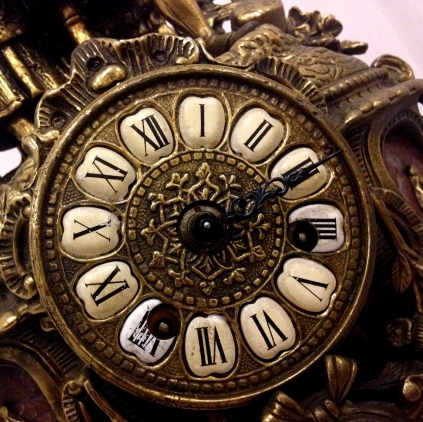 Photo credit: diannehope from morguefile.com
My critique group always argues about how you should write time. 5 o'clock or 5:00 pm? And do you have to write out numbers, as in five thousand, or can you go with 5,000 (in fiction?)
Yours truly,
Counting on you
Dear Counting,
Unfortunately, there isn't one hard and fast rule for this. These sorts of decisions are what industry pros call "style." Every publisher has its own style guide dictating its preference for ha...
Photo credit: diannehope from morguefile.comMy critique group always argues about how you should write time. 5 o'clock or 5:00 pm? And do you have to write out numbers, as in five thousand, or can you go with 5,000 (in fiction?)
Yours truly,
Counting on you
Dear Counting,
Unfortunately, there isn't one hard and fast rule for this. These sorts of decisions are what industry pros call "style." Every publisher has its own style guide dictating its preference for ha...


November 4, 2015
The End: reflections on wrapping a draft
Monday night I wrote the words "The End" on a manuscript I have been working on steadily for roughly three years. I should be ecstatic, right?
 Photo credit: deegolden from morguefile.com Instead I'm scratching my head about why it took me so freaking long when other people can draft an entire book in a matter of weeks.
My process is such, however, that my "first draft" is more like a NaNo participant's fourth draft. It's not a mess or full of holes. Though I'm an organic (ak...
Photo credit: deegolden from morguefile.com Instead I'm scratching my head about why it took me so freaking long when other people can draft an entire book in a matter of weeks.My process is such, however, that my "first draft" is more like a NaNo participant's fourth draft. It's not a mess or full of holes. Though I'm an organic (ak...
October 28, 2015
Thanks, Will: idioms from Shakespeare you're probably misspelling
 image by http://wallpaper222.com/William Shakespeare is considered a key transforming force in the English language. There are hundreds of words and phrases, particularly colorful idioms, he is believed to have coined. While scholars may squabble over which terms he invented and which ones were simply the slang of his day that he recorded for the first time, there's no doubt that his plays have hugely influenced our language.
Ask a teen to read Shakespeare, and they'll say his work is ful...
October 21, 2015
The good of bad reviews: writing tips from the meanies
 Photo credit: JulesInKY from morguefile.comI have a somewhat embarrassing habit when it comes to using Goodreads. I really love to read negative reviews of books that are extremely popular. At first I focused on classics, because their haters are quite hilarious. Then I began branching out to books others raved about that just didn't do it for me. It was gratifying to hear others describe problem after problem.
It's also a bit small minded to be wasting time hunting for another...
October 7, 2015
The stirring conclusion: how do you wrap up a story with drama?
 Denouement can involve untangling and weaving
(photo by DodgertonSkillhause from morguefile.com)
I'm in currently in the midst of drafting the final chapter of my WIP, that this, the denouement section. I have the scenes roughed out, but my concern is how to handle weaving the threads without the chapter feeling like a series of info. dumps.
I realize that by nature, denouements have an info-dump-ish quality built in. Here are some of the ways the term is defined:
Oxford dictionari...
September 30, 2015
Beware the myth of Easy Street
The other day, a well-meaning writer on Twitter tweeted, "I've found that if the story isn't easy to write, it's because you're telling the wrong one."
Once in a while, that might be true--some stories do practically write themselves in a blaze of white-hot inspiration. But most writers I know don't have that experience every time, only once a career, or sadly, on and off as they get in the grips of a bipolar mania.
 Image source: www.metrolic.comI think the myth that easy = right is a creativel...
Once in a while, that might be true--some stories do practically write themselves in a blaze of white-hot inspiration. But most writers I know don't have that experience every time, only once a career, or sadly, on and off as they get in the grips of a bipolar mania.
 Image source: www.metrolic.comI think the myth that easy = right is a creativel...
September 23, 2015
A picture is worth a thousand words: visual prompts
I'm a verbal/auditory thinker. My stories usually begin with a character talking to me. I actually get pretty confused by assembly instructions from Ikea that are nothing but images. I NEED words to understand the world. So it was a real eye-opener when my last post, with seasonal writing prompts, garnered this comment: "I find I 'freeze' when given a written prompt. But visual prompts...get me writing."
She's not alone there. J.K. Rowling's Harry Potter series was born from a single image: "a...
September 16, 2015
Kindling for the bonfire: Autumn writing prompts
 Photo credit: ali110 from morguefile.comIn this post, I discussed using warm-ups as a means to break through your initial reluctance to start a writing session.
Sometimes seasonal prompts can be helpful in your routine, to get you paying attention to your immediate environment and the sensory experiences you can collect. It can also get you thinking about story potential in everyday events. Consider how to spin theses prompts for different genres or milieus. "My earliest school...
September 9, 2015
Five tips for diversifying your cast
 Photo credit: Prawny from morguefile.com Last year, a handful of authors began an initiative called "We Need Diverse Books" to raise awareness about the lack diversity in traditionally published children's books. Librarians and educators have joined them. In their mission statement, they clarify what they mean by diverse:
We recognize all diverse experiences, including (but not limited to) LGBTQIA, people of color, gender diversity, people with disabilities*, and ethn...
September 2, 2015
With me or against me? Using dual and duel
For today's phonics fun, I'm going to tackle the semi-homophone pair, dual and duel. Most pronounce the words similarly, though one of the pair might have two syllables (dewl; DEW-ul). There may be significant variation here depending on your dialect. The two are most often confused in written contexts, because they sound nearly alike and are spelled nearly alike.
Their meanings, however, are nearly antonyms. Nearly because they aren't the same part of speech. The A version is an adjective, th...
Their meanings, however, are nearly antonyms. Nearly because they aren't the same part of speech. The A version is an adjective, th...