
Sarah Jamila Stevenson's Blog: Blog - Sarah Jamila Stevenson, page 43
April 23, 2015
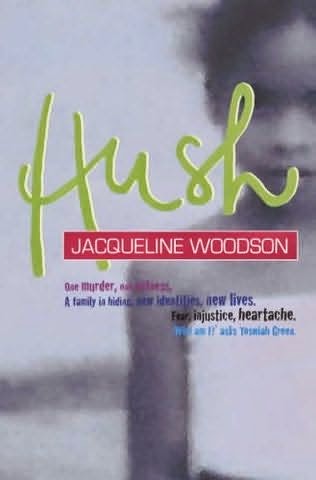
IN TANDEM: HUSH, by JACQUELINE WOODSON

Welcome to another edition of In Tandem, the read-and-review blog series where both A.F. and I give our on-the-spot commentary as we read and team blog a book together. (You can feel free to guess which of us is the yellow owl and which of us is the purple owl...we're not telling!)
Whenever book awards are announced, we're intrigued -- and sometimes bewildered. There are SO many books published every year, it's hard to keep up with them based on buzz and word of mouth. Oftentimes many of the weighty "worthies" which are awarded are virtual unknowns to us -- but not this time. When this year's National Book Awards were announced, we cheered again for Jacqueline Woodson, one of the winningest authors we know. We're familiar with Jacqueline Woodson's work, much of which can be characterized with the words "quiet," and "intelligent" and "revealing." Despite the hype about other writers inventing realistic fiction, anyone who reads a Woodson book knows that's simply not true - and hasn't been for her entire career. Because much of what we'd read of Woodson's was a.) middle grade, and b.) picture books and c.) a long while back, we hadn't blogged more than one of her books here. We decided to read and tandem-blog a Woodson book - one we knew nothing about, one that hadn't won any particular awards - and randomly chose HUSH. As we explored this short, poignant book, we found it wasn't nearly as straightforward as it appeared. While we've done our best to outright avoid spoilers, some of the plot is revealed in a general fashion, so reader be advised. Without any other caveats, we invite you to join us as we discuss this book, which we discovered was a National Book Award finalist (Ms. Woodson seems to be inescapably award-winning - that's what we get for just going by sticker/lack of sticker on a cover). We're...
Two writers,
& Two readers,
With one book.In Tandem.
Evie Thomas is not who she used to be. Once she had a best friend, a happy home and a loving grandmother living nearby. Once her name was Toswiah.We read library copies of this book in the treehouse. You can find HUSH by Jacqueline Woodson at an online e-tailer, or at a real life, independent bookstore near you.
Now, everything is different. Her family has been forced to move to a new place and change their identities. But that's not all that has changed. Her once lively father has become depressed and quiet. Her mother leaves teaching behind and clings to a new-found religion. Her only sister is making secret plans to leave.
And Evie, struggling to find her way in a new city where kids aren't friendly and the terrain is as unfamiliar as her name, wonders who she is.
Jacqueline Woodson weaves a fascinating portrait of a thoughtful young girl's coming of age in a world turned upside down.
 tanita: So, this book... surprised me. I tried really hard to avoid reading the jacket copy or knowing much of anything that it was about, aside from the single-sentence WorldCat description. And then, I was reading along and the phrase "the blue wall of silence" just sort of popped out at me. And, I was like, "Hmmmmmmmmm."
I wanted to read HUSH because of the microtrend identified at STACKED awhile ago, as Kelly Jensen blogged about the sudden splash YA witness protection novels were making. I didn't know anything about witness protection or why the people in HUSH were even in protective arrangements ... and the reason now makes me wonder about the people - the families of the people - involved in the recent police violence and filmings of police brutality and misconduct, and in the ensuing court cases... where are they now? Is this their lives now? I love it when a book just pulls me right into the moment and slaps me upside the head. I love when it takes me off-center from what would normally be my focus. What's ironic/weird/funnynotfunny is that this book was written in 2002. We've either entered a serious time warp or society is going backwards. Either way....
aquafortis
: I've read the first chapter and I am already in love with the author's sense of the musicality of language, and how quickly she draws these characters, this family, for us. I'm kind of in awe.
It's also very interesting that a book which might traditionally be framed as a suspense story and go straight to the danger and whatnot, really isn't about that, at least so far. What we're getting instead is a story of what's been lost, of coping and grieving, of having to give up who you are just when you're starting to figure it out. I remember reading, ages ago, a Lois Duncan book about a family in witness protection, and I think that's the type of story I tend to associate with witness protection as a theme: suspense, somebody's-after-you-- Don't Look Behind You was the name of the book. Rarely, it seems, are the PEOPLE and their feelings and their upended lives the focus.

tanita
: Oh, I agree -- I love Jacqueline Woodson's writing style - how her "quiet" books nevertheless have a massive, ringing impact on the reader. Woodson keeps our focus tightly honed in on the characters - how she structures the novel really works toward that. Opening the story in the "before," with all that Toswiah had and what she lost feels like the right decision because it helps articulate the now so much better, and the heartbreak she experienced.
Right there, that evening with Inspector Albert Oliver standing on our porch, biting on his cuticle, is the point where I'd pause. Then I'd press stop and my father would still be a cop in Denver, his uniform pressed, his shoes shined, his face calm and smiling. HUSH, by Jacqueline Woodson, p. 50
aquafortis
: YES--that moment right there was so poignant and sad. This book is packed with images like that, almost like static photos of Toswiah/Evie's life before; still frames that she can never have back.
tanita
: Yes - I like that use of imagery. So, the theme is identity - loss - loss of identity, and there's this sense of desolation -- not a lot of whining, but desolation brought to life in just a few word pictures. Continuing through this story, I'm drawn as well to the characterization. The language is still somehow spare, even with all if evokes.
aquafortis
: I agree--it's impressive how the author has such a spare use of language and yet packs so much in. It's not at all surprising that she's written books-in-verse. There's the constant sense that the words are conveying so much more than they're saying on the surface, as with poetry.
tanita
: Interesting that you mention poetry - Woodson is a poet, and I think that actually informs a lot of her prose writing style. It gives each word she chooses that certain heft and polish that poets seem to use.
"Afraid" is this hollowed-out place that sometimes feels bigger than I am. Most days my fear is as long as my shadow, as big as my family's closet of skeletons." p. 77
Along with the evocative and beautiful language, the narrative really resonates with me on a personal level because I find myself, day after day, nostalgic for a time when I waved at the police from the backseat of our station wagon, a time when I trusted the police, when I proudly wore the little silver star my adopted uncle left me with his badge number etched on it, and the words "police niece." Toswiah -- Evie -- is not only grieving for the name she's lost, she's grieving for lost innocence. That's huge, and to lose innocence and identity so early in life is devastating... because innocence, once lost, is not recaptured, and our identities are always a shifting thing anyway - we chase after who we are for so much of our lives, once we become adolescents anyway that this seems like loss piled upon loss. Even if she recovers herself, to my mind, Evie will always have a cynical part of herself, and that's really painful -- and really true -- of our society in many ways right now.
aquafortis
: It is cynical, and true, and so, so sad. Stories like this, and like the ones we are seeing reported so often in the news recently (as opposed to before, when they would happen and go unrecorded and uncontested) make me want to cry because it's not the type of world I want to live in or want young people to grow up in, and yet it IS, and the stories must be told if we ever want to change anything. Evie is a perfect narrator for this story because she epitomizes the lost innocence of the observer, caught up in events beyond her control.
tanita
: Having finished with this novel, I know why it was shelved and marketed to YA readers, but at twelve, then thirteen, then fourteen, Evie is definitely a young adult, with all of the growing and changing that implies. I think this novel would appeal so very much to thirteen- to-fifteen-year-olds, just experiencing those shifts, wherein life kind of transitions from one piece to the next -- because this novel would help them maybe understand and articulate the things that are going on inside, from being able to have such an articulate character go through some of the same thing.

aquafortis: Right, and one of the most powerful themes that comes in here with her coming of age is the idea of names, and their power, and the power we have to name ourselves and in doing so, not only invent ourselves but fix our sense of self in place. One of the most touching moments of this story for me was when Evie's track teammates decide to start calling her Spider, and she settles into it, into an identity, for the first time in a very long time. Names are such a fundamental part of how we connect with others; and one of the many ways in which their family was uprooted, besides physically, was psychically--they couldn't be themselves, NAME themselves, even to one another.
The bullet holes were like small black caves against the white kitchen wall. I stared at them without blinking. I was not afraid. Some part of us that had been the same way forever was gone. The holes in the walls proved it... p. 54
tanita
: You mentioned that danger wasn't what the book focused on -- but in a way, in many ways, it's what's underneath, as we see later in the story.
This is a short novel -only 180 pages in hardback - and so it's taken me a very short time to read it, yet it's taken a much longer time to take it in emotionally. This is... a kind of huge book. It's about identity and race and the limits of friendship and family -- all terribly personal and painful, yet beautiful. It brings you in, with the language, but I kept flinching away from and circling back to the... reality.
aquafortis
: Yes, I've been reading it in slow sips, because I need the time in between to let the story sink in and...sort of expand inside my mind. Like the TARDIS, it's bigger on the inside. There is so much here.
tanita
: Final thought: Two things stand out to me - one, that adults can have these losses of self, too, which can actually be pretty vital information to teens, since it's easy to get caught up in your own drama and forget that everyone is fighting a battle. Both of Evie's parents fall short, in their own ways. Two, the truth of that lovely quote from A Farewell to Arms - "The world breaks everyone and afterward many are strong in the broken places." I can see this so appealing to teens finding out about those first breaks - and giving them a peculiar kind of comfort, that everyone fractures, and that those fractures heal. I look at Evie - and Anna - and I know, I just know, that to be true. And more than that, it reminds me that this can be true of all of us, too.
aquafortis: Yes. It CAN be true of all of is, and it so often is, whether we're young or adult. Having that hope that our wounds will heal, even if we aren't the same afterward--is so important. We all need to remind ourselves that the fact of not being the same, the fact of growth and change and metamorphosis, doesn't mean that we are negating ourselves in the process.
Thanks again for reading another of our Tandem Reviews! There will be more...
This work is copyrighted material. All opinions are those of the writer, unless otherwise indicated. All book reviews are UNSOLICITED, and no money has exchanged hands, unless otherwise indicated. Please contact the weblog owner for further details.


April 20, 2015
Themed Cybils Reading Lists!
Read-Aloud Non-Fiction
Robot Stories for Elementary Readers
Read Aloud Fiction Picture Books
Kid-Friendly Biographies
Fun and Funny Fantasy Read Alouds for the Whole Family
Ten Cybils Poetry Books
Young Adult High Fantasy
Readable Nonfiction
This is the Cybils Awards crew's latest addition to their wonderful and growing collection of children's and young adult book resources. The books aren't limited to this year's contest, so you'll find a wide range of titles from the contest's inception in 2006 through the 2014 awards. I was happy to see that I'd read ALL the YA High Fantasy books on the list, EXCEPT ONE! :) One book that will now immediately go on my Want-To-Read list...
This work is copyrighted material. All opinions are those of the writer, unless otherwise indicated. All book reviews are UNSOLICITED, and no money has exchanged hands, unless otherwise indicated. Please contact the weblog owner for further details.
April 16, 2015
Bits, Bobs, and Blurbs
The upshot is, I'm trying to craft something that's enticing, that is specific to the story at hand rather than generic. I also keep reminding myself that I'm not writing a review...which is what I'm more used to doing...
In the process of my neurotic googling over the past few days, I also ran across this article in the New York Times on self-doubt and its pernicious ability to cripple writerly creativity. We writers have a unique relationship to our inner critics--as the article's author points out, "the problem with my inner critic is that it’s inseparable from my outer critic, which is the means by which I earn a fair proportion of what for rhetorical purposes I will call 'my living.'" We are forever faced with the dilemma of having to compartmentalize our capacity for self-criticism, harness it for productive purposes when it's expedient and necessary, and ignoring it when we need to. I'm still struggling with that dilemma, myself, but it is reassuring, sort of, to remind myself it's all a part of the writer's process.
National Poetry Month continues with the Poetically Speaking series over on Miss Print--today's post features fellow YA author Justina Chen interviewing poets Janet S. Wong and Sylvia Vardell about their poetry anthologies. Go forth and be poetic!
This work is copyrighted material. All opinions are those of the writer, unless otherwise indicated. All book reviews are UNSOLICITED, and no money has exchanged hands, unless otherwise indicated. Please contact the weblog owner for further details.
April 13, 2015
Poetry Month Roundup: Novels in Verse
 Roz Chast's Poetry Month poster - request it here!I like to do the occasional link roundup, and since it's National Poetry Month, I thought it would be fun to revisit our past reviews of novels in verse. It's not a genre we tend to focus on--I'll freely admit that I don't gravitate toward novels in verse, so most of the reviews that we've posted in that genre are Tanita's. Of course, plenty of readers do not only gravitate toward, but even prefer, novels in verse. YA authors such as Ellen Hopkins and Sonya Sones are veterans of the genre, of course, and greatly popular among young adult and grown adult readers alike. I'm not even able to address all of the wonderful authors of verse books for tween readers and younger, from Naomi Shihab Nye to the Kidlitosphere's own Kelly Fineman and Laura Salas.
 In any case, I rounded up what we do have in terms of reviews of novels in verse or heavily featuring verse in the storytelling:
Hesse, Karen: Witness
Koertge, Ron: Coaltown Jesus and Shakespeare Bats Cleanup
Koyczan, Shane: To This Day
McCormick, Patricia: Sold
Sandell, Lisa: The Weight of the Sky
Venkatraman, Padma: A Time to Dance
Wein, Elizabeth: Rose Under Fire
This was a useful exercise for me because I really need to make more of an effort to read the occasional novel in verse. I know there are fantastic ones out there, and when I do read them I generally enjoy them, but for some reason I'm often reluctant to pick them up in the first place. I guess I usually prefer stand-alone poems. Ah, well, it is what it is...
This work is copyrighted material. All opinions are those of the writer, unless otherwise indicated. All book reviews are UNSOLICITED, and no money has exchanged hands, unless otherwise indicated. Please contact the weblog owner for further details.
April 9, 2015
In Tandem: PINNED, by Sharon G. Flake
Happy Thursday and welcome back to In Tandem, the read-and-review blog series where both Tanita and I give our opinions, back and forth, conversation-like. Come join our book talk! Today we're discussing
Pinned
, by Sharon G. Flake. Pinned is a great fit for us here in Wonderland, with its two complex and indomitable main characters, both of whom expand and redefine the boundaries of ability and disability. It's also a book featuring characters of color who defy stereotypes in all kinds of ways--Autumn is strong, sure, and the only girl on her school's wrestling team, while Adonis is in a wheelchair, yes, but also prides himself (and I mean PRIDE) on being the smartest guy in the room. And being Mr. Brainy means he does NOT have time for underachieving jocks like Autumn--even if she has a crush on him the size of Mt. Everest. We found a lot to talk about with this one, needless to say.
Two writers,
& Two readers,
With one book.
In Tandem.
 Tanita S. Davis (TSD): The first thing I noticed about this book is that it's not written entirely in SAE, and I know how much "nonstandard" English bugged people in grad school - we talked a lot about patois and all of that. It has nothing to do with the storyline, on the one hand - but on the other hand, it's indicative of who Autumn is, so I think it's a great choice. Readers might have to work to find her state of mind within her tersely truncated speech, I think writers need to write the voices they hear - because it makes the story. Sure, they will get pushback from editors -- because editors edit, and they even will edit BAE, which can be touchy, since it's only somewhat standardized within itself -- but I think that EVERYONE needs that realism in voice. It can make the difference between a good story and a great one, and allow the writer to get the correct distance from the narrative.
 Sarah J. Stevenson (SJS): I really think the voice strikes a good balance, where it's easy to read AND to hear, and uses nonstandard English but not to an extreme. (I was just reading a different book in which a character had just WAY too many street-urchin apostrophes for my liking...) I think it IS possible to strike that balance. And I also think it's really important to portray characters like Autumn, for whom school is not easy because reading itself is not easy. It happens so often, I suspect it underlies a lot of academic issues for a lot of people, but it's kind of like a "hidden epidemic" because many just muddle through. I like and appreciate that her parents are taking a certain level of responsibility not only for her difficulties but also for helping her through them.
TSD: I really appreciate that there's talk with and about Autumn's parents in this book. Educational deficits are often generational... and how many of the teens reading this would know that? I can imagine some of them having an "Ohhhhhhhhh..." moment reading that her parents struggled too -- and the biggest drawback from not having that high school diploma is new jobs and moving and new jobs and moving and tearing down and building up over and over, never with enough time to really get anywhere or anything. This novel has that bit of realism that really expands the mind... Certainly if I were a rigid and perfect ...twerp like Adonis, it would enlighten me.
My man Adonis doesn't ask enough questions, methinks.
 The no-holds-barred back cover
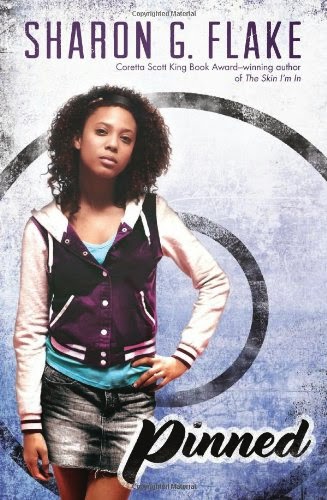
on Tanita's copy.I LOVED when he said, "I'm disabled, I'm not weak." Big cheer, here. I love the cover of this book so much - even though I feel like they got his chair wrong, because that looks like the type of chair in which someone pushes you not in which you push yourself. There's a difference, and Mr. Adonis wouldn't be relying on anyone but himself, thank you muchly.
SJS: Agreed--although I have a different cover (it just has a girl on it, in front of a background with two concentric circles that suggest a wrestling ring and kind of also wheelchair wheels, but otherwise no reference to Mr. Adonis. Boo.). But then--I think to myself, who names their kid Adonis Einstein and doesn't think it's going to give him some kind of complex? So in certain ways it doesn't surprise me that he not only isn't weak, he won't even admit weakness in any way. Even connecting with others on a human level, for him, is out of bounds.
 This was the back cover on my copy.TSD: The double rings I liked a lot - we have a constant visual reminder of a wrestling ring -- Autumn's home away from home. More subtly, we also have a quiet reminder that this entire book is about wrestling with things - there's not just ONE level of "hard" here. It's hard all over.
 SJS: Meanwhile, Autumn is someone who wears her heart on her sleeve and can't help but try to connect, because it's inconceivable not to. She TRIES, lord how she tries, except, like Adonis, she has this one critical problem: Why would I put an effort into something I'm not good at? They are both hard on themselves; in different ways, with very different manifestations, but neither one can truly accept failure. Adonis, in particular, has trapped himself before others can do the same to him. Problem is, Adonis won't even recognize the possibility he might ever fail, and Autumn gives her failures too MUCH power over her.
TSD: Oh, AUTUMN is KILLING ME. I've crushed on a boy who doesn't like me before, but this girl is, like, teflon-coated and a super-hero. SHe never lets him get her. He hurts her, she's momentarily wounded, and then she bounces back up. Words don't ever not hurt -- but if you don't understand them as well as you could, I think that can help insulate you... ALthough Adonis' attitude is clear enough -- ugh. Snobby punk.
SJS: TOTAL agreement on that so far. Adonis. Puh-lease. Total punk. Autumn is definitely a superhero here. How much punishment can one girl take? It's his contempt that really infuriates me, and yet that also makes him very human and very much a teenage boy of a particular type.
TSD: I keep wanting her to give up!!!! I ask myself, "is her persistence... normal?" But, then I can imagine JUST this kind of girl; I had a girl who wanted to be friends with me in high school kind of friend-stalk me like that. She was just... so... enthused. And I was just as much of a punk as Adonis, almost. At least I had such nasty thoughts, I hope I wasn't that rude, but... meh. There was a lot of not answering so I couldn't be called on my attitude. But, honestly, she kind of scared me. She looked up to me and thought I was AWESOME! with exclamation points and sprinkles. I just... wanted her to ... tone it down. To ignoring me.
Hm.
Annoying that I have more in common with Mr... twerp... than I thought.
SJS: I think a lot of us have been in the situation of not-quite reciprocating the enthusiasm of someone else, whether it's a friendship or a crush. That's going to be familiar for plenty of readers; I know I've been there (and quite possibly I've also been the person on the opposite end doing the annoying, as well).
TSD: I find their observations and interactions with their teachers fairly telling, too. Mr. E, always on a diet makes me a bit sad -- I hope none of my students knew that about me, but I'm pretty sure they picked up on that. Adonis saying that "so what if he's fat, he's smart and nice," is HUGE. I like that Adonis accepts himself, he is very - well, except for being a full on punk at times - he's very well-rounded.
 Photo courtesy of the author's websiteSJS: And yet, and yet--he is socially very lacking because he hasn't allowed himself to reach out, and doesn't even acknowledge that it scares him to do so, and that's what is blocking him when it comes to Autumn. Autumn, meanwhile, doesn't give up, and that is her core personality trait that will allow her to survive and even thrive. The fact that her teachers support her and want her to succeed--really everyone around her wants her to succeed--makes me glad, too, and makes it clear that sometimes we are our own greatest obstacle.
 TSD: Ah, yes. Everyone in this book is their own worst enemy - which seems to be the natural state of human beings. *sigh*
So, Autumn as a wrestler - wow. I wanted to spend more time in that place, in her head. She doesn't seem to think anything of being a wrestler. That's not a huge "I'm out of my gender role" thing for her - it seems to be for others, but not so much her. (How much do I love that she BAKES!!) She's full of being ...herself. No dichotomies there, just being ... Autumn. I wish the model on the cover would have reflected her body type more - not that she had to be huge, but wrestler girls look like they can take you down a bit! I love how the work it takes to be a wrestler is applied to other things...
SJS: Yes, I find myself really caring about Autumn and what happens to her--I don't want her to fail, and she is so enthusiastic and kindhearted so good at so many other things that I don't want this particular set of failures to set her back, to hold her down in that bad place where so many students go who are lost in the cracks. She is STRONG, and she is proud of her strength, and I want to see her claim that again and realize that the same things that make her a good person and a good wrestler and baker can be harnessed to help her in other ways.
As we see over the course of the book, both characters learn in critical ways to accept and be who they are, finding that inner core that means you can let go of the damaging notions about yourself that you thought were true and yet still be YOU. Getting yourself out of a rut doesn't mean you're fundamentally changing who you are. For Autumn, she realizes that her real strength is something she's had all along, and for Adonis--well, HE learns that resilience can be stronger than rigidity. In many ways this is a "quiet" story, in that there aren't any drastic melodramatic events that suddenly change the course of life forever. But that makes it a very REAL story.
TSD: I looked at the cover, and couldn't tell what kind of story it would be, going in. I like a lot that Adonis isn't always... er, praiseworthy. I was with my sister last week in Mendocino; she's in a wheelchair. And the number of people who spoke to us and smiled at us and gave her a lot of positive strokes - they had her grinding her teeth. People expect the physically-impaired to be founts of sweetness and kindness and somehow inspirational. My sister wanted to push everyone into the ocean for not just letting her be a girl with her sister, just hanging out... she doesn't like the attention, and for her sake, neither do I. Adonis was a jerk. Just like "regulars," as he calls them, are allowed to be. I like a lot that Sharon Flake didn't try to write Adonis into being any less of a stuck-up, weaselly terrified snob than he is - he's just a guy, wrestling his fears down, like everyone else.
Also? I wasn't sure at first, but the longer I thought about it, I'm glad Autumn got at least one thing she wanted. She couldn't explain to anyone's satisfaction why she wanted it? But... yeah. That was satisfying. There are definitely loose ends - no insta-friendship and just-add-water forgiveness spectacles - time may or may not heal all things, especially with no effort behind it. But those things worth wrestling for? Are achieved. I like this book. I'd give it to a quiet tween or a louder one - because there are two equally relatable characters within.
We both went Full Library on this one, but you can also find PINNED by Sharon G. Flake at an online e-tailer, or at a real life, independent bookstore near you!
This work is copyrighted material. All opinions are those of the writer, unless otherwise indicated. All book reviews are UNSOLICITED, and no money has exchanged hands, unless otherwise indicated. Please contact the weblog owner for further details.
April 2, 2015
Happy Poetry Month!
 The series is called Poetically Speaking, and my post is scheduled for next Tuesday, April 7th. I wrote about my experiences as a member of our poetry center, helping to get it started as an organization, and slowly getting more involved with poetry in the community--including giving a poetry workshop to some middle school girls last month. (If you want to find out what the CHUPACABRA has to do with poetry, you'll have to read my post and find out...)
For an introduction to the series, and the full schedule, go check out this roundup on Miss Print, and don't miss the daily update! Today, Terra McVoy talks about one of my longtime favorite poets, Emily Dickinson:
"...for me, Emily’s life was a testament to the truth: that it’s the work that matters, and nothing else. Being a serious writer who is taken seriously means dedicating your life to shaping your writing into its highest, purest, most powerfully beautiful form, and all else is distraction."More here.
This work is copyrighted material. All opinions are those of the writer, unless otherwise indicated. All book reviews are UNSOLICITED, and no money has exchanged hands, unless otherwise indicated. Please contact the weblog owner for further details.
March 26, 2015
Thursday Review: THE WALLS AROUND US by Nova Ren Suma
 Summary
: Happy book birthday—two days ago—to Nova Ren Suma's latest YA offering, The Walls Around Us! This title shares a lot with Imaginary Girls, most noticeably the atmosphere of strangeness and the slow unfolding of past and present events; the unreliable narrators and their limited viewpoints which only let slip a little at a time of what really happened.
Summary
: Happy book birthday—two days ago—to Nova Ren Suma's latest YA offering, The Walls Around Us! This title shares a lot with Imaginary Girls, most noticeably the atmosphere of strangeness and the slow unfolding of past and present events; the unreliable narrators and their limited viewpoints which only let slip a little at a time of what really happened. Our two narrators here are Violet and Amber. Violet is a talented dancer who shines onstage, but whose heart hides the pain of her best friend Orianna's imprisonment for a horrifying crime. Amber, locked in a girls' detention center, lives and relives day after monotonous day behind those walls, until someone new arrives and a shocking occurrence changes everything.
Peaks : One of the most wonderfully page-turning aspects of this book is the author's ability to slowly release tantalizing details, from each narrator's viewpoint, that subtly weave together in the reader's mind as the story progresses, until we gradually realize this tale has already been set in stone, the ending inevitable. This also means I can't say much without spoilers, but I will say that there is so much to this book—it's so deceptively simple on the surface but hides a myriad of delicate layers. The writing is literary and yet not self-conscious, focusing us on the characters and the mystery unfolding both inside and outside their minds.
Forming a backdrop to the mystery is the sort of train-wreck-fascinating world of ballet and the single-minded competitiveness and even viciousness that seems to pervade that environment, as well as the class implications of who each character is—Violet, who comes from wealth, but it's her cutthroat determination and hard work sending her to Juilliard; Orianna, mixed race (though that's not an Issue in the book), quirky and kind, decidedly not rich but devastatingly talented. And Amber, a bit of a cipher, trapped behind walls that are not simply physical.
Valleys : This one isn't a traditionally structured suspense novel. If you're looking for the kind of mystery that offers consistent action and a clear sense of what's going on at all times, this may not be the book for you. The Walls Around Us is far more mysterious, circling the truth and coming closer and closer each time, rather than progressing in a straight line toward the big reveal. I wouldn't call that a negative thing at all, just something that may attract a different set of readers.
Conclusion : This book is hard to talk about, elusive, difficult to pin down without telling too much. You'll just have to read it. The writing is luminous, and the genre not easily categorized, though you could call it magical realism. If you've enjoyed Nova Ren Suma's other YA books, you'll have an idea of what to expect. Readers who like a distinctive voice and an intense, literary style—I keep thinking of A.S. King, or Beth Kephart—would probably enjoy this one.
I received my copy of this book courtesy of the publisher. You can find THE WALLS AROUND US by Nova Ren Suma at an online e-tailer, or at a real life, independent bookstore near you!
This work is copyrighted material. All opinions are those of the writer, unless otherwise indicated. All book reviews are UNSOLICITED, and no money has exchanged hands, unless otherwise indicated. Please contact the weblog owner for further details.
March 23, 2015
In Tandem: BLACK DOVE, WHITE RAVEN, by ELIZABETH WEIN
Welcome to another edition of In Tandem, the read-and-review blog series where both A.F. and I give our two cents at the same time. (You can feel free to guess which of us is the yellow owl and which of us is the purple owl...we're not telling!) We're discussing the latest book from Elizabeth Wein today, the well-regarded NY Times bestselling YA fiction author, and, in the interest of disclosure, a personal friend. Told, as it is, in a series of essays, a letter, and flight logs, the novel is a pastiche of places and histories. Our discussion, to reflect this, will be more thematic than linear summary, so be warned. We also won't go into more detail than the jacket copy supplies, so you can read without fear of spoilers, if you worry about that kind of thing. This imagination-capturing story is an unforgettable work of historical fiction dealing with airplanes, Ethiopia, and love of country. It's billed as a historical thriller, a novel put together with a series of other documents - pieces of essays, a letter - detailing lives and purpose - and a need to go home. Join us. We're...
Two writers,
& Two readers,
With one book.
In Tandem.
A new historical thriller masterpiece from New York Times bestselling and award-winning author Elizabeth Wein

Emilia and Teo's lives changed in a fiery, terrifying instant when a bird strike brought down the plane their stunt pilot mothers were flying. Teo's mother died immediately, but Em's survived, determined to raise Teo according to his late mother's wishes - in a place where he won't be discriminated against because of the color of his skin. But in 1930s America, a white woman raising a black adoptive son alongside a white daughter is too often seen as a threat.
Seeking a home where her children won't be held back by ethnicity or gender, Rhoda brings Em and Teo to Ethiopia, and all three fall in love with the beautiful, peaceful country. But that peace is shattered by the threat of war with Italy, and teenage Em and Teo are drawn into the conflict. Will their devotion to their country, its culture and people, and each other be their downfall or their salvation?
We received copies of this book courtesy of the publisher, via NetGalley. After March 31st, you can find BLACK DOVE, WHITE RAVEN by Elizabeth Wein at an online e-tailer, or at a real life, independent bookstore near you.
LANDS, PEOPLE, PLACES & EMPIRE
ts davis ~ As always, I appreciate a good Elizabeth Wein book, and this one is no exception. This is a biiiig book. A big book. Not so much in terms of ... size dimensions, although I guess it's three hundred and sixty-eight pages, which is about a little longer than average, but it's a big book because it contains... multitudes. It's about love. It's about loss. And it's about ...history. The history of an old, old world that Westerners, really, but mostly Americans - know not that much about. Africa has been misidentified too many times as a single culture, a single story; a country and not a continent. And now here's this piece of a piece of a place, broken down to give us a little bite -- and it's just not enough. Though I'm not usually a fan of "reader directions," per se, like glossaries and forewords and the like, I love the afterword by the author, because she gives us a little more history and places the story within context - but lets us know how much more there is to know. I realize that everything I want to know about Ethiopia will never be enough. This is a novel which makes me want to both think, and travel. Maybe even time travel.
...many don't know the history of Marcus Garvey and Liberia and African Americans in the early part of the 20th century leaving the United States, and longing for a place where no one would mess with them. As an African American now, I have a different perspective - and no real connection to any nation in Africa, as it's not an empty continent onto which we can impress our stories - it has its own stories, and yes my ancestors were taken from there hundreds of years ago, but stories move on. Their story is no longer my own, and the people who were kind of "deported" to Liberia eventually figured that out... Anyway, I was intrigued by the whole concept - of what Americans would have had a connection with Ethiopia, and how they would have seen it.
sj stevenson ~ The whole idea of Empire as not "constructive" (constructing a vast landscape) but destructive (of what it already there) is something that we are given a vivid glimpse into in this story. Both kids, having grown up pretty much American in some critical ways, are our eyes, through which we see the problematic early-20th-century history of a place in which many nations were still clinging to the last vestiges of the old-style empires. And Ethiopia too was clinging to their own past, their own great empire and history. It never ceases to awe me that they were the last country to retain its independence against outside empirical powers. Really, there is a lot in this book to be inspired by: the accomplishments of women and African American pilots, just for a start. The movement between worlds, opened up and made possible by air travel.
 Bessie Coleman; Photo: Smithsonian Institutionts davis ~ Travel seems like it was so much easier back in the 20's and 30's - between the British and their Grand Tours and their "empiring" everything in sight, and the Americans "empiring" everything that was left (which wasn't much, granted), there were wealthy white people colonizing things all over the place. It was really nice in this story to see historical brown faces in the mix, too -- some I'd never heard about before, but then some I'd known about for years. I love so much that Bessie Coleman was included in the book as an inspiration for Em and Teo's mothers, who were at that time just pretty ladies sitting on the sidelines, to become barnstormers.
sj stevenson ~ Yes - I was fascinated by this unusual, adventuresome, determined family who are so dedicated to carving a space of their own, and how Ethiopia fit into that space (and they into IT). "I want to live in a place where people can do what they like, and it is ordinary." It is amazing to remember that this is still something many are struggling with--the right, the ability to simply live their lives and be who they are. And Africa as a setting is something that many people still see as an undifferentiated, monolithic place. We see the overarching (yet less important) similarities and know nothing about the vast differences between cultures. This book breaks down that monolith and introduces us to distinct landscapes, to concrete places we can feel (Beehive Hill!), to individual human beings and their stories.
MOTHERHOOD, MANHOOD, WOMANHOOD, PERSONHOOD
ts davis ~Em and Teo's mothers are striking - Delia, because she is game for anything, and makes it work, and Em's mother, because she appears, at first read, ...flighty. There's really no other word for her - at first read. She has that post-Great War, 1920-30's enthusiasm thing - everything's a bright, lovely game! Let me drink champagne out of your slipper! And stand on the wings of my plane - wheee! - It's like they were all making up for the Great War, and dancing as hard as they could, Gatsby style, and yet, despite her breathless narrative, there was something more to this woman - because she was raised Quaker and a believer in equality? I don't know. What would make her really befriend this Colored woman, Delia? And what would make Delia really trust her? So much in that relationship - in the barnstorming and the friendship - depended on so little - one tiny point of congruence: absolute trust.
I also loved that though Em & Teo's mothers - and the shadows they cast - were immensely impacting in their lives that they were still different - they didn't allow their mothers to overwhelm them, force them into identical roles, etc., though at times it was a near thing!
sj stevenson ~ I completely agree with your characterization of the two mothers. Their personality contrast is fascinating, and yes--making up for the Great War by almost WILLING themselves into a different world, some parts of which were real and other parts fantasy, perhaps. The two women have a fascinating story in and of themselves for sure. Something I didn't really HAVE to know--but which kept popping into my head time and again--was the nature of their relationship. They were "soul mates," yes--and I really loved the fact that Grandma characterizes a soul mate as something unique and qualitatively different, not necessarily your life partner or spouse (though they could be) but your best friend in the whole world, someone who understands you better than anybody else. Besides that, though--clearly the moms were best friends, they were partners in flight, they were a team. They are the kids' parents, and that trumps any other possible aspects of their relationship. The four of them are a family and that is the important part and nothing else matters. There was something profoundly simple about that which I loved.
ts davis ~ As with the friendship of Diana and Anne in ANNE OF GREEN GABLES, there are those people who feel that Elizabeth Wein's books have lesbian subtexts - that the relationship between the original Black Dove and White Raven is romantic, and maybe it is - but I have also often heard the author rail against the idea that there must be a romance in every single YA - that if you're not romantic, or if you're just not there yet or choose not to partake in relationships that there is no story for you. I think that these women could have had a romantic relationship, but I think they were truly and deeply soul mates, in truth, above all and before other considerations. And I find that I am intrigued by that, in many ways, because I don't know how to do that with girls... most of the female friendships in the Western world are not that trusting. I mean, we get the idea of "Mean Girls" shoved at us in the second and third grades. A misogynist society pits women against each other, as if men are some resource we're running out of -- so we don't know how to be this kind of friends.
Wouldn't it be amazing if we could learn?

With the exception of Teo and a few of the Ethiopian guys, in this novel, men - makers-of-rules, bringers-of-war, goers-back-on-deals - don't fare too well. Historically they were the makers of empire, the writers of history - but this time, they tried to write history on a place which had its own. Even the Emperor Selassie didn't fare well - his mistakes, in tolerating some things in the name of support in other areas is a political trade-off that happens all the time - this time with fairly disastrous results. And yet, Teo grows up to be a man -- a good man. Why? Because he was raised with his eyes open, observing men... and observing women.
I liked the roles in which this novel depicted women. They didn't always need or want husbands, that they didn't always have or show maternal caring. Some of them have children and love them traditionally, and others, differently. Despite the hard-and-fast roles for women in that time, this novel showed them crossing continents, and their love - for families, children, partners, friends - surviving, even in an age without electronics, where the only connection comes via airmail. This love doesn't have to be in the same room to be love. Love doesn't have to be on the same page, of the same color, of the same family. I think that, for some people, will be a discovery most profound. Some people will not see this mother as a loving mother - but she was, and she remained so... but she also loved herself. That's not something we see a lot of in fiction -- mothers, if they don't love the character as they want, are uniformly bad. This seems like it opens up so many possibilities. I'm liking the non-binary trend I am seeing in realistic and historical fiction -- that there is more than black and white, more than one story, areas of gray. This is, at last, truth.
METAPHOR, IDEOLOGY & MEANING
ts davis ~ "Doing the thing you are scared of is much harder than not being afraid of anything. It is easy to be brave. It is not so easy to be scared and do a brave thing anyway." Sometimes, breathless optimism wears you out. Sometimes it can feel like recklessness. Then, desperation. As I read this novel, I was both glad NOT to be a mother, and that no one was asking anything adventurous or protective of me, in a time of war.
 Emperor Haile Selassiesj stevenson ~ It was so painful to witness Teo being caught up in events in Ethiopia simply due to his parentage, something he had no control over. And yet, in the end, seeing him realize that if people had only ASKED him if he wanted to perform the task, rather than turning right away to their ownership of him, he would have done it freely--Wow.
ts davis ~ Who owns us - what we owe - these things are SO HARD. As an Ethiopian of African American descent, Teo wasn't a caricature of a black Southerner as is so often the case in YA historical fiction where we see black kids on a plantation or something -- he was depicted as a regular, 1930's kid, someone who wore his sweater backwards and wrote stories and read comic books and flew planes and went to school and had a mom who died -- and someone whose life was just as suddenly shot out of the air like a previously soaring bird. He was just... downed. Boom. All that potential, crumpled up and ricocheting off the edge of the garbage can. Doomed by history. And even in the calmest manner, the book doesn't shy away from this: "Are we important, or just valuable?"
Part of me - cynical, person-of-color me - was really mad at Em's mother and thought, You fools! You walked him right into this snare! And again, this idea is reflected by Em: "Everything is all your fault. You are our momma, and you are supposed to protect us."
I like the way the book talks about that ownership, though -- how it is something which just grows with you, like the cells with which you were born. That inevitability of Teo and Ethiopia meeting up in negative ways felt a lot like how inescapable everything has been, since last summer, about all the racial violence and tension just floating in the air... it owns you, in a way, even if you don't think you know or care about it... because it's written on your skin, it's a birth...debt, instead of a birthright. You, by virtue of your birth, are owned by this faceless THING and you can't escape it -- "The whole way out, White Raven worried about how they were going to get rid of Black Dove's invisible chains without hurting him any more." The metaphor in that story that Em and Teo wrote together is just kind of mind-blowing. Invisible chains. It's what shackled Teo at every turn. At every turn. That realization within the narrative was, for me, just huge.
STORY & STRUCTURE
sj stevenson ~ I wasn't entirely absorbed at first by the narrative format, but once the story got going, as always, the author is a master of using an epistolary storytelling method. And the "Theme for Miss Shore" provoked echoes for me of Langston Hughes' "Theme for English B" and its honest, self-exploratory, subtly provocative style.
ts davis ~ I love that Hughes piece, so much, and I think it's a brilliant little leap from that to this. If I could write essays like Em and Teo could when I was a teen, I would've been happy... It was a happy-sad thing for me how they wrote stories when they were completely overwhelmed and out of ...countenance with the world. When they needed to think. When they needed ... a bedtime story themselves, they wrote themselves one. Very poignant, and true-to-life as a coping/comfort mechanism.
sj stevenson ~There is some really awesome stuff in this book about the power and role of story, how we can turn to stories in times of trouble and they will strengthen us for the times when we need to put the book away and ACT. Em and Teo create their own stories, their own alter egos, and find strength in them. They are "maps to help you navigate." I love that.
ts davis ~ That larger theme is what makes this a crossover, to my mind - and that's one of the other things I like about the writing of Elizabeth Wein. It's not like she writes FOR teens, and tries to simplify things, or FOR adults, and tries to write... up, or what have you. She just writes, and tells her true. Honestly, this is not going to be an easy book to read for everyone. It's like paging through a scrapbook and finding an historical mystery, and putting the pieces together - an essay here, a flight log there, a little bit of backstory, a fragment of history -- and then you find this family. And they're real. And they're vital. And they -- change things; maybe even their own hearts and mine, maybe how we think of slavery and freedom and people of color, maybe nothing... but maybe everything. And this is a Wein book. She writes her truth, and I think her books always find their tribe.
As noted, we received copies of this book courtesy of the publisher, via NetGalley; all quotations from the book are from the uncorrected review copy and may not reflect the final version. Thanks for joining us on this journey. And if you've read the book, feel free to join in the conversation!
This work is copyrighted material. All opinions are those of the writer, unless otherwise indicated. All book reviews are UNSOLICITED, and no money has exchanged hands, unless otherwise indicated. Please contact the weblog owner for further details.
March 16, 2015
Cybils Finalist Review: THROUGH THE WOODS by Emily Carroll
 Summary
: Horror fans take note: if you're a fan of, say, Holly Black, Neil Gaiman, Edgar Allan Poe--you will not want to miss this graphic novel compilation of spooky tales by webcomic artist Emily Carroll. It's beautiful, and frightening, and difficult to describe. It's as if you took all the scariest folk tales--like Bluebeard, like the Armless Maiden--and put them all together in a striking, can't-look-away visual format. But these aren't any tales you've already heard, though they have echoes you might recognize. And they aren't going to posit any implausible happily-ever-afters; these stories will introduce you to the wolf lurking in the dark forest, the unknown monsters that disguise themselves all around us. Bring a night light, and prepare to be chilled.
Summary
: Horror fans take note: if you're a fan of, say, Holly Black, Neil Gaiman, Edgar Allan Poe--you will not want to miss this graphic novel compilation of spooky tales by webcomic artist Emily Carroll. It's beautiful, and frightening, and difficult to describe. It's as if you took all the scariest folk tales--like Bluebeard, like the Armless Maiden--and put them all together in a striking, can't-look-away visual format. But these aren't any tales you've already heard, though they have echoes you might recognize. And they aren't going to posit any implausible happily-ever-afters; these stories will introduce you to the wolf lurking in the dark forest, the unknown monsters that disguise themselves all around us. Bring a night light, and prepare to be chilled.  click to embiggen
Peaks
: For teens into dark and gothic literature, or fantasy, or retold fairy tales, this one is fantastic, in terms of both artwork and writing and overall style. The tales are well-written and creepy, echoing existing stories without feeling in any way derivative. The art and text were wonderfully integrated and just right for this set of stories: striking and evocative and perfectly interwoven. I loved the hand-painted look of the images and text, and the atmospheric feel of the pages that utilized blank space to great visual advantage. It really looks unlike anything I've seen before.
click to embiggen
Peaks
: For teens into dark and gothic literature, or fantasy, or retold fairy tales, this one is fantastic, in terms of both artwork and writing and overall style. The tales are well-written and creepy, echoing existing stories without feeling in any way derivative. The art and text were wonderfully integrated and just right for this set of stories: striking and evocative and perfectly interwoven. I loved the hand-painted look of the images and text, and the atmospheric feel of the pages that utilized blank space to great visual advantage. It really looks unlike anything I've seen before.  click to embiggen
Valleys
: Other than being a bit scary for some readers (I wouldn't hand it to younger kids; this is definitely a YA title), I wouldn't say there are any valleys here. Not all of the stories provide a tidy explanation; this one rewards readers who are comfortable with ambiguity and want to read and re-read and ponder what is being said between the lines and in the empty spaces.
click to embiggen
Valleys
: Other than being a bit scary for some readers (I wouldn't hand it to younger kids; this is definitely a YA title), I wouldn't say there are any valleys here. Not all of the stories provide a tidy explanation; this one rewards readers who are comfortable with ambiguity and want to read and re-read and ponder what is being said between the lines and in the empty spaces. Conclusion : This was a title that got a lot of rave reviews and positive comments and oohs and aahs from the Cybils graphic novel panel in Round 2. Take a gander at the sample images here and you'll quickly see why. It's just so well done, and immerses the reader immediately into a world of darkness and danger and unease. Gorgeous and frightening.
I received my copy of this book courtesy of my library. You can find THROUGH THE WOODS by Emily Carroll at an online e-tailer, or at a real life, independent bookstore near you!
This work is copyrighted material. All opinions are those of the writer, unless otherwise indicated. All book reviews are UNSOLICITED, and no money has exchanged hands, unless otherwise indicated. Please contact the weblog owner for further details.
March 9, 2015
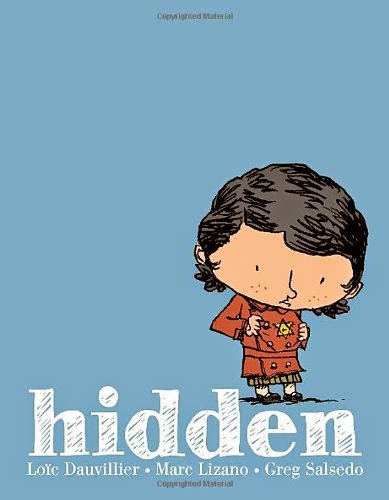
Cybils Finalist Review: HIDDEN: A CHILD'S STORY OF THE HOLOCAUST
 Summary
: Told through the eyes of a grandmother recalling her childhood during the Nazi occupation of Paris, this story takes the wrenching events of the Holocaust and shows how important it is to remember our history and set it free so that the healing process can begin. In the book's frame narrative, the grandmother, Dounia, begins to tell her story to her granddaughter Elsa, a story she has kept secret for decades: a story of survival during a dark time, and of the kindness that still existed in others despite the horrors of persecution. As a young French Jewish girl during World War II, Dounia is cared for and hidden away by friends and neighbors even after her own parents are taken away; suffused throughout with hope and small kind acts, the story ultimately leads to a heartwarming and touching ending.
Summary
: Told through the eyes of a grandmother recalling her childhood during the Nazi occupation of Paris, this story takes the wrenching events of the Holocaust and shows how important it is to remember our history and set it free so that the healing process can begin. In the book's frame narrative, the grandmother, Dounia, begins to tell her story to her granddaughter Elsa, a story she has kept secret for decades: a story of survival during a dark time, and of the kindness that still existed in others despite the horrors of persecution. As a young French Jewish girl during World War II, Dounia is cared for and hidden away by friends and neighbors even after her own parents are taken away; suffused throughout with hope and small kind acts, the story ultimately leads to a heartwarming and touching ending. Peaks : This book provides another entry (on an admittedly already-crowded bookshelf) into an important historical event, and it does so with a particularly deft and gentle touch. The love between the family members and the kindness of their allies is clear, and provides a strong uplifting note throughout—instead of showing how the Holocaust brought out the worst and most desperate in people, it shows how people were brought closer together and showed heroism in small, individual ways.
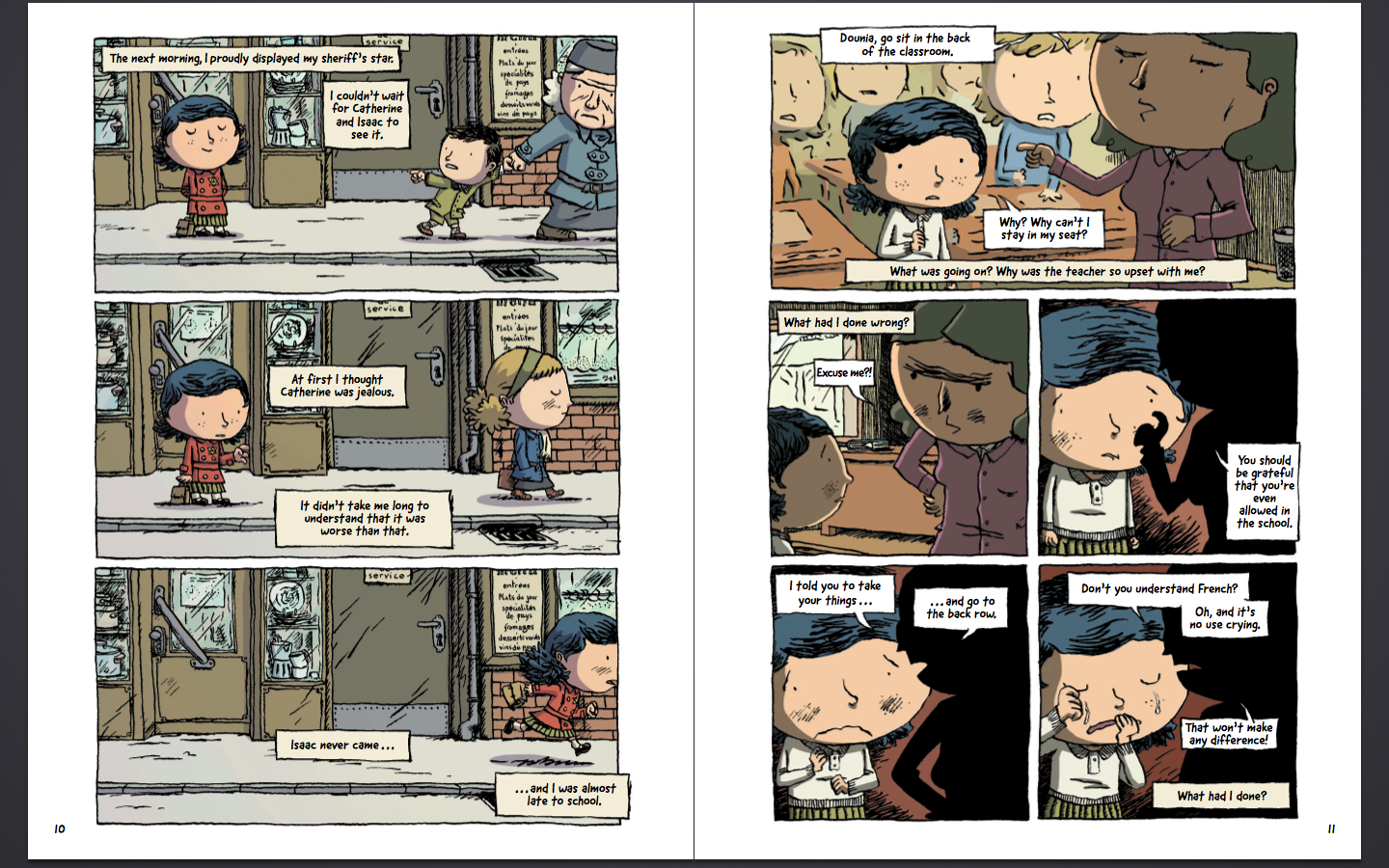 click to embiggenIn my opinion, this one avoided being didactic and remained rather sweet and innocent despite the subject matter, making it a good one for very young readers. The main character, Elsa's grandmother, makes a relatable narrator, and we see everything convincingly through her eyes: the story is faithful to a child's perspective, including the idea that children see a lot more than we give them credit for.
 Valleys : Will kids say "oh, no, not another Holocaust story"? I'm not sure. As already mentioned, there are plenty of stories about this time in history, but on the other hand, there are as many individual stories of the Holocaust as there are individuals around to tell them. For readers who aren't quite ready for Maus by Art Spiegelman, Hidden takes a gentler approach that nevertheless conveys the hardships of the Nazi occupation on Paris's children.
Conclusion : With characters that are cute, funny, even unintimidating, the overall effect is perfect for a book for younger readers that deals with heavier historical themes. Moments of humor balance the seriousness, and in the end, the message is conveyed that storytelling itself can heal.
I received my copy of this book courtesy of the publisher. You can find HIDDEN by Loïc Dauvillier, Marc Lizano and Greg Salsedo at an online e-tailer, or at a real life, independent bookstore near you!
This work is copyrighted material. All opinions are those of the writer, unless otherwise indicated. All book reviews are UNSOLICITED, and no money has exchanged hands, unless otherwise indicated. Please contact the weblog owner for further details.
Blog - Sarah Jamila Stevenson

- Sarah Jamila Stevenson's profile
- 80 followers

