
Sarah Jamila Stevenson's Blog: Blog - Sarah Jamila Stevenson, page 40
September 28, 2015
My Semicolon Soul Mate
Anyway, appropriately enough, while at the same museum, I saw this painting entitled The Allegory of Grammar (1650, Laurent de la Hyre):
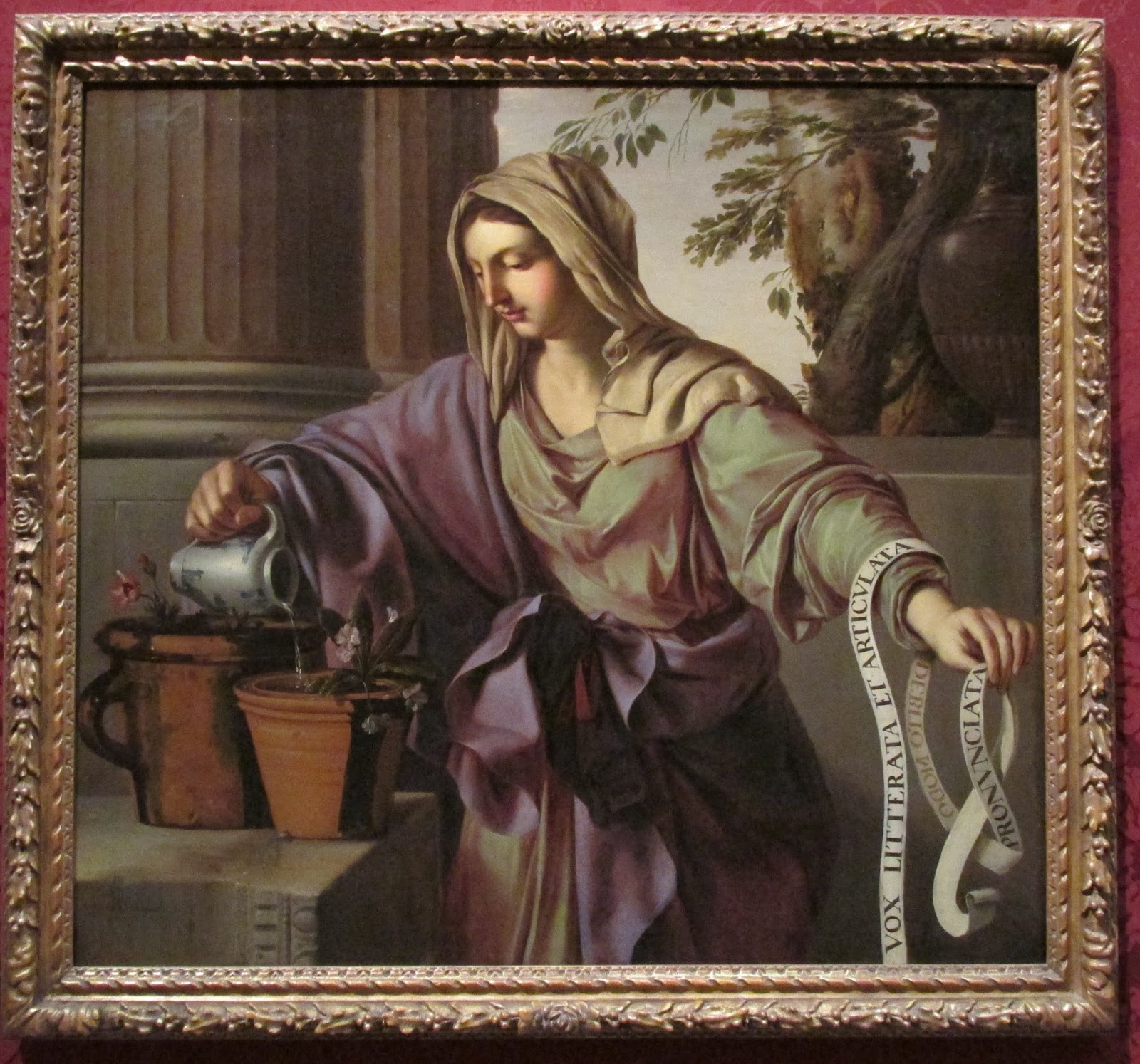 Who knew Grammar was so purty? And, um, apparently is not a great gardener? Those flowers look a little sad...
Anyway, one more cool writing-related picture for you. We went to the Smithsonian Museum of American History, which ended up being much more fascinating and amazing than we had expected (who couldn't get a little teary looking at the original Kermit the Frog? seriously.). One of the objects they had on display was Lawrence Ferlinghetti's typewriter. How cool is this?
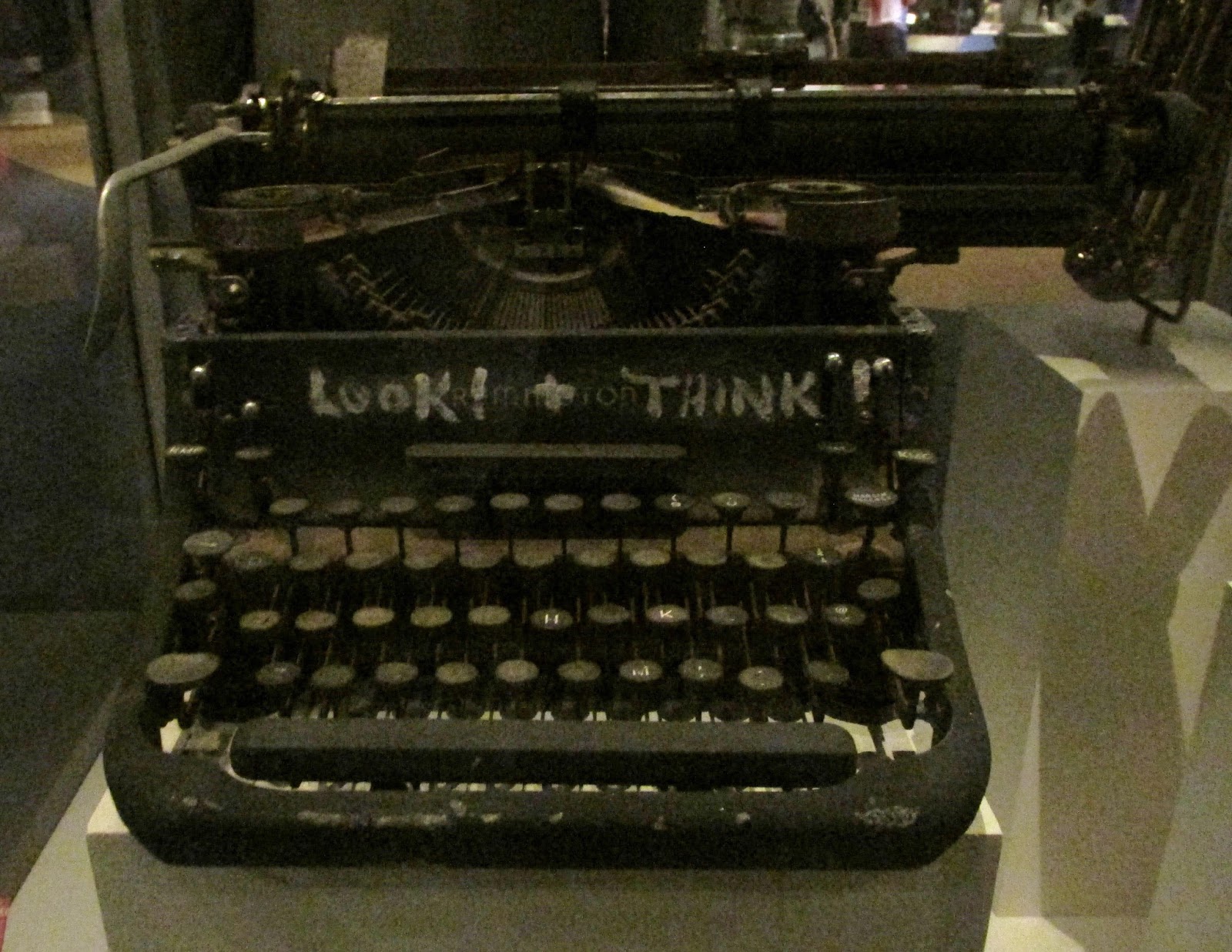
LOOK! + THINK! I'll leave you with that, and promises to catch up on reviews soonest.
This work is copyrighted material. All opinions are those of the writer, unless otherwise indicated. All book reviews are UNSOLICITED, and no money has exchanged hands, unless otherwise indicated. Please contact the weblog owner for further details.


September 14, 2015
Monday Review: MAGISTERIUM: THE COPPER GAUNTLET by Holly Black and Cassandra Clare
 Summary
: Just out this month is the second volume of the middle-grade fantasy Magisterium series by the extremely talented Holly Black and Cassandra Clare. The Copper Gauntlet is that book, and it is not only a very satisfying second installment but will leave you eager for the next book—that is, if you loved the first book as much as I did. A magical school, the fight against evil forces, the often-stubborn bonds of friendship and the fear of having family and allies turn against you—all good stuff. Oh, and a Chaos-ridden wolf. But he's really just a big old softie.
Summary
: Just out this month is the second volume of the middle-grade fantasy Magisterium series by the extremely talented Holly Black and Cassandra Clare. The Copper Gauntlet is that book, and it is not only a very satisfying second installment but will leave you eager for the next book—that is, if you loved the first book as much as I did. A magical school, the fight against evil forces, the often-stubborn bonds of friendship and the fear of having family and allies turn against you—all good stuff. Oh, and a Chaos-ridden wolf. But he's really just a big old softie.Peaks : This second book really ramps up the tension in main character Callum Hunt's life. Call has now spent a year at the secret school of magic known as the Magisterium. He's made friends, he's acquired a rather unusual pet, and he's found out some rather alarming secrets about his own identity (minor spoilers, if you haven't read book one)—he's supposedly harboring the reborn soul of the evil Chaos magician Constantine Madden. So he's constantly on the lookout for signs he might be turning into an Evil Overlord, which is both hilarious and sad.
As if that isn't enough, Call comes home one day to find that his wolf, Havoc—whom his father was never really comfortable with—has been locked up in the basement, possibly for the purposes of some awful ritual. And he finds incriminating evidence of something scary going on: the plot to steal a powerful magical object (the copper gauntlet of the title). Is his father trying to kill Havoc? Or worse, is he trying to kill Call? For their own safety, Call and Havoc decide that Back to School should happen just a tad bit early this year…but of course, even being back with his friends Aaron and Tamara and their teacher Master Rufus is no guarantee of safety.
I love how the friendships (and even the frenemies, like Jasper) are portrayed in this book. There is a strong message of loving your friends for the people they ARE, rather than fearing them because of what others say they're supposed to be. And there is another important take-away, which is that you can be allies with someone even if you aren't friends with them…and even if you don't particularly like them.
Valleys : I guess this is one of those where I have to say the only drawback is the next book isn't out yet.
Conclusion : This is another action-packed read which should appeal to fantasy readers of any gender (boys and girls alike get to do cool and exciting things), and particularly to fans of the early Harry Potter books and Tamora Pierce's novels for younger readers. It's a wonderful blend of fantasy and humor, is both fun AND just a bit scary, and it plays off both authors' strengths in terms of infusing magic into a contemporary setting.
I received my copy of this book courtesy of the publisher at ALA 2015; all comments are based on the uncorrected review copy. You can find THE COPPER GAUNTLET by Holly Black and Cassandra Clare at an online e-tailer, or at a real life, independent bookstore near you!
This work is copyrighted material. All opinions are those of the writer, unless otherwise indicated. All book reviews are UNSOLICITED, and no money has exchanged hands, unless otherwise indicated. Please contact the weblog owner for further details.
September 7, 2015
A Little Bittersweet

With excitement and more than a little sadness, the last Sir Terry Pratchett novel--featuring my favorite character arc with Tiffany Aching--has joined my TBR pile, loaned by a friend who said he cried during the very first scene. I predict some sniffles on this end as well.
And yes, if you were wondering, that is a Warhammer Fantasy Roleplay character sheet. What are YOU doing on Labor Day? (I also wrote another new page of my novel-in-progress, causing my poor protagonist to get very drunk and wake up in dire straits. But that's all I'm going to say about that!)
This work is copyrighted material. All opinions are those of the writer, unless otherwise indicated. All book reviews are UNSOLICITED, and no money has exchanged hands, unless otherwise indicated. Please contact the weblog owner for further details.
August 31, 2015
Interview (Part 3) With Ashley Hope Pérez, Author of OUT OF DARKNESS
 Happy Monday! We're back again today with the final installment in our interview with the wonderfully articulate and interesting Ashley Hope Pérez, who has stopped by on her blog tour for her forthcoming novel Out of Darkness. The story is based on real-life events of the March 1937 gas leak which caused a massive explosion and killed almost 300 children and teachers at a school in New London, Texas. It also explores the fraught racial, cultural, and economic environment of Depression-era, pre-WWII small-town America.
In the conclusion of our interview, we talk about what effect writers can have in exploring stories like the one in Out of Darkness; what responsibilities authors might feel when writing a story that examines issues of race and violence, whether it takes place in the historical past or the present; and how writers decide to tackle endings that don't conform to the traditional "Happily Ever After."

Tanita Davis: Can reading books like OUT OF DARKNESS, which examines the racialized violence of the past, do anything other than provoke disdain for an ignorant history and ancestry and reinforce the idea that racism is a boogeyman from the past for teens who are allegedly post-race and colorblind?
Ashley Hope Pérez: For students who have not had the history of race relations in this country impressed on them (whether academically or in how they experience the world), I can imagine that there will be a desire to quarantine racism to the ward of “evils from history.” But I think readers can do more with Out of Darkness than that. I’ve already begun to suggest this, I suppose, when I said that Out of Darkness asks us to think about the present as well as the past. But you’re right that a lot depends on how readers receive the world of the novel.
 Perhaps notions like “post-race” and “colorblind” do have relevance for some teens of color in some places, but for the most part it’s hard for me to imagine how anyone following the news—or just paying attention to the world around us—could believe race has no impact on contemporary experience. In my view, the notion of colorblindness has been a tactic of (often well-meaning) people who want to avoid the discomfort of talking about race. Other people have made better arguments than I can about why this is problematic, both for people of color and for well-meaning white people. You can see one example of this line of reasoning—that conversations of race matter for everyone, not just people of color—in this article about why and how to talk about race with kids.
 TD: So maybe there’s an alternative reaction to racism as the boogeyman from the past…
AHP: I think so. Although racism is rarely expressed as openly and directly today as we see it in the experiences of the characters in Out of Darkness, the novel can still attune readers to how racism and inequality persist in our world. The vulnerability of brown and black lives in public spaces is one example; another is the view that some loves are legitimate and some are not. I hope readers’ empathetic response to Naomi, Wash, and other characters primes them to embrace the precious humanity of people like and unlike themselves, especially when those people encounter discrimination or other injustice.
Sarah J. Stevenson: Do you see your book, or other books like it, as a call to action or a form of action in and of itself (or both)? If so --what did writing this book FEEL like you were doing, besides writing a compelling story? What do you feel is the author's responsibility, if any, for making a social statement, and did you feel like you needed or wanted to convey a particular message? Did the act of writing this book feel like it ought to be a crusade?
 Photo of the 1937 New London school explosionAHP: I didn’t have a message in mind as I was first figuring out what the book would be. In the beginning and for much of the way, there was just the painful work of trying to draw my story out of a set of historical possibilities and one actual event. I did know, though, that my starting place for telling this story was not the white community, which has been the focus of pretty much every account of the New London school explosion. The heroes of Out of Darkness are people who, if they were real, wouldn’t even register in the official historical record. If I was crusading for anything, it was for the notion that these experiences at the margins of history matter. They matter deeply because every experience deserves a place in our understanding of the past. When we broaden our criteria for whose stories “count” in history, our notion of what the past was changes.
  An East Texas oil field, historical photoAuthors have many responsibilities when they write, but I think any social statement has to grow out of the dynamics of the narrative; it can’t be imposed or decided in advance. Of course, plenty of writers have done this, but I don’t think it works. I think that, when I’m writing, my biggest responsibility is to pay attention to what the story is trying to become. When I revise, I revise to make my story more like itself, more what it wants to be. I realize that this sounds very mystical, so let me give an example.
 Originally, I hoped for a different ending to Out of Darkness. I researched possibilities, charted escape routes, pondered the rare spaces in the world (Canada? The Caribbean? A black colony in Mexico?) where my characters might succeed in making their family. I wanted a positive outcome for Naomi and Wash, a future that, in spite of its challenges, was made bright because they were able to share it with each other. What happened? It wasn’t that this happy ending was impossible; as I said, I ferreted out some historical possibilities and tried to force it for a while. But ultimately that ending proved to be profoundly at odds with the story as it wanted to be. So even though the ending of the novel brings shade upon shade of darkness, even though it denies the reader’s desire for “Happily Ever After,” I believe writing it was my responsibility.
TD: And as tough as it was, at the end of the day, telling the true, and not rearranging for a “Happily Ever After,” is always the right call.
We are thrilled to have had this opportunity to have such a deep, meaningful conversation with the author about the book, about writing, and about the power of stories to help us forge connections with our own history, even (perhaps especially) when that past is uncomfortable or difficult. Thanks, Ashley, for stopping by, and a hat tip to her editor, too, the amazing Andrew Karre at Carolrhoda LAB. If you missed Part 1 or Part 2, just click the links! Also, Ash is over at Diversity in YA today with an essay which gives a bit more background on the hows and whys of her writing OUT OF THE DARKNESS. The essay is called, "Words That Wake Us."
This work is copyrighted material. All opinions are those of the writer, unless otherwise indicated. All book reviews are UNSOLICITED, and no money has exchanged hands, unless otherwise indicated. Please contact the weblog owner for further details.
August 29, 2015
Interview (Part 2) With Ashley Hope Pérez, Author of OUT OF DARKNESS

Welcome back to our conversation with author Ashley Hope Pérez, author of the forthcoming YA historical novel OUT OF DARKNESS, which is based on real-life events of the March 1937 gas leak which caused a massive explosion and killed almost 300 children and teachers at a school in New London, Texas. This is part two of our three-part interview.
OUT OF DARKNESS has been described as,“a powerful, layered tale of forbidden love in times of unrelenting racism,” while BookRiot's Kelly Jensen calls it “powerful, painful, raw, and easily one of the best books I’ve read this year.”
It's always great when a book receives a lot of quiet but intensifying buzz, as people all over the blogosphere begin sharing their experiences with it. Notable for its timeliness as well as its gut-wrenching love story, you also won't want to miss:
8/5: A detailed review @ The Midnight Garden: YA for Adults,8/9: A Q&A with Shelf Life @ U of Texas 8/10: Sarah's Monday Review @ Wonderland. 8/12: An interview/giveaway @ YA Outside the Lines 8/17: A guest post on that elegant cover art @ Actin’ Up With Books, 8/21: A giveaway and 8/28 review and imaginary casting @ Forever Young Adult, 8/28: A review and exploration of history @ The Sarah Laurence Blog,...as well as our three-part interview here, 8/28-31.
There's a real beauty to this type of meandering blog tour, where bloggers get a real chance to actually discuss a topic in-depth. We as bloggers can take the time to do a bit more thinking so as not to trot out the same questions everyone else is asking, and this gives Ashley a larger platform for a deeper exploration of her work. There's just a lot to explore, and a lot to discuss, so on that note - on with the show.
We rejoin the conversation, musing a bit on reading tough, uncomfortable books - and what we gain from reading them. Today's conversation is both on reading -- and writing.
Sarah J. Stevenson: In my experience, teens learn a lot from challenging their comfort zones, as readers and, of course, in life. Empowering and encouraging them to examine WHY they feel a certain way and learn to articulate it, rather than avoiding uncomfortable feelings entirely—that seems like a critical life skill. 
Ashley Hope Pérez: A life skill and a way of exploring the ethical implications of how and why and what we read. This subject of “difficulty” or discomfort in reading is an area of overlap between my fiction, which makes some people uncomfortable, and my academic work, which often examines how difficult topics are handled in literature. Some treatments of violence, for example, are horrifying but cathartic in a way that lets readers “move on” from the tragedy. Other treatments don’t give the reader that kind of release. It’s terribly uncomfortable to be put in that position as a reader, and yet I also think it’s important. It’s important because it shouldn’t always be easy to “read past” suffering. I’d even say that reckoning with discomfort often has an ethical dimension.
Tanita S. Davis: This kind of inescapable, you-can't-shut-your-eyes-on-it discomfort - I love how Kirkus uses "unrelenting" in this context - this is something that I think a large part of our population (READ: me) would do anything to avoid, and yet I agree with Sarah -- it tends to teach us a great deal to get out of our comfort zones. It's like taking an Implicit Bias test and realizing that we're frozen on a "right" answer -- because it's not right to us, not really. As hard as it is to learn – and it really does sometimes feel impossible, with the way we avoid, avoid, avoid any hint of "not nice" feelings – we have to pay attention to what our discomfort is telling us, as human beings, about our resistance, and about the ethics of bias and racism.
AHP: In the past ten years, I’ve seen students become increasingly receptive to this kind of work, especially around race, gender, and other forms of difference. The generation of students in my classroom now is still struggling with how to talk about these areas of life, but they get that they need talking about.
I think it helps to shift some of the focus from the “what” of the text (topics that make me uncomfortable, etc.) to the “who” of the reader. I often ask my students to register and then examine their reading responses. The sources of discomfort in reading can be hard to diagnose, but often when we really dig, we discover something about ourselves as well as the literature we’re reading.
At least that’s what I believe. And it’s an idea I encourage my students to try on.
TD: Yes. The idea of reframing a perspective as a new way into a story resonates with me. If I might bring up a book of mine, in a way, I did that with MARE'S WAR -- we've all had WWII history ad nauseum, but telling that familiar piece of history from the POV of a person of color, a runaway, an underage, cynical little soldier whose future generations in the form of grandchildren were in every way her opposite (except in cynicism, in Talia's case) - opened it up for ME to find a place in it, not to mention readers.
AHP: I find a lot of overlap between the ways of thinking and the practices that make writing possible for me on the one hand and the kinds of experiences or thought experiments that shift readers’ thinking on the author. Also, there’s such a difference between big-h history and all the smaller histories that are, fundamentally, about human experience rather than about big events.

SJS: Yes, I thought that was a really insightful comment about historical fiction, and the reason why readers always have the potential to learn something new even from fictional accounts of the same event or era.
TD: Jumping off of that, I wonder how writers can kind of take that advice, about reframing perspectives, and use it to delve into other works of historical fiction -- more specifically, I wonder if that's actually the key to working with fictional accounts of real things which happened entirely...?
I think of the incidents of racial violence in Charleston this summer and imagine how those events will be seen, seventy-eight years from now, the way we're looking at the New London explosion – and I imagine how I would tell this story which is still so, so raw, and find a new way in, find a way to make it relevant and immediate to young readers seventy-eight years in the future who might have heard of it as simply another piece of history. Just as an exercise, how would you guys frame that history, if you were finding a way to tell it to young adults in the future? Is there anything which would cause us as writers - and readers and thinkers - to dig deeper, to see more, to care more, and thus extend those emotions to others? For myself, I think I'd be... I'd be a relative of the shooter, I think. That's WELL outside my comfort zone - White, Southern, possibly public school educated to my years of private, religious education, possibly less involved in higher education -- a working class person, living comfortably in a solid community, in a smaller, and in some ways more secure and insular world. How would something like that change me, as that extended family member? How would it change my belief in myself and in my place in the world?
SJS: I agree—a relative of the shooter, or a neighbor or former classmate, would be an interesting perspective from which to approach the story. To add to what you said above, I think I gravitate toward that perspective because it would be a means to increase my own understanding of how such a tragedy could occur, what would lead someone to do that, to feel that way, and to choose to ACT that way. I guess that's the former psychology major in me, always trying to understand why people do what they do.
AHP: Or even the shooter himself. That would be the most radical—and uncomfortable—narrative space to enter for most of us. I found myself recoiling from the idea of narrating parts of Out of Darkness from the perspective of Naomi’s racist, abusive step-father, but I think I had to go there to capture the particular kind of horror that is part of her world. One of the best compliments my editor gave me about the book was that it was made more terribly by the fact that Henry (the stepfather) emerges as a deeply flawed human being rather than (just) a monster.
TD: Whoa. That's an amazing compliment. When we see even our enemies in all their humanity, we've then truly achieved something in our understanding of the world - and in our ability to forgive. ...all that being said, I definitely agree it would be a radical and uncomfortable narrative space, and take some major work to go there, and not punk out.
“...there is some good in the worst of us and some evil in the best of us. When we discover this, we are less prone to hate our enemies. When we look beneath the surface ...we see within our enemy-neighbor a measure of goodness and know that the viciousness and evilness of his acts not quite representative of all that he is.” - Dr. Martin Luther King, Jr., July 1963

Adorbs photo courtesy of the author.
Ashley Pérez is an enormously talented and intelligent human being as well as a brilliant writer, and we're grateful she took the time - out of caring for her two little guys, the newest of whom arrived in June - and doing all of her other teaching and writing and family stuff to speak to us.
Stay tuned for the conclusion of this conversation on Monday!
What does it take to write and to edit a book like this? If you missed Ashley's conversation with editor Andrew Karre back in May, pop over to Cynsations and give it a read.
This work is copyrighted material. All opinions are those of the writer, unless otherwise indicated. All book reviews are UNSOLICITED, and no money has exchanged hands, unless otherwise indicated. Please contact the weblog owner for further details.
August 27, 2015
Interview (Part 1) with Ashley Hope Perez, Author of OUT OF DARKNESS
Welcome to Part 1 of our 3-part interview (we just couldn't stop chatting!) with Ashley Hope Perez, author of the forthcoming YA historical novel Out of Darkness, which is based on real-life events (and which we reviewed here).Not only was this a great opportunity to learn more about the story behind the story, it was also a chance to have a virtual conversation with one of our long-running blog buds and writer friends--because we DO like to put these in a less structured, more interactive form, going back and forth with the interviewee for more information and putting in a few thoughts of our own here and there. Check out the results today, tomorrow, and Monday! We were really pleased to delve into meaty topics like the difficulties of tackling such a tragic real-life event in fictional form and the challenges of writing about such events for teens (and teaching them).
With no further ado, here's Ashley. :)
SJS: How did you get interested in this particular piece of 1937 history? How is it remembered in Texas?
AHP: I grew up one county over from New London, so from a pretty young age I was at least vaguely aware of the disaster and the fact that many children had died. But until about 10 years ago, the explosion was almost never discussed. I think that silence was deeply painful for survivors and their families, and I’ve heard many stories of people who believed that they’d done something to cause the explosion (kicking a pipe, telling a lie) or were otherwise responsible for someone’s death. In the novel, two children change seats, and one of them dies. That’s the kind of situation that leaves the survivor wracked with guilt. “It should have been me…” That sort of thing did happen.
SJS: Was it was difficult to find first person narrative about the New London explosion? What kind of research did you do? Did you base your characters, however loosely, on historical individuals and to what extent? Did this story start with the characters, the setting, the premise, or...?
 AHP: Most of the details related to the explosion are drawn from historical accounts. There are many oral histories and other records related to the disaster, and I was fortunate to access these at the London Museum and in the Stephen F. Austin University archives. About two years after I started writing the novel, an excellent non-fiction book came out on the explosion:
Gone at 3:17: The Untold Story of the Worst School Disaster in American History
by David M. Brown and Michael Wereschagin. From reading the book, I learned quite a few things I hadn’t uncovered on my own, like the fact that the Texas Rangers came out to guard the houses of school board members and that they actually turned away a mob of angry men. That detail becomes important in the novel, where I imagine what would have happened if the men had sought out another scapegoat, one whom no one was protecting.
AHP: Most of the details related to the explosion are drawn from historical accounts. There are many oral histories and other records related to the disaster, and I was fortunate to access these at the London Museum and in the Stephen F. Austin University archives. About two years after I started writing the novel, an excellent non-fiction book came out on the explosion:
Gone at 3:17: The Untold Story of the Worst School Disaster in American History
by David M. Brown and Michael Wereschagin. From reading the book, I learned quite a few things I hadn’t uncovered on my own, like the fact that the Texas Rangers came out to guard the houses of school board members and that they actually turned away a mob of angry men. That detail becomes important in the novel, where I imagine what would have happened if the men had sought out another scapegoat, one whom no one was protecting.For me, character almost always comes first. But then again, characters emerge in large part from the situations we place them in. I guess I could say that I almost start by writing somewhere in the middle of the story—a story whose arc I don’t even know yet.
TD: I’m definitely a character person too – character and connections.
SJS: I can relate to both of those, as a writer—the story starting from a character, but also from a "what-if". What if something different had happened? What if we followed the event from behind the scenes, or through the eyes of a different character? In a very fundamental way, character + what-if = STORY.
AHP: Absolutely. The “what if” about the Texas Rangers is actually secondary to another “what if”: What if a Mexican American girl from San Antonio found herself in rural East Texas? Where would she fit? What would her life be like? I think these kinds of questions are especially important when working with a historical topic. I can lose myself in research for weeks—almost a year for this book—but at some point a writer has to turn loose from the historical record and enter the world of fiction. That happened rather quickly since, at least in New London, minority voices simply weren’t a part of the account of the New London explosion. That exclusion went beyond this particular event; for example, when a “colored” school in the nearby town of Longview burned down, it wasn't even covered in the local newspapers.
TD: Since you have a lot of background in education and are currently teaching at the Ohio State U, where would you see Out of Darkness fitting - in a history, sociology, poli-sci course? College, high school?
 AHP: I’m interested in all thinking, feeling readers, but I write YA because I trust teens with even the most difficult stories. When I write, I often think of the students I taught during my three years in Houston. Whereas What Can’t Wait and The Knife and the Butterfly are about (very different) contemporary Latino experiences, Out of Darkness digs into aspects of history that I felt were still relevant to the lives of my diverse but mostly Mexican American students. I wanted to write a book that would make my students think and feel, not only about the past, but also about the present.
And I certainly hope Out of Darkness has a place on high school library shelves and in high school classes. Some brave HS teachers out there will recognize what it can offer to the study of literature and history (among other subjects).
TD: In that case, how would you see teaching this book?
AHP: I’d never dare teach one of my own novels, but if I were giving advice, I’d say that certainly the historical context needs attention. For example, the novel demands that we investigate the particulars of school segregation, which was three-fold in some Texas settings like San Antonio and Houston (white, black, and “Mexican” schools). There’s also the nature of migration and the patterns that can be detected in certain kinds of racialized violence (e.g., how violence is often triggered by external pressures on a community, such as economic stress or disaster).
But there’s a lot to think about, too, in terms of the actual experience of reading the novel. Although it has its moments of bliss, I’m aware that reading can feel very much like a descent into darkness, a descent that may not be especially welcome for all readers but that is, nevertheless, important. When I task my students with intense (they would say “depressing”) works in my university classes, I begin by building a framework for what it means to encounter difficult subjects in literature. We talk about the fact that, our responses to what we read require reflection, even interpretation. We ask questions like, “why am I uncomfortable/angry/frustrated with this portion of a text? What does that emotion do to my reading? To what extent is it a product of narrative and style? To what extent does it result from a mismatch between what the text is and what I wish for it to be?
Come back tomorrow--same bat channel--for Part 2 of our interview with Ashley!
This work is copyrighted material. All opinions are those of the writer, unless otherwise indicated. All book reviews are UNSOLICITED, and no money has exchanged hands, unless otherwise indicated. Please contact the weblog owner for further details.
August 24, 2015
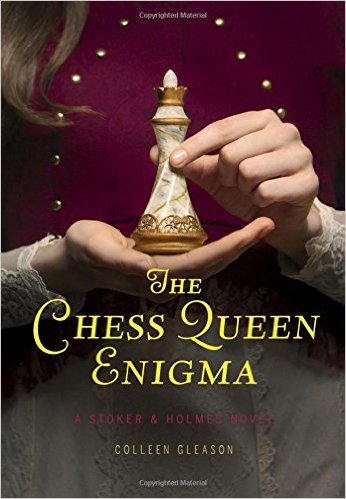
Monday Review: THE CHESS QUEEN ENIGMA by Colleen Gleason
 Summary
: This steampunk-paranormal mystery series is just plain fun. Three books into the Stoker and Holmes adventures and I'm still enjoying them immensely—prickly, socially awkward Mina Holmes; quick-tempered, impulsive, but brave Evaline Stoker—and this from a series that I actually wasn't initially sure I would like. The Chess Queen Enigma (love that word, enigma) is book 3, and it continues Mina and Evaline's fight against the shadowy and frightening person known only as the Ankh. Oh, and vampires. There are, of course, vampires to be vanquished, a princess to protect, and a chess piece to find, a carved queen that could determine the fate of nations. It's not out until October 6th, but I really needed to review this one before I forget the details—when I grabbed a review copy at ALA this summer, I was just too tempted to read it ASAP. And so I did.
Summary
: This steampunk-paranormal mystery series is just plain fun. Three books into the Stoker and Holmes adventures and I'm still enjoying them immensely—prickly, socially awkward Mina Holmes; quick-tempered, impulsive, but brave Evaline Stoker—and this from a series that I actually wasn't initially sure I would like. The Chess Queen Enigma (love that word, enigma) is book 3, and it continues Mina and Evaline's fight against the shadowy and frightening person known only as the Ankh. Oh, and vampires. There are, of course, vampires to be vanquished, a princess to protect, and a chess piece to find, a carved queen that could determine the fate of nations. It's not out until October 6th, but I really needed to review this one before I forget the details—when I grabbed a review copy at ALA this summer, I was just too tempted to read it ASAP. And so I did. Peaks : Much as I of course love the setting of a mysterious alternate version of Victorian London, and all the fun and imaginative steampunk gadgets, for me this book is all about the characters. Not just the mystery-solving protagonists Evaline and Mina, but the love interests like Pix and Grayling, who add spice and interest to each case—Pix through his meddling about via the London criminal underworld, and Grayling in his legitimate job as a young policeman. And of course let's not forget Dylan, a boy from (more or less) our world, who somehow ended up in Mina and Evaline's world through an accident of time travel. We get a cameo from the illustrious Uncle Sherlock, of course, and plenty of over-the-top menace from the Ankh him-or-herself.
This particular volume was another rollicking mystery with plenty of misdirection and red herrings to throw off even the most detail-oriented reader, and it nicely combined the ongoing plot arc with the case at hand—always interesting to me, since I don't write series fiction myself (or, anyway, haven't yet). And there's plenty of humor to be found as the characters end up in all sorts of outlandish, unexpected, and otherwise sticky situations.
Valleys : Besides some anachronism here and there (hard to avoid, in this type of book), I don't really have any quibbles. You'll either enjoy the Stoker and Holmes series or you won't. If you like steampunk fiction, then I definitely recommend it, because you'll already be familiar with the specific brand of suspension of disbelief that accompanies the genre.
Conclusion : As I said, this is fun stuff, and highly enjoyable. It's the perfect kind of book to curl up with and escape into when your mood needs a lift, and you'll find yourself absorbed by the mystery, the action, the brooding greyness of Victorian London, and most of all the quirky and entertaining characters.
I received my review copy of this book courtesy of the publisher at ALA; all comments are based on the ARC and not the finished version. You can find THE CHESS QUEEN ENIGMA by Colleen Gleason at an online e-tailer, or at a real life, independent bookstore near you, on October 6th!
This work is copyrighted material. All opinions are those of the writer, unless otherwise indicated. All book reviews are UNSOLICITED, and no money has exchanged hands, unless otherwise indicated. Please contact the weblog owner for further details.
August 17, 2015
Cybils Call for Judges AND Poetry Contest for NorCal Peeps!
The Northern California Women's Music Festival is having a poetry contest in conjunction with the Modesto-Stanislaus Poetry Center, and the deadline is coming up soon--September 1. ALL poets in Northern California are eligible (dudes too) and entry for 2 poems is FREE! (Full disclosure: I'm involved in the contest behind the scenes, so you may hear about this again...) Anyway, if you fit the criteria, here's more information for you. And check out the Festival page, too--it looks like it'll be great, with headlining acts Tracy Bonham and Lita Ford.
And that's all I've got on this busy Monday. Some freelance work flooded in over the weekend, and I had a chapter to finish writing, so off I go to be industrious.
This work is copyrighted material. All opinions are those of the writer, unless otherwise indicated. All book reviews are UNSOLICITED, and no money has exchanged hands, unless otherwise indicated. Please contact the weblog owner for further details.
August 13, 2015
2 More Days to Be a KidLitCon Early Bird
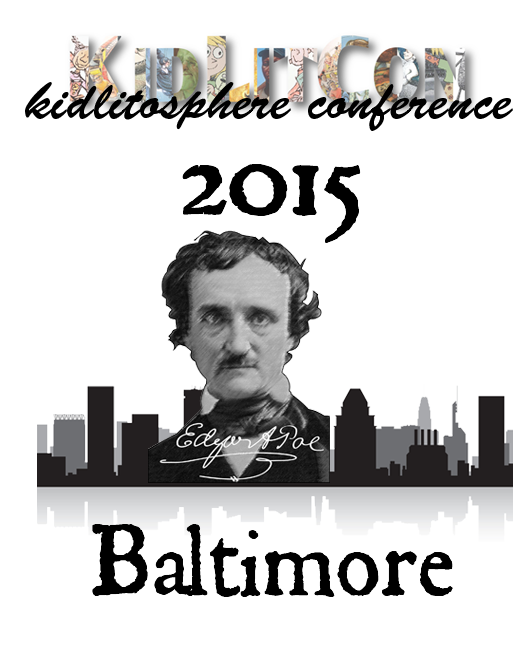
Have you registered yet for KidLitCon 2015 in Baltimore? With sessions October 9th and 10th and a fantastic tour of the area on October 11th, you won't want to miss it! (Sadly, I won't be there because I'll be at the Great Valley Bookfest, but I will be enjoying it in spirit.)
The full schedule has been released over at Kidlitosphere Central, and includes a wide variety of sessions and panels and topics: Middle Grade Horror, Visual Storytelling, A Panel Discussion with Literary Award Judges, Kidlit Podcasting, etc., etc., and oh, did I forget to mention Keynote Speakers Carrie Mesrobian and Tracey Baptiste? It's going to be an amazing weekend of learning from fellow bloggers, writers, and book enthusiasts of all stripes. It's one of my favorite conferences of the year (which is why I'm bummed I can't clone myself and/or otherwise be in two places at once, but career duties call and I'm even getting paid, so the tough decision had to be...decided).
You have until August 15th to get the early bird conference discount, so go check out these links and register, fast! Go!
Register
Get the conference discount on your room reservation
See the full schedule
This work is copyrighted material. All opinions are those of the writer, unless otherwise indicated. All book reviews are UNSOLICITED, and no money has exchanged hands, unless otherwise indicated. Please contact the weblog owner for further details.
August 10, 2015
Monday Review: OUT OF DARKNESS by Ashley Hope Pérez
 Summary
: Ashley Hope Pérez's latest novel comes out on September 1. I tell you this so you can brace yourself. Out Of Darkness is historical fiction of the most wrenching kind: based on a real-life tragedy, with plenty of collective guilt to go around and no easy answers. The time and place: 1937 in New London, an oilfield town in East Texas. From Wikipedia:
Summary
: Ashley Hope Pérez's latest novel comes out on September 1. I tell you this so you can brace yourself. Out Of Darkness is historical fiction of the most wrenching kind: based on a real-life tragedy, with plenty of collective guilt to go around and no easy answers. The time and place: 1937 in New London, an oilfield town in East Texas. From Wikipedia: The New London School explosion occurred on March 18, 1937, when a natural gas leak caused an explosion, destroying the London School of New London, Texas.... The disaster killed more than 295 students and teachers, making it the deadliest school disaster in American history.
The story is set against the backdrop of the months leading up to the disaster, but it's no tale of oblivious youth unknowingly headed toward an inevitable tragedy. New London is a difficult place to live. It's a difficult place to just BE if you're Wash Fuller, who is black, or Naomi Vargas, who is Mexican. Naomi's bringing her younger twin half-siblings to live with their white father in the hope of a better life. Certainly, Beto and Cari have an easier time of it—they look more white, and they fit in at their new school just fine. For Naomi, everything's more complicated: with teachers, with her peers, and, in a really bad way, with the twins' father, who is an on-again, off-again alcoholic who works in the oil fields. Then things get complicated in a good way for Naomi, when she meets Wash, who is smart, kind, and lives on the wrong side of town, in an era when segregation is still widespread. In a world like theirs, though, good things are often all too fleeting.
Peaks : There is so much packed into this novel. It is not only a book about racial issues, reminding us that the traumas and mistakes of our history are still resonating even today, reminding us that we still have work to do. It's also a book about class and education, and the misunderstandings and bad behavior that can result when racism and classism and differing education levels intertwine and create a complex and simmering stew of hostility. And the characters will break your heart. Without giving too much away, the reader gets multiple viewpoints on the unfolding events: Naomi and Wash are the primary characters, but we also hear from the twins, Beto and Cari, and from their father, Henry. Perhaps most surprisingly, we also receive an occasional dispatch from "The Gang"—written in first-person plural, the readers are placed as complicit in the behavior of Naomi and Wash's peer group, and yet mute, watching, we are unable to affect the inevitable slide toward tragedy.
Valleys : This novel is GRIM. I'm not going to lie. It is hard to read, and it will take your emotions to the brink of despair, and you won't be able to put it down. If you are faint of heart, be warned that there are lots of difficult, painful-to-read moments, scenes that will make you uncomfortable and themes that are thorny and risky enough to make this one more suitable for older YA audiences: racism both insidious and virulent, abuse, violence, and other morally questionable behavior by characters. The most frightening part is knowing that while the specific characters are fictional, the reality underlying this situation—the explosion itself and the social context—makes the imagined story all too believable.
Conclusion : Out of darkness, comes light…There is the faintest glimmer of hope about this one, of the possibility of making something right—and this book, in its way, is a part of that making-something-right, a part that we artists have, rather incredibly, some control over. There may be no redemption to be had, let alone a happy ending, but this book reminds us that no matter what has happened in the past, from now on, this moment right here, there is always the chance to do something good, to put good into the world. We don't have to accept being part of "The Gang" and standing aside in the face of injustice. It's a message that is newly, repeatedly, sadly relevant: to what extent are we—any of us—willing to risk ridicule, punishment, even harm, to right a wrong? To defy an unjust social directive, like Naomi and Wash? They might be uncomfortable questions to contemplate, but that doesn't make them any less important.
Stay tuned later this month for an interview wherein Tanita and I have the opportunity to ask Ashley Hope Pérez all about the inspiration for the book and her motivations for telling this particular story.
I received my copy of this book courtesy of NetGalley and the publisher; this review is based on an Advance Reading Copy. You can find OUT OF DARKNESS by Ashley Hope Pérez at an online e-tailer, or at a real life, independent bookstore near you, on September 1st!
This work is copyrighted material. All opinions are those of the writer, unless otherwise indicated. All book reviews are UNSOLICITED, and no money has exchanged hands, unless otherwise indicated. Please contact the weblog owner for further details.
Blog - Sarah Jamila Stevenson

- Sarah Jamila Stevenson's profile
- 80 followers

