Rachel Maddow's Blog, page 3394
June 11, 2013
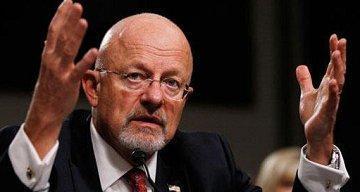
What James Clapper told Ron Wyden
Associated Press
In March, at an open congressional hearing, Sen. Ron Wyden (D-Ore.) asked Director of National Intelligence James Clapper a simple question: "Does the NSA collect any type of data at all on millions or hundreds of millions of Americans?" Clapper said the NSA does no such thing. We've now seen pretty obvious evidence to the contrary.
When NBC's Andrea Mitchell asked Clapper over the weekend about the exchange, he said the question was "not answerable necessarily by a simple yes or no," so he "responded in what I thought was the most truthful, or least untruthful, manner by saying, 'No.' "
Fred Kaplan makes a persuasive case that the Director of National Intelligence's defense is ridiculous.
There are many ways that he could have finessed the question, as administration witnesses have done in such settings for decades, but Clapper chose simply to lie. "Truthful" and "untruthful" are not relative terms; a statement either is or isn't; there's no such thing as speaking in a "most truthful" or "least untruthful" manner.
Nor was this a spontaneous lie or a lie he regretted making. Wyden revealed in a statement today that he'd given Clapper advance notice that he would ask the question and that, after the hearing, he offered Clapper a chance to revise his answer. Clapper didn't take the offer.
So by any reasonable definition, the DNI was given sworn congressional testimony on an important issue, was asked a direct question, and gave an answer that was plainly false. Given a chance to privately set the record straight, Clapper declined.
For Kaplan, this means the DNI "has to go." And what I'm wondering today is why congressional Republicans aren't saying the same thing.
Keep in mind, for the congressional GOP, calling for Obama administration officials to resign is about as routine as drinking a cup of coffee in the morning. Last week, Republicans were comfortable accusing the Attorney General of "perjury," even when it didn't make any sense. There are very few top administration officials who haven't, at one point or another, heard from GOP lawmakers who asked them to quit.
Indeed, two years ago, Sen. Lindsey Graham (R-S.C.) called for Clapper to resign for having said something that was objectively true. And yet, at least so far this week, I can't find any congressional Republicans pushing the DNI to give up his post.
Anyone care to explain why this is? Perhaps Republicans are less concerned because Clapper said something untrue to a Democrat? Maybe Republicans are giving him a pass because they like the NSA program he was lying about?


'Congress needs to act,' but will it?
Flanked by non-traditional allies from the AFL-CIO and the Chamber of Commerce, President Obama spoke from the White House this morning, urging Congress to complete its work on comprehensive immigration reform. "If you're serious about actually fixing the system, then this is the vehicle to do it," the president said of the bipartisan Senate bill, which he described as the "best chance we've had in years to fix our broken immigration system."
"To truly deal with this issue, Congress needs to act," Obama added. "And that moment is now."
The timing of the remarks was not coincidental -- in about two hours, the Senate floor debate on the "Gang of Eight" legislation will begin in earnest, and the White House hopes to rally some public pressure to help the bill overcome a Republican filibuster.
The process will unfold slowly in the upper chamber, and as best as I can tell, there are no firm head counts when it comes to the final outcome. That said, most observers seem to agree the 60 votes needed to prevent GOP obstructionism should be there in the end.
And then there's the House.
To be sure, a lot can happen as this process unfolds, but I wouldn't be surprised if the ultimate outcome hinges on a simple political equation: will House Speaker John Boehner (R-Ohio) rely on Democratic votes to pass the bipartisan Senate bill or won't he?
Boehner talked to ABC this morning and as Greg Sargent explained, the Speaker was cagey when discussing the issue.
First, he would not say whether the final bill that emerges from the House will have a path to citizenship in it. And -- even more important -- he would not say whether he would refrain from allowing the House to pass a final bill mostly with Democratic support. Both of these are critical to understanding how this whole battle is likely to unfold.
Pressed repeatedly by George Stephanopoulos on whether the House would pass something that includes a path to citizenship, Boehner demurred again and again, only saying that he expected the House bill to be "to the right" of the Senate bill. And pressed repeatedly on whether he would allow the final product to pass with mostly Dems, Boehner said: "It's not about what I want. It's about what the House wants ... we're gonna let the House work its will."
For immigration reform proponents, this is about as good an answer as can reasonably be expected, at least at this point. We've known for months that every major legislative initiative of this Congress will depend on Boehner's willingness to ignore the so-called "Hastert Rule," and immigration legislation is arguably at the top of the list. And if "the House works its will," and there are 218 votes for the Senate bill thanks in large part to Democratic support, then there's no reason to assume this effort will fail.
At a minimum, Boehner is reluctant to rule out the possibility, knowing that he's likely to have no other choice.
Tuesday's campaign round-up
Today's installment of campaign-related news items that won't necessarily generate a post of their own, but may be of interest to political observers:
* Following last week's House vote against Dream Act kids, the DCCC is launching this Spanish-language ad targeting Reps. Mike Coffman (Colo.), Blake Farenthold (Texas), John Kline (Minn.), Joe Heck (Nev.), Buck McKeon (Calif.), Gary Miller (Calif.), Erik Paulsen (Minn.), Steve Pearce (N.M.), and Frank Wolf (Va.).
Watch on YouTube* Massachusetts' U.S. Senate special election is two weeks from today, and two new polls -- from WBUR and Suffolk -- both show Rep. Ed Markey (D) leading Gabriel Gomez (R) by seven points.
* In New Jersey's U.S. Senate special election, a Quinnipiac poll released yesterday showing Newark Mayor Cory Booker crushing his intra-party rivals in the Democratic primary. The poll did not include State Assembly Speaker Sheila Oliver, who entered the race yesterday.
* On the Republican side, New Jersey Republicans will chose between two self-identified Tea Party candidates: former Bogota mayor and political gadfly Steve Lonegan and Dr. Alieta Ecks.
* In Illinois this morning, Bill Daley (D) launched a gubernatorial campaign, which had been rumored for months. Daley served as President Obama's chief of staff and President Clinton's Commerce Secretary. He's also son and brother of former Chicago mayors.
* Today is primary day in Virginia, and Democrats in the commonwealth will chose their nominees for lieutenant governor and attorney general. Given the extremism of the GOP nominees, the winners of the Dem primaries have a credible shot at victory.
* In Arkansas, the National Republican Senatorial Committee is launching a new attack ad against Sen. Mark Pryor (D), hoping to tie him to the dwindling IRS controversy. What does the story have to do with Pryor? Apparently nothing, but the NRSC is doing it anyway.
* And in Iowa, where Republicans have struggled to find a credible U.S. Senate candidate for 2014, conservative radio host Sam Clovis kicked off his campaign yesterday. He's running on a right-wing platform of repealing President Obama's accomplishments and eliminating federal income taxes.
Did the NSA stop Najibullah Zazi?

Associated Press
It's only natural that successful terrorist plots will generate vastly more attention that unsuccessful ones, but I've long believed the Najibullah Zazi is one of the under-appreciated stories of the last several years.
If the name doesn't ring a bell, we're talking about what was arguably the most serious domestic terrorist threat since 9/11. Zazi plotted with two friends to detonate bombs in New York City -- Grand Central and Times Square -- during rush hour, in the middle of the packed trains, to ensure the most carnage possible.
The plot had progressed to a rather dangerous point -- this was not just an aspirational goal -- before Zazi was taken into custody. From there, the system worked flawlessly -- Zazi cooperated with law enforcement; co-conspirators were caught; and many lives were saved. In the post-9/11 era, this was as big a counter-terrorism victory as any we've seen in the United States, even if most Americans have no idea it happened.
Why am I bringing this up now? Because as Dan Amira explained, unnamed officials brought this up last week.
Late last week, unnamed sources told CBS News, Reuters, and the New York Times that the NSA's PRISM had helped to disrupt Najibullah Zazi's plot to bomb New York's subways in 2009. Thanks to PRISM, authorities were monitoring an e-mail address known to belong to a member of Al Qaeda. Zazi e-mailed that address and unwittingly revealed himself and his plans. He was arrested and now faces life in prison. Huzzah.
But it wasn't long before the credibility of this narrative was questioned.
The Associated Press' Adam Goldman explained that the NSA program was very likely irrelevant -- British intelligence had already identified an al Qaeda email address, and shared that information with U.S. officials. Zazi did, in fact, send an urgent message to that address, which ultimately led to his arrest before he could successfully murder a lot of people.
So, what does this have to do with NSA surveillance, metadata, and PRISM? Given what we know, nothing.
But maybe, the argument goes, British intelligence learned of the al Qaeda email address in the first place thanks NSA programs. Right? No, as it turns out, the address was found on a laptop when a different terrorist was captured in 2009.
It appears, then, that conventional intelligence gathering saved the day -- though that's not what the public heard over the weekend.
On the Sunday shows, Senate Intelligence Committee Chair Dianne Feinstein (D-Calif.) and House Intelligence Committee Chair Mike Rogers (R-Mich.) both said that when it came the Zazi case, the NSA programs in question were "exactly [what] was used."
It is, of course, possible that Feinstein and Rogers know details of the Zazi case that are highly relevant, and that the public is not aware of. But at a minimum, using this as an example to bolster the case in support of NSA surveillance seems dubious.
And stepping back, it's also worth acknowledging the bigger picture. For defenders of NSA surveillance programs, including the programs that have come to public light in recent days, there's a simple calculus: the surveillance saves lives and prevents terrorism, ergo they have merit and should be left in place.
To be sure, we can at least have a credible conversation about this -- some may well argue that excessive government surveillance simply isn't worth the cost, even if it prevents attacks, and it's a debate worth having.
But we're not even at that point, since we don't know whether NSA surveillance is saving lives or not. And the one example the programs' defenders are touting seems fairly hard to believe.
House GOP eyes more anti-abortion votes
Associated Press
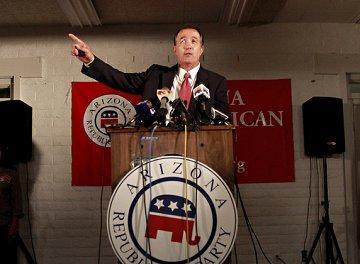
Rep. Trent Franks (R-Ariz.) always seems to be pointing to his right.
House Republicans' laser-like focus on job creation -- which is to say, they've passed zero jobs bills in three years -- is poised to take yet another detour.
The House will vote next week on a bill banning abortions across the country after 20 weeks of pregnancy.
Doug Heye, deputy chief of staff to House Majority Leader Eric Cantor, R-Va., confirmed to CQ Roll Call that the chamber is on track to consider legislation next week that would ban all abortions after the 20-week threshold -- the point at which some medical professionals believe a fetus can begin to feel pain.
The effort started in late April, when Rep. Trent Franks (R-Ariz.) started pushing an anti-abortion bill, which he hoped to impose on the residents of the District of Columbia against their will. As we discussed in May, the proposal mirrors efforts that have popped up among Republican lawmakers at the state level: abortion would remain legal, but only if pregnancies are terminated within the first 20 weeks.
Following Kermit Gosnell's recent murder conviction in Philadelphia, Franks and his allies decided to pursue this as a national policy, to be imposed on all states, constitutional concerns be damned.
It was not immediately clear what House GOP leaders would do about this. On the one hand, they support the party's culture-war agenda and want to keep far-right, rank-and-file members happy. On the other, the Republican leadership realizes that voters would prefer to see Congress tackle real issues, occasionally even passing meaningful bills that can become law, and more work on pointless anti-abortion legislation undermines the whole "rebranding" idea.
So, would GOP leaders prioritize the culture war, working on yet another abortion bill that can't pass the Senate and won't get the president's signature? Of course they will. In fact, they're poised to do it more than once.
Franks' 20-week bill is now poised for a floor vote, but Dorothy Samuels noted yesterday that another anti-abortion provision is on the way, too.
[O]n Thursday, the House passed a Homeland Security Appropriations bill containing a Republican amendment that would go a step beyond the current, restrictive federal policy regarding the ability of women held in immigration detention centers to access abortion services. The extreme provision, which the Senate should firmly reject, could be read to allow an employee with no medical training to decide whether or not a woman's pregnancy is "life-threatening," and to grant leeway to refuse to facilitate an abortion even then.
Party leaders are no doubt aware of the GOP's larger difficulties, including the gender gap, and the fact that younger voters have no use for the party's right-wing agenda, seeing Republicans as "closed-minded, racist, rigid, [and] old-fashioned."
But for now, it appears the GOP just can't help itself.
* Update: My friend Jay Bookman emails to note the Franks bill is arguably even more pernicious than it seems at first blush. The proposal is specifically written to ban abortions in what are called "medically futile pregnancies," involving fetuses so badly compromised that they have no chance of survival. The bill is intended to force women to carry such pregnancies through to the doomed birth.
June 10, 2013
Ahead on the 6/10 Maddow show
Tonight's guests:
Barton Gellman, Pulitzer Prize-winning journalist currently working on assignment for the Washington Post, he's a contributing editor-at-large for Time magazine and a senior fellow at the Century Foundation, broke the NSA surveillance story
Ron Suskind, Pulitzer Prize-winning journalist, senior fellow at Harvard's Center for Ethics, and bestselling author, "The One Percent Doctrine"
Here's executive producer Bill Wolff with a preview of tonight's show, that's Monday's show in case you didn't know what day it is:
Monday's Mini-Report
Today's edition of quick hits:
* Iraq: "A wave of car bombings rocked central and northern Iraq on Monday, killing at least 57 people and extending the deadliest eruption of violence to hit the country in years."
* Afghanistan: "Insurgents launched an hours-long attack early Monday on the heavily guarded military side of Kabul’s international airport, which houses a key NATO strategic headquarters, but failed to breach that part of the complex before all seven attackers were slain, officials said."
Watch on YouTube* President Obama spoke at the White House this afternoon on the 50th Anniversary of the Equal Pay Act, and among other things, urged Congress to approve the Paycheck Fairness Act.
* The Diplomatic Security Service: "CBS News has uncovered documents that show the State Department may have covered up allegations of illegal and inappropriate behavior within their ranks."
* Texas shooting: "At least one person was injured Monday after a person fired shots at Joint Base San Antonio-Fort Sam Houston. The post was placed on lockdown status after the shooting, but few other details were available. Scanner traffic indicates that one person is in custody."
* I wonder how many questions were asked at these 22 briefings: "Obama administration officials held 22 separate briefings or meetings for members of Congress on the law that has been used to justify the National Security Agency's controversial email monitoring program, according to data provided by a senior administration official."
* A fading hero: "Former President Nelson Mandela of South Africa was in intensive care on Monday, the third day of his latest hospitalization for a recurring lung infection, South African officials said."
* Climate crisis: "Global emissions of carbon dioxide from energy use rose 1.4 percent to 31.6 gigatons in 2012, setting a record and putting the planet on course for temperature increases well above international climate goals, the International Energy Agency said in a report scheduled to be issued Monday."
* Senate Majority Leader Harry Reid (D-Nev.) considers Sen. John Cornyn's (R-Texas) "trigger" amendment on immigration policy a "poison pill." Reid's correct, and it's important that he stick to this line.
* E.J. Dionne Jr. ponders a fascinating question: "Why are there no libertarian countries?"
* What progress looks like: "An internal posting by the Pentagon this week announced that 'same-sex domestic partners' should be able to begin receiving military benefits and identification cards on September 1."
Anything to add? Consider this an open thread.
Progress on climate from Obama, Xi

White House photo
President Obama was in California over the weekend for talks with Chinese President Xi Jinping, and according to National Security Advisor Tom Donilon, the discussions "were positive and constructive, wide-ranging and quite successful in achieving the goals that we set forth for this meeting."
Of course, that kind of diplomatic description is routine and largely unhelpful. What, exactly, was "quite successful" about the bilateral talks? Well, for one thing, there was an agreement on hydrofluorocarbons (HFCs), which Jon Chait saw as a "big deal," in part because it will help combat the climate crisis, and in part because of what it tells us about the near future.
Basically, the save-the-planet game plan involves a series of steps. First, the Obama administration has to craft a plan to regulate existing power plants. Then that plan has to survive the inevitable conservative legal challenge (which is why Obama's belated steps to fill vacancies on the D.C. Circuit, the court where a challenge will be heard, is so vital). Finally, having put in place a credible plan to meet its international climate goals, then the United States can negotiate a global climate treaty in 2015.
The last part is probably the trickiest. The United States is the worst carbon polluter in the world, but most of the growth in future emissions is expected to come from developing countries, most prominently China, that are rapidly moving people from farms to factories. China's willingness to negotiate poses the biggest obstacle.
The right stresses this regularly. While most conservatives have come to believe that the entirety of climate science is a communist plot intended to destroy capitalism, a smaller contingent of conservatives are prepared to accept the scientific reality -- but their acceptance comes with a catch. They invariably argue, "Even if the climate crisis is real, a meaningful remedy would require action from the U.S. and China, and since the Chinese won't act, we shouldn't either."
I've never cared for the argument, not just because it's a defeatist attitude that dooms the future of humanity, but also because it ignores the potential for American leadership. Our willingness to lead shouldn't be dependent on some other country's willingness to do the same -- we're the global superpower, and we do the right thing because it's the right thing, not because China agreed to a deal.
But the agreement over the weekend suggests the premise of the right's argument isn't correct, either -- China will negotiate and will take steps to address the climate crisis.
It's more than I can say about congressional Republicans.
E. W. Jackson's Christine O'Donnell problem
Associated Press
Remember Christine O'Donnell? The silly U.S. Senate candidate suffered from a variety of serious problems as a candidate, but one of the more glaring issues was the way in which humiliating quotes from her past would come to public attention, one at time. There was a seemingly bottomless well of O'Donnell embarrassments, and the more researchers looked, the more head-shaking gems they would find. It wasn't long before the extremist candidate looked like a clown that few could take seriously.
Three years later in Virginia, E. W. Jackson is caught in the same kind of loop.
The Republican nominee for lieutenant governor of Virginia, E. W. Jackson, compared abortion, pornography, in-vitro fertilization, and cloning to Hitler and Stalin in his 2008 book Ten Commandments to an Extraordinary Life. Jackson wrote the book when he was serving as a minister.
To be sure, those who equate in-vitro fertilization and Hitler have a whole host of issues, none of which reflect well on someone who's currently seeking statewide office in a competitive commonwealth on a major-party ticket.
But what amazes me is Jackson's Christine O'Donnell problem -- it seems like there's yet another story, just about every day, that makes him look ridiculous. Today it's his comparisons of abortion, pornography, in-vitro fertilization, and cloning to Hitler and Stalin. This story came within hours of a report on Jackson having a history of money and legal troubles that date back 30 years.
A few days ago, it was his argument that evolutionary biology can't be true because most animals can't talk. And shortly before that, we learned that Jackson had warned that yoga can put you at risk for satanic possession.
Before these revelations, there was the melon video. And the bizarre condemnations of homosexuality. And the comparisons between Planned Parenthood and the KKK. And the time he accused President Obama of having "Muslim sensibilities" and seeing the world "from a Muslim perspective." And the time Jackson said Democrats have a policy agenda "worthy of the Antichrist."
And on and on.
If all of this came out at once, it might be easier for Jackson and Virginia Republicans to deal with, but instead, with each passing day, Jackson looks increasingly nutty. That's not a positive development with an election less than five months away.
If NSA controversies are a recurring issue...

Associated Press
I'll show you the lede; you guess the date.
The National Security Agency is facing renewed scrutiny over the extent of its domestic surveillance program, with critics in Congress saying its recent intercepts of the private telephone calls and e-mail messages of Americans are broader than previously acknowledged, current and former officials said.
The agency's monitoring of domestic e-mail messages, in particular, has posed longstanding legal and logistical difficulties, the officials said.
These were the first two paragraphs of an article published in the New York Times on June 17, 2009 -- almost exactly four years ago this week.
To be sure, this story has since faded from the political world's memory, and I only stumbled upon it because I was doing some background Googling on the NSA earlier today. But reading the above excerpt, one might be tempted to think it was published at some point over the last few days.
Which suggests something important: these NSA controversies keep popping up. There's certainly a great deal of interest about revelations that surfaced last week, and for good reason, but the fact that the questions and concerns about expansive surveillance overreach keep happening should tell us something important about the nature of the underlying issue -- and the prospect of potential abuses.
I realize there are sincere disagreements among credible observers about the propriety and efficacy of these NSA programs. But if we're looking at a policy landscape in which, every few years, the nation pauses and asks, "Wait, we're doing what? NSA surveillance is going how far?" then maybe it's time for Congress to pause and take a closer look at where lawmakers have drawn the lines.
Except, at least for now, that seems unlikely.