Rachel Maddow's Blog, page 3382
June 27, 2013
Senate approves comprehensive immigration reform, 68 to 32
Following months of bipartisan negotiations, the U.S. Senate easily approved landmark immigration legislation with a 68-to-32 vote. In recognition of the seriousness with which Senate leaders took the issue, members took the unusual step of voting from their desks.
In the end, 14 Senate Republicans joined Senate Democrats in support of the proposal. Despite the so-called "border surge" and other provisions secured by GOP senators, 32 of the 46 Senate Republicans -- about 70% of the caucus -- still voted against the bill. (In 2006, 21 GOP senators voted for comprehensive immigration reform, suggesting, despite electoral pressures, the party is slowly becoming more hostile on the issue, not less.)
Immediately after the Gang of Eight's bill was approved, Dream Act kids in the Senate gallery could be heard chanting, "Yes we can."
The reform bill now heads to the House where its prospects are very much in doubt. While it's true that there are many House Republicans who privately hope the legislation passes -- even if they're not willing to vote for it -- it's also true that House Speaker John Boehner (R-Ohio) isn't leaving himself a lot of wiggle room.
With the Senate poised to end debate on and pass its own comprehensive immigration reform bill, House Speaker John Boehner (R-OH) significantly narrowed the legislative path toward making it law.
At is weekly Capitol briefing Thursday, Boehner extended his requirement that immigration legislation enjoy the approval of at least half of his members to any final agreement between the House and the Senate, known as a conference report.
As of two weeks ago, Boehner had left the door wide open. "It's not about what I want. It's about what the House wants," the Speaker said of the bipartisan reform bill, adding, "We're gonna let the House work its will."
Boehner isn't saying that anymore. On the contrary, even if most of the House supports the Senate bill, he won't let the House "work its will"; he says he'll only pursue legislation most of his radicalized caucus is willing to tolerate.
Even on the conference report, Boehner is narrowing his focus. Last week, it seemed plausible to think House Republicans would pass a right-wing immigration alternative; the bill would go to conference; and the Speaker would bring the resulting compromise bill to the floor, letting the chips fall where they may.
But as of this morning, Boehner isn't even willing to do that -- if House Republicans don't like the Senate bill, it's dead, and if House Republicans don't like a conference bill, it's dead, too.
I've talked to several Capitol Hill sources today, each of whom have said roughly the same thing: "Don't take Boehner's words at face value. He changes his mind, he changes direction, and he backs down from threats."
This is, to be sure, a fair assessment of his last three years as Speaker. But it's also true that Boehner is leaving himself very little room to work on finding a solution, and he freely admits he has no intention of trying to lead anyone anywhere when it comes to immigration policy.
Looking ahead, the pressure on the House will be intense. We are, after all, talking about a popular bipartisan bill, which reduces the deficit, boosts the economy, improves the finances of the Social Security and Medicare systems, and help private-sector employers.
But all of this is counteracted by House Republicans' propensity for post-policy nihilism.
Either way, it's going to be one hell of a fight.


GOP senator argues for eliminating minimum wage

Associated Press
Sen. Lamar Alexander (R-Tenn.)
In February, President Obama pushed for an increase in the minimum wage, and soon after, a national poll found that by a nearly three-to-one margin, Americans agreed with him.
But among many congressional Republicans, there isn't just opposition to increasing the minimum wage, but also to the existence of a minimum wage.
Sen. Lamar Alexander (R-Tenn.), the ranking Republican on the Senate's labor committee, said in a hearing Tuesday that he would prefer to see the minimum wage abolished.
Alexander's declaration came amid a back-and-forth between a witness from the conservative Heritage Foundation and Sens. Tom Harkin (D-Iowa) and Bernie Sanders (I-Vt.). The trio had been debating what kind of impact a higher minimum wage would have on a theoretical worker, and it seemed Sanders wanted to know whether the witness opposed raising the minimum wage or having a minimum wage at all.
When Sanders noted that there are "some conservatives who do not believe in the concept of the minimum wage," Alexander jumped in to endorse that position. "So you do not believe in the concept of the minimum wage?" the Vermonter asked? "That's correct," Alexander responded. When Sanders followed up, asking if the Tennessee Republican would "abolish" the minimum wage, Alexander replied, "Correct."
The GOP lawmaker said he preferred a "negative income tax" system and an expansion of the Earned Income Tax Credit, though Alexander added he opposes these ideas, too -- he just sees them as less offensive than a minimum wage.
Such talk is increasingly common in Republican circles. For many years, the debate was partisan but limited -- Democrats pushed for minimum-wage increases; Republicans pushed for leaving the wage where it is, even as it lost its purchasing power. But as the GOP has become more radical, it's easier to find prominent Republicans rejecting the very idea of a minimum wage altogether.
Consider just the last few years.
In 2010 Senate races, for example, Republican nominees in Connecticut, Alaska, West Virginia, Kentucky, and the state of Washington all argued that they either oppose the minimum wage, consider its existence unconstitutional, or both. In March 2012, there was a debate among Republican Senate candidates in Missouri, most of whom argued for the elimination of the minimum wage. And a year later, Sen. Marco Rubio (R-Fla.), who has obvious national ambitions, said he too is against the existence of a minimum wage.
Before the party's radicalization, Republican leaders used to champion a "living wage," and as recently as the 1970s, GOP support for wage controls, at least on a temporary basis, was not uncommon.
Today's GOP would have been unrecognizable to these Republicans of decades past.
ENDA support steadily grows in Senate
Associated Press
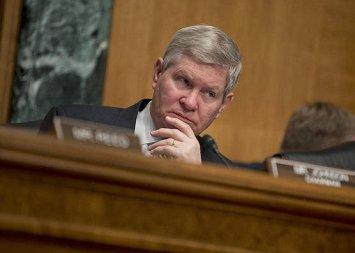
Sen. Tim Johnson (D-S.D.)
On Tuesday, the day before the breakthrough at the Supreme Court, Sen. Tim Johnson (D-S.D.) threw his support to the Employment Non-Discrimination Act (ENDA), increasing the total number of Senate cosponsors to 53.
Only three Senate Democrats -- Sens. Joe Manchin (W.Va.), Bill Nelson (Fla.) and Mark Pryor (Ark.) -- have not signed on, while two Republicans, Sens. Susan Collins (Maine) and Mark Kirk (Ill.), are cosponsors.
As is the case with any bill of any consequence, it's safe to assume Senate Republicans would filibuster ENDA and require a 60-vote supermajority, so 53 backers is obviously seven short. But Roll Call reports today that the bill may well "get a boost" from the Supreme Court.
The Employment Non-Discrimination Act already has more than 50 Senate supporters and is set for its first committee test vote next month. And Senate Majority Leader Harry Reid, D-Nev., committed Wednesday to full Senate action.
"The fight for equality continues. I will soon bring the Employment Non-Discrimination Act to the floor of the Senate for a vote," Reid tweeted.
Bill sponsor Sen. Jeff Merkley cited the high court's historic rulings to overturn the Defense of Marriage Act and California's gay-marriage ban as a beginning to an even larger legislative battle on lesbian, gay, bisexual and transgender issues.
Backers continue to keep an eye on Sen. Rob Portman (R-Ohio), who supports marriage equality because his son is gay, but has not yet endorsed this anti-discrimination proposal. His office this week said Portman "has not studied the most recent version of ENDA," despite the fact that proponents have sought his support on the bill since April.
Also keep an eye on Sen. Lisa Murkowski (R-Alaska), who endorsed marriage equality last week.
I'm hard pressed to imagine how anyone can argue, "I support the rights of gay Americans to get married, but if they get fired from their jobs solely because of their sexual orientation, that's fine."
Texas' Perry tries mansplaining abortion to Wendy Davis
Just yesterday, Texas Gov. Rick Perry (R) called for a second special session of the Texas Legislature, specifically in the hopes of passing sweeping and legally dubious new restrictions on abortion rights. The Republican governor said such a move is necessary because "Texans value life." (Perry's administration executed a 52-year-old woman a few hours later.)
This morning, Perry followed up the move with a speech at the National Right To Life conference, where he chose to discuss state Sen. Wendy Davis' (D) personal background. Igor Volsky posted this remarkable clip:
Watch on YouTubeFor those who can't watch clips online, the Texas governor said, in reference to Davis:
"[E]ven the woman who filibustered the Senate the other day was born into difficult circumstances. She was the daughter of a single woman, she was a teenage mother herself. She managed to eventually graduate from Harvard Law School and serve in the Texas senate. It's just unfortunate that she hasn't learned from her own example that every life must be given a chance to realize its full potential and that every life matters."
In the same remarks, Perry added, "The louder they scream, the more we know that we are getting something done."
The Washington Post's James Downie summarized the problem well this morning, noting, "I don't care what your stance on abortion is. Using an opponent's teen pregnancy in any debate is unbelievably vile."
I'll confess that when I saw some emails about Perry's comments, I thought someone must have made a mistake. The Texas governor is out there, but is he really that far gone?
Alas, the quotes are real. This really is Perry's character on full display.
How's that outreach initiative going, Reince?
Update: Wendy Davis responded to Perry's comments with the following statement: "Rick Perry's statement is without dignity and tarnishes the high office he holds. They are small words that reflect a dark and negative point of view. Our governor should reflect our Texas values. Sadly, Gov. Perry fails that test."
Thursday's campaign round-up
Today's installment of campaign-related news items that won't necessarily generate a post of their own, but may be of interest to political observers:
* The Democratic National Committee slammed Republicans this week for the failure of the RNC's "rebranding" initiative. This video was released to coincide with the 100-day mark since Reince Priebus' "autopsy" report was released.
Watch on YouTube* On MSNBC's "All In with Chris Hayes" last night, Texas state Sen. Wendy Davis (D) acknowledged that she's interested in running for governor in 2014.
* Speaking of the Lone Star State, Gov. Rick Perry (R) signed Texas' new congressional map into law yesterday, a move that was made possible by the U.S. Supreme Court gutting the Voting Rights Act.
* In New Jersey, Newark Mayor Cory Booker (D), currently the front runner in his state's U.S. Senate special election, released his first television ad of the race this week.
* In Ohio, Gov. John Kasich's (R) public standing continues to steadily improve. The latest Quinnipiac poll shows his approval rating up to 55%, and the governor holds comfortable leads over his likely Democratic challengers in hypothetical match-ups.
* In Montana, Public Policy Polling shows a very competitive Senate race in 2014. In hypothetical match-ups, former Gov. Brian Schweitzer (D) leads Steve Daines by three points, 48% to 45%, but narrowly trails Marc Racicot by one, 47% to 46%.
* In Iowa, Republican Mark Jacobs, best known as the former CEO of Houston-based Reliant Energy, kicked off a U.S. Senate campaign yesterday. Jacobs, an Iowa native, returned to the state from Texas last year.
* There were some rumors in Louisiana this week that Gov. Bobby Jindal (R) might take on Sen. Mary Landrieu (D) next year, but an advisor to the governor quickly knocked down the rumor. "No interest," Jindal's advisor said. "At all."
* And for some reason, John Bolton, the former U.S. Ambassador to the U.N. and an outspoken neocon, has decided to launch a "tour of early primary states." National Review added, "Sources say Bolton is also planning to launch a few related groups that will help elevate his argument and his national profile."
Rand Paul walks back talk of cross-species marriage

Getty Images
Now there's a headline in the Washington Post every Senate office wants to see: "Rand Paul mentions non-human marriage while discussing gay marriage, says it was joke."
Since we talked yesterday about Sen. Rand Paul's (R-Ky.) controversial appearance on Glenn Beck's show, it's only fair that I note his efforts to walk his comments back.
Sen. Rand Paul (R-Ky.) on Wednesday appeared to suggest a link between the Supreme Court's rulings on gay marriage and marriage between a human and a non-human, but later walked back that suggestion and said it was a joke. [...]
Paul's office said Thursday that the senator was making a joke, according to Slate's Dave Weigel. "Sarcasm sometimes doesn't translate adequately from radio conversation," a spokesman said.
I, too, received an email from the senator's communications director, who said Paul's comments had been "unfortunately taken out of context by a number of media outlets."
For the record, I published the entirety of his 181-word response so that readers could see the entire context (which, to my mind, don't help the senator's case). You can also listen to the exchange, since it was posted to YouTube.
Whether his comments about cross-species marriage were meant in jest or not, it's clear Rand Paul, an alleged champion of limited government and personal freedom, remains a staunch opponent of equal marriage rights for all Americans.
June 26, 2013
Wednesday's Mini-Report
Today's edition of quick hits:
* President Obama's African trip will clearly not be a leisurely vacation.
* Just minutes ago, Texas Gov. Rick Perry (R) called for another special session of the state legislature, presumably to tackle a proposal to restrict reproductive rights. The session is apparently slated to being on July 1. Perry said the session is needed because Texans "value life."
* On a related note: "Texas is poised to execute its 500th inmate since reinstating the death penalty in 1982, passing a grim milestone in the state that has executed more prisoners than any other state in the country."
* That was $2.3 million of our money: "House Democrats ripped GOP leadership Wednesday for spending millions defending the Defense of Marriage Act after the Supreme Court ruled Wednesday that it violated the Constitution."
* Comprehensive immigration reform may pass the Senate as early as tomorrow.
* Australia: "Julia Gillard, the Australian prime minister hailed as a feminist icon after a fiery speech against 'sexism and misogyny' in politics, was dumped from office by her own party Wednesday. The country's first female leader lost a dramatic political gamble by calling a leadership vote in a bid to end internal dissent in her Labor Party, which polls suggest is heading for defeat in imminent elections."
* U.S. military leadership: "President Barack Obama said Wednesday that he's re-enlisting Army Gen. Martin Dempsey for another term as chairman of the Joint Chiefs of Staff. The president also said he has asked Adm. Sandy Winnefeld to serve another term as Dempsey's vice chairman."
* House Minority Leader Nancy Pelosi (D-Calif.) "will not be trolled" by Michele Bachmann.
* And in 2009, Edward Snowden had a very different perspective towards those who leak classified information. "Those people should be shot in the balls," Snowden apparently said of leakers in a January 2009.
Anything to add? Consider this an open thread.
Post-DOMA, Rand Paul fears humans marrying non-humans
Getty Images
It seems much of the media establishment has decided Sen. Rand Paul (R-Ken.) deserves to be taken seriously. He's made seven Sunday show appearances since February; the New York Times recently described Paul has one of his party's "rising stars"; and the Washington Post's Chris Cillizza last week referred to the Kentucky Republican as "the most interesting politician in the country" and "the most interesting man in the (political) world."
And yet, it's difficult to reconcile the media adulation and Rand Paul's occasional crackpot tendencies.
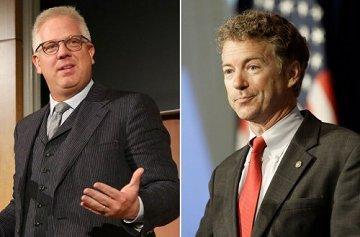
Earlier today, for example, the senator appeared on Glenn Beck's show to discuss, among other things, the Supreme Court's ruling striking down the Defense of Marriage Act. The host suggested the ruling could lead to polygamy: "If you change one variable -- man and a woman to man and man, and woman and woman -- you cannot then tell me that you can't logically tell me you can't change the other variable -- one man, three women. Uh, one woman, four men.... If I'm a devout Muslim and I come over here and I have three wives, who are you to say if I'm an American citizen, that I can't have multiple marriages."
For Paul, this seemed perfectly sensible. In fact, the senator went even further than Beck. Here's the entirety of Rand Paul's response, in which the senator said he's "kind of with" the unhinged host.
"I think this is the conundrum and gets back to what you were saying in the opening -- whether or not churches should decide this. But it is difficult because if we have no laws on this people take it to one extension further. Does it have to be humans?
"You know, I mean, so there really are, the question is what social mores, can some social mores be part of legislation? Historically we did at the state legislative level, we did allow for some social mores to be part of it. Some of them were said to be for health reasons and otherwise, but I'm kind of with you, I see the thousands-of-year tradition of the nucleus of the family unit. I also see that economically, if you just look without any kind of moral periscope and you say, what is it that is the leading cause of poverty in our country? It's having kids without marriage. The stability of the marriage unit is enormous and we should not just say oh we're punting on it, marriage can be anything."
Raise your hand if you think Rand Paul has any idea what he's talking about.
I realize there's a "Stand With Rand" crowd that's convinced the Kentucky Republican is a visionary when it comes to limited government, and I understand that much of the media establishment is eager for us to perceive him as a serious and credible person. But Rand Paul decided to chat with Glenn Beck, and during the interview the senator raised the prospect of marriage-equality proponents asking, "Does it have to be humans?"
If this is what constitutes an "interesting" politician and "rising star" in Republican politics, the GOP is in dire straits, indeed.
There is a contingent of the population that's desperately looking for a prominent political figure in Washington who celebrates civil liberties, is openly uncomfortable with the national security state, and opposes the rush towards more wars, especially in the Middle East.
But we're frequently reminded why Rand Paul probably isn't the champion these folks have been waiting for. He believes bizarre and unsettling conspiracy theories; he's convinced the Obama administration is responsible for problems with his toilet; his concerns about armed drones are strikingly ignorant and contradictory; he considers fringe outlet like World Net Daily to be credible news organizations, and on the morning of a civil-rights breakthrough for LGBT Americans, he hangs out with Glenn Beck and raises the specter of bestiality.
If you've chosen Rand Paul as your freedom-celebrating hero, you've probably picked the wrong guy.
Blue dots, red states and the hope of marriage equality
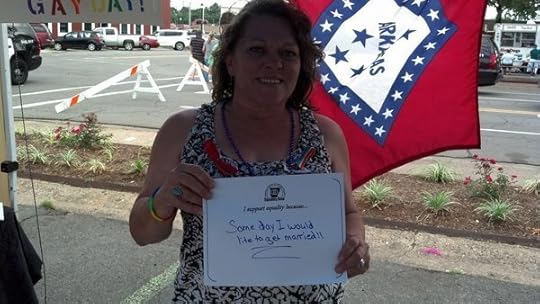
This month in Arkansas. Photo: The Arkansas Initiative for Marriage Equality
These may not be the very most optimistic words in the English language right now, but they're up there:
The Arkansas Marriage Equality Amendment
AN AMENDMENT TO THE ARKANSAS CONSTITUTION TO PROVIDE THAT THE RIGHT TO MARRY SHALL NOT BE ABRIDGED OR DENIED ON ACCOUNT OF SEX OR SEXUAL ORIENTATION – PROVIDING THAT NO MEMBER OF THE CLERGY OR RELIGIOUS ORGANIZATION SHALL BE REQUIRED TO PROVIDE ACCOMMODATIONS ADVANTAGES, FACILITIES OR PRIVILEGES RELATING TO THE SOLEMNIZATION OR CELEBRATION OF MARRIAGE AND THAT THE REFUSAL TO DO SO SHALL NOT CREATE ANY CIVIL CLAIM OR CAUSE OF ACTION.
Yes, that is the actual preamble to a proposed referendum for marriage equality in bright-red Arkansas. Repeating: In Arkansas.
Trey Weir of the Arkansas Initiative for Marriage Equality tells us they started meeting the day after the 2012 elections, when voters in Maine, Washington and Maryland all approved marriage equality measures. Weir notes that Arkansas approved a constitutional amendment banning same-sex couples from marriage in 2004. The vote -- the last in Arkansas on the issue since then -- went 75-25.
With today's Supreme Court ruling, maybe Weir's quiet goal becomes that much more possible to achieve. We've begun tracking nascent movements like Arkansas' in states all across the country. More on that later, but know for now that some amount to not much more than a point person and email address, and some, like the one in Arkansas, are actively crafting measures and getting ready to collect signatures. In Arkansas, they're trying for the ballot in 2016. Weir says that for now, it matters just to make the effort:
We have hopes that the snowball effect of LGBT rights will find its way to Arkansas and the rest of the south in the near future. Our success rate is not seeing it get passed but also educating Arkansans on the issue. . . . We hope that our efforts will put marriage equality and other LGBT issues on the fast track in the right direction here in Arkansas.
Nothing gets a ball rolling like pushing it. If you're out there in red states or anti-equality states and you know of a marriage movement, sing out in the comments, please.
(H/t interns Katie Riley and Carl Dawson for reporting.)
'It is the right thing to do'

Associated Press
In February, the Pentagon made an important and welcome announcement, extending new benefits to gay men and women serving openly in the military and their families. There was, however, a catch: the Defense of Marriage Act prevented the Department of Defense from going as far as officials wanted to.
And now that DOMA is no more, the military is ready to finish the job.
The Pentagon will offer full benefits to same-sex military couples after the Defense of Marriage was struck down by the Supreme Court, Defense Secretary Chuck Hagel said Wednesday.
Hagel said that the Defense Department would immediately begin implementing the changes in the law stemming from the Supreme Court's decision, which had prevented same-sex military spouses from receiving medical coverage, on-base housing and other benefits.
In a statement, Hagel explained, "The Department of Defense intends to make the same benefits available to all military spouses -- regardless of sexual orientation -- as soon as possible. That is now the law, and it is the right thing to do.... Today's ruling helps ensure that all men and women who serve this country can be treated fairly and equally, with the full dignity and respect they so richly deserve."
When Hagel was a conservative Republican senator, he was not a supporter of gay rights, and there were some questions during his confirmation process about whether he would follow through on these issues at the Pentagon. It appears those questions have been put to rest.
Regardless, substantively, it's yet another aspect to the larger breakthrough: "The decision is likely to have a big impact on 17,000 troops and veterans whose same-sex spouses have been shut out of a wide variety of benefits, from health care to military housing -- and even the ability to be buried at the same cemetery."