Armand Inezian's Blog
November 20, 2020
Reader's block- and how fantasy holds a special place for me.
I am an avid reader across many genres. I mostly read fiction, but that includes fantasy, sci-fi, classics, modern literary, Westerns, you name it. I also occasionally delve in non-fiction, short stories, essays, plays, graphic novels, magazine articles newspapers, and- every once in a while- poetry.* I have to admit that I don't read much in the romance genre and rarely touch murder mysteries (although I think I would probably like a well-written mystery). But, overall, I read a lot of different genres.
The funny thing about my reading, however, is that I tend to read very heavily for a year or two and then suddenly stop. Sometimes, after I stop, it might take a year or two to really get started again. That doesn't mean stop reading all together, but I tend to only read newspapers and maybe, a couple of books while on vacation.
It's almost like a version of writer's block. Let's call it reader's block. Does this happen to you?
Anyway, after reading a lot in 2019, I ran into another episode of "reader's block" this year. How can I describe reader's block? It's like books are almost too heavy to pick up. It starts to feel like reading a book has become more of a job than a pleasure**. It's like dating when you are a single introvert. It's like when you decide to take up jogging, realize how healthy it is but also realize that you can't stand it. You just can't face it.
Anyway- I know this is a long, rambly post, so thanks for bearing with me; we're almost done here!
The point here is that I have recently been in the funk of reader's block, and I was thinking about it while I was taking a walk (but not jogging!) and it suddenly occurred to me that I needed to get my hands on a good fantasy novel. But why a fantasy novel? That question popped into my brain.
It's hard to explain, but I feel like fantasy (and science fiction) stories have some power over us that other stories (no matter how great) don't quite have. I remember reading an essay once that attempted to describe why there were alway
s Star Trek Conventions and Star Wars Conventions, but no MASH Conventions, nor Friends Conventions***, nor Miami Vice Conventions. There is some draw or connection in that which is fantastic and (somehow) we see ourselves in those different universes with different rules.
For me, growing up, fantasy and science fiction were my first literary loves. In retrospect, a lot of it wasn't even very good, but even the most corny, unoriginal, stupid story could open the door to a whole new universe to get lost in. That sense of wonder (The wonder of seeing "what might be") has always carried me back to reading. And as much as I love literary fiction, it does not contain that element of "what might be".
So- of all things- it's the fantasy novels that most often pull me out my reader's block and get me moving again. It's like meeting an old friend who invites you over to their house, or invites you out to a pub. Somehow, getting back to fantasy of sci-fi takes me back to my roots and allows me to start reading again.
footnotes:
*I have to admit that I sometimes have trouble "getting" poetry. Not to say that there isn't some poetry that I've really enjoyed, but some of it is abstract enough that I have a hard time following it.
**Having a book feel more like work than pleasure always reminds me of 8th grade.
*** Was there a Friends Convention? Maybe there was one.


October 30, 2020
Storytelling and the art of literary surprise.
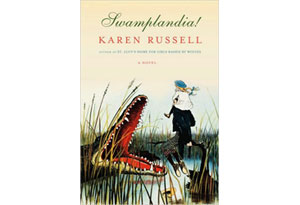
It probably a good idea to start with the movies, but we will move on to books in a moment. My reason to start with movies is this; it's more likely that you and I share the experience of seeing M. Night Shyamalan's movie, The Sixth Sense, then it is that you and I have both shared the experiencing of reading Atonement by Ian McEwan or Swamplandia! by Karen Russel.
So let's just start with the movies. The Matrix and The Sixth Sense. Old movies by now, but I remember when they were new, and they surprised so many of us. In fact, I would argue that these two films hold some of the best surprises in movie history because of the kind of surprises they present. They were bold. These were no ordinary surprises. These were not simple plot twists, or a discovery of the killer's true identity. Nope, these were like a good magician's trick. They did not simply pull the rug out from under your feet; they pulled reality out from beneath you!
I still remember the moment the moment in the Matrix when Neo (Keanu Reeves) was suddenly flushed down the drain pipes. I still remember the moment that I realized what Malcolm Crowe (Bruce Willis) truly was. The chills. The moment when I was both elated at this revelation and confronted by the fact that the evidence had been there- in my face- the whole time.
But Matrix and The Sixth Sense are movies, created by companies with huge budgets and astounding special effects; can the same be accomplished in a book? Well sure! And, in some ways, books can be more insidious. Take these two cases: (warning spoilers!): Ian McEwan's literary triumph, Atonement, and the lesser known (although quite amazing) Swamplandia!, a contemporary fiction novel by Karen Russel.
Books can trick us by using unreliable narrative and ambiguous genre. They play with these questions:
Can I trust what I'm reading here?
And what am I reading here?
By manipulating these elements, authors can spin us until we are dizzy.
Atonement was a big enough deal that there was a movie made from it, and on the surface, it presents the story of doomed lovers in WW2 era Britain. Beautiful writing, rich characters, and a real sense of that era, but like the Matrix, Atonement conceals a brilliant surprise; it makes great use of unreliable narrative. Most of the book is the "true story", but one part, a significantly vital section, has been written by a character within the book, and it's not all true. In fact, that untrue section is the main character's "atonement", her attempt to redress something terrible that she has done. Sound complicated? Well it's not any more complicated than the Matrix movie. We, the audience, discover that part of the story is not true. In the case of the Matrix, it was events that transpire in virtual reality. In Atonement, it's not virtual reality but a virtual story tucked inside a "realistic" story.
Swamplandia! uses a different kind of tension, that of genre ambiguity. There's a lot going on in Swamplandia!, actually, but the biggest story arc involves a young girl who is either: going on a spiritual journey into the land of the dead with the mysterious "Birdman", or maybe she's being kidnapped by a sick weirdo. It becomes and stays unclear for a lot of the book, and such was the power of the tension that, based on my background as a reader, I was not sure what I was reading. Early on, Swamplandia! hints (from the girl's point of view) that ghosts are real in this world, but troublesome hints start to push as in the opposite direction. What's real? Am I reading a ghost story or is this just a bad event filtered through the eyes of teenaged girl with dark obsessions? Were they going to find the land of the dead or was she going to be killed out there in the swamp? The simple act of not knowing what it is that I'm reading kept me on the edge of my seat.
Both these books gave that wonderful of surprise and engagement. And these kind of surprises, the power to shift the underpinnings of the world, bring me back to being that kid in the movie theater. That moment in the dark. The chills and the revelation.
September 9, 2020
Dreaming of masks.
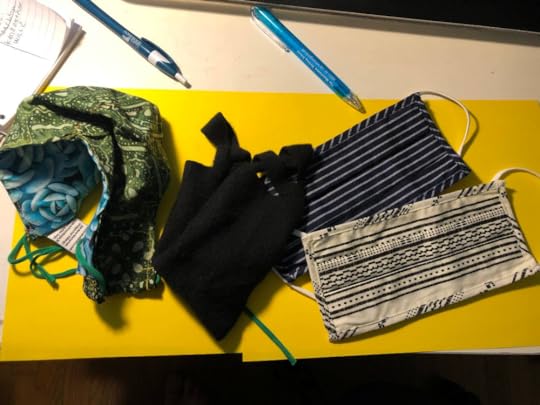
Last week, I had a dream that I was going out with my family, and- for the first time since the quarantine- I stopped mid-dream and realized that I had forgotten my mask! Anyone else having masks creep into their dream life?
August 22, 2020
What a YA novel from 2001 taught me about negative emotions.
I am a fairly eclectic reader. I like to delve into a different genres: literary fiction, the classics, fantasy. Sometimes I read kids' books, YA, non-fiction, and even poetry. Lately, with the world falling apart, I have reading the NY Times more than anything else, but my point is that I'll pick up a book from almost anywhere.
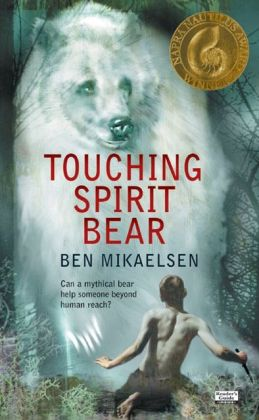
My most recent read was Touching Spirit Bear, a YA novel by Ben Mikaelsen. Touching Spirit Bear is a tough-love kind of novel about a teenaged boy who must deal with his uncontrollable anger issues by living alone on a wilderness island in Alaska. We got the book because it was part of my son's 8th grade summer-reading list, and I grabbed it from the shelf on a whim and started reading.
Overall, the story is fairly compelling, and while I have read better books, Touching Spirit Bear is particularly interesting because I actually learned something about my own life.
This is what happens: When the main character, Cole Matthews, is sent to live alone on an island, he is escorted (and "sponsored") by two Native Americans, both of whom have dealt with anger issues of their own.
One of them, Edwin, talks Cole through a scenario. He picks up a stick and asks Cole to imagine that right end of the stick is Cole's happiness, and that the left side is Cole's anger. Then he asks Cole to break off the left side of the stick to get rid of his anger, so Cole does just that.
"You broke off the left end, but the left end still exists," Edwin tells him.
"The left end will always be there," Cole replies.
Edwin explains that people spend their lives breaking the stick to get rid of anger, but it will never entirely go away, …"because there will always be a left end to a stick."
So Cole asks how people get rid of anger then, and Edwin basically explains that anger will always be there, and that we just have to choose to focus more on happiness (the other end of the stick) and less on being angry.
As I read this, I realized it was a very thoughtful way to address negative emotions. Instead of trying to remove the negative feeling- like anger or self-pity- and pretending it was never there (which may be impossible), I should try to live with the negative feelings, but also focus on the "right side of the stick", on feelings like forgiveness and gratitude that can move me towards having a better life. As I spend more time with these positive emotions, I can learn to better accommodate the negative ones which makes them less of an impediment in everyday life.
It's very rare that I feel like I actually learned a practical life skill, or a different way of thinking from a novel (I'm more likely to learn such things from non-fiction), and I just needed to tip my hat to Ben Mikaelsen and his book!
August 20, 2020
Catch-22
Short post today- I snuck the term "catch-22" into an email today for my regular day job! I felt so literary!
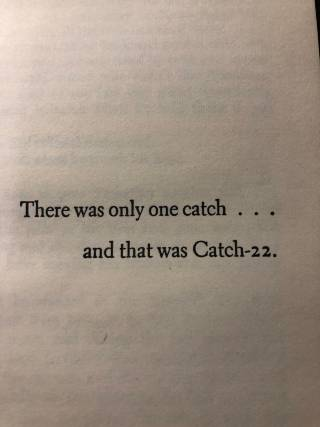
Catch-22
Short post today- I snuck the term "catch-22" into an email today for my regular day job! I felt so literary!
August 8, 2020
Thinking about what poetry gives to me as a writer:

We—could tremble—
But since we got a Bomb—
And held it in our Bosom—
Nay—Hold it—it is calm—
Therefore—we do life's labor—
Emily Dickinson, I tie my Hat—I crease my Shawl
In some way, poetry is the forgotten cousin of the literary world, but it can be a useful tool for writers.
Walk into almost any bookstore, and you will almost always find a poetry section. But who buys poetry? Who reads it? English majors? Folk signers? People who want to look smart? I don't think it's much a stretch to say that poetry is definitely a niche product.
For many of us, poetry harkens back to high school when we were forced to read Shakespeare, or Robert Frost, Emily Dickinson, or E.E. Cummings. Maybe we had to pass a quiz about it, or even write a paper. Maybe some of us tried writing poetry at some point, but, for most of us, it is not the stuff of everyday life.
But I believe that- for writers in particular- it's important to keep poetry around, and to look into it occasionally, because it broadens our horizons, and, if you are a writer, it can be help give us a different perspective on your craft. Poets are doing something different from mainstream writers. Poets are experimenting with words, the atoms that make up all writing. They are the atom-smashers and re-shapers of elements. They will place words in new orders and rebuild sentences in ways we have never seen before.
Because a lot of modern poetry is short form, they also spend a lot of time working on economy of language. A good poem might change our perspective, expose history, or bring us to a deeper understanding of the world using only a few phrases. Poets need to deliver big ideas in very small packages.
So let's dust off the poetry; it can change the way we write; it's like painting with a totally different brush. It helps us reconsider how we say something, what our words might mean, and can help us discover new methods to express feelings and stories.
July 29, 2020
Soviet Humor (?)

My new novel, The Ghost Code is set in 1950's Soviet-era Russia. As I wrote and edited the book, I turned to numerous non-fiction books for a perspective of that time, place, and culture. Among the books I read were
I learned so much from those books, but what I want to share today is, of all things, jokes. The way a joke is told, the way it plays out, can tell you a lot about a time and place. From all the reading I did, two jokes really stuck with me, they are both from the 1970's, when the Soviet economy was starting to flag (Just like the US economy of the 70's!). By this time the natural resource boom and economic benefits of industrialization were giving away to economic stagnation. While jobs were still guaranteed by the government, the chances of being promoted or finding meaningful work were getting smaller. Real wages were in decline, even a centralized economy could not stop that.
So these jokes are Russian jokes that address the slow decline of the Soviet economy. Also, I just think they're funny.
The train ride joke:
Soviet leaders Josef Stalin, Nikita Khrushchev, and Leonid Brezhnev are riding on a train together. Everything seems to be going fine, until the train slowly grinds to a halt. It turns out there is some problem with the train or the tracks (no one is sure), but the train engineers are working on it.
Minutes go by, and then hours, but still nothing happens. Finally, in a fit of bloody rage, Stalin- who was responsible for the deaths of millions- tells his soldiers to go outside and shoot the engineers. "That'll show them!" Stalin says. "After that, everyone will be scared, and they'll start the train again immediately." The soldiers go out and kill the engineers, but- unfortunately- the train is still sitting there, not moving at all.
After a long time, Khrushchev says, "Well, let me try." And Khrushchev, who had worked to lessen the burden of the earlier Soviet violence, writes a long, heartfelt letter pardoning the engineers for any past crimes, and he declares that they were, in fact, heroes. He sends the letter out. "When people hear that that we have pardoned the engineers, they will take heart, and they will start the train," he says.
However, that does not work either.
More time passes, and the train continues to sit quietly, not moving at all. Finally, Secretary Brezhnev, who presided over the collapsed economy of the 70's, gets up. He goes to each window in the railcar and pulls down the shade, so no can see out. Then he says, "You know, let's all just pretend we're moving."
The professor joke:
A famous professor of economics is traveling outside of Moscow. As part of his travels, he visits factories and farms in the hinterlands of the Soviet Union. In a small town, he gets finds himself in a discussion with a factory worker. "So you study economics?" the worker asks.
"Yes, I'm an expert," the professor explains. "My specialty is the structure of the Communist economy, which your factory is part of. Would you like me to explain the basics to you?"
"Oh no, I already understand," the factory worker says.
"You do?"
"Oh sure. We pretend to work and the government pretends to pay us!"
July 24, 2020
Harry Potter and Human Nature - Or: Can magic be boring? Absolutely just apply human nature.
Overall, I liked it, but what I really want to talk about is how J.K. Rowling has (inadvertently?) captured a basic characteristic of human nature in Harry's schooling, the characteristic of becoming jaded.
Here's the thing, in the story Harry Potter suffers a terrible upbringing. He is underfed, bullied, and generally dismissed and maliced by his aunt and uncle's family. Then, in that first book, something amazing happens! He learns that magic is real and- amazingly- he is invited to wizard school. His whole life is about to change. He is going to learn spells that defy the basic laws of physics. He is going to discovers mysteries of the Universe! He's going to immerse himself in the sorcerous world.
Amazing right?
Except… Except a few months into his schooling, the glow starts to fade. It turns out that learning magic is tedious, difficult, and requires repetition and practice. It turns out that some magic teachers are big jerks. It isn't long before Harry is annoyed at his classes, distracted. He and Ron wind up copying notes from Hermione. Could it be that magic school itself is boring? In fact, Harry's favorite part of magic school is sports. His true comfort zone is Quidditch, so in wizarding terms, he's a jock!
As a parent of school age kids who sometimes complain about school, this element of the story stands out to me.
I don't think that Rowling set out to analyze or even touch on this theme specifically. My guess (and it's only a guess) is that she basically took the idea that kids find school boring and just went with it, but the idea is there anyway. Either accidently or on purpose, we see a fundamental truth of human nature revealed in the pages of this series.
And, in a way, we all are as jaded as Harry Potter. We live in a world where magic is almost real. We don't have flying carpets, but we have giant, metal rocket-gliders that can take you thousands of miles in an afternoon. We don't crystal balls, but we have cell phones that let us talk to (and see) almost anyone on the planet in an instant. And we don't need death curses--- do we? --- because (well) we have guns.
The list goes on!
Imagine a small box that can quickly warm your dinner!
Imagine a book that is only a single screen, able to rearrange the words over and over again!
Imagine a camera that can fly over your head!
Imagine small animated discs that clean and scrub your floors!
Imagine a chariot that pulls itself and that activates using only some liquid!
Our ancestors of previous centuries would be amazed if they could travel through time and see the near-magic inventions of today, or at least they would be amazed for about a month and then, like Harry Potter, they would slowly grow jaded, until magic school is just school.
Maybe what we need, instead of all this magical technology, is a fresh set of eyes.
Can magic be boring? Absolutely! Just apply human nature.

This year, after being prompted by my daughter, I finally got around to reading the Harry Potter series. I know that I read it 20 years too late!
Overall, I liked it, but what I really want to talk about is how J.K. Rowling has (inadvertently?) captured a basic characteristic of human nature in Harry's schooling, the characteristic of becoming jaded.
Here's the thing, in the story Harry Potter suffers a terrible upbringing. He is underfed, bullied, and generally dismissed and maliced by his aunt and uncle's family. Then, in that first book, something amazing happens! He learns that magic is real and- amazingly- he is invited to wizard school. His whole life is about to change. He is going to learn spells that defy the basic laws of physics. He is going to discovers mysteries of the Universe! He's going to immerse himself in the sorcerous world.
Amazing right?
Except… Except a few months into his schooling, the glow starts to fade. It turns out that learning magic is tedious, difficult, and requires repetition and practice. It turns out that some magic teachers are big jerks. It isn't long before Harry is annoyed at his classes, distracted. He and Ron wind up copying notes from Hermione. Could it be that magic school itself is boring? In fact, Harry's favorite part of magic school is sports. His true comfort zone is Quidditch, so in wizarding terms, he's a jock!
As a parent of school age kids who sometimes complain about school, this element of the story stands out to me.
I don't think that Rowling set out to analyze or even touch on this theme specifically. My guess (and it's only a guess) is that she basically took the idea that kids find school boring and just went with it, but the idea is there anyway. Either accidentally or on purpose, we see a fundamental truth of human nature revealed in the pages of this series.
And, in a way, we all are as jaded as Harry Potter. We live in a world where magic is almost real. We don't have flying carpets, but we have giant, metal rocket-gliders that can take you thousands of miles in an afternoon. We don't crystal balls, but we have cell phones that let us talk to (and see) almost anyone on the planet in an instant. And we don't need death curses--- do we? --- because (well) we have guns.
The list goes on!
Imagine a small box that can quickly warm your dinner!
Imagine a book that is only a single screen, able to rearrange the words over and over again!
Imagine a camera that can fly over your head!
Imagine small animated discs that clean and scrub your floors!
Imagine a chariot that pulls itself and that activates using only some liquid!
Our ancestors of previous centuries would be amazed if they could travel through time and see the near-magic inventions of today, or at least they would be amazed for about a month and then, like Harry Potter, they would slowly grow jaded, until magic school is just school.
Maybe what we need, instead of all this magical technology, is a fresh set of eyes.