Edward Cline's Blog, page 14
March 31, 2016
Restroom Follies

Bisexual aliens, bestiality gourmands, man-boy lovers, woman-girl lovers, voluntary amputees, and eunuchs welcome.
The traditional source of the law of non-contradiction is Aristotle's Metaphysics where he gives three different versions.
1. ontological: "It is impossible that the same thing belong and not belong to the same thing at the same time and in the same respect." (1005b19-20)2. psychological: "No one can believe that the same thing can (at the same time) be and not be." (1005b23-24) 3. logical: "The most certain of all basic principles is that contradictory propositions are not true simultaneously." (1011b13-14)
In short, A is A; A cannot be A and non-A (or B) at one and the same time.
Aristotle did not deal in traditions. Traditions are not a fundamental basis for establishing facts, politics, art, or even gender. Traditions are “time-honored” actions or beliefs, which may or may not be worthy of observation. But they are not philosophy.
In today’s culture, a culture that has more or less repudiated Aristotle in its government, in its culture, and even in “gender identification,” it is possible for transgenders, gays, and other identity-deficient individuals to believe that they can be one gender and not what they don’t want to be. This phenomenon is possible only in a culture of philosophical disintegration.
This writer was banned and all records of his past columns “archived” out of public sight on http://capitalismmagazine.com/ over an article he wrote and posted in June of 2015, “The Prancing Unicorn of Bruce Jenner.” The article criticized Bruce Jenner, who decided he was Caitlyn Jenner, a woman. He claims he is no longer a man. But when he undergoes the emasculating surgery that will enable him (and all his fans) to pretend he is a woman, in fact, he will still be a man, but now a eunuch. Neither the blog host nor many of the site’s readers, cared for that logic. As a consequence, I no longer post columns on the site, and no longer read it.
Logic is the art of non-contradictory identification. Ayn Rand, the novelist/philosopher wrote succinctly and eloquently on the subject:
All thinking is a process of identification and integration. Man perceives a blob of color; by integrating the evidence of his sight and his touch, he learns to identify it as a solid object; he learns to identify the object as a table; he learns that the table is made of wood; he learns that the wood consists of cells, that the cells consist of molecules, that the molecules consist of atoms. All through this process, the work of his mind consists of answers to a single question: Whatis it? His means to establish the truth of his answers is logic, and logic rests on the axiom that existence exists.
Logic is the art of non-contradictory identification. A contradiction cannot exist. An atom is itself, and so is the universe; neither can contradict its own identity; nor can a part contradict the whole. No concept man forms is valid unless he integrates it without contradiction into the total sum of his knowledge. To arrive at a contradiction is to confess an error in one’s thinking; to maintain a contradiction is to abdicate one’s mind and to evict oneself from the realm of reality.
There are many people in the population now who believethey are contradictions, and prefer to be contradictions. It’s how they feel. They feel they are one gender but not the one defined by their physiology, because of their feelings. Feelings, or emotions, emotions they have not bothered to examine in any meaningful depth, to them are indisputable tools of cognition. Reality can be whatever they wish it to be. “Gender orientation” is based strictly on feelings, feelings based on what can only be mental disorders or some severe forms of neurosis that remain unexamined, uncorrected, and unchallenged by conventional psychoanalytic wisdom.
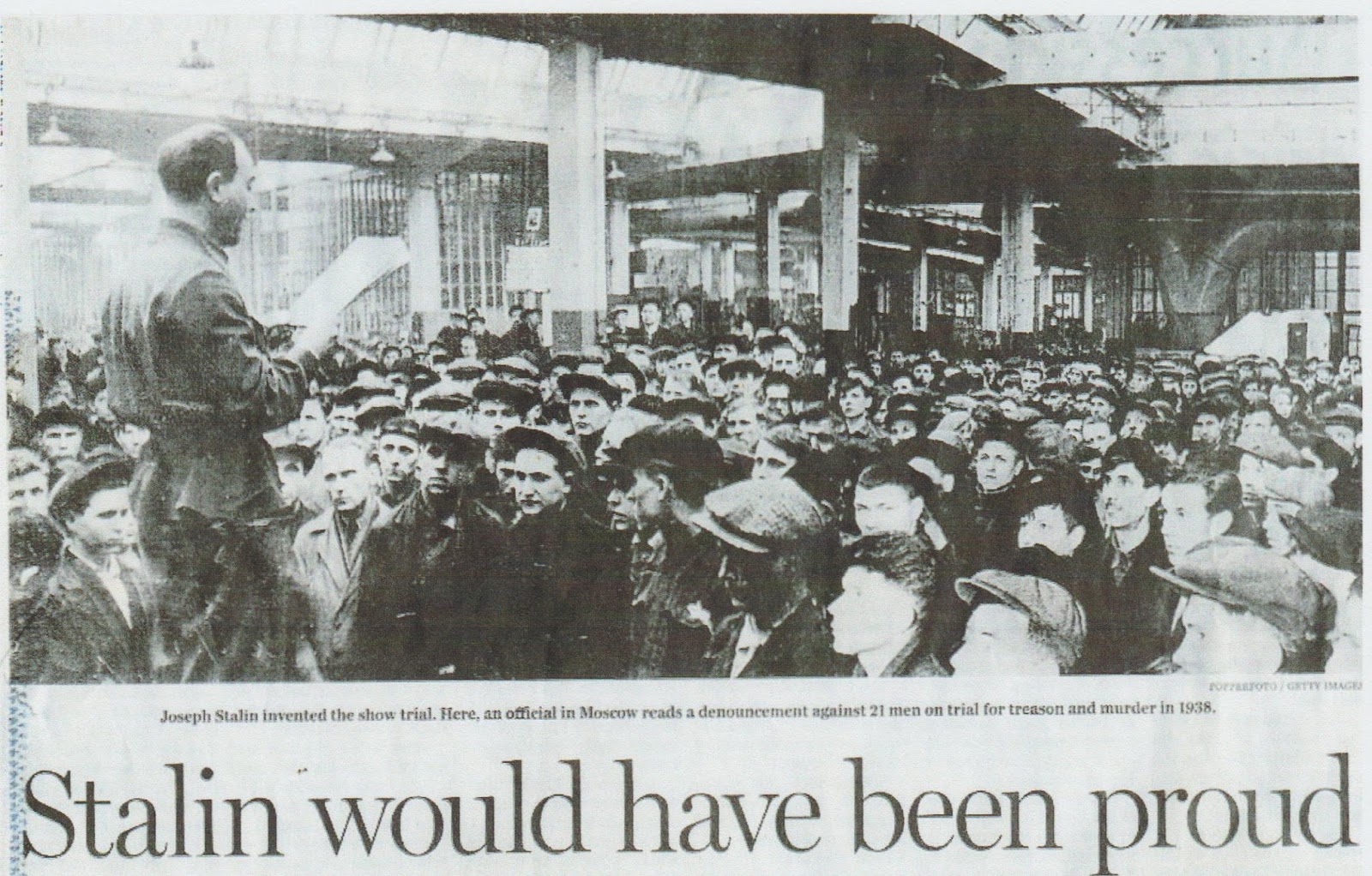 Of our American style Stalinism.
The chief subject here is not the political mare’s nest that governs local, state, and federal laws governing discrimination, freedom of assembly or association, and freedom of speech. These laws are themselves a consequence of statist premises. It is all part of the same, inexorable process of disintegration. North Carolina’s House Bill II, otherwise known as the “Public Facilities Privacy & Security Act,” has certainly touched off a reaction among those who favor discrimination in favor of the walking vehicles of feelings, of the abridging of freedom of speech, of forcing one’s association, under penalty of law, with people one would not otherwise choose to associate with, and constraints on speech because the speech – or idea – may “offend” another or hurt his feelings.
So, I’m not going to try to sort through whether or not the state had a right to override local ordinances or whether or not local governments had a right to pass ordinances governing who shall enter public facilities or restrooms. The Charlotte Observer on March 26th, in its article, “Understanding HB2: North Carolina’s newest law Solidifies state’s role in defining discrimination,” neatly synopsized the bill and its implications.
In a one-day specially convened session Wednesday, North Carolina’s legislature passed a sweeping law that reverses a Charlotte ordinance that had extended some rights to people who are gay or transgender.
The law passed by the General Assembly and signed that same night by Gov. Pat McCrory goes further than a narrow elimination of Charlotte’s ordinance, which had generated the most controversy by a change that protected transgender people who use public restrooms based on their gender identity. The new law also nullified local ordinances around the state that would have expanded protections for the LGBT community.
Moreover….
North Carolina’s new law sets a statewide definition of classes of people who are protected against discrimination: race, religion, color, national origin, age, handicap or biological sex as designated on a person’s birth certificate. Sexual orientation – people who are gay – was never explicitly protected under state law and is not now, despite recent court decisions that legalized same-sex marriage.
Transgender people who have not taken surgical and legal steps to change the gender noted on their birth certificates have no legal right under state law to use public restrooms of the gender with which they identify. Cities and counties no longer can establish a different standard. Critics of the Charlotte ordinance cite privacy concerns and say it was “social engineering” to allow people born as biological males to enter women’s restrooms.
HB2 does not affect existing local or state law governing the “protected” status of the LGBT tribe; it simply says local ordinances can't amend or expand the privileged status of the LGBT tribe.
Out, a gay magazine, claimed in its March 29th article, “New York, Seattle, San Fran Ban Travel to North Carolina Over Anti-LGBT Law,” that the North Carolina law blatantly discriminates against gays:
Pro-LGBT corporations and government officials have turned their focus toward North Carolina and its' HB2 after Georgia's Governor Nathan Deal announced Monday that he would officially veto the state's impending anti-LGBT legislation.
North Carolina's legislation would allow discrimination against LGBT individuals and ban trans individuals from using the bathroom associated with their gender identity. Google, Facebook, the NBA and the NCAA have all spoken out against the law that was created in response to the passing of a non-discrimination ordinance in Charlotte, N.C.
However, speaking of “equality,” that’s for the LGBT tribe, not for heterosexuals.
In response to the discriminatory law, Seattle's Mayor Ed Murray has banned official travel to the state.
“It is my hope for our nation that we do not allow issues of discrimination to divide us. Our union is only made stronger when all Americans are treated equitably."
New York Governor Andrew Cuomo and New York City Mayor Bill de Blasio have joined forces in their North Carolina boycott. In an official statement, the Governor banned nonessential travel to North Carolina.
"From Stonewall to marriage equality, our state has been a beacon of hope and equality for the LGBT community, and we will not stand idly by as misguided legislation replicates the discrimination of the past. As long as there is a law in North Carolina that creates the grounds for discrimination against LGBT people, I am barring non-essential state travel to that state."
These bans join a similar one invoked by San Francisco's Mayor Edwin Lee on March 25:
"I believe strongly that we should be adding more protections to prevent discrimination against lesbian, gay, bisexual and transgender communities in the United States, not taking them away."
The key fallacy employed throughout the whole controversy, which, given the that LGBT “community” can turn ugly and rancorous, is the notion of “gender identity” vs. “gender at birth,” or the biological fact of a person’s existence. The New York Times was quick to side with all the groups, businesses, and organizations that have not given an iota of thought to the contradiction, if, indeed, they are even aware of.
So, if one were driving a convertible car, one could wish and fancy that one were driving a Tootsie Roll. Why not? Reality is malleable. One’s consciousness creates and defines reality. Didn’t philosophers from Descartes and Immanuel Kant forward say this was true?The Times, in its March 24th story, “North Carolina Gay Bias Law Draws a Sharp Backlash,” reported the lemming-like rush to condemn the state legislature and the legislation.
A day after Gov. Pat McCrory of North Carolina signed a sweeping law eliminating anti-discrimination protections for all lesbians, gays and bisexuals and barring transgender people from using bathrooms that do not match the gender they were born with, the battle lines were clear in a bitterly divided state.
On social media and in public rallies, civil rights groups, businesses and politicians expressed dismay at the law, which was passed by the Republican-controlled legislature and signed by the governor within just 12 hours during a hasty special session on Wednesday.
American Airlines, which employs 14,000 people in the state and has its second largest hub in Charlotte, along with other companies with operations in the state, including Apple, Dow Chemical, PayPal, Red Hat and Biogen, all issued statements critical of the new law.
The object of the boycott is not so much to protest the North Carolina law, as to punish anyone who does not conform to the “settled science.” It has been established that one can change one’s gender at will, and demand that others recognize one’s homosexuality, lesbianism, and transgender status as “normal” and uncontroversial. Heterosexuality itself is being automatically labeled as a form of “bigotry,” just as whites are being labeled bigoted against blacks by the fact of their “whiteness.”
Truth Revolt carried this story on March 30th about the latest episode of the American version of a Stalinist purge: “Conservative Prof Must Confess 'Guilt' for His Political Views or Be Fired.” The subheading read: “Deems his views 'reckless and incompatible with the mission and values of Marquette University and you [must] express deep regret for the harm' they've caused.”
Because one of its professors defended a student's view of traditional marriage against a leftist philosophy instructor deeming it homophobic, Marquette University has threatened the conservative professor's job unless he confesses "guilt" for being "reckless" and causing "harm" to the offended instructor.
This incident dates back to November of 2014, when Professor John McAdams wrote a blog post chiding instructor Cheryl Abbate for trying to silence one of her students by telling him "some opinions are not appropriate." The exchange was secretly recorded by the student and McAdams was able to hear what was said and included those quotes in his blog.
In her "Theory of Ethics" class, Abbate was going through a list of political issues for discussion and when she came to "gay rights," she brazenly stated, "Everybody agrees on this, and there is no need to discuss it." The conservative student took issue with this and confronted her about it after class, telling her he disagrees with many of the tactics of the gay lobby, especially when it comes to pushing same-sex marriage and gay adoption.
The politically correct speech enforcer, according to the article, has left Marquette for another teaching – or brainwashing – position, but Marquette is now punishing Professor McAdams.
But now Marquette, listed as a Catholic university, is bringing charges against McAdams for his blog post and a so-called diverse faculty committee has recommended his suspension without pay through the fall of 2016 first, and then his position terminated if he doesn't confess "deep regret" for damages to Ms. Abbate.
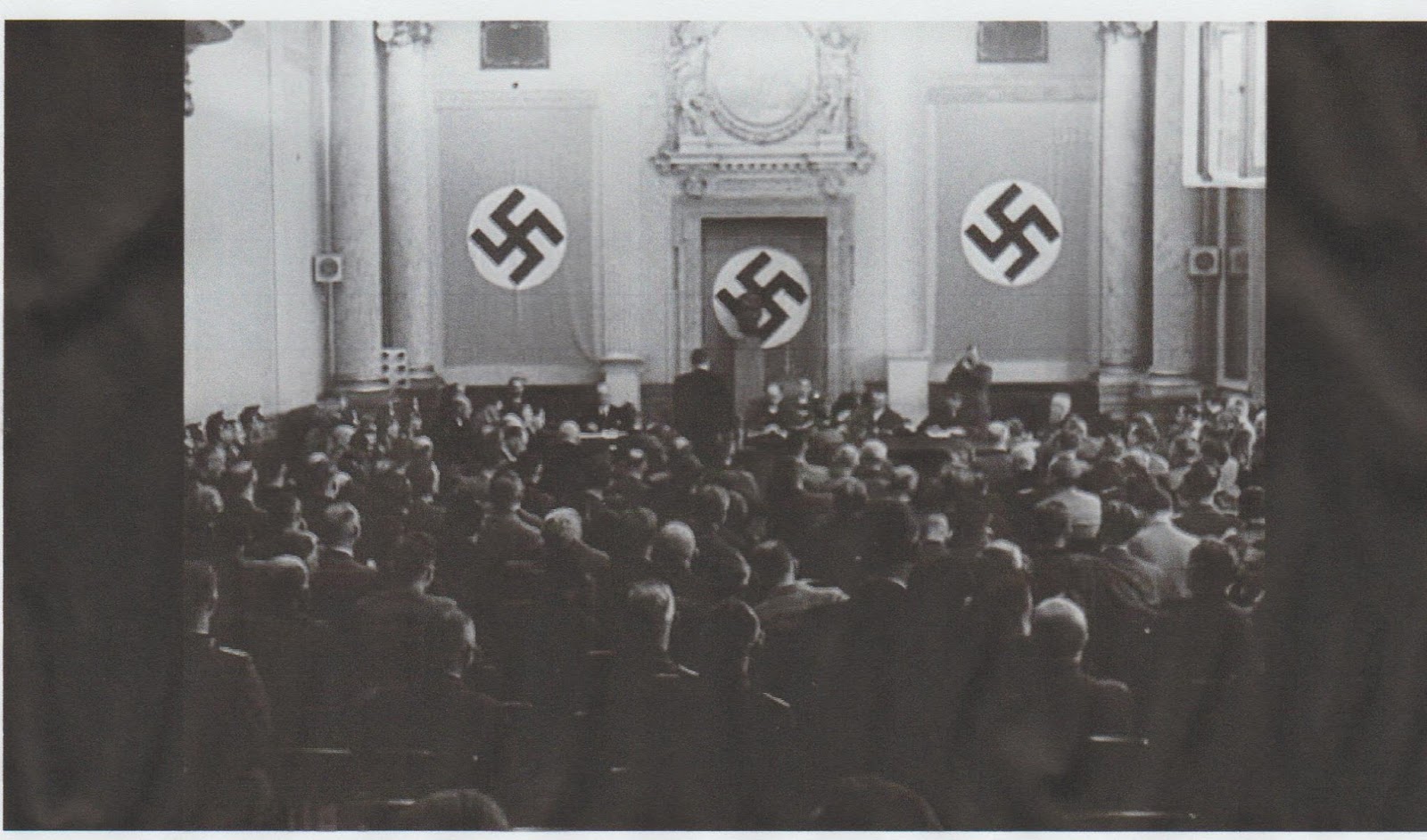 Hitler would have been proud, too, of our political correctness enforcers.The next step would be a show trial in the “tradition” of a Soviet prelude to execution. Already “global warmists” are calling for the execution of climate change “deniers.” The fact is that the “deniers” have never denied that climate never changes. They have demonstrated that climate changes all the time, and has changed over four or so billion years, even when the human race did not exist.
 The piling on of North Carolina over HB2 by every anti-logic, anti-reason individual and group now in existence is symptomatic of a vitriolic hatred of anyone who does not conform to the collectivist, totalitarian notion of reality. It is not the first time this has shown its ugly face, and it will not be the last.


March 26, 2016
A Walking Jihadist Postscript
What follows are expanded notes from Negan and the Walking Jihadists, plus further observations by me and by an anonymous correspondent who has also watched the series.
 I noted in Negan and the Walking Jihadists:
…In literature, while there is a limited amount of malevolence one can accept in fiction, it is not, or should not be, a permanent, unlimited feature; a continual presence of evil or of a malevolent character or theme can dull one’s brain and make one indifferent or hostile to any and all values. In a story, evil or malevolence must be defeated at some point and rendered impotent. If it is not foiled and made powerless, but instead becomes a continuous presence and a driving theme in a story, then there is no point in contemplating the story any further.
This is basically the state of literature and art today. There is little respite from the malaise. One finds relief where one can. Where can one turn in a dying culture in which the grotesque, such as The Walking Dead, is the norm? Where does one turn when even the mitigating attributes of the grotesque, such as the heroism of some of the players, are going to be diminished if not outright extinguished? For that is what is going to happen in The Walking Dead, and when it does, my TV screen will go blank.
In today’s culture, the moral – that is, the rationally moral – is regarded as the impractical, as the unjust, as wrong. It is regarded as an affront to hold another person to a moral standard and to call for justice, either for his good actions or his evil actions.
The almost drooling anticipation in many of the series’ fans of the debut of Negan in the finale of Season Six of The Walking Dead, which I have been watching as a dramatization of emergency ethics in an apocalyptic world, is not flattering to those fans. I sense that the writers and directors of The Walking Dead are going to at least partially pander to fans’ appetites for brutality and gore and a kind of nihlistic fireworks. Which means that I would stop watching the series.
Many strong characters emerged over the six seasons, chief among them, at least from my moral and esthetic tastes, Carol Peletier (played by Melissa McBride) and Daryl Dixon (played by Norman Reedus). Carol’s character blossomed from a self-effacing housewife with a brute of a husband (who dies early on) into an efficacious dreadnaught of a zombie fighter and a moralist who finds values to fight for outside of her formerly shrunken realm of domestic chores. Daryl’s character evolved from an ambiguous, brash, loud-mouthed, back-country redneck to a man of quiet, understated moral certitude and honesty.
But they may be sacrificed to the irrational demands of the series’ fans.
A bellwether indication of the direction the series is taking now is in the character of Morgan Jones, played by British actor and playwright, Lennie James, who in a very long, special episode is depicted as being converted to some pacifist philosophy of life – actually a martial art – Aikido, by a recluse. It is called “The Art of Peace,” one of whose tenets are that “All life is precious.” Morgan is taught that bringing justice to a criminal does not give one “peace.” A criminal who has slaughtered countless people is somehow redeemable. He can be allowed to go on living, even though his victims are dead.
Morgan encounters the Wolves, looters and killers. He easily defeats them – but does not kill them – and leaves them unconscious in an abandoned car, safe and sound. He encounters them again in a later episode, and again lets them go, who go on to kill again. Because “all life is precious,” and the killers can “change.” They can become “good” people and blameless with no blood on their hands.
One of the things that shocked me in the Star Warsmovie, Return of the Jedi, was the denouement, in which Darth Vader, a.k.a. Anikin Skywalker, the incarnation of evil, was elevated to the pantheon of Jedi sainthood because he saved his son, Luke, from the evil emperor. Here was a character who had blown up planets and killed millions of people in his career before he died, yet he was forgiven. At the end of the episode, “Obi-Wan, Yoda, and the redeemed Anakin [are] watching over them.”
Carol Peletier apparently has been influenced by the pacifist philosophy of Morgan Jones. In the last two episodes of the series she begins to express doubts about killing men who are killing or are capable of killing her friends. From out of nowhere, she produces Catholic worry-beads or a rosary, even while her hands are secured together with duct tape. (It isn’t clear if she found the rosaries on the floor of where she was being held hostage, or if they had been on her possession all the long.)
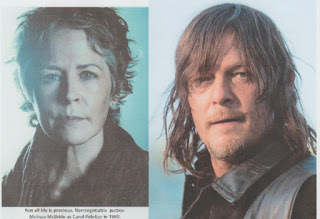 Melissa McBride as Carol, and Norman Reedus as DarylAbruptly feeling remorse, without any warning to viewers and in contradiction to the series story line, Carol writes a note to one of the characters that she is leaving the safe zone of Alexandria. It is addressed to everyone living in the zone:
“I wish it didn’t have to end, not this way. It was never my intention to hurt you, but this is how it has to be. We have so much here—people, food, medicine, walls – everything we need to live. But what we have, other people want, too. And that will never change. If we survive this threat [from the Negan gang] it’s not over and another one will take its place, to take what we have. I love you all here. I do. And I’d have to kill for you. And I can't. I won't. Rick sent me away and I wasn’t ever going to come back (from an earlier “safe zone”], but everything happened and I wound up staying. But I can't anymore. I can't love anyone because I can't kill for anyone. So I’m going as I always should have. Don’t come after me, please.”
The note is basically a capitulation to the irrational. After all her fearless fights, she has had enough of fighting, even though she knows that for as long as irrational killers are out there, there will always be a conflict with the irrational. To fight for her values is no longer possible for her. But, to refuse to fight for her values, is, in effect, to surrender those values to the irrational. Carol has written what amounts to be a suicide note.
My anonymous “pen pal” wrote me, and left on a fan blog site, Verge, this comment:
It’s a miserable thing to watch a favorite character being destroyed by his or her creators. I’ve seen that more than I care to and it appears that may be what is happening to the great Carol Peletier. To watch a timid, abused woman grow into an implacable protector of the good and then be brought down by guilt-inducing religious mysticism is inexcusable. Shame on the TWD writers if that is what they are doing.
I replied:
Having just watched "Twice as Far," and Carol's goodbye note to Tobin and everyone else, if the scripters kill her off, I'm done with TWD. If they somehow compromise or kill of Daryl, I'm double done with TWD. Carol's "leaving" the story because she can't kill people who are trying to kill her or the people she values, is a dead end, as far as I'm concerned. To hell with the rosary, and the implied pacifism of Carol. Bad turn in the series. We want heroes, not characters who are angst-ridden about defending their values.
My correspondent noted further, about the Season Six finale:
How they deal with the pure evil of Negan is going to be a turning point. I think we can wave Glenn goodbye because his character arc has pretty much hit cruise control and Maggie is taking over as the family badass. That's going to be tough to watch, and if it's going to be as dark as everyone's saying there has to be a lot more of the same. Confronting that level of evil requires defining values precisely and making an absolute commitment to defend them. If they waffle on that out of fear of "becoming like Negan", then I'm through with them as well.
Melissa McBride, who plays Carol, got a preview of Season Six’s finale and said that she felt she had fallen into a “black hole.”
I left this comment to my correspondent and on Verge:
I have a bad feeling that Carol's "getting religion" is going to be the death of her. I have no idea why the scripters decided to wussify her. She and Daryl are the only two characters I have any empathy for. In reality and in fiction, you can't defend the ones you love by refusing to kill those who intend on killing them. It's like the Belgians' "arrangement" with Islamic jihadists, who promised not to kill anyone. You don't declare a detente with killers.
You don't say, "All life is precious" when the killers don't value life, not even their own lives. You’re the one with the values to defend, you’re the one who wants to live. In war, you extinguish the killers when they show their faces, before they extinguish you. You extinguish them before they take more lives you may not even know. I do not look forward to the debut of Negan. It appears he's a thorough-going nihilist and evil to the core. When he shows up, I'm quits with TWD. It seems that the scripters are pandering to viewers who want Negan. I'm not one of them. TWD was a great dramatization of how men can conduct themselves as emergency ethics. I don't need Negan. We have the kill-happy Islamists in the real world. Why would I want it in fiction, unless it was defeated forthwith?
My correspondent wrote:
… I can't come up with anything additional. Checked some fan sites -- one in German, big help that was -- and everything seems to be speculation over who gets the Lucille treatment [Negan has named his barbed wire baseball bat, “Lucille”] from Negan. There is a constant thread of what a "great" character Negan is because he's totally evil but so "complex… I'm not interested in "complicated" people who steal, kill, rape, and beat innocent people to death to instill fear. I'm interested in "complicated" people who beat hell out of the bad guys, though I'll take uncomplicated ones in a pinch. There is speculation that Daryl will be the one to get Lucille'd, but unless Reedus has come up with some reason to leave the show, I doubt it. Daryl's character arc isn't anywhere near finished. Neither is Carol's, but it would indeed be "heartbreaking" if she were the one….
Carol’s note is not an expression of cowardice. Rather, it is an expression of hopelessness. The tireless fighter for values has grown tired, exhausted, discouraged. Perhaps she is even traumatized. Trauma is a state of paralysis. Her solution is to stop having values worth defending. It is a sentence of death.
Evil never seems to stop attacking. So, let it come.
But evil is not a metaphysical necessity in one’s life. This is a lesson she has never learned from any of the other characters, not in the whole series. None of the “good” characters has learned it. The scriptwriters have “martyred” Carol’s character in a grotesque TV series in a surrender to their own nihilism.
 I noted in Negan and the Walking Jihadists:
…In literature, while there is a limited amount of malevolence one can accept in fiction, it is not, or should not be, a permanent, unlimited feature; a continual presence of evil or of a malevolent character or theme can dull one’s brain and make one indifferent or hostile to any and all values. In a story, evil or malevolence must be defeated at some point and rendered impotent. If it is not foiled and made powerless, but instead becomes a continuous presence and a driving theme in a story, then there is no point in contemplating the story any further.
This is basically the state of literature and art today. There is little respite from the malaise. One finds relief where one can. Where can one turn in a dying culture in which the grotesque, such as The Walking Dead, is the norm? Where does one turn when even the mitigating attributes of the grotesque, such as the heroism of some of the players, are going to be diminished if not outright extinguished? For that is what is going to happen in The Walking Dead, and when it does, my TV screen will go blank.
In today’s culture, the moral – that is, the rationally moral – is regarded as the impractical, as the unjust, as wrong. It is regarded as an affront to hold another person to a moral standard and to call for justice, either for his good actions or his evil actions.
The almost drooling anticipation in many of the series’ fans of the debut of Negan in the finale of Season Six of The Walking Dead, which I have been watching as a dramatization of emergency ethics in an apocalyptic world, is not flattering to those fans. I sense that the writers and directors of The Walking Dead are going to at least partially pander to fans’ appetites for brutality and gore and a kind of nihlistic fireworks. Which means that I would stop watching the series.
Many strong characters emerged over the six seasons, chief among them, at least from my moral and esthetic tastes, Carol Peletier (played by Melissa McBride) and Daryl Dixon (played by Norman Reedus). Carol’s character blossomed from a self-effacing housewife with a brute of a husband (who dies early on) into an efficacious dreadnaught of a zombie fighter and a moralist who finds values to fight for outside of her formerly shrunken realm of domestic chores. Daryl’s character evolved from an ambiguous, brash, loud-mouthed, back-country redneck to a man of quiet, understated moral certitude and honesty.
But they may be sacrificed to the irrational demands of the series’ fans.
A bellwether indication of the direction the series is taking now is in the character of Morgan Jones, played by British actor and playwright, Lennie James, who in a very long, special episode is depicted as being converted to some pacifist philosophy of life – actually a martial art – Aikido, by a recluse. It is called “The Art of Peace,” one of whose tenets are that “All life is precious.” Morgan is taught that bringing justice to a criminal does not give one “peace.” A criminal who has slaughtered countless people is somehow redeemable. He can be allowed to go on living, even though his victims are dead.
Morgan encounters the Wolves, looters and killers. He easily defeats them – but does not kill them – and leaves them unconscious in an abandoned car, safe and sound. He encounters them again in a later episode, and again lets them go, who go on to kill again. Because “all life is precious,” and the killers can “change.” They can become “good” people and blameless with no blood on their hands.
One of the things that shocked me in the Star Warsmovie, Return of the Jedi, was the denouement, in which Darth Vader, a.k.a. Anikin Skywalker, the incarnation of evil, was elevated to the pantheon of Jedi sainthood because he saved his son, Luke, from the evil emperor. Here was a character who had blown up planets and killed millions of people in his career before he died, yet he was forgiven. At the end of the episode, “Obi-Wan, Yoda, and the redeemed Anakin [are] watching over them.”
Carol Peletier apparently has been influenced by the pacifist philosophy of Morgan Jones. In the last two episodes of the series she begins to express doubts about killing men who are killing or are capable of killing her friends. From out of nowhere, she produces Catholic worry-beads or a rosary, even while her hands are secured together with duct tape. (It isn’t clear if she found the rosaries on the floor of where she was being held hostage, or if they had been on her possession all the long.)
 Melissa McBride as Carol, and Norman Reedus as DarylAbruptly feeling remorse, without any warning to viewers and in contradiction to the series story line, Carol writes a note to one of the characters that she is leaving the safe zone of Alexandria. It is addressed to everyone living in the zone:
“I wish it didn’t have to end, not this way. It was never my intention to hurt you, but this is how it has to be. We have so much here—people, food, medicine, walls – everything we need to live. But what we have, other people want, too. And that will never change. If we survive this threat [from the Negan gang] it’s not over and another one will take its place, to take what we have. I love you all here. I do. And I’d have to kill for you. And I can't. I won't. Rick sent me away and I wasn’t ever going to come back (from an earlier “safe zone”], but everything happened and I wound up staying. But I can't anymore. I can't love anyone because I can't kill for anyone. So I’m going as I always should have. Don’t come after me, please.”
The note is basically a capitulation to the irrational. After all her fearless fights, she has had enough of fighting, even though she knows that for as long as irrational killers are out there, there will always be a conflict with the irrational. To fight for her values is no longer possible for her. But, to refuse to fight for her values, is, in effect, to surrender those values to the irrational. Carol has written what amounts to be a suicide note.
My anonymous “pen pal” wrote me, and left on a fan blog site, Verge, this comment:
It’s a miserable thing to watch a favorite character being destroyed by his or her creators. I’ve seen that more than I care to and it appears that may be what is happening to the great Carol Peletier. To watch a timid, abused woman grow into an implacable protector of the good and then be brought down by guilt-inducing religious mysticism is inexcusable. Shame on the TWD writers if that is what they are doing.
I replied:
Having just watched "Twice as Far," and Carol's goodbye note to Tobin and everyone else, if the scripters kill her off, I'm done with TWD. If they somehow compromise or kill of Daryl, I'm double done with TWD. Carol's "leaving" the story because she can't kill people who are trying to kill her or the people she values, is a dead end, as far as I'm concerned. To hell with the rosary, and the implied pacifism of Carol. Bad turn in the series. We want heroes, not characters who are angst-ridden about defending their values.
My correspondent noted further, about the Season Six finale:
How they deal with the pure evil of Negan is going to be a turning point. I think we can wave Glenn goodbye because his character arc has pretty much hit cruise control and Maggie is taking over as the family badass. That's going to be tough to watch, and if it's going to be as dark as everyone's saying there has to be a lot more of the same. Confronting that level of evil requires defining values precisely and making an absolute commitment to defend them. If they waffle on that out of fear of "becoming like Negan", then I'm through with them as well.
Melissa McBride, who plays Carol, got a preview of Season Six’s finale and said that she felt she had fallen into a “black hole.”
I left this comment to my correspondent and on Verge:
I have a bad feeling that Carol's "getting religion" is going to be the death of her. I have no idea why the scripters decided to wussify her. She and Daryl are the only two characters I have any empathy for. In reality and in fiction, you can't defend the ones you love by refusing to kill those who intend on killing them. It's like the Belgians' "arrangement" with Islamic jihadists, who promised not to kill anyone. You don't declare a detente with killers.
You don't say, "All life is precious" when the killers don't value life, not even their own lives. You’re the one with the values to defend, you’re the one who wants to live. In war, you extinguish the killers when they show their faces, before they extinguish you. You extinguish them before they take more lives you may not even know. I do not look forward to the debut of Negan. It appears he's a thorough-going nihilist and evil to the core. When he shows up, I'm quits with TWD. It seems that the scripters are pandering to viewers who want Negan. I'm not one of them. TWD was a great dramatization of how men can conduct themselves as emergency ethics. I don't need Negan. We have the kill-happy Islamists in the real world. Why would I want it in fiction, unless it was defeated forthwith?
My correspondent wrote:
… I can't come up with anything additional. Checked some fan sites -- one in German, big help that was -- and everything seems to be speculation over who gets the Lucille treatment [Negan has named his barbed wire baseball bat, “Lucille”] from Negan. There is a constant thread of what a "great" character Negan is because he's totally evil but so "complex… I'm not interested in "complicated" people who steal, kill, rape, and beat innocent people to death to instill fear. I'm interested in "complicated" people who beat hell out of the bad guys, though I'll take uncomplicated ones in a pinch. There is speculation that Daryl will be the one to get Lucille'd, but unless Reedus has come up with some reason to leave the show, I doubt it. Daryl's character arc isn't anywhere near finished. Neither is Carol's, but it would indeed be "heartbreaking" if she were the one….
Carol’s note is not an expression of cowardice. Rather, it is an expression of hopelessness. The tireless fighter for values has grown tired, exhausted, discouraged. Perhaps she is even traumatized. Trauma is a state of paralysis. Her solution is to stop having values worth defending. It is a sentence of death.
Evil never seems to stop attacking. So, let it come.
But evil is not a metaphysical necessity in one’s life. This is a lesson she has never learned from any of the other characters, not in the whole series. None of the “good” characters has learned it. The scriptwriters have “martyred” Carol’s character in a grotesque TV series in a surrender to their own nihilism.
March 25, 2016
Negan and The Walking Jihadists
Who or what is “Negan”?
 Negan is a vile, evil character who will debut in April at the end of Season Six of The Walking Dead. Negan is a brutal tyrant who lords over an enclave of plague survivors and likes to smash victims’ heads with a baseball bat sheathed in barbed wire. He has a policy of extortion that requires other, productive enclaves to give him half of what they have in exchange for his not raiding, raping, enslaving, and killing their inhabitants and trashing their communities.
As one of their spokesmen said to others in an earlier teaser scene: “Everything you own now belongs to Negan.” His group or gang is called The Saviors. Negan’s crew are dedicated nihilists.
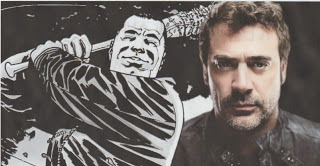 The comic book Negan, and Jeffrey Dean Morgan as NeganNegan could be taken as a metaphor for the Obama administration, or for Islamic jihadists. Both entities are looters, plunderers, and destroyers.
Advisory: I am not a “zombie” fan or aficionado by any means. Out of desperation to watch anything of interest on Netflix, I tried the first episodes of The Walking Dead and found them intriguing in the personal conflicts and character growth of many of the characters. Nor am I enamored of the original and ongoing graphic comics rendition of the series, written by Robert Kirkman. The artwork in the comics is crude and without any redeeming value whatsoever, and the storyline in the dialogue is banal, naturalistic, if not repellant. Fortunately, the AMC TV series does not follow the graphic comics’ storyline.
The similarities between Negan and his Savior underlings and Islam and Muslims are striking to those observant enough to see the parallels and not afraid to point them out. The Islamic Negan has been raiding, killing, and trashing Western societies for decades. Note the latest raid in Brussels. Often these Negan jihadists and invaders are invited into these societies for a variety of political and economic reasons. Daniel Greenfield as Sultan Knish wrote, and warned, in 2010, in his column, “Immigration Jihad,” and the incremental and inevitable Islamization of Austria:
Where once upon a time Islamic armies had to lay siege, plant gunpowder charges and finally breach the walls in massive costly charges-- today they can simply hop a plane. And so what started out as a few newspaper vendors, factory workers and janitors, morphed into a full blown cultural invasion complete with a network of Islamic schools where students are taught that Islam is incompatible with democracy, that Muslims are superior to non-Muslims, and where 8.5 percent of the teachers surveyed said that it is understandable when violence is used to spread Islam. The pattern however is not limited to Vienna, it exists worldwide…..
But like any takeover in which the enemy is allowed inside the gates, it could not happen without the active collaboration of those on the inside. And they have their various motivations. Left of center politicians and parties often expect that Muslim immigrants will serve as a reliable voting base for them, and they are correct about that—in the short term. Meanwhile more middle of the road pols see rising population figures as a regional net benefit and a shot at elevating their own political importance, without examining the consequences down the road. Companies are always on the lookout for cheap labor, and particularly in countries and areas with a low birth rate, there are always some dirty jobs that need doing. The jobs that Americans, Austrians, Frenchmen, Israelis and Norwegians don't want to do. But those same jobs are also part of the critical infrastructure of a local economy. And by capturing them, they capture the base processes by which the system exists.
The production values of the TV series, however, are first-rate and profit from a first-class cast, half of whose principal actors, one learns to one’s astonishment, are British. Most of the characters are supposed to hail from twangy Georgia. But, not a vowel of tea-and-crumpets escapes their dialogue.
However, in literature, while there is a limited amount of malevolence one can accept in fiction, it is not, or should not be, an unlimited feature; a continual presence of evil or of a malevolent character or theme can dull one’s brain and make one hostile to any and all values. In a story, evil or malevolence must be defeated at some point and rendered impotent. If it is not foiled and made powerless, but instead becomes a continuous presence and theme in a story, then there is no point in contemplating the story any further.
This is basically the state of literature and art today. There is little respite from the malaise. One finds relief where one can.
That is what is going to happen in The Walking Dead, and when it does, off will go my screen.
The almost drooling anticipation in many of the series’ fans of the debut of Negan in the finale of Season Six of The Walking Dead, which I have been watching as a dramatization of emergency ethics in an apocalyptic world, is not flattering to those fans. I sense that the writers and directors of The Walking Dead are going to at least partially pander to fans’ appetites for brutality and gore. Which would mean that I stop watching the series.
Many strong characters emerged over the six seasons, chief among them, at least from my moral and esthetic tastes, Carol Peletier (played by Melissa McBride) and Daryl Dixon (played by Norman Reedus).
Carol’s character blossomed from a self-effacing housewife with a brute of a husband (who dies early on) into an efficacious dreadnaught of a zombie fighter who finds values to fight for outside of her formerly shrunken realm of domestic chores.
 Melissa McBride as Carol Peletier, and Norman Reedus as Daryl Dixon, The Walking Dead's most heroic characters.
The character of Daryl evolved from an ambiguous, loud-mouthed, back-country redneck to one of moral certitude and honesty.
A bellwether indication of the direction the series is taking now is in the character of Morgan Jones, played by British actor and playwright, Lennie James, who in a very long episode is depicted as being converted to some pacifist philosophy of life – actually a martial art – Aikido, by a recluse. It is called “The Art of Peace,” in which “All life is precious.”
Morgan encounters the Wolves, looters and killers. He easily defeats them – but does not kill them – and leaves them unconscious in an abandoned car, safe and sound. He encounters them again in a later episode, and again lets them go, who go on to kill again. Because “all life is precious,” and the killers can “change.”
What is the difference between the Negans of fiction and the Negans of the real world? The fiction will not kill you. The real ones can and will. As happened in Paris and Brussels and New York City and dozens of other places over decades. There are dozens of Koranic verses for violence that the fictional Negans could just as well adopt, such as:
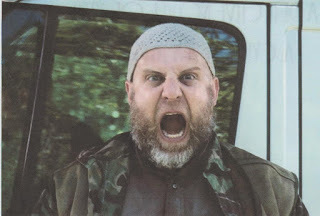 An Islamic Negan: Kill them, slay them, take what is theirs.
47:4: “When you meet the unbelievers, smite their necks, then, when you have made wide slaughter among them, tie fast the bonds; then set them free, either by grace or ransom, till the war lays down its loads. So it shall be; and if Allah had willed, He would have avenged Himself upon them; but that He may try some of you by means of others. And those who are slain in the way of Allah, He will not send their works astray.”
2:191-193: “And slay them wherever you come upon them, and expel them from where they expelled you; persecution is more grievous than slaying. But fight them not by the Holy Mosque until they should fight you there; then, if they fight you, slay them — such is the recompense of unbelievers, but if they give over, surely Allah is All-forgiving,
Angela Merkel, the French, the Swedes, the Danes, and other European countries welcomed the hordes of barbarians into their countries because they believed that “all life is precious.” Substitute Allah for “Negan” and you get the horrifying idea that Muslims do not regard all life as precious, especially not the lives of infidels. If Allah can will it, so can Negan. These are the Negan Jihadists.
 Negan is a vile, evil character who will debut in April at the end of Season Six of The Walking Dead. Negan is a brutal tyrant who lords over an enclave of plague survivors and likes to smash victims’ heads with a baseball bat sheathed in barbed wire. He has a policy of extortion that requires other, productive enclaves to give him half of what they have in exchange for his not raiding, raping, enslaving, and killing their inhabitants and trashing their communities.
 As one of their spokesmen said to others in an earlier teaser scene: “Everything you own now belongs to Negan.” His group or gang is called The Saviors. Negan’s crew are dedicated nihilists.
 The comic book Negan, and Jeffrey Dean Morgan as NeganNegan could be taken as a metaphor for the Obama administration, or for Islamic jihadists. Both entities are looters, plunderers, and destroyers.
Advisory: I am not a “zombie” fan or aficionado by any means. Out of desperation to watch anything of interest on Netflix, I tried the first episodes of The Walking Dead and found them intriguing in the personal conflicts and character growth of many of the characters. Nor am I enamored of the original and ongoing graphic comics rendition of the series, written by Robert Kirkman. The artwork in the comics is crude and without any redeeming value whatsoever, and the storyline in the dialogue is banal, naturalistic, if not repellant. Fortunately, the AMC TV series does not follow the graphic comics’ storyline.
The similarities between Negan and his Savior underlings and Islam and Muslims are striking to those observant enough to see the parallels and not afraid to point them out. The Islamic Negan has been raiding, killing, and trashing Western societies for decades. Note the latest raid in Brussels. Often these Negan jihadists and invaders are invited into these societies for a variety of political and economic reasons. Daniel Greenfield as Sultan Knish wrote, and warned, in 2010, in his column, “Immigration Jihad,” and the incremental and inevitable Islamization of Austria:
Where once upon a time Islamic armies had to lay siege, plant gunpowder charges and finally breach the walls in massive costly charges-- today they can simply hop a plane. And so what started out as a few newspaper vendors, factory workers and janitors, morphed into a full blown cultural invasion complete with a network of Islamic schools where students are taught that Islam is incompatible with democracy, that Muslims are superior to non-Muslims, and where 8.5 percent of the teachers surveyed said that it is understandable when violence is used to spread Islam. The pattern however is not limited to Vienna, it exists worldwide…..
But like any takeover in which the enemy is allowed inside the gates, it could not happen without the active collaboration of those on the inside. And they have their various motivations. Left of center politicians and parties often expect that Muslim immigrants will serve as a reliable voting base for them, and they are correct about that—in the short term. Meanwhile more middle of the road pols see rising population figures as a regional net benefit and a shot at elevating their own political importance, without examining the consequences down the road. Companies are always on the lookout for cheap labor, and particularly in countries and areas with a low birth rate, there are always some dirty jobs that need doing. The jobs that Americans, Austrians, Frenchmen, Israelis and Norwegians don't want to do. But those same jobs are also part of the critical infrastructure of a local economy. And by capturing them, they capture the base processes by which the system exists.
The production values of the TV series, however, are first-rate and profit from a first-class cast, half of whose principal actors, one learns to one’s astonishment, are British. Most of the characters are supposed to hail from twangy Georgia. But, not a vowel of tea-and-crumpets escapes their dialogue.
However, in literature, while there is a limited amount of malevolence one can accept in fiction, it is not, or should not be, an unlimited feature; a continual presence of evil or of a malevolent character or theme can dull one’s brain and make one hostile to any and all values. In a story, evil or malevolence must be defeated at some point and rendered impotent. If it is not foiled and made powerless, but instead becomes a continuous presence and theme in a story, then there is no point in contemplating the story any further.
This is basically the state of literature and art today. There is little respite from the malaise. One finds relief where one can.
That is what is going to happen in The Walking Dead, and when it does, off will go my screen.
The almost drooling anticipation in many of the series’ fans of the debut of Negan in the finale of Season Six of The Walking Dead, which I have been watching as a dramatization of emergency ethics in an apocalyptic world, is not flattering to those fans. I sense that the writers and directors of The Walking Dead are going to at least partially pander to fans’ appetites for brutality and gore. Which would mean that I stop watching the series.
Many strong characters emerged over the six seasons, chief among them, at least from my moral and esthetic tastes, Carol Peletier (played by Melissa McBride) and Daryl Dixon (played by Norman Reedus).
Carol’s character blossomed from a self-effacing housewife with a brute of a husband (who dies early on) into an efficacious dreadnaught of a zombie fighter who finds values to fight for outside of her formerly shrunken realm of domestic chores.
 Melissa McBride as Carol Peletier, and Norman Reedus as Daryl Dixon, The Walking Dead's most heroic characters.
The character of Daryl evolved from an ambiguous, loud-mouthed, back-country redneck to one of moral certitude and honesty.
A bellwether indication of the direction the series is taking now is in the character of Morgan Jones, played by British actor and playwright, Lennie James, who in a very long episode is depicted as being converted to some pacifist philosophy of life – actually a martial art – Aikido, by a recluse. It is called “The Art of Peace,” in which “All life is precious.”
Morgan encounters the Wolves, looters and killers. He easily defeats them – but does not kill them – and leaves them unconscious in an abandoned car, safe and sound. He encounters them again in a later episode, and again lets them go, who go on to kill again. Because “all life is precious,” and the killers can “change.”
What is the difference between the Negans of fiction and the Negans of the real world? The fiction will not kill you. The real ones can and will. As happened in Paris and Brussels and New York City and dozens of other places over decades. There are dozens of Koranic verses for violence that the fictional Negans could just as well adopt, such as:
 An Islamic Negan: Kill them, slay them, take what is theirs.
47:4: “When you meet the unbelievers, smite their necks, then, when you have made wide slaughter among them, tie fast the bonds; then set them free, either by grace or ransom, till the war lays down its loads. So it shall be; and if Allah had willed, He would have avenged Himself upon them; but that He may try some of you by means of others. And those who are slain in the way of Allah, He will not send their works astray.”
2:191-193: “And slay them wherever you come upon them, and expel them from where they expelled you; persecution is more grievous than slaying. But fight them not by the Holy Mosque until they should fight you there; then, if they fight you, slay them — such is the recompense of unbelievers, but if they give over, surely Allah is All-forgiving,
Angela Merkel, the French, the Swedes, the Danes, and other European countries welcomed the hordes of barbarians into their countries because they believed that “all life is precious.” Substitute Allah for “Negan” and you get the horrifying idea that Muslims do not regard all life as precious, especially not the lives of infidels. If Allah can will it, so can Negan. These are the Negan Jihadists.
March 24, 2016
Review: Radical by Nature
 At the outset, I will admit that this review of Thomas McCaffrey’s seminal book on the history of and devastation wrought by environmentalism from its earliest days to the present,
Radical by Nature: The Green Assault on Liberty, Property, and Prosperity
, cannot begin to do it justice. As I underscored the importance of Lisa McGirr’s groundbreaking book,
The War on Alcohol
, about how Prohibition fostered the growth of the pervasive, all-encompassing State, I can only point with some humility to the heavy lifters of these two books and to the stellar and indefatigable efforts of their authors to bring their works to fruition and to the public eye.
At the outset, I will admit that this review of Thomas McCaffrey’s seminal book on the history of and devastation wrought by environmentalism from its earliest days to the present,
Radical by Nature: The Green Assault on Liberty, Property, and Prosperity
, cannot begin to do it justice. As I underscored the importance of Lisa McGirr’s groundbreaking book,
The War on Alcohol
, about how Prohibition fostered the growth of the pervasive, all-encompassing State, I can only point with some humility to the heavy lifters of these two books and to the stellar and indefatigable efforts of their authors to bring their works to fruition and to the public eye. Radical by Nature could easily be retitled, The War on Man. McCaffrey begins his history and exposé of the whole environmentalist movement, from olden times and brings it up to the present. With meticulous detail, a compelling narrative, and abundant documentation, he paints the anti-man, anti-civilization trends and motives behind the environmentalist movement in all its variegated forms.
From the Publisher, Stairway Press:
Environmentalism is a good idea that gets carried to a bad extreme on occasion by a few radicals. This is the standard critique of environmentalism—and it is false.
It echoes my own position on “radical Islam” (a fatal redundancy, to be sure). The press release goes on to say that environmentalism:
…is not a benign set of ideas promulgated by well-meaning idealists whose efforts are occasionally hijacked by extremists. It is a radical ideology that is moving inexorably toward its logical, entirely predictable conclusion.
McCaffrey writes on his Amazon page, and this cannot be overemphasized. We are not dealing with Girl Scouts or mentally “challenged” do-gooders:
Environmentalism is not about reducing pollution to manageable levels, as most Americans believe. It is about eradicating it completely, even if it means eradicating industrialism in the bargain, a process that is already well under way. It is not about conserving marginal amounts of energy by devising more efficient light bulbs and car engines. It is about eliminating our use of fossil fuels and replacing them with far smaller quantities of energy from wind and solar, even though this will cripple our economy. It is not about preserving a few tracts of scenic landscape here and there, as in our national parks and wildernesses. It is about channeling all new development into already existing urban centers and then preserving the vast majority of our land in its natural state. Expect the familiar call for mass transit to be accompanied one day soon by calls for mass housing. (See my article, “Global Urban Renewal”.)
Environmentalism does not aspire to make a few adjustments to a capitalist industrial system grounded in the rights of individuals. It aspires to abolish that system entirely and to replace it with one based on government command and control. We tried individual freedom, say the environmentalists, and it brought us to the brink of environmental destruction. Now freedom is a luxury we can no longer afford.
Environmentalism will vastly diminish our comfort, health, wealth, safety, and security from foreign enemies, and it will ultimately deliver us to tyranny….
That “predictable conclusion,” in short, is nothing less than the obliteration of individual rights and of private property, and the institutional regimen of enforced impoverishment of Americans and of people around the globe – in the name of climate “stability,” in the name of the new god, “Mother Earth.”
McCaffrey begins at the logical place to discuss environmentalism vs. natural rights, to establish his premises on which to later argue against environmentalism and for individual and property rights – with the English philosopher John Locke (1632-1704) and with the Founders. He devotes the very first chapter of Radicalto the ideational innovations of John Locke.
Locke’s Second Treatise (1690) changed the course of political philosophy. The idea of natural rights was new in the history of mankind.
Locke started from the idea of a “state of nature.” If there were no government, if men lived in a state of nature relative to each other, there would still be right and wrong, things men ought and ought not to do. Locke referred to these moral principles collectively as the “law of nature.” The means that men have to discover this natural law is their faculty of reason. Locke said that the law of nature is reason. Or, as Jerome Huyler has suggested, the fundamental moral tenet implicit in Locke’s conception of natural law is “follow reason.” (p. 11)
Locke wrote:
And Reason, which is that Law [of nature], teaches all Mankind, who will but consult it, that being all equal and independent, no one ought to harm another in his Life, Health, Liberty, or Possessions. (pp. 11-12)
In a subsequent chapter, McCaffrey discusses the debt of political philosophy John Adams and Thomas Jefferson owed Locke. Adams wrote:
Adams was clear that liberty and property are inseparable. He wrote:
Res Populi, and the original meaning of the word republic … had more relation to property than liberty. It signified a government, in which the property of the public, or people, and every one of them, was secured and protected by law. This idea, indeed, implies liberty; because property cannot be secure unless the man be at liberty to acquire, use, or part with it, at his discretion, and unless he have his personal liberty of life and limb, motion and rest, for the purpose. It implies, moreover, that the property and liberty of all men, not merely of a majority, should be safe; for the people, or public, comprehends more than a majority, it comprehends all and every individual. (p. 35)
McCaffrey writes of Jefferson and the Declaration of Independence:
Liberty, in turn, is inseparable from property; Adams was as aware of this as John Locke had been. The American Founders’ commitment to individual liberty is nowhere more clearly expressed than in the Declaration of Independence.
We hold these truths to be self-evident, that all men are created equal, that they are endowed by their Creator with certain unalienable Rights; that among these are Life, Liberty and the pursuit of Happiness. That to secure these rights, Governments are instituted among Men, deriving their just powers from the consent of the governed, that whenever any Form of Government becomes destructive of these ends it is the Right of the People to alter or abolish it, and to institute new Government, laying its foundation on such principles and organizing its powers in such form, as to them shall seem most likely to effect their Safety and Happiness.
It would be difficult to compose a more concise and eloquent summary of Locke’s political philosophy than this. All the more curious, then, is Jefferson’s substitution of “pursuit of Happiness” for “property” in the familiar trio of rights. (pp. 35-36)
McCaffrey devotes several pages to Jefferson’s curious but anomalous substitution of “the pursuit of happiness” for “property.” This is no light-weight discussion of important principles and historical precedents. The author maintains this level of intellectual acuity throughout the work. (Parenthetically, and historically, it may have been John Adams or Benjamin Franklin who made the substitution as they emended Jefferson’s document, with Jefferson’s agreement. The Princetondiscussion here about the Declaration’s rough draft is one of several such studies.)
Jumping far ahead to McCaffrey’s discussion of the assault on reason and reality by the Pragmatists and the Progressive, he writes:
In its early years, Progressivism drew heavily upon the philosophical movement called Pragmatism. Three Americans composed the core of the Pragmatic movement in philosophy, Charles S. Peirce (1839–1914), William James (1842-1910), and John Dewey (1859-1952). Among the services these men provided to progressivism was a redefinition of what constitutes truth. (p. 112)
And what did the Pragmatists seek to achieve? McCaffrey writes:
To men who could write “We hold these Truths to be self-evident,” the meaning of the word “truth” is clear; a statement is true if it corresponds with the facts of reality. This is the correspondence theory of truth, and it goes back to Aristotle. “To say of what is that it is not, or of what is not that it is, is false; to say of what is that it is, or of what is not that it is not, is true.” This definition of truth is based on the assumptions that something exists, that man can know this something, and that truth is a correspondence between what a man knows and what this something in fact is. (pp. 112-113)
The Pragmatists, however, would disagree with a simple statement that “it is raining”:
“It is raining” would not mean that actual drops of water are actually falling from an actual sky. For the pragmatist, the “meaning” of a proposition is not some objective fact of reality but, rather, the subjective experiences that men come to associate with that proposition. (p. 113)
McCaffrey continues about the Pragmatist’s treatment of rain:
For the pragmatist, this means that if I were to go outside, I would see drops of water falling from the sky, feel drops of water hitting my skin, hear drops of water hitting the ground, taste water on my tongue, and undergo myriad other experiences that I would come to associate with the statement, “It is raining.” The sum total of these experiences would be the meaning of “It is raining” for the pragmatist. “It is raining” would not mean that actual drops of water are actually falling from an actual sky. For the pragmatist, the “meaning” of a proposition is not some objective fact of reality but, rather, the subjective experiences that men come to associate with that proposition. (pp. 113-114)
In another vein, a Pragmatist would itemize all his experiences about a duck and conclude he observed a duck: “If it looks like a duck, swims like a duck, and quacks like a duck, then it probably is a duck.” His abductive reasoning, likely adjudicated by the “probability theory,” however, would be invalid if even one of those observations or experiences was absent. In reality, the duck would actually exist, even without the Pragmatist’s observations. To a Pragmatist, if his “experiences” are in the least skewed, he might conclude he was seeing an elephant, and he would need to start all over again to reach a “probable” truth.
 Depending on his "experiences," a Pragmatist may conclude this is an elephant.
McCaffrey hits another stride by tracing of the evolution of the late 19th and early 20th century conservation movements to environmentalism. He discusses the intellectual underpinnings of conservation and the resulting fascination with “natural nature,”
Progressivism aimed to expand the power of government in the United States. In the later decades of the nineteenth century there appeared a number of individuals and groups who prefigured Progressivism in this respect, who aimed specifically to extend the power of government to manage the nation’s forests, waterways, wildlife, and even its scenic beauty. Around the turn of the century, these resource protection groups would coalesce into a larger movement that comprehended all their respective goals under the heading of “conservation.” And, because all of these groups aimed, to one extent or another, to expand government power, they were easily absorbed into the larger Progressive movement….(p. 202; Italicsmine.)
The chief proponents of conservation were George Perkins Marsh, George Bird Grinnell, John Wesley Powell, and Gifford Pinchot. Each of these men, in private and in a government capacity, advocated the expansion of federal lands and the adoption of conservation policies. McCaffrey writes:
When Progressivism arrived on the scene, about 1890 or so on the local level, and Progressives began to hammer away at the constitutional protection of property rights, their efforts helped to clear the way for just the sort of government intervention on behalf of resource protection that the various resource guardians had been promoting for years. Although many of the resource-protection efforts predated the advent of Progressivism, after 1890 many of the more prominent advocates of conservation were themselves Progressives. It was no coincidence that the most prominent conservationist of them all, Theodore Roosevelt, ended his political career as an arch-Progressive. By the end of Roosevelt’s second term, conservation would come to be identified as an integral part of the broader Progressive movement. (pp. 240-241)
The principal aim of the early conservationists was to remove Federal forests from any kind of development or exploitation by private interests. It was, frankly, to remove these lands from economic realities and to bar any private individual interests from interfering with the designs of “nature’s” appointive and self-appointive guardians.
By the time Roosevelt left office in 1909, there would be 149 forest reserves covering 193,000,000 acres. By then, the federal government would no longer be just a temporary owner whose primary purpose was to transfer federal lands to private citizens; it would be a permanent owner and manager of a vast forest empire, and Pinchot would be instrumental in effecting the transformation. Pinchot once said that government needed to be run more like a business. This would have made little sense to the men of 1789 with their idea of limited government, but for a government determined to manage a nation’s natural resources, it did made a certain sense, and in his management of the National Forests Pinchot showed how to do it. (pp. 245-246)
McCaffrey writes:
With Theodore Roosevelt’s leaving office in 1908, centrally organized conservation began to wane, although the idea of conservation, and a great many of the government initiatives and private organizations would prove lasting. The conservation movement continued to influence events right up until the 1950s and 60s, when it would be subsumed by a new movement called environmentalism. (p. 249)
Part III of Radical is devoted almost entirely to the growth and establishment of environmentalism as an official government policy. McCaffrey delves in detail into the National Environmental Policy Act of 1969, the Wars on Energy and the Auto, the various Wars on virtually every product of an industrial civilization (e.g., nuclear energy, oil, shale production), all of which, to oblige our “guardians” of the environment, must come under stringent control, regulation, or even appropriation – i.e., seizure – by the government, not so much anymore, for the “public good,” but for the environment qua environment, shorn of any human interest or value. Any one of the subjects discussed by the author would deserve a book-length treatment.

The Environmentalists’ imaginary capitalist nightmare and bogeyman; a city of darkened skies and perpetual rain. A still from Blade Runner (1982). But, this is exactly the kind of world the Progressives, Environmentalists, and other GlobalistPlanners wish to force men into: a society in which men are pressed together in undifferentiated masses with no privacy, no freedom, and no prospect of escape from the city or from each other.
Personally, the most salutary demonstration of the “environmental” mind set for me was news of the fate of the Galileo spacecraft that was launched in 1989 and was deliberately obliterated in September 2003.
I remember emailing NASA, when it was decided to destroy the Galileoorbiter, which had been circling Jupiter between 1995 and 2003, by sending it to be vaporized in Jupiter’s atmosphere. I asked why the spacecraft could not just be left to orbit the planet indefinitely, as a token of man’s achievement, as evidence its existence. I could not believe the explanations I had read in the newspapers.
Someone at NASA replied to my query, writing that Galileo, which had run out of maneuvering fuel, might crash into Io or another Jovian moon, and contaminate it with terrestrial microbes. This was after being in space for fourteen years and continuously subjected to life-killing cosmic rays and radiation from Jupiter. The explanation defied reason. Yes, the NASA respondent replied to me with some indignation: Galileo might despoil the pristine lifelessness of Io or another moon with man-made microbes!
And that was a bad thing, remote as the likelihood of contamination was on any of the moons? Microbe-carrying meteors, comets, and asteroids, regularly crash into all the solar bodies, including Earth, our own moon, Mars, Titan and other bodies. That is somehow permissible. But risk a man-made object ruin one of those bodies?
Out of the question! Man may not leave his mark anywhere. He must be erased out of existence, as though he had never been there.
On Earth, as well as on the toxic, sulfur-coated moon Io or on the frozen, cosmic ray bathed plains of Ganymede.
Radical by Nature is a veritable treasure trove of information on the deleterious consequences of man-hating environmentalism. When people celebrate “Earth Day,” it is not man’s place on Earth that they are marking. The “extremists” among them are hoping for man’s extinction.
For your own edification, to bolster your own certitude that you are right in the knowledge that environmentalists are as mortal your enemies as are Islamic jihadists, I urge readers to read Thomas McCaffrey’s indictment of environmentalists and environmentalism.
Radical by Nature: The Green Assault on Liberty, Property, and Prosperity , by Thomas J. McCaffrey. Las Vegas, NV: Stairway Press, 2016. 580 pp.
March 21, 2016
Review: The War on Alcohol
 Lisa McGirr’s scholarly but hard-hitting and thoroughly documented exposé of the role of Prohibition in its contribution to the cancerous growth of statism, The War on Alcohol: Prohibition and the Rise of the American State, should be the touchstone of all future studies and analyses of why the country is in such poor shape. This is the State we recognize today, the one that demonizes smoking with bogus statistics and ubiquitous propaganda yet depends on and collects revenue on tobacco sales, the one that demonizes “recreational drug” use but prohibits pharmaceutical companies from perfecting and releasing life-saving drugs, the one that criminalizes private gun ownership by private citizens and would leave them defenseless against gun-toting criminals who do not care about the law and who will always get guns.
 This is the State whose entrenched educational political establishments work to mold all Americans into docile, obedient ciphers and drones, but whose experts and managers feel themselves exempt from their own “social engineering” imperatives and expect to be indemnified against disastrous consequences of their failed policies. This is the State that will fine property owners for draining mosquito-infested bogs or seize their property so that corporations can build “environmentally friendly” headquarters, or so that some “endangered” or “protected” animal species can thrive. This is the State that will chip away at one’s freedom of speech, and keep American blacks on the welfare “plantation” in the name of entitlements and “compassion.”
Our current, post-Prohibition, super- State has a vested interest in continuing its policies even when they are proven, costly, and destructive failures. Look at solar energy. Look at wind-powered towers. Look at light bulbs. Look at what McGirr called the federal “penal state,” created by Herbert Hoover and which has exploded to dozens of prisons today with hundreds of thousands of inmates, many of them sentenced for having violated arbitrary federal laws.
McGirr, a professor of history at Harvard, deftly knits together all the contributing factors leading, first, to Prohibition and the enactment of the 18th Amendment, then to all the salient influences that led to the repeal of the 18th Amendment some fourteen years later. The Amendment, otherwise known as the Volstead Act, was passed in September 1919, and went into effect on January 16, 1920. Between passage and repeal the county rode a heady and often violent carousal of defiance and criminal enterprise, of property destruction and death, of terror from government “revenuers” and vigilante Prohibition enforcers ranging from righteous “volunteer” Volstead armies to a deputized Ku Klux Klan.
The War on Alcohol is an eye-opener. It does not dwell on the Jazz Age or flappers or the Charleston. It focuses on the 19th century origins of the temperance movement, such as the Women’s Christian Temperance Union and the Anti-Saloon League. The temperance movement was a copasetic fellow traveler with the Progressive Movement, which aimed at creating a “just” society of egalitarianism dominance over Americans with the muscle of the State.
In the name of the “noble experiment” of enforced sobriety and “clean living,” the State created a monster in itself and in the fostering of nearly invincible criminal gangs and cartels.
In a Facebookposting in which recommended McGirr’s book, I touched on one of her central revelations that explains yesterday and explains today:In the book I'm reviewing, "The War on Alcohol," by Lisa McGirr, what is happening now parallels what happened in 1928: Droves of life-long Republicans switched to the anti-Prohibition candidate and Democrat Al Smith because most people wanted repeal of the 18th Amendment. Al Smith was the unbeatable spoiler because he voiced the sentiments of the "common man." We see the same thing happening here today. Life-long Democrats are switching to the "GOP" and Donald Trump, even in Congress. That's because most Americans sense that the "same ‘ole, same ‘ole" policies of establishment Democrats and Republicans offer nothing but continued decline, corruption, and socialist policies. Democrat FDR capitalized on this and defeated Smith in the run-up to the 1932 nomination and election. Smith was a mixed bag, but FDR was a statist through and through. He also came out, after a change in campaign strategy, against Prohibition. People voted for him and against Republican Herbert Hoover, who was for a stringent enforcement of the Prohibition. What people wound up getting in the end, after repeal, was a glass of beer, in exchange for an authoritarian state and vastly expanded federal powers over everyone’s lives, property, happiness, and livelihoods. Many people were for that, because they wanted "something done" about crime and the Depression. People turned to the federal government to "solve" all the problems which were basically the consequences of government economic and regulatory policies. The question today is: What is Donald Trump actually "for"? Cruz, Rubio, and others are all "same 'ole" politicians good at pulling the wool over people's eyes. Trump doesn't do that. I'm leery of Trump because he hasn't really articulated a consistent policy. I'm not really sure what he's "for." Less government? Getting the government out of the economy, out of education, out of trade? People who are pro-Trump, notably a large number of black Americans, are reacting to Trump from a "sense of life" disgust with the political establishment. As McGirr demonstrates, we got rid of Prohibition, but got a vastly expanded welfare and regulatory state as a result. As McGirr ably and convincingly demonstrates, the federal government simply built on what was established during Prohibition (one can trace things back to Woodrow Wilson and WWI, but Wilson didn't have the whole federal government at his beck and call, although under his regime we got the income tax and the Federal Reserve, and also the first "war on drugs.") When Prohibition was repealed, the federal government recalibrated its "war-fighting" capabilities to target narcotics. Organized crime switched from bootlegged beer to “illicit” and “dangerous” drugs as its main "money-making" racket. There's no difference between the activities, means, ends, and philosophy between the Prohibition Bureau and the Drug Enforcement Administration (DEA), except that the DEA is significantly greater in scope and power. The lesson to be learned by Americans is that you can't have a state that "protects" you from the designated “evil” of the day, and also stays out of your life. As Ayn Rand remarked so many decades ago, a "sense of life" isn't enough to defend your freedom and liberties.
As McGirr repeatedly shows, enforcement of Prohibition victimized mostly the poor, minorities, and the “foreign born.” Arrests, convictions, and imprisonment fell on anyone who tried to keep body and soul together by making, selling, or imbibing bootleg. The full force of enforcement fell not on the wealthy or on organized criminal gangs, but on those least able to resist the invasions and incursions on their liberties by crusading government (and often corrupt) agents, bureaucrats, and “hang ‘em” high judges. The purpose of Prohibition was to instill fear and obedience in ordinary Americans and create an “upright,” patriotic, and civic-minded electorate. It failed.
A tenacious residue of Puritanism has always resided in the American sense of life that rises to the surface and becomes a crusade against anything that provokes its ire. It obliterates the general benevolent and tolerant approach to individual life that can stamp American character. It has usually taken on an emotionalist revival house religious character, impervious to reason and calm reflection, calling down on “sinners,” if not the wrath of God, then the wrath of the State. This phenomenon even occurred before and after American Revolution in the form of the Great Awakening. In the absence of an explicit philosophy of reason in everyday life, and after a period of Americans living their own lives and minding their own business but wishing good will to others, enough of them to make noise would allow that infection to color their outlook on the world, and would “get religion.” In turn they would browbeat and persecute anyone who did not share their fervor for “doing the right thing” in the name of society and the “public good.”
Or, they would get State religion and claim that if God would not “make things right,” then the State could, should, and would.” Regardless of the new cause, and regardless of their age or education, they would become “social justice warriors” ranging from militant anti-smokers to Occupy Wall Street to Black Lives Matter. With repeal and FDR, the expansion of State powers evolved from pious women holding prayer meetings outside saloons in the late 19th and early 20th centuries to an empowered federal, state, and local governments dictating myriad things and actions it now regulates, controls, taxes, and even prohibits.
McGirr remarks on the general miasma of the State as the miracle worker for all social problems.
Prohibition sparked a new debate over federal power in the era of otherwise conservative retrenchment. Its manifest successes and failures contributed to widely altered understandings of government’s purview. Despite the relative moderate Progressive Era regulatory apparatus – such as the Food and Drug Administration and the Federal Trade Commission or the dramatic but brief expansion of federal power during the First World War, the federal government was rarely visible at a local level. National power had usually been exercised in imperial expansion or the capture and reorganization of land and territory, from the West to the Panama Canal. Outside of wartime, most Americans only experienced the federal government through visits to their local post offices….
To many opponents of Prohibition, the Eighteenth Amendment signaled the government’s capture by a highly mobilized minority, the “tyrannical power of the Billy Sundays” as one ethnic newspaper put it. In response, opponents of the law mobilized so that they might grasp the reins of power for themselves and in the process steer the state in a new direction. (pp. 61-62)
And what is that “new direction”? It is unfettered collectivism, the worship of an unrestrained State unashamedly and without scruple employing government power against the individual, against families, against minds.
 William Hogarth's 1751 "Gin Lane" on the evils of gin in the right hand panel, and "Beer Lane"on the beneficent virtues of beer in the left. An early and effective campaign against the unregulated consumption of alcohol.In 18th century Britain, the government waged several campaigns against the consumption of gin, whose name was derived from genièvre (French)) and from jenever (Dutch), both of which meant "juniper." This was to reduce the crime rate in especially London and to reduce the number of deaths resulting from drinking doctored gin. At a time when it was hazardous to drink water in the cities and in the rural areas, men turned to spirits of all kinds, but particularly to gin, which more often than not contained toxic chemicals and poisons. Gin could kill one even though it was extracted from boiled water. The government encouraged men to drink beer, which as a rule underwent more rigorous boiling and production processes. William Hogarth(1697-1764), an engraver and printer, published in 1751 a satirical cartoon called “Gin Lane,” which depicted the lethal effects of gin for the individual and for society.
In America, Prohibition made war against not only “bathtub” gin but against beer, as well. It and its anti-liquor advocates in and out of government sought to fit Americans into the straightjacket of total abstinence. That crusade failed.
The anti-everything statists picked up Humpty Dumpty and from the pieces put together a voracious, omnivorous juggernaut drunk on the narcotic of power.
The War on Alcohol: Prohibition and the Rise of the American State , by Lisa McGirr. New York: W.W. Norton, 2016. 330 pp.
March 19, 2016
First Things Preview
In late April, 1929, Cyrus Skeen, private detective in San Francisco, is visited by a teenager, William Yeager, who asks him to find his missing girl friend, Darla Rampling. Skeen is startled by the request, and is reluctant to take on the case, but what the boy says intrigues him. The girl, living with adoptive parents, seems to have run away. Yeager does not quite believe it. Skeen interviews the girl’s parents, and his suspicions about the status of the girl are aroused. He discovers more than he had ever bargained for on any of his previous cases.First Things is the 16th Skeen adventure.
Chapter 4: More First Things
Skeen drove directly from the Coyles’ to the Marina police station at Bay Street and Van Ness Avenue. After identifying himself he managed to track down the officer who had taken the call from the Coyles about Darla Rampling’s disappearance. This officer was still on duty, Lieutenant Brandt Noiles. “You’ve worked with Dolan and Donovan down at headquarters, right?”

Skeen nodded.“Have a seat, shamus,” said Noiles, nodding to a chair beside his desk. “Ain’t this a come-down for you Skeen?” asked the officer. “Gone from beating up bruisers to looking for missing school girls? Hard times, eh?”The detectives’ room at the station was a smaller version of the one at the Hall of Justice. Noiles – noisy, smoky, and filled with tired-looking men in plainclothes and in uniform.Skeen shook his head. “No. I’m doing this as a favor to a love-struck kid. He wants to know why the girl ran away.”Noiles, a stocky man in his forties, chewed gum but invited Skeen to smoke. Skeen lit an Old Gold.“Don’t we all?” replied Noiles. “Who’s the kid?”“Her next door neighbor, William Yeager. He saw her and went out with her on dates when he came home from school back East. That was two weeks ago. Then he and he parents took a road trip. When they got back a week or so later, she was gone. The girl’s adoptive parents said she’d just left, about a day or two after Yeager went on that trip. Left them a note.”“We didn’t talk to the kid,” said Noiles. “Just to the Coyles when they reported her missing. Some people from the Missing Persons Bureau downtown also showed up the same time we did. The Coyles had called them, too.” Noiles shrugged. “This case ain’t going anywhere, not unless you can put some gas in it.”‘Did you see the note she left behind?”“Yeah. There wasn’t much to it, was there?” “What did you think of the Coyles?” asked Skeen.“Why should I think of them? I think of them and they’re a blank. Probably nice people in their own way.”Skeen said, “William Yeager told me the girl had bruises on her legs. Around the calves, as though someone had walloped them with a belt or a strap. They disappeared, but they shouldn’t have been there at all.”“That’s news to me. The Coyles said nothing about it.”“They wouldn’t if they were the ones responsible.”“So, you’re thinking the girl took a powder because the folks were using a strap on her, and maybe not just on her legs? It’s usually a kid’s bum that gets the walloping.”“That’s the long and short of my thinking.”“Good luck with that,” said Noiles. “It’s the girl who’s got to make the complaint, and then it ain’t a police matter. Might be for the Children’s Resettlement Society, or some social worker. We’d only be called in if there was something really nasty happening, or if a kid had to be put in a hospital.”Skeen suggested, more to himself than to Noiles, “There’s the California Children’s Rescue Bureau in Sacramento.”“Yeah, there’s them. Not that I speak from experience, but I heard that if those people get involved, the foster parents really don’t want to deal with them. They’d better duck for cover. They can be pretty brutal.”Skeen rose from his seat at Noiles’s desk. “Here’s hoping Darla Rampling returns home soon and safe.”“You and me both, Mr. Skeen.”Skeen turned and left the detectives’ room. He drove back to Carmel Towers. It was nearly six o'clock.
§
Cyrus Skeen had no opinion of children. He neither liked them nor hated them. They existed on the periphery of his active consciousness. They were, to him, just little people who had not yet developed into independent men and women, able to think and act without much perilous error.His only point of reference was himself. He was the measure of what a child should become, or at least become a version of. Was that vanity? No, he thought. It was pride. And pride was not a deadly sin in his scheme of things. Nor was greed or lust. Skeen was sitting in his study. On impulse, he took out the sheet of paper on which he had written his metaphysical importance notes and wrote on it the standard seven deadly sins and appended a short note after each. He was smiling. The exercise amused him.
Pride: If one has achieved something formerly thought impossible, or accomplished something one set out to do and it required extraordinary effort and it made one happy, why not be proud of it? The antonym for it would be humility, which is absurd.Greed: If one wants something, one wants it. There can't be a selfless greed. If an evangelist preacher tells his flock that they should give up their vices, isn’t that a form of greed? What would motivate him to preach such a thing if not some “greedy” satisfaction of seeing his flock deny themselves things? Is there such a thing as selfless greed? Perhaps there is, in preachers, priests, and politicians who keep harping on the virtue of sacrifice. Aren’t they expressing their own form of “greed”? They “need” people to give up things they enjoy. Why? This subject needs to be explored.Lust: If lust were such a capital vice, the human race would be extinct. There’s no such thing as selfless sex, except perhaps among animals and insects.Envy: If one wishes to have what someone else has, it’s not a failing of one’s character. Things exist, and other people have them. Gluttony: An irrational obsession with food. Can be controlled. Wrath: Anger. Outrage. An injustice must provoke wrath. Something must be threatened or destroyed, something one places a value on. It can be a rational value or an irrational one.Sloth: There’s nothing inherently wrong with being lazy, except when one habitually expects another person to do what should be done by oneself. I have often felt lazy or slothful, and felt no pangs of guilt about it.
Each of those subjects, thought Skeen, deserved a book-length treatment. He thought that perhaps he could write a book, Metaphysical Importance, and discuss those “sins” in separate chapters. What a project that would be!Dora Crammer, the cook and maid, had fixed him a late dinner and had gone home. He told her he would not need her in the evenings until Dilys returned in about a week and a half; he would dine out. “I may be in and out at unpredictable times, Doris, especially in the evenings. So there’d be no point in your waiting for me.”
 Cyrus Skeen's office building“Yes, Mr. Skeen. Thank you, and good night.”Skeen put the notes aside and concentrated on the matter of Darla Rampling. What interested him now were the “spots” William Yeager said he had noticed on the girl’s legs. Skeen’s first thought, independent of what Yeager thought of them, was that they were the result of beatings with a belt or a leather strap.But there were other possible explanations for them. He took out one of his encyclopedias and found some of them.Under “rashes,” he saw that there were four or five different kinds of rashes or inflammations on the skin that could occur as natural but abnormal phenomena: rosacea, psoriasis, lichen planus, granuloma annulare, and eczema. And if any one of these occurred on the girl’s legs, they could just as well erupt elsewhere on her body. Presumably William Yeager had not gotten that far in his courtship of the girl to observe one of those conditions above her calves.What Yeager saw as bruises or welts just may be the visible manifestations of those conditions. And if they were any one of those conditions, then the Coyles were blameless concerning any kind of abuse they may have subjected the girl to.But, then again, thought Skeen, he did not particularly like the Coyles. They had seemed to him a little too bright and chipper about the disappearance of their adopted daughter. He did not get a sense of trepidation from either the father or the mother. It was almost as though their dog had run away, and were concerned about it. But a dog is a dog, not a human being, and can't have the same value placed on it as one would place on a supposed loved one, no matter how attached one might become to a pet.He knew there were men and women and even children who did treat a pet as though it were another person. He regarded that as an aberration, not as a measure of normalcy.Tomorrow, he thought, he would call on the Yeagers. And perhaps even the Coyles again.There was something not quite right about the girl’s disappearance. He could not put his finger on it.
 End of Chapter
February 16, 2016
How to Enable Islam…and Evil
Daniel Greenfield, in his Sultan Knish columns, writes about Islam from a perspective that is 100% objective and rational, a perspective I wish more people were capable of grasping. They don’t need to emulate his writing style or acquire as in-depth knowledge of Islam as his to appreciate the value he offers readers, indeed, offers the nation. Grasping the unchanging and unchangeable nature of Islam is a simple exercise in non-contradictory identification. A is A. Islam is Islam.
A.K.A. Sultan Knish, intellectual enemy of all Social Justice Warriors, in government and out.
“Bad” Islam is just “Good” Islam in a bad mood, he writes. “Bad” Islam has nothing to do with Islam. It’s as though “Bad” Islam were not quoting from the Koran, but from the Peanuts cartoons and the translation always gets skewed in the process.
Greenfield is not an Islam-basher for the sake of bashing Islam. With his unbeatable gift for irony, he unleashes the same no-holds-barred passion as he bashes phony politicians (is there a difference?), and phony technologies (like solar and wind power), and phony humanitarians who profit from phony charities and leave chump change for the alleged beneficiaries (re Mark Zuckerberg, Bill Gates, the Clintons, George Clooney, and two or three dozen more extraordinarily rich people who want to “do good”). The private organizations “resettling” Muslim “refugees” in American cities, and which are paid and subsidized by the U.S. government, are a case in point.
He recognizes Islam’s root poisons and premises and tactics. And he does this no better than in his recent column “Good Islam and Bad Islam” of February 16th. He writes from the assumption that his readers are conversant in current events that concern Islamic terrorism. He dwells in a different but no less effective and persuasive way on the means and ends of Islamic jihad against the West from Stephen Coughlin’s exhaustive but compelling treatise on the delusional policies of our political and intelligence communities in Catastrophic Failure: The Blindfolding of America in the Face of Jiahd.
Friends of Islam, collectivists of a variety of stripes, BDSadvocates, fiends of the Palestinians, flaccid but repellent Israel-haters, and Democrats (and most Republicans) all share an ideological allergy to reason, objectivity, and facts. It’s as though If they attempted reason, they would probably break out in spots or contract some horrid disease. They would be baffled by Greenfield’s opening line in his column:
Our only hope of defeating Islamic terrorism is Islam. That’s our whole counterterrorism strategy.
Some will remain in a state of bafflement, from either a natural state of inert ignorance or because their minds will slam shut when they smell a truth that must not be acknowledged. Others who exercise their minds and indulge in, for them, rare spates of analysis will understand that the statement is a nose-tweaking of our current “Countering Violent Extremism” policy (CVE), a policy which is chary of even naming Islam as the foremost incubator of “violent extremism.” (See Coughlin’s book for the tortuous road to self-delusion surrounding “CVE”), lest our intelligence agency risk the charge of “Islamophobia.” As a generic term, “extremism” could mean anything from armed American militias to taking the U.S. Constitution seriously to demanding that all dairy products sold in the country be lactose-free.
Islam, however, was waging terrorism against the West for decades and concurrently with that of the IRA, Basque separatists, and the Belgian Walloon separatists. The last three have wilted from just about everyone’s memory. Only terrorism rooted in Islam remains energized. Echoing Coughlin, Greenfield’s next sentence, however, would clarify things for the baffled and the face-makers:
But Islamic terrorism is not a separate component of Islam that can be cut off from it. Not only is it not un-Islamic, but it expresses Islamic religious imperatives.
 That is, it expresses Sharia law. Imposing Sharia on everyone is the end-all and be-all of Islamic Jihad. The triumvirate of Islamic terrorism is jihad, dawah (or proselytizing) and the Ummah (what I like to refer to as the Borg hive or collective, or the Islamic zombie herd). In its quest to thoroughly enfeeble the West’s resistance to Islamic conquest I wrote in “Interfaith Bridges to Islam”:
…No member of the tripartite alliance of jihad, dawah, and ummahin the organizing principle, which is Sharia, can nullify, frustrate, or contradict the other two. They work together as one entity in an aggressive ideological gestalt.
Greenfield notes:
Muslim religious leaders have occasionally issued fatwas against terrorism, but terrorism for Muslim clerics, like sex for Bill Clinton, is a matter of definition. The tactics of terrorism, including suicide bombing and the murder of civilians, have been approved by fatwas from many of the same Islamic religious leaders that our establishment deems moderate. And the objective of terrorism, the subjugation of non-Muslims, has been the most fundamental Islamic imperative for the expansionistic religion since the days of Mohammed.
It is important to note that when fatwas are issued by Islamic clerics against terrorism, they are in fact condemnations of Muslims killing other Muslims. The fatwa does not include killing non-Muslims – except if the non-Muslims sue for “peace” and submit. To Islam, it is always open season on infidels, Jews, and other non-Muslims. This has been true for about 1,400 years. And also on Muslims of differing faiths: Sunnis vs. Shi’ites, and vice versa.
Greenfield continues:
Our strategy, in Europe and America, under Bush and under Obama, has been to artificially subdivide a Good Islam from a Bad Islam and to declare that Bad Islam is not really Islam. Bad Islam, as Obama claims [but Bush said it first], “hijacked” a peaceful religion. Secretary of State Kerry calls Bad Islam’s followers, “apostates”. ISIS speaks for no religion. It has no religion. Which means the Islamic State must be a bunch of atheists.
Yes. It’s always a bunch of atheists who repeatedly quote the Koran before, during, or after their latest round of butchery.
Let’s concoct a Saturday Night Live skit to demonstrate how CVE works – or doesn’t work. Say, you are an innocent infidel, out walking your pet armadillo. A female jihadist walks up to you and her burqa shows a suspicious bump beneath it. She says to you, “I hate armadillos! Allahu Akbar!” And she blows herself and you up.
You, the suicide bomber, and the armadillo are but guts and blood all over the place, and basically unrecognizable. The FBI calls in “Dexter,” a blood splatter pattern expert and graduate of CVE Academy. He hands in his splatter report: With meticulous precision, he details the trail of blood caused by the bomb, and concludes that while your scattered remains and those of the armadillo are identifiable, there was no third person. No suicide bomber. He suggests that you were the unfortunate victim of a renegade quark from an alternate universe that intruded into our universe and exploded on contact. Case closed. Islam is not indicted. Muslims have not been denigrated. Their “self-esteem” as Muslims has been preserved.
Or perhaps Dexter will offer an alternative explanation for the “violence”: There really was a third person, a suicide bomber who was an armadillo-hating “extremist” who also hated armadillo pet owners.
That’s how CVE works. Blame anyone – anything – but the identifiable perpetrator. But there’s nothing even darkly humorous about how CVE works and how it contributes to the ongoing Islamic jihad with real blood being splattered in Europe and in the U.S.
Greenfield discusses the Mainstream Media version of CVE:
After every terror attack, the media painstakingly constructs a narrative to determine why former moderates like Anwar Al-Awlaki, the Tsarnaevs or the San Bernardino killers turned bad without resorting to religious explanations. Their efforts at rationalization quickly become ridiculous; Nidal Hasan, the Fort Hood killer, contracted airborne PTSD, Anwar Al-Awlaki, the head of Al Qaeda in Yemen, became an “extremist” because he was afraid the FBI had found out about his prostitutes, and the Times Square bomber turned into a terrorist because his “American Dream” was ruined.
So, formerly “Good” Muslims turn “Bad” for every reason under the sun but the non-negotiable moral imperative in Sharia to kill non-Muslims. Let’s hear another doozy: “I killed all those people in the Paris concert hall because I gained 30 pounds, because the Jews and infidels control food distribution and foist non-halal, saturated fat food on Muslims, causing them to have heart attacks.” Is that reason any better – or more ludicrous – than what one can hear mouthed by photogenic talking heads on CNN or Fox?
Greenfield:
Nobody, they conclude, becomes an Islamic terrorist because of Islam. Instead there are a thousand unrelated issues, having nothing to do with Islam, which creates the Muslim terrorist. Even the term “Radical Islamic Jihadist”, an absurd circumlocution (is there a moderate Islamic Jihadist?), has become a badge of courage on one side and a dangerous, irresponsible term that provokes violence on the other.
One might guess that a “Radical Islamic Jihadists” likes to slaughter people by the dozen; a “moderate Islamic Jihadist” will settle for one or two, perhaps running Jews down with cars, or resorting to the knife; he’s a humanitarian with limited jihadi resources). Greenfield asks:
But what is the distinction between Good Islam and Bad Islam? It isn’t fighting ISIS. Al Qaeda and the Taliban do that. It isn’t terrorism. Our Muslim allies, Saudi Arabia, Pakistan, Turkey and Qatar, are hip deep in the terror trade. It isn’t equality for non-Muslims. No Muslim country under Sharia law could have that. Equality for women? See above.
What are the metrics that distinguish Good Islam and Bad Islam? There aren’t any. We can’t discuss the existence of Bad Islam because it would reveal that Bad Islam and Good Islam are really the same thing.
There is no measurable difference between Good and Bad Islam. They are one and the same. They hale from the same malevolent pool of poisonous glop of wanting the unearned, of envy, of jealousy, all insatiable appetites unless corrected by objective justice. Good, non-violent Islam cajoles its auditors into believing Muslims just want to be left alone to follow their faith, and it’s unfair to ascribe the actions of the few to the many. And the next thing you know the cajoled are blood splatters on sidewalks and walls or are crushed smears of flesh in the smoking ruins of the World Trade Center. But sooner or later Bad Islam loses patience and starts sharpening its swords and machetes and giving lessons on how to create bombs and how to fly planes into buildings. And then they do it.
Good Islam is a chiseler, writes Greenfield. It plays its cards with a marked deck, and demands that it be the dealer or banker.
To win over Good Islam, we censor cartoons of Mohammed and criticism of the Koran, open our borders, Islamize our institutions and then wait to see if we’re on the good side of Good Islam. We adapt our societies and legal systems to Islamic norms and hope that it’s enough to let us join the Good Islam Coalition. If we go on at this rate, the experts will tell us that the only way to defeat Islamic terrorism is for us to become Muslims. Only then will we become members in good standing of Good Islam.
And when the card game is over, Islam is left with piles of chips and all the pot.
Greenfield concludes:
The Jihad isn’t coming from some phantom website. It’s coming from our Muslim allies. It’s coming from Pakistan, Turkey, Qatar and Saudi Arabia. It’s coming from the Muslim Brotherhood and its front groups. It’s coming from the moderate Muslim leaders that our leaders pose with at anti-extremism conferences. And it’s coming from the mosques and homes of the Muslims living in America. There is no Good Islam.
There is no Bad Islam. There is just Islam.
The alternative title for this column, of course, could just as well be, “How to Enable Evil…and Islam.”
A is A. Islam is just Islam.
Catastrophic Failure: Blindfolding America in the Face of Jihad, by Stephen Coughlin. Washington, DC: Center for Security Policy Press, 2015. 788 pp.
A.K.A. Sultan Knish, intellectual enemy of all Social Justice Warriors, in government and out.
“Bad” Islam is just “Good” Islam in a bad mood, he writes. “Bad” Islam has nothing to do with Islam. It’s as though “Bad” Islam were not quoting from the Koran, but from the Peanuts cartoons and the translation always gets skewed in the process.
Greenfield is not an Islam-basher for the sake of bashing Islam. With his unbeatable gift for irony, he unleashes the same no-holds-barred passion as he bashes phony politicians (is there a difference?), and phony technologies (like solar and wind power), and phony humanitarians who profit from phony charities and leave chump change for the alleged beneficiaries (re Mark Zuckerberg, Bill Gates, the Clintons, George Clooney, and two or three dozen more extraordinarily rich people who want to “do good”). The private organizations “resettling” Muslim “refugees” in American cities, and which are paid and subsidized by the U.S. government, are a case in point.
He recognizes Islam’s root poisons and premises and tactics. And he does this no better than in his recent column “Good Islam and Bad Islam” of February 16th. He writes from the assumption that his readers are conversant in current events that concern Islamic terrorism. He dwells in a different but no less effective and persuasive way on the means and ends of Islamic jihad against the West from Stephen Coughlin’s exhaustive but compelling treatise on the delusional policies of our political and intelligence communities in Catastrophic Failure: The Blindfolding of America in the Face of Jiahd.
Friends of Islam, collectivists of a variety of stripes, BDSadvocates, fiends of the Palestinians, flaccid but repellent Israel-haters, and Democrats (and most Republicans) all share an ideological allergy to reason, objectivity, and facts. It’s as though If they attempted reason, they would probably break out in spots or contract some horrid disease. They would be baffled by Greenfield’s opening line in his column:
Our only hope of defeating Islamic terrorism is Islam. That’s our whole counterterrorism strategy.
Some will remain in a state of bafflement, from either a natural state of inert ignorance or because their minds will slam shut when they smell a truth that must not be acknowledged. Others who exercise their minds and indulge in, for them, rare spates of analysis will understand that the statement is a nose-tweaking of our current “Countering Violent Extremism” policy (CVE), a policy which is chary of even naming Islam as the foremost incubator of “violent extremism.” (See Coughlin’s book for the tortuous road to self-delusion surrounding “CVE”), lest our intelligence agency risk the charge of “Islamophobia.” As a generic term, “extremism” could mean anything from armed American militias to taking the U.S. Constitution seriously to demanding that all dairy products sold in the country be lactose-free.
Islam, however, was waging terrorism against the West for decades and concurrently with that of the IRA, Basque separatists, and the Belgian Walloon separatists. The last three have wilted from just about everyone’s memory. Only terrorism rooted in Islam remains energized. Echoing Coughlin, Greenfield’s next sentence, however, would clarify things for the baffled and the face-makers:
But Islamic terrorism is not a separate component of Islam that can be cut off from it. Not only is it not un-Islamic, but it expresses Islamic religious imperatives.
 That is, it expresses Sharia law. Imposing Sharia on everyone is the end-all and be-all of Islamic Jihad. The triumvirate of Islamic terrorism is jihad, dawah (or proselytizing) and the Ummah (what I like to refer to as the Borg hive or collective, or the Islamic zombie herd). In its quest to thoroughly enfeeble the West’s resistance to Islamic conquest I wrote in “Interfaith Bridges to Islam”:
…No member of the tripartite alliance of jihad, dawah, and ummahin the organizing principle, which is Sharia, can nullify, frustrate, or contradict the other two. They work together as one entity in an aggressive ideological gestalt.
Greenfield notes:
Muslim religious leaders have occasionally issued fatwas against terrorism, but terrorism for Muslim clerics, like sex for Bill Clinton, is a matter of definition. The tactics of terrorism, including suicide bombing and the murder of civilians, have been approved by fatwas from many of the same Islamic religious leaders that our establishment deems moderate. And the objective of terrorism, the subjugation of non-Muslims, has been the most fundamental Islamic imperative for the expansionistic religion since the days of Mohammed.
It is important to note that when fatwas are issued by Islamic clerics against terrorism, they are in fact condemnations of Muslims killing other Muslims. The fatwa does not include killing non-Muslims – except if the non-Muslims sue for “peace” and submit. To Islam, it is always open season on infidels, Jews, and other non-Muslims. This has been true for about 1,400 years. And also on Muslims of differing faiths: Sunnis vs. Shi’ites, and vice versa.
Greenfield continues:
Our strategy, in Europe and America, under Bush and under Obama, has been to artificially subdivide a Good Islam from a Bad Islam and to declare that Bad Islam is not really Islam. Bad Islam, as Obama claims [but Bush said it first], “hijacked” a peaceful religion. Secretary of State Kerry calls Bad Islam’s followers, “apostates”. ISIS speaks for no religion. It has no religion. Which means the Islamic State must be a bunch of atheists.
Yes. It’s always a bunch of atheists who repeatedly quote the Koran before, during, or after their latest round of butchery.
Let’s concoct a Saturday Night Live skit to demonstrate how CVE works – or doesn’t work. Say, you are an innocent infidel, out walking your pet armadillo. A female jihadist walks up to you and her burqa shows a suspicious bump beneath it. She says to you, “I hate armadillos! Allahu Akbar!” And she blows herself and you up.
You, the suicide bomber, and the armadillo are but guts and blood all over the place, and basically unrecognizable. The FBI calls in “Dexter,” a blood splatter pattern expert and graduate of CVE Academy. He hands in his splatter report: With meticulous precision, he details the trail of blood caused by the bomb, and concludes that while your scattered remains and those of the armadillo are identifiable, there was no third person. No suicide bomber. He suggests that you were the unfortunate victim of a renegade quark from an alternate universe that intruded into our universe and exploded on contact. Case closed. Islam is not indicted. Muslims have not been denigrated. Their “self-esteem” as Muslims has been preserved.
Or perhaps Dexter will offer an alternative explanation for the “violence”: There really was a third person, a suicide bomber who was an armadillo-hating “extremist” who also hated armadillo pet owners.
That’s how CVE works. Blame anyone – anything – but the identifiable perpetrator. But there’s nothing even darkly humorous about how CVE works and how it contributes to the ongoing Islamic jihad with real blood being splattered in Europe and in the U.S.
Greenfield discusses the Mainstream Media version of CVE:
After every terror attack, the media painstakingly constructs a narrative to determine why former moderates like Anwar Al-Awlaki, the Tsarnaevs or the San Bernardino killers turned bad without resorting to religious explanations. Their efforts at rationalization quickly become ridiculous; Nidal Hasan, the Fort Hood killer, contracted airborne PTSD, Anwar Al-Awlaki, the head of Al Qaeda in Yemen, became an “extremist” because he was afraid the FBI had found out about his prostitutes, and the Times Square bomber turned into a terrorist because his “American Dream” was ruined.
So, formerly “Good” Muslims turn “Bad” for every reason under the sun but the non-negotiable moral imperative in Sharia to kill non-Muslims. Let’s hear another doozy: “I killed all those people in the Paris concert hall because I gained 30 pounds, because the Jews and infidels control food distribution and foist non-halal, saturated fat food on Muslims, causing them to have heart attacks.” Is that reason any better – or more ludicrous – than what one can hear mouthed by photogenic talking heads on CNN or Fox?
Greenfield:
Nobody, they conclude, becomes an Islamic terrorist because of Islam. Instead there are a thousand unrelated issues, having nothing to do with Islam, which creates the Muslim terrorist. Even the term “Radical Islamic Jihadist”, an absurd circumlocution (is there a moderate Islamic Jihadist?), has become a badge of courage on one side and a dangerous, irresponsible term that provokes violence on the other.
One might guess that a “Radical Islamic Jihadists” likes to slaughter people by the dozen; a “moderate Islamic Jihadist” will settle for one or two, perhaps running Jews down with cars, or resorting to the knife; he’s a humanitarian with limited jihadi resources). Greenfield asks:
But what is the distinction between Good Islam and Bad Islam? It isn’t fighting ISIS. Al Qaeda and the Taliban do that. It isn’t terrorism. Our Muslim allies, Saudi Arabia, Pakistan, Turkey and Qatar, are hip deep in the terror trade. It isn’t equality for non-Muslims. No Muslim country under Sharia law could have that. Equality for women? See above.
What are the metrics that distinguish Good Islam and Bad Islam? There aren’t any. We can’t discuss the existence of Bad Islam because it would reveal that Bad Islam and Good Islam are really the same thing.
There is no measurable difference between Good and Bad Islam. They are one and the same. They hale from the same malevolent pool of poisonous glop of wanting the unearned, of envy, of jealousy, all insatiable appetites unless corrected by objective justice. Good, non-violent Islam cajoles its auditors into believing Muslims just want to be left alone to follow their faith, and it’s unfair to ascribe the actions of the few to the many. And the next thing you know the cajoled are blood splatters on sidewalks and walls or are crushed smears of flesh in the smoking ruins of the World Trade Center. But sooner or later Bad Islam loses patience and starts sharpening its swords and machetes and giving lessons on how to create bombs and how to fly planes into buildings. And then they do it.
Good Islam is a chiseler, writes Greenfield. It plays its cards with a marked deck, and demands that it be the dealer or banker.
To win over Good Islam, we censor cartoons of Mohammed and criticism of the Koran, open our borders, Islamize our institutions and then wait to see if we’re on the good side of Good Islam. We adapt our societies and legal systems to Islamic norms and hope that it’s enough to let us join the Good Islam Coalition. If we go on at this rate, the experts will tell us that the only way to defeat Islamic terrorism is for us to become Muslims. Only then will we become members in good standing of Good Islam.
And when the card game is over, Islam is left with piles of chips and all the pot.
Greenfield concludes:
The Jihad isn’t coming from some phantom website. It’s coming from our Muslim allies. It’s coming from Pakistan, Turkey, Qatar and Saudi Arabia. It’s coming from the Muslim Brotherhood and its front groups. It’s coming from the moderate Muslim leaders that our leaders pose with at anti-extremism conferences. And it’s coming from the mosques and homes of the Muslims living in America. There is no Good Islam.
There is no Bad Islam. There is just Islam.
The alternative title for this column, of course, could just as well be, “How to Enable Evil…and Islam.”
A is A. Islam is just Islam.
Catastrophic Failure: Blindfolding America in the Face of Jihad, by Stephen Coughlin. Washington, DC: Center for Security Policy Press, 2015. 788 pp.
February 10, 2016
Huma Abedin: Wicked Witch of Islam

I sometimes have the fantasy of approaching Huma Abedin as a scout for Playboy Magazine and offering her a cover and foldout deal with the publication. I’m more curious about her possible response to such a proposition. Perhaps she would cast a voodoo hex on me, or a curse, or turn to a handy Muslim djab or imam to issue a fatwa. Or perhaps she’d just slap my face and sic the Secret Service goons on me. I’ve never seen her in a bathing suit, so I’m not sure about her figure. Perhaps she isn’t Dallas Cheerleader material.
But she certainly is a fashion plate – unlike her boss, that aging Goodyear blimp in pantsuits – and apparently a well-paid one, at that. Huma is always expertly groomed, she looks like she lives comfortably in the nicest, safest neighborhoods, and possesses some poise, almost as much poise as Queen Noor of Jordan (Lisa Halaby) and that regal fox, Queen Rania, wife of King Abdullah.
But one would not be in error to claim that Huma Abedin is a card-carrying member of the Muslim Brotherhood. Or, shall we say, of the Muslim Sisterhood? Not so far-fetched a charge. There is an actual division of the Muslim Brotherhood called the Muslim Sisterhood. Hillary Clinton and Samantha Power are only honorary members of that organization, because they’re not Muslims. But they, too, work against U.S. interests, and against Israel’s. They, too, wish to see Israel wiped from the map and the U.S. beholden to Islam..There is so much dope on Huma Abedin that it could serve as raw material for a Mata Hari movie, and certainly enough to send her to prison at least on charges of treason, for helping Hillary breach national security, together with half a dozen other Federal felonies. She is, after all, an American citizen, born in 1976 in Kalamazoo, Michigan. There are several blog sites that contain all the necessary information that could be used to indict Abedin for at least acting as an agent against the U.S. for a foreign power, particularly Saudi Arabia, and generally, for the Muslim Brotherhood.

But, she’s not a spy. Known spies are not usually invited to embed themselves in an enemy administration; and the Obama administration is definitely an enemy – of the U.S. Abedin fills the same role that Colonel House played to Woodrow Wilson, and that Harry Hopkins played to Franklin D. Roosevelt – a backseat position, mostly out of the limelight, but able to lean forward and whisper sweet-nothings of policy in the receptive executive’s ear about what was practical and what wasn’t. Abedin could also be compared to a high school driving instructor with his own steering wheel, and actually steer the ship of state in the right direction – “right” being whatever Islamic supremacists think is correct and proper and which conforms with the agenda established by the Muslim Brotherhood’s and the Organization of Islamic Cooperation. For details on that alliance, see Stephen Coughlin’s Catastrophic Failure: The Blindfolding of America in the Face of Jihad.
Huma Abedin is all for bringing into the U.S. as many Muslim “refugees” as possible. Which is tantamount to endorsing the introduction of Ebola and malaria into the national culture.
Discover the Networks has compiled a rap sheet on virtually every villain in American politics, and Huma Abedin has one of the longest dossiers. Her parental and political antecedents are not murky, but in plain view.
….Her father, Syed Abedin (1928-1993), was an Indian-born scholar who had worked as a visiting professor at Saudi Arabia's King Abdulaziz University in the early Seventies.
Huma's mother, Saleha Mahmood Abedin, is a sociologist known for her strong advocacy of Sharia Law. A member of the Muslim Sisterhood (i.e., the Muslim Brotherhood's division for women), Saleha is also a board member of the International Islamic Council for Dawa and Relief. This pro-Hamasentity is part of the Union of Good, which the U.S. government has formally designated as an international terrorist organization led by the Muslim Brotherhood luminary Yusuf al-Qaradawi.
The Center for Security Policy, in a special 2012 report on Abedin’s mother, “Center Report Reveals Radical Islamist Views and Agenda of Senior State Department Official Huma Abedin’s Mother,” among other things lists the Sharia-compliant rules of living in Islamic society.
 The Mother Bear, Saleha S. Mahmood Abedin
In light of the escalating controversy over the role being played in U.S. security policy-making by Ms. Abedin and others with personal and/or professional ties to the Muslim Brotherhood (see Part Eight of the Center for Security Policy’s online curriculum atExcerpts from Women in Islamin Ties That Bind? The Views and Agenda of Huma Abedin’s Islamist Mother include Islamic shariah justifications for the following practices (square brackets mine):
Stoning for Adultery when Married; Lashing for Adultery when Unmarried [un-Islamic behavior will not be tolerated]No Death Penalty for the Murder of an Apostate [nor for the murder of an infidel]Freedom of Expression Curtailed to What Benefits Islam [censorship; no criticism by women or men of Islam; criticism of Islam doesn’t much benefit it, does it?]Women’s Right to Participate in Armed Jihad [knifing sprees in Israel, suicide vests, etc.]Social Interaction Between the Sexes is Forbidden [partitioned off from the men during prayers and even in Starbucks]Women Have No Right to Abstain from Sex with their Husbands [men cannot be denied their “rights”]A Woman Should Not Let Anyone Into the House Unless Approved by Her Husband [he wouldn’t want any gays, Dallas Cheerleaders, or service dogs befouling his “castle”]Female Genital Mutilation is Allowed [to ensure that women experience no joy in sex]Man-Made Laws “Enslave Women” [didn’t Allah say man-made laws are an abomination to him? Man-made laws also enslave Muslim men]Daughter Huma has not repudiated any of this. At least, there is no report of her uttering a single word, pro or con, about her mother’s endorsement of Fatima Umar Naseef’s Women in Islam: A Discourse on Rights and Obligations , originally published in 1999 by International Islamic Committee for Woman & Child (IICWC).
President Barack Obama’s February 3rd Baltimore mosque speech, says Steve Emerson of The Investigative Project on Terrorism, read like a Muslim Brotherhood script, a kind of long-winded pep talk to make Muslims feel good and cause everyone else hang their heads in shame. Who better to write such a speech than Huma Abedin? Her English language skills are impeccable, and beyond the range of Obama’s composition skills.
Discover the Networks traces Abedin’s work life. She has not only been a career Clintonista, but an editor of an anti-West journal.
At age 18, Huma Abedin returned to the U.S. to attend George Washington University. In 1996 she began working as an intern in the Bill Clinton White House, where she was assigned to then-First Lady Hillary Rodham Clinton. Abedin was eventuallyhired as an aide to Mrs. Clinton and has worked for her ever since, through Clinton's successful Senate runs (in 2000 and 2006) and her failed presidential bid in 2008….
From 1996-2008, Abedin was employed by the Institute of Muslim Minority Affairs (IMMA) as the assistant editor of its in-house publication, the Journal of Muslim Minority Affairs (JMMA). At least the first seven of those years overlappedwith the al Qaeda-affiliated Abdullah Omar Naseef's active presence at IMMA. Abedin's last six years at the Institute (2002-2008) were spent as a JMMAeditorial board member; for one of those years, 2003, Naseef and Abedin servedtogether on that board.
Throughout her years with IMMA, Abedin remained a close aide to Hillary Clinton. During Mrs. Clinton's 2008 presidential primary campaign, a New York Observer profileof Abedin described her as "a trusted advisor to Mrs. Clinton, especially on issues pertaining to the Middle East, according to a number of Clinton associates." "At meetings on the region," continued the profile, "... Ms. Abedin’s perspective is always sought out."
And today Huma is “vice chair” of Hillary Clinton’s imploding presidential campaign. Given Clinton’s long and consistent record of bare-faced lying, hither-and-yon hiding, bilious blustering, and other crimes of her power-lusting hubris, “vice” is an appropriate name for the position.

It’s all in the family, too, the Abedin dawah against the U.S. and the West. Aside from Saleha Abedin’s literary excursions, as Discover the Networks concludes:
Huma Abedin's brother, Hassan Abedin, has ties to the Muslim Brotherhood and is currently an associate editor with the JMMA. Hassan was once a fellowat the Oxford Center for Islamic Studies, at a time when the Center's board included such Brotherhood-affiliated figures as Yusuf al-Qaradawi and Abdullah Omar Naseef.
Huma's sister, Heba Abedin (formerly known as “Heba A. Khaled”), is an assistant editor with JMMA, where she served alongside Huma prior to the latter's departure.
Huma Abedin is a witch, a wicked, conniving, embedded agent for Islam. Perhaps her laugh is more of a cackle, similar to that of the “Weird Ladies” in Macbeth. Or, better yet, like that of the Wicked Witch of the East. She’s determined to get us, and our little dogs, too. We all know how Muslims are brought up to hate dogs.
February 6, 2016
Affirmative Action in Film
Spike Lee and other black actors are demanding more racial or ethnic “diversity” in film, especially in films that win Oscars, regardless of whether or not anyone wants to see them or their films, or even if the films in which “minorities” appear deserve an Oscar or any kind of recognition.
 What Lee and other claimants of entitlements want is much like anti-smokers demanding that all restaurants and bars be made smoke-free by law. That is, for the government to favor their voting bloc or pressure group and to “socialize” private property and private associations. To “socialize” private property and private associations, however, is to seize them. Or, compare that with Muslims demanding that supermarkets create a special section for halal food products.
What no one seems to understand is that affirmative action in film – which is what #OscarsSoWhite is demanding – will mean affirmative action in literature. Most films today are based on novels or on adaptations from novels (mostly bad adaptations, and a handful of decent ones). Or on film scripts. “Diversity” in employment has always been linked to political correctness in speech and even in imagery. One can see it in television and print advertisement. It also means “rationing” casting parts to blacks and other minorities. It means forced social associations.
It means the collectivization of artistic and moral values based on race, gender, and even disabilities.
There is a minor character in Ayn Rand’s prophetic novel, Atlas Shrugged, which, among other things, chronicles the destruction of America at the hands of statists, egalitarians, career parasites (politicians and bureaucrats), and other looters-by-law. The character is Balph Eubank, a failed writer who nonetheless has political pull in Washington
 Wikipedia has a special site for breaking down Atlas Shrugged by plot and character. Here is the section on Balph Eubank:
Called "the literary leader of the age", despite the fact that he is incapable of writing anything that people actually want to read. What people want to read, he says, is irrelevant. He complains that it is disgraceful that artists are treated as peddlers, and that there should be a law limiting the sales of books to ten thousand copies. He is a member of the Looters. Balph Eubank appears in section 161 (“The Non-Commercial”) (Italics mine)
And what does Balph Eubank write? Books that no one wants to read. Books that are eminently non-commercial. Unsalable. Ballast for the bookstores’ remainder and bargain tables. But Eubank (and his brain brothers in other realms) want to repeal the trader principle.
…Eubankdeclares that suffering is the essence of life, and that free will, achievement, and happiness are laughable concepts of old literature. Plot, he says, is a primitive vulgarity in literature. Moreover, life is about suffering and frustration, that the only thing to live for is brotherly love. He later says that the machine age has destroyed man's humanity, observing that Dagny Taggart runs a railroad rather than practicing the beautiful art of the handloom and bearing children.
Maura Pennington, in her Forbes article of August 3rd, 2013, “Atlas Shrugged’s Balph Eubank Long ago, Predicted the Impoverished Future for Writers,” wrote:
In Atlas Shrugged, in the scene at the Reardens’ anniversary party, the satirical character with the bombastic name Balph Eubank proposes an “Equalization of Opportunity Bill” for literature, as had been suggested for industry earlier in Ayn Rand’s novel. Applied to literature, it would stipulate that no author would be allowed to sell more than 10,000 copies of a book, opening up the field for more writers because people would be forced to read a wider variety instead of the same popular volumes.
Someone at the party wonders, wouldn’t that be tough on writers? Balph Eubank responds haughtily, “So much the better. Only those whose motive is not moneymaking should be allowed to write”….
Remember that Atlas Shrugged was published in 1957, long, long before terms such as “diversity” and “equal opportunity” became part of the political and social lexicons and were embedded by fiat law in the nation’s “consciousness.” I am not the first to say that Rand’s novel is “prophetic”; columnists and pundits have said it countless times over the last decade. In the current context, however, it is prophetic in the general principles elucidated by Rand, principles that govern the Balkanization of a country into warring pressure groups and noisy, belligerent tribes, into a mosaic of separatist “communities,” a social and political disintegration driven by the abandonment of reason and a deeply-rooted hostility to reality, to individualism, and to objectivity.
But Rand could never have imagined the numerous ugly forms the phenomenon has taken. Racial and ethnic “diversity” in art in her time was not one of them, but if it went unchallenged, it was bound to rear its life-freezing Medusa head as it has today, with a dozen poisonous snakes wreathing on its head: homosexuality, transgenderism, feminism; pedophilia; mental and physical disabilities, and other abnormalcies whose advocates champion “rights.”
The hashtag #OscarsSoWhite is a child of #BlackLivesMatter.
President Barack Obama is a party to the disintegration; he is one of its chief vehicles. Even during his Baltimore mosque address on February 3rd, he touched on the absence of non-violent Muslims in TV:
….Many [Americans] only hear about Muslims and Islam from the news after an act of terrorism, or in distorted media portrayals in TV or film, all of which gives this hugely distorted impression….
Our television shows should have some Muslim characters that are unrelated to national security -- (applause) -- because -- it’s not that hard to do. There was a time when there were no black people on television. And you can tell good stories while still representing the reality of our communities.
 Mickey Mouse was not cast in the Coen
Brothers' Hail, Caesar! Was he not black enough?
Or not white enough?
“There was a time when there were no black people on television.” When? In the late 1940’s? The early 1950’s? Beginning in the 1960’s, there were hundreds of black sitcoms on TV. Where was Obama when “The Jeffersons” was running? “Sanford and Son”? Bill Cosby’s several sitcoms, including an animated show, “Fat Albert”? And many more shows, some targeted to black viewers, others to the general viewing audience.
And on the Oscar “diversity” issue, the left-wing British Guardian, in its January 28th article, “Barack Obama on Oscars diversity: are we giving everyone a fair shot?” reported Obama’s nickel’s worth:
US president Barack Obama has spoken for the first time on Oscars diversity, suggesting that the issue comes down to basic fairness and challenging Hollywood to ask if people of all races are “getting a fair shot”.
Describing the furor over all-white lists of nominees for this year’s ceremony as “just an expression of this broader issue” Obama said the American film industry could benefit creatively by championing the creativity of those from black and minority ethnic backgrounds.
“I think that California is an example of the incredible diversity of this country. That’s a strength,” he told reporters at the White House. “I think that when everyone’s story is told … that makes for better art.” Added Obama: “It makes for better entertainment; it makes everybody feel part of one American family, so I think as a whole the industry should do what every other industry should do which is to look for talent, provide opportunity to everybody. And I think the Oscar debate is really just an expression of this broader issue. Are we making sure that everybody is getting a fair shot?” It seems that Hollywood has given especially blacks more than a “fair shot” in film. There are hundreds of films that feature blacks or that were made by blacks or that were targeted at black viewers. But TV and big screen movies made by American Indians? By Asians? By Hispanics? By the “disabled”? By gays? By transgenders? By Pakistanis? By Muslims? Not so many of those stories have been told. Have I overlooked any “minorities”? The aged? The feminists? The autistic? The wheelchair-bound? The obese? The blind? The mute? The deaf?
So, one must ask oneself? Where have Spike Lee, Will Smith, Chris Rock, Barack Obama, and Ethan Hawke been all these years? In what alternate universe have they been living? What is their true complaint? Will Smith co-starred in two Men In Black films. What chip sits on his shoulder?
One reader wrote on Daniel Greenfield’s column of February 6th, "’Guam is Tipping Over’" Congressman Demands Black Oscar Quotas:” “Maybe they should change the hashtag to "#OscarsNotBlackEnough.”
And there’s the nub. The Doberman barks or bares its teeth; Hollywood jumps through hoops. Bridget Johnson in her PJ Media article of February 5th, “Lawmakers Hope Academy Works with Congress to Make Oscars Less White,” reported:
On Jan. 21, the Board of Governors of the Academy of Motion Picture Arts and Sciences approved "sweeping" changes to membership rules, such as extending voting terms in regards to how long it's been since a member actively worked in Hollywood, and promised to recruit a more diverse voting membership.
“The Academy is going to lead and not wait for the industry to catch up,” said Academy president Cheryl Boone Isaacs. “These new measures regarding governance and voting will have an immediate impact and begin the process of significantly changing our membership composition.”
Greenfieldput it simply and brutally: “The entire #Oscarissowhite whine is racist, entitled and stupid.”
The point man for the whole #OscarsSoWhite boycott movement is Spike Lee. Breitbart’s February 2nd column, “Spike Lee Calls Out ‘Progressive’ Hollywood: ‘Step up’ to Fight #OscarsSoWhite,” reported:
During a recent CNN interview with several “Hollywood heavyweights” about the lack of diversity among this year’s Academy Awards nominees, film director Spike Lee chided his “progressive” counterparts in the industry for not being “active” in this “movement.”
“Hollywood has many times in the past been active with progressive movements,” Lee said. “I would like to see more people step up because we’re going to be on the right side of history….We’re not going,” Lee said, referring to the calls to boycott this year’s Oscars ceremony. “Even with the changes the made, which I think are great, we’re still going to be at the Nicks game.”
What Spike Lee and others of his malevolent, no-talent ilk want are: Quotas. They want their 10,000 copies and the guaranteed income and prestige that come with the print run or with the box office.
And if a novelist is fortunate (unlucky enough) to have his work selected by a Hollywood studio for adaptation to film, will many of his characters be appropriated and transformed into black characters? Suppose he does pen a novel with many black or other “minority” characters, will the black casting be treated as “fair enough,” or “not enough”? Will the writer have any say in what happens to his characters? Not bloody likely.
There are many other unaddressed complications. If a film comes out with the “right” quota of white and black roles, should an Hispanic viewer care? Or if a film comes out with the “right” amount of white and Hispanic characters, should a black viewer care? An Asian? A Jew? A gay? A transgender? Will he feel “left out,” “under-represented,” or “snubbed”? Which ethnic, religious, or racial “community” will cry “discrimination”? And if the correct quota of Oscar winners is not of a specific ethnic, religious, gender, or racial class, will a flurry of new outraged, super-sensitive hashtags emerge on Twitter: #OscarsSoLatino? #OscarsTooHeterosexual? #OscaesSoWhite/Black/LatinaChick? #OscarsSoBlack?
However, failing to get those guaranteed 10,000 film roles, blacks and other minorities who feel under-represented doubtless will accept direct or indirect government film production subsidies, which go by the various names of “tax breaks,” “tax credits,” and “movie production incentives.” There are many articles on the subject of state subsidies. Three of the leading series now on Netflix, “House of Cards” (shot largely in Baltimore), “Orange is the New Black” (shot largely in Rockland County, New York), and “The Walking Dead” (it’s never left Georgia, even though later seasons were set though not filmed in Alexandria, Virginia). They benefit from special tax breaks and other state government-granted advantages, such as the suspensions of state and local hotel/motel taxes, sales taxes, and other government levies while a company is filming on location in a state. Often segments of the series are shot free of charge on government property, saving the producers the cost of constructing sets.
“Dexter,” a crime series (2006-2013), features one of the most “multi-racial,” “multi-ethnic,” and multi-location TV series on Netflix, shot largely in Miami, Florida and Long Beach, California.
Trigger Warning! There are few black characters in the Cyrus Skeen detective novel series, and none in Silver Screens. This writer accepts no subsidies, and certainly no “incentives” to produce. He knows that if he did, that would be the end of his writing career.
 What Lee and other claimants of entitlements want is much like anti-smokers demanding that all restaurants and bars be made smoke-free by law. That is, for the government to favor their voting bloc or pressure group and to “socialize” private property and private associations. To “socialize” private property and private associations, however, is to seize them. Or, compare that with Muslims demanding that supermarkets create a special section for halal food products.
What no one seems to understand is that affirmative action in film – which is what #OscarsSoWhite is demanding – will mean affirmative action in literature. Most films today are based on novels or on adaptations from novels (mostly bad adaptations, and a handful of decent ones). Or on film scripts. “Diversity” in employment has always been linked to political correctness in speech and even in imagery. One can see it in television and print advertisement. It also means “rationing” casting parts to blacks and other minorities. It means forced social associations.
It means the collectivization of artistic and moral values based on race, gender, and even disabilities.
There is a minor character in Ayn Rand’s prophetic novel, Atlas Shrugged, which, among other things, chronicles the destruction of America at the hands of statists, egalitarians, career parasites (politicians and bureaucrats), and other looters-by-law. The character is Balph Eubank, a failed writer who nonetheless has political pull in Washington
 Wikipedia has a special site for breaking down Atlas Shrugged by plot and character. Here is the section on Balph Eubank:
Called "the literary leader of the age", despite the fact that he is incapable of writing anything that people actually want to read. What people want to read, he says, is irrelevant. He complains that it is disgraceful that artists are treated as peddlers, and that there should be a law limiting the sales of books to ten thousand copies. He is a member of the Looters. Balph Eubank appears in section 161 (“The Non-Commercial”) (Italics mine)
And what does Balph Eubank write? Books that no one wants to read. Books that are eminently non-commercial. Unsalable. Ballast for the bookstores’ remainder and bargain tables. But Eubank (and his brain brothers in other realms) want to repeal the trader principle.
…Eubankdeclares that suffering is the essence of life, and that free will, achievement, and happiness are laughable concepts of old literature. Plot, he says, is a primitive vulgarity in literature. Moreover, life is about suffering and frustration, that the only thing to live for is brotherly love. He later says that the machine age has destroyed man's humanity, observing that Dagny Taggart runs a railroad rather than practicing the beautiful art of the handloom and bearing children.
Maura Pennington, in her Forbes article of August 3rd, 2013, “Atlas Shrugged’s Balph Eubank Long ago, Predicted the Impoverished Future for Writers,” wrote:
In Atlas Shrugged, in the scene at the Reardens’ anniversary party, the satirical character with the bombastic name Balph Eubank proposes an “Equalization of Opportunity Bill” for literature, as had been suggested for industry earlier in Ayn Rand’s novel. Applied to literature, it would stipulate that no author would be allowed to sell more than 10,000 copies of a book, opening up the field for more writers because people would be forced to read a wider variety instead of the same popular volumes.
Someone at the party wonders, wouldn’t that be tough on writers? Balph Eubank responds haughtily, “So much the better. Only those whose motive is not moneymaking should be allowed to write”….
Remember that Atlas Shrugged was published in 1957, long, long before terms such as “diversity” and “equal opportunity” became part of the political and social lexicons and were embedded by fiat law in the nation’s “consciousness.” I am not the first to say that Rand’s novel is “prophetic”; columnists and pundits have said it countless times over the last decade. In the current context, however, it is prophetic in the general principles elucidated by Rand, principles that govern the Balkanization of a country into warring pressure groups and noisy, belligerent tribes, into a mosaic of separatist “communities,” a social and political disintegration driven by the abandonment of reason and a deeply-rooted hostility to reality, to individualism, and to objectivity.
But Rand could never have imagined the numerous ugly forms the phenomenon has taken. Racial and ethnic “diversity” in art in her time was not one of them, but if it went unchallenged, it was bound to rear its life-freezing Medusa head as it has today, with a dozen poisonous snakes wreathing on its head: homosexuality, transgenderism, feminism; pedophilia; mental and physical disabilities, and other abnormalcies whose advocates champion “rights.”
The hashtag #OscarsSoWhite is a child of #BlackLivesMatter.
President Barack Obama is a party to the disintegration; he is one of its chief vehicles. Even during his Baltimore mosque address on February 3rd, he touched on the absence of non-violent Muslims in TV:
….Many [Americans] only hear about Muslims and Islam from the news after an act of terrorism, or in distorted media portrayals in TV or film, all of which gives this hugely distorted impression….
Our television shows should have some Muslim characters that are unrelated to national security -- (applause) -- because -- it’s not that hard to do. There was a time when there were no black people on television. And you can tell good stories while still representing the reality of our communities.
 Mickey Mouse was not cast in the Coen
Brothers' Hail, Caesar! Was he not black enough?
Or not white enough?
“There was a time when there were no black people on television.” When? In the late 1940’s? The early 1950’s? Beginning in the 1960’s, there were hundreds of black sitcoms on TV. Where was Obama when “The Jeffersons” was running? “Sanford and Son”? Bill Cosby’s several sitcoms, including an animated show, “Fat Albert”? And many more shows, some targeted to black viewers, others to the general viewing audience.
And on the Oscar “diversity” issue, the left-wing British Guardian, in its January 28th article, “Barack Obama on Oscars diversity: are we giving everyone a fair shot?” reported Obama’s nickel’s worth:
US president Barack Obama has spoken for the first time on Oscars diversity, suggesting that the issue comes down to basic fairness and challenging Hollywood to ask if people of all races are “getting a fair shot”.
Describing the furor over all-white lists of nominees for this year’s ceremony as “just an expression of this broader issue” Obama said the American film industry could benefit creatively by championing the creativity of those from black and minority ethnic backgrounds.
“I think that California is an example of the incredible diversity of this country. That’s a strength,” he told reporters at the White House. “I think that when everyone’s story is told … that makes for better art.” Added Obama: “It makes for better entertainment; it makes everybody feel part of one American family, so I think as a whole the industry should do what every other industry should do which is to look for talent, provide opportunity to everybody. And I think the Oscar debate is really just an expression of this broader issue. Are we making sure that everybody is getting a fair shot?” It seems that Hollywood has given especially blacks more than a “fair shot” in film. There are hundreds of films that feature blacks or that were made by blacks or that were targeted at black viewers. But TV and big screen movies made by American Indians? By Asians? By Hispanics? By the “disabled”? By gays? By transgenders? By Pakistanis? By Muslims? Not so many of those stories have been told. Have I overlooked any “minorities”? The aged? The feminists? The autistic? The wheelchair-bound? The obese? The blind? The mute? The deaf?
So, one must ask oneself? Where have Spike Lee, Will Smith, Chris Rock, Barack Obama, and Ethan Hawke been all these years? In what alternate universe have they been living? What is their true complaint? Will Smith co-starred in two Men In Black films. What chip sits on his shoulder?
One reader wrote on Daniel Greenfield’s column of February 6th, "’Guam is Tipping Over’" Congressman Demands Black Oscar Quotas:” “Maybe they should change the hashtag to "#OscarsNotBlackEnough.”
And there’s the nub. The Doberman barks or bares its teeth; Hollywood jumps through hoops. Bridget Johnson in her PJ Media article of February 5th, “Lawmakers Hope Academy Works with Congress to Make Oscars Less White,” reported:
On Jan. 21, the Board of Governors of the Academy of Motion Picture Arts and Sciences approved "sweeping" changes to membership rules, such as extending voting terms in regards to how long it's been since a member actively worked in Hollywood, and promised to recruit a more diverse voting membership.
“The Academy is going to lead and not wait for the industry to catch up,” said Academy president Cheryl Boone Isaacs. “These new measures regarding governance and voting will have an immediate impact and begin the process of significantly changing our membership composition.”
Greenfieldput it simply and brutally: “The entire #Oscarissowhite whine is racist, entitled and stupid.”
The point man for the whole #OscarsSoWhite boycott movement is Spike Lee. Breitbart’s February 2nd column, “Spike Lee Calls Out ‘Progressive’ Hollywood: ‘Step up’ to Fight #OscarsSoWhite,” reported:
During a recent CNN interview with several “Hollywood heavyweights” about the lack of diversity among this year’s Academy Awards nominees, film director Spike Lee chided his “progressive” counterparts in the industry for not being “active” in this “movement.”
“Hollywood has many times in the past been active with progressive movements,” Lee said. “I would like to see more people step up because we’re going to be on the right side of history….We’re not going,” Lee said, referring to the calls to boycott this year’s Oscars ceremony. “Even with the changes the made, which I think are great, we’re still going to be at the Nicks game.”
What Spike Lee and others of his malevolent, no-talent ilk want are: Quotas. They want their 10,000 copies and the guaranteed income and prestige that come with the print run or with the box office.
And if a novelist is fortunate (unlucky enough) to have his work selected by a Hollywood studio for adaptation to film, will many of his characters be appropriated and transformed into black characters? Suppose he does pen a novel with many black or other “minority” characters, will the black casting be treated as “fair enough,” or “not enough”? Will the writer have any say in what happens to his characters? Not bloody likely.
There are many other unaddressed complications. If a film comes out with the “right” quota of white and black roles, should an Hispanic viewer care? Or if a film comes out with the “right” amount of white and Hispanic characters, should a black viewer care? An Asian? A Jew? A gay? A transgender? Will he feel “left out,” “under-represented,” or “snubbed”? Which ethnic, religious, or racial “community” will cry “discrimination”? And if the correct quota of Oscar winners is not of a specific ethnic, religious, gender, or racial class, will a flurry of new outraged, super-sensitive hashtags emerge on Twitter: #OscarsSoLatino? #OscarsTooHeterosexual? #OscaesSoWhite/Black/LatinaChick? #OscarsSoBlack?
However, failing to get those guaranteed 10,000 film roles, blacks and other minorities who feel under-represented doubtless will accept direct or indirect government film production subsidies, which go by the various names of “tax breaks,” “tax credits,” and “movie production incentives.” There are many articles on the subject of state subsidies. Three of the leading series now on Netflix, “House of Cards” (shot largely in Baltimore), “Orange is the New Black” (shot largely in Rockland County, New York), and “The Walking Dead” (it’s never left Georgia, even though later seasons were set though not filmed in Alexandria, Virginia). They benefit from special tax breaks and other state government-granted advantages, such as the suspensions of state and local hotel/motel taxes, sales taxes, and other government levies while a company is filming on location in a state. Often segments of the series are shot free of charge on government property, saving the producers the cost of constructing sets.
“Dexter,” a crime series (2006-2013), features one of the most “multi-racial,” “multi-ethnic,” and multi-location TV series on Netflix, shot largely in Miami, Florida and Long Beach, California.
Trigger Warning! There are few black characters in the Cyrus Skeen detective novel series, and none in Silver Screens. This writer accepts no subsidies, and certainly no “incentives” to produce. He knows that if he did, that would be the end of his writing career.
February 4, 2016
“Islam is Just Christianity Misspelled”
Daniel Greenfield, writing in his Sultan Knish column on February 2nd, “Will Banning Muslim Migration Ruin the Anti-ISIS Coalition?” noted:
The Muslim world wants to know what to expect from us. It hates Obama because of his unreliability. To them, his political ideology resembles some species of mysticism which they do not share. It much prefers an arrangement based on mutual interests over our misguided mystical attempts to discover shared values by pretending that Islam is just Christianity misspelled. (Italics mine.)
I couldn’t resist using that last part – “Islam is just Christianity misspelled” – as the thematic title for this column. But it is true. The phrase encapsulates the common notion that Islam “shares” the same humanistic values as Christianity and Judaism. The three faiths are alleged to be interchangeable, distinguished only by their traditions and rituals, with no significant or worrisome doctrinal differences. Christian and Jewish clerics who engage in “interfaith dialogue” with Muslims act under the assumption that Islam is just another religion, basically benign, not out to threaten or hurt anyone or force people to act against their religious beliefs by converting “peacefully” to Islam.
But there is no “peaceful” conversion to Islam. Islam tolerates no other religion. It is fundamentally “anti-coexistence.” To paraphrase Henry Ford’s 1909 dictum, Islam’s philosophy of coexistence is, “You can have any religion you want as long as it’s Islam.”*
 I discuss the futility of “interfaith dialogue” in my January 2nd Rule of Reason column, “Interfaith Bridges to Islam,” which is based on Stephen Coughlin’s vital critique of our current and absolutely anemic and counter-productive “War on Terror” policies, Catastrophic Failure: Blindfolding America in the Face of Jihad. Coughlin offers a brutal, thorough, but necessary vivisection of the pretentions and fallacies of interfaith dialogue. I noted that:
Postmodernism has allowed Islam unopposed and unparalleled entrée into the minds and values of Westerners. Coughlin discusses how this entrée works and the consequences of Christian and Jewish religionists compromising their own beliefs by agreeing to form a “united front” for peace and coexistence and multi-beliefs with Islam. He correctly identifies the chief culprit and enabler of Muslim Brotherhood-dominated interfaith dialogue as postmodernism. Postmodernism is not incidental to the inroads being made by Islam in the West. It is a key factor.
Without the assist of postmodernism – which Islam did not create – neither the Brotherhood nor the Organization of Islamic Cooperation (OIC) could exploit the self-criticism of the West nor inveigle their way into the language and behavior of non-Muslim interfaith participants. Islam would be stopped cold, told to return to the miserable pestholes from which it came, and not admitted through the gates of Aristotelian thought. The shiny shield of reason consistently applied to everything and every idea could not be breached by the underhanded finagling and deft finessing machinations of the Brotherhood and the OIC.
A West that doubts or questions its own value qua West is destined for destruction, either by Islam or by “its own hands.” Islam will provide the rope.
But our political leaders, academia, and the news media all “blank out” the fundamental nature of Islam – that it is totalitarian – and Islam’s primary and steadfast goal: the imposition of Sharia law on the West and on America.
Greenfield continued near the end of his column:
It’s not an immigration ban that poses a threat to the coalition, it’s the insistence that shared values come before shared interests. If we are to have shared values with a Muslim coalition, that requires us to prosecute blasphemy against Islam, provide a special status to Muslims and a lower status to non-Muslims. Such an approach is incompatible with our own values, yet we have begun doing just that. Locking up filmmakers and condemning cartoonists has given us more in common with Saudi Arabia and ISIS. And it would be unfortunate if we had to become an Islamic state to fight the Islamic State.
We can best fight ISIS by being a free nation. There is no use in defeating ISIS just to become ISIS. That will not prevent us from joining coalitions of shared interests with anyone else, but it will stop us from trying to find shared values with Islamic tyrannies of the axe, burka and sword. A ban on Muslim migration will allow us to fight ISIS abroad instead of fighting ISIS and becoming ISIS at home.
President Barack Obama indulged in his own brand of “interfaith dialogue” when he spoke on February 2nd at a Baltimore mosque about “shared values.”
If you listen to Obama claim – or if you read the transcriptof his Baltimore speech – with his signature, folksy, bilious bombast, that Muslims contributed greatly to America’s history and growth, you would be left with the impression that Muslims were all over the place, from colonial times to the present, whooping it up with cowboys in North Dakota, “cranking out cars” on Henry Ford’s assembly line, designing Chicago’s skyscrapers – and that Muslims were Thomas Jefferson’s and John Adams’s best friends and regular house guests. Obama insinuated in his speech that without Muslim contributions, America would be so much the poorer. To his hand-picked and highly-screened audience he said:
Generations of Muslim Americans helped to build our nation. They were part of the flow of immigrants who became farmers and merchants. They built America’s first mosque, surprisingly enough, in North Dakota. (Laughter.) America’s oldest surviving mosque is in Iowa. The first Islamic center in New York City was built in the 1890s. Muslim Americans worked on Henry Ford’s assembly line, cranking out cars. A Muslim American designed the skyscrapers of Chicago.
 There was one claim in his speech that piqued my curiosity, that a Muslim designed many of Chicago’s skyscrapers. So, I did a search, and found Fazlur Rahman Khan (3 April 1929 – 27 March 1982; naturalized American citizen, 1967). Khan was from Bangladesh. It is highly doubtful that this accomplished man had been a practicing Muslim. Reading his life story, you can't imagine him taking time out five times a day to perform the self-abnegating Islamic prayer ritual. Further, he can't have been a practicing Muslim when “He believed that engineers needed a broader perspective on life, saying, ‘The technical man must not be lost in his own technology; he must be able to appreciate life, and life is art, drama, music, and most importantly, people.’"
Islam frowns on, if not outright prohibits, art, drama, and music.
But Obama insinuates that Islam was somehow responsible for the man’s achievements. Not the man himself. Obama suggested that Khan was accomplished because he was a Muslim, not in spite of it. Assuming, that is, that Khan was not an apostate or a lapsed Muslim.
In his speech lauding Muslims and Islam, Obama employed all the flattering “puffery” devices invented by Mr. Puff in Richard Brinsley Sheridan’s comedy, The Critic , all intended by Obama to inflate the “self-esteem” of Muslims and the Muslim “community”: the puff direct, the puff preliminary, the puff collusive, the puff collateral, and the puff oblique (or by implication). And also intended to put over a lie and a fraud.**
Pamela Geller, in her February 3rd Atlas Shrugs column, “Radical Speech: Muslims Keep Us Safe,” stressed the evasive deviousness of Obama in Baltimore:
In the wake of the San Bernardino, Chattanooga, Paris and Garland jihad attacks, President Obama visited a radical mosque in Baltimore today.
“An attack on one religion is an attack on all religions,” Obama says as he visits a U.S. mosque for the first time as president.
Pathetic. The only religion attacking, subjugating and slaughtering members of other religions en masse is Islam. The religion attacking other religions is Islam. President Obama speaks nothing of this. Gender apartheid, creed apartheid, cultural annihilation, jihad wars, and enslavement are raging across the world under his presidency. And yet Obama proselytizes for Islam.
This is nothing new. Obama has been engaged in his own brand of dawah since his first day in office. And Islam has been on the warpath for 1,400 years.Geller went on:, quoting Obama:
“For more than a thousand years people have been drawn to Islam’s message of peace,” Obama says of Islam. [Islam has been on the warpath for 1,400 years.]
He neglects to mention that it is at the end of a sword. [Convert, or else.]
He gives Hollywood his marching orders: “Our TV shows should have some Muslim characters that are unrelated to national security,” “It’s not that hard to do.”
Obama’s stunning silence on Christian genocide, Yazidi genocide, and Islamic Jew hatred is criminal and inhumane.
“Muslim Americans keep us safe,” Obama says as he visits a U.S. mosque for the first time as president. “They are our police. They are our fire fighters. They’re in Homeland Security.”
No one takes issue with law-abiding, peaceful Muslims. But there are millions of Muslims waging jihad in the cause of Allah. What about them? And why is opposition to jihad terror labeled “anti-Muslim”?
As for the Muslims working at Homeland Security, how have they been vetted? By appointing Muslim Brotherhood operative Mohamed Elibiary a senior member of DHS’ Homeland Security Advisory Council (HSAC), then we have serious problems.
This is where I disagree with Geller. Islam is not an incubator of individualism, it is not a fountainhead of independent thought, it is not a promoter of independence from the crowd, from the mob, from the collective, from the herd. It is a totalitarian cult that attracts selfless conformists because it saves them the bother of egoism. It saves the intellectually lazy the effort of thinking for themselves. “Law-abiding, peaceful Muslims” frankly constitute a fifth column of the Muslim Brotherhood’s overall plan to Islamize America. They are oblivious to or hostile to any Freedom of Speech or First Amendment issue. They simply parrot whatever their spokesmen say in public. When Muslim spokesmen speak of “Freedom of Speech” or “Freedom of Religion,” they are talking about a Muslim’s freedoms, not those of non-Muslim.
In Baltimore, Obama touched on ISIS and other “radical” Islamic terrorist gangs:
Now, we do have another fact that we have to acknowledge. Even as the overwhelming majority -- and I repeat, the overwhelming majority -- of the world’s Muslims embrace Islam as a source of peace, it is undeniable that a small fraction of Muslims propagate a perverted interpretation of Islam. This is the truth.
Groups like al Qaeda and ISIL, they’re not the first extremists in history to misuse God’s name. We’ve seen it before, across faiths. But right now, there is an organized extremist element that draws selectively from Islamic texts, twists them in an attempt to justify their killing and their terror. They combine it with false claims that America and the West are at war with Islam. And this warped thinking that has found adherents around the world – including, as we saw, tragically, in Boston and Chattanooga and San Bernardino – is real. It’s there. And it creates tensions and pressure that disproportionately burden the overwhelming majority of law-abiding Muslim citizens. And that overwhelming majority of “law-abiding Muslim citizens” is largely silent about the mass crimes committed in their religion’s name. Islam has not been “perverted,” nor has it been “hijacked.” The “violent” verses that ISIS and other groups cite as justifications for terrorism abrogated or replaced the earlier, “peaceful” ones. Terrorism, per Sharia and scholarly interpretations of Islam, refers exclusively to Muslims killing other Muslims. However, Muslims killing non-Muslims is condoned and encouraged in the Koran and Hadith.
Christianity and Judaism, while as mystical as Islam, at least offer individuals a chance to live independent lives and to make independent choices. Islam, which means submission;, does not. it does not mean “peace,” or “peace be upon you,” as Obama claimed in his speech. (“And the very word itself, Islam, comes from salam -- peace. The standard greeting is as-salamu alaykum -- peace be upon you” – if you’re a Muslim. If not, then no peace for you.) Islam is totalitarian, root, branch, and trunk, as Judaism and Christianity never were.
Islam is not Christianity misspelled. Islam is Islam.
Catastrophic Failure: Blindfolding America in the Face of Jihad, by Stephen Coughlin. Washington, DC: Center for Security Policy Press, 2015. 788 pp. * https://en.wikiquote.org/wiki/Henry_Ford -- My Life and Work (1922), Chapter IV, p. 72.**https://www.youtube.com/watch?v=mD4p2...
The Muslim world wants to know what to expect from us. It hates Obama because of his unreliability. To them, his political ideology resembles some species of mysticism which they do not share. It much prefers an arrangement based on mutual interests over our misguided mystical attempts to discover shared values by pretending that Islam is just Christianity misspelled. (Italics mine.)
I couldn’t resist using that last part – “Islam is just Christianity misspelled” – as the thematic title for this column. But it is true. The phrase encapsulates the common notion that Islam “shares” the same humanistic values as Christianity and Judaism. The three faiths are alleged to be interchangeable, distinguished only by their traditions and rituals, with no significant or worrisome doctrinal differences. Christian and Jewish clerics who engage in “interfaith dialogue” with Muslims act under the assumption that Islam is just another religion, basically benign, not out to threaten or hurt anyone or force people to act against their religious beliefs by converting “peacefully” to Islam.
But there is no “peaceful” conversion to Islam. Islam tolerates no other religion. It is fundamentally “anti-coexistence.” To paraphrase Henry Ford’s 1909 dictum, Islam’s philosophy of coexistence is, “You can have any religion you want as long as it’s Islam.”*
 I discuss the futility of “interfaith dialogue” in my January 2nd Rule of Reason column, “Interfaith Bridges to Islam,” which is based on Stephen Coughlin’s vital critique of our current and absolutely anemic and counter-productive “War on Terror” policies, Catastrophic Failure: Blindfolding America in the Face of Jihad. Coughlin offers a brutal, thorough, but necessary vivisection of the pretentions and fallacies of interfaith dialogue. I noted that:
Postmodernism has allowed Islam unopposed and unparalleled entrée into the minds and values of Westerners. Coughlin discusses how this entrée works and the consequences of Christian and Jewish religionists compromising their own beliefs by agreeing to form a “united front” for peace and coexistence and multi-beliefs with Islam. He correctly identifies the chief culprit and enabler of Muslim Brotherhood-dominated interfaith dialogue as postmodernism. Postmodernism is not incidental to the inroads being made by Islam in the West. It is a key factor.
Without the assist of postmodernism – which Islam did not create – neither the Brotherhood nor the Organization of Islamic Cooperation (OIC) could exploit the self-criticism of the West nor inveigle their way into the language and behavior of non-Muslim interfaith participants. Islam would be stopped cold, told to return to the miserable pestholes from which it came, and not admitted through the gates of Aristotelian thought. The shiny shield of reason consistently applied to everything and every idea could not be breached by the underhanded finagling and deft finessing machinations of the Brotherhood and the OIC.
A West that doubts or questions its own value qua West is destined for destruction, either by Islam or by “its own hands.” Islam will provide the rope.
But our political leaders, academia, and the news media all “blank out” the fundamental nature of Islam – that it is totalitarian – and Islam’s primary and steadfast goal: the imposition of Sharia law on the West and on America.
Greenfield continued near the end of his column:
It’s not an immigration ban that poses a threat to the coalition, it’s the insistence that shared values come before shared interests. If we are to have shared values with a Muslim coalition, that requires us to prosecute blasphemy against Islam, provide a special status to Muslims and a lower status to non-Muslims. Such an approach is incompatible with our own values, yet we have begun doing just that. Locking up filmmakers and condemning cartoonists has given us more in common with Saudi Arabia and ISIS. And it would be unfortunate if we had to become an Islamic state to fight the Islamic State.
We can best fight ISIS by being a free nation. There is no use in defeating ISIS just to become ISIS. That will not prevent us from joining coalitions of shared interests with anyone else, but it will stop us from trying to find shared values with Islamic tyrannies of the axe, burka and sword. A ban on Muslim migration will allow us to fight ISIS abroad instead of fighting ISIS and becoming ISIS at home.
President Barack Obama indulged in his own brand of “interfaith dialogue” when he spoke on February 2nd at a Baltimore mosque about “shared values.”
If you listen to Obama claim – or if you read the transcriptof his Baltimore speech – with his signature, folksy, bilious bombast, that Muslims contributed greatly to America’s history and growth, you would be left with the impression that Muslims were all over the place, from colonial times to the present, whooping it up with cowboys in North Dakota, “cranking out cars” on Henry Ford’s assembly line, designing Chicago’s skyscrapers – and that Muslims were Thomas Jefferson’s and John Adams’s best friends and regular house guests. Obama insinuated in his speech that without Muslim contributions, America would be so much the poorer. To his hand-picked and highly-screened audience he said:
Generations of Muslim Americans helped to build our nation. They were part of the flow of immigrants who became farmers and merchants. They built America’s first mosque, surprisingly enough, in North Dakota. (Laughter.) America’s oldest surviving mosque is in Iowa. The first Islamic center in New York City was built in the 1890s. Muslim Americans worked on Henry Ford’s assembly line, cranking out cars. A Muslim American designed the skyscrapers of Chicago.
 There was one claim in his speech that piqued my curiosity, that a Muslim designed many of Chicago’s skyscrapers. So, I did a search, and found Fazlur Rahman Khan (3 April 1929 – 27 March 1982; naturalized American citizen, 1967). Khan was from Bangladesh. It is highly doubtful that this accomplished man had been a practicing Muslim. Reading his life story, you can't imagine him taking time out five times a day to perform the self-abnegating Islamic prayer ritual. Further, he can't have been a practicing Muslim when “He believed that engineers needed a broader perspective on life, saying, ‘The technical man must not be lost in his own technology; he must be able to appreciate life, and life is art, drama, music, and most importantly, people.’"
 Islam frowns on, if not outright prohibits, art, drama, and music.
But Obama insinuates that Islam was somehow responsible for the man’s achievements. Not the man himself. Obama suggested that Khan was accomplished because he was a Muslim, not in spite of it. Assuming, that is, that Khan was not an apostate or a lapsed Muslim.
In his speech lauding Muslims and Islam, Obama employed all the flattering “puffery” devices invented by Mr. Puff in Richard Brinsley Sheridan’s comedy, The Critic , all intended by Obama to inflate the “self-esteem” of Muslims and the Muslim “community”: the puff direct, the puff preliminary, the puff collusive, the puff collateral, and the puff oblique (or by implication). And also intended to put over a lie and a fraud.**
Pamela Geller, in her February 3rd Atlas Shrugs column, “Radical Speech: Muslims Keep Us Safe,” stressed the evasive deviousness of Obama in Baltimore:
In the wake of the San Bernardino, Chattanooga, Paris and Garland jihad attacks, President Obama visited a radical mosque in Baltimore today.
“An attack on one religion is an attack on all religions,” Obama says as he visits a U.S. mosque for the first time as president.
Pathetic. The only religion attacking, subjugating and slaughtering members of other religions en masse is Islam. The religion attacking other religions is Islam. President Obama speaks nothing of this. Gender apartheid, creed apartheid, cultural annihilation, jihad wars, and enslavement are raging across the world under his presidency. And yet Obama proselytizes for Islam.
This is nothing new. Obama has been engaged in his own brand of dawah since his first day in office. And Islam has been on the warpath for 1,400 years.Geller went on:, quoting Obama:
“For more than a thousand years people have been drawn to Islam’s message of peace,” Obama says of Islam. [Islam has been on the warpath for 1,400 years.]
He neglects to mention that it is at the end of a sword. [Convert, or else.]
He gives Hollywood his marching orders: “Our TV shows should have some Muslim characters that are unrelated to national security,” “It’s not that hard to do.”
Obama’s stunning silence on Christian genocide, Yazidi genocide, and Islamic Jew hatred is criminal and inhumane.
“Muslim Americans keep us safe,” Obama says as he visits a U.S. mosque for the first time as president. “They are our police. They are our fire fighters. They’re in Homeland Security.”
No one takes issue with law-abiding, peaceful Muslims. But there are millions of Muslims waging jihad in the cause of Allah. What about them? And why is opposition to jihad terror labeled “anti-Muslim”?
As for the Muslims working at Homeland Security, how have they been vetted? By appointing Muslim Brotherhood operative Mohamed Elibiary a senior member of DHS’ Homeland Security Advisory Council (HSAC), then we have serious problems.
This is where I disagree with Geller. Islam is not an incubator of individualism, it is not a fountainhead of independent thought, it is not a promoter of independence from the crowd, from the mob, from the collective, from the herd. It is a totalitarian cult that attracts selfless conformists because it saves them the bother of egoism. It saves the intellectually lazy the effort of thinking for themselves. “Law-abiding, peaceful Muslims” frankly constitute a fifth column of the Muslim Brotherhood’s overall plan to Islamize America. They are oblivious to or hostile to any Freedom of Speech or First Amendment issue. They simply parrot whatever their spokesmen say in public. When Muslim spokesmen speak of “Freedom of Speech” or “Freedom of Religion,” they are talking about a Muslim’s freedoms, not those of non-Muslim.
In Baltimore, Obama touched on ISIS and other “radical” Islamic terrorist gangs:
Now, we do have another fact that we have to acknowledge. Even as the overwhelming majority -- and I repeat, the overwhelming majority -- of the world’s Muslims embrace Islam as a source of peace, it is undeniable that a small fraction of Muslims propagate a perverted interpretation of Islam. This is the truth.
Groups like al Qaeda and ISIL, they’re not the first extremists in history to misuse God’s name. We’ve seen it before, across faiths. But right now, there is an organized extremist element that draws selectively from Islamic texts, twists them in an attempt to justify their killing and their terror. They combine it with false claims that America and the West are at war with Islam. And this warped thinking that has found adherents around the world – including, as we saw, tragically, in Boston and Chattanooga and San Bernardino – is real. It’s there. And it creates tensions and pressure that disproportionately burden the overwhelming majority of law-abiding Muslim citizens. And that overwhelming majority of “law-abiding Muslim citizens” is largely silent about the mass crimes committed in their religion’s name. Islam has not been “perverted,” nor has it been “hijacked.” The “violent” verses that ISIS and other groups cite as justifications for terrorism abrogated or replaced the earlier, “peaceful” ones. Terrorism, per Sharia and scholarly interpretations of Islam, refers exclusively to Muslims killing other Muslims. However, Muslims killing non-Muslims is condoned and encouraged in the Koran and Hadith.
Christianity and Judaism, while as mystical as Islam, at least offer individuals a chance to live independent lives and to make independent choices. Islam, which means submission;, does not. it does not mean “peace,” or “peace be upon you,” as Obama claimed in his speech. (“And the very word itself, Islam, comes from salam -- peace. The standard greeting is as-salamu alaykum -- peace be upon you” – if you’re a Muslim. If not, then no peace for you.) Islam is totalitarian, root, branch, and trunk, as Judaism and Christianity never were.
Islam is not Christianity misspelled. Islam is Islam.
Catastrophic Failure: Blindfolding America in the Face of Jihad, by Stephen Coughlin. Washington, DC: Center for Security Policy Press, 2015. 788 pp. * https://en.wikiquote.org/wiki/Henry_Ford -- My Life and Work (1922), Chapter IV, p. 72.**https://www.youtube.com/watch?v=mD4p2...