
Marylee MacDonald's Blog: Writing and Caregiving - Posts Tagged "als"
The Ice Bucket Challenge
The Ice Bucket Challenge has gone viral, and even grandmas aren't safe! Two of my granddaughters just challenged me.
So will I do it or not? A cooler of ice water might feel pretty good in Phoenix this time of year, but I'd have to hunt up a neighbor, and most of them have fled to Colorado or northern Arizona.
Just to be clear, if you are challenged, you have a choice: get dunked or make a donation to support ALS research.
Here's the website for ALSA. http://www.alsa.org/donate/
I'll be making my video tomorrow, and it will show me writing a check.
Compared to cancer, Parkinson's, or Alzheimer's, ALS is a relatively rare disease, and that is why this boost in funding is so wonderful. In the past, ALSA raised money through Walks to DeFeat ALS. With so few people affected by the disease, the turnout of sponsored walkers was comparatively low. But numbers can be deceiving.
When I've read excerpts of my novel, Montpelier Tomorrow, in front of civic groups, I've been amazed at how many in the audience have acquaintances or friends who've died of ALS. I hope the Ice Bucket Challenge goes on and on, raising money and raising awareness.
According to ALSA, "about 5,600 people in the U.S. are diagnosed with ALS each year. The incidence of ALS is two per 100,000 people, and it is estimated that as many as 30,000 Americans may have the disease at any given time."
So will I do it or not? A cooler of ice water might feel pretty good in Phoenix this time of year, but I'd have to hunt up a neighbor, and most of them have fled to Colorado or northern Arizona.
Just to be clear, if you are challenged, you have a choice: get dunked or make a donation to support ALS research.
Here's the website for ALSA. http://www.alsa.org/donate/
I'll be making my video tomorrow, and it will show me writing a check.
Compared to cancer, Parkinson's, or Alzheimer's, ALS is a relatively rare disease, and that is why this boost in funding is so wonderful. In the past, ALSA raised money through Walks to DeFeat ALS. With so few people affected by the disease, the turnout of sponsored walkers was comparatively low. But numbers can be deceiving.
When I've read excerpts of my novel, Montpelier Tomorrow, in front of civic groups, I've been amazed at how many in the audience have acquaintances or friends who've died of ALS. I hope the Ice Bucket Challenge goes on and on, raising money and raising awareness.
According to ALSA, "about 5,600 people in the U.S. are diagnosed with ALS each year. The incidence of ALS is two per 100,000 people, and it is estimated that as many as 30,000 Americans may have the disease at any given time."


Do the Fates Play a Role in Our Lives Today?
We are all fallible, and while we can see the blind spots in other people, we rarely can see our own.
The narrator of my novel, Colleen Gallagher, has blind spots. Her heart is in the right place, but she's too honest for her own good. One of her biggest failings is that she doesn't recognize the real antagonist: fate.
Or in the case of the Greeks, the Fates. When I was a freshman in high school, Edith Hamilton's Mythology: Timeless Tales of Gods and Heroes was required reading. How odd it seemed to contemplate a posse of Olympians with their petty jealousies and power plays intervening in the lives of "mere mortals."
To refresh my memory about Fate, I took a look at the definition on the website Greek Mythology.com, http://greekmythology.com/
Nowadays, we're largely insulated from tragedies that, to the Greeks, seemed "fated." Until a spouse is killed in an auto accident, until a parent dies, until a child dies young, or until a man in the prime of life contracts ALS.
All these events fall outside the norm of Saturday morning soccer and parents' date-nights out. Living our busy lives, confident that Western medicine can cure us, we find it easy to push away thoughts of our own mortality. And, yet, bad things do happen to good people. We are those good people. We're startled when the intruders--the Fates--knock on our door and turn our lives upside down.
That's what happened to Colleen Gallagher. Fate knocked a second time. In her efforts to protect her daughter, Colleen's own life veered off course.
The narrator of my novel, Colleen Gallagher, has blind spots. Her heart is in the right place, but she's too honest for her own good. One of her biggest failings is that she doesn't recognize the real antagonist: fate.
Or in the case of the Greeks, the Fates. When I was a freshman in high school, Edith Hamilton's Mythology: Timeless Tales of Gods and Heroes was required reading. How odd it seemed to contemplate a posse of Olympians with their petty jealousies and power plays intervening in the lives of "mere mortals."
To refresh my memory about Fate, I took a look at the definition on the website Greek Mythology.com, http://greekmythology.com/
The Fates have the subtle but awesome power of deciding a man's destiny. They assign a man to good or evil. Their most obvious choice is choosing how long a man lives. There are three Fates. Clotho, the spinner, who spins the thread of life. Lachesis, the measurer, who chooses the lot in life one will have and measures off how long it is to be. Atropos, she who cannot be turned, who at death with her shears cuts the thread of life.
Nowadays, we're largely insulated from tragedies that, to the Greeks, seemed "fated." Until a spouse is killed in an auto accident, until a parent dies, until a child dies young, or until a man in the prime of life contracts ALS.
All these events fall outside the norm of Saturday morning soccer and parents' date-nights out. Living our busy lives, confident that Western medicine can cure us, we find it easy to push away thoughts of our own mortality. And, yet, bad things do happen to good people. We are those good people. We're startled when the intruders--the Fates--knock on our door and turn our lives upside down.
That's what happened to Colleen Gallagher. Fate knocked a second time. In her efforts to protect her daughter, Colleen's own life veered off course.
Real Readers, Finally!
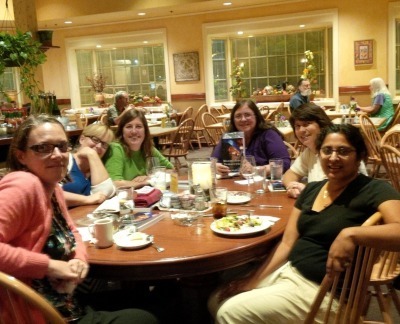
Reading a novel about a family struggling with ALS is not the same as reading a newspaper article about a celebrity taking the Ice Bucket Challenge. MONTPELIER TOMORROW immerses readers in the Ice Bucket, and as I expected, the women in this book group commented that the book was sad, well written, and true to life.
Full disclosure: My daughter-in-law Steffie invited me to meet with her book group, the Sunnyvale Las Madras 2001 Book Club. The women have been talking books since their kids were toddlers. There is no group facilitator, so they asked if I would come up with some discussion questions. They passed the sheet of questions around, and I sat like a nervous fly on the wall.
What made me nervous? Well, I had poured my heart and soul into writing this book. It had taken me years to write, and the subject itself--ALS--is inherently sad. Because I had been so close to the material for so long, I had lost perspective on whether it was a funny book about death or a sad book about life. To add to that, I wasn't sure if the questions would lead to a good discussion, or if the members would have other things they wanted to talk about.
One of discussion questions asked readers to consider who the villain was. That's kind of an author-type question. Who is the protagonist and who is the antagonist? Every story needs one of each. I thought the villain was Fate. These readers thought the villain was ALS, and I thought, Yes, ALS is the villain because it strikes not just the sick person, but every single person in the family.
The discussion turned to the characters: the protagonist Colleen, her daughter Sandy, and Sandy's husband Tony. When I wrote this book, my goal was to make each character have major flaws, and I wanted to "play against type," meaning I didn't want Tony, the dying man, to be a near-saint, nor did I want the protagonist, Colleen to be the self-sacrificing mom who jumps in to take care of her son-in-law without a thought about the impact this would have on her own life. I wanted her to have a life. I wanted her to be passionate about projects the caregiving would interrupt. Because the story is told from Colleen's point-of-view, I wanted readers to like her, even if they could see her errors of judgment.
So how did these characters do in the likeability department>?
One reader said, "I didn't find Tony all that likeable." Another added, "If they're in a wheelchair, don't assume they're nice."
About Colleen, the caregiver, one said, "If you're there for a long time, it's different. It's indeterminate. You don't get a weekend off." Another commented, "How lonely it is for Colleen. She has no life apart from her life as a caregiver."
You got that right!
The group had a great back-and-forth about bad things happening to good people. Why is it that some families, or some people within them, get clobbered with multiple disasters, while others glide through life unscathed?
"It does seem like some families have too much, like the Kennedys," one said.
One woman added, "My sister is the one bad things happen to."
Listening in on the discussion allowed me to see the way the novel affected readers emotionally. The book got them in the gut. There was a lot of talk about family communication or lack thereof, the effects of illness on young children, and the perception that the characters in this novel were all living in a pressure cooker. One comment I particularly liked was that in these situations, "People who step up are often just doing the best they can."
I believe that's right. Most of the time, we're just doing the best we can.
Writing and Caregiving

My novel, MONTPELIER TOMORROW is about a mother and daughter trying to resolve old grievances, while caring for a dying man. The book won a Gold Medal for Drama from Readers' Favorites' International
...more
- Marylee MacDonald's profile
- 373 followers

