
Christopher Linforth's Blog, page 6
July 13, 2011
MORE NEW FICTION
Back in 2007, I wrote my first story set in Kansas. That story came to be known as "Fence" and was published in the 2009 Summer issue of Camas. The story has now been reprinted in the lastest edition of Sleet, an online magazine that showcases the work of new and established authors. You can check out my story here.





June 30, 2011
NEW FICTION
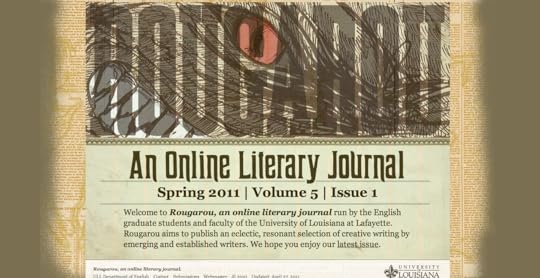
Recently, I've managed to publish a few flash fictions. There's "Dear Id" at Atticus Review, "The Temple at Avenue D" at Big Lucks' online arm Quick Lucks, "Notes From a Fruit Dentist," at Penguin Review, "The Sale" at RipRap, and finally "The Walk" at Rougarou. In addition, I have a full length story, "Moonbow," in the inaugural issue of The Lindenwood Review.





June 16, 2011
Best American Short Stories: Part Three
The first two posts charting my odyssey through thirty volumes of the Best American series can be found here and here. While reading another one of the books, I came across a recent survey by VIDA, an organization that deals with women in the arts. VIDA completed a statistical analysis of the gender discrepancies in each of the Best American Short Stories, Poetry, and Essays anthologies. They found over the last thirty years women accounted for 29% of the essays, and 39% of the poems. However, in terms of the short stories they discovered practical equality:
…of the stories published in the anthologies from 1978 through 2010, 47% were written by women. Of the thirty-three years of the Best American Short Stories we counted, there were sixteen years in which the number of works by women published in the anthologies were equal to or greater than the number of works by men.
Some fascinating data there. I leave it to others to draw their own conclusions. So onward with my latest year:
The Best American Short Stories 2000
Standout stories: Geoffrey Becker's "Black Elvis," Ha Jin's "The Bridegroom," and Jhumpa Lahiri's "The Third and Final Continent."
Overall, I found this edition to be lackluster, many well-written but so-so stories. Often I found myself wanting more profundity in the work, the type of insight gleaned at by the guest editor, E.L. Doctorow, in his fascinating introduction:
It was the Freudian disciple Wilhelm Reich who realized that extensive dream analysis was not necessary to uncover a patient's psyche: anywhere you looked — in actions taken, habits of thought, tone of voice, body language — you would find the typified self. That about describes the working principle of the short story as practiced by James Joyce and Ernest Hemingway.
Throughout his short essay, Doctorow offers his thoughts on the short story and its development and progression over the last few years. Of particular interest, he examines episodic and epiphanic narrative modes and discusses the strengths and pitfalls of Frank O'Conner's The Lonely Voice (1963), a sweeping and yet detailed study of the short story genre. In the past, I've read sections of O'Conner's book. I think it may be time to pay it another visit.





June 3, 2011
Esquire Follow Up
Recently I wrote about an Esquire reading list that contained 75 books, 74 of which were authored by men. In my brief discussion, I mentioned the idea of gendered writing. Since then I've been directed to "The Gender Genie," a computer-based algorithm that its creators reckon can determine author gender with 80% accuracy. Various words, it supposes, are used primarily by one gender or the other. According to Alexander Chancellor in The Guardian:
One of their findings is that women are far more likely than men to use personal pronouns ("I", "you", "she", etc), whereas men prefer words that identify or determine nouns ("a", "the", "that") or that quantify them ("one", "two", "more").
Interesting stuff. I tried it out on a range of my writing and it was only right half the time.
In related news (again from The Guardian), the Nobel laureate, VS Naipaul, recently said, "I read a piece of writing and within a paragraph or two I know whether it is by a woman or not. I think [it is] unequal to me." Naipaul goes on to argue that no woman, even Jane Austen, is his writing equal. This outburst has caused somewhat of a furore over in Britain, where he is more widely known than he is in the US. Needless to say, the man is clearly deluded, blinded by ego and hubris.





May 30, 2011
Best American Short Stories: Part Two
In my first post on the Best American Short Story series, I outlined my plan to read the last thirty editions. I'm reading the books for craft, the nuts-and-bolts of (short) storytelling, and to read some damn-good fiction. As I mentioned in my previous post, many of the magazines that submitted to the series are now defunct (Antaeus, Four Quarters, Kansas Quarterly, Ontario Review, TriQuarterly) for various reasons. Others, mostly university-based journals, have simply changed their names over the years. It's interesting for me also to read writers I'd previously never discovered: Kent Nelson, Tess Gallagher, Jessica Neely. I will be checking out their collections in the years to come.
The Best American Short Stories 1986
Standout stories: Charles Baxter's "Gryphon," Ann Beattie's "Janus," Ethan Canin's "Star Food," and Mona Simpson's "Lawns."
This really was a stellar year for short fiction, or perhaps the selections were more to my tastes. It's no surprise, I suppose, the guest editor of that year was Raymond Carver — one of my major influences.





May 29, 2011
Esquire Reading List
Over at htmlgiant Roxanne Gay has blogged about a recent Esquire list, which lists 75 books a man should read (note: I've read 19 of the 75). She notes that only one of the books, Flannery O'Conner's A Good Man is Hard to Find (one of my favorites!), is by a woman. The magazine has omitted many classic books, written by women, that deserve to make the list. Authors such as Anne Beattie, Susan Sontag, Lorrie Moore, Joyce Carol Oates, and dozens of others should be on that list. The idea of gendered writing and whether such a thing exists in literary fiction is a controversial point. Is there something inherent in the writing itself? The subject matter? The point of view? I, for one, believe gendered writing could not be picked out of an anonymous line-up of stories or novels. The magazine, and consequently the list, is geared toward men. Therefore, it is no surprise the list turned out the way it did. Roxanne Gay is right, though, in holding Esquire accountable for the extreme bias in the list.





May 27, 2011
Best American Short Stories
For the first part of this summer — before I start work at a temporary Johns Hopkins' job — I'm reading through multiple Best American Short Story anthologies. Each volume contains twenty stories in their entirety and mentions one hundred other distinguished stories of the past year. Around three thousand published stories are whittled down by the series editor and then the guest editor selects the final one hundred and twenty. The commercial magazines and literary journals from which the stories are chosen includes: the famous (The New Yorker, The Atlantic, Harper's), the established (The Paris Review, Agni, Ploughshares), the university-based (The Minnesota Review, The Indiana Review) the challenging (Conjunctions), and the less well known (Upstreet, Kestrel) and many, many others.
The series has been running since 1915 and has reprinted some of the finest and most widely anthologized work in American literary history. Working through the volumes from the 1980s (more on them in a later post) I noticed many writers and magazines I'd never heard of. Many of the writers were supremely accomplished; yet through various factors, including my lack of knowledge about the eighties writing scene, these writers have faded from public life. Whether through death, retirement, or literary tastes changing, other writers have taken their places.
It's my aim to read the volumes 2010-1980 this summer. That's 600 stories! My wish is to pick up some of the finer points of craft and gain a few answers on the eternal question: what makes a short story? And more importantly, what makes a good short story? By the time of the hundredth Best American anniversary arrives in 2015, I hope to place at least one story in that top one hundred and twenty of the year's best.
Below I note the books I've read so far and the stories that leave me in awe:
The Best American Short Stories 2010
Standout story: Marlin Barton's "Into Silence."
The Best American Short Stories 2008
Standout stories: Nicol Krauss' "From the Desk of Daniel Varsky" and Katie Chase's "Man and Wife."
The Best American Short Stories 2007
Standout stories: Lauren Groff's "L. Debard and Aliette: A Love Story" and Mary Gordon's "Eleanor's Music."
The Best American Short Stories 1995
Standout stories: Andrea Barrett's "The Behavior of the Hawkweeds" and Don DeLillo's "The Angel Esmeralda."





May 8, 2011
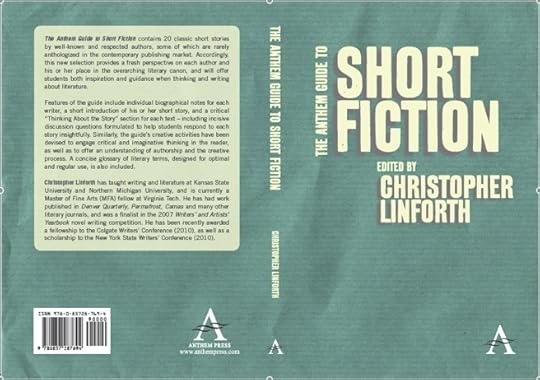
BOOK RELEASED
Hi folks,
My book is out next week. Click on the image to buy a copy at Amazon.com.





May 1, 2011





April 24, 2011
MFA ALTERNATIVES
GalleyCat has recently posted a list of alternatives to MFA programs. Although the website has some reasonable suggestions, it highlights the New York-centric view that MFAs are financially probative. Many programs, of course, are costly. In particular, the ones in and around NYC*, and low-res programs. The ever-present Seth Abramson lists dozens of programs that are fully-funded. You can see how these programs play out in the Poets and Writers rankings. You'll notice state schools often feature highly in the rankings. This is partly due to the wealth of TA-ships they offer. The consequence of funding opportunities is a high number of applications and high selectivity, often less than 5%, sometimes as low as 0.1%.
My advice: If you don't get into an MFA program the first time, read and write for a year, enroll in night classes, pontificate in coffee shops, attend readings and bug the writers about how they got in, work a job that makes you hungry for grad school, then reapply the following year. Many people don't get in on their first try, especially to programs that are willing to fund you. I have friends and acquaintances that got into top 20 programs on their second or third attempts.
If all else fails, join the Peace Corps! At least, then, you'll have done some good and some great material to write about!
*Because of the absence of fellowships and scholarships, which cover the high tuition costs, and because of large cohort sizes, the programs at schools like Columbia and Sarah Lawrence have high acceptance rates and large debt burdens left on their students. The cachet of such programs, glamorized by attending students, often leave these programs in higher esteem than they should be. That's not to say these programs don't have stellar faculty and successful alumni, they do. Rather, attending students don't seem to realize they are paying serious amounts of money to be in their workshops, while several hundred other students across the nation are being paid to attend theirs.





