
Christopher Linforth's Blog, page 4
March 6, 2012
AWP 2012: Random Quotes
AWP is the biggest writers conference held each year in America. Writers, publishers, professors, MFA students, CW undergrads, literary journals, agents, and editors all converge on one destination. This year was Chicago.

Below are some random quotes I heard, or perhaps said, over the four-day period:
"I'm Margaret Atwood. Where's my suckling pig?"
"I'm the other Toni Morrison."
"I've self-published two novels. Would you like to buy one? I have plenty of copies."
"Are you Sandra Beasley?"
"I'm thirsty. Would you like a beer?"
"Take a free copy of our journal. We'd like a five-dollar donation for it."
"It's not a podium. It's a lectern!"
"Oh, you're that Christopher Linforth."
Fun times! Feel free to add your own quote in the comments section.





February 24, 2012
Midwestern Gothic Interview
Recently, I was interviewed by the literary journal Midwestern Gothic. You can find it here.
My story, "The Model," appeared in issue 3, and my story, "Fence," in issue 4.







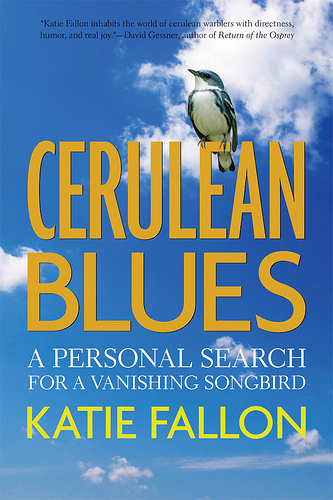
An Interview with Katie Fallon
I recently completed another writer interview for The Minnesota Review. This time it was with the nonfiction writer, Katie Fallon.
Click on the book to visit her publisher:





February 20, 2012
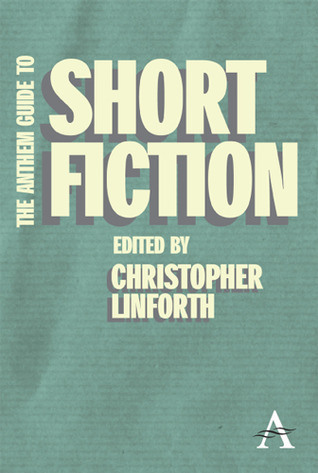
Free Book: The Anthem Guide to Short Fiction
For the next couple of weeks there's a chance to win a copy of The Anthem Guide to Short Fiction (Anthem Press, 2011) over at GoodReads.
Click on the picture below for the link:





February 9, 2012





January 22, 2012
Best American Short Stories: Part 6
Pre-1978 The Best American Short Story series had a single editor. For decades, from 1915 to 1941, Edward O'Brien fulfilled this role. After his death, Martha Foley took over. Raymond Carver mentions Foley's importance for American short fiction during his superb 1983 interview with The Paris Review:
INTERVIEWER
Is it true—a friend of yours told me this— that you celebrated your first publication by taking the magazine to bed with you?
CARVER
That's partly true. Actually, it was a book, the Best American Short Stories annual. My story "Will You Please Be Quiet, Please?" had just appeared in the collection. That was back in the late sixties, when it was edited every year by Martha Foley and people used to call it that—simply, "The Foley Collection." The story had been published in an obscure little magazine out of Chicago called December. The day the anthology came in the mail I took it to bed to read and just to look at, you know, and hold it, but I did more looking and holding than actual reading. I fell asleep and woke up the next morning with the book there in bed beside me, along with my wife.





January 8, 2012
Best American Short Stories: Part 5
The Best American Short Stories 1988 was a strange collection of work. From Raymond Carver's "Errand" (a story of almost all summary and filled with a heavy dose of biographical material taken from Henry Troyat's Chekhov) to Majorie Sandor's enigmatic "Still Life," there was a wide berth of subject matter, character, and thematic emphasis. Interestingly, 1988 appears to be the first year writers were asked to provide some background on their stories, and it's worth checking out these back pages for some nuggets on each work's genesis.
The guest editor—the right-leaning Mark Helprin—introduces the collection with an in-depth and intellectual essay that rails against minimalism, left-wing politics, writing programs, and the surge of women writers and ethnic literature. In terms of the latter two, he argues these forms of writing have taken over English literature college classes in the U.S., deemphasizing Shakespeare and many other authors Helprin holds close to his heart. Although well argued, his essay is misguided and reactionary on so many points, it would take an equally long rebuttal (his introduction "The Canon Under Siege" is 8,500 words!) to defuse many of his conjectures
The questions Helprin raises about the minimalist aesthetic are interesting and are worth noting here
Why are so any minimalist stories about despicable people in filthy unkempt garden apartments filled with ugly bric-a-brac, where everybody smokes, drinks, stays up all night, and is addicted to coffee? Why are the characters almost uniformly pudgy, stiff, and out-of-shape, even if they are in their twenties? Why do they watch so much about television? Why do they have so many headaches? Why are they impotent, frigid, promiscuous, or all three combined?
He continues asking questions for another half a page. For me, some of these observations are indeed facets of the genre, this "Dirty Realism," which in the following years went out of vogue. Although these scenarios appear infrequently in contemporary literature, they occasionally reemerge in similar or sometimes innovative forms (see some of my stories! or Carve magazine, for example), they are for the most part relegated to a few names: Raymond Carver, Tobias Wolff, and others, and a period: the late 1970s to the 1980s. The editor of Granta, Bill Buford, coined the term in a 1983 issue of the magazine.
Standout stories:
Tobais Wolff's "Smorgasboard" and Ralph Lombreglia's "Inn Essence."





December 20, 2011
End-of-Year: Writing and Publishing
I've never sat down before and worked out a year's writing output. By my standards, this past twelve months has been especially fruitful. You may note that some of the figures might not add up. That's because some of work published was written in previous years, and also when I say "published" that takes into account pieces accepted for publication, but may come out in 2012.
Stories written: 10
Stories published: 14
Stories reprinted: 3 (one of them twice!)
Stories remaining to be published: 7
Ideas for new stories: 1
Novel pages written: 85
Essays written: 1
Essays published: 1
Essays remaining to be published: 1
Poems written: 9
Poems published: 6
Poems remaining to be published: 8
Other publications: 3
Overall rejections for all genres: Around 100
Pushcart Prize nominations: 2
I also wrote and re-wrote about 50-60 pages of material for my anthology/textbook, The Anthem Guide to Short Fiction. Next year, I envisage fewer publications due to my continuing man-hours spent on the novel. If I finish it, it will be my first completed novel! As my career moves forward, I think longer projects will be more beneficial and rewarding.
Happy New Year to all!





December 19, 2011
End-of-Year: The Atticus Review
Earlier this year, The Atticus Review published my flash fiction, "Dear Id." Now, they have created this great end-of-year image, which details all the fine contributors of 2011. Some wonderful pieces are available to read on their website, and it's free!






December 13, 2011
The New River
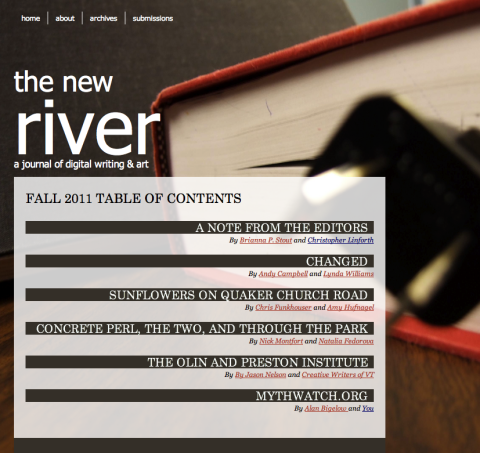
The New River, Issue 23, Fall 2011
Virginia Tech's The New River: a Journal of Digital Writing and Art is proud to announce the publication of our newest issue. Thematically centered on collaboration, this edition features work, such as audio-visual poetry, a surreal campus map, interactive digital narrative, script-fueled poem generators, and a transnational exploration of myth, from established writers as well as some new voices. In conjunction with a new site design, the issue features new media works by Alan Bigelow, Andy Campbell and Lynda Williams, Chris Funkhouser and Amy Hufnagel, Nick Montfort with translations by Natalia Fedorova, and Jason Nelson in conjunction with a group of creative writers at Virginia Tech.





