
Jane Lindskold's Blog, page 108
May 19, 2016
TT: Mobile Treats Transformed
JANE: I had fun revealing the mysteries of the Good Humor Man to you, then you ended with a teaser.
You said that something has taken the place of the ice cream van in your landscape. So what is it?

Coffee Culture (Southwestern U.S. Version)
ALAN: Mobile coffee vans. They don’t prowl the streets like the ice cream vans used to. But wherever groups of people gather together, sooner or later a van selling coffee will turn up. There’s one where I leave my car when I take Jake for a walk in the park, and when we had some free jazz concerts on the village green at the start of the year, there was one there as well.
JANE: I’ve seen some of these and, as a highly devoted coffee drinker, I approve.
And when I say “highly devoted,” I mean it. My first memories of drinking coffee are of sipping off the top of my parents’ mugs when I’d carry them their morning coffee. I was probably in single digits. My mom ground her own beans long before doing so was trendy, and I’d occasionally eat beans as well.
ALAN: I once knew a cat who liked to eat chocolate covered coffee beans. After two of them, you had to pull him down off the ceiling!
JANE: I’ve had chocolate-covered coffee beans. They don’t put me on the ceiling, though. And my dental hygienist highly disapproves of what they do to my molars.
When I was in high school, my best friend, Anna, went to Jamaica to visit her dad. She brought me back a pound of Jamaican Blue Mountain coffee beans. I kept them in my locker as a snack. Made the entire row smell wonderful.
How do you drink your coffee? As you may suspect, I drink mine black.
ALAN: I drink mine black as well, and so does Robin. (I knew we were going to get married the first time I saw her drinking coffee.)
JANE: Ah… A romantic thought. However, Jim (with whom I’ve shared space for twenty years now) pollutes his coffee with cream and sweetener. It doesn’t taste bad that way, more like a dessert, though, than coffee.
ALAN: There’s quite a coffee culture here in New Zealand. It ranges from high end, very snobbish cafes to the lowest common denominator of Starbucks. There’s a tendency to sneer at Starbucks, but I quite like it as long as I stick to just coffee. I’m a bit suspicious of the weirder things on their menu, but I think the straightforward coffee is rather good.
The vocabulary is remarkably odd though. Why do I have to ask for a Venti Americano when all I want is a black coffee in a big mug? If I ask for a black coffee in a big mug I just get blank looks…
JANE: Eh… I’ve got to disagree with you about Starbucks Coffee. Their default roast tastes burnt to me and I’ve heard that they deliberately over-roast the beans so that some coffee taste can permeate the elaborate “coffee drinks” that make them their money.
The only time I’ve put cream in my coffee was when I met Joan Saberhagen at a Starbucks because the location was convenient. I got a cuppa and found I couldn’t drink it without ameliorating it.
ALAN: Other people have also told me that they find Starbucks coffee to be a bit burnt, but I can’t taste whatever it that they are objecting to. Perhaps I have an unsophisticated palate.
JANE: Or maybe you just like the slightly burned flavor, the way some people like a “peaty” scotch rather than a smooth.
ALAN: Good point. I like “peaty” scotch as well. Perhaps the two tastes are related.
JANE: Now, I’ll admit, I prefer a medium/dark roast – a good Sumatran, for example – to the very dark roasts like Italian or French. However, I find the “Maxwell House” or “Folger” coffees, which are the standards of many American kitchens, weak and without proper “mouth feel.” A good coffee should have body, not just caffeine.
ALAN: Oh, definitely. I’m not familiar with “Folger”, but “Maxwell House” is available here (though only as freeze dried instant coffee) and I find it quite insipid. If their real coffee has a similar flavour, I doubt that I’d like it much.
JANE: Instant coffee! Oh… That’s a completely different topic. Remind me to bring it up later.
So, in addition to Starbucks, what sort of coffee do you like?
ALAN: At the moment we are drinking Hawthorne’s Coffee because the beans are grown locally in the Hawke’s Bay. But the best coffee I have ever drunk in my life was on the Pacific island of Vanuatu. The island is an ex-French colony and so bread and coffee are very important to the local culture and both are taken extremely seriously. They grow their own coffee beans on the island. The coffee they make is utterly wonderful – full bodied, smooth and full of flavour.
JANE: That sounds decadent… I bet they do good pastries, too. I’m swooning. Have you ever been to a coffee plantation? Do they have tastings like at wineries?
ALAN: No, I’ve never been to a coffee plantation, so I don’t know if they do tastings – but it sounds like a wonderful idea to attract the tourists. You could certainly put me down for it.
JANE: Or you me. Maybe if I ever come to New Zealand again, we can explore the option. That would be fun. Hobbiton and coffee plantations…
ALAN: That sounds like a plan! Meanwhile, I’ve just started a pot of coffee going, so we’ll have to continue this discussion next time.


May 18, 2016
Mission Accomplished (Almost)
This weekend, Jim and I finally got most of the garden in. Most of what we plant is seeds because in this dry, hot climate we find that the plants do better if they have a chance to establish from seed.

Look Carefully for the Giraffe
*This is probably a metaphor for writing, but I’m not sure exactly how to work it out. *
We purchased seedlings from a local nursery for peppers and eggplant and, this year, most of our tomatoes. For some reason, the tomatoes we started from seed didn’t do well this year. Unlike last year, when we planted twenty-one seeds and ended up with twenty-one plants – most of which grew up to monster bushes that produced lots of fruit – this year we planted twenty-one seeds and ended up with only three surviving plants.
*There is a reason I would not want to be a farmer. Farming makes writing for a living seem almost like a sane and predictable career choice. Kindly note, I said “almost.”*
Now the fun begins. I’ll start my morning by opening the blinds in the bedroom and looking out. First a quick count to see if the seven tomato plants I can see from there made the night. Next, have any of the beans sprouted? We plant the climbers to grow up a net right outside our window. By midsummer, if all goes well, we’ll have a natural curtain of green livened with lavender (liana) and red (scarlet runner) bean flowers. Oh, and lizards. They like to climb the bean vines. And hummingbirds come by to sample bean nectar. The cats love it. So do we.
But that’s later. Right now, the game is spotting what’s coming up. The squash bed is a bit further away, but zucchini seedlings have fairly large leaves, so sometimes I can see what’s come up from a fair distance. Carrots and radishes, however, require a closer inspection, as does basil, chard, cucumbers, and various herbs.
*I suspect this is also a metaphor for writing. Probably something to do with coming up with ideas that aren’t obvious. Hmm…*
We didn’t quite finish planting this weekend. Many of our perennial flowers are already doing very well. The lilies are shooting up, and we should have blossoms in a couple of weeks. The window boxes have been spruced up with snapdragons and dianthus that we purchased leafed out and budding. We’ll plant a chaotic assortment of zinnias and portulacas in other planters, as well as among the hollyhocks, so we have color when the hollyhocks are done with their first round of flowers. We’ll also plant more zinnias along the sidewalk leading to the front door. By the end of the summer, getting up that path will involve skirting flowers.
*Probably another metaphor, although whether for writing or for life in general, I can’t say.*
So, we planted most of the garden this weekend. Of course, that’s just the beginning. Persistence and patience will be needed if we’re to see fruit and flowers, rather than just dust and dry stems.
*And this is truth and also a metaphor. Funny how that works, isn’t it?*


May 13, 2016
FF: Comfort Books
I’ve had a rather horrible cold for the last week or so. Along with lots of homemade chicken soup and orange juice, I’ve been treating with liberal doses of stories I know I like.
Ogapoge Sets Sail
For those of you just discovering this feature, the Friday Fragments lists what I’ve read over the past week. Most of the time I don’t include details of either short fiction (unless part of a book-length collection) or magazine articles.
The Fragments are not meant to be a recommendation list. If you’re interested in a not-at-all-inclusive recommendation list, you can look on my website under Neat Stuff.
Once again, this is not a book review column. It’s just a list with, maybe, a bit of description or a few opinions tossed in.
Recently Completed:
Light Thickens, Death at the Bar, Scales of Justice, all by Ngaoi Marsh. Audiobooks. As mentioned above, “comfort reading” while sick and recovering.
Rooftoppers by Katherine Rumdell. Emphasis on setting and style over character and plot.
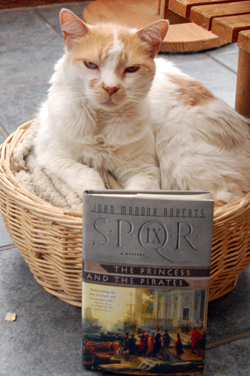
The Princess and the Pirates by John Maddox Roberts. SPQR IX. The “princess” is sixteen year-old Cleopatra. The pirates are off the newly acquired Roman territory of Cyprus – acquired from Egypt.
In Progress:
Black as He’s Painted by Ngaio Marsh. Audiobook.
Attack on Titan by Hashima Isayama. Manga. Volumes 5 and following.
A Point of Law by John Maddox Roberts. SPQR X. Decius is back in Rome. Pirates are easier to deal with than his fellow Romans.
Also:
Taking a break from the “Great Courses” mythology stuff until my head’s a bit clearer.


May 12, 2016
TT: What’s Good Humor?
ALAN: The other day I was reading a novel which used the phrase “Good Humor Man”. I have no idea what that means and the context wasn’t helpful. So can you unravel the puzzle for me?
Strawberry Shortcake
JANE: Good Humor was an ice cream brand. They had trucks that went around selling ice cream and other frozen treats. As I recall, they had a specific song they played, but maybe it was array of songs or bells?? Anyhow, definitely one of the sounds of summer when I was a kid was the slightly tinny, tickly sound of the Good Humor truck.
Our neighborhood was rather isolated, so it wasn’t as if the truck came through daily or even weekly. Instead, it was rather like Gandalf arriving in Hobbiton, unpredictable and wonderful – especially if we had pocket money or could pry some out of Mom on short notice, which was not a certain thing by any means.
I remember hearing the music, running for Mom, begging loose change, running back, fearful the traveling treats would have moved on. Then the debate as to what to get…
ALAN: Ah! I remember those – but we just called them Ice Cream Vans (how dull of us). Generally the music they played was Greensleeves, though I do recall hearing other tunes as well. It was always a thrill when one came up our street. If I went out to buy an ice cream, I had to make sure to buy one for my dog as well. He loved ice cream and he would sulk if he didn’t get his share.
We did have some brand-specific vans – they were always called Mr Whippy Vans, because that’s what they sold. I never much liked Mr Whippy. In my view it wasn’t proper ice cream. It was very runny and the Mr Whippy man just put a cornet under a tap, turned the tap on, and ice cream flowed into the cornet.
Proper ice cream isn’t supposed to be runny…
JANE: Wow! You just opened up a whole bunch of things…
It sounds as if what Mr Whippy sold was what we call “soft serve” ice cream. This was very different from what the Good Humor Man offered. His special treats were the solid, creamy ice cream, but molded into bars (rather than scooped out of a tub). The bar was often coated in chocolate or a soft, crumbly, cake-like coating.
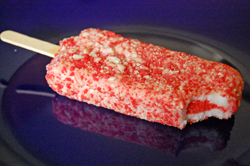
One of the great things about the Good Humor Man was that he had ice cream treats no one else did, such as Chocolate Eclair and Strawberry Shortcake. These were marvelous and wonderful, multilayered things. They were also the most expensive.
Later, I believe, they developed some that had an actual bit of solid chocolate in the middle. I recall these fondly, although I don’t think I’ve had one since I was sixteen or seventeen.
ALAN: Gosh, it all sounds very luxurious (and a bit exotic). We didn’t have anything like that.
JANE: You mention “Mr. Whippy” putting his ice cream in a “cornet.” I think that’s what we call a “cone.” But the Good Humor man didn’t do anything like that. You’d go up to the truck, review the delicacies depicted on the brightly-colored, illustrated menu (a good idea, since smaller kids can’t read), and then make your selection. He would then reach into the appropriate freeze and check if he still had any. Suspense! Would he? Would you need to make a new selection?
ALAN: Our orders were all individually made, though there wasn’t a huge range of choice. A favourite was a “99” which was a scoop of ice cream (or maybe two if you were feeling rich) in a cornet with a Cadbury Chocolate Flake stuck it.
JANE: Yum!
I checked Good Humor on-line and discovered to my delight that the founder of the company apparently originated the idea of frozen treats on a stick. You can read more about it here.
ALAN: We call the frozen things on sticks ice lollies. Our vans did have some of them in the freezer. They weren’t at all luxurious though – just frozen fruit juice on a stick. They did eventually get a bit more elaborate. I vividly remember when mivvis first appeared – a mivvi had an ice cream centre with a fruit ice outer coating. They were available in orange, strawberry and raspberry flavours. My favorite was raspberry.
JANE: Ah… Again we have a culture twist here. Frozen juice (or frozen sugar water with flavoring) on a stick is a popsicle.
Your “mivvis” sound close to what we’d call a “creamsicle.” Orange is most common, with raspberry next. I think there was also strawberry but, as these were never my favorites, I don’t recall.
Time for your SF quiz! Which author coined a term for bodies preserved by freezing (with the intention of later being animated) that played off the word “popsicle”? You get a bonus if you also give his term.
ALAN: Ah! I know this – Larry Niven’s “corpsicles”. The joke never worked very well on our side of the pond since we don’t have popsicles…
JANE: I’m trying to make up a term for frozen corpse that plays off “ice lolly” and I just can’t do it…
I didn’t read the whole article on Good Humor, so I don’t know if the Good Humor Man still makes his rounds.
I certainly don’t see Good Humor trucks here in New Mexico, so I don’t know if Good Humor has stopped sponsoring such trucks. The practice does seem to have continued, but the trucks seem to be more “gypsy” operations. And, of course, now that I have more than enough pocket money, running to get an ice cream treat doesn’t have the same allure. I very well could have missed some.
ALAN: Certainly they’ve long disappeared from our streets. During the (short) English summer, they were one of the highlights of my life. The vans had the advertising slogan “Stop Me and Buy One” painted on them (though I don’t recall ever seeing anybody flag a van down) and that slogan became so much a part of the language that “Buy Me and Stop One” was often to be found as a graffito on condom vending machines.
JANE: Oh… That’s perfect! I shall restrain myself from making off-color jokes.
Still, this discussion has made me rather nostalgic. I do recall at one time seeing Good Humor treats in the grocery freezer cases. Maybe I’ll check… But do I want to risk contaminating the memory?
ALAN: No you don’t – fond memories are precious things.
The ice cream vans of my childhood may have started to disappear, but I’ve noticed that something else has taken over that particular ecological niche. Shall we investigate that next time?
JANE: Absolutely… I wonder what you have in mind?


May 11, 2016
Why We Need Book Friends
Recently, I finished Shannon Hale’s The Princess Academy. This is a book that – despite it having been a Newbery Honor book – I never would have read without a recommendation from my friend, Julie Bartel.
Book Bunnies
For me the title, with its evocation of the cult of Disney Princesses, was a complete and utter turn-off. Having seen Ms. Hale associated with the commercial tie-in “Ever After High” novels and the apparently utterly cute “Princess in Black” lower middle grade books, her name would not have been a recommendation either.
And, boy, oh, boy, oh, boy would I have been missing out. As those of you who read my Friday Fragments may have noticed, I’ve been reading a lot of Shannon Hale’s works lately – up to and including several of the “Ever After High” books. I have already given my young niece The Princess in Black for Christmas. I’m seriously considering Book of a Thousand Days as a gift for another niece.
When I think about it, some of my favorite books are not ones I found myself but are books that were recommended to me by someone else. I read The Raven Boys by Maggie Stiefvater because two friends (Sally and Yvonne) separately mentioned loving it. When I mentioned The Raven Boys to Julie and she started raving about it, I immediately got the book. I am now nervously awaiting the final book in the four-book “cycle” – The Raven King. I’ve loved the other three but ,as I’ve mentioned elsewhere how a book or series ends is crucial to whether I continue to rave or whether I end up hating the story.
So what makes a good book friend?
First, I think you need to have discussed books enough to have a sense of each other’s likes and dislikes.
Years ago, I spent time with a woman with whom my taste in books rarely overlapped. We both read SF/F, so we kept trying to find common ground. One day we began discussing a book we’d both read and liked. I could tell that she was as pleased as I was that we both seemed to have liked this one. However, when we got to specifics, it turned out that the scene I’d like the most was the one she hated. The ending, which I had really disliked, was something she thought was brilliant.
Funny… Even when we liked books by the same author, the book I’d like best would be her least favorite and vice versa!
Second, a good book buddy doesn’t necessarily only read exactly what you would be reading anyhow. When Jim and I started dating, he introduced me to Patrick O’Brien’s “Aubry and Maturin” sea sagas. I never would have picked these up on my own, but I tried one and, for weeks thereafter, I would borrow two volumes from Jim each week. Chatting about what Steven and Jack were up to became a regular element in our courtship. We read the final books in the series together.
Jim also introduced me to Robert Parker’s “Spenser” novels. Again, these were books I doubt I ever would have read without him. I can’t say I liked them as much as I did the O’Briens, but that was all right. I found a lot to enjoy, and our discussions of the elements that grated for me were a lot of fun for us both.
My good friend, Paul Dellinger, is enough older than me that his reading tastes were shaped by older SF. Years ago, I went to him and asked for a list of authors and specific titles he had liked so I could expand my horizons. In this way, I read a lot of books I would have otherwise not known to pull out of the herd.
When Roger Zelazny and I started corresponding, he began sending me books, sometimes by the box load. Often he’d scribble a note in the front of a volume, telling me why he’d liked a particular book or why it was important to the field or, sometimes, that it was by a friend of his. Eventually, I started telling him about books I’d liked, and he’d try them. One of the last books Roger read – and enjoyed sincerely – was one of my recommendations: David Weber’s Path of the Fury.
Alan Robson’s “wot i red on my hols” column has opened my eyes to authors I would not have otherwise encountered, as have our frequent book chats on the Thursday Tangents. More often than folks realize, I take note of books mentioned in the Comments on my blogs. I may not get to them right away, but I do notice. Titles I read because of Comments on my blog include Uprooted by Naomi Novik and The Scorpio Races by Maggie Stiefvater.
Third, if you’re going to be a good book friend, you need to be willing to gently and politely push the other person’s limits. That’s what Julie did with me with Shannon Hale’s work. David Weber insisted I read Emma Bull’s War for the Oaks, even after I told him I’d tried it and couldn’t get beyond the opening. “So skip the opening. You’ll love this book!” He was right.
When Jim and I started seeing each other, Jim not only hadn’t read any middle grade or YA novels since he moved out of his teens, he actively avoided them figuring they’d be too “young” for him. I kept offering him new YA books I loved. Finally, he gave one a try. When he realized that modern YA novels were where the sort of novels he’d always loved were now being published, he expanded his reading choices. From there, he began to read middle grade novels as well.
Fourth, a key element in both finding and being a good book friend is remembering that no one’s tastes overlap precisely. I’m pretty grumpy about books that require the main character to turn off his or her brain or the plot will stall. My friend Sally knows this, so when she recommended Libba Bray’s “Diviners” novels, she said, “I’ll warn you that Evie, the main character, can be really, really annoying, but there’s a lot of other good stuff if you can deal with that.”
Equally, I remind myself that while I really love books with quirky characters (for example Marjorie Allingham’s Tiger in the Smoke), Sally may be turned off, so I provide her a “possibly too quirky” warning when talking about a book I like.
Sadly, two areas that used to be good places to get recommendations outside of one’s immediate circle of friends have recently become less sure. One of these are “best of” anthologies. Some of these are, indeed, edited by people who go out of their way to read widely in the area in which they are claiming to be choosing the “best.” The best of fantasy and horror series that Ellen Datlow and Terri Windling used to edit was a good example of this sort of collection.
However, recently I was shocked to see a market list (that is a list of places where writers can submit their work) that included several listings that were, basically, places where authors could send their work to be considered for a “best of” anthology of some sort. To me, this isn’t “best of,” this is “Best of what we read. Oh, a lot of that was what we were sent by people looking to promote themselves.”
Of late, awards have also become problematic. No. I’m not going to discuss the Sad Puppies controversy, except to say that it has drawn light to the serious problem of how easy it is to “game” certain awards. For example, SFWA is constantly trying to find ways to limit “vote trading” or “campaigning” for Nebulas. These days, I’m more likely to consider an award as a recommendation for a book if I know that the award was given by a panel or jury consisting of people who are knowledgeable about an area rather than by general membership of an organization.
So, who are your book friends? Do you belong to a formal book group of any sort? Do you use on-line reviewing sites like Goodreads or Amazon? How about book blogs?


May 6, 2016
FF: Thoughts on Action
Too often books are dismissed as “slow,” because the action has little to do with physical danger. Sad, because danger to the “soul” or “self” is really far more dramatic than any number of near misses by bullet or sword.
Kwahe’e Reads Titan
For those of you just discovering this feature, the Friday Fragments lists what I’ve read over the past week. Most of the time I don’t include details of either short fiction (unless part of a book-length collection) or magazine articles.
The Fragments are not meant to be a recommendation list. If you’re interested in a not-at-all-inclusive recommendation list, you can look on my website under Neat Stuff.
Once again, this is not a book review column. It’s just a list with, maybe, a bit of description or a few opinions tossed in.
Recently Completed:
Something Wicked This Way Comes by Ray Bradbury. Audiobook. Would a modern reader sit still for the philosophizing? I’m not sure but, if not, it’s a pity. Without it, the book is just creep show. With it, there’s both greater creepiness and deeper redemption.
Whiskey and Charlie by Annabel Smith. They’re twins. They’re not close as brothers. When William “Whiskey” is hit by a car, Charlie finally confronts the reality of their relationship – rather than the version of it that he’s held on to for many years. I liked very much.
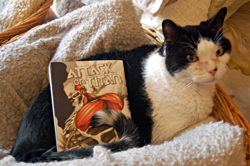
Attack on Titan by Hashima Isayama. Manga. Volumes 2-4.
In Progress:
Light Thickens by Ngaoi Marsh. Audiobook. Have read before, but decided to read again.
Rooftoppers by Katherine Rumdell. Quirky.
The Great Mythologies of the World volume one in the Great Courses series. Audio. Finished Greek and Roman. Only one disk on Celtic?? And the “lecturer” couldn’t consistently pronounce Cuchulain??? I realize there are variations, but this really made me wonder about her “expertise,” or if she was just reading someone else’s script. Now on to Norse.
Also:
Tried several books that ended up not holding my attention.


May 5, 2016
TT: The Good and Bad of Evocative Styles
JANE: Last time we talked about some of the elements of older SF style that may contribute to making it harder for newer audiences to get into.
Surely not all the recognizable “older” styles were bad… Do you have any positive examples?
Writing SF with Style
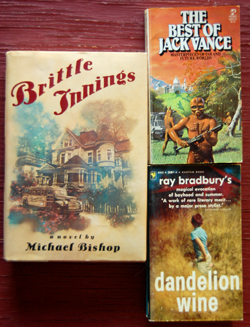
ALAN: Yes, I do. Jack Vance’s voice is unmistakable. He has a mannered, flowery style full of rare (and sometimes made-up) words. He is often witty, droll and dry. Reading his prose can be a sensuous experience.
“The creature displayed qualities reminiscent of both coelenterate and echinoderm. A terrene nudibranch? A mollusc deprived of its shell? More importantly, was the creature edible?”
That’s from a fix-up novel called Cugel the Clever.
JANE: Ooh, boy… I happen to know most of those words, but I wonder if Vance really communicated to his audience? Still, I guess he had faith they’d use a dictionary. These days, with on-line dictionaries, it would be even easier to check out odd words.
Did Vance write like that all the time?
ALAN: Interestingly, no, he didn’t. His detective novels are told in a plain, straightforward manner with none of the stylistic flourishes that ornament his SF. So clearly his SF style was a deliberate artistic choice. But I have no idea why he chose to write so differently in the two genres.
JANE: Quite possibly because he was aware that the dominant style for detective stories of the time was plain and unadorned, whereas he was clearly weaving sound (as well as idea) images with his SF/F.
What other writer would you suggest had a recognizable style?
ALAN: Ray Bradbury is another unique stylist – his prose is poetic, often rhythmical and full of odd images that stay with the reader forever. I will never forget the story “Kaleidoscope” (in the collection The Illustrated Man) which opens with a wrecked spaceship that spills its doomed crew out into the void “…like a dozen wriggling silverfish”.
JANE: Now, that’s a great image. Even people who haven’t encountered the insect silverfish would mentally “translate” into “silver fish,” and still get some of the same impact.
Bradbury is often praised for being “pastoral,” and “nostalgic.” This deceptive gentleness of style is very effective in making his creepier stories more creepy.
ALAN: Oh gosh yes – he could be very creepy when he wanted to be and I’m sure you’re right in your observation about the contribution his style made to that effect.
The style an author choses for a story really can have a profound emotional impact. In Flowers for Algernon by Daniel Keyes, the style is so intrinsically part of the story’s structure that I can’t imagine it being told in any other way. It concerns an intellectually handicapped man who receives treatment that turns him into a genius. The sections where the character is still handicapped are told in simple (often badly spelled) prose. As the character’s intelligence increases and matures, so too the writing changes to reflect his more sophisticated understanding. Both sentence structure and vocabulary become more complex.
JANE: Oh! I agree. I re-read the short story version of this recently and was, once again, brought to tears. If the language used hadn’t perfectly represented poor Charlie’s experience, it would not have worked.
Style should and can be a tool. I have a couple of examples in mind
Have you read Michael Bishop’s novel Brittle Innings? Its opening provides a great example of a deliberate stylistic choice that can prove a barrier to a reader.
ALAN: I’ve sort of read it… I simply couldn’t get past the opening because I am quite ignorant about baseball and the culture surrounding it. The novel made too many assumptions about my level of knowledge and I found it impenetrable. Normally, I like Michael Bishop’s books, but this one defeated me.
JANE: For those who haven’t read it, Brittle Innings is a World War II era Southern Gothic novel in which the Frankenstein monster plays minor league baseball.
ALAN: Perhaps Bishop should re-write the novel for a UK audience, using cricketing culture instead of baseball. I’d find that a lot easier to come to grips with, though I suspect Americans might find it a bit tricky to follow…
JANE: That we would. I am perennially confused by cricket references in British novels. Since they’re usually background, I can go “la-la” and skim, but in Brittle Innings both the sport and the time period are essential to the novel.
Bishop is a fine and elegant stylist. In Brittle Innings, he chooses not only to use slang and imagery of the time, but to deeply immerse the reader in the subculture (including jargon) of baseball. As a reader too young for the one, as well as being fairly ignorant of baseball, I found this challenging.
To further complicate matters, after I’d twisted my brain into comfort with that stylistic choice, Bishop introduced long passages from Jumbo’s journal. As was appropriate, it was written in the ornate prose of the late 1700s/early 1800s. After the breezy, slangy prose of the previous 200 and some pages, this was like hitting a wall of cold molasses.
I ended up quite enjoying the novel, but I’ll admit, it wasn’t a breezy, easy read.
Any other thoughts about style?
ALAN: Sometimes a writer’s style can be defined by their devotion to a single word. I have a funny story about how that created a new game.
JANE: Do tell!
ALAN: The game is called Clench Racing and is played by UK fans. Competitors are provided with a Thomas Covenant novel by Stephen Donaldson. When the game begins, everyone opens their novel to a random page and starts scanning forwards. The winner is the first person to find the word “clench” in the text. Apparently, most games are finished very quickly!
JANE: Okay. I need to try that one of these days.
Just as an experiment, I pulled up a file of Artemis Awakening and did a search for “clench.” It didn’t come up even once! So I think you’re absolutely right that word choice is one of the things that is key to a writer’s specific style.
We’ve been very literary these last several weeks, and I’ve quite enjoyed it. I wonder what we’ll come up with next?
ALAN: I’m clenching my jaw to stop myself blurting out the secret…


May 4, 2016
Meow Wolf’s Mystery House
Appropriately, the first person who told me about Meow Wolf was wearing a mask.
Last October, I was chatting with George R.R. Martin at a Halloween party hosted by our mutual friends, Patricia Rogers and Scot Denning. Behind the dark leather Venetian half-mask, George’s eyes shone with excitement as he talked about how he’d purchased an abandoned bowling alley in Santa Fe, and how the Meow Wolf art consortium was in the process of transforming it into a permanent art installation to be called “The House of Eternal Return.”

Music of the Spheres?
When George started describing the project, I wasn’t quite sure how this art installation would be more than an artsy variation on the old carnival fun house. Mind you, even that sounded like fun. But what hooked me was when George mentioned that the House of Eternal Return wasn’t just a vast three-dimensional work of art, it was a story.
When the House of Eternal Return opened to great reviews about six weeks ago, I asked Jim if he’d like me to take him as part of his birthday present. When he expressed enthusiasm, I went on to suggest that we invite some of our friends to go with us, specifically, our current gaming group. From what George had said, I had the impression that the story told by the House of Eternal Return was distinctly non-linear, to be understood more by interpreting clues than by following an orderly script.
Also, most of this group is very artistic. Those of you who are familiar with the book covers for my Wanderings on Writing and Curiosities are already familiar with Tori and Rowan’s work. One of Cale ‘s drawings was the direct inspiration for the cover of Artemis Awakening. Dominique is the shyest about sharing her art (although I’m hoping to get her to show some at this year’s Bubonicon). Melissa restricts herself to stick figures but, though she poo-poos them, they’re actually remarkably expressive.
So I figured that this was the perfect team to take to explore the House of Eternal Return.
When we arrived mid-day last Saturday, the place was already packed. Despite ample parking, we had go well down the block to find street parking. We bought our tickets and got in line. Even there, we could see that we were in for an interesting time. Instead of the usual bland announcement about no eating or drinking while inside, a monitor showed a man in a lab coat who spoke in a halting, staccato , warning us that Charter Agents would be watching: “No eating. No drinking. No thinking.” He then went on to say some other very odd things (I was too busy enjoying to take notes) before the image dissolved into static.
When a Charter Agent in a white lab coat admitted our group into the exhibit, we found ourselves on a twilight lit street across from a Victorian house. We crossed over and entered by the front door. To our right was a living room – and a laughing woman was popping out through the back of the fireplace. Ahead of us was a staircase going up to a second floor. Possibly because the first floor was so crowded, Tori dove for the staircase and the rest of us followed, so we began our tour on the second floor.
This was fine. The House of Eternal Return really does succeed in providing a non-linear story experience. If we’d started on the first floor, we definitely would have had some information sooner. However, I’m not sure it would have meant anything to us at that point.
I’m not going to risk ruining the experience for anyone else by going into our explorations in detail. I will say that Jim and I picked the absolutely right people to go with. In addition to being delighted by all the wonderful areas to explore, our group scavenged for clues. We’d separate and meet again, share thoughts. Was there just the father or were there two men who looked a lot alike? How did the grandmother fit in? What exactly was the Charter?
Wait… I’ve got to stop or I will give too much away. So much of the fun is figuring out what is significant and how each element fits into the others. The art is not just there to have fun with (although it’s lots of fun to play music on lasers or by beating on glowing fungi or on a deliberately atonal electric piano). Much of it provides hints as to the larger story. The same is true of the fragmented bits of narrative on various video monitors and audio clips that can be accessed from headsets tied to assorted consoles.
If I have one gripe, it was that these were very hard to hear. In one room, while we were trying to listen to a crucial narrative, a boy who had obviously been through before kept saying over and over, very loudly, “This is one of the boring ones! This is one of the boring ones!” Maybe, if you’re eight and all you want to do is run around, but not if you’re into the story. I hope that Meow Wolf is eventually able to have adult-only times, for those who want to appreciate the details.
After we’d completed an appreciative wander through and up and down and in and out, and said “Look at this! Did you see that!”, we started pooling what we’d learned or guessed or suspected about various elements of the story. I knew my gamers were getting serious when we finally made it back to the kitchen on the first floor and found Rowan seated at the kitchen table, immersed in the newspapers that were spread about, as if members of the family had just finished their morning coffee. Later, we gathered around… No. I won’t tell.
I’m very proud to announce that we succeeded in working out the story in most major details and lots of minor. Mind you, I still have some questions, but when we emerged from the House, the first Charter Agent we spoke with was very impressed by how much we’d worked out. Indeed, she cheered when we told her we’d found… Nope! Not going to tell you what…
Later, Dominique spoke with a member of the narrative team who confirmed many of our guesses.
So Meow Wolf not only lived up to its press. For me and my group, it exceeded expectations. As a storyteller, I was particularly impressed by the complexity of the tale the House of Eternal Return told – and that they managed to tell it without relying on overt sex or violence or even grotesquery. And yet, to quote Tori, “It was still amazingly creepy.”
We’ll definitely go back, on a quiet day, and this time we’ll listen to all the audio stations, have a chance to hear (as well as see) the video clips. Maybe then we’ll have the answers to a few lingering questions. Even if we don’t, I know we’ll have a lot of fun!


April 29, 2016
FF: Lots of Shapes and Colors
I realized I hadn’t read much new (to me) in illustrated format for a while, but I certainly didn’t avoid print.
Kel Understand True Princesshood
For those of you just discovering this feature, the Friday Fragments lists what I’ve read over the past week. Most of the time I don’t include details of either short fiction (unless part of a book-length collection) or magazine articles.
The Fragments are not meant to be a recommendation list. If you’re interested in a not-at-all-inclusive recommendation list, you can look on my website under Neat Stuff.
Once again, this is not a book review column. It’s just a list with, maybe, a bit of description or a few opinions tossed in.
Recently Completed:
A Wonderlandful World (Ever After High #3) by Shannon Hale. Focus shift to new characters works well.
Book of a Thousand Days by Shannon Hale. I loved – and was impressed by – this YA adaptation of the Grimm’s fairytale “Maid Maleen.”
Y: The Last Man by Brian Vaughn and Pia Guerra. Graphic novel. Issues 1-10. Post-apocalyptic premise might have worked better for me with more innovative art and less irritating characters.
Attack on Titan by Hashima Isayama. Manga. Issue 1. The art is sketchy, almost crude, and then I realized why… Want to read more.
The Princess Academy by Shannon Hale. No. This has nothing to do with Disney Princesses. This is much more interesting.
In Progress:
Something Wicked This Way Comes by Ray Bradbury. Audiobook. I’d missed this one. I can understand it’s continued appeal.
Starship by Brian W. Aldiss. Just started.
The Great Mythologies of the World volume one in the Great Courses series. Audio. Sometimes, even with a subject I know a lot about, I enjoy someone else’s point of view.
Also:
Skimming issues of fashion magazines. A great way to put color and odd images into my subconscious.


April 28, 2016
TT: Putting on the Style
JANE: Last time we started taking a look at why the style (in which we included narrative conventions) of older SF can provide a barrier to newer readers – even those who are perfectly willing to accept, say, a Mars with breathable air or starship engineers who use slide rules, as a sort of “alternate history.”
Kel: Arbiter of Style
Since anyone who missed that can look here, I’m just going to dive in where we left off.
ALAN: Go for it!
JANE: I think one of the biggest hurdles older SF faces is that – especially given that these stories are full of people who are little more than talking heads – the dialogue sounds so fake.
Let me quote from early in Stanley G. Weinbaum’s “A Martian Odyssey” (1934).
“Well,” exploded Harrison abruptly, “are we going to hear what happened? You set out all shipshape in an auxiliary rocket, we don’t get a peep for ten days, and finally Putz here picks you out of a lunatic ant-heap with a freak ostrich as your pal! Spill it, man!”
If this had been the narrative hook, I might be more forgiving, but we’ve already had a page of info dump… including a very long, very dense, very dull paragraph, much of which has absolutely nothing to do with the story.
If you will bear with me, I’ll take a closer look.
ALAN: The closer the better – I’m intrigued.
JANE: First, I’m reminded, once again, of old-radio dramas, where, since they can’t show what’s happening, they tell you, often through dialogue. Let’s take a closer look at that dialogue.
“Exploded abruptly” is redundant. Explosions are by definition “abrupt.”
“Shipshape” would have been verging on old-fashioned jargon even in 1934, unless you were a very traditional wet water sailor.
“Peep,” “pal,” “freak,” “spill it” all seem to be trying too hard to sound like casual, slangy speech.
Moreover, I think Weinbaum himself was aware of how fake and stilted his dialogue was, since one of the subtexts of the story is a commentary on language. Nor is that commentary restricted to the difficulties of talking to aliens, but is dealt with repeatedly between the humans.
As soon as Harrison finishes his diatribe, that it is intended to be confusing is made clear. Again, I quote:
“Speel?” queried Leroy perplexedly. “Speel what?”
“”He mean ‘spiel’,” explained Putz soberly. “It iss [sic]to tell”
Note the redundant adverbs “perplexedly” and “soberly.” Again, I think Weinbaum was completely aware of what he was doing, because he stops later in the story. But to an audience not in on the joke, this is a barrier they may never get beyond. Actually, they may never get beyond the info-dump in paragraph three.
Okay… I’ll stop now.
ALAN: Righto – I’ll start.
If you are paid by the word, which many of these writers were, it helps your pay cheque if you can insert some extra words here and there. Maybe I’m being cynical, but I wouldn’t be surprised if the adverbial and adjectival redundancy that you spotted was quite deliberate.
We’re on shakier ground when it comes to slang. I know little or nothing about period American slang, but “Peep,” “pal,” “freak,” “spill it” may well have been commonly used terms when Weinbaum was writing (I’m sure I’ve seen these and similar words in other stories from the period).
If so, of course, his original audience would have accepted them unquestioningly. What’s a poor writer to do? You can only use the words that you know, even if you are sure that they will not stand the test of time and you may well end up looking quaint. Your only other alternative is to try and invent a future slang and that will almost certainly leave you looking ridiculous.
JANE: To clarify… It is the sheer amount of slang crammed into those sentences, not any one word in itself I was noting. But you do have a good point. Go on!
ALAN: As far as I know, only Robert Heinlein ever had any real success here – waldo (from the short story “Waldo”), grok (from Stranger in a Strange Land) and tanstaafl (from The Moon is a Harsh Mistress) were so successful that they have migrated backwards and, particularly in the case of “grok”, have become part of everyday speech in the real world. I guess that makes Heinlein a neologiser of Carrollean skill!
JANE: I agree that Heinlein was very successful. I’m sure someone reading the word “waldo” out of the context of the initial story (in which the inventor’s name is given) would assume that Heinlein was using an established term, not that his term for remotely operated robotic devices had entered the general language.
Jack Williamson also had a talent for inventing terms that would become mainstream. His include “androids,” “genetic engineering,” and “terraforming.”
ALAN: But of course none of that invalidates your conclusions and I think you are right about why a modern audience might find those stories difficult to read. And that will only get worse as time passes. Already they sound quaint and forced. Soon, I suspect, they will stop making sense entirely.
JANE: If I had to choose, I’d say that info dumps are a greater danger than any amount of “quaint” language – especially if they come before the audience is fully hooked. However, both were part of the dominant style of older SF.
ALAN: Infodumps are almost always a turn off, particularly when they start with a character saying something along the lines of “As you know, Professor…”. Harry Harrison parodied this beautifully in his novel The Technicolour Time Machine. A character asks the inventor of the time machine to explain how it works. Cue infodump. But the inventor replies by telling the character that he is too stupid to understand the explanation. The story moves on and no infodump takes place!
JANE: Editors sometimes use the phrase “As you know, Bob…” as a shorthand for “obvious infodump.’ After all, if you know, why would you need to be told?
But SF style, even that used by those “older” writers, isn’t all bad, is it? Maybe we can take a look next time!



