
Jane Lindskold's Blog, page 100
November 18, 2016
FF: More Time to Read
Jim and I finished what we’d been watching, and switched to reading in the evening, so I had more time this past week.

Can We Wash the Black Off?
For those of you just discovering this feature, the Friday Fragments lists what I’ve read over the past week. Most of the time I don’t include details of either short fiction (unless part of a book-length collection) or magazine articles.
The Fragments are not meant to be a recommendation list. If you’re interested in a not-at-all-inclusive recommendation list, you can look on my website under Neat Stuff.
Once again, this is not a book review column. It’s just a list with, maybe, a bit of description or a few opinions tossed in.
Recently Completed:
Goldenhand by Garth Nix. The first novel to carry the excellent “Old Kingdom” series forward since Abhorsen. Pluses – ties the prequel Clariel more into the series. Minuses – suffers a bit from how good the resolution was to Abhorsen. Still, I enjoyed.
A Year Down Yonder by Richard Peck. Sequel to A Long Way From Chicago. Very strong. I’ll need to try some of Peck’s other works.
In Progress:
The Golden Specific by S.E. Grove. Audiobook. Sequel to The Glass Sentence. Split plot lines. One has the more “go-getter” character, the other the more interesting material. Makes for an odd read.
Six of Crows by Leigh Bardugo. This has been getting a lot of buzz, so I decided to try it.
Also:
Finished off what’s available of The Wicked and the Divine. Am happily speculating on where the final plot twist may lead. I have two theories…



November 17, 2016
TT: Live Long and Prosper
ALAN: Do you want to live forever?
JANE: Depends. Do I get to stay relatively young and healthy? Does everyone I love get to keep living, too, or do I need to watch all of them die? Immortality is a lot more complicated than just not dying.
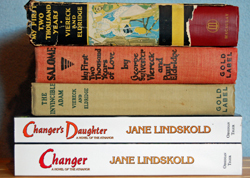
Long Term Fiction
ALAN: And considerations like that make immortality a fascinating subject to investigate in fiction.
We’ve been telling stories about living forever for as long as we’ve been telling stories. The Epic of Gilgamesh is the oldest story we know. It dates from about 2100 BC and part of it tells of a hunt for the secret of eternal life.
It’s a popular idea, and it’s a story that we’re still telling today, in one way or another.
JANE: It’s worth noting that The Epic of Gilgamesh (which exists in several variations) deals with all of my concerns. In one of the most common versions, the reason Gilgamesh goes looking for the secret of immortality is because his best friend, Enkidu, dies. Gilgamesh learns the secret, but – being merely mortal – does not succeed in bringing the gift back to humanity. The secret of eternal youth (and presumably health) is a separate deal.
So there we have all of it: not dying, staying young (and healthy), and the dread of loss wrapped up in one tidy package.
ALAN: Tidy indeed!
It seems to me that there are three basic story lines belonging to this theme. We have the search for immortality (the Gilgamesh Gambit, if you like). You can also use an immortal protagonist as an observer who watches, and comments on, the passage of history. And finally you can have a protagonist whose immortality gives him the experience to cope with whatever crisis or conflict he is currently facing in (probably) the modern day or the near future.
I have examples of all of these from both SFF and the mainstream, one of which was written by a certain Jane Lindskold… The story line of your novel Changer is a perfect example of the last category I mentioned. What made you decide to write the novel in this way?
JANE: Damn… I hate to do this to you, but I didn’t decide. The story decided. I started what would become Changer relatively soon after I’d come to Santa Fe to live with Roger Zelazny. Twenty years ago, Santa Fe was less self-consciously touristy, more a place where people lived and tourists came, in part because of the people who lived there and the things they made.
One of the things that I encountered one day when Roger and I were walking down to the Plaza to have lunch was a section of concrete sidewalk where someone had drawn a magic circle, complete with a few little crystals embedded in it when the concrete had still been wet.
Roger walked right over it without deeming it worthy of comment. At that moment, I resolved to write a story set in New Mexico before I, too, took such things for granted. Changer and the athanor began to take shape that day. But I didn’t sit down and say, “Well, I think I’ll write an ‘immortals among us’ story.” It just happened.
Doubtless the fact that I am a life-long reader of myth and legend had something to do with my choices, but I wasn’t at all conscious of making them.
ALAN: You may not have been conscious of it, but I think you were well aware of what you were doing on a deeper level. When I was reading Changer, I was interested to come across this sentence:
“There are turtles,” Eddie says, “like the one that Salome had in Viereck and Eldridge’s novel.”
The reference here is to a trilogy of mainstream novels from the late 1920s by George Sylvester Viereck and Paul Eldridge. The first, My First Two Thousand Years was the autobiography of the Wandering Jew and is a perfect example of the second story line that I mentioned before, in that Viereck and Eldridge use the myth of the Wandering Jew to comment on the passage of history. The other novels in the series (Salome and The Invincible Adam continue the theme from other points of view). They are rather obscure books and for a long time I thought I was the only person in the world who had read them. So I was pleased to see your little aside. Clearly you were also familiar with the books – something else that we had in common!
How did you come across them and how influential did you find them to be?
JANE: I was given my copies by Roger Zelazny. Once Roger and I started corresponding regularly, he’d send me books, often ones that he’d loved and wanted to share.
When he sent me my copies (which I still have), he said, “When I was growing up I read the 2000-Year Trilogy (each volume told from a different viewpoint) many times, & was doubtless influenced thereby in my own writing.”
As for how influential I found them? In one way, not at all, except that they were good books. However, I’d already encountered the motif of “immortals among us” through the works of many writers – including, no great surprise, Roger Zelazny. However, in that Viereck’s and Eldridge’s novels had an impact on a writer who, in turn, was a great influence on me, I suppose you could say they had a tremendous influence.
Influence is all a matter of timing…
ALAN: I think you might have just said something quite profound.
There’s still a lot more to say about this subject. Shall we look into it again next time?
JANE: Absolutely! After all, you came up with three general types of immortality stories and we’ve barely touched on any of them. Let’s explore the secret of immortality together.


November 16, 2016
Moving Along Now
Thanks to everyone who weighed in last week regarding branding as it applies to books and your awareness of them. I’ll keep you posted on developments. Please feel free to keep sending me comments, either on the post or to my work e-mail: jane2@janelindskold.com.
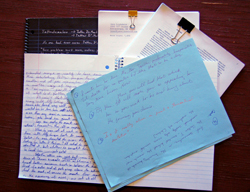
A Pile of Ongoing Projects.
Currently, I’m focusing in on the writing/editing side of things. Last week, Jim finished reading the manuscript for a novel I wrote on spec. The original manuscript was 54,000 words, but I recently expanded it to a tidy 72,000. One of my jobs this week will be polishing the expanded version and getting it to a few beta-readers.
I’ve also selected which of my out-of-print Avon novels I’ll be getting ready for e-book publication. Smoke and Mirrors, originally published in 1996, is a far future science fiction novel about what happens when a very unlikely person becomes among the few to realize that there just may be hostile aliens infiltrating human-inhabited worlds. It’s more thriller than war story, because I prefer the small picture to massive troop movements.
If you can’t wait for the e-book, I still have some copies of the original mass market paperback of Smoke and Mirrors. See my website bookstore for details.
I’m also writing a short story, because I’ve learned the hard way that if I’m not doing something creative, I get very, very grumpy.
This past weekend featured several fun and creatively stimulating events. Friday, I read my yet-unpublished short story “A Familiar’s Predicament” at the monthly meeting of the Albuquerque Science Fiction Society. I very much enjoyed the discussion afterwards. Particular thanks to the lady who cheered at the story’s resolution.
Saturday, Jim and I went to the New Mexico Archeological Counsil’s annual conference. Although Jim’s paper was the last of the day, we went early enough to listen to most of the other papers. Even though this is technically outside of my “field,” I find such events very creatively stimulating precisely because the papers are outside of what I would usually be reading and thinking about.
Many of the papers we listened to had to do with the crossing of the various cultures that have settled the region now known as New Mexico. In addition to the “alien invasions” represented by the incursion of peoples from Europe, there were culture clashes and cross fertilizations between the numerous indigenous peoples – many of whom spoke completely different languages and practiced widely varied religions. By contrast, modern “America” looks positively homogeneous. How many cultures have occupied this landmass is worth remembering, especially in these days when there is a rising myth that the United States was once a monoculture.
Sunday, I had a lovely time running my on-going roleplaying game. Running a game is an entirely different type of storytelling. I very much enjoy the stimulus of setting up a situation, then seeing how my players react as they discover something. This week in particular was full of discoveries. I can hardly wait for next time…
But, for now, I’m off to split my time between pen and paper and keyboard once more. The stories are calling, and I must come!


November 14, 2016
TT: Special Edition!
Hi Folks,
I’ve had e-mail asking me if Alan is okay after the earthquake that hit the South Island in New Zealand.
Yesterday, Alan e-mailed me to let me know that although the South Island was hit by a 7.5 earthquake, he, his wife, their dog, and two cats are fine.
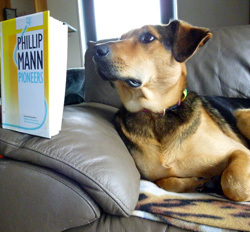
Jake Robson, Not an Earthquake Detectorre fine.
Obviously, there could be further problems from aftershocks, tsunami, and the like but, as of my latest report, Alan and family are well.
With typical Alan sense of importance, he noted that — contrary to folklore — none of their animals reacted to the quake.
Let’s all keep a good thought as the world does Shake, Rattle, and Roll…


November 11, 2016
FF: Reading Tonight and Always
Tonight I’m giving a reading of a yet unpublished short story at the meeting of ASFS, the Albuquerque Science Fiction Society. Hope to see some of you there!
For those of you just discovering this feature, the Friday Fragments lists what I’ve read over the past week. Most of the time I don’t include details of either short fiction (unless part of a book-length collection) or magazine articles.
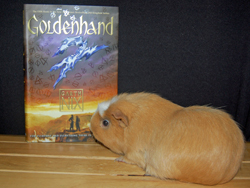
Starlight Reads!
The Fragments are not meant to be a recommendation list. If you’re interested in a not-at-all-inclusive recommendation list, you can look on my website under Neat Stuff.
Once again, this is not a book review column. It’s just a list with, maybe, a bit of description or a few opinions tossed in.
Recently Completed:
The Man in the Tree by Sage Walker. Advanced Bound Manuscript of forthcoming release. Not your usual car chase murder mystery, but a thoughtful examination how murder impacts a closed community – in this case on a generation ship about to set off for the stars.
The Beasts of Tarzan by Edgar Rice Burroughs. Audiobook. Weaker than the prior two, with too much repetition and a plot that relies on both Tarzan and Jane being really dumb.
In Progress:
Goldenhand by Garth Nix. The first novel to carry the excellent “Old Kingdom” series forward since Abhorsen. So far an interesting journey.
The Golden Specific by S.E. Grove. Audiobook. Sequel to The Glass Sentence.
Also:
Almost done with the issues of The Wicked and the Divine graphic novel I have on hand. I can’t help but think Roger Zelazny would have liked this, too.


November 10, 2016
TT: To Time Travel or…
JANE: So, before we fall into minutia, it’s time for the Big Question. Is time travel as a trope still viable? One of the articles I read suggested that, in fact, it was played out. What do you think?
ALAN: Certainly the mainstream doesn’t think time travel is played out. They’ve adopted the idea wholeheartedly (after filing the serial numbers off it, of course).

Viable Time Travel
In Martin Amis’ 1991 novel Time’s Arrow, for example, people age backwards through time from death to birth. If you think that sounds like a similar plot to Philip K. Dick’s Counter-Clock World (1965), you’d be quite right. I think that Dick did it much better than Martin Amis did – indeed, I seriously doubt that Martin Amis even knew about the Dick novel (though I’ll guarantee that the book was well known to his father Kingsley!)
JANE: That’s right, as well as being a literary lion, Kingsley Amis wrote one of the first definitive works of SF/F criticism, New Maps of Hell. I realize sons and fathers don’t always share each other’s tastes, but I wonder if Martin Amis could truly claim to be innocent of influence from earlier time travel works. Ah, well, unless he chooses to tell, we’ll never know.
“Wholeheartedly” implies more than one example, and I’m betting you have one up your sleeve.
ALAN: Indeed I do. The best example is Audrey Niffenegger’s magnificent novel The Time Traveler’s Wife (2003). The title tells you all you need to know about the plot. It was marketed as a mainstream “literary” novel with no hint whatsoever that the author was slumming in the SF genre. It was a huge best seller. I thoroughly enjoyed it and I thought she handled the “Time Paradox” aspects brilliantly.
JANE: To be the grump…
Mainstream authors can have huge successes with an SF trope precisely because it’s new to their audience. I haven’t read either of those novels, but I will admit that I’ve read other (not only time travel) ventures by “mainstream” authors into turf already well-tended by SF/F and been bored because what is new to them is far from new to me.
ALAN: That’s always a danger of course, and the Martin Amis novel is definitely rather disappointing for that very reason. But The Time Traveler’s Wife is, quite simply, superb no matter how you try and categorize it.
JANE: So, has anyone writing specifically in SF/F done anything fresh and interesting with the time travel theme recently?
ALAN: Well, in 1995, to celebrate the centenary of Wells’ novel, Stephen Baxter published The Time Ships, which is a brilliant sequel to Wells’ original story. But perhaps that doesn’t really count as an answer to your question.
JANE: Maybe not, but I’m curious as to what Baxter chose to focus on for his sequel. Can you give me a non-spoiler thumbnail sketch?
ALAN: In 1891, the time traveller attempts to return to the year 802,701 in order to save Weena, the Eloi who died in a fire during the battle with the Morlocks. Unfortunately, he fails to reach his destination because, it turns out, there are multiple mutable futures. Complex cross-time adventures ensue…
JANE: I always felt bad about what happened to Weena… Maybe I’ll need to find out if she gets saved this time.
ALAN: One problem with time travel stories is that there is a tendency to concentrate on well-known historical incidents and to examine them from the point of view of the time traveller, who acts purely as an observer or with the intention of trying to change the events so as to alter the course of history. This can lead to a certain sameness in the story lines. There’s a definite narrowness of focus enforced by the trope.
That’s probably the reason why the article that you read claimed that the idea was played out.
But in the hands of a skillful writer, even the hoariest old idea can take on a new life. Stephen King’s novel 11/22/63 (2011) tells of a man who travels through time to try and stop Lee Harvey Oswald from assassinating John F. Kennedy. The book has received rave reviews from one and all. Indeed, some people have claimed that it is the best thing that Stephen King has ever written!
JANE: I’ll admit, I gave this one a pass because whether or not JFK was assassinated didn’t interest me enough. If I want to read a story like that, I’ll re-read Day of the Jackal.
King’s novel may be among the best things he’s done, but he’s still using the trope in a familiar fashion. Is there anything new being done with the time travel trope?
ALAN: Yes, I think there is. In a series of novels and stories published between 1997 and 2013, Kage Baker tells the story of The Company which operates from the 24th century, and uses time travel to exploit the past for commercial gain by rescuing valuable artefacts just before the forces of history conspire to destroy them. As far as the continuity of the time stream is concerned, these things no longer exist and therefore no paradoxes can result by saving them. It’s a nice idea with lots of ramifications and Kage Baker explores them all. The stories are clever, witty, satirical and complex with a long story arc that gradually reveals that the eponymous Company is not quite what it seemed to be at first.
It’s a brilliant sequence and I find it hard to imagine how anyone could ever improve on it. So maybe Kage Baker has written the definitive time travel story and effectively killed the whole idea. But I doubt it…
JANE: You’ve mentioned the “Company” stories before and always with enthusiasm. I keep forgetting to read them. This time I vow I will!
Any other examples of creative uses of time travel?
ALAN: In 2007, Joe Haldeman came up with a nifty time travel idea in The Accidental Time Machine in which his hero invents a time machine while attempting to construct a calibrator to measure the relationships between gravity and light. The machine travels exponentially into the future, initially by seconds… Then by minutes… It isn’t long before the inexorable laws of arithmetic mean that every jump the traveller takes moves him forwards by centuries… And then by millennia.
The hero uses the device to leave his problems behind him, long forgotten in a dim and distant past; the statutes of limitation long expired. He also comes across and (superficially) investigates a lot of interesting and cleverly constructed future societies. The novel was nominated for a Nebula Award and a Locus Award, so it was certainly well received. But I suspect that, clever though it was, the future societies were not explored in sufficient depth to make the book a classic. Nevertheless it came very close!
JANE: So, here’s a novel where—unlike what you mentioned with space exploration – it might have benefited from being turned into a series. Interesting!
ALAN: Much as I hate series, I’m forced to admit that you could well be right.
You might think that the paradoxical implications of time travel have been so thoroughly explored by now that nothing new remains to be said about them. But in 2009, Jack McDevitt found a clever little wrinkle that nobody else had ever thought of and he wrote a novel in which he assured us that Time Travelers Never Die.
So I think that, on balance, time travel stories really are alive and well and flourishing.
JANE: I think you’re right… I also think that you just told me about a McDevitt novel I believe I somehow missed. I’m off to check my bookshelves.
I don’t think we’ve exhausted all the perennial SF tropes. Let’s choose another for next time!


November 9, 2016
What to Do?
Last week, I handed Jim a copy of the expanded manuscript of a novel I wrote on-spec, and then turned my mind to other projects. One of these involved climbing up into the crawlspace over our library and moving boxes around until I found the copy-edited manuscripts of a couple of my earlier novels.
(Many thanks to Cale Mims who sacrificed part of his day off, got scruffy dirty, and helped me move boxes up and down and down and up so I could get to the boxes at the very back.)

Nix Example
In any case, the project I mentioned a few weeks ago is underway – getting some of my early novels released as e-books.
(By the way, I still have a few copies of some of these available in the original mass market paperbacks. Chad Merkley scored the last one of Pipes of Orpheus. Consider taking advantage of these while I still have them, either for yourself or as unique holiday gifts. Unlike sports and movie stars, I don’t charge extra for signing and personalization. Take a look at my website bookstore at www.janelindskold.com. If you don’t see what you’re hoping to find, feel free to query. I may be able to work with you.)
Preparing the manuscripts is only part of the job and the one I feel most equipped to do. The one that I’d love to solicit your input on is the importance of cover art, branding, and other elements of the general “package.” On and off over the years, we’ve chatted about cover art, so many of you know that I find the whole question of what goes into the visual presentation fascinating.
However, fascination doesn’t mean I consider myself an expert. It’s more along the lines of “I know what I like when I see it.”
Anyhow, it’s been suggested to me that while I’m at it, I should consider “branding” my work. What’s “branding,” you may ask? (I did.)
Branding has a lot of different meanings, but the one that applies here is that of designing a visual presentation that simultaneously serves two purposes. The first is presenting the work in a fashion that will convince the reader to at least take a look at the book. The second is sending the message “This is by that writer you like.”
A good example of effective branding has been used by the publishers of Mercedes Lackey. Whatever she’s writing, the same font is used for her name and the book title.
Another good example is when many years ago Roger Zelazny’s work was re-released with covers that played off the same theme: black background, “mandala” art, with the cover dominated overall by the author’s name and the book’s title is white.
Branding is very common for series. It signals the reader “Here’s another book in that series you liked.” The challenge with branding for an author’s work – especially when that author (like me) writes all sorts of different types of stories, even within the same genres – is finding an approach that can encompass a wide variety of types of stories.
It’s been very interesting to see the different approaches. One that caught my eye was a relatively recent re-release of Agatha Christie’s work that used her signature for the author’s name, and a relatively simple font for the title. The cover art was also minimal.
Cover art and font can be very important. I can think of at least two authors I discovered because the cover art made me pause and pick up the book. One of these was Tamora Pierce’s “Protector of the Small” series.
The other was Garth Nix’s “Old Kingdom” series. I remember that one in particular because the cover of Sabriel literally made me stop in mid-step on my way down an aisle in the library and take a closer look. When I picked up the book, I remembered that my friend Rowan Derrick had raved about this series. But, even without that, I might have tried them anyhow.
Recently, Nix restarted the series, first with the release of the prequel Clariel. Then, this October, with Goldenhand, which carries the story that ended with Abhorsen forward. When I bought Clariel, I was disappointed to see that the package had changed. The same font was used, although in a slightly more cursive mode, but gone were the iconic depictions of the characters. They’re dramatic covers, certainly, but would they have stopped me in mid-stride?
No. In fact, to me, these are covers that are selling an established series to the established fans of the series. If you know the “Old Kingdom” series (previously called “the Abhorsen trilogy”), then you know the enigmatic markings that dominate the covers are charter marks, the basis for the mysterious magic used by those who do not practice dangerous “free magic.” If you don’t, they’re just doodles. The tiny band of illustration at the bottom did nothing for me.
What is cool is how Garth Nix’s name has been turned into a sort of icon in a box, perfectly suited for a wax seal or branding iron. I really like how it looks!
So what to do? I’d like to come up with an interesting and provocative way to present my novels, works that range from science fiction to fantasy, and are all over the place within those two diverse genres.
Is author branding something that you find appealing? What sort of branding approaches have worked for you? Which haven’t? Have any turned you off?
I’d love to hear! Your answers will help me make some major decisions in the months to come.


November 4, 2016
FF: Embarrassment of Riches
I’m in the middle of four or five different fictional works and loving it!
For those of you just discovering this feature, the Friday Fragments lists what I’ve read over the past week. Most of the time I don’t include details of either short fiction (unless part of a book-length collection) or magazine articles.

Kel Wonders Why a Man Would Be in a Tree
The Fragments are not meant to be a recommendation list. If you’re interested in a not-at-all-inclusive recommendation list, you can look on my website under Neat Stuff.
Once again, this is not a book review column. It’s just a list with, maybe, a bit of description or a few opinions tossed in.
Recently Completed:
The Long Earth by Stephen Baxter and Terry Pratchett. Audiobook. More a travelogue through possible worlds with short stories tossed in than a usual novel. I’ll take a break but at least nibble the start of the next one.
Parsifal’s Page by Gerald Morris. I enjoyed and will continue the series when time permits.
In Progress:
The Man in the Tree by Sage Walker. Advanced Bound Manuscript of forthcoming release.
Goldenhand by Garth Nix. The first novel to carry the excellent “Old Kingdom” series forward since Abhorsen. Much anticipated.
The Beasts of Tarzan by Edgar Rice Burroughs. Audiobook. I haven’t read this one is decades so it’s going to almost be a like a new book.
Also:
Finished the “Commercial Suicide” story arc of The Wicked and the Divine graphic novel last week. Now dipping in to material that will move the story forward, rather than do some (much enjoyed) fleshing out of characters.


November 3, 2016
TT: Time for a Change
JANE: So, we’ve been chattering away about perennial SF/F themes. Last week we were talking about time travel and, of course, did not have sufficient time to do justice to a complex topic.
I believe you were going to tell me about your favorite accidental time travel story.

Time for Halloween
ALAN: The very best accidental time travel story is L. Sprague de Camp’s novel Lest Darkness Fall. Martin Padway, a twentieth century archeologist, is struck by lightning and transported back to the dying days of the Roman Empire. He survives by introducing (or in some cases failing to introduce) twentieth century ideas to the society. The story is similar to Mark Twain’s A Connecticut Yankee in King Arthur’s Court, but it hangs together much better and, despite having been published in 1939, it hasn’t dated at all. It’s still a marvellous story.
JANE: I’ve read it and enjoyed it. It’s definitely more a “tech” story, while A Connecticut Yankee is more a social commentary story. Can you think of other “accidental time travel” stories? I’m drawing a blank.
ALAN: Yes – there’re quite a few. The Ship That Sailed the Time Stream by G. C. Edmondson tells the story of a US Navy battleship equipped with some complex electronics designed to detect submarines. After being caught in a freak storm, the next thing the crew notices is a Viking longboat off the port bow…
Gerald Kersh’s short story “The Brighton Monster” is the harrowing tale of a man caught in the blast of the Hiroshima atomic bomb who is transported 200 years into the past. In a similar vein, David I. Masson’s “A Two Timer” is the story of a 17th Century man’s revulsion at the modern, 20th Century world he is transported to. This story is a little linguistic gem – it is told entirely in the vocabulary and idiom of the late seventeenth century!
But probably the most famous is Eric Flint’s 1632 (and its many, many, many sequels by other writers) in which a modern American community is stranded lock, stock and barrel in seventeenth-century Germany during the Thirty Years’ War.
JANE: Sheesh! How could I forget? S.M. Stirling’s Island in the Sea of Time is an accidental time travel story, and one I really love. In this case, the entire island of Nantucket and those boats close by end up in the exact same location, but in the Bronze Age. Unlike the “Emberverse” series, to which it is related by shared disaster, this series only goes for three volumes, each of which packs a lot of punch.
ALAN: I’m glad I could jog your memory!
JANE: So, once travel in time becomes more than an experiment, tourism is a likely development – and, as I mentioned last time, that tourism may have vast ramifications. Still, let’s start with those stories built around simple touring.
ALAN: Plundering other times or using them for tourism is best exemplified by Robert Silverberg’s Hawksbill Station, and his hilarious (and sometimes quite dirty) Up the Line. Rather more seriously, Michael Moorcock’s Behold the Man sends an observer to the crucifixion of Jesus with unexpected results…
JANE: I keep meaning to – and forgetting – to read Behold the Man. I wonder if some time traveler is messing with my memory.
Once people start being about to tour in time, there will be those who will wish to exploit the past – no matter how dangerous their ventures will be to others, both in the past and present. For that reason, “time police” were a logical development. Do you have any favorites?
ALAN: The best “time police” stories are what is arguably Isaac Asimov’s finest novel, The End of Eternity and Poul Anderson’s Guardians of Time, a fix-up novel first published in 1955. I was addicted to the Anderson stories in my childhood and I read them countless times. Baen Books republished the book (and retitled it as Time Patrol) in 2006 with some extra stories added. I was pleased to see that it still read very well.
JANE: I can’t remember if I’ve read The End of Eternity, but I’m very fond of the “Time Patrol” tales. I’ve often thought that they would make a great framework for a role-playing game or theme anthology because different people could run the games or write the stories within the same framework, but without the awkward problems of shared terrain.
I wonder if anyone has ever done either of these?
ALAN: I don’t know. Certainly I can’t remember any such anthologies. I’m not a gamer, so I’m not well informed about that aspect. I wonder if any of our readers know?
JANE: Hopefully, they’ll weigh in if they do.
Now, as I recall, you separated out “wars across time” from “time police.” Can you explain why these are different? After all, many a modern war has developed when police action is not enough.
ALAN: I agree that they do tend to merge into each other, but I think of “time police” stories as being concerned with efforts to maintain the “real” time stream (whatever that means – the reality that is being preserved may not always be one that we recognise as our own). In other words the time police are charged with preventing actions that may change the course of history. Time wars, on the other hand, have no such concerns. Indeed, changing history may well be a deliberate tactic used by the warring sides in order to obtain a strategic advantage.
JANE: That’s an excellent differentiation. Of course, for any of these to work, the author needs to figure out a way around what has become a very common explanation as to what would actually happen if someone played around with time. This is that the original timeline wouldn’t change, rather an alternate would be created.
ALAN: Once you start delving too deeply into that particular aspect of time travel, you are only a teensy, weensy step away from a full-blown Alternate History story. The one segues imperceptibly into the other. Indeed, you could argue that novels such as L. Sprague de Camp’s Lest Darkness Fall are just as much Alternate History stories as they are time travel stories, and if you did, I don’t think I’d disagree with you too strongly.
Mind you, these days Alternate History stories are largely moribund because Harry Turtledove bestrides the field like a colossus and so he has the whole theme to himself.
JANE: There is some truth to that… Still, can you recommend Time War story?
ALAN: Absolutely, but first, I just thought of another great Time Police story. John Brunner’s Times Without Number features a Society of Time that struggles hard to preserve a historical framework in which the Spanish Armada successfully invaded and occupied England. I’ve often felt that the Spanish Armada is to British SF what the Battle of Gettysburg is to American SF…
Wars across time are perhaps best exemplified by Fritz Leiber’s Change War stories. Probably the most well-known of these is his novel The Big Time.
JANE: I’ve read The Big Time, but it’s been a while. I don’t think I realized Lieber had done other stories within that framework.
ALAN: In addition to the novel, there’s a collection of linked short stories that was published as The Change War.
JANE: Thanks! We’ve had a lot of fun with this, but I think it’s time we turned to the Big Question… How about next time?


November 2, 2016
Bringing the Pieces Together
This past weekend, Jim and I went to a “Space Station” themed Halloween party. Probably because I’ve written stories for so many theme anthologies, I couldn’t resist the challenge of coming up with a costume that would fit the theme.

Tatter D’MaLeon
What I didn’t realize was how much the process of designing my costume would be similar to how I write a story. Since “Where Do You Get Your Ideas?” is the question writers get asked most frequently, I thought I’d take you through the journey.
When I started designing my costume, almost immediately I thought of a Chinese-style brocade tunic that my friend Kathy Hedges (wife of author Walter Jon Williams) had given to me some years ago. The tunic is lovely, but the fabric is beginning to perish. No sooner did I have the torn hem fixed than I noticed that the back of one shoulder was ripping out. Still, damaged or not, I couldn’t bring myself to throw the tunic out. Now it would provide the perfect foundation for my costume.
The tunic also gave me the beginnings of a theme. I wouldn’t try to hide the tears or fraying elements. I’d celebrate them. “Tatterdemalion” is a word that means “ragged or disreputable.” I adapted it, and my yet incomplete character became “Tatter D’MaLeon.”
Next I needed something to wear on my legs. A trip to a thrift store supplied me with a magnificent pair of metallic bronze trousers. Many years ago – possibly long enough ago that my hosts had not yet been born – I’d indulged in a pair a fringed leather moccasin boots. The cats had chewed the laces, so I took this as inspiration to replace them with a silvery grey parachute cord that contrasted nicely with the pale, shimmery gold of the tunic.
I decided that this party was the excuse I’d been waiting for to decorate a mask. I’d already purchased a form from a craft store. Now I pulled out some permanent markers and started ornamenting the surface, beginning around the eyes and working outwards. I deliberately went for asymmetry to further develop the evolving theme of mismatched elements.
As I was working on the mask and contemplating what jewelry might go with the costume, I remembered some charms I’d purchased on clearance at an arts and crafts store. I sewed three of these onto the tunic, then carefully drew the same shapes onto one cheek of the mask. I highlighted these with faux gemstones, placing just a few others here and there. While the “gems” that ornamented the charms were colored, the others were in an aurora borealis finish that highlighted, without distracting from, the other decorations on the mask.
So, as is so often is the case when I’m writing a story, various elements – some completely unanticipated at the time – came together to create a working whole: an old tunic , an even older pair of boots, a set of charms picked up on impulse. The desire to decorate a mask created a character who would inherently be mysterious. My friends’ space station theme (itself owing not a little to hostess Rowan Derrick’s desire to wear a particularly fetching alien costume) gave me the setting.
Since my character was original, I provided myself with a badge announcing: “Tatter D’MaLeon. Your problem isn’t mine… Unless you want me to make it so.”
Ah, but the final part was yet to come, the twist that can make or break a story. As anyone who has ever worn a costume based around a full-face mask knows, there is a problem with such masks. You can’t eat or drink without considerable effort. (Cale Mims, who came as the Scarecrow of Batman comics notoriety, drank his wine through a straw for part of the evening.) Full-faced masks can also get hot (something we amended with the judicious use of a drill to create a pattern of air holes) and make it hard to be heard when you talk. However, if the mask is removed, much of the costume’s effectiveness is lost.
I really didn’t want to drink my coffee (provided by Melissa “Wonder Woman” Jackson) through a straw, so I planned ahead. I found a set of temporary tattoos built around the “tribal” theme that is quite popular. Most were a dark greenish-black, although a few were accented with color. With these tattoos, I constructed a secondary mask directly on my face. I very much liked the contrast of these dark tattoos to the bright colors on the original mask.
I wore the full-face mask until most of the guests had arrived. Then, when Melissa reminded me she had made me coffee, I removed the first mask and revealed the second. The response was more than I could have hoped. The best part was having Kibeth (the family dog, named for the character from the Garth Nix “Old Kingdom” novels) sit and study my face, trying to find my eyes within the twisting patterns.
And, yes, a story is evolving, a story about a mysterious figure who can be found on certain space stations or even on the deserted decks of ships sailing the void. If you have a problem you can’t solve, you may appeal to her. But beware the consequences. You may get more than you bargained for…



