Patrick Whitehurst's Blog, page 29
February 21, 2014
Ukrainians have a thing for Christmas spiders
Beautiful, dazzling spider stories keep
Christmas alive in the Ukraine.While the Ukraine ignites in what has all the earmarks of an intense civil war in Kiev, we in America are learning, some of us for the first time, a thing or two about the country we didn’t know before. Some of us are even learning where the place is in relation to other countries, and to do that we need to know where the Carpathian Alps are, and the Black Sea, which I think most Americans can find on Google Earth.
While there may be very divided political lines in the Ukraine these days, particularly when it comes to Russian ties, or European ties, depending on your preference, the largely Slavic country’s ethnicities include Romanian, Russian, Moldovan, Hungarian, Bulgarian and other nationalities; all blended into a stout cultural soup.
Among their many holidays, many of which bear a striking resemblance to American ones, Ukrainians also celebrate their own memorable occasions. Women’s Day is held on March 8 each year as a day to honor females by showering them with love and gratitude.
And they have a pretty unique way of celebrating the Christmas holiday too. Ukrainians do it with spiders. In the Ukraine, spiders were integral characters in a holiday story about a woman who cleaned her house so well in preparation for Christmas that the spiders themselves had nowhere to hide. Wanting to see the arrival of the Christ child on Christmas morning, however, the spiders opted to hide in the Christmas tree itself. There they had a grand old time playing and spinning their webs in its branches. When the Christ child arrived on Christmas morning, he turned the myriad webs into sparkling treasures so not to disappoint the woman who worked so hard to make everything perfect. Many believe this tale, of the spider and the Christ child, led to the modern-day tradition of hanging tinsel on the tree.
There are variations to the story as well, which holds the woman was a widow raising her two children alone and in poverty, when they are helped by a group of spiders that feel sorry for the meager family and spins webs throughout their tree to decorate it themselves. When the sun shone its light on the branches in the morning, those finely detailed gifts turned to silver.
And spiders themselves are often sold as ornaments to hang on the Christmas tree as a sign of good luck, lending a bit of the macabre perhaps, to the tree, though it’s doubtful Ukrainians see it that way!
Christmas alive in the Ukraine.While the Ukraine ignites in what has all the earmarks of an intense civil war in Kiev, we in America are learning, some of us for the first time, a thing or two about the country we didn’t know before. Some of us are even learning where the place is in relation to other countries, and to do that we need to know where the Carpathian Alps are, and the Black Sea, which I think most Americans can find on Google Earth.
While there may be very divided political lines in the Ukraine these days, particularly when it comes to Russian ties, or European ties, depending on your preference, the largely Slavic country’s ethnicities include Romanian, Russian, Moldovan, Hungarian, Bulgarian and other nationalities; all blended into a stout cultural soup.
Among their many holidays, many of which bear a striking resemblance to American ones, Ukrainians also celebrate their own memorable occasions. Women’s Day is held on March 8 each year as a day to honor females by showering them with love and gratitude.
And they have a pretty unique way of celebrating the Christmas holiday too. Ukrainians do it with spiders. In the Ukraine, spiders were integral characters in a holiday story about a woman who cleaned her house so well in preparation for Christmas that the spiders themselves had nowhere to hide. Wanting to see the arrival of the Christ child on Christmas morning, however, the spiders opted to hide in the Christmas tree itself. There they had a grand old time playing and spinning their webs in its branches. When the Christ child arrived on Christmas morning, he turned the myriad webs into sparkling treasures so not to disappoint the woman who worked so hard to make everything perfect. Many believe this tale, of the spider and the Christ child, led to the modern-day tradition of hanging tinsel on the tree.
There are variations to the story as well, which holds the woman was a widow raising her two children alone and in poverty, when they are helped by a group of spiders that feel sorry for the meager family and spins webs throughout their tree to decorate it themselves. When the sun shone its light on the branches in the morning, those finely detailed gifts turned to silver.
And spiders themselves are often sold as ornaments to hang on the Christmas tree as a sign of good luck, lending a bit of the macabre perhaps, to the tree, though it’s doubtful Ukrainians see it that way!


February 16, 2014
REVIEW: 'Rebellious Slave' by Billierosie
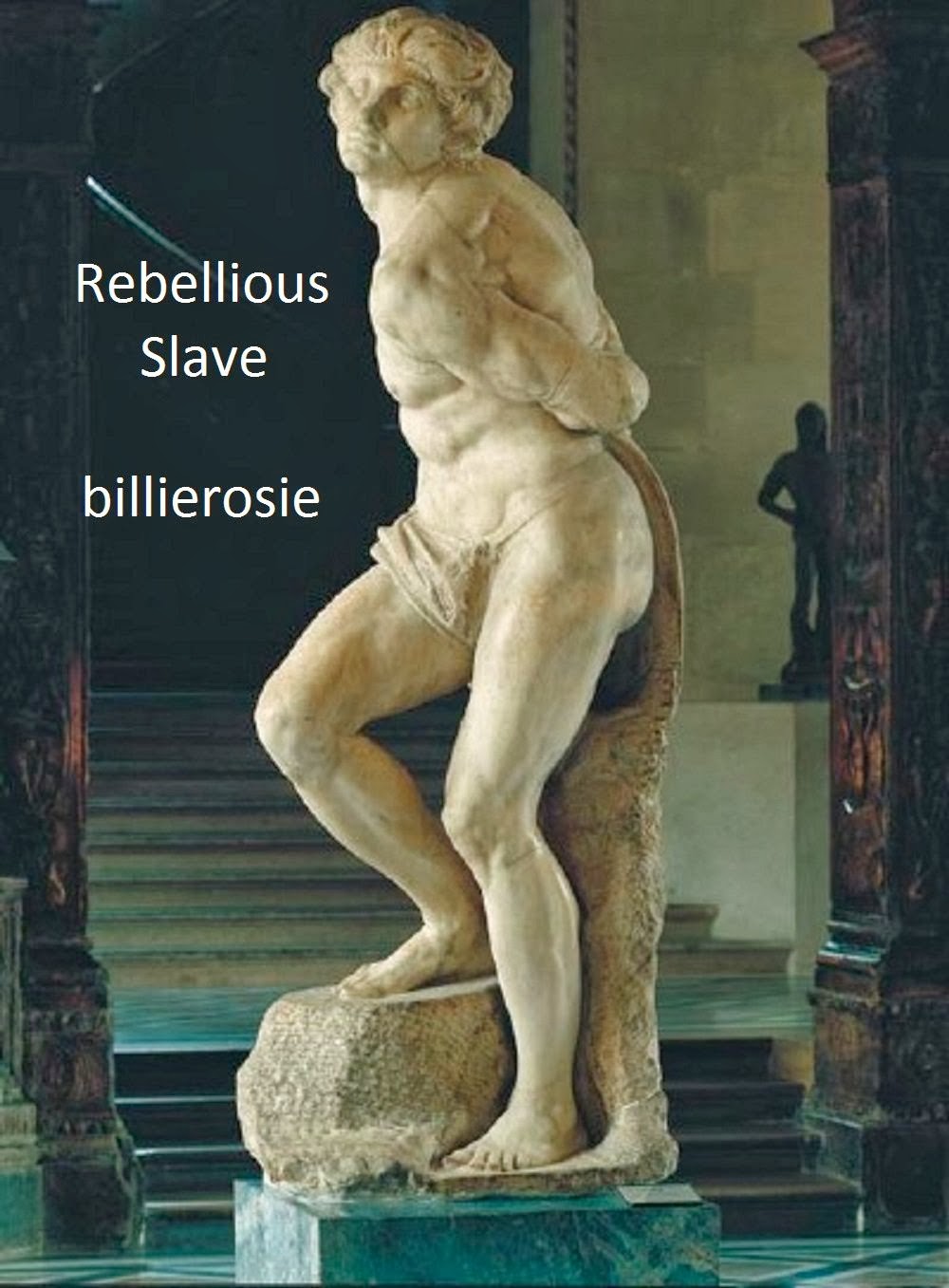 'Rebellious Slave' by Billierosie.Whenever Billierosie takes on a new project, her fans sit politely in anticipation, all the while squirming inside - hot for her words of erotic passion.
While her newest contribution to the erotica genre may be short, around 30 pages or so, it packs an impressive punch. Her descriptions of musculature, pulse rates, and facial features lend an intimate understand of Reuben's physiology before we even learn his name. In “Rebellious Slave,” Billierosie explores the dominant and submissive lifestyle from the unique view of a male submissive. As most readers of the popular sub-genre can attest, that particular role is typically left to female characters. Here, however, the tops are members of the cruelly sensual organization known as The Coterie, operated entirely by female dominants. It's this reversal from the norm that gives “Rebellious Slave” an edge.
In Slave, Reuben commits a cardinal sin against his alluring Mistress, Melissa, something she does not take lightly. Light, historical, clever, and oh-so-raunchy, “Rebellious Slave” is sure to linger in your mind long after the "climax," which comes all too soon.
But those waiting to learn more about the sexual women of the Coterie can always look to the past. In 2012, Billierosie produced the wonderfully erotic “Enslaving Eli,” which takes the point of view of another male submissive, Eli, after he falls for the wrong (or right?) girl. Jasmine shares her wild secret life with the eager young man, introducing him to The Coterie organization and its charter of full male domination. Can Eli escape their clutches? Or will his addiction to relinquish control overwhelm all else?
Billierosie's short works have appeared in numerous anthologies, including "The Love That Never Dies:Erotic Encounters with the Undead," the Sherlockian erotica book "My Love of all That is Bizarre: The Erotic Adventures of Sherlock Holmes" and many others. Her first collection of wonderfully smutty BDSM stories, Fetish Worship, raised the bar for quality erotic fiction.
To read "Rebellious Slave" on your Kindle, click here.
February 13, 2014
NEW REVIEW: Monterey Pulp
 'Monterey Pulp' is available
through PageTurner Editions
and on Amazon.com and
other locations where e-books
are sold.Honored to read this wonderful review of my latest Barker mystery 'Monterey Pulp' by the talented writer Billierosie. Big thanks to her for such a wonderful write-up!
IN THE FOOTSTEPS OF SHERLOCK HOLMES February 11, 2014
By billierosie
It is no surprise to me, that Patrick Whitehurst is absolutely wowed; turned on by the BBC TV series Sherlock. As an avid reader of Sir Arthur Conan Doyle’s work and since childhood, an irrepressible fan of the detective genre, I would have allowed Patrick the right to be picky. He is intuitive to the characteristics in the template of the great detective that Conan Doyle gives his readers and using that template Patrick sensitively builds his own detective; the enigmatic, charismatic, homeless, unattainable Barker.
In Monterey Pulp, Book Two, Barker’s tale continues and as in the first novel of the Barker Mysteries, a three dimensional character steps onto the stage of the reader’s imagination. Patrick Whitehurst has devotedly crafted his creation to be unforgettable in the reader’s mind.
But what is really important, is that the reader is already seeing this strange, elusive figure, crafted carefully and carved with precision, as a fully rounded character.
And as a reader, I am wondering about this strange man who deliberately chooses to live in the margins of society. Will I know any more about him by the end of the book? I wonder!
Barker can make anywhere a home; he is as resourceful as the pack of hounds that are his devoted companions. Barker has become a Cause célèbre in Monterey due to his skill in solving a famous kidnapping case. Barker has no time for the media and its nonsense; he prefers obscurity and he takes refuge in the peace and quiet of the woodlands. But mystery has a way of following Barker around. A camper tells Barker a strange tale of a nightmare and an abduction. The reader sees Barker’s intuitive response in action. In stylish, leisurely prose Patrick Whitehurst’s Barker quietly, precisely averts a heinous scheme of double dealing and destruction.
And this first chapter, this tale sets the pattern for the book. Barker’s instinct never fails him, neither do his dogs; loyal, and as intuitive to Barker, as he is to them. They can read each other and they are never wrong. Murderers, thieves, kidnappers, the unscrupulous; none of them escape Barker’s incisive, insightful gaze. He cuts through appearance and reality, explaining patiently what actually happened, not what we are meant to think happened.
Barker is a worthy successor to Sherlock Holmes; Sir Arthur Conan Doyle would not be disappointed; neither will any fan of the detective genre.
Patrick Whitehurst is an elegant and economic writer. Words are never wasted. He understands language and conveys sentiment, atmosphere and character, with an ease that other writers will envy. This novel will delight and intrigue the reader.
If you’ve read the first book in the Barker series, you’ll be hungry for more. If you are new to Barker you will soon be as addicted to him, and his pack of hounds as I am. I hope that Patrick Whitehurst doesn’t make us wait too long for the next book in this captivating series.
Check out Monterey Pulp on Amazon.com here!
February 4, 2014
Writing magazines and why I'm quitting them
 All about the MFAs.
Here’s why I may kill my subscription to “Poets & Writers,” and why, at the very least, I plan to unsubscribe from various writing-related emails. They’re selling products, intentionally trying to get excited writers to toss their money into the wind, and boring the hell out of me. Plain and simple. They’re killing my literary bloodlust.
Here’s why I joined these email lists, and subscribed to Poets & Writers, in the first place. I love writing. I love hearing about other authors, their stories, what their stories led them to write this year, or why they haven’t written in years, what people can expect from royalty rights, news on the writing front, upcoming books, street level writers, and much more.
But what I get these days is quite different. These days I see stories on how to get an MFA (master of fine arts), how to get your writing to the next level by attending very expensive workshops in some far away, super-luxurious place, and more fluff on MFA creationism. A look at the sheer volume of MFA and workshop ads tells me why the magazines are filled with these kinds of stories.
In front of my eyes, the idea of what it is to write grows bastardized and commercialized. Soon, I’ll have to earn more than 20k a year to write. No poor people can do it anymore, not if you’re to believe the ads that your writing will only go to the next level with an MFA or a certificate of writing from Writer’s Digest.
I counted around thirty ads for various MFA programs in a single issue – pretty awesome for their sales folks. There were about ten ads for various conferences, institutes and writers workshops as well. That’s not counting the classified sections, which also offers various calls for submissions. Of course, in today’s world, those calls focus more on the gender, sexual orientation, or race of the writer before the story itself is considered.
On Feb. 3, I got an email (perhaps more, I delete them quickly) from Writer’s Digest University for an advanced novel writing class. Basically it’s for writers who want feedback on their work, especially those who need a stopwatch (in the form of someone getting paid to stay on top of you), and you get to believe you’re a novelist “who wants to make real progress towards publication.”
“Hurry, Only 16 Seats Left,” it proclaimed.
Another email, from LitReactor, that same day, asked “Are you ready to get serious about your writing goals?” Apparently, their workshops, with no less than five in the queue for mid-February to late March, and paying for them, are the only way to get serious about writing. To their credit, they didn’t capitalize every letter in their tag line like the folks at Writer’s Digest University. Thanks for that.
 Be a pro, spend.Spending money, getting some form of certificate or another, is a sure-fire way to become the next Hemingway, London, Angelou, Rowling, or Franzen. Those authors did nothing more than post writing-related jpgs on social media. They did nothing more than dole cash for critiques and peer-oriented chat groups, while letting some best-selling author they’ve never heard of send them template-generated reminder notes when it’s time to have the next chapter jerked off. They wrote their best work in a Florida hotel complex while wearing sunhats and attending classes on strong character development.
Would that my mom still lived, she’d take a first read for me free of charge. But she’s dead. That lesson, for me, proved far more valuable to my writing. And it didn’t cost a dime.
What did cost a pretty penny was losing my home to foreclosure, and the divorce; those cost a lot mentally.
Maybe scraping by, fearful of every dollar, is something our new generation of writers need not concern themselves with.
And perhaps the next “Blackboard Jungle” (Evan Hunter’s, or Ed McBain’s, novel, of which the film is based) will have something to do with cyber-bullying among privileged dot-comers and how terrible it felt. Surely one needs an MFA, and debt, to write that.
January 23, 2014
VIDEO: Patrick Whitehurst on the Morning Scramble
It’s been a fun week for promoting the Barker Mysteries for sure. Last week I had the opportunity to appear on the Morning Scramble television show in Prescott, Ariz., which airs throughout the state. Following that I got a chance to guest blog for Jenny Kane’s website, where I got a chance to talk a little more about my love for mysteries and pulp novels.
Special thanks to AZTV host Sandy Moss and Jenny Kane for giving me the opportunity to blab about my passions!
Click here to read my guest post for Jenny Kane.
And be sure to visit my author’s page on Amazon.com by clicking here.
January 17, 2014
Marathon Woman Natalia Molina
 Natalia and a pair of her favorite
running shoes.If books on runners, on marathons, and fast athletes lined up at the starting line of the P.F. Chang Rock and Roll Marathon in Tempe, Arizona, there would be more than enough to fill a few city blocks.
From books like Murakami’s “What I Talk About When I Talk About Running,” to Alan Sillitoe’s “The Loneliness of the Long Distance Runner,” the study of the sport and of the people has rarely ever stopped for air.
That’s because people who run have interesting stories. There’s always a reason behind why they run. And for those of us who watch from the window of a coffee shop, those reasons are always pretty cool, and never boring. It takes a special kind of person to get moving like that. And once you start running, you never want to stop.
Sedona athlete Natalia Molina is that sort of person. She’s fast, she’s devoted, and she’s smart. And she’s running for a good cause on April 27 at the 29th Big Sur International Marathon on California’s central coast. Molina has run in so many marathons it’s hard to keep track. Her feet have pounded pavement in San Diego, Boston, Sedona, Cottonwood, Flagstaff, Tempe and elsewhere. The Monterey County marathon, operated via a non-profit organization, benefits local charities and promotes a healthy, fit lifestyle, something Natalia knows a thing or two about.
 Natalia Molina.This year, Natalia’s running the marathon as a fundraiser for Doctor’s Without Borders, a humanitarian organization that delivers critical medical assistance to over sixty countries suffering from epidemics, armed conflicts, neglect, weather catastrophes and more. The international organization first formed in 1971. Natalia hopes to raise approximately $2,500 for the humanitarian group.
For Natalia, who earned a masters degree in public health from Drexel University, the decision to support the cause was an easy one.
“When I came across this opportunity, I felt personally compelled to do this. The right to health knows no boundaries and neither should access to care. Additionally, what a fun way to do this – raising funds and awareness while running,” Natalia writes.
For more information on the Big Sur International Marathon, click here .
Click here to donate to Natalia’s fundraising effort with Doctors Without Borders.
January 16, 2014
Interview Jitters
 Talking it up with television host Sandy Moss.
 Being interviewed, on the radio, on television or by print media, can be a frightening exercise in social interaction for hermit-like, introverted authors. It can feel like being in front of a firing squad, like you’re Ebenezer Scrooge before the ghosts came, and it can almost make you worry to the point of illness.
But it isn’t that bad. At least it isn’t if you ignore the worry and slap off the jitters. Authors entertain with written words, not with body language, and conveying your work by opening your mouth isn’t something many writers feel comfortable doing – not sober at any rate.
But all writers have to do it at some point. And nearly all writers fret over it. And it’s wonderful when the opportunity presents itself.
Author jitters are so common, believe it or not, that there are blogs dealing with the issue, videos, and articles offering tips to prepare the overly anxious wordsmith for their brief moment of limelight.
 Thanks to Natalia for
 the screen grab!For my recent television appearance on the Morning Scramblewith celebrated author and host Sandy Moss, I had the assistance of a well-spoken extrovert, Natalia, who happened to be on Cottonwood, AZ, television a week before, and she didn’t feel jittery about her lengthy appearance in the least, while I got stomach pains over it. I suggest finding a Natalia.
First and foremost is to be prepared and get to the appointment a bit early. Dress appropriately and nicely for TV. No bright colors, no crazy patterns the camera would go psycho over. Avoid speaking like you’re the favorite customer of a cracked-out meth dealer. Don’t speak like someone stuck in a slow-mo time machine either. The second is to keep your tired old eyes on the interviewer. Have a conversation with him or her, not the technician, and beyond that, the audience at home. Bring talking points, but don’t lean on them too heavily and keep to your point as much as possible. They say smiling helps too.
And, if at all possible, try and have a really good time.
Despite being worried, despite feeling ill and hermit-like, I ended up having just that.
Tips on preparing for media interviews:
http://authoritypublishing.com/book-marketing/media-training-for-authors-how-to-prepare-for-interviews/
http://www.thinkaha.com/blog/2012/11/how-to-prepare-for-a-radio-interview-2/
http://www.kateyschultz.com/2013/07/how-to-prepare-for-tv-interview.html
January 7, 2014
Artwalks and tumors
 Natalia enjoys the art walk atmosphere outside
Jerome's Pura Vida Gallery.
For the sake of argument, let’s say northern Arizona is like one of those dudes from Duck Dynasty – gloriously ignorant, bearded (because of dubious privilege and lethargy), unkempt and fabulously adorned in sun-bleached camouflage.
And let’s say that’s a bad thing.
But a tumor is growing on the pale, wrinkled shoulders of that bearded creature. More than one tumor, in fact, has begun to pop up. Let’s say those tumors represent the arts, particularly art walks or “Artwalks.” You can find them in Flagstaff, Sedona, Prescott and Jerome. Other communities, like Williams, are beginning to bounce them on their knee as well. They’re growing. They’re spreading. They could be infected.
And let’s say those tumors are a good thing.
Leaving the others alone, let’s explore the Jerome tumor – as it’s the most colorful, the least ostentatious, and (quietly) one of the most successful of the bunch. Jerome’s art walk is held monthly, but not on Friday as it is in Flag and Sedona, nor on the fourth Friday as it is in Prescott, but on the first Saturday of every month. Things usually get going around 5:30 in the evening.
Even in January.
On a recent trip to the Mingus Mountain colony of hipsters and cookeries, Natalia and I found an experience similar to what we’ve seen in the banging-hot summer months. Crowds and crowds of shoppers. Art. Food. Warm smiles.
We always start at the Jerome Artists Cooperative. The artists whose work can be found within the rooms operate the local coop. While the work doesn’t change super quickly, something is always there to catch the eye – and the artists strive to chat it up, lay out the free food and drinks, and share their out-of-the-box passion with possible buyers. Prices can range from cheap to super duper. But the flavor sets the tone for the other shops we frequent during the art walk.
Next we hit The Wary Buffalo directly across the street. There may not be a lot of locally produced art within, but there’s a tad, and the place is sweet. Antiques and collectibles are what one will find at the WB, but they aren’t the usual mix one might expect when reading about such things. Comics, antique pulp novels, old Star Wars collectibles, stuff from the old “Alf” TV show (that furry alien I loved as a kid). Former “Guardians of the Galaxy” comic book writer Michael Gallagher and his wife Candace run the place. It’s a must for those hitting the walk.
Our next stop brings us to the upscale, and always elegant, Gallery 527. Not only do the house artists create a great assortment of munchies, including vegan cake and wine, but they welcome a visitor like family. The small space is full of visual flare, and quite reminiscent of a New York gallery in both substance and posh.
Up the street one finds Pura Vida Gallery, a larger space featuring a different sort of fine art –art that is also useful, from mirrors and clocks, to clothing, furniture and drink ware. Another reason to visit is the “champagne lady,” who makes everyone feel like an old friend from the neighborhood.
The Merchants Gathering usually rounds out our evening stroll. Featuring live music, more food, art, clothing and Day of the Dead, Frida Kahlo, and other odds and ends from numerous Latin American locales. Artist Cody DeLong’s Studio can also be found there, as can the artist himself most walks.
Other artsy spots, like the Old Jerome High School, bring their own pounding magic to the hillside colony. A full spread on the monthly obstacle course can be found here.
While tumors dry up and fall away, it seems more and more tumors are popping up all the time, some replacing others and growing even more bulbous than the original. The good thing about a tumor, of course, is they make the bearded Duck Dynasty dude realize something is different – that, for better or worse, something has changed on his wrinkled, white landscape. He’s got to think about tumors now, he’s got to think differently, and that is a good thing.
January 3, 2014
Barker III Preview

Homeless sleuth Barker is a character shrouded in mystery.He doesn’t remember his past, he doesn’t even remember his first name. Most know him only as Barker, the man who runs with a pack of wild dogs in the Monterey Peninsula. Some also know him as an adventurer with a knack for figuring things out, a rugged, handsome creature as fierce as he is intelligent. Those with a mind for mayhem give Barker a wide berth.But there are others who wish to see the vagrant dead. One man in particular, known as Sleepy Redbone, also knows a thing or two about Barker’s cloudy past, and the role Barker played in sending him to Soledad Prison years ago. Redbone intends to revenge himself upon the homeless man. From the fog-shrouded California coast to the red rocks of Sedona, Arizona, he'll will do whatever it takes to see Barker turned to ash and make a few bucks while he’s at it. There are others, after all, who don’t mind paying for a little old-fashioned revenge.Beginning with “Monterey Noir” and then “Monterey Pulp,” Barker’s adventures continue in author Patrick Whitehurst’s first stand-alone entry in the Barker Mysteries, tentatively titled “Monterey Confidential.”
Read an advanced sneak peek below:
News of the missing teenagers spread to every newspaper in the Monterey Peninsula. It was also carried nationally, albeit in a smaller form. For the residents of Carmel it was big, frightening news. Three teens had vanished in the last week. Charly and Lynne were the latest to vanish from the face of the earth. The other was a girl named Marie. Everyone thought, simply enough, Marie had run away from home and expected her to turn up, begging dad for money, within the week. When Charly and Lynne went missing as well, two rebellious kids, but on good terms with their parents and not the type to vanish without a trace, people began to rethink Marie’s disappearance. Speculation spread like a brush fire across the Peninsula. Most agreed there was a serial kidnapper nestled in their neighborhood. All three missing teens were from roughly the same part of Carmel and had last been seen within blocks of each other. Most homeless people don’t bother paying attention to stories of these kind. In fact, most tend to leave the area in which the incidents occur, as they are more often than not placed on a list of some kind, if not held for questioning. One man in particular, who bathed in the ocean on a regular basis, washed his clothes in the sea, and gathered most of his food from dumpsters or friendly contributions, paid special attention to the articles. His name was Barker. He was rarely seen without his large blue parka with the fur-lined hood. Nor was he without his faithful traveling companions most of the time. Their names were Dangler, Destiny, Griz, Connor and Zero. The latter, being a Shih-Tzu, was the smallest. His ego gave even the biggest dog a run for his money. Dangler, a Rottweiller, was the largest among the dogs. He proffered food and naps over pretty much anything else. Destiny was a young Mastiff, who was only waiting for another growth spurt before he took his place as the biggest. Griz was the most restless of the bunch, often leaving for weeks on end to do his own thing. Being part Coyote and part Collie, he had an affinity for exploring. Connor, the border collie, served as the tracker of the group. She could sniff out a cheeseburger from a mile away. Barker lived with his companions under the planks and asphalt of Old Fisherman’s Wharf. Built beneath the bustling tourist mecca was a small room called Bernie’s Camelot, named after the small shanty’s prior tenant. Upon his death, the room became Barker’s. It hung over the dark, greenish sea that lapped against the pillars beneath the wharf. Orange and red starfish clung tenaciously to the old supports, surrounded by white and gray barnacles. The room was built from old planks and boards and was accessible by traversing a myriad path of slick wood and two-by-fours. If anyone looked under Old Fisherman’s Wharf, they would never see the place.
December 27, 2013
Whitehurst's Top 5 Reads of 2013
Social media and books, despite best efforts, don’t jive. You either do one or the other. As an introvert, a writer, and half-assed bibliophile; I prefer residence in a world where people are interesting, or at least on another planet or fighting a noble fight. This year I made it a point to track my reading on Goodreads, a site where social media and the written word crash together.
I managed to keep tabs through the whole year as a matter of fact. In all, I read fifteen books, which averages to a little more than one a month. Not bad for a slow reader. And most were pretty damn good, from “I, the Jury” by Mickey Spillane, to “Rama II” by Arthur C. Clarke. For fun, I thought I’d draw out my top five – the ones that stuck with me well after I turned the last page – if anything it reminds me of my year in reading.
 “Rendezvous with Rama” by Arthur C. Clarke
Science fiction is an incredible tool for authors to tell stories that mirror the reality in which we all (most of us) live. It’s also a means for exploring the reactions humans have to the unbelievable. Take aliens for example. Fiction and film is saturated with that question, some good and some sucky.Arthur C. Clarke asked great questions – and backed it up with hard science told in such a way to make it possible for a reader to turn the page and keep on keeping on. Rendezvous with Rama is a perfect example. It’s short, it’s exciting, and it’s brilliantly written. Having read “Rama II” this year as well, which is much longer, and a little drier as it is co-written with Gentry Lee, chief engineer for Jet Propulsion Laboratory, I found I preferred the shorter first novel more. I also got around to “2061” and “3001” this year as well, completing my Clarke quota for a few years, and found Rama sticking in my head far after I finished reading it.
“Hellhole” by Brian Herbert and Kevin J. Anderson
 Hellhole is another case in point when it comes to thrilling science fiction. The novel isn’t what one would call hard science fiction. It’s more along the lines of a space opera and focuses more on relationships than technical know-how. The characters and exotic planets provide the richness readers like me drool over.
 Like Rama, however, the first in a planned trilogy off books also explores the way in which humans relate to one another and to the creepiness of the unknown. Written by Brian Herbert and Kevin J. Anderson, authors of the Dune continuation novels, Hellhole is the nickname for a planet inhabited by the dregs of space society, including Tiber Adolphus, ringleader of a failed rebellion attempt against The Constellation – a sinister group for sure. Hellhole is also a planet with a wicked secret, and a unique form of alien life that could alter the fabric of the cosmos and put Tiber’s rebellion back into play.
“Doctor Sleep: A Novel” by Stephen King
It’s been a while since I wholeheartedly devoured a horror novel. King had been absent in my reading life for some time, though I periodically read some of his newer work. Doctor Sleep, however, had me chomping at the bit before it even came out. I’m a fan of “The Shining” novel, and the different but incredible Stanley Kubrick film adaptation, so when I first read he was penning a sequel I nearly had an orgasm.And, to me, it didn’t disappoint. The novel follows Danny Torrance into adulthood, and into a new tale of creepiness and intrigue.While not as frightening or creepy as the first novel, I couldn’t put Sleep down. It had its own charm and its own personality. Its flavor, as it were, told a human story over a terrifying one and I, for one, thought it made 2013 all the better.
 “Travels with Charley: In Search of America” by John Steinbeck
Steinbeck is always a treat to read, maybe because I grew up where he did, maybe because I have the central coast in my blood, or maybe because he knew how to tell a story I want to read. After a recent trip to the peninsula, and a visit to the Steinbeck Center, I decided to read “Travels.” If the visit to the coast counted as the wedding, the book was something of the honeymoon.Steinbeck’s weird little 1962 odyssey (sort of) across America, with Charley, his French poodle, served as the right mix of hate and love that most guys experience into maturity. And he did it in a little traveling camper named Rocinante, which again makes most guys drool. Having peeked inside Rocinante while visiting the center this year, I could feel that sense of place within the cramped enclosure. At the very least I could taste the effort, the sheer desire, to give it a sense of place. That picture stayed within my head as I read the book. And, whether all the accounts within the pages are true or not, I found it went down well at just the right time.
“Nonconformity: Writing on Writing” by Nelson Algren
 Having never read, or even heard of, Nelson Algren until this year, I found him to be a writer of surprising caliber and one I plan to add to my regular reading list – at least until I’ve devoured all his stuff. Like Steinbeck, he filled a need in me that needed filled this year, and speaks to much of the same angst I feel myself. Not only that, but he speaks (quietly these days) to a segment of the population too embarrassed to speak for themselves – those who scrap for every little ounce of American pie they can get their hands on.Nonconformity isn’t a fiction piece, but reads eloquently, and provides a landing strip for authors looking to write out their own inner angst. I didn’t want the book to end, but it’s a short read, so it did. And fast.
With “Catch 22,” “Sisterhood of Dune,” “Inferno,” "The Wednesday Daughters" and “Catcher in the Rye” on my reading list for 2014, next year should be fucking cool – in a literary way.