
Cynthia Morris's Blog, page 61
August 3, 2012
Fluent in Three Months: Benny Lewis Tells all at WDS
This is part of a series of peeks into my notes from the World Domination Summit.
It’s been a lifelong dream of mine to speak several, if not many, languages. I’m fluent in French, and am the proud holder of a highly useful French degree.
When I went nomad in 2008, I was determined to try another language. My plan was to live in Florence, so I took an Italian class at the university before I left. Bene, molto bene.
But I didn’t end up in Florence. I fell in love in Lisbon and moved to Portugal instead. So I took up the notoriously difficult Portuguese language. Attending daily classes for a month, living with a Portuguese man, surrounded by Portuguese.
Despite my best efforts, I was not fluent in three months. Nor in five months. I thought, okay Cynthia, maybe not in this lifetime. I contented myself to a smattering of phrases and gestures that could get me the coffee I wanted anywhere in the world.

The cunning linguist tells all. Click to enlarge.
So when I heard that Benny Lewis, the infamous Irish polyglot, was presenting at the World Domination Summit, I signed up to attend.
Benny’s humor and the astounding nature of his premise – that you can be fluent in three months, without even being surrounded by the language – had me on the edge of my seat, taking notes as fast as I could.
I’m leaving for Rome and Sicily in a month. I may just try Benny’s method – putting in many hours practicing – to see if I can touch down in Italy a wee bit more fluent than I am now.
What about you? Do you think you could learn a language in three months?


July 31, 2012
Why You’re Not Creating Like You Want
I recently polled my Impulses subscribers, asking what was blocking their creative satisfaction.
What do you think is the biggest thing lacking in people’s lives? Guess.
 That’s right. Time.
Lack of time is the #1 obstacle people believe prevents them from creating. Is this your excuse too?
An excuse, not a real obstacle? Yes and no. There’s one way that we make ourselves victims of time. Read on and see if this is you.
Curb your time optimism
It’s a wonderful thing to be an optimist. Life is good, things always work out, we’re on the right path…we like these optimistic perspectives.
But when we extend our optimism to the clock, our positive perspective backfires on us.
We believe that we can do it all, that tasks take less time than they do, and that we can catch up later. Consequently, we book our days to bursting. Our schedules are crowded. We rush to keep up with all we’ve committed ourselves and our families to.
There’s no space. No space to rest, to relax, and to allow fresh solutions and insights to float in.
I believe you can reduce your time optimism and increase your satisfaction with your creativity.
Fifteen minutes a day
Start taking back your time with fifteen minutes each day. Before the day starts, in between errands, at the end of the day – wherever – insert some sanity space into your days.
In your space, do what you want. Perhaps you nap, read, write, play, stroll or meditate.
Do not use this 15 minutes to check your email, peruse Facebook or throw in another load of laundry. This is space to dream, be, refuel and inspire yourself. Not a space to tick items off your list.

Space opening up for you
It’s not easy to slow down and do nearly nothing, even for 15 minutes. But it’s vital. In the cracks between busyness we hear our wisdom.
When we put pen to paper or take a walk, we often hear the answer to the question that’s been puzzling us. We get to know ourselves in ways that are necessary to lead an empowered, authentic life.
Experiment with inserting 15 minutes into your days in August. In this space do whatever you want, but don’t try to get anything done.
If you’re not creating how you want, be honest with yourself: is your time optimism stealing your creative satisfaction?
What would 15 minutes of space a day do for your mood and happiness?
Who’s in? This is an informal challenge, and I’d love to hear if you decide to do it. Leave a comment below and let me know you’re putting space into your life for the sake of your creative sanity.
 I’m doing the Free Write Fling in August. I don’t have an agenda for my writing time. I look forward to a daily dose of space for myself, where I can lie on a blanket in the park and rest with my notebook, or prop myself up on the couch midday to pen my 15 minutes away. I look forward to this space.
We start August 1st. Ah, sweet space! Do it with us!
July 30, 2012
Can Introverts Rise To the Top?
Today’s WDS spread is from the interview with Jonathan Fields and Susan Cain. Susan recently authored Quiet: The Power of Introverts in a World that Can’t Stop Talking, which is garnering a lot of attention.
 I loved it when Susan said “introverts receive information at a higher level.”
While I don’t go for a hierarchical comparison between introverts and extroverts, I do appreciate the idea that introverts are tuning in differently. And that we need to find ways to respect that.
Because introverts, and the traits introverts possess, are responsible for the kind of creative thinking that’s more needed than ever.
We need space to receive information. Time away from the fray. Receptive time.
Claiming space
As a borderline introvert, I need quiet. It’s not always easy to stake a claim for it. One way I take space is at yoga classes.
The class itself provides a container where I am not talking. I am focused on my breath and physicality. But I also claim the space after class.
It’s easy to get chatty with the people at the studio. I like them. We’re sweating it out together. But I also adore that trance-like, relaxed yet alert feeling my yoga practice gives me.
So I protect it for as long as I can. This noise-free state allows me to hear and trust my instincts. My instincts are the biggest asset of my creative capital and I cultivate them as much as possible.
Whether introvert or extrovert, your creative resources must be protected and cultivated. Our creativity leads the way to our rise – to the top – or to a quiet corner.
With the ever-growing cacophony around us now, it’s no surprise that Quiet is ringing a loud – and welcome – bell for us.
Are you an introvert? What introvert trait of yours helps you be more creative? Dish in a comment below about your secret introvert weapon.
July 28, 2012
Take a photo stroll: WDS style
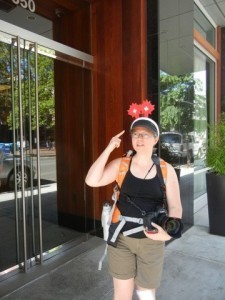
Darlene pointing the way
Photographer Darlene Hildebrandt, though not a Portland local, organized a photo walk on Friday before WDS started. Not an Oregonian or even an American (Darlene is from Edmonton, Canada) she knows that the best way to get to know people is to share what you love.
I respect that. I love that. Boldness is rewarded.

Spilling over...and out. Anyone else capture this?
Still, being me, I hesitated to commit to the photo walk. What if something better was happening elsewhere? (FOMO)
Then I thought, wait. This is what I love: go to a new city, wander around with no aim other than to see and capture it in my notebook and with photos.
With other WDSers as part of the deal, how could I resist? Thank god I didn’t. Trekking for several hours with new friends, I took over 100 photos, which I’ll share another time. I also got completely sunburnt cleavage, which goes to show that if you can burn in Portland, anything can happen, anytime, anywhere.

Quick sketch of elephant in North Park + coupons, curation & kriya
What are you doing this weekend? Why not take a photo stroll around your own scene?
July 26, 2012
Getting a New Lens at WDS

David eating a Voodoo Doughnut. He let me eat an arm.
The minute I saw him I knew I had to approach him. Who wouldn’t want to talk to a guy wearing goggles around his neck?
It wasn’t long before David Delp of Pilot Fire had positioned the goggles on my face and fed me questions:
What roles do you play?
What do you want to do before you die?
What will you do this year to get there?
See my response to the last two questions below the waves in this first page from Friday at WDS. 
Also on this page was the question that my pal Kristoffer Carter of This Epic Life asked:
Does it contract or expand your lens?
Kristoffer recommends asking this question when trying to decide on something, big or small, in your life. He just wrote about it in his recent article, “Upgrade Your Lens, Upgrade Your Life”.
Of course I adored these men and their questions. As a coach, my questions are my currency. They’re what open people up, what spark new insight, what provoke action. I’m thrilled I was given these new ways to see.
Thank you, gentlemen.

KC is a big kid; my smile here is the same as when I was six.
July 25, 2012
What Unites an Unconventional Crowd?
This is part of a series of peeks into my notes from the World Domination Summit.
Gathering 1,000 writers, entrepreneurs, artists and dreamers is no small feat. Finding commonality is even more difficult.
 But Chris Guillebeau is on a mission: to help people live remarkable lives in an conventional world.
I’ve been a fan of Chris’ since I first saw Art of Nonconformity three years ago. I instantly recognized the power of his message, and I appreciated that he had several things going on, and that he made his work cohesive for an audience.
He told the crowd at WDS that three values unite us: service, adventure and community.
Chris generated an atmosphere of generosity and fun. He always acknowledging his volunteer staff of 50 and us, the people who had gathered in a hopeful huddle to drive our dreams forward.
Thanks, Chris, for the wonderful weekend that keeps on giving.
July 24, 2012
Solving Water Shortage One Drop at a Time
This is part of a series of peeks into my notes from the World Domination Summit.
If I wasn’t weeping enough after Brené Brown’s talk on vulnerability, Scott Harrison took the stage at the World Domination Summit to tell the story of his work – Charity: Water.
Scott is on a mission to change the world in two ways: to solve the water problem and to change the way charity works.
 Scott and his team found a very effective to raise funds is to have people donate their birthday to charity: water.
When Scott asked the 1,000 participants at WDS if they would donate their birthday this year to charity: water, I’m pretty sure we all stood up.
My birthday just passed, but I will donate next year’s birthday. This year I’m posting this and invite you to visit charity: water and consider donating your birthday.
Every clean sip of water, every hot bath we take can help us value the sweetness of available water. I’m awash in awe and gratitude for what Scott Harrison has created.
I really was weeping throughout his entire speech. I didn’t care who saw me crying; I’m sure we were all pumping out water in that darkened theater. It was hard to see my page and now I appreciate that. My notes for this session are simple but hopefully spark something in you.
July 19, 2012
Brené Brown Cracks Open Our Hearts
WDS, day one, session one: Brené Brown, researcher and storyteller, takes the stage to crack our hearts wide open. Blending science, humor and story, Brené moved all of us to recognize and accept our vulnerability, to embrace our ‘uncoolness’ for the sake of our health and happiness.
And then we all stood and sang along to Journey’s Don’t Stop Believing. It may sound corny, but I can attest to the power of moving emotion through singing and swaying with others.
This, of course, was the perfect way to open the World Domination Summit.

July 18, 2012
The World Domination Summit in Color
Packing for the World Domination Summit in Portland, I hesitated to pack my watercolor crayons. I wasn’t sure I would be able to take visual notes at WDS.
I had other things on my mind: giving a presentation there on Sunday, sharing news of my novel with people I met, and getting in the proper mindset to deliver my book writing workshop later that week.
But I had to capture notes. It’s what I do. It helps me focus and it brightens my world. My notebook goes everywhere with me.So I packed my Caran d’Ache watercolor crayons and a fresh Moleskine Japanese album.

My 2012 WDS notebook
During the sessions, I scribbled notes, made doodles and smeared the pages and my fingers with color. I listened, laughed, cried and felt the conference’s messages move through me to the page.
On the flight from Portland to Denver, I finished the notebook, adding color, line and words. I wasn’t happy with the results. The pages were messy, crowded and chaotic. The colors were exuberant and slightly feverish.Typical self-doubt pecked at me and I had to fend off disclaimers I wanted to make. I struggled to overcome my judgements of my pages. When I step back to look at the entire notebook, it’s an explosion of energy. It’s bright. It’s imperfect. It’s full and dizzying, just like WDS, the conference for world changers.
Invitation to a visual narrative
This visual narrative invites a different way of absorbing information: a more engaged way.
 A visual – an image that instantly conveys something. (drawing, icon, photograph)
A narrative – a linear story told with words. (story, essay, blog)
A visual narrative - neither one nor the other; a fresh blend of both.
When you first see the spreads, it can be overwhelming. There are visual elements but they don’t immediately communicate something. There are words but they don’t tell a linear story.This visual narrative asks you to participate more in reading. You have to decide where to start. You get to follow your own curiosity as you read.
Can you slow down enough to allow your eye to wander and receive instead of scanning bullet points to quickly grasp something? Which pieces capture your attention?
 I fill these journals because they help me slow down and receive. They help me engage with what’s directly in front of me. They help me forget all the other things I need to do and be here now.
Later, they provide a way for me to remember not just the words from the conference, but the energy and vibrancy of being with more than 1,000 people united to change the world.
I’ll be posting the pages over the next few weeks. Enjoy my version of WDS. (Click images to enlarge.)
Please ask questions and leave comments.
July 10, 2012
Collaborating on a Novel Across an Ocean
From November of 2010 to May of 2011, I woke almost every day excited to get to work on what I considered the last revision of my novel Chasing Sylvia Beach. On my main writing days – Friday through Monday – I’d make my cappuccino and eagerly log on to get started.
Now, I can’t say I approached all drafts of the novel with this much enthusiasm. Perhaps like me, you may have routinely experienced dread, fear and deep resentment of your project. I certainly didn’t want to do another draft.
I, like you, prefer to do something fun and hedonistic like lie around the pool in my new swimsuit reading someone else’s work.
Instead, I found a way to write my novel that both challenged me to my creative edge and made my book better. What was the secret sauce that sparked me to leap out of bed every morning?
Writing across an ocean
I began collaborating. On the last revision of the book, I worked with a man near Paris to clear up some of the plot problems and to enhance the male characters.

D at Shakespeare and Company bookshop in Paris
It’s a long and juju-licious story how I found D and how we started working together. Suffice it to say, coming to terms with allowing someone so deeply into my project was not easy.
The language barrier was the least of our challenges. We spoke and wrote in French. I loved learning new vocabulary and practicing my French.
More challenging was his French disinclination to ever give any praise. Praise, for the French, is idle or intentional flattery that only makes the recipient soft and weak.
I also had to release my need to look good and open to suggestions and criticism.
But once I learned how to manage the emotional challenges, the play of collaborating became very fun.
The practical matters of collaborating
It took some time to get our stride with how we were going to work on the project together. A 100,000-word, thirty-three chapter novel is a big beast to manage. One big document, many chapters, hundreds of pages…how to keep it all straight?
1. Google docs We operated not only on different continents, but also on different operating systems. Him, Linux. Me, Mac.
D is a bit software obsessed and tried several different formats so each of us could share and work on the documents.
But the best solution turned out to be google docs. We were able to:
Share files in one consolidated place
See and retrieve all previous versions of the documents
View, edit and comment in full view of the other viewer
Comment in the sidebar to keep the manuscript itself cleaner
Easily organize and manage many files in shared folders
2. Gmail We communicated bigger conversations outside the documents easily using gmail. That’s no surprise but email was a major form of communication. I loved waking up to his notes about the book.
3. Dropbox Videos, songs, images and large written documents were all easy to share on our Dropbox folder. It’s free and easy to use.
4. Private site D built a site where he created a gallery of images. We tried to use the project management aspect of this site, but it turns out we didn’t need that. This was a great place to share a gallery of images and documents.
5. Skype We never used the video feature, but we were able to talk for hours (the longest session was nine hours). We could share links and files and look at the documents on google docs to make changes and discuss in real time.
Using these five valuable and free resources, we were able to work together across the ocean for ten months. He helped me develop the male French character in my novel, Paul. He also helped make the Nazi part a bit more menacing and exciting. He’d make suggestions, we’d brainstorm ideas, and I’d write scenes and get his feedback.
Fin
On May 16th, 2011, I woke up with my usual instinct: get up and see what D had sent during my sleep.
But no. We were done.
We are still friends and we stay in touch, but now that the project is complete, we aren’t in daily contact like we were as collaborators.
I learned so much about my writing and myself through this collaboration. The emotional challenges grew me as a person and the mechanics of partnering challenged me as a writer and businesswoman.
What about you?
There are plenty of collaboration tools out there. I’m not suggesting what we used is the best way; it’s what worked for us to drive the penultimate draft to completion.
You don’t have to be across the ocean from your collaborating partner. You could be in the next office, co-authoring a book that will push your work to a legacy state. It’s never been easier to work together to create something.
What indispensable and perhaps free tools do you use to collaborate with others? For other types of artists, what helps you collaborate with others?


