Kay Kotan's Blog, page 6
December 6, 2022
Endless Possibilities
God is ready to overwhelm you with more blessings
than you could ever imagine so that you’ll always
be taken care of in every way and you’ll have more than enough to share.
Remember what is written about the One who trusts in the Lord:
He scattered abroad; He gave freely to the poor;
His righteousness endures throughout the ages.
The same One who has put seed into the hands
of the sower and brought bread to fill our stomachs will provide and
multiply the resources you invest and produce an abundant harvest from your righteous actions.
You will be made rich in everything so that your generosity will spill over in every direction.
Through us your generosity is at work inspiring praise and thanksgiving to God.
For this mission will do more than bring food and water to fellow believers in need—
it will overflow in a cascade of praises and thanksgivings for our God.
2 Corinthians 9:8-12
There are those times in the life of the church when it’s hard to see the bright side – when the bank balances are dwindling, there aren’t enough people to serve, and the repairs to the building are endless. It is difficult to see possibility when everything feels like a challenge.
One of the favorite activities I love to share with church leaders is a game called, Mission Possible. The game is an interactive design-thinking exercise. A group of leaders are asked to tackle a very large and difficult social issue (i.e., homelessness). They are provided very limited (pretend) resources (i.e., a circus tent, 10,000 pennies, 10 hours of graphic artist services) and asked to address the issue. Through the design-thinking process, leadership groups brainstorm and make multiple decisions throughout multiple steps in a very condensed timeframe. During the process, the teams feel rushed but they always manage to finish on time. The fascinating outcome every time is how creative the teams’ have been in using their limited resources to address the issues with such incredible impact.
What researchers have determined is when people have more time, they talk themselves out of bold, innovative decisions. Their first inclination is to be much more courageous, but over time they become more cautious and hesitant. In the life of the church, this rings true, too. Church plants are much more innovative and courageous than established churches. Church plants often have small budgets and are resourceful and creative in how they do ministry in their early days. Established churches who once experienced earlier glory days, but are now faced with challenging times sometimes find it difficult to be resourceful and creative with their limited resources. They have not had to flex those creative, bold muscles in years or decades.
Yet, leaders are sometimes the most innovative and creative when being forced into a corner by limitations (such as lack of resources). As the old proverb reminds us, “Necessity is the mother of invention.” When we are comfortable and things are working well, we keep doing things as we have always done them. It is only when we must find another way forward that we do so. And even then, we are not necessarily bold in our steps forward as oftentimes a cautious and scarcity culture has begun to develop.
As Christ followers, I believe we are challenged to remember that God will provide abundantly for the ones who trust in the Lord. Therefore, let us go forth boldly trusting that God has gone before us and is calling us into the future in ways that are creative to reach new people in new ways in this upcoming new year – and the resources we need will be provided and the harvest will be bountiful!
If your church would like to journey with other church leaders in thinking creatively about new ministries in the coming year, join the Innovating for Love Cohorts. Register now to save your spot for the January launch.


November 29, 2022
Unpacking Church Innovation
The word innovation has been used more frequently the last few years in the church world. I’ve found the reactions to its usage to be quite fascinating. Some find the word exciting – seeing a future full of opportunity, hope, and possibilities. Others cite being “over it” already. Some of our younger leaders state it is just the latest fad and it, too, will wane just like other church fads have done in the past. Still another group is terrified at the mere mention of the word innovation. For this group, innovation instantly brings up feelings of fear. The fear is often rooted in knowing that innovation often brings about change. For some change equates not only to fear, but also to an unknown future, doubt, loss, and discomfort. Who knew that one word could spark such vastly different responses and reactions for a variety of people? It’s not like we live in a country that already has any social and cultural divides!
Let’s take a deeper look at innovation. According to Dictionary.com, innovate simply means something newly introduced, such as a new method or device. There are actually four (others would say five to ten) different types of innovations:
Incremental – is also commonly known as continuous improvement. It is often a participative approach for a company to build a culture of continuous improvement to their product or service.Adjacent – is an expansion to an existing product or service. This might include expanding into a new market or new audience.Disruptive – is an action taken by a smaller company or a new company that enters the marketthat shakes up a larger competitor. The smaller company may even eventually take over the market completely.
Radical – is a brand new (often revolutionary) product or service that have a strong positive impact on customer benefits and/or expectations. This may lead to displacing other products or services.Upon review of these definitions, it becomes pretty clear. If churches have innovated at all, most often they have taken on incremental innovation to some degree or another. Some may have even had a few spurts of adjacent innovation in their courageous days. Maybe a few churches were disruptive innovators. Now, Jesus, on the other hand was a radical innovator. He turned the whole world upside down and inside out. He challenged people to think differently. He challenged those of authority in their way of ruling the land. He challenged the laws of the time. Jesus was creative in the way he went about his ministry. He didn’t have his disciples gather up people and bring them to Him at the Temple. Instead, Jesus went to the people and taught and healed them as they went about their ordinary daily lives. He mentored the disciples as he ministered to the people. That was radically innovative ministry for that time. In fact, wouldn’t it be radically innovative ministry today?
Circle back to how you and your leaders respond to the word innovation as it relates to your church today. Unless your church is in the small percentage of churches that have grown in the past two years, it’s likely that your church will need to consider some level of innovation in 2023. In my experience, most churches tend to be most comfortable in the incremental type of innovation and some will dabble in the adjacent realm. Yet for this postmodern culture, the church will likely need to be disruptive or radical innovators. This is not to squash out any competition (there are plenty of nones, dones, and spiritual but not religious folks to go ‘round). Rather, the disruption and radical shifts needed are likely inside the hearts and minds of those of us who are already followers of Jesus. We will first likely need to drastically adjust our own methods, thinking, attitudes, and approaches about what it means to be the church in this postmodern, most-pandemic world and significantly alter what effective ministry looks like going forward.
If you and your church would like to explore innovation and looking for resources, check outInside Out: Everting Ministry Models for the Postmodern Culture , Innovating for Love: Joining God’s Expedition through Christian Social Innovation, and consider joining Kenda Dean and Kay Kotan for an Innovating for Love Cohort Experience. Click here for more information.
November 15, 2022
Innovating Starts with Your Ears
Remember when you first became interested in that special someone? The two of you would spend hours together listening to stories about one another. You had insatiable curiosity about one another’s likes, dislikes, childhood, and hopes and dreams for the future. Every detail about who that person was became of the utmost importance to you. Likewise, they desired the same from you. There was a shared vulnerability while at the same time a profound appreciation that someone else cared enough to want to know that much about you.
You are likely curious about what your first love interest has to do with innovation! Too often churches come at innovation with good intentions, but from the wrong direction. Innovation is motivated by what the church desires, what the church “thinks” the community might respond to, or how the church intends to narrow their income versus expenses gap. While the church certainly needs some giftedness and passion around their innovation, it must be first and foremost community-centric.
Let’s dive into this community-centric mind shift.
First, we all know that God is already at work ahead of us. We sometimes have to be reminded of this fact and become more aware and notice where the Holy Spirit is already bubbling up. Sometimes we are working way too hard trying to make things happen when God has already prepared the ground for us. Christian social innovation is responding to where God is calling us.
Second, we will often need to extend ourselves to be in the community in new places. Getting stuck in our comfortable relationship ruts is common and those ruts many times include our current congregational brothers and sisters. We frequently gravitate towards people who are similar to ourselves. Becoming more community-centric will stretch us to move outside congregational relationships, outside our other existing relationships, and intentionally extending into building new relationships with different demographics in different settings than we might typically invest in. Christian social innovation calls us into a vulnerable investment in new community relationships in new places.
Third, just like when we first became interested in that special someone, Christian social innovators invest in multiple conversations with new friends in the community. Through multiple conversations, not only does each continue to learn about one another, but an authentic relationship continues to build, trust is developed, and there is the continued opportunity to demonstrate genuine care for one another. Christian social innovation starts by leading with your ears not your ideas.
Fourth, we must be careful not to react too quickly. Sometimes one person from the congregation hears one thing and the church decides to run with the idea/need as the innovation. Christian social innovation is birthed from a common thread noticed in multiple conversations identifying a community need, gap, or opportunity that is not already being addressed by someone else. Christian social innovation is noticing where the alignment is where God is calling the congregation, where God is already at work opening doors, and where the congregational gifts and passions align with the community’s area impact area to be addressed that will have the greatest Kingdom impact.
Fifth, above all else, Christian social innovation is grounded in love. Kenda Dean reminds us, “Love surpasses our need to succeed.” At the root of Christian social innovation is our sincere desire to love our neighbor as Jesus loves us. No strings attached.
If your church would like to innovate with your ears and explore Christian social innovation, gather your cohort and join Kenda Dean and Kay Kotan for a six-session, Innovating for Love series.
November 8, 2022
Innovating for Love
What church doesn’t want to new people to start coming on Sunday, right? But what is the underlying reason for that desire to reach new people? Are we looking for more people to ease the burden of paying the growing overhead expenses of the church? Are we short on people to volunteer to carry out the ministries we have always conducted? Do we grieve not having young children to go forward at children’s time during worship? Or are we as disciples who make up the congregation, heartbroken because more people in our neighborhood are not experiencing this loving relationship with Jesus that we have had the honor and privilege of experiencing? Do we have a burning desire to love our neighbors as Christ loves us so that we can introduce Christ to them?
Christian social innovation is motivated by love – the love of Christ. We innovate as a church to have a greater Kingdom impact. Of course, there can also be all sorts of additional benefits such as launching additional ministries, job creation, feeding people, clothing people, additional revenue streams, and much more. But the underlying motivation must first be that we are doing it for love. Spoiler alert . . . isn’t that why we should be doing everything in the church? Kenda Dean sums it up like this.
“Innovating for love means holding our ideas for ministry loosely to make room for the Holy Spirit’s work as well as ours, lest we drive ourselves (or others) into the ground. Love surpasses our need to succeed. Innovative ministries mutate, adapt, change, and when we no longer need their scaffolding to love people well, they fall away. But love never fails.”
A few months ago, I was on a coaching call with a mid-size church pastor. Emerging out of the pandemic, his church was growing in attendance, generosity, staffing, and ministries. Even the church’s endowment was growing. This pastor was ripping through a list of the church’s goals for the year including a significant growth in the endowment. I stopped him mid-sentence and asked him the purpose for the endowment. Stunned, he replied it was to provide services for the community. Probing further, I asked what kind of services. After a few more questions, it turned out the church wrote significant checks each year for donations to local social services. While these non-profits did some good things for the community, I asked the pastor how funding those social services helped the church in its mission of making disciple-making disciples who transform the world starting with transforming his community. Several seconds passed as the pastor looked at me in disbelief. He then replied, “I got so caught up in raising the funds that I lost sight in why I was doing so. I forgot the mission. I failed to connect to the why. I need to go back to the drawing board.”
When our church gets stuck or we want to go back to when ministry felt easier, sometimes in our desire to see the church flourish again we might lose sight of our why. Our motivation becomes misguided. We lose sight of Jesus’s Great Commission.
If your church is looking to impact your community in a fresh way or perhaps your church has a desire to innovate with love, but just not sure where to start, join Kenda Dean, author of Innovating for Love: Joining God’s Expedition through Christian Social Innovation and Kay Kotan, Founder of the Greatest Expedition (Innovating for Love is one of the resources in the Greatest Expedition) for a virtual cohort experience starting in January. Click here for more information and to register. Space is limited, so recruit your team and register soon! Kenda and Kay can’t wait to meet you and begin this expedition together through Christian social innovation!
November 1, 2022
Guest Blogger Charity Goodwin Shares The Wholistic Approach to Building Teams
This week, we are thrilled to host a guest blog from friend and colleague, Rev. Charity Goodwin who is the Pastor at The Gathering in St. Louis.
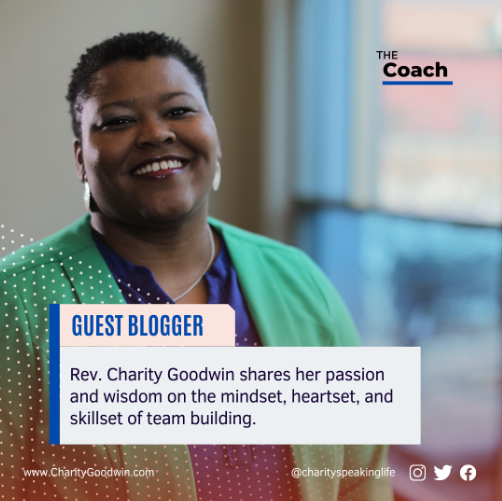
Rev. Charity Goodwin is The Gathering’s Clayton Site Pastor in St. Louis, Mo. She’s an ordained Elder in the UMC, endorsed by the Missouri Annual Conference as a coach, trained with Coaching4Clergy as well as a facilitator of Brené Brown’s research and emotional intelligence. All of this she integrates to consult with churches and pastors toward a healthier culture in her business Speaking Life Leadership Coaching . She convenes the Pastors Doing a New Thing Facebook Group and does live teaching weekly.
Rev. Goodwin is also the author of GET UP: Unearthing Your Passion and Taking Brave Action in 50 Days. Her first ministry is with her sons Gabriel,11 and Levi, 9. She calls them her boyjoys.
A Holistic Approach to Building Teams
Too often ministry experts assume one size fits all. You know that’s rarely, if ever helpful. Furthermore, the teaching tends to highlight what one needs to do. As Wesleyans, we value the head (mindset), heart (heartset) and hands (skillset). This is also referred to as thinking, feeling, and doing. Taking an integrative approach to ministry and specifically team building is how the best teams form.
What does a holistic approach to build your team look like? Let’s explore the head, heart and hands of building your team.
Mindset
Thinking through ministry teams two questions come to mind: why teams and what are the benefits of ministry teams.
Jesus was team centric. He, along with having a diverse and unlikely 12-plus person team, (remember the women who are named throughout as well) shared power with them. In Luke 10 Jesus commissions 72 to serve on his behalf. While we read and preach this scripture, creating a 12-person team or mobilizing 70 folks to implement ministry was not a class.. And yet, the ministry of Jesus impacts lives today in part because of the team approach Jesus incarnated. Building teams is a faithful response to being like Jesus.
Heartset
To lead with heart, you have to be aware of what feelings you’re experiencing. In society we lack an emotional vocabulary causing it to be difficult to navigate emotions in a healthy way. Emotions are neutral and yet we’ve ascribed good and bad values to them. When we can embrace emotions and see them as signs in which to pay attention and information to be gleaned, our leadership and team development is artistic rather than cookie cutter. How do you view emotions in your leadership? Or if you’re like me I viewed emotions as weak and vulnerable – now I appreciate them in a wholistic way as part of being a human and even sacred.
Skillset
This is the part that most folks lean on heavily – the to do’s and tools.
Writing a description of the perceived key duties and expectations of the role for the team member. Articulating your role in relationship to the team member essentially, what can they expect from you. You’ll also want to track your invitations to teams using something like Google Sheets. Noting and tracking dates for the following touchpoint sequence such as initial 1-1, the ask, reply, and onboarding next steps (this can be an entirely new Sheet).
If any of this wholistic and team talk challenges or inspires you, I invite you this Friday, November 4 at 11 a.m. CST to a free training called The Best Ministry Teams Start Here. All the details are here for you to sign up. I’m committed to supporting you, my colleagues in ministry. May all that we do be for the sake of Christ and to make his presence known and experienced here on earth.
October 25, 2022
Why Now is the Best Time to Turn Your Church Inside Out
In the past two and a half years, most everyone’s world has been turned upside down to various degrees. What most seek is comfort, normalcy, and familiarity. Most often, those who are churched seek such refuge in their church, so to suggest that this is the best time to turn the church inside out sounds ludicrous. However, this is indeed the absolute best time to examine our churches from basement to steeple and literally turn our churches inside out.
First, let’s address why such action is needed and why now is the time. By and large churches have not kept up with culture and therefore find themselves becoming more and more irrelevant to mainstream society – and even more so as we emerge out of the pandemic. The gap has continued to widen with our churchy language versus secular language, the ministries offered versus the ministries the community would likely engage in, the age difference in most churched versus unchurched populations, approaches to preferences of gathering people, schedules, and much more including the rise in distrust of church leaders and perceived hypocrisy. As a result, the country is growing more and more unchurched according to a Gallup Poll citing only 47% of US adults belong to a church, synagogue or mosque – down 20 points since 2000. We must develop a sense of urgency to reach new people for Jesus Christ.
Second, let’s look at some initial first steps a church can take. Since we are already in a time of disruption and liminality, it is indeed the very best time to fight against going back to the way we’ve always done things in the life of the church (which likely wasn’t all that effective anyway) and instead use this as a time of deep evaluation and soul searching. Gather some of the church leaders and begin processing these questions: What’s working well in the life of the church in reaching new people? What is not? What do we need to stop so that those resources (time, energy, money, building usage, etc.) can be diverted into something that is more effective? Where are our personal preferences and internal relationships driving decisions rather than the mission of making disciples? Are we more of a museum for the saints and gold plagues or a hospital for the hurting in our community? What is the signature ministry of the church (what are we known for in the community)? If the church were too close tomorrow, would anyone notice? Is the church focusing first on reaching new people and second on taking care of those already gathered? How does the church deploy themselves into the community to serve and build new relationships with the unchurched regularly? How many disciple-making disciples are there in the church? How many are being developed each year?
Third, let’s look at some resources to assist churches. As your leaders begin to process the questions above, you may have already felt as though you’ve been twisted, pulled, tugged, challenged, and even turned inside out! This is indeed difficult, transformational work – yet holy, important work we are called to do. Here are some resources to help you in your journey:
Books/Leadership Guides
Inside Out: Everting Ministry Models for the Postmodern Culture
Being the Church in the Post Pandemic World
IMPACT! Reclaiming the Call of Lay Ministry
Webinars/Coaching
If you are interested in an equipping webinar or needing congregational coaching, check out the resources at kaykotan.com or email info@kaykotan.com.
October 18, 2022
How to Revive the “Magic” of Wesley’s Small Groups
Too often we have convinced ourselves that most people just won’t make long-term and/or on-going commitments whether that is to serve on a committee or to join a small group. Is this actually true? Perhaps for some, but I am convinced that we are asking for the wrong kind of commitment. People simply don’t have the margin in their lives to waste any time or energy. Lives are jammed-packed full of school, hobbies, work, family, travel, experiences, and extracurricular activities. Without margins, a person needs and wants every minute to count. Therefore, they have no time or tolerance to sit in meetings that have no impact and don’t have any meaningful outcomes. Unfortunately, churches have often misread the signals and made entry points low-commitment, low expectation, low impact, and slow (if any) meaningful outcomes trying to get more young people involved. This approach has for the most part backfired and left even fewer young people interested and involved in the life of the church.
Let’s peer back at the wisdom in how John Wesley set up the three levels for discipling people. Beyond the Sunday morning worship experience, Wesley created an ingenuous three-prong approach – the society, the class meeting, and the band. Each of the experiences had a specific purpose and unique setting in the discipleship journey. The society meetings met on Sunday evenings and encompassed anywhere from 50 to 200 people and were mainly geared towards education in faith. The weekly class meetings were required and consisted of about 12 people led by a class leader that focused on personal spiritual growth, spiritual nurture, spiritual direction, and mutual encouragement. Class meetings is where the offering was taken and if a person missed too many meetings, they would no longer be able to participate. Bands were the deepest level of commitment and were small gatherings of 3-4 people of the same gender and marital status. Bands were accountability groups focused on intimate sharing of temptations and confessions of sin. Only about a quarter of Methodists participated in Bands.
In Wesley’s model, notice that the class meetings (discipleship) were not optional, but bands (the highest level of commitment and accountability) were optional. Not everyone was able or ready for the high-commitment, high accountability bands. One could opt into a band when they felt ready, but discipleship was expected. Discipleship included the development of both the mind (education through the society meetings) and development of the heart (spiritual nurture, direction, and encouragement through the class meetings).
Too often, the modern church has practiced discipleship as optional and educational instead of expected and transformational of both the head and the heart or that the only discipleship needed is what one receives in worship alone. Wesley felt strongly that these deepening levels of discipleship occur as accountability and commitment grows stronger and the size of the group grows smaller and more intimate.
We all know that magic is just an illusion. Yet we do know that it is in relationships in small groups that people usually take their biggest leaps in discipleship growth and development. It seems that a small group is where the Holy Spirit can take hold and maybe where people find community, feel safe, and are most open to exploring their faith through their head and heart with others who are on the same journey. When people find this kind of experience, they are willing to make this high commitment, high accountability plunge. They will make the time for experiences that make a difference and breathe meaning and purpose into their lives.
How are you offering meaningful small group experiences in your church? If you are looking for new small group offerings, check out these resources from Market Square.
October 11, 2022
The Colossal Crisis in Church Leadership
While we would all like to report and ultimately experience something different, we all know the alarming statistics. Fewer people are choosing to become part of clergy leadership (especially younger people). The same is true for laity in the church. The most common dilemma the church is facing is the lack of competent leadership – at all levels. Other organizations are struggling to some degree, but not to the crisis level the church finds themselves in when it comes to the colossal crisis in the lack of quality leadership. How do we find ourselves at such a place? Following are ten ways the church has created their own leadership crisis:
Warren Bennis reminds us, “Growing other leaders from the ranks isn’t just the duty of the leader, it’s an obligation.” Unfortunately, with too many pastor-centric teachings and models, leaders have not been raised up.There is a lack of accountability when it comes to leadership in the life of the church. There is no accountability or consequences for the mission, vitality, or effective leadership.The Committee on Nominations has not been trained or equipped to understand that they are the leadership development body of the congregation.“Leaders don’t create followers; they create more leaders.” says Tom Peters. If a pastor does not trust laity to share Jesus with the unchurched, but instead feels the laity need to gather people and bring them to the pastor on Sunday to be taught by the “chosen/called one,” we are creating followers instead of empowered and equipped leaders.What leadership equipping that is done is done primarily for the preservation of the institution rather than for Kingdom impact.The job of the pastor and paid/unpaid staff/leaders of the church is to identify, recruit, equip and deploy people for ministry. We have too many pastors and staff that find their worth and self-identity in doing the ministry rather than being people and team builders as intended.“My main job was developing talent. I was a gardener providing water and other nourishment to our top 750 people. Of course, I had to pull out some weeds, too.” Jack Welch reminded us. Too often in ministry, we are unwilling to pull out the weeds and the weeds overtake the garden.Paying attention to diversity is critical, but we sometimes make decisions based only on diversity without also considering one’s giftedness and talent.Leadership in the church is often chosen based on representation rather than spiritual gifts or even more importantly on spiritual maturity, commitment, and accountability.Too often we have people leading without vision. Where there is no vision, the people perish. Proverbs 29:18How is your church developing new leaders? If you are looking for a resource on development a leadership development process, check out Launching Leaders by Kotan and Schroder and the On Demand Webinar of the same title.
October 4, 2022
Strategic Ministry Planning
We blinked and it was summer and now the crisp fall season is in full swing. Before this season slips away, be sure your leadership makes time for the critical work of strategic ministry planning for next year. Have you calendared and begun to plan your church’s strategic ministry planning retreat with your leadership team (board/council) yet? Have you planned for your staff’s (paid and unpaid people leading ministry areas) ministry planning retreat to set objectives for the goals set by the leadership team? Or, perhaps, does all of this sounds overwhelming or even like gibberish? No worries, Strategy Matters is your go-to guide to plan, execute and follow up on a strategic planning retreat. You can find the book here, the webinar here, or a special combo package for both here – be sure to use the coupon code SMPSHIP in conjunction with the special combo package!
To help you get in the spirit of strategic ministry planning, here are the Top Three Misses and Top Three Opportunities when it comes to strategic ministry planning.
Top Three Misses
“Planning is bringing the future into the present so that you can do something about it now.” Alan Lakein
When leadership does not make strategic ministry planning a part of their annual rhythm, they are much more likely to lose sight of their purpose/mission and likely operate reactively or with a management focus rather than having an intentional missional focus. Without a strategic planning retreat, there is a missed opportunity for the much-needed, annual deep dive into the evaluation of vision, goals, polies, procedures, vital signs, guiding principles and more.Without a leadership retreat, the leadership team misses the opportunity for team building, establishing a new covenant together for the upcoming year with new team members, and a unified sense of direction and ownership in the upcoming year’s church effectiveness.Top Three Opportunities
“It takes as much energy to wish as it does to plan.” Eleanor Roosevelt
Strategic ministry planning provides a clear pathway for both leaders and staff to engage in a collaborative, missional and intentional approach to live into the mission and vision of the church.Strategic ministry planning sets the gauge for an evaluation of ministry effectiveness in the upcoming year. Without it, activities will have nothing to align to and leaders will have nothing to evaluate against.With effective strategic ministry planning, there is a heightened understanding of missional focus, alignment, energy, and momentum at all levels of the church.As you can see, effectual strategic ministry planning is one of the major keys in creating and sustaining congregational health and vitality. So, what are you waiting for? Get your calendar out now and plan these two retreats – board and staff. Be sure to pick up a copy of Strategy Matters to help you plan, implement, and follow up after a great strategic ministry planning retreat!
September 27, 2022
A Fresh Approach to Cooperative Parishes
The idea of cooperative parishes is nothing new. In the past couple of decades, they have most commonly been used to solve an appointive dilemma. In other words, when a church can no longer afford a full-time pastor, no pastor at all, or experience some other reduction in pastoral support, the judicatory leader responsible for that church brings together another nearby church to be in some sort of cooperative ministry with each other. Typically, the reduction in pastoral support is driven by shrinking financial resources. The church believes they are at a crossroad with no other options than reducing pastoral compensation. Structure rather than vision is clearly driving this decision. When structure is driving organizational decisions, the church is on the declining side of the lifecycle.
Since the appointment of a pastor is year to year, there are critical decision-points that congregational leaders are forced to make each year about appointments. This is unlike other decisions congregations can delay month after month and year after year such as their missional effectiveness in reaching new people. And because the judicatory leader typically only has one real influence and tool for each congregation, the appointment of pastors, forming a cooperative parish or multiple point charge is the only option used for congregations in this situation.
By using the cooperative parish as a solution to appointment issues, we have limited our understanding of the meaning and purpose of cooperative parishes. In addition, we have also severely limited what might be possible if we were to use the cooperative parish model more like it was it was intended and even outlined in the UMC Book of Discipline. In fact, there are multiple models of cooperative parishes offered in the BOD! Check out the ten distinctive models in the BOD in Part VI, Section II, ❡206. You just might be surprised at the variety of cooperative parishes offered.
What is this fresh approach we are challenging churches to consider? In our book, An Effective Approach to Cooperative Parishes: A Congregational Guide to Discernment and Implementation, my co-author, Jason Stanley, and I suggest that the approach in becoming a cooperative parish is much healthier when it is organic and congregationally-driven. The process to make the decision to enter into a cooperative parish takes time and must be part of discernment by all the congregations involved in the potential cooperative parish. A decision for congregations to become a cooperative parish due to a judicatory mandate (top-down approach) hardly ever proves to be effective or vital. It often feels imposed and heavy-handed to the congregations. Therefore, there is usually low commitment by the congregations.
On the other hand, when congregations take an organic journey through a process of discernment (grass-roots bottom-up approach), holy conversations, facing current reality, making critical decisions upfront, and having a shared vision for God’s preferred future for the cooperative parish, there is a much higher likelihood that the cooperative parish will be healthy, vital, and have Kingdom impact within the mission field of the new cooperative parish. This approach is not structurally-driven like the top-down approach. Instead, this approach is driven by vision and provides the opportunity for a new lifecycle to be birthed together by the newly formed cooperative parish.
Fore more information on this organic approach to cooperative parishes, check out, An Effective Approach to Cooperative Parishes: A Congregational guide to Discernment and Implementation. This resource is for churches who are considering forming a cooperative parish together. The guide will take leaders through a step-by-step process of discernment and understanding what true cooperative ministry actually means and how to enter into a cooperative parish model with a comprehensive plan and shared commitment from the start. The congregational guide walks leaders through the process of developing a shared and cooperative vision. One the vision for the cooperative parish has been established, the guide then guides the leaders through a process of how to develop the plan for cooperating through ministry, resources, and strategic alignment. No stone is left unturned! The process takes leaders through questions, surveys, analysis, and conversations that help them clearly understand the current reality of their own ministry landscape as well as the ministry landscape of the other potential cooperative parish partners upfront. It also aids leaders in having the tough conversations about alignment, planning, resource allocation, and more. It like the pre-marital counseling equivalent for cooperative parishes!
And finally, we believe there are four key advantages for cooperative parishes to be built by church leaders:
Greater Leadership ImpactWhen local church leaders decide on their own to form expressions of cooperative parishes, the local church leaders lead the local congregations in the discernment and decision-making process.
2. More Creativity
When local congregants are involved in the process from the very beginning, there is a much higher likelihood of creativity and innovation in the options and implementation. Local congregants are likely to be more engaged in creative solutions to make the cooperative parish successful when deciding to move forward.
3. Wider-Spread Engagement
When the cooperative parish idea springs up organically from the local context, the excitement and enthusiasm build and spread from leader to leader and congregant to congregant. Before long, it will be a snowball effect rolling down a giant hill picking up steam and growing in size and momentum.
4. Deeper Commitment and Buy-In
When people are a part of the decision-making process, they have a deeper sense of commitment and buy-in. They are more likely to sacrifice their preferences for the greater good since their voice is part of the decision-making process. They participated in the discussions and decisions along the way. They were privy to the information, the “why” from the very beginning, and heard varying pros and cons for each step in the decision-making process.