Kay Kotan's Blog, page 5
February 20, 2023
Three Common Ways Friendly Churches Screw Up Guest Hospitality
Most churches have made concentrated efforts to improve the ways guests are received. Many
now have Hospitality Teams in place. There is a sincere desire to offer a great experience for guests. Yet, there is a disconnect between being friendly and offering extravagant hospitality.
Being friendly is a good first impression. Hospitality is helping people feel welcome, comfortable, and that one could actually become part of the community. Extravagant hospitality is exceeding one’s expectations. Those who serve on hospitality teams are probably the folks who really are the ones that like people and have a strong desire for guests to have a good experience when they encounter their church. But often, members of hospitality teams are not always well-equipped for this important frontline ministry. Here are common ways churches screw up guest hospitality:
Ushers Aren’t Integrated as Part of the Hospitality Team
Ushers need to be integrated as part of the hospitality team and not seen as a separate team.
Anyone who is on the frontline interacting with guests should be integrated and equipped as
part of the hospitality team. If someone is not willing to be trained, they should not be
considered for the hospitality team. Expectations around greeting and hospitality have changed over the years, so team members need to be trained and reminded. It takes time to build a culture of hospitality within the hospitality team and within the church as a whole.
Lack of Congregational Culture for Extravagant Hospitality
While the hospitality team is the front line for hospitality, it is imperative to also equip the congregation in becoming welcoming and hospitable. Even if the hospitality team is top-notch, a congregant can ruin a guest experience. This can happen by telling a guest that s/he is sitting
in someone’s pew, someone being or doing something rude to a guest, or even looks of
judgment can run off a first-time guest.
Friendliness Is Not the End Game, It’s Only the First Step
Hospitality is about first impressions and making people feel welcome. Make sure the experience does not stop there. Helping guests connect relationally is extremely important. If a guest has a great first impression, but can not see how to connect relationally with others, we may not get the opportunity to receive them as a second-time guest. Help guests with relational connection options – not just connections to ministry. Relational connections are why people stick with a church. Is your church friendly? Or is your church practicing extravagant hospitality with an emphasis on relational connections? This distinction is key! To equip your Hospitality Team and others who interact with guests, check out this on-demand Hospitality Webinar.
The post Three Common Ways Friendly Churches Screw Up Guest Hospitality appeared first on Kay Kotan.

February 13, 2023
What Courageous Way is Your Faith Community Loving Neighborhood Children?
How a faith community loves the children in the neighborhood matters – really matters. Loving the children of the neighborhood is well beyond tolerating them. Loving children is well beyond making a congregation feel good about the future viability of the church by parading cute kids up the center aisle for children’s time only to be dismissed afterward so they won’t be disruptive for the rest of the worship service. We are reminded in Matthew 18:5, “Whoever welcomes one such child in my name welcomes me.” (CEB)
What non-verbal messages is your church sending to neighborhood children? Are there signs posted in the parking lot such as “No Skateboarding” or on the playground stating “For First Church Use Only” or has the net on the basketball rim been missing for four years? How welcoming is your church to the neighborhood children? Do all the programs, signs, building use policies, and acts of the congregants lovingly welcome and embrace every child and their families of the surrounding neighborhood? Afterall, Dr. Seuss reminds us, “A person’s a person no matter how small.”
Have we noticed how today’s young families with children are struggling? As if parents didn’t already have their hands full, the pandemic created yet another layer of complexity for parents to navigate raising their children. With the closing of more than 16,000 childcare centers across the country in an already underserved industry, parents are struggling to find childcare availability, let alone affordable childcare. Add to this crisis the delayed learning caused by the closing of schools or the transition to virtual learning. In addition, parents are overwhelmed with balancing work and family life, making the family budget balance as inflation escalates, and the division and polarization of the country on issues of politics and racial justice.
These parents of the Millennial and Gen Z generations are increasingly spiritual but not religious, missing from mainline churches, and are searching for safe spaces to explore their spirituality and help them raise spiritual families. Yet, data from Pew reports, “Gen Z really wants to help people” and “shape the future,” but “when we see religious aspects of the church or other religions just tearing that down and oppressing people or hurting people, instead of showing how the church or religion can be used to help people, they [younger generations] just don’t want to associate with that.” Thus, the church finds itself in a difficult position of trying to reach these two generations who want help in nurturing their children’s faith but are reluctant to associate with the church.
To have the privilege and opportunity to journey alongside parents who are searching for assistance with resourcing their children in their spiritual development, the church will need to first show up and offer help where it is needed (childcare), build relationships (love our neighbors), and then slowly over time by building trust, the faith community can be invited into spiritual conversations and help parents develop confidence through providing resources, programs, and tools to develop their children’s faith.
Childcare Crisis Facts:
● According to Catalyst.org over 71% of mothers are employed
● Over 62% of the married couples with children, both parents are employed per the Bureau of Statistics, 4/20/22.
● 51% of Americans live in communities classified as childcare deserts, Essential US Childcare Statistics, September 2022
● Per Zippia.com, nearly 32% of US children under age five can’t access a childcare slot
● The current childcare system places a $98 billion burden on the US economy per Essential US Childcare Statistics, September 2022.
With the childcare crisis, some innovative churches are rethinking their call to children’s ministry. Is your church providing full-time care for children along with kindergarten readiness and summer programming? Are you fully leveraging your facility for this ministry? Is your church intentionally and effectively integrating families from the childcare center into a spiritual community? Is your church taking a holistic family approach with the child care center? Does the staff of the child care center see their role as a ministry? Is there at least 20% of the tuition left to reinvest back into the ministry after all overhead expenses have been paid?
If you can’t answer each of these questions with 100% certainty, consider a Childcare Analysis of your existing center or preschool. Or contact us for information about becoming part of a growing network of new centers who are living into this ministry model. Info@Children’sTable
The post What Courageous Way is Your Faith Community Loving Neighborhood Children? appeared first on Kay Kotan.February 6, 2023
How Sure Are You That Your Neighbors Would Actually Recommend Your Church?
If ten people from the neighborhood surrounding your church were asked, how confident are you that they would actually recommend your church to someone? What do they know about your church? How have they formed those opinions? Has the church been intentional in informing the neighbors about its ministries? Has the church been intentional in forming relationships with the neighbors? Even if your neighbors don’t attend your church, how is your congregation being good neighbors? What does your congregation do to improve or invest in the neighborhood? How is your church having a positive impact on the lives of the neighbors?
It’s time for a reality check! We are in a culture that is growing more and more unchurched. The church is viewed by many as being hypocritical and untrustworthy. Our denominational struggles have done us no favors at a time when people are looking for places of peace, love, hope, grace, and a sense of community. We must be more intentional in tending to our community reputation and witness. But hear me very clearly – this is not about the right marketing strategy! This is instead about the right focus.
Your neighbors will recommend your church when your focus is aligned. Your neighborhood will be positively impacted when your focus is on the right stuff. Your neighbors will know about your ministries when the church is focused where it should be. Your congregation will be building relationships with the neighbors if the focus is properly aligned. Your church will no longer be invisible if the focus is leveraged by the congregational gifts and leaders’ passions. The lives of your individual neighbors will be positively impacted because of your congregation’s focus.
What is this focus? It is honestly quite simple. The church sometimes makes it so complex, but it really isn’t. The focus is this – missional focus. When the church has a missional focus, everything aligns to the mission. Programs, ministries, and events that are no longer missionally effective are discontinued. Personal preferences are trumped by missional alignment. Congregational resources are leveraged for missional effectiveness. All the church does helps existing congregants grow deeper in their discipleship and new people come to know Christ and begin their discipleship journey. When the congregation gets this missional focus, they become hyper-focused. When the congregation can focus on their mission of making disciples who transform the world, you better believe that knowing the neighbors, building relationships with the neighbors, having a positive impact on the lives of the neighbors, and transforming the neighborhood is a top priority for the congregation. Why? Because that is what the mission is
all about!
When a church gets how to “focus,” they can be assured that their neighbors will indeed recommend their church! This recommendation will not come from advertisement or second-hand information. No! This recommendation will come from first-hand experience!
If you’re interested in a Neighborhood Recommendation Consultation for your church, please
email Info@YouUnlimited.com for more information.
January 30, 2023
How to Boost the Untapped Passion and Impact for Laity Leadership Empowerment
Is your church struggling to fill all those committee slots? Are you tired of begging for volunteers so the church can provide all the ministries it always has provided? Is the passing of the clipboard asking people to sign up not working? Are you frustrated and not sure what to do? Believe it or not, you are not alone! Many churches are struggling with these same issues and questions.
In my experience, here is why most churches are wrestling with these concerns around
engagement:
● People are no longer interested in the ministries being offered.
● People feel the committees they are being asked to serve on are no longer effective nor impactful.
● The ministries or committees people are being asked to help with do not have a clear purpose.
● The role the person is being asked to take is unclear and/or they do not feel they have been equipped for the role.
● The committee or ministry the person is being asked to serve in does not align with their gifts or passions.
● The role the person is being asked to take does not feel relevant to the time, the church’s mission, or where the person feels the church needs to head.
● The role the person has been asked to take does not actually have the authority and responsibility to get the job done.
● The person does not feel like their time spent in the ministry or committee will make any difference in the life of the church, reach a new person, or have any impact on the community.
The Book of Discipline of the United Methodist Church clearly states ALL are called to ministry in ¶128:
“…all Christians are called to minister wherever Christ would have them serve and witness in deeds and words that heal and free.”
Yet, the church has lost its zeal, emphasis, focus, and practice for identifying, equipping, recruiting and deploying laity for ministry. Instead, we have concentrated on placing people in committee positions, holding countless meetings, reading endless reports to one another, and diverting our attention away from our purpose and accountability to the mission of making disciples.
Here are ways to boost the untapped potential and passion of your laity for empowerment and
missional impact:
● Simplify your structure for nimble decision-making eliminating delays and wasting time in meetings.
● Create an accountable leadership culture at all levels where leaders are empowered with authority and responsibility and held accountable for their role, actions, and alignment to the mission and vision.
● Engage the accountable leadership assessment cycle for all ministries to help us stop ministries that are no longer effective.
● Create a permission-giving culture that eliminates the leadership board from being the bottleneck for day-to-day operations through guiding principles.
● Practice engaging in leadership covenants starting with the leadership board, all ministry teams, staff, small groups, etc. to outline expectations of one another and the ministry
they will be doing together.
● Have a shared vision for the church representing the unique way your church is making
disciples in this given season of ministry taking into consideration the gifts of the congregation, the passions of the leaders, and the solution/impact the church is
providing for the community. This provides clear direction for everyone to head together.
● Leverage and align the church’s resources for the mission and vision. This eliminates the pressure for personal preferences and traditions and instead provides the shared understanding of missional alignment.
● Create and engage people in a leadership development process that helps people
identify their spiritual gifts, secular experience, passions, and understanding of
accountable leadership. People therefore see the direct connection to their unique
giftedness and how it fits into the mission, vision, and ministries.
● Identify a signature ministry for the church to reach the targeted mosaic the church is
called to reach. Go deep relationally with handoff ministries and events related to this
signature ministry rather than providing numerous unrelated ministries and unrelated
demographics. Do fewer ministries with excellence with this targeted demographic to
eliminate burnout, make better use of resources, and actually reach more people.
● Do not delay handling bullies, conflict, employee performance, power struggles, etc.
using Matthew 18:15-21 and accountable leadership practices. This is not only biblical
and demonstrates mature spiritual leadership, but this is the way a healthy, vital
organization leads and grows.
How does a church go about making these shifts and tapping into this potential and empowering laity? Check out the Local Church SAS, Equipping Leadership Boards, Simplified, Accountable Church Coaching, and Simplified, Accountable Structure Overview Webinar. Laity (especially Millennials and Gen Z) will no longer serve on a committee out of a sense of obligation; they will engage only when they feel like it can make a difference. Empower your laity for ministry by providing impactful ways to engage in laity leadership!
The post How to Boost the Untapped Passion and Impact for Laity Leadership Empowerment appeared first on Kay Kotan.January 23, 2023
Why Every Church Leader Absolutely Needs Trips to the Lighthouse
Do you remember how difficult it is driving on those foggy nights? You are tempted to turn on your high beams hoping it will help you see better, but you know it will only make the visibility worse. Those high beams make the fog more opaque making it even more difficult to see the road ahead. In non-inclimate weather, traveling at night is eased for modern-day travel using automotive headlights for seeing up to an estimated 200 feet ahead or those high beams shine up to 400 feet ahead. Ships are also guided by lights to warn them of rocky or shallow waters or to guide them safely into the harbor. Lighthouses that contain those powerful lights to guide those ships can be seen up to 30 miles away.
As church leaders, we are also guided by the light. For us Christians the light is often used as a symbol for spiritual insight, creativity, holiness, goodness, knowledge, wisdom, grace, hope, joy, and God’s revelation. The Bible teaches us to walk in the light, to let our light shine, and not hide our light.
In my experience as a coach for church leaders, I find that many church leaders are only accessing limited light sources. It seems as though they are driving on those foggy nights with their high beams on desperately trying to find greater visibility to no avail. Yet they persist with those high beams glaring back into their eyes hoping the fog will eventually dissipate.
Every church leader needs time at the lighthouse! The lighthouse provides altitude, greater visibility, different views, and distance. When a church leader spends all their time on the ground tending to the day-to-day operations of the church, it is like driving the car in the fog with those high beams on. Clear visibility is just not there! You can only see a few feet in front of you at a time – maybe just getting to the end of the week or even to the end of the day. Driving/leading in these conditions limits church leaders’ creativity, insights, visibility, energy, joy, and so much more.
Time at the lighthouse is most productive with a guide – aka a coach. The coach can help the church leader see things you might otherwise miss, inquire about something that causes a new insight or awareness, be a neutral observer and listener, and call things to your attention as an outsider that an insider can’t see. Guided trips to the lighthouse are recommended at least monthly.
These guided lighthouse trips should not be considered a luxury. Nor should they be something a church leader partakes in only when things are really tough, there’s a crisis, or a special project coming up. Guided lighthouse trips (coaching) are an essential leadership tool for today’s church leader – nevermind the fact that about 40% of pastors are seriously considering leaving the ministry.
Those of you who are responsible for the line item in your church budget that would cover this vital ministry tool for your pastors, make sure it includes coaching and the other continuing education needed for your pastor. In addition, how are your other staff, ministry team leaders, and board members being resourced with these essential trips to the lighthouse? For more information on coaching or to start your guided lighthouse visits, click here.
The post Why Every Church Leader Absolutely Needs Trips to the Lighthouse appeared first on Kay Kotan.January 16, 2023
Want to Modernize Your Leadership Culture to Empower and Expand High Capacity Leaders?
What church isn’t desperate for high capacity leaders? Why is it that leaders are so difficult to identify and recruit in the life of the church? There was some cry for leaders pre-pandemic, but the gap in leadership has only substantially widened in the past three years. What is this leadership deficit about? It boils down to these core shifts churches will need to make if they expect high capacity leaders to step into leadership roles in their churches:
Vision – A church needs a unique and compelling vision of where they are headed. A vision provides energy, excitement, momentum, and clarity. It legitimizes leadership and increases generosity and traction. Vision provides the focus so resources can be aligned towards attainment of that vision. When God’s preferred future for how a particular church has discerned they are called to live out the mission of making disciples in a particular season (aka vision), the leaders no longer spend time debating on direction, priorities, or resources. The direction has been identified and the congregation is working together towards a shared common preferred future. High capacity leaders won’t engage in a church’s leadership without a compelling vision they can commit to.
Culture – Organizational culture consists of underlying beliefs, assumptions, values, norms, customs, systems, and ways of interacting that contribute to the unique social and psychological environment of an organization. Each church has its own unique culture that has evolved over time. Organizational culture influences employees’ behaviors, affects the way people within the church interact with one another, leaders, pastors, and the community.
Many church attenders who are leaders in the secular world are not interested in church leadership. Why? They experience the church with ineffective decision-making systems, unhealthy organizational cultures, and an inability to engage in anything that is impactful or worth the investment of their time, energy, or commitment. If the pandemic taught these leaders nothing else, leaders today want what they choose to invest their time in to make a difference. When most churches are just going through the motions of reading reports and rubber stamping “what they’ve always done,” leaders are not inspired to step up. (Click here for how this disconnect has contributed to non-profit organizations’ growth.)
If churches desire leaders (especially under the age of 40) to engage in church leadership, they will have to transform organizational culture. Complexity, hidden agendas, lack of transparency, lack of authenticity, long meetings without purpose or outcomes, lack of vision, etc. will all need to be eliminated. Leaders desire to be empowered with trust, authority, and responsibility through written guiding principles with repercussions if violated. Gone are the days of micromanaging, planning by photocopying, and just going through the motions of “playing church.”
Accountability – Most churches are led with a bureaucratic or autocratic system. The bureaucratic system is committee-driven or consensus-driven. It usually takes a very long time for decisions to be made. Decisions are based on keeping those already attending happy rather than based on aligning with the church’s purpose of making disciples. It’s a fairly safe leadership model, but it is not an effective model.
The autocratic leadership system is usually driven by a pastor, matriarch, or patriarch. All decisions made have to run through one person. Decisions can be made quickly, but sometimes they are hasty and not missionally aligned decisions. The church is limited due to the capacity of one leader. This leadership style is not safe, but can sometimes be effective. However, once the leader is removed, moves, burns out, or passes away, the growth and ministries collapse because everything was centered around this one leader.
The accountable leadership model is the recommended leadership model. Leaders are given authority, responsibility, and are held accountable. The accountable leadership model is both safe and effective. While the practice of accountable leadership is common in other organizations, it is not nearly as common in churches. In fact, some church leaders are resistant to accountable leadership – something I struggle to understand. If our responsibility as a disciple of Christ to lead the church in its disciple-making commission isn’t worth being held accountable for, then what is? As Steven Covey puts it, “Accountability breeds response-ability.” (Read more here.)
Believe it or not, most leaders prefer the accountable leadership model. They are frustrated with the slow-moving, ineffective bureaucratic model. As ones who appreciate collaboration and teaming, high capacity leaders see the harm the autocratic leadership model can have. Accountable leadership when implemented and practiced well, is a healthy and effective leadership model that most leaders appreciate.
In closing, if you are having difficulty recruiting leaders, assess your vision, organizational culture, and leadership model. If any one of these three is unhealthy (let alone two or three), you will likely need to make some adjustments before you will be able to recruit healthy, high capacity leaders.
The post Want to Modernize Your Leadership Culture to Empower and Expand High Capacity Leaders? appeared first on Kay Kotan.January 10, 2023
Three Simple Ways to Grow and Empower Church Leadership
There is no doubt the pandemic changed everything including churches as I wrote about specifically in the book, Being the Church in the Post-Pandemic World: Game Changers for the Post-Pandemic Church. How people engage in the life of the church as attenders, volunteers, and leadership is no exception.
Among other things, the years 2021 and 2022 will go down in history as being known as the Great Resignation or the Great Reshuffle when more than 45 million employees left their jobs each year. These employees changed companies, changed professions, left the workforce, or moved from the for-profit sector to the nonprofit sector. People report seeking better pay and/or benefits, more opportunity for advancement, a healthier work environment or office culture, more meaningful work, more flexibility, and childcare issues.
Working with churches and leaders across the country, one consistent message heard is how frustrating it can be to find people who are willing to step into church leadership. Many churches are having to rebuild committees and teams post-COVID, but the leaders are reluctant to commit. Here are some reasons I believe this is the case:
The pandemic gave people the chance to pause, reflect, and prioritize. They no longer want to invest their time and energy in places or activities where they don’t see a difference or an impact being made on someone or something.The pandemic revealed much more efficient ways to get things done. People know there is no need to be involved in outdated systems and structures when more efficient and effective methods are available.They and the world moved on without all those church committee meetings for months. This causes pause to wonder if all those meetings are needed and what they were really accomplishing.There is a definite shift in how people want to spend their time and what they value.Spending time with family, rest, and mental health and well-being are of high value.Do less to have more impact.Simplify all the church does.Discern and declare a very specific, succinct, distinct, and clear vision for how your church is being called to live out the mission in the next year or two.Once these shifts are made, leaders will be much more likely to step up and commit. This is much more of the kind of environment they desire to serve in and will be able to clearly see how an impact is possible.
“Growing other leaders from the ranks isn’t just the duty of the leader, it’s an obligation.”
Warren Bennis
Next, begin practicing accountable leadership at all levels. Accountable leadership keeps leaders on track, in their respective lanes, aligns resources, and helps keep leaders’ eyes on the purpose of the organization. To ultimately grow and empower leaders, embrace the accountable leadership model through these three simple steps:
Responsibility. Empower leaders to make decisions, lead ministries, complete tasks,and perform duties within clearly identified healthy boundaries.Authority. Give leaders the power to provide direction or make decisions within their
area of ministry.Accountability. Invite leaders to commit to their areas of responsibility and authority
and be held amenable. Check in on their progress. Offer constructive feedback and
consequences.
While the steps are simple, they are not easy. Accountable leadership is not something most churches have commonly practiced. It will take some time, course correction, patience, consistency, and maybe even some outside coaching to fully adopt this new form and culture of leadership. However, churches who adopt this accountable leadership find it to be life-giving, effective, efficient, empowering, and much more missionally focused. For a video demo of practicing accountable leadership at the board level, click here.
The post Three Simple Ways to Grow and Empower Church Leadership appeared first on Kay Kotan.January 2, 2023
Hack this Really Simple But Powerful Ministry Tool
What do Kansas City Chiefs’ quarterback, Patrick Mahomes, singer, actress, and fashion designer Rihanna, church leadership communicator, and influencer, Carey Nieuwhof, and Oprah Winfrey, owner of Harpo Films, OWN, and O Magazine all have in common? Obviously, all four of these people have made great strides in their chosen professions. One might even refer to them as the cream of the proverbial crop. They certainly don’t share the same professions, gender, ethnicity, age, skills, or passions. What each of these “successful” people have in common is each has invested and continues to invest in this one simple, yet powerful leadership tool. Rihanna, Patrick, Oprah, and Carey all have coaches. Yes, even these G.O.A.T.’s (Greatest of All Times) have coaches.
Each of our G.O.A.T.’s above invest in different types of coaches from athletic to voice to executive to leadership. Yet, the core relationship and purpose of having a coach is the same for each. As Michael Jordan states, “A coach is someone who sees beyond your limits and guides you to greatness!” The International Coaching Federation (ICF – the leading global organization for coaches and coaching) defines coaching as partnering with clients in a thought-provoking and creative process that inspires them to maximize their personal and professional potential. The process of coaching often unlocks previously untapped sources of imagination, productivity, and leadership.
In the church world, it is important to understand that coaching is not the same as mentoring, counseling, spiritual directing, or consulting. Those terms are often used interchangeably, but have very different meanings and applications.
Mentors guide others along a journey where they have already traveled. They have the experience to know the ruts, detours, points of interest, rest stops, and areas where cautious travel will be required. Having a mentor should lessen the mentee’s time, learning curve, and potential hazards traveling the same journey.
Counseling is based in psychological health and counseling or therapy usually needs to focus on a recovery from a past pain or dysfunction with their clients. In contrast, coaching assumes an overall level of health and wellness occurs in an environment of curiosity and wonder towards discovery.
Spiritual Directors work with clients specifically on spiritual formation. The focus is on the client’s relationship with God. A client typically seeks a spiritual director when they are exploring how to grow more spiritually mature, feel closer to God, connect in more meaningful ways, and more fully discern the implications of how that relationship with God affects her/his life.
Consultants are recognized experts in a certain field who diagnose a problem and prescribe solutions to solve the issues identified. In consulting, the consultant is responsible for the desired outcome. In coaching, the client is provided a discovery-based framework that taps into the expertise of the person being coached for empowerment, self-discovery, and generation of their own plans and actions.
Coaching provides a focused time for leaders to remove themselves from the hectic day-to-day distractions, to-do lists, emails, and meetings to instead look out over the extended organizational landscape. A coach will help her client navigate the learnings from those landscape observations. Coaching is an intentional time set aside for ministry leaders to concentrate important leadership level processing and thinking on such topics as her progress made, blindspots, self-discovery, new awareness, how to overcome obstacles, troubleshoot situations, what the client needs to stop doing, create healthy boundaries, create action steps, and continue to build on her personal foundation. Some sample questions are: Where are you trying to get to? Is that desired outcome in alignment with the organization you are leading? Why is that the desired destination? Are your current actions and habits supporting this desired outcome? What’s the gap between your current situation and your desired destination or outcome? What steps need to be taken to close the gap? How are you sabotaging yourself and/or your desired outcome/destination?
Without a coach, ministry leaders hop from one project to the next appointment, from one hospital call to the next meeting, from one email to the next text, and suddenly find another year has gone by without that well-intentioned plan to be less reactionary, more responsive, work less but be more effective, less stressed, take all vacation earned, and more strategic in 2023. Do yourself a favor in 2023, make an investment in becoming a G.O.A.T. – the Greatest of All Time YOU! Contact a coach to get started today.
The post Hack this Really Simple But Powerful Ministry Tool appeared first on Kay Kotan.Hack This Really Simple But Powerful Ministry Tool
What do Kansas City Chiefs’ quarterback, Patrick Mahomes, singer, actress, and fashion designer Rihanna, church leadership communicator, and influencer, Carey Nieuwhof, and Oprah Winfrey, owner of Harpo Films, OWN, and O Magazine all have in common? Obviously, all four of these people have made great strides in their chosen professions. One might even refer to them as the cream of the proverbial crop. They certainly don’t share the same professions, gender, ethnicity, age, skills, or passions. What each of these “successful” people have in common is each has invested and continues to invest in this one simple, yet powerful leadership tool. Rihanna, Patrick, Oprah, and Carey all have coaches. Yes, even these G.O.A.T.’s (Greatest of All Times) have coaches.
Each of our G.O.A.T.’s above invest in different types of coaches from athletic to voice to executive to leadership. Yet, the core relationship and purpose of having a coach is the same for each. As Michael Jordan states, “A coach is someone who sees beyond your limits and guides you to greatness!” The International Coaching Federation (ICF – the leading global organization for coaches and coaching) defines coaching as partnering with clients in a thought-provoking and creative process that inspires them to maximize their personal and professional potential. The process of coaching often unlocks previously untapped sources of imagination, productivity, and leadership.
In the church world, it is important to understand that coaching is not the same as mentoring, counseling, spiritual directing, or consulting. Those terms are often used interchangeably, but have very different meanings and applications.
Mentors guide others along a journey where they have already traveled. They have the experience to know the ruts, detours, points of interest, rest stops, and areas where cautious travel will be required. Having a mentor should lessen the mentee’s time, learning curve, and potential hazards traveling the same journey.
Counseling is based in psychological health and counseling or therapy usually needs to focus on a recovery from a past pain or dysfunction with their clients. In contrast, coaching assumes an overall level of health and wellness occurs in an environment of curiosity and wonder towards discovery.
Spiritual Directors work with clients specifically on spiritual formation. The focus is on the client’s relationship with God. A client typically seeks a spiritual director when they are exploring how to grow more spiritually mature, feel closer to God, connect in more meaningful ways, and more fully discern the implications of how that relationship with God affects her/his life.
Consultants are recognized experts in a certain field who diagnose a problem and prescribe solutions to solve the issues identified. In consulting, the consultant is responsible for the desired outcome. In coaching, the client is provided a discovery-based framework that taps into the expertise of the person being coached for empowerment, self-discovery, and generation of their own plans and actions.
Coaching provides a focused time for leaders to remove themselves from the hectic day-to-day distractions, to-do lists, emails, and meetings to instead look out over the extended organizational landscape. A coach will help her client navigate the learnings from those landscape observations. Coaching is an intentional time set aside for ministry leaders to concentrate important leadership level processing and thinking on such topics as her progress made, blindspots, self-discovery, new awareness, how to overcome obstacles, troubleshoot situations, what the client needs to stop doing, create healthy boundaries, create action steps, and continue to build on her personal foundation. Some sample questions are: Where are you trying to get to? Is that desired outcome in alignment with the organization you are leading? Why is that the desired destination? Are your current actions and habits supporting this desired outcome? What’s the gap between your current situation and your desired destination or outcome? What steps need to be taken to close the gap? How are you sabotaging yourself and/or your desired outcome/destination?
Without a coach, ministry leaders hop from one project to the next appointment, from one hospital call to the next meeting, from one email to the next text, and suddenly find another year has gone by without that well-intentioned plan to be less reactionary, more responsive, work less but be more effective, less stressed, take all vacation earned, and more strategic in 2023. Do yourself a favor in 2023, make an investment in becoming a G.O.A.T. – the Greatest of All Time YOU! Contact a coach to get started today.
The post Hack This Really Simple But Powerful Ministry Tool appeared first on Kay Kotan.December 13, 2022
Are You Feeling Stuck?
“If you always do what you always did, you will always get what you always got.” – Albert Einstein
Are you feeling stuck, but more change feels too overwhelming? Did you realize that the human mind is actually hardwired to resist change? The brain interprets change as a threat and releases a hormone called amygdala for protection. It’s that old fear, fight, or flight of our ancestors kicking in again. No wonder we are feeling stuck and change is so difficult – our bodies are fighting against change!
But I bring you good news! There is hope for those desiring to get unstuck! In the 1960’s, David Gleicher created the Gleicher’s Formula: C = D x V x F x CL > R or Change = Dissatisfaction x Vision x First Concrete Steps x Creative Leadership (added by Kathleen Dannemiller in 1992) > Resistance (aka monetary and psychological cost of change). The formula represents the necessary factors for change to take place. In other words, the pain of staying the same has to outweigh the perceived cost of the change.
Let’s unpack these terms a bit to understand them a bit better. Dissatisfaction in the church world might be represented in fewer number of people, fewer resources, lack of energy, grieving the “good ol’ days,” and perhaps even a sense of apathy while seeing other churches reach new people. Vision is defined as an inspirational new future, new opportunities, hope, some new situation or circumstance, and working together towards God’s preferred future for the congregation. Those first steps are realistic actions, a coherent path, engaging steps, attainable objectives, or a smart approach for getting started. The creative leadership might be a coach, consultant, or bold inside leader with outside eyes that can help those inside see and desire something new and be willing to give up the comfort of the existing to pursue the new vision. The resistance is the fear of the unknown, lack of trust, reluctance to novelty, fear of change, challenging the “way we’ve always don it,” or “we’ve tried something like this before and it didn’t work.”
Below is a chart demonstrating the outcome when dissatisfaction (need for change), vision, creative leadership, (capability to change and resources), and first steps are left out of the change formula. Notice the only path to successful change is for all factors to be in play.
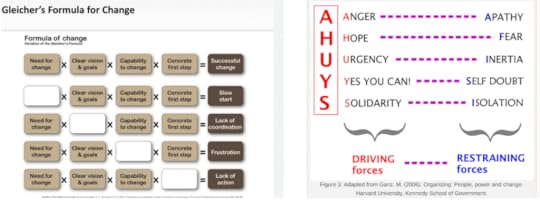
According to Kurt Lewin, developer of Lewin’s Field Theory, there are driving forces and restraining forces at play during change, too. (See chart above.) The driving forces are working towards the desired state – the new vision. The restraining forces (resistance to change) are working against the driving forces trying to keep the status quo. Lewin argues that the most effective change occurs not from increasing driving forces, but from decreasing restraining forces (aka belief barriers). Imagine the dotted lines from the left side of the chart (i.e., anger) to the right side (apathy) as a rope taught with tension, but still connected. A person can be anywhere on the continuum between these two psychological opposites, but the potential for swinging in the opposite direction always exists. Lessening the restraining forces is helping move people towards aha’s (AHUYS) or new awareness.
“He who rejects change is the architect of decay.” – Harold Wilson
Change is hard! Leading change is even harder. Yet, when we are stuck and what we are doing is no longer working, it’s time to faithfully move on to what God has for us next.
The Enthroned continued, “Look! I’m making everything new.
Write it all down—each word dependable and accurate.”
Revelation 21:5 (MSG)