Sarah Kozloff's Blog, page 2
February 7, 2020


February 2, 2020
Concerning Names
Names are a difficult part of fantasy writing: too esoteric—too full of double “XX’s or unpronounceable strings of vowels, and they feel too artificial; too plain and you lose any sense of other-worldly difference. Only a few fantasy authors have succeeded in creating clear and usable naming systems. Akardy Martine’s number-noun pattern in Memory of Empire, e.g. “Three Seagrass,” “Twelve Azalea,” etc. works really well. On the other hand, in The Goblin Emperor, Katherine Atkinson’s system of changing suffixes and prefixes by gender and rank ends up totally confusing me.
For years, while I was in the midst of writing The Nine Realms, I marched the ten-minute walk to my parking lot to an internal chant, “Gimli, son of Gloin.”
Readers of Tolkien will recognize the names of two of his dwarves. This kind of slantwise chime is what I wanted for The Nine Realms because I had so many characters—the style list of people, animals, and places for the four books ultimately grew to around 600—I knew that readers would need all the help they could get.
So, I set up patterns. My first decision was to separate names by gender. Female names would end with a long “a” or a long “e” sound and male names wouldn’t.
Then, as the realms multiplied, I inserted “nationality” markers. Lorther names include an “il.” Green Isles names an “et,” while Oro names include the letters “um.” Alpie names had either a double vowel or a double consonant, e.g. “Gunnit,” “Aloon.” The queens of Weirandale all have names that start with a “C.” I relied mostly on English and French phonemes (because to wander into Chinese or Arabic sounds would smack of cultural appropriation), but sticking strictly with familiarity would be too parochial so I took a few chances on made-up spellings such as “Yurgn.”
Before a reader plays “gotcha,” let me confess I stuck to my own rules only 90% of the time: sometimes I was too attached to a name or sound to give it up. (Apparently, in every world, parents sometimes like to be different.)
I extended patterns to the animals. Goats carry the names of flowers; horses are named after common objects, usually decided by color: “Cinders,” “Teapot,” “Barley.”
The holy grail I always reached for was “Gimli, son of Gloin,” that is, ways of connecting families. Sometimes I fell into the same pattern as Tolkien, that is, an exact rhyme, like his dwarves “Fili” and “Kili.” In The Nine Realms “Dalogun” and “Balogun” are twins. I’m more satisfied with the names of three Free State brothers—“Hake,” “Thalen,” and “Harthen”—because their names are similar but not clones. By the same token, “Percia” is the daughter of “Stahlia.”
Will the effort I spent on creating and sustaining these patterns pay off? Will my choices help readers identify characters? Most will never bother to puzzle out the rules I crafted, but my hope is that they will work on a subconscious level. As a reader, I hate being confused so I did my best to provide subtle guidance.
If you ever do feel at sea, never fear, I included an easy-to-use Appendix of character and place names at the end of each book!

January 24, 2020
November 17, 2019
November 8, 2019
Concerning: Entering a Story
Between our real lives and the world of a story lies a barrier, something like a shimmering wall. To enter a story we have to pass through that barrier, leave a part of ourselves behind, and re-orient ourselves in new and strange surroundings.
Sometimes—even for habitual readers—the barrier feels thick and hard to penetrate. We’re stressed or distracted; perhaps our eyes are tired; we can’t summons the energy to push through.
Various factors make the wall appear more solid. A physical copy of a book that is battered or small print. Being an outsider to the genre. A literary style that is unfamiliar.
Publishing professionals know that the magic talisman that eases transportation into a storyworld is familiarity. “In the tradition of X” vouchsafes that reorientation will not be difficult and the journey worthwhile. We follow authors and genres that we’ve liked before because we built up a level of competence and comfort with their characteristic voice and tropes.
Series build familiarity into the structure of their narratives. Once we have made the investment in a story, learned the rules, oriented in new surroundings and met new people, we want to stay there as long as possible.
A few years ago I was shocked by a student who said she liked television more than movies because I’d grown up with movies having higher production value, more complicated characters, more artistic prestige, and more adult material than network television. With the advent of streaming series, and the move of great writers and performers onto television screens, I realized that television series have an advantage that films lack: they offer more time inside the storyworld. Once you commit to a show, you get to stay there for hours and hours—or at least for however many seasons and episodes have been produced, as opposed to a movie (which provides a one-and-done pleasure . . . unless, as so many movies are nowadays, the film is part of a series or “universe”.)
Knowing that I have an episode of a television series that I’m invested in to watch after dinner makes my day. My interest in the plot and characters only grows more intense over time. Even though the quality of a series may degrade over seasons, once I’ve committed, I’ll never leave episodes on the table.
I don’t know about you, but once I’ve done the work of getting inside, I want to stay there. So, I avoid short stories, because to me the work of pushing through the barrier doesn’t pay off for a bite-sized experience.
I wrote four volumes of The Nine Realms and am publishing them all in row, January-April 2020, for readers, like me, who want to binge-read.
When a series ends, and we are thrown back out though that shimmering barrier, back into real life, we again feel an emotional passage, but this time it is a keen sense of exile and loss. This is why so many people re-watch their favored tv series or reread their favorite books. (Netflix, so sneaky and canny, even provides a row, “Watch it again.”)
Narrative is universal and timeless not only because it explains confusing phenomena, not only because it provides us with views of other lives and choices, not only because it offers us wisdom about life choices, but because, as Wordsworth once said, “The world is too much with us; late and soon.” Yelling, “Stop the world—I want to get off,” has been tried—unfortunately it doesn’t work. But getting “lost” in a story is a way of leaving this world behind . . . at least for awhile.
“Escaping” to another world is neither cowardice nor hedonism, but a way to refresh our psyches from the bruising realities around us.
August 27, 2019
Concerning Teaching: Goodbye to All That
My emotional experience of teaching goes like this: at the beginning of the semester, you stand nervously on the top of the white cliffs of Dover. At the starting gun, you jump off into the choppy Channel and start swimming as hard as you can. The water is freezing and rough but by now you are an experienced swimmer. At mid-semester break a sea captain pulls alongside and lets you rest against the gunwale, spooning warm broth into your mouth. Then for the last lap, you use your remaining reserves of strength until finally, your stretching fingers touch the coast of France. Exactly where you end up is a mystery—you might have swum in a straight line directly to Calais, but strong currents or the wake of sea traffic might have deposited you anywhere from Dunkirk to Cherbourg. With shaking limbs you climb out . . . and get ready to do it all over again.
This image captures the can’t-turn-back/must-press-forward stress of guiding a class through the material.
What it doesn’t capture is the joy of teaching.
In 1981, I taught my first class (a Freshman composition class) as a graduate student at Stanford. As a baby-faced twenty-five-year-old, my students mistook me as one of their fellows, as opposed to their instructor. This fall, I will be teaching my last Vassar classes, on Romantic Comedies and Emotional Engagement with Film. (For the latter, I am blessed with a companion, Prof. Dara Greenwood, from Psychology.)
I have loved teaching. The most wonderful aspect my profession is that my joy in the material is triply enhanced by sharing it. I know movies—fantastic movies—that students have never seen or even heard of and I can pull them out of my sleeve like a magician and to a degree, change their lives. (For wasn’t your life changed subtly but forever by His Girl Friday or Johnny Guitar?) Similarly, when we discuss film history and theory, when I lead students to examine arguments and appreciate interconnections, to probe beneath the surface, I feel as if I am introducing them to the deep pleasure of the life of the critical mind.
I’ve also loved my students. They are so eager, so receptive, so smart, sometimes rocking me back on my heels and making me examine my own preconceptions. Through the magic of social media, many have stayed in touch and let me watch their lives unfold. If some days students have broken my heart by not doing the reading or not being receptive to a film I adore (the class that didn’t appreciate Moonstruck still boggles my mind, as does the group that didn’t do the reading from Victor Navasky’s Naming Names), I’ve learned to swim on through these choppy patches.
If I love teaching so much, then why have I decided to leave Vassar in my early sixties? Many faculty members stay on well into their seventies. Financial incentives encourage one to do so.
First, because I have this new career as a novelist. It is exciting to open a new chapter of my life and I want the freedom to give it all my time and attention, not sneak it in during summers or breaks. Life is too short for one career, one big adventure. Starting over constitutes renewal.
Secondly, because I am now decades away from my graduate school training and generations removed from current students’ popular culture and taste. Although I have striven to keep up, increasingly I sense a gap. Academia is refreshed by younger faculty members who are abreast of the current theories.
So I know that I have made the right decision for myself and Vassar. After years and years of swimming that Channel, I shall paddle in other waters on different schedules. But I start this last semester thinking, “This is the last time I will show a class It Happened One Night, Roman Holiday, A Separation, and Dr. Strangelove.”
If I am teary-eyed in the corridors of the Vogelstein Center for Drama and Film, please pay it no never mind. The hallways just throng with ghosts—of cherished movies, students, and colleagues—and I'm having a little trouble pushing through them as I rush back to my office to prepare for the next class.
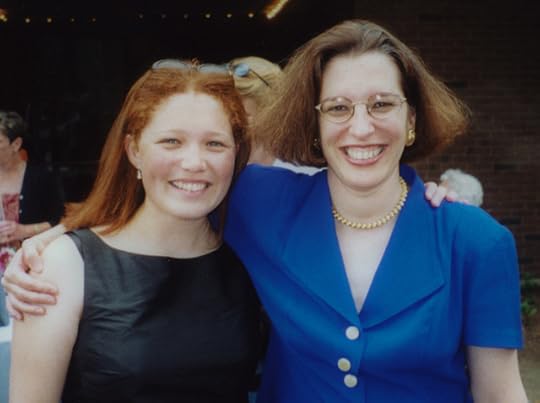
Portrait of a (younger) professor with a graduating senior, Ms. Jennifer Romero, Vassar ‘01
Concerning Teaching
Concerning Teaching
My emotional experience of teaching goes like this: at the beginning of the semester, you stand nervously on the top of the white cliffs of Dover. At the starting gun, you jump off into the choppy Channel and start swimming as hard as you can. The water is freezing and rough but by now you are an experienced swimmer. At mid-semester break a sea captain pulls alongside and lets you rest against the gunwale, spooning warm broth into your mouth. Then for the last lap, you use your remaining reserves of strength until finally, your stretching fingers touch the coast of France. Exactly where you end up is a mystery—you might have swum in a straight line directly to Calais, but strong currents or the wake of sea traffic might have deposited you anywhere from Dunkirk to Cherbourg. With shaking limbs you climb out . . . and get ready to do it all over again.
This image captures the can’t-turn-back/must-press-forward stress of guiding a class through the material.
What it doesn’t capture is the joy of teaching.
In 1981, I taught my first class (a Freshman composition class) as a graduate student at Stanford. As a baby-faced twenty-five-year-old, my students mistook me as one of their fellows, as opposed to their instructor. This fall, I will be teaching my last Vassar classes, on Romantic Comedies and Emotional Engagement with Film. (For the latter, I am blessed with a companion, Prof. Dara Greenwood, from Psychology.)
I have loved teaching. The most wonderful aspect my profession is that my joy in the material is triply enhanced by sharingit. I know movies—fantastic movies—that students have never seen or even heard of and I can pull them out of my sleeve like a magician and to a degree, change their lives. (For wasn’t your life changed subtly but forever by His Girl Fridayor Johnny Guitar?) Similarly, when we discuss film history and theory, when I lead students to examine arguments and appreciate interconnections, to probe beneath the surface, I feel as if I am introducing them to the deep pleasure of the life of the critical mind.
I’ve also loved my students. They are so eager, so receptive, so smart, sometimes rocking me back on my heels and making me examine my own preconceptions. Through the magic of social media, many have stayed in touch and let me watch their lives unfold. If some days students have broken my heart by not doing the reading or not being receptive to a film I adore (the class that didn’t appreciate Moonstruck still boggles my mind, as does the group that didn’t do the reading from Victor Navasky’s Naming Names), I’ve learned to swim on through these choppy patches.
If I love teaching so much, then why have I decided to leave Vassar in my early sixties? Many faculty members stay on well into their seventies. Financial incentives encourage one to do so.
First, because I have this new career as a novelist. It is exciting to open a new chapter of my life and I want the freedom to give it all my time and attention, not sneak it in during summers or breaks. Life is too short for one career, one big adventure. Starting over constitutes renewal.
Secondly, because I am now decades away from my graduate school training and generations removed from current students’ popular culture and taste. Although I have striven to keep up, increasingly I sense a gap. Academia is refreshed by younger faculty members who are abreast of the current theories.
So I know that I have made the right decision for myself and Vassar. After years and years of swimming that Channel, I shall paddle in other waters on different schedules. But I start this last semester thinking, “This is the last time I will show a class It Happened One Night, Roman Holiday, A Separation,and Dr. Strangelove.”
If I am teary-eyed in the corridors of the Vogelstein Center for Drama and Film, please pay it no never mind. The hallways just throng with ghosts—of cherished movies, students, and colleagues—and I'm having a little trouble pushing through them as I rush back to my office to prepare for the next class.
Portrait of a (younger) professor with a graduating senior, Ms. Jennifer Romero, Vassar ‘01
June 16, 2019
Concerning Magic
“I need a little magic in my life,” said a friend to me over lunch, after our depressing political discussion had segued into my interest in epic fantasy.
Don’t we all.
But how much magic?
Magic to me is like the white icing on top of a cinnamon bun. If the baker sloshes it on too liberally, she drowns out the taste of the cinnamon, raisins, butter, and the fluff of the pastry with too much cloying sugar. If she gets the right amount, the sweetness on the top brings out and enriches all the other ingredients and complements the swirling structure.
So, although I don’t personally care whether magical elements are ordered into a logical “system” or not, I do appreciate fantasies in which the unearthly works within limitations. Kristen Cashore’s Graceling series, for example, endows only certain characters with circumscribed powers. In Connie Willis’s The Doomsday Book, the only aspect of the story that is fantastical is the Oxford historians’ ability to time travel. No one has miraculous powers of healing or telepathy. The characters are frustrated and defeated by the same constraints that affect us all, such as communication difficulties, material shortages, petty vanities, and disease.
Too much magic throws me off the plot and characters, because there’s no rhyme or reason to what can happen in this world. In Game of Thrones (books and tv), I accepted the white walkers and the dragons without difficulty and I could stretch to the Faceless Men of Braavos, but once we got to Beric Dondarrion’s multiple resurrections, R’hilor’s intermittent interventions, and the three-eyed raven’s baffling powers, I started rolling my eyes.
In Lord of the Rings, Tolkien uses the modest and earthy hobbits as foils against the extraordinary elves, wizards, and Númenóreans. Nonetheless, my brother told me he had “outgrown” Tolkien when he realized that throughout The Hobbitand LOTR not a single character ever urinated. (Dan, I made sure to include peeing in The Nine Realms, partly to make my characters more grounded in real life, and partly because I found that basic biology can be used to reveal character.)
Despite having chosen fantasy as my genre, ironically, I suspect that deep down I am . . . a realist. The offspring of a scientist and a lawyer, I like facts, proof, and social constraints. I so admire Middlemarch, The Grapes of Wrath, The Age of Innocence, or Empire Falls, novels about normal people coping with the pressures of their milieus. I’ve always shied away from surrealism or abstraction in fine arts. Let’s go look at Rembrandt, please, rather than Picasso, Dali, or even Chagall.
But balance is everything. Perhaps I should have chosen a more prosaic food than cinnamon pastries in the metaphor above. Unfortunately, meat and potatoes wouldn’t add surprise and unexpected pleasure to my lunch companion’s life. I yearn for a harmony between the fantastic and the mundane. The world is too much with us late and soon, and we ache for something more, something special, something that will give us joy. The perfume of miracle that elevates Shakespeare’s TheWinter’s Tale and The Tempest, such that these plays are separated from the rest of his corpus under the label “romances.”
A note, literally, of grace.
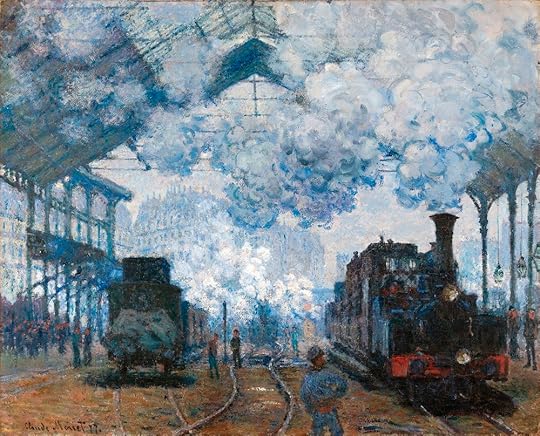
This is the quality many people find in French Impressionist art. The Rouen cathedral or the everyday haystacks are recognizably there, right there, without distortion, but Monet’s brush trembles at their beauty and the light around them becomes luminescent. The Impressionists didn’t need to paint mythological, religious, or classical subjects; through their eyes, we see normal life but through a glass, brightly.
This shimmering brings out the beauty that was always there but overlooked. Which, to me, is magical.
January 10, 2019
Concerning Writing at a "Certain Age"
I never considered myself in the least creative. My mind is analytical—I adored books and movies but I adored studying them, taking them apart, and understanding what gave them their resonance and how they fit into history. My admiration for creative people was boundless, but I would never be so bold as to attempt their magic. When I fretted about finding an academic job, my parents never tired of telling me I would have made a good lawyer—like my mother or a scientist—like my father.
Thus, no one was more surprised than me to find that at age 57 I started writing a 4 volume fantasy series. I had never written a short story; I had never taken a creative writing class. I hadn’t even read any “how to” manuals. When my novels hit the shelves I will be 63.
(My best friend from childhood, Linda, is the only person who thought that I would eventually wind up here, because of the elaborate stories I would weave when we played with our trolls.)

Linda and I had whole families of trolls.
For me, writing later in life has worked out well. The years have given me a vast exposure to narrative texts: children’s stories (my own and my sons’), literature, movies, and television series. I’ve studied narrative techniques, but I’ve also internalized the rhythms of stories in my bones. Through my decades of obsessively following the news, I’ve also absorbed larger tales about people, social movements, and government.
Practical considerations have been equally as influential in allowing me to write during this phase of life. My sons are grown; my parents have passed—no one (except the dog) chafes at my hours at the computer. Years of my husband and I saving for retirement have made the financial risk of embarking on a new career less daunting.
The biggest advantage of my age is that now I can draw on a lived experience. The mantra to “write what you know” has always struck me as devaluing the role of imagination—did Shakespeare meet three witches or stab a king? Was he shipwrecked? Was he ever besotted with a donkey? But if we take the adage not to refer to specific events or settings but to the horizon of one’s emotional life, it becomes more meaningful. I haven’t sought adventure, but just by living six decades (with—it must be noted—certain financial means), I’ve been exposed to different cultures and countries; flown on the wings of professional success and crashed with failure; ridden on horses and traveled by boat and ship; marveled at blizzards, hurricanes, Santa Ana winds, tornados, and earthquakes. I am well acquainted with homesickness, loneliness, terror, arrogance, insecurity, sleeplessness, and the rare blessing of contentment.
I’ve gained friends and lost friends. I’ve had my heart broken and fallen in love. I know exactly how little children whine. I’ve personally been caught on the far side of the membrane that separates those in peril from the healthy going about their business; I know the exhaustion and stress of a loved ones with a chronic disease; and I’ve held someone’s hand as he died.
To use a pop culture reference from my childhood, Pete Seeger’s adaptation of stanzas from Ecclesiastes into an anti-war anthem: “To everything there is a season.”
These are my years to write fiction.