Sarah Kozloff's Blog, page 3
October 26, 2018
Concerning How I Wrote The Nine Realms
Every writer has a different behind-the-scenes story. Before memory softens away the rough edges, I’d better write it down.
As the King says in Through the Looking Glass, “The horror of that moment . . . I shall never forget!”
“You will, though,” the Queen said, “if you don’t make a memorandum of it.”
The first drafts:
I started writing in the summer of 2013. I outlined nothing; I didn’t know I needed to world build first. I just took my laptop everywhere I went—scenes and characters came to life while waiting in the dentist’s office or when I couldn’t sleep. I spent the year (I had a sabbatical leave) in an imaginative haze, with only one foot in IRL.
My general habit is to write from 6 a.m. until I run out of steam (usually around noon) every day other responsibilities don’t intrude.
By the fall of 2015 I had drafted the entire series of four books but I knew I needed expert help to improve.
Moving toward publishing:
I was such a rube I didn’t even know the term “query letter,” but I was fortunate (actually, privileged) to have access—through friends and work connections—to professionals who patiently set a newbie on the proper path.
In November of 2015 I sent out about a dozen query letters, getting just enough requests for sample pages not to feel crushed. To reassure myself that I was on the right track, I hired a professional editor to critique my first 50 pages. Then I revised all four books again. After crumpling up an insane number of drafts of a query letter, I gathered up my courage and approached agents again in the late summer of 2016.
For a heady two weeks around Labor Day 2016 I had two agents vying for me to sign with them. My choice, Martha Milliard of Sterling Lord Literistic, managed to interest Tor Books in the series, but the press wanted to be certain I willing and able to make changes. I auditioned by reworking a few chapters according to their guidelines. Tor offered me a contract in the winter of 2017.
Revisions, more revisions, and yet more revisions:
My editor, Jen Gunnels, now supervised my rewriting the books all over again. Books I and II needed more work (primarily cutting excess threads, trimming the interior monologue, and researching topics I had fudged my way through), while by the later books I had hit my stride.
Simultaneously, instead of relying on the kindness of friends and relatives as beta readers, I found another fantasy writer to serve as my writing partner, and we critiqued every paragraph of one another’s manuscripts.
From August to October 2018 I reworked the whole series again, concentrating particularly on character dialogue and on world building touches.
After initially drafting and redrafting in Microsoft Word, in the winter of 2017 I bought the writing software Scrivener. The “writing history” panel of a random chapter shows that I changed it 67 times.
The four books are now off for copy-editing, and then I’ll have one last chance to approve changes and make final tweaks.


August 4, 2018
Concerning Ghost Chapters
Sometimes a chapter you’ve written, revised, and polished twenty times just doesn’t work with the overall flow of book. Then, either you or your editor (ideally both, in a meeting of the minds), has to cut the cord: “Sorry, that chapter or subplot has to go.”
In A Queen in Hiding, a subplot about a spy/assassin named Gretna just had to go. She was a delicious character in her own right, and she served higher narrative purposes, but her devious machinations became distracting. So out she went.
But—is she really gone? I don’t mean that I will recycle those chapters into some other work; I’m not even sure that I could find or recover those drafts. (I’m not sentimental about such passages and they aren’t my “darlings.”) I mean, that even though she doesn’t appear in the final manuscript, she lingers around the edges of the fictional world. I inserted just one phrase where the spymaster says he will try to send an agent to Liddlecup—and that leaves the door open for Gretna to still inhabit her shabby rooming house and still try to ingratiate herself into Tidewater Keep. So she’s there for me, if not for the reader. A phantom presence, a danger that lurks.
Other deleted chapters and events enrich the series. I wanted to show how character X discovered an important piece of information—now I know, down to the exact phrasing. Another deleted chapter traced how character Y recovered from a trauma—although the scene is gone I know who helped her and how. So the time and energy spent on the chapters that end up on the cutting room floor isn’t wasted; the scenes leave an aura behind, like a bird dropping a feather.
The deleted chapter that haunts me the most originally fit toward the end of Book I. The Wyndton family traveled to Gulltown for Solstice Fest. It was a quiet interlude (and thus out of place near the book’s crescendo). Two sisters shared confidences and then the whole family celebrated the holiday by buying strawberry ices and by joining the processional, carrying tall tapers. I can still taste the ice, see the candlesticks, and feel the mundane happiness and irritation of a family united . . . for what turns out to be the last time. But since neither the characters and nor my readers could know that this was the last time, the poignancy that I invested was too private and self-indulgent. It had to go.
In my experience, “Director’s Cuts” of movies are usually less interesting and more digressive than the studio release. Studios have accumulated experience about how to tell a story most effectively; directors lose sight of their audience’s needs when they insist that every drop of their vision is precious.
Ghost chapters have to stay ghosts. The real tricks lie in finding ways to share with reader the perfume of their passage on the wind and in creating a sense that the fictional world is populated by people or events that may always remain un-dramatized, but give the reader a sense of depth and a flicker of a shadow.
July 7, 2018
Concerning Pixels and Peonies
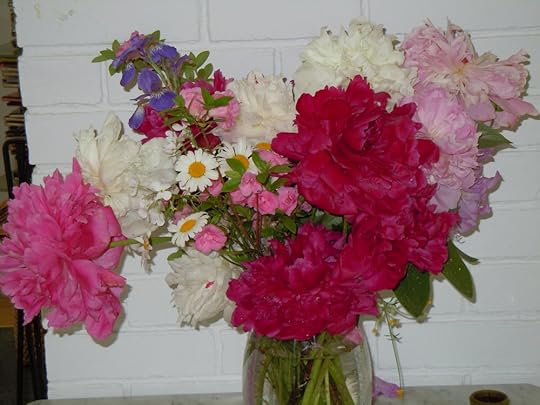
If I’m not at my computer writing--at least in the summer--I’m often in the garden. Although you’d think these pursuits diverge, actually they overlap.
In both cases
· You plant, you water, you prune;
· You transplant, you fertilize;
· Volunteers spring up unforeseen;
· Ripeness takes years.
Sometimes I think that all I do is move pixels around a bed of white, or delete weeds from beds of green.
Even the downsides are remarkably similar: both entail physical challenges. The computer screen dries your eyes and sitting makes your back stiff, while carting mulch pulls your muscles and sweat stings your eyes. Which hurts more—those yellow jacket stings or the sting of having a manuscript rejected? Which itch is more maddening—that patch of poison ivy blisters or the worry that you’ve chosen the wrong approach?
Generally, no one forces you write or garden—these are vocations of choice, arising from the privilege of having the time “to waste” in Sisyphean vocations.
Just as deer may decapitate your lilies and slugs turn your hostas into ribbons, the book may not find its readers. You can control neither the weather nor the literary market.
In both cases you have the opportunity to build a world, a world that might thrive and create . . . for one brief, shining moment, a Camelot of a pattern of order, harmony--even beauty. But you have to launch such projects knowing that it is more likely your world will suffer from drought, frost, and Japanese beetles.
As Margaret Atwood once said, “Gardening is not a rational act.”
The irrational writer/gardener needs to love the hours doing the work,not pin her hopes on some fantasy result.
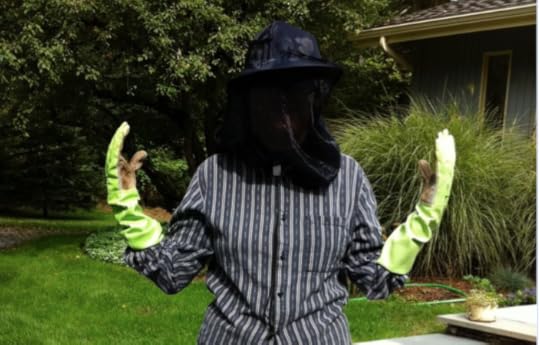
The author, about to tackle a hill full of poison ivy, thistles, and blood-sucking mosquitos.
April 13, 2018
Concerning Dragons
You’d think that someone who likes fantasy novels as much as I do would like dragons. Actually, I loathe the creatures. I’ve literally quit books when—in the middle of a perfectly good story about people—a dragon slithers in.
And they crop up all the time, in J. R. R. Tolkien, George R. R. Martin,Robin Hobb, Ursula LeGuin, Anne McCaffrey, and a myriad of other authors. They have deep roots in mythology, folktales, and religion (St. George and the Dragon, anyone?). They have become one of the most popular twentieth-century fantasy tropes. Nothing says “fantasy” as much as a dragon on the cover. Evidently, other readers enjoy them.
My friend the psych professor, Dara, has taught me about individual differences in responses to art. So I want to understand—what could be dragons’ appeal?
And what’s wrong with me?
First, dragons can fly. Defeating space and gravity is a cool conceit, which connotes freedom and exhilaration.
But I don’t like flying. I’m sure my distaste arises partially from too many hideous experiences on United, but I also find the very idea of flying unappealing. Yes, everyone would love to move quickly from one place to another without the tedium of earthbound travel. But I’d prefer to beam or tesser from one place to another. Flying necessarily entails being high in the sky and looking down on everyone and everything. You see landscapes only as abstract patterns and you don’t see people at all. The dragon or her rider’s viewpoints are removed from human concerns—theirs is a cold and superior gaze.
So dragons connote flight, freedom, and detachment. Yet Tinkerbell flies, but she’s not a dragon. The difference between Tinkerbell and dragons is a one of scale. Dragons are always big and always deadly, shooting out fire and burning people to death. Power! Excitement! Battle prowess! Dragons are the super-heroes, the Incredible Hulks, of the genre.
I like excitement as much as the next reader, but dragon power often brings an unfair advantage. When Daenerys calls in her dragons to burn up her enemies, my overall reaction is not awe, but horror at the escalation. Talk about a non-commensurate response to provocation!
Finally, some authors make their dragons the repository of everything ancient, wise, and lost. Dragons—which spring forth from ancient legends—come pre-packaged for nostalgia.
But when I ponder dragons as arising from a land before time, I think of them as akin to dinosaurs (with tiny brains) and you can probably guess how well that works for me.
Of course, some writers draw their dragons as sensitive and devoted. And much prose and billions of pixels have been devoted to dressing them in beautiful colors.
However, if you want a nice beast, a soul-mate type, I’d advise swiping left at fire-breathing reptiles in the OkBestiary.
When I was five we visited Arizona and brought back a terrarium of lizards as a pitiful stab at household pets. I don’t know what went wrong, but the lizards ate one another. Everyday when I checked, there was one less and the survivor had a companion’s limb sticking out of his jaw.
The only dragon I’ve ever been able to build up any fuzzy feelings toward is “my father’s dragon,” in the Ruth Stiles Gannett children’s books. That’s because, of course, this poor, captured, orphan dragon has lost all his lizard qualities and been turned into a stuffed toy in expensive, Swedish cotton pajamas, with a small seahorse head, ears, and red nail polish.
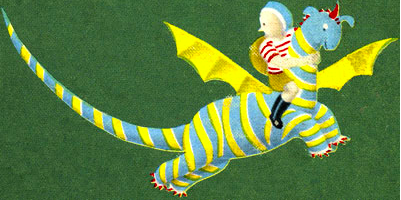
But if you go too far down that route, you end up with Barney . . . who is repellant in a different way.