Ryk E. Spoor's Blog, page 66
October 18, 2013
On My Shelves: Primeval

You spend your entire career planning for just about every crisis imaginable – up to and including alien invasion – then this happens. So much for thinking outside the bloody box.
— James Lester
The first episode of Primeval opens up like a classic monster movie flick; a young woman in trouble, chased by something we don’t see clearly but is definitely huge and hostile, and then a quick chase sequence which indicates our momentary heroine is a goner.
But Primeval is nothing like your typical monster flick.
The central concept of this BBC SF series is that for some reason, “Anomalies” – space-time disruptions which look to the human eye like drifting sculptures of chiming crystal – periodically open up at various places around the world. Because of their rarity and random nature, they were not scientifically proven to exist until now.
But when a strange, monstrous creature appears in the Forest of Dean, Dr. Nick Cutter is driven to investigate it; his wife, Helen, disappeared in the Forest of Dean years ago, under similar circumstances, and this is the first hint he’s gotten that there may be answers still out there. Along with his long-time companion and expert hunter Stephen Hart, Nick Cutter acquires an impromptu team composed of himself, Stephen, Abby Maitland (a reptile expert), and ubergeek extraordinaire Connor Temple.
As their investigations – originally separate, but eventually dovetailing – progress, they find there are indeed strange creatures in the Forest of Dean, creatures that shouldn’t be there. As they investigate, Claudia Brown, from the Home Office, shows up, and swiftly proves to be an agent of some organization within the government that’s trying to throw a lid over the investigation – in as polite a manner as possible, of course.
They get their monster – and more questions. The various creatures they encounter, from a strange flying reptile simply called “Rex” to the “monster” originally reported (a gorgonopsid, thought extinct for over two hundred million years) certainly could not possibly have been living in the Forest of Dean – or indeed anywhere in the United Kingdom – undetected all these years.
And indeed, they have not. The creatures come through crystal-like gateways in space and time, enter our time, and – usually – end up returning to their own through the Anomaly. But for some reason, the Anomalies are starting to open up more frequently, more widely…
Thus is Primeval started and a peculiar team assembled. Under the control and direction of James Lester, appointed administrator for the project, they locate and deal with incursions from multiple time periods of varying danger, while trying to solve the mystery of the Anomalies.
This isn’t as straightforward as it sounds; the next few episodes show that Nick’s wife Helen has survived, but her survival has … changed her. It is not immediately clear what her goal is, but she demonstrates a knowledge of the schedule of the Anomalies, possibly even a way to control them, and as time goes on it becomes clear that her goals are anything but beneficent.
The science of Primeval is in a sense the centerpiece of the show, but it’s definitely science fiction. While most of the creatures we see have some basis in reality, the specifics of them are changed for dramatic license; for instance, Arthropleura’s size was roughly doubled and it was given a venomous bite, neither of which have any scientific evidence to support them. Most other creatures have such artistic liberties taken with them as well.
At the same time, the general drift of the discussions respect science, even if they ignore the facts of our universe in areas, and the creature effects are usually quite well done; this isn’t a surprise since the same special effects team did Walking With Dinosaurs.
The real key to enjoying the series, though, is to follow the characters and plot twists. One twist, commonly used for an episode or two in other shows but never, as far as I can recall, used as a long-term change, was to have one of the team’s missions change the timeline. Rather than – as most such shows do – have the change reversed after an episode or so, the change to the timeline was permanent, with the characters from the original timeline having to deal with the slight, but disconcerting changes in their world.
The characters themselves are quite… colorful. Nick Cutter, the true leader of the group, is a maverick, short-tempered scientist, badly damaged by the loss and, now, betrayal of his wife (who, it later turns out, also had an affair with Stephen). Despite his brusque exterior, however, Nick is capable of considerable sympathy and loyalty to his team and is utterly incorruptible and not able to be intimidated; these traits are key to keeping Helen from wreaking even more destruction than she does.
Abby Maitland, although a small, very pretty blonde girl who seems set up as the “animal friend” of the group, is highly intelligent, very educated and skilled with animal handling, and dangerously physically competent; she is an accomplished martial artist and often serves as the main combatant whenever Stephen isn’t present; even when he is, Abby remains quite an Action Girl. Though she initially (and justifiably) finds Connor extremely annoying, the two form a friendship and eventually a romance follows.
Abby and Nick are the “preservers” of the group – their concern is to protect and rescue the animals stranded from their own time and return them home. The others understand this motive, but tend to be more concerned with the human element – what damage the creatures can do, and what the overall Anomaly phenomenon means.
Connor Temple is the third of the main characters. Uncertain with himself and compensating with fast talk, showing off his knowledge, and armored with a nigh-impenetrable cluelessness at times, Connor’s strengths are his encyclopedic knowledge of ancient creatures and ability to make the right deductions under stress. In addition, he is extremely technically gifted and eventually even creates a device to detect, and seal shut, Anomalies.
He is also apparently possessed of a particularly perverse form of luck; he will get into numberless scrapes through inattention, overconfidence, and clumsiness, but under extreme stress will take dramatic and very effective unorthodox actions that lead to his survival and, often, those around him.
Connor immediately becomes infatuated with Abby upon meeting her, and while it takes some time, she eventually warms to him. Connor is a classic geek, often describing things in pop-culture terms that either lose Nick, or irritate him, and is a positive fanboy of prehistoric creatures; he will sometimes literally squee upon encountering something really spectacular.
James Lester at first is the distant bureaucrat who wants to control the team and views them as a bunch of misfits, but as time goes on he comes to see that, unorthodox as they are, they’re also the right people for the Anomaly Research Centre – concerned not about what possible weapons or advantages can be wrung from the Anomalies but in understanding them and protecting the world from them.
While the initial episodes play with the “monster of the week” format, there is a long-running plotline that develops around Helen Cutter and her knowledge of the Anomalies, one that is driven by a strangely nhilistic view which she seemed to have formed over her time lost behind the Anomalies, and by her ability to select –and perhaps – control creatures from the Anomalies.
The most formidable of these creatures is simply called the “Future Predator” – a highly evolved super-bat with tremendous speed, strength, and senses. Blind, it uses exceedingly accurate sonar to detect, locate, and track prey, and can do so with preternatural quickness. It is in many ways played up similarly to “The Predator” from the similarly-named movies, and may be fully intelligent (though it is hard to tell). One of James Lester’s Crowning Moments of Awesome is his duel – alone in the ARC – against a Future Predator sent to kill him. One such creature has been known to kill many trained soldiers; Lester should have been no problem, but it turns out that it never pays to underestimate an experienced administrator with a reputation for unorthodoxy.
The combination of quirky characters, monsters from future and past, evil schemes, and cool special effects – and an absolutely marvelous soundtrack – make Primeval one of the best BBC shows I’ve watched. This one is definitely worth a try!


October 14, 2013
Just For Fun: My Top Ten Villains!
While, at least in theory, we cheer for the victory of the heroes, it is often the villains that define a work, and certainly the villains tend to get the best lines, best music, and commonly the coolest “style” in a work.
This probably partly stems from the fact that villains are more “free” than the heroes; they get to do what they want rather than what they should or must. In addition, the villains tend to be in control, the ACTIVE force, in the story, at least up until the end; the heroes spend much of their time reacting rather than being directly active themselves.
Still, there are good villains, bad villains, and “meh” villains… and a few, a very few, that stand out so much from the others that they say “This is what you should aspire to, if you seek to be on the side of evil. Look, and see what a true VILLAIN can be!”
So I herewith present a list of my top ten villains from various forms of fiction!
Number 10: E. P Arnold Royalton
E. P. Arnold Royalton, almost always referred to simply as “Mr. Royalton”, is the head of Royalton Industries in the movie version of Speed Racer. Played with scenery-chewing relish by Roger Allam, Royalton is a powerful and wealthy industrialist who has no conscience nor pity for any below him. He believes wholeheartedly in the dog-eat-dog world of corporate warfare – not merely wholeheartedly, but passionately preaching the gospel of the corporate game: “That’s what racing is about. It has nothing to do with cars or drivers. All that matters is power, and the unassailable might of money!”
One of only two “normal humans” on this list, Royalton wouldn’t be nearly so fun a villain if he weren’t capable of wearing a convincing mask,and wear it he can. Even though we know he has to be a bad guy, he seems to be the ideal of the corporate man – one who climbed from nothing to the top, and yet remembers what it’s like to be at the bottom – perhaps a bit overeager to impress, but then, many at the top are. The moment when Royalton tears off that mask is actually quite horrifying; it is a very Jekyll-and-Hyde moment, and Speed’s utter shock resonates with us.
Royalton demonstrates the pitilessness and vicious nature of evil – and, ultimately, its pettiness.
Number 9: Prince Koura
There’s something about an evil sorcerer that’s hard to beat for a villain, and The Golden Voyage of Sinbad offers us one of the best: Prince Koura, nobleman, visionary, and master of the blackest arts of magic, after a mystical prize which can grant the wearer youth, a crown of untold riches, and a shield of darkness. Played magnificently by Tom Baker (who later became famous as the fourth incarnation of The Doctor), Koura is not merely powerful but intelligent, skilled, and physically quite competent as well.
Koura’s primary magic is the ability to bring the unliving to life, ranging from creating a homonculous from his own blood to serve as a spy to animating a multi-armed statue of Kali and sending it against his foes. He uses it only reluctantly, however, because the use of magic quite literally drains the life out of him; he ages noticeably after each significant feat of magic. This shows, also, his tenacity and dedication to his mission; he is willing to risk his own life to achieve this goal, and does so repeatedly.
At the same time, Koura shows us something very rare in true villains. He has a servant and companion, Achmed, who repeatedly tries to dissuade Koura from continuing the quest, or failing that to at least refrain from the use of his magic. Koura shows that he appreciates Achmed’s concern and the basic wisdom of his advice; moreover, when the climactic confrontation is approaching, he sends Achmed to safety, not wanting to risk his life as well. This consideration and understanding that ones’ servants should be well treated is a startling and gratifying feature in one otherwise so dark; it shows a much greater intelligence than most bad guys are allowed to have.
Prince Koura also is quite willing to face people physically; he shows himself to be roughly equal to Sinbad himself in swordsmanship, and had he not become overconfident, the movie would have had a much darker ending! The combination puts him here, at number nine!
Number 8: Ellsworth Toohey
The second of the two “normal humans” on this list, Ellsworth Toohey is the main villain in Ayn Rand’s novel The Fountainhead. Overall, The Fountainhead is in my view not as good a novel as Atlas Shrugged or her much shorter work Anthem. None of the main characters are as likeable as, say, Hank Rearden, and their motives/personalities are more difficult to understand. Perhaps the most likeable of them is the non-villain antagonist Gail Wynand.
But despite the less-impressive nature of the book as a whole, Rand’s depiction of Toohey is spectacularly creepy. Toohey is, in modern terms, an extremely high-functioning sociopath; a classical weak, glasses-wearing, bullied geek as a child, Toohey has focused his genius (and he is, indeed, a genius) on learning how to manipulate people. He could, of course, use this talent to improve people’s lives, drive people towards the areas they will most excel in, and generally be a force for good.
Instead, Ellsworth Toohey focuses on manipulation through subtle destruction. He uses poisoned versions of classic therapy and group dynamics to undermine confidence where it is justified, and build it up where it is not; he encourages the glorification of the incompetent and the destruction of competence wherever he finds it. He does this on small scales (watching his careful and precise demolition of everyone in his circle of “friends” is horrific) and on large scales, setting events in motion which are intended to destroy huge corporations – or individuals who normally are considered powerful and capable.
As the villain, Toohey eventually “gets his” – in what I think of as one of the most understated Moments of Awesome ever written – but it is something of a Pyrrhic victory, because the cost to shut him down is immense. It does not begin to make up for the damage he has done, and it isn’t clear that he will not be able to start his venomous manipulations up again somewhere else.
For being one of the most politely vile adversaries I have ever read, Ellsworth Toohey gets the Number 8 slot on my list.
Number 7: Van Helsing‘s Dracula
I’ve reviewed Van Helsing elsewhere, and in that review I made a clear point that Richard Roxburgh’s version of Dracula made that movie. As a nod to the old Universal and Hammer films, Van Helsing doesn’t have sympathetic vampires; these are damned souls, some of them cursed and desiring release from the demonic drives that have taken them over, others enjoying the freedom and power of their transformation.
None enjoy their undead state more than Dracula; he even mocks the angsty, conflicted vampires of more modern times, with a monologue of how terrible it is:
“I have no heart, I feel no love. Nor fear, nor joy, nor sorrow. I am hollow… and I will live… forever.”
Followed immediately with a cheerful, triumphant laugh, and
“I am at war with the world! And every living soul in it! But soon… the final battle will begin.”
Contrary to his little speech, it is clear that this version of Dracula does feel most emotions, twisted though they might be. We see him happy, angry, if not loving at least aware of the difference between having people who are only afraid of him and people who worship him, and certainly he shows fear when he realizes that Van Helsing has become the one thing that might destroy him.
It is the casual, confident, and humorous air that he brings to the monstrous which makes Roxburgh’s Dracula so impressive. He is much more powerful than many other depictions of the King of Vampires, but more importantly he has a marvelously fluid ability to transition from urbane monologues and amusing bon mots to scenery-chewing rants and back again, often while pacing evenly along walls, floor, and ceiling.
This version of Dracula is also, to some extent, genre-savvy and aware of the clichés that he likes to fulfill, and those he finds less amusing:
Velkan: I would rather die than help you!
Dracula: Oh, don’t be boring; everybody who says that dies.
Ultimately, it is his cheerful embrace of his own monstrous nature that brings this version of Dracula to the Number 7 position on my list!
Number 6: Yardiff Bey
As I said earlier, an evil sorcerer is always a good choice for a villain. Yardiff Bey is the main antagonist/villain in Brian Daley’s Coramonde dualogy. At first he seems a standard “evil Vizier” type, having arranged to get the good king (the Ku-Mor-Mai) out of the way and now runs the kingdom through the Queen and her son. But as the plot progresses, it becomes clear that Bey is much more than this. He is a master of manipulation, long-term thinking, and layer upon layer of backup plans. It is not possible to defeat him with a single stroke; you need to break multiple plans of his before he is even close to vulnerable.
He is also not at all averse to personal confrontation, and in addition to a huge array of magical powers, Bey has many allies and specifically designed sorcerous devices, up to and including a giant flying fortress called “Cloud Ruler” which uses magicotech approaches – binding a fire elemental inside a casing that allows its fire to be channeled as a set of rocket/jet drives. He has also replaced one eye with the eye of some unnamed but terribly powerful monster which, when uncovered, fires an almost irresistable beam of power at whatever Bey is looking at; unfortunately it also derives its power from the user’s soul, so Bey can’t use it often.
What makes Bey stand out is how, even when faced by things beyond his control or, sometimes, knowledge, he makes the correct deductions and at least attempts to take the appropriate actions. When his well-ordered plan to take over Coramonde and associated lands begins to fray at the edges, he examines all elements and comes to the correct conclusion that it is the outside factors – represented by the two natives of Earth, Van Duyn and Gil MacDonald – which have caused all of the problems, and MacDonald’s military knowledge and presence which is the current issue. He then moves to destroy MacDonald by a remote mechanism – no personal confrontation, no warning, just “oh. That’s the problem. Let’s kill him quickly.”
When that goes sour, Bey goes and throws himself on the almost nonexistent mercy of the demonlords he serves, and manages to talk his way – calmly and rationally, despite his terror – out of punishment and actually into a more powerful position than he was previously with them. He then proceeds to engineer worse activities to bedevil, distract, and/or destroy his adversaries.
Given what I like to read, one can be sure that Yardiff Bey is eventually defeated, but he does indeed do more than well enough as a villain to get him the Number 6 slot in my countdown of villainy!
Number 5: Mr. Bester
Walter Koenig was best known for his role as the fiercely Russian Pavel Chekov on the original Star Trek series. Played with a slightly-exaggerated accent and a definitely over-the-top Russian nationalism, Chekov was otherwise the “boy wonder” of the show, being played as younger, more innocent, and more naïve than most of the other crewmembers.
As Alfred Bester (named deliberately after the author of The Demolished Man), P-12 agent of the Psi Corps, Koenig got to play a character that was very nearly the polar opposite, and demonstrate that he could play any role he wanted. Unlike many of my favorite villains, Bester rarely, if ever, chewed the scenery; he was always quiet, polite, and often had quite a sense of humor:
Lauren Ashley: We don’t often see a sense of humor in Psi Cops.
Alfred Bester: Reports of our depression are vastly exaggerated.
He was also very much a villain; not merely a policeman working for a corrupt regime (although he was certainly that), Bester is one of the top people in the Corps and believes – wholeheartedly – that the telepaths (which is their term for all psionics, really) are the next stage of human evolution and that regular humans are outmoded and to be pushed aside for the far superior species that follows.
Bester will use every tactic at his disposal to get what he wants – but he is far, far too clever to be easily tricked into overstepping himself. He is also very aware of how much he is disliked by most, and meets hostility and threats with poison-candy smiles and the most polite yet deadly ripostes.
At the same time, his loyalty to “my people” – the telepaths – is complete and real. He will risk his life and make difficult bargains in order to protect the telepaths of Psi Corps, or those he believes can be brought to join him.
This combination – plus his powerful position with the Earth Government and Psi Corps – allows him to generally manipulate things so that he is just this side of being dispensable by the Babylon 5 crew. They may want to throw him out the airlock, but he knows precisely the right buttons to push in order to keep himself alive, even when Babylon 5 declares its independence:
Captain John Sheridan: [Bester arrives in a Psi Corp Starfury] Mr. Bester, we no longer have any ties to Earth or to the Psi Corps. So we don’t have to put up with *you* or your games. Now, I am sitting on four brand new uni-directional pulse cannons. Give me one good reason why I shouldn’t blow you out of the sky.
PsiCop Alfred Bester: Because you’re curious. Kill me and you’ll never know what brought me all the way out here. I think if you weigh that against the brief satisfaction of blowing me out of the sky, you’ll do the right thing.
Bester’s smiling, pleasant exterior hides someone usually as cold and implacable as a steel blade, but he is, ultimately, very human – allying himself with Babylon 5 for the sake of the woman he loves, and in the end falling in love with a normal human woman.
But despite his humanity, he remained, mostly, a monster, and especially for the hideous things he did to Michael Garibaldi, Bester gets himself the Number 5 villain spot.
Number 4: Emperor Palpatine
Immediately recognizable to almost any fan, Emperor Palpatine is the ultimate Big Bad of the Star Wars saga; he is, in fact, the trope image for the trope “Big Bad”.
Here we return to dramatic, scenery-chewing villany, and Ian McDiarmid proves that he can chew it as well as anyone in this role-of-a-lifetime, perhaps role of several lifetimes. Originally an older man was being considered, but ultimately McDiarmid was selected to play the role in old-man stage makeup – a decision which turned out extremely well, since it allowed the same actor to reprise that role in the prequels as a reasonably-aged “elder statesman”, Senator Palpatine.
Ironically, McDiarmid’s work as the ostensibly younger Palpatine, slowly pulling strings both as Palpatine and “Darth Sidious” to make himself ruler of the Galaxy, is one of the few truly worthwhile parts of the prequel movies. Palpatine dominates his scenes, even when just being the soft-spoken, apparently kindly Senator rather than the Sith Lord. He shows his acting ability in stark contrast to most of the other actors (whose roles appeared to be more constrained by direction), able to switch between a genuine-seeming sympathy and support and a diabolically cunning and malicious glee whenever the occasion demands.
Palpatine is a man who enjoys his work. He’s rarely at a loss, and rarely truly angered; it’s clear that many of the times he appears angry, disturbed, or confused are just more manipulation tactics. Driven to extremes by his use of the Dark Side, the Emperor still maintains an iron control of his every faculty, only making mistakes at the very end of his career. Up until then, his most famous quote is literally true:
“All that has transpired here has done so according to my design!”
In his original appearances in Return of the Jedi, Palpatine also brought us to the understanding of the potential power of the Dark Side, in a way that Darth Vader, towering and threatening presence though he was, could only hint at. He knew everything that was happening, and possessed powers of the Force that we hadn’t even realized were possible. His only real mistake was in forgetting that Luke – unlike his father – had not been raised around Palpatine, and thus hadn’t been “worked on” long enough to be completely confused and misdirected by the Emperor.
And even with that mistake, it was a very, very near thing.
So a salute to one of the most recognizable of all villains, coming in at Number 4!
Number 3: Marc C. DuQuesne
Doc Smith’s Lensman series is generally considered his magnum opus, but it was in his (mostly) earlier Skylark series that he created his finest villain – and, in some ways, perhaps his finest character: Marc C. “Blackie” DuQuesne.
Designed as the opposite number for the hero Richard Seaton, DuQuesne was physically identical in build but visually contrasting, with darker skin and black hair and eyes which earned him his nickname. He and Seaton were also equal in intellect.
But where Seaton was basically an all-American clean-cut young man who happened to be a physics genius, DuQuesne was a scientist robber baron, with the intent to take over the world and re-make it in his image of what it should be – and he damn near did it, more than once. DuQuesne was ruthless, brilliant, methodical, and dedicated, willing to endure whatever was necessary in order to achieve his goals.
What kept him alive was that he was also a man of his word: once he gave his word to do something, he would do it, and do it without hesitation or stint. When circumstances forced him to ally with Seaton, he would act fully as a member of Seaton’s crew, and Seaton would act as his, without a second thought.
While DuQuesne often appeared to be almost a villainous Vulcan – cold emotionless analysis, a machine – he was not without emotion, and could be surprised, frightened, or even engaging and affectionate under some circumstances. He appreciated other people’s ability, especially when it didn’t get in the way of his goals.
DuQuesne only really failed because he was, mostly, a one-man show. He only could connect with people in specific ways, and truly felt he was so superior to most other people that he had no patience for cultivating their good will. This was, of course, his true mistake; Seaton stayed ahead of him not because Seaton was smarter – both Seaton and DuQuesne acknowledge that the other guy is at least as smart as they are – but because Seaton made friends easily and honestly. He gained alliances with multiple other species because he was straightforward and genuinely interested in making the universe a better place. Because of this, Seaton often got “freebies” – information or material handed to him by people who he had allied himself with, that DuQuesne would either have had to work out all by himself, or steal once he learned of its existence.
This is of course unsurprising; villains are like that, often, and if you don’t give the bad guy SOME kind of disadvantage your heroes may be screwed.
What is somewhat surprising – and a moment of awesome – is the endgame of the series. DuQuesne, Seaton, and Crane (Seaton’s partner) are in the middle of wiping out the implacable and utterly nasty Chlorans while rescuing all the humanoid species in the same galaxy, in one of the most titanically overpowered sequences in fictional history. But a few of the Chlorans catch on and launch a counterattack that takes out Seaton and Crane, leaving Marc C. DuQuesne in sole control of the most powerful starship in the universe (perhaps the most powerful starship ever conceived) and his two major adversaries dead or unconscious.
DuQuesne sticks with the program, finishes wiping out the Chlorans, and keeps things going until Seaton and Crane are back on their feet. At that point… he gives up his war against Seaton. He won’t ally with him, but he will leave the Galaxy and go far, far away to where he and Seaton need never conflict again.
It was fascinating to watch his evolution as a character, and for his coldly honorable brilliance I put him at Number 3 on my Villain List; he also, of course, was honored by my creating a namesake for him in Grand Central Arena.
Number 2: Davros
There’s villains who want to take over cities. There’s ones that want to take over the world. There’s others who want revenge for some (real or imagined) slight against their people or reputation. There’s others that just like killing.
But then there’s the Omnicidal Maniac. This guy doesn’t want rulership. He wants the ultimate expression of power: wiping out everything. Maybe he just hates life. Maybe it’s the only way to prove his genius. Maybe he’s in love with death itself. But for whatever reason, he really, truly, means to KILL ‘EM ALL, and that means you, your family, your planet, everything.
And if you look under the dictionary for “Omnicidal Maniac”, a picture of Davros should be the first thing you see.
Davros is the megalomaniacally insane creator of Doctor Who’s longest-running and most popular adversaries, the Daleks. His existence was something of a retcon, but for modern audiences not all that much of one; Davros first appeared in the Fourth Doctor (Tom Baker) serial Genesis of the Daleks, and became an instant hit (in a villanous way).
Like many of the great villains, Davros is capable of multiple moods and expressions depending on his needs and situation. Unlike all the others on this list, Davros himself is physically not merely fragile, but nearly helpless; burned terribly by an accident (probably caused by his own arrogance, but we never know for sure), Davros is confined to a self-powered chair which serves as his life-support system, control center, communications net, and defense. Davros is blind, though he seems able to see through a cybernetic eye he has implanted in his forehead, and has the use of only one arm – and that not terribly well.
It is not clear whether his accident had anything to do with unhinging his mind, but unhinged or not, Davros remains brilliant beyond easy description. The Doctor has faced many adversaries throughout his career, but it is doubtful that any of them – with the possible exception of the Doctor’s opposite number, The Master – has ever given him the same amount of trouble, or run him into so many corners.
Davros is not merely intelligent; he is also quite cunning, and has many times used his apparent helplessness as a ploy or a lever to get concessions. In addition, he can play the concerned, philanthropic scientist to the hilt, with a gentle, almost musical voice of pure reason.
Using these tactics, he maneuvered both his own people, the Kaleds, and their adversaries, the Thals, into a final pitched war that would end with the extermination of both. While he was doing this, he created the first of his most infamous inventions: the cybernetic organisms called Daleks.
The constant radiation and poisoning of their world was slowly mutating the Kaleds (and Thals), and Davros determined that the ultimate end of this degeneration would be a hideous tentacled blob. He set about creating a cybernetic shell which would shelter and empower the mutant within. Believing that positive emotions such as love, remorse, pity, and friendship were weaknesses, he also genetically engineered out any predisposition to these emotions in the Daleks.
The Doctor was sent to try to stop this “genesis” of the Daleks, and in one memorable moment tries to convince Davros that the Daleks must be destroyed, that they are a destructive force too evil to be released:
The Doctor: Davros, if you had created a virus in your laboratory, something contagious and infectious that killed on contact, a virus that would destroy all other forms of life, would you allow its use?
Davros: It is an interesting conjecture.
The Doctor: Would you do it?
Davros: The only living thing, a microscopic organism reigning supreme… A fascinating idea.
The Doctor: But would you do it?
Davros: Yes… Yes…
[raises hand as if holding the metaphorical capsule between thumb and forefingers]
Davros: To hold in my hand a capsule that contains such power, to know that life and death on such a scale was my choice… To know that the tiny pressure of my thumb, enough to break the glass, would end everything… Yes, I would do it! That power would set me up above the gods! AND THROUGH THE DALEKS, I SHALL HAVE THAT POWER!
There we see the omnicidal maniac’s own mind, laid bare by Davros’ words. And at that point, of course, Davros drops his quiet, reasonable façade and CHEWS THE SCENERY AS IS HIS DESTINY!
When overexcited or angered, Davros’ voice rises in pitch and insistence and gains an electronic overtone that echoes that of his creations.
Ultimately, of course, Davros had an ironic death; the Daleks he had created saw him as just another not-Dalek, and cared nothing for his being their creator. He was exterminated by one of his own creations.
But death… ah, death is not the end for Davros. He returned, the Daleks seeking him out and reviving him when they realized that they were constantly being defeated. It is something of a cycle; the Daleks call on Davros’ help, but often try to imprison or betray him. As they cannot conceive of any of the more positive emotions, the idea of gratitude or even of simple forethought seems to elude them. Fortunately for Davros, his tremendous intellect always provides him with the forethought and preparation to survive even his own childrens’ betrayal.
His greatest appearance following that debut was in the two-part New Who story, The Stolen Earth/Journey’s End, in which he demonstrated his insanity and brilliance with some of the most inspired Large Ham ranting the small screen has ever seen; trapping the Doctor, playing on the Doctor’s own doubts and fears in a manner showing that he is, indeed, very capable of understanding people far better than most think:
Davros: The man who abhors violence, never carrying a gun, but this is the truth, Doctor: you take ordinary people and you fashion them into weapons… behold your Children of Time, transformed into murderers. I made the Daleks, Doctor, you made this.
The Doctor: I’m trying to help.
Davros: Already I have seen them sacrificed today, for their beloved Doctor. The Earth woman who fell opening the Sub Wave Network.
The Doctor: Who was that?
Rose Tyler: Harriet Jones. She gave her life to get you here.
[flashback of Harriet Jones]
Davros: How many more? Just think, how many have died in your name?
[more flashbacks of the people who have died helping The Doctor]
Davros: The Doctor, the man who keeps running, never looking back because he dare not, out of shame. This is my final victory, Doctor. I have shown you yourself.
But Davros doesn’t need to rely on psychology; he has also created the most over-the-top weapon in the history of television: the Reality Bomb, a space-time weapon that will disintegrate all matter throughout the multiverse, back to its component subatomic particles,and he – and the Daleks – intend to use it, and then rebuild the universe in their image.
A salute to the maddest mad scientist in the Whoniverse, sitting here at the penultimate position in my villain countdown!
Number 1: Orochimaru
The journey to the top has seen a lot of villains, and there are many more excellent villains who aren’t on this list. Picking the top dog in this contest some years ago would have been very, very hard.
But not any more.
Orochimaru is the longest-running single adversary in the very long-running anime and manga Naruto/Naruto Shippuden. Once, he was one of the Three Legendary Sannin, top-skilled shinobi or ninjas (under Naruto’s definition of “ninja”, which isn’t the usual one) for the Leaf Village who were the equal of nearly anyone else in the world; the other two were Tsunade (who later became the Fifth Hokage, ruler of the Leaf) and Jiraya (the Toad Sage, who became Naruto’s teacher and remained one of the most powerful warriors in the world until his death).
Orochimaru is often described as “twisted”, possibly because of the deaths of his parents at a very young age, but in his earlier days, while a bit creepy in an Addamsesque way, he showed some sympathy and empathy for other people, particularly Tsunade, whom he appeared to have a personal affection for. He was even shown as crying when she lost the person most dear to her.
But Orochimaru was always a bit… different, and it seemed that these events, along with the pain of his past, triggered a change within him. He began to seek out answers to the riddle of death itself; not merely because he wanted to not die, nor because he wanted to stop the losses he had been pained by, but because he had a far greater purpose: he wished to become the greatest shinobi who had ever lived, mastering every technique (“jutsu”) in the entire shinobi world. That seemed a task beyond even the most brilliant person to accomplish in a single lifetime, and besides, if he died, what if someone else invented a new technique afterward? He’d never have learned it.
“I want to obtain all the techniques and gain a true understanding of everything in this world. The first one to mix blue and yellow called the new colour “green”. I want to do something similar to that. If blue is the chakra, then yellow is the seal, and green is the jutsu… Just as there is no end to the variety of colours, there are so many thousands… tens of thousands of techniques in the world as well. But in order to obtain every possible technique and truth, it would require an eternity. Only one who understands everything after spending such time on this can be fittingly called the Ultimate Being.”
Wanting to fight back against death is not uncommon. Being a high-functioning sociopath is also not terribly uncommon, at least in fiction. In such fiction, it’s also not terribly unusual for someone to be a genius at whatever the key powers of the universe are. The combination is terrifying. Orochimaru sought the answer to death and life through experiments forbidden in any civilized world, while learning an uncountable number of combat and medical techniques that made him an ever-more-formidable adversary. When his experimentation was discovered, he fled… and found a way to get his own village of willing test subjects.
Orochimaru has everything a great villain should: a long-term vision, physical power, genius, and a worldview that stands against anything that good and just people believe in. He is possibly the smartest villain I have ever seen in fiction. He makes David Xanatos (Gargoyles), the Trope Namer for Xanatos Gambit, look like a complete amateur in playing the chessmaster, while also being the equivalent in Naruto’s world of an expert in medicine, biology, chemistry, physics, military weaponry, martial arts (both mundane and supernatural) espionage, small-unit tactics and large scale strategy, as well as ancient lore. And he uses this knowledge carefully and with forethought that goes multiple layers deep.
That part is very important; by making backup plans for his backup plans for his backup plans, Orochimaru is free to take his expertise directly to the battlefield whenever it looks convenient or a possibility for a swift advancing of his fortunes, because he has already provided for any possibility of defeat. Even if you think you kill him… you haven’t; remember that his first and still ongoing goal is complete and total immortality.
On top of all this, Orochimaru has style. Even when he’s outmatched, he can appreciate the skill and power of his opponent (the only exceptions I can think of is when it appears he is really, truly going to die, which makes sense given his purpose; whenever there’s some reasonable escape for him, defeat is just an amusement). He knows how to make a dramatic entrance, how to unveil a new power to maximum shock-and-awe, how to speak quietly with creepy menace and how to rant to the heavens.
Orochimaru has arrogance in his abilities, but he also can temper his pride when needed; in the latest sequence, he has chosen to oppose the Big Bads of the season because their plan would ruin his own, and having done so, shows a DuQuesne-like tendency to fulfill that commitment in spirit as well as letter. He’s pulling out all the stops to assist – healing those injured, fighting alongside his former teacher, rallying others to the cause, and in short showing why he used to be one of the greatest heroes of the Leaf.
There isn’t a single characteristic of a great villain he lacks, and in power, skill, and long-running menace he is utterly unmatched. In shonen anime, where the villain of the season often becomes next season’s second string, and the third year’s comic relief, it is very rare for a villain who was the principal adversary in an early season to retain his threat rating; by contrast, Orochimaru is still possibly the most formidable character we have encountered, more than a decade into the universe of Naruto.
For all of this, he has taken the top spot in my Villain Countdown!

October 7, 2013
On My Shelves: Flash Gordon
“Will you destroy this… ‘Earth’?”
“Later! I like to play with things a while… before annihilation…”
Perhaps best known for its awesome rock soundtrack by none other than Queen, Flash Gordon is a cult favorite movie beloved for its unabashed and magnificent cheesiness. Based – with, as to be expected, considerable latitude –on the classic comic strip and old movie serials, Flash Gordon tells the story of Earth natives “Flash” Gordon (quarterback, New York Jets), journalist Dale Arden, and scientist Dr. Hans Zarkov who find themselves in a distant spaceborne realm called Mongo, ruled over by Emperor Ming (called the Merciless for good reason), and their battle to stop Ming from destroying the Earth.
Flash Gordon‘s success, in the years following its release, is undoubtedly due to the fact that it embraced the retro-comedy of its origins in the modern era, rather than trying to somehow update it and remove what were some of the key elements of its appeal.
No sleek, modern, aerospace-influenced vessels here; the ships of Flash Gordon are joyously baroque, rocketships with exuberantly ridiculous fins, pointed ramming needles, ray guns galore, and eye-searingly bright paint jobs with a lot of crimson and gold leaf. No realistic spacescapes and nice round planets with boring, conventional atmospheres for this universe; instead we get to fly through psychedelic torrents of light, drifting cloudscapes, “planets” of whatever shape and composition suit the mood of the designers, and so on. (The Arena, from Grand Central Arena, clearly echoes Flash Gordon in some areas). Even the weapons are ridiculously, impossibly over-ornamented pieces of retro-styled art, down to the dazzlingly-bright and uselessly blunt sword Flash holds in his final showdown with Ming.
Even the characters and their performances are filled with wheels of cheese and acres of overacting. Ming the Merciless doesn’t try to avert the Yellow Peril depictions of bygone years, but instead dives headlong into it with a yellowface-wearing, Fu-Manchu styled Max Von Sydow using every ounce of his acting ability to chew so much scenery that he must have supplied every pulp factory in North America with enough material to make paper for the next ten years. Ming is cheerfully, dramatically Evil-with-a-capital E that few other characters are allowed to even attempt, let alone reach.
Sam Jones’ Flash Gordon is so clean-cut, heroic, and square-jawed that it’s a wonder he can’t punch someone out with his chin from across the room. Topol’s Doctor Hans Zarkov demonstrates the impossible multidisciplinary capabilities of a Golden-Age space opera scientist, and of course one cannot forget BRIAN BLESSED’s over-the-top performance as Prince Vultan of the Hawkmen: “Oh well… who wants to live forever? DIIIIIIIVVVVE!”
It’s no surprise that this cheesiness was deliberate; the writer, Leonard Sample, had written many episodes of the 1960s Batman series and recognized that the only way to keep all the key elements of the original series, yet not offend too many people, would be to use the camp approach. It succeeded brilliantly, although the initial release of the film did not perform terribly well.
I actually saw Flash Gordon more times than any other film in my life, at least prior to the era of easy home-video re-watchings. This was due to a friend of mine, Alex Pinchuk (tuckerized by name in Boundary as Helen Sutter’s professional nemesis) having a pass to one of the local theaters to see movies whenever he felt like it. This did mean I was kinda sick of it after a while, and it took some years before I could enjoy watching Flash Gordon again.
Watching the movie today is actually sometimes more entertaining because I have more perspective on what and who I’m watching. Seeing a young Timothy Dalton hamming it up as Prince Barin before he became James Bond and, later, Rassilon is very amusing, as is the inspiringly grandiose work of Von Sydow as Ming when compared to many of his other films. There is also the occasional Whedonesque sequences of banter: “I’ve changed, Aura.” “I’ve changed too, Barin.” “HA! I knew it was one of the prime numbers of the Zeeman series! I haven’t changed!”
At the same time, it does the same as Galaxy Quest in that it takes itself seriously within its universe; the characters never stop and look at us as if to say “this whole thing is really too stupid to believe, right?”. This allows some real tension in between the comedy. Perhaps the most dramatic and painful moments are with Dr. Zarkoff as he is imprisoned and about to be turned into a servant of Ming’s regime:
Emperor Ming: “Every thousand years, I test each life system in the Universe. I visit it with mysteries, earthquakes, unpredicted eclipses, strange craters in the wilderness. If these are taken as natural, I judge that system ignorant and harmless – I spare it. But if the Hand of Ming is recognized in these events, I judge that system dangerous to us. I call upon the great god Dyzan, and for his greater glory … and our mutual pleasure… I destroy it utterly.”
Doctor Zarkov: “You’re saying… it’s my fault the Earth is being destroyed?”
Emperor Ming: “Precisely, Doctor! I thought it might amuse you to know that… before your mind is gone.”
Flash Gordon is no masterpiece of cinema to compare with the greats of film, but it is a pure, fun romp that doesn’t have pretensions to be anything else, and because of that, it succeeds where many more ambitious films have failed. If you’ve never seen it before, give this oldie but goodie a chance, and you’ll probably end up humming the theme tune too… “Flash! AAA-AAAAH! Savior of the Universe!“

October 4, 2013
On My Shelves: The Darwath Trilogy by Barbara Hambly
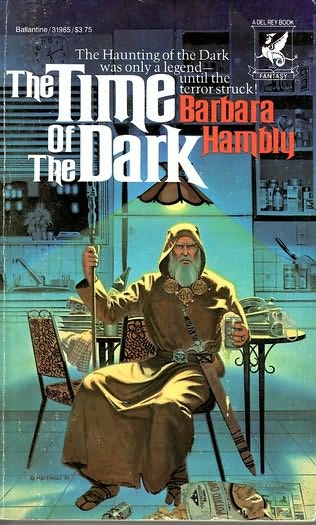
One day, many years ago, I was in a Borders bookstore, and I saw this book with a very peculiar cover. It showed a classic fantasy wizard – hat, long white hair and flowing beard, staff, robes, the works – sitting in a 1970s-80s efficiency kitchen like in apartments I’d lived in (formica counters and cheap chairs and all), holding a can of Budweiser.
I picked the book off the shelf, slightly annoyed, saying to myself, “There is no way this cover actually represents what’s in the book.” Given the common history of book covers, I had some basis for that belief.
But I was wrong.
The book was The Time of the Dark, first book in Barbara Hambly’s Darwath Trilogy (since expanded); the other two books are The Walls of Air and The Armies of Daylight, and this was my introduction to Barbara Hambly’s work.
The book opens with nightmarish imagery of a fantastic city under siege by… something horrible, and then gives us mundane slices of life in a world very like our own. These two worlds are of course on a collision course, and that collision is engineered by Ingold Inglorion, one of the greatest wizards (and also greatest swordsmen) of the land of Darwath. Ingold comes to our world as a temporary refuge, where he meets Gil Patterson – a graduate student who has had the dreams of Ingold’s world – and Rudy Solis, a young man who has never quite fit in. It is in Gil’s apartment that Ingold precisely fulfills the description on the cover.
Ingold’s purpose is to save the last prince of the country of Renwath, a baby named Tir, by keeping him safe in our world away from the terrible things that seek him – the things called the Dark. The Dark are never clearly described, but are semi-amorphous creatures of blackness and cutting tentacles and tails that have always sounded, to me, like a floating manta ray with a tentacled mouth. They are described with a horror-novel, eldritch atmosphere that makes them extremely Lovecraftian. The Dark are very tough, can dissolve into shadow and return apparently at will, and can not only strip flesh from bodies but can destroy minds, leaving bodies intact but mindless. Their only true weakness appears to be light and fire; even a strong moonlight will tend to keep them away.
But the Dark manage to find their way through the Void that separates worlds and the ensuing battle leaves Ingold little choice but to cross back to his home – bringing Gil and Rudy with him.
So begins an epic quest to save a kingdom, perhaps a world, from the rising threat of the Dark – whose powers can also dampen those of even powerful wizards – and, at the same time, personal quests of Gil and Rudy to discover what place, if any, they have in this world of swords, magic, treachery, and monsters.
Hambly plays deftly with expectations and tropes, sometimes using them straight, sometimes turning them slightly, sometimes tipping them completely over. She’s not above a bit of bait-and-switch plotting; for instance, the dreams that Gil has would at first seem to imply that she is, or could be, a wizard like Ingold, but instead it turns out that it is Rudy who is the untrained wizard, and Gil (short for Gillian) Patterson becomes a fearsome warrior, tremendously talented and quickly learning the trade of a soldier. Similarly, while some tropes might lead the reader to expect Gil and Rudy to become a pair, Gil actually turns out to be attracted to Ingold, while Rudy falls in love with the widowed Queen.
The Dark are a truly terrifying threat; they rise from deep places within the earth and fly to nearly anywhere at night. They are also more than strong and smart enough to break through ordinary defenses, leaving the only choice for safety the ancient “Keeps” – extraordinary gargantuan fortresses which turn out to be relics of a far more advanced ancient civilization.
Hambly has some quirks which are perfectly reasonable writing devices but that she re-uses in multiple books. In particular, she has as a nearly constant theme the existence of a “Church” of some sort which is diametrically opposed to the wizards. As this was my first encounter with Hambly’s work, I didn’t mind it in this trilogy, but after reading several of her other works such as the Darkmage dualogy and the Starhawk and Sun Wolf novels, I think her treatment of the “Church” in this trilogy is significantly less nuanced, and thus weaker, than in later novels. The later ones seem to make something more of an effort to justify or explain the Church’s stance, while in the Darwath trilogy the Church is mostly there as a pain in the ass for Our Heroes to overcome in some manner while addressing the more important issues of how to keep all of humanity from being appetizers or slaves of the Dark.
I won’t go into great detail as to the actual events in the trilogy; this is a very good, very complex plotline that Hambly deftly guides to a startling climax. I will say that the actual resolution of the major conflict surprised the living hell out of me when I read it, and I considered it, upon reflection, to be one of the most brilliant underminings of classic expectations I’ve ever seen – mainly because it worked for me, even though it was undermining expectations that I would normally want to see fulfilled.
Atmospheric, complex, and powerful: if you want to see what a great debut by a great writer looks like, look no farther than the Darwath Trilogy.

October 2, 2013
On My Shelves: One Piece
Wealth. Fame. Power.
The man who had achieved everything in life, like none before him, was the Pirate King, Gold Roger.
The few words he spoke at his execution drove people the world over to take to the seas:
“My treasure? If you want it, you can have it.
Seek it out! I left everything in my life at that place!”
The anime and manga One Piece, by Eiichiro Oda, is a shonen (boy’s) adventure series which follows the adventures of Monkey D. Luffy and his peculiar crew across one of the most bizarre worlds ever animated. This review is based primarily on the anime, and covers events up through about episode 195 (the end of the Skypiea/God Enel arc). The series is still continuing today, well past 600 episodes in length, so obviously this review is only covering about one-third of the currently existing episodes. Still, two hundred episodes is enough to talk about!
The background of One Piece starts out as a deceptively simple, not to say ridiculous, premise; the great pirate king, Gold Roger, is captured, but his treasure –including the legendary, never described “One Piece” – is not recovered, and on the execution block he says he left it all at “that place”.
“That place” is understood by most to mean at the end of the “Grand Line”, an array of islands in the most treacherous sea of that world (the other seas being called “blues” and designated by direction – East Blue, South Blue, etc.). This announcement triggers a huge surge of treasure hunters and bandits – collectively, of course, called pirates – to seek out the One Piece and the rest of Gold Roger’s treasure.
One Piece stretches my tolerance for comedy to the breaking point – and then, regularly and consistently, pulls off moments of awesome and drama that make up for all the jackassery in between. Like Dragonball and some other shows, One Piece has an art style that can jump between pure comedy and solid drama quite fluidly – or jarringly, on occasion. The overall conceit of the story – of a world where “pirates” are a major factor, often wielding (bizarre and even absolutely ludicrous) super-powers, and often apparently threats to major governments, all of them seeking after this mythical, perhaps mystical treasure, is patently ridiculous. Yet…
Eiichiro Oda’s work has a strangely dreamlike logic in it that makes it work. This is a world, not of rationality and seriousness like that of Fullmetal Alchemist, but one where dreams and myth and symbols rule supreme.
The central character of One Piece is Monkey D. Luffy. Luffy is in many ways the classic “Idiot Hero” – although he very often shows signs of being more “Obfuscating Stupidity” and is most certainly a textbook example of “Crouching Moron, Hidden Badass”. Luffy is a skinny, gangling looking young man who generally wears a red vest, a straw hat, shorts, and flip-flop sandals. He is one of the most unprepossessing main characters one might expect to encounter, and his demeanor does nothing to dissuade any first meeting him from this impression. He is a wide-eyed innocent with no guile (and rarely any understanding of others’ deviousness) and an absolute confidence in his destiny, which he will announce to anyone he meets: “I will be the Pirate King!”
This confidence, as opponents often discover to their dismay, turns out to have some considerable basis. Luffy is one of those blessed with unusual powers due to the consumption of the “Devil Fruit”. Devil Fruit confers on the eater an apparently random power, with one limitation: immersion in seawater renders the Devil Fruit eater not merely powerless, but paralyzed, and they will sink to the bottom of the ocean and die if not rescued. For someone venturing on the sea, this is a not at all insignificant weakness; there are also objects and materials that can echo/concentrate this power of the sea, so that nets and other objects can be made which, in effect, play a similar role to that of Kryptonite versus DC’s Superman. These Devil Fruit powers also are, apparently, exclusive; that is, only one person may have a given special power.
Luffy has eaten the “Gum-Gum” fruit – and become, as he often states, a rubberman. He has the ability to stretch and deform like rubber, rather like well-known superheroes Mr. Fantastic, Elastic Man, and Elastigirl from The Incredibles. Belying his idiot act, Luffy is extremely inventive and innovative with these abilities when he has to be, although his preferred approaches are “hit it harder”. His powers make him almost utterly immune to blunt force impacts of any magnitude and it is shown that he also has the insulating properties of rubber.
While this is indeed a formidable power (as any who have read comic books with similar heroes can attest), it is certainly not adequate for all situations, and in fact is at best only co-equal to Luffy’s true power: convincing the right people to follow him. Luffy’s recruitment approach is basically the same: decide that he needs a particular type of person on the crew, look for a person that could perform that job, and then recruit them – whether they want to join at first or not. Astonishingly, this ends up working. Luffy’s innocent, straightforward approach, unflinching honesty, and loyalty win over nearly everyone in the end.
The latter characteristic is one of the key things that differentiates him from one of his obvious inspirations, Dragonball’s Son Goku. Much as I love Goku’s adventures, Son Goku was clearly more of an adventurer interested in the contest; aside from one or two incidents, his greatest driving force was mostly testing his abilities, not defending others per se (although he would certainly do that, and didn’t like seeing weak people beaten up.
Monkey D. Luffy is all about proper treatment of people. His “nakama”, his crew, is of course first and foremost, but he will notice mistreatment of others, especially those weaker than other people around them, and he will not tolerate it. He will risk his own life for people he has barely met. It is this characteristic, more than any other, which wins formerly reluctant people to his side – that and his unswerving loyalty. If he has decided you are one of his nakama, then he believes in you – he will not tolerate or entertain for a moment the possibility that you have truly betrayed him, nor will he give up on you. The moment that he demonstrates this to Nami – who had given every reason for him to believe her a traitor, and then begged him for help – is one of the Crowning Moments of Heartwarming combined with Awesome in the entire series (thus far, anyway!).
The other members of his crew (called the Straw Hat Pirates, because Luffy always wears a wide-brimmed straw hat which has personal significance to him) are equally odd, yet also detailed. One thing Oda does with great care is to work out the backgrounds and motivations of all his characters, heroes and villains alike, so that they are not mere archetypes or jokes, but people – albeit often extremely strange people. He hasn’t quite gone Kishimoto’s (Naruto) route of knowing every charater’s ancestry back for three generations in detail, but he’s devoted a great deal of effort to the characters as well as the bizarrely detailed world of One Piece.
Rorona Zoro is the swordsman of the Straw Hats. A green-haired, very strongly built man, Zoro wields three blades simultaneously in a unique style he designed himself; one in each hand, and one in his mouth. (Don’t try to make sense of this. That way lies madness). Zoro’s major driving force is to become the greatest swordsman in the world, but not – as with so many similar heroes – purely as a matter of personal pride. It was also an oath he swore to a young lady who was his rival and friend when they were young, and when she died in a terrible accident, he swore that he would complete their oath. Fantastically skilled with the sword, up to and including mystical-level combat techniques, Zoro is otherwise… not terribly bright, and has perhaps the worst sense of direction since Ryouga Hibiki (Ranma 1/2). He will often talk like a cynic, pretend to be uncaring, but he, like Luffy, will not abide bullies and will intervene whenever he sees such things.
Nami is the ship’s navigator, a very pretty pink-haired girl of slender build. Money appears to be her primary motivator – originally for a specific purpose, but time has shown that it’s a major interest for her in person. However, her true interest is in maps, and her goal is to be the first person to draw an accurate map of the entire world, including the never-mapped, chaotic seas of the Grand Line. Nami is physically one of the least capable of the Straw Hats, but does not lack for bravery. She is skilled, though not tremendously strong, and is one of the smartest people in the crew; she often sees the solutions to complex problems and can think very fast on her feet, even in combat. She is also the sometimes frustrated “den mother” of the crew, who tries to keep her eye on the actual goal while others – led by Luffy – get distracted by almost every possible event.
Usopp is the mechanic and master of ranged weapons aboard the Straw Hat’s ship, the Going Merry; he is dark complexioned, with tightly curly hair and a comedically long nose. He is also an inveterate coward and liar, who has the paradoxical goal of becoming one of the greatest warriors of the sea. Backed to the wall, however, Usopp can become desperately inventive and dangerous, much more so than his comical appearance, voice, or foolish boasts would lead one to believe. Usopp’s overall traits make him appear to be a clear reference/riff on the classic tale of Pinocchio – the long nose, the lies, and the desire to be something that he patently is not. Over the course of the episodes we have seen, Usopp has slowly grown in bravery and willingness to act; he is still very, very far from being a hero as he’d like to be, but he has grown and changed. He is also a master gadgeteer, and has provided Nami with a multi-part, multi-powered staff that she has used to surprising effect.
The ship’s cook is Sanji, a tall, slender, blonde young man who is indeed a master chef. Sanji is also a master of a kick-based fighting style which is roughly equal with Zoro’s swordsmanship; the two have often had semi-friendly competitions to see which could, for example, hunt down the most meat animals in a given period of time, using nothing but their fighting skills. Sanji, befitting the others in the crew, has his own goal – to become a master of the cuisines of all seas, and particularly to reach the rumored All Blue, a sea where all the Directional Blue seas meet and thus the fish of all seas can be found. He is particularly fond of, and vulnerable to, beautiful women, becoming infatuated with them at a glance. He is, however, always a gentleman (not a Kame-Senin-like ecchi) and will play the knight in shining armor at every opportunity.
Chopper is the ship’s medic, a master doctor… who happens to be a reindeer (and whose origin story is clearly drawn from none other than Rudolph). Raised by a human doctor after being driven from his tribe, Chopper became a great physician and has decided that his ultimate goal is to become the greatest doctor the world has ever seen, perhaps even to defeat death itself. Chopper has also eaten one of the Devil’s Fruit, this one giving him … the powers of a human. Yes, he can change into a manlike shape. He has combined this with his knowledge of alchemical medicine to create a “Rumble Ball”, a magical pill that allows him to supercharge his human shapechanging and assume multiple powerful forms (a super-fast form, super-strong, etc.). Chopper is not inherently a fighter and often seems as cowardly as Usopp, but is not given to bragging; indeed, he usually underestimates himself drastically.
The most recent addition to the crew is Nico Robin, a beautiful dark-haired woman who is an archaeologist, seeking the true history of the world – a history lost, perhaps covered up, centuries ago, and now only written on mysterious monoliths called Poneglyphs. Robin is also a Devil Fruit eater, with the bizarre power to cause duplicates of her arms to materialize on any object or surface she can see. This is actually a very frightening power, because it means you cannot escape her grasp, and she is quite strong and combat skilled to begin with; she was one of the Straw Hats’ powerful enemies at first during the Alabasta/Crocodile arc.
These peculiar allies sail through a world which at first seems to consist of powerful pirate renegades and a distant military, usually represented by “Marines”, which hasn’t got the power to control such people. But as time goes on, we discover that the world is much deeper and more complex – often in sinister ways – than it appears at first. The Marines begin to show up with members quite capable of throwing down with the Straw Hats or other pirates, and we see glimpses of machinates of the overall world government – including their agents – which lets us know that there are many other events happening that the Straw Hats, in their simplistic cruise across the seas, haven’t an inkling of, and which may well end up changing everything they think they know.
The show is filled with spectacular scenery, dramatic and comedic characters, and sometimes jawdroppingly awesome combats. Despite the peculiarity of the world and people, the heroism and dedication of the Straw Hat gang draws you onward to see what they will face next, and has you cheering for them. While some of their adversaries are as black-hearted villains as you could ever wish to see punched in the face (Crocodile, the man of sand, and self-proclaimed God Enel, living incarnation of lightning), many of them turn out to be more complex than they at first appeared, and sometimes can be turned from enemy to neutral, or even to friend.
I have noticed that there seems to be a trend – thus far – to avoid actual deaths. At least, of all named characters I can recall onscreen, I’m unsure I’ve seen one actually die. Some appear to die, but then we get a glimpse of something indicating that they were just mostly dead. This may fit with the dreamlike nature of the world of One Piece; death is more a guideline than a rule, so to speak.
I have, thus far, been very much enjoying One Piece – despite its sometimes wincing comedy and strange universe – and if you like offbeat adventure with some humor and awesome combat, this may just be for you!

September 30, 2013
On My Shelves: The Stainless Steel Rat
“James Bolivar DiGriz, I arrest you on the charge –”
I was waiting for the word charge; I thought it made a nice touch that way. As he said it I pressed the button that set off the charge of black powder in the ceiling, the crossbeam buckled and the three-ton safe dropped through right on the top of the cop’s head. He squashed very nicely, thank you. The cloud of plaster dust settled and all I could see of him was one hand, slightly crumpled.
It twitched a bit and the index finger pointed at me accusingly. His voice was a little muffled by the safe and sounded a bit annoyed. In fact he repeated himself a bit.
–Harry Harrison, “The Stainless Steel Rat”
Many are the stalwart and noble heroes of fiction, clean-cut, upright, honorable. You can depend on them to do what’s right, to help the helpless, to oppose the evil, to leave the world a better place, and never demand a reward for all of this.
And then there’s James Bolivar DiGriz, AKA The Stainless Steel Rat.
The creation of science fiction great Harry Harrison, DiGriz is a classic Crook with a Heart of Gold. Able to crack any lock, master of unarmed and armed combat, fast-talker and a devious plotter second to none, DiGriz is something like James Bond seen in a darker, sardonic mirror, down to his womanizing ways (although his later marriage reduces this tendency). Early in his first story (“The Stainless Steel Rat”) he is finally captured – after a long interstellar crime spree – by the Special Corps, who offer him a classic choice: join them and help catch the criminals that are much worse than he is, be mentally “adjusted”, or go to jail for a long, long time.
While DiGriz is, in many ways, antisocial, he is truly a good man somewhere in his heart, and he really doesn’t have to think too long to make that choice. DiGriz does not permanently injure people, and does not kill unless he has absolutely no choice; in fact, when we first meet him, he has never actually killed anyone (the “cop” in the quoted section above is a police robot), and as far as I can recall through the series his body count never rises out of the single digits. Given that he’s a master crook trying, usually, to stop psychopaths or worse, that’s pretty impressive.
I first encountered James DiGriz in The Adventures of the Stainless Steel Rat, an omnibus collection of his first three adventures (“The Stainless Steel Rat“, “The Stainless Steel Rat’s Revenge” and “The Stainless Steel Rat Saves the World“). This shows off Harrison’s strengths to best advantage, allowing us to follow Jim’s career through a considerable story arc. DiGriz begins as a loner, is sucked into the world of espionage, tries to leave, and finally realizes that he really is needed for these jobs – although he will still register his independence in various ways.
In many ways, the Rat’s adventures in this book remind me of a Joss Whedon series; the heroes are quick with quips in danger, competent, smart, and dramatic in almost every way. Also in the fact that the single most dangerous person in the entire series is not, in fact, Jim DiGriz, nor his boss in the Special Corps; that honor belongs to his delicate, harmless-looking wife Angelina – once the most dangerous criminal Jim ever encountered, and still far more willing, and able, to kill than he ever was or will be.
Jim’s adventures are clever in numerous ways. Harrison has a gift for figuring out entertaining problems to present to our hero, or tense situations to put him into, and then let him work his way out of them in style. Some of these are very memorable; the Gray Men are particularly chilling adversaries, and have a method of torture and brainwashing that may well be one of the most convincing I have ever read about in terms of believing that it would detach the sufferer from a clear grasp of reality.
Some years later, Harrison returned to DiGriz’ world, releasing other books such as The Stainless Steel Rat Saves the World, The Stainless Steel Rat for President, and A Stainless Steel Rat is Born. They were not terrible additions to the canon, but I honestly felt that all of them did not clear the bar set by their initial predecessors; in fact, their quality declined linearly in order of publication, pretty much. That is, The Stainless Steel Rat Saves the World, being the first of the new Rat novels, was the best of the follow-ons, with the others of steadily decreasing quality.
Part of the decrease was a “Flanderization” of the Rat – his characteristics became exaggerated to the point that he seemed to me to be approaching self-caricature – and Harrison’s writing quirks began to dominate the story, rather than merely accent it. There was also something of a power inflation, though not a regular one, and at times it felt like Harrison was stretching himself thin – trying to write a James DiGriz story when he didn’t really have a good James DiGriz idea.
The first three stories, however, remain some of my favorite SF works, and are still very much worth reading. If you want an adventure with a roguish thief who’s still (mostly) on the side of the angels, give the Rat a try!

September 26, 2013
A PUBLIC APOLOGY to Steve Davidson of Amazing Stories
Recently, on my LJ and Facebook, I posted a question on what is and is not appropriate to do in preparing to publish a new magazine; the scenario I presented was universally viewed as improper at best. This scenario was sparked by a discussion of a solicitation for an “unpaid” editor position for Amazing Stories.
However, Mr. Davidson has — with patience and politeness — contacted me directly, and addressed my real concern: specifically, he has stated unambiguously and firmly that *all* participants — bloggers and editors and all — *WILL* be compensated for their *prior* efforts when the project goes live and begins to bring in money.
This is a very different scenario, and one I find perfectly acceptable; in this one, the people aren’t posting “for free” but are instead making a bet; that the project will succeed, and then their efforts will be compensated, rather than their efforts simply leading to the success of the project but not their own.
I therefore apologize most sincerely to Mr. Davidson and any and all connected with the revival of Amazing Stories, and I wish him great success in his attempt to bring ASM back to life. What he has told me of his business plan makes sense, and shows some considerable recognition of the realities of the current market which has been sadly lacking in prior attempts to make new SF magazines.
Thank you for your clarifications, Mr. Davidson, and once again, my apologies.
Ryk E. Spoor

September 25, 2013
Under the Influence: The Incompleat Enchanter
Fletcher Pratt and L.Sprague deCamp were well-known authors of science fiction and fantasy in the Golden Age. Separately they both produced well-respected works for many years. But together they created something truly amazing: the world of the Mathematics of Magic, featuring Harold Shea and Reed Chalmers – two masters of mathematical logic who theorize that mathematics and logic and perception dominate reality, and thus if one can encode the logic of a particular world into one’s calculations, one could in theory travel to the world so described.
Harold decides that theory is all well and good, but it means nothing if it’s not tested. So he carefully follows the guidelines he and Reed have determined, and focuses on the postulates and mathematical guidelines…
… to find himself suddenly in the land of Norse mythology.
From that beginning, Fletcher Pratt and L. Sprague deCamp take Harold and, eventually, Reed, on a wild ride through the cosmos of fiction and myth that ranges from the coming of Ragnarok to Irish myth, Coleridge’s Kubla Khan, and The Castle of Otranto and beyond.
This story was one of the first truly multiversal stories I ever read, and I found endlessly fascinating because of two concepts that resonated very strongly with me: first, the existence of unlimited numbers of universes, some derived from (or perhaps inspiring!) our own fiction, and second, the existence of logical, rational, scientific rules that could, and indeed must, govern even apparently magical interactions.
The latter was and is very important to me. A common comment made to people who find some aspect of a fantasy hard to swallow is “It’s magic, man. Stop thinking so hard,” or something to that effect. But to me, if the world depicted is in any way like our own – and is apparently containing human beings who are like our own – magic that is in any way usable implies that there are, in fact, reliable and knowable rules in its operation. Violating that by simply waving hands and saying “it’s magic!” is a cheap violation of the reader’s trust; it means that you can pretty much do anything and there’s no actual tension that the reader can rely on to drive the story’s action.
Another aspect of the stories which was and is terribly important to me wasthe important reminder to both reader and characters to watch out for your unexamined assumptions about the world. This bites Harold Shea on his rear end more than once early on, when he forgets that the basic principle of operation was to transfer him to a world whose natural laws are not the same as his own; he therefore takes a stainless-steel blade and a handgun with him to the world of Norse myth, figuring they’ll be surprised by such things. He then discovers that the blade rusts and the gun doesn’t work, because the underlying rules and logic of that world don’t encompass firearms or our world’s steel alloys. It then takes him a bit to realize that, correspondingly, this means that he can actually do magic – real, functional magic – because that’s the essence of the logic and world-transforms he’s enacted.
Narratively, this is a very useful concept. You can show your hero as someone who thinks things out, plans carefully, and still screws up because he/she is immersed in various associations and beliefs that don’t accord with the situation in which they finds themselves. This is part of the essence of Digital Knight (soon to be re-released as Paradigms Lost) – Jason Wood carefully figures out various explanations and approaches for various things, to discover that sometimes they don’t work because his assumptions are wrong. He has to change his assumptions and approach because the world is not what he thought it was; as Big Trouble‘s Jack Burton would put it, “I’m a reasonable man, but I’ve just experienced some very unreasonable things.”
Pratt and deCamp played with their concepts in numerous ways. Another striking one was recognizing effects, within that universe, of writing something that was heavily inspired by another source. In his second adventure, Harold Shea falls in love with and finally marries Belphebe (warrior maiden from The Faerie Queene by Spenser). When the group travels to the world of The Castle of Otranto, Belphebe disappears, to be discovered again as “Belphegor”, a very similar character but with no memory of Harold; as Otranto was inspired and informed heavily by The Faerie Queene (according to Reed Chalmers; I have no idea if that is true in real life), Belphebe had therefore been forced into a similar role in the world of Otranto, but without the backstory of having met Shea, who was of course an outside element. Shea’s attempts to restore her memory are a central part of The Castle of Iron, the story taking place in the Otranto universe.
By modern standards there are shortcomings of the stories – Belphebe, though reasonably strong and capable in her own context, is nonetheless a secondary character in most of her scenes, for instance – but they were very well-written and engaging stories that captured my imagination strongly and helped solidify the multiple-world concept in my mind (along with The Chronicles of Amber and some other works, such as Robert Heinlein’s interesting though flawed The Number of the Beast).
If multi-world adventures are your cup of tea, grab your adventuring gear and hop aboard the “Syllogismobile” with Harold Shea!

September 20, 2013
On My Shelves: Big Trouble in Little China
“You know what Jack Burton always says?”
“Who?”
“Me. Jack Burton. Jack Burton always says… ahh, what the hell.”
Kurt Russell’s played many roles throughout the years – from the Computer in Tennis Shoes to Snake Plissken to Colonel O’Neill in the original Stargate. But in many ways my favorite is his two-fisted everyman trucker, Jack Burton, who gets into a pulp-fiction adventure way over his head… all because he wins a bet and agrees to do a favor for a friend on the way to collect.
Big Trouble in Little China is a wonderful send-up and homage to the great pulp adventures of early 20th century, with some modern sensibilities thrown in just to mix things up a bit. It has the overly-dramatic speeches, the poses, the pulp-fiction piling of cliffhanger upon cliffhanger. It takes the old Yellow Peril imagery and works it for all its worth, giving us the immortal villain Lo Pan (played with scenery-chewing relish by the magnificent James Hong), working ancient Chinese sorcery in a hidden enclave under the streets of San Francisco – and also doing business as the crippled businessman David Lo Pan. If he can undo a curse placed upon him centuries ago, he will be able to use his immense sorcerous powers to “rule the universe from beyond the grave!”. And now the very thing he needs to break the curse has appeared: a girl with pure green eyes…
Against him is a quirky band of would-be heroes – Burton, who really just wants to collect his money and, after his first run in with Lo Pan and his gang, to get his truck back, Gracie Law (Kim Catrall), the stereotype Girl Reporter Out for the Scoop, Wang Chi (Dennis Dun) who’s trying to rescue his fiancee from Lo Pan’s sinister schemes, and tour-bus driver and part-time wizard Egg Shen (Victor Wong), who has a sacred mission to stop Lo Pan.
This is a movie that succeeds, to a great extent, for the same reason that Galaxy Quest did: it manages to provide comedy without condescension, and takes itself seriously within its universe, even as that universe appears ridiculous to us from the outside. The seriousness is set from the beginning, with Egg Shen being interviewed by a lawyer; Shen vehemently tells him to leave Burton alone, for the services he’s done, and when the lawyer expresses severe doubts about the reality of what Shen’s talking about… Egg Shen produces lightning between his hands. “That? That was nothing. But that’s how it always begins. Very small….”
It also draws upon the tropes of every adventure movie ever made, and then turns them upside down. Perhaps the most obvious of these is Jack Burton himself. While Burton is not completely incompetent, he is clearly utterly out of his depth in this cosmic war,with his major asset being dogged determination and master-level wisecrackery. He thinks he’s the real hero of the story, but an outside observer might think that he’s really just the sidekick to Wang Chi, who is more serious, more competent, more focused, and more aware of things than Jack; the one battle in the warehouse emphasizes this, when Jack loses his weapon early on, and by the time he manages to recover it and make it ready, Wang’s taken down the entirety of a roomful of thugs by himself.
At the same time, he isn’t actually an idiot hero, and shows some ability to pull off quick cons and disguises… and in the end, does defeat Lo Pan, though not exactly the way he intended.
The dialogue of the characters is a huge part of the humor; they deliver the breathlessly infodumpy, purple-prose narratives straight out of the worst penny-dreadfuls with straight faces and convincing emotion, in the midst of the most ludicrous situations; I particularly loved Gracie’s introduction, with her doing an As You Know Jack speech that tells us all about her, and the Mysterious David Lo Pan, and all the danger they’ll be getting in, with occasional asides. Wang lets us know what kind of dialogue we’re in for earlier, with his overly-long speeches to Jack while they’re on their way to the airport to pick up his fiancee.
Big Trouble in Little China was also many people’s first introduction to wire-fu and some of the tropes of Chinese magic/Hong Kong Action flicks, with the grand finale involving in-air swordfights, symbolic magical duels, and the occasional machine gun. A serious introduction to a wider audience wouldn’t happen until Crouching Tiger, Hidden Dragon burst onto the scene. It inspired me enough so that in the original version of “Photo Finish” (the werewolf section of Digital Knight) there was a scene, now deleted, in which Jason Wood encounters a trucker named Jack Burton in… unusual circumstances.
This is one of the relatively few movies to get me to both laugh and cheer even the third or fourth time I’ve seen it. It’s completely un-self-conscious fun. If you’ve never seen it, you really should!

September 18, 2013
On My Shelves: My Neighbor Totoro
In any discussion of anime, there are very few names that are spoken with almost unqualified awe and pleasure. There is Osamu Tezuka, “Anime no Kami”, the founder of the industry in many ways. One could make a case for Leiji Matsumoto, creator of Space Battleship Yamato (Star Blazers), Galaxy Express 999, and Space Pirate Harlock.
And there is Hayao Miyazaki, sometimes called the “Japanese Disney”, creator of some of the most wonderful, magical films ever made (which I will review later), including Laputa: Castle in the Sky, Kiki’s Delivery Service, The Castle of Cagliostro…
… and My Neighbor Totoro.
Totoro is my choice for the most pure family sense-of-wonder film ever made. It is at once a close, quiet family film and a magical series of adventures that takes an ordinary village and makes it a mystical realm.
The Kusakabe family – Tatsuo and his two daughters Satsuki and Mei – move to a house in the country to be near their mother (recovering in a nearby hospital; based on time period and symptoms, I have always suspected tuberculosis, but it could be any long-term, slow-recovery illness that leaves no obvious visible effects). Even on their first day, they encounter what appear to be mysterious little spirits – dust or soot sprites that inhabit old houses. But the dust sprites leave once it’s clear they’ve settled in, and life appears to be turning to a quiet stay in a country house, far from the city.
But then Mei, wandering in the back yard, sees something moving through the grass… something that isn’t like any animal she has ever seen…
My Neighbor Totoro is a modern rarity, a film without direct conflict at its core. Emotional development and wonder are the heart of this film. No one is ever in physical danger (though it is thought, for a short time, that Mei is), and the mysterious supernatural happenings that Satsuki and Mei encounter, while sometimes somewhat “creepy”, are harmless and, in fact, often helpful and inspiring.
Totoro himself, that gigantic, fluffy nature-spirit, is never seen by the adults, but sufficient evidence exists to show that this is not a matter of pretend, but a real, magical being who has decided to watch over the children whose mother is ill and who have come into his domain. It is unclear how much he continues to interact with them after the events of the movie, but it appears that his presence continues for at least some time.
While there is no direct physical conflict or enemies, the movie avoids saccharine sweetness (at least for me) through realistic emotional reactions. Now that I have had children of my own, I’m even more impressed by Miyazaki’s work on Totoro. Satsuki and Mei are believable children. They act as girls of their age should; Satsuki’s attempts to be an adult, with emotional swings tied to her mother’s condition (which sometimes worsens without warning), is all too familiar, and Mei’s stubbornness and sudden decisions to do things that are beyond her ability, but not beyond her comprehension, is very, very much what little girls of her age do; I look at Domenica and see someone very much like Mei.
The climax of the movie – with Mei lost and Satsuki desperately searching, to finally go to the one last hope she has – Totoro – is a heart-wrenching, yet wonderfully touching sequence, with Satsuki blaming herself (she had shouted something rather hurtful at Mei while worried about her mother) and determined to find her sister at any cost, running until her feet are bleeding and she stumbles, exhausted, into Totoro’s lair… and Totoro, awakened, understanding what is needed and letting loose with an earthshaking, awesome call that can send chills down my spine.
The detail in My Neighbor Totoro is – as one expects from a Miyazaki film – incredible. This is a film that is as visually beautiful as it is perfectly scripted, with a beautiful, enchanting soundscore that complements every aspect of the movie.
I don’t give many works of anything perfect scores… but My Neighbor Totoro is one of them.