
Christopher Hinz's Blog, page 4
December 6, 2017
Autograph session
I'll be autographing my books and comics this Saturday, Dec. 9, at the Antietam Valley Farmers' and Artists' Market, from 9 a.m. to noon. It's indoors at Parkview Ave. and Byram St. in Carsonia, ten minutes from downtown Reading, PA.
Feel free to stop by and say hello; no need to make a purchase. Other authors will be signing too and the market offers a variety of scrumptious food.
https://www.facebook.com/antietamvalleyfarmersmarket/ (scroll down for profiles on authors attending)
Feel free to stop by and say hello; no need to make a purchase. Other authors will be signing too and the market offers a variety of scrumptious food.
https://www.facebook.com/antietamvalleyfarmersmarket/ (scroll down for profiles on authors attending)


October 11, 2017
"Liege-Killer" on sale today!
My first novel is available now (Wednesday, Oct. 11, 2017) for the bargain price of $1.99. The ebook can be downloaded from all major online retailers, including Amazon, Apple, Barnes & Noble, Google and Kobo.

August 13, 2017
I'd rather be telling stories...
Here’s a revelation sure to unsettle those responsible for selling and promoting an author’s books. I don’t care for an essential aspect of the contemporary publishing business: the author as chief promoter, cook and bottle washer.
Yes, I know, it’s considered indispensable in this Amazonian, take-no-prisoners, con-encrusted slab of modern times that the author grab the rudder and hustle his or her latest book with the tenacity of that great white shark from Jaws hunting its next meal. Those who fail to adopt such aggressive tactics are considered by publishers, agents, fans and other movers-and-shakers to be hopelessly out of touch, or worse, actively courting authorial extinction.
They have a point. There are millions of new titles and reprints published each year. Some statisticians put the total number of books in the world at well over a hundred million. Common sense dictates that a way must be found for an author to stand out from the crowd.
I do a certain amount of promotion, of course—this website is one obvious example. Nevertheless, my idea of standing out from the crowd is decidedly old school. If your passion happens to be track and field, run faster. If you want to succeed at your job and maybe ascend to a higher position, work harder. And if you’re an author trying to sell copies, write better books (while acknowledging that better is one of the most subjective words in the language).
Subjective or not, I concentrate the bulk of my energies on storytelling. I try to give readers memorable tales, the kind that sends thematic shrapnel coursing through their synaptic byways long after the last page is reached.
Speaking of pages, it’s time to get back to working on that new novel.
Yes, I know, it’s considered indispensable in this Amazonian, take-no-prisoners, con-encrusted slab of modern times that the author grab the rudder and hustle his or her latest book with the tenacity of that great white shark from Jaws hunting its next meal. Those who fail to adopt such aggressive tactics are considered by publishers, agents, fans and other movers-and-shakers to be hopelessly out of touch, or worse, actively courting authorial extinction.
They have a point. There are millions of new titles and reprints published each year. Some statisticians put the total number of books in the world at well over a hundred million. Common sense dictates that a way must be found for an author to stand out from the crowd.
I do a certain amount of promotion, of course—this website is one obvious example. Nevertheless, my idea of standing out from the crowd is decidedly old school. If your passion happens to be track and field, run faster. If you want to succeed at your job and maybe ascend to a higher position, work harder. And if you’re an author trying to sell copies, write better books (while acknowledging that better is one of the most subjective words in the language).
Subjective or not, I concentrate the bulk of my energies on storytelling. I try to give readers memorable tales, the kind that sends thematic shrapnel coursing through their synaptic byways long after the last page is reached.
Speaking of pages, it’s time to get back to working on that new novel.
August 8, 2017
July 28, 2017
Upcoming ebook sale
In the wake of the successful one-day sale of "Liege-Killer" by ebook publisher Open Road Integrated Media, publisher Angry Robot Books will do a similar promotion for "Binary Storm" next month. Stay tuned for details.
And special thanks to Berks Book Junkies for having me as the guest at their latest meeting. Good conversation, good food and drink--a thoroughly enjoyable evening.
And special thanks to Berks Book Junkies for having me as the guest at their latest meeting. Good conversation, good food and drink--a thoroughly enjoyable evening.
July 18, 2017
"Liege-Killer" ebook for $1.99 (one day only)
BookBub, a daily ebook deals newsletter with millions of subscribers, will feature "Liege-Killer" this Saturday (7/22/17). That day only, the ebook will be available for $1.99 from all U.S. retailers.

July 6, 2017
DOING THE DARK POP APOCALYPTIC GENRE HOP
First, try uttering the title three times in rapid succession, preferably to the beat of clapping hands and stomping feet. Did you manage it? Great! Now you’re in the right frame of mind to experience this rant.
My latest novel, Binary Storm, is a science fiction thriller about the hunt for assassins existing simultaneously in two bodies. More to the point, it’s set against the backdrop of an impending apocalypse.
Now, stories depicting apocalyptic or bleak futures (dark pop) are nothing new in SF/Fantasy, whether in books, movies, comics, games or other media. Each new generation, but especially those born after the start of the nuclear age, at times feels the urge to whisper or shout that the world can’t go on like this and that doom is upon us and that all is lost because we didn’t…
A) Eliminate nukes
B) Respect our fragile environment
C) End prejudice and bigotry
D) Other
E) All of the above
But what seems to have changed in the dark pop canon in the last decade or so, besides the ascendance of zombies and other delegations of the brain-dead, is the increasing migration of such stories from SF/Fantasy into the Young Adult and Literary genres, and thus into wider public consciousness.
(Btw, Literary is and always has been a genre despite some of its advocates protesting otherwise. By definition, a genre is a category of artistic composition with distinctive form, content and style, and the big L fits that criteria. Literary happened to reach the top of the fiction pyramid ahead of the other genres, which enabled it to set the agenda, define the categories and guard its lofty summit with the ferocity of Smaug nesting on treasure.)
Okay, I’ve got that out of my system. Moving on…
Well-received dark pop novels of the Literary persuasion such as Cormac McCarthy’s “The Road” paint bleak futures for Earth and humanity. In the YA realm we have “The Hunger Games” by Suzanne Collins, “The Scorch Trials” by James Dashner and other series too numerous to mention. Bottom line, dark pop fiction is springing up faster than kudzu in the Carolinas. And the spread is likely to continue unchecked for the foreseeable future.
Why? The answers might come down to…
A) The collapse of civilization’s social pillars (i.e., old white guys no longer exclusively in charge)
B) Destruction of the environment
C) Increasing economic inequality
D) Other
E) All of the above
Yet here’s something interesting. According to Max Roser, an Oxford University economist, we’re living in the safest, healthiest and most peaceful era in recorded history. There are fewer wars and homicides. Poverty rates are dropping across the globe. Democracy is on the upswing.
When it comes to dark pop belief systems and enshrined cynicism, statistical analysis can be a real buzzkill. (Roser’s data: http://www.pri.org/stories/2014-10-23...)
If Roser and others are correct, why is there such an escalating need for dark pop? Could it be that such works serve a purpose distinct from rationality and logic, namely that we don’t feel safe and secure in today’s world and thus require fiction that reinforces those feelings?
I’m a Baby Boomer from before the information explosion, where three TV channels broadcast news segments only a few hours a day. Most citizens learned what was happening in the world largely through those broadcasts, as well as from newspapers and magazines. Yet despite living through the height of the Cold War, I believe the news media’s limited scope served to make my universe feel safer and more secure.
Today, information bombards us constantly via the Internet and 24/7 news channels, which I suspect is the primary reason for dark pop’s growth. On the positive side, the info explosion has somewhat democratized the media by removing it from the sole control of elite gatekeepers, enabling minorities and many other disenfranchised souls to have a voice.
On the negative side, that democratization too often has allowed heat to triumph over light, enabling emotions unbridled from reason—fear, anger, hate—to dominate. We seem to be constantly pummelled by the idea that we should all be mad as hell and not take it anymore, that the world is besieged by a terrible storm, that the fierce rains of Armageddon are pounding our windshields with such fury that even with the wipers on high speed, a crash is imminent.
And so we seek refuge from the hazy blur ahead, from a future we’ve been told is soaked in terror, by losing ourselves in universes that reflect or refract our fear and bewilderment. Fictionalized catastrophe becomes a safe space, a retreat from the relentless bombardment of pessimistic and upsetting emotions.
Yet those dark pop representations also can serve to refortify our psyches. Having already explored the worst possible futures, we’re better immunized against the turbulence, real or imagined, of the great unknown that lies ahead.
My latest novel, Binary Storm, is a science fiction thriller about the hunt for assassins existing simultaneously in two bodies. More to the point, it’s set against the backdrop of an impending apocalypse.
Now, stories depicting apocalyptic or bleak futures (dark pop) are nothing new in SF/Fantasy, whether in books, movies, comics, games or other media. Each new generation, but especially those born after the start of the nuclear age, at times feels the urge to whisper or shout that the world can’t go on like this and that doom is upon us and that all is lost because we didn’t…
A) Eliminate nukes
B) Respect our fragile environment
C) End prejudice and bigotry
D) Other
E) All of the above
But what seems to have changed in the dark pop canon in the last decade or so, besides the ascendance of zombies and other delegations of the brain-dead, is the increasing migration of such stories from SF/Fantasy into the Young Adult and Literary genres, and thus into wider public consciousness.
(Btw, Literary is and always has been a genre despite some of its advocates protesting otherwise. By definition, a genre is a category of artistic composition with distinctive form, content and style, and the big L fits that criteria. Literary happened to reach the top of the fiction pyramid ahead of the other genres, which enabled it to set the agenda, define the categories and guard its lofty summit with the ferocity of Smaug nesting on treasure.)
Okay, I’ve got that out of my system. Moving on…
Well-received dark pop novels of the Literary persuasion such as Cormac McCarthy’s “The Road” paint bleak futures for Earth and humanity. In the YA realm we have “The Hunger Games” by Suzanne Collins, “The Scorch Trials” by James Dashner and other series too numerous to mention. Bottom line, dark pop fiction is springing up faster than kudzu in the Carolinas. And the spread is likely to continue unchecked for the foreseeable future.
Why? The answers might come down to…
A) The collapse of civilization’s social pillars (i.e., old white guys no longer exclusively in charge)
B) Destruction of the environment
C) Increasing economic inequality
D) Other
E) All of the above
Yet here’s something interesting. According to Max Roser, an Oxford University economist, we’re living in the safest, healthiest and most peaceful era in recorded history. There are fewer wars and homicides. Poverty rates are dropping across the globe. Democracy is on the upswing.
When it comes to dark pop belief systems and enshrined cynicism, statistical analysis can be a real buzzkill. (Roser’s data: http://www.pri.org/stories/2014-10-23...)
If Roser and others are correct, why is there such an escalating need for dark pop? Could it be that such works serve a purpose distinct from rationality and logic, namely that we don’t feel safe and secure in today’s world and thus require fiction that reinforces those feelings?
I’m a Baby Boomer from before the information explosion, where three TV channels broadcast news segments only a few hours a day. Most citizens learned what was happening in the world largely through those broadcasts, as well as from newspapers and magazines. Yet despite living through the height of the Cold War, I believe the news media’s limited scope served to make my universe feel safer and more secure.
Today, information bombards us constantly via the Internet and 24/7 news channels, which I suspect is the primary reason for dark pop’s growth. On the positive side, the info explosion has somewhat democratized the media by removing it from the sole control of elite gatekeepers, enabling minorities and many other disenfranchised souls to have a voice.
On the negative side, that democratization too often has allowed heat to triumph over light, enabling emotions unbridled from reason—fear, anger, hate—to dominate. We seem to be constantly pummelled by the idea that we should all be mad as hell and not take it anymore, that the world is besieged by a terrible storm, that the fierce rains of Armageddon are pounding our windshields with such fury that even with the wipers on high speed, a crash is imminent.
And so we seek refuge from the hazy blur ahead, from a future we’ve been told is soaked in terror, by losing ourselves in universes that reflect or refract our fear and bewilderment. Fictionalized catastrophe becomes a safe space, a retreat from the relentless bombardment of pessimistic and upsetting emotions.
Yet those dark pop representations also can serve to refortify our psyches. Having already explored the worst possible futures, we’re better immunized against the turbulence, real or imagined, of the great unknown that lies ahead.
May 25, 2017
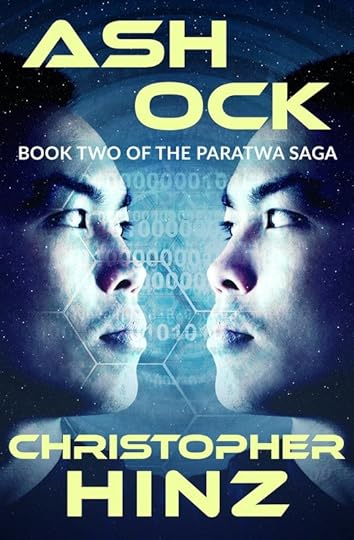
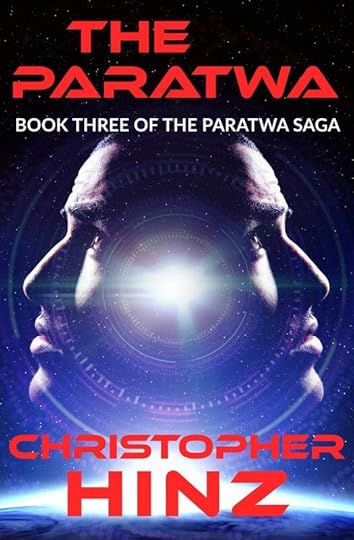
New "Paratwa Saga" covers
Some cool new covers for the Paratwa Saga ebooks by publisher Open Road Integrated Media. Available from Amazon and most major ebook providers.

March 17, 2017
March 17th, 2017
An increasing number of people are attempting to contact me on Facebook Messenger. Be advised that for various reasons, technical and otherwise, I'd prefer to avoid this service. Instead, please send any personal messages to the email address associated with this website, chinz@christopherhinz.com. I'll try to respond to each and every one as soon as possible. Thanks!


