Stuart Ross's Blog, page 10
May 29, 2016
A poem for the Little Criminals
For a very long time, maybe a couple of decades, I've belonged to a list-serv dedicated to the great singer-songwriter Randy Newman. This guy:
Randy Newman is one of my Top 5 favourite songwriters, along with Nick Lowe and Bob Dylan and Aimee Mann and David Ackles. (Sometimes Van Dyke Parks is on that list, sometimes Kristin Hersh, but Randy is always on the list.) We on the list-serv call ourselves the Little Criminals, named after the Newman album of the same name. Over the years, I've been fortunate enough to meet half a dozen or so Little Criminals, and what amazing people they are. There are many more I haven't met but who I consider friends.
On November 28, 2002, I wrote a poem called "Poem for Randy Newman's Birthday." It appears in my 2003 collection, Hey, Crumbling Balcony! Poems New & Selected (ECW Press). The same book also contains the poem "Sonnet (Storm & Cat)," a poem about Toluca, a cat that lived with a Little Criminal named Joan, down in California. The Little Criminals are all over the world. Some are poets, some are musicians, others are impresarios, airline employees, students, nurses. They have been great supports at difficult times. They are intelligent, funny, interesting people. I mean, they must be if they love Randy Newman, right? And they have made it possible for me to meet my hero a few times in Toronto and once in Rochester.
In my new book, A Sparrow Came Down Resplendent (Wolsak & Wynn), Randy makes a very significant appearance in a poem I wrote last year, "And Oscar Williams Walked In." It's about the time the poetry anthologist Oscar Williams, who probably edited just about every American poetry collection up until the early 1960s, visited me at my home on Pannahill, about a decade after his death. Oscar Williams is this guy:

Anyways, Oscar Williams came to visit. So I went to the park and I took some paper along, and that's where I made this poem, posted here as a gift to my dear friends the Little Criminals:
AND OSCAR WILLIAMS WALKS IN
I’m sitting in my bedroom listening to Linda Ronstadt’s Heart Like a Wheeland then Leo Sayer’s Just a Boyand after that Randy Newman’s Sail Awayfor which I read the lyrics on the record sleevewhile it plays, every word, even though I’ve listened to it about a hundred times beforeand my mother’s in the kitchen burning steaksand making mashed potatoes and she yells up,“Stuart! Your friend is here!” and Oscar Williams(as I later find out his name is) walks inwearing a bow tie and John Lennon glasses andsays, “I see you like reading,” and it’s not becauseI’m reading the lyrics to “Simon Smithand the Amazing Dancing Bear” at thatmoment but because—I follow his eyes—one wall of my room is covered in bookshelves.I find him pretty creepy even thoughI have lots of friends who are older than memostly because of this poetry workshopled by a guy named George MillerI go to every Saturday with Mark Labawhere everyone is older than us.“Have you ever read this?” asks OscarWilliams and he holds out a mouldy copy of Immortal Poems of the English Language.“I saw you have a mother down there. My motherwas named Chana Rappoport and my fatherwas named Mouzya Kaplan. I am Williamsin the same way you are Ross. Have you everread this?” Oscar Williams asks and he holdsout a dog-earred copy of The New Pocket Anthology of American Verse from ColonialDays to the Present. “They’re pretty good,you know, they have poems by people likeEzra Pound and Robert Frost and Edna St.Vincent Millay and William Carlos Williamsand Oscar Williams of course. Do you want to gohang out at the cigar store?” The album cover forSail Away has a big picture of Randy Newman’sface and I hold it up over my own face so itlooks like I am actually Randy Newman.“Pardon me,” says Oscar Williams, “I thoughtyou were Stuart Ross, teenage author of such immortal poems as ‘jesus tobacco’ and ‘Ritualof the Concrete Penguins.’ I died in 1964so I sometimes get confused.” And then he is gone.Like it was a dream. I go downstairs wheremy mother is opening a can of peas and say,“Why did you let that guy in, Mom?” and she says,“What guy? All that rock music you play is givingme a headache and you hallucinations. Go washyour hands, we’re having dinner soon.”It is 1974. In forty-two years I will include thispoem in a book called A Sparrow Came DownResplendent. Barry and Owen sit down at the table,and me and my mom and dad. We take turnstrying to pronounce Worchestershire.
Over and out.


May 27, 2016
An appreciation by Michael Dennis; a chat with Pearl Pirie; Cobourg newspaper stuff; and Aaron Tucker clubbers me in chess
As I wait for all the paperwork to be completed for the Nobel Prize, my new poetry collection, A Sparrow Came Down Resplendent, is beginning to get a bit of pre-Sweden attention.
My very good friend, the unstoppable Ottawa poet Michael Dennis, who has blogged — about a new book of poetry he's enjoyed — every two days for the past several years, has written an appreciation of Sparrow. He writes, among other things: "…Ross has added two new twists to his considerable canon. Access to his massive and generous heart and a concerted effort to tie into a more direct narrative." I hope Michael Dennis is Swedish.
And earlier this week, I had a great chat with intriguing Ottawa poet Pearl Pirie, who hosts CKCU FM's Literary Landscape. It aired last night, but it's available online.
Meanwhile, here in Cobourg, local newsrag Northumberland News ran some generous advance notice of my June 6 Cobourg launch, which will also feature Ashley-Elizabeth Best reading from her debut collection and a musical set by Rhonda Murdoch.
And finally, fine Toronto poet and better-chessplayer-than-me Aaron Tucker posted this on his Facebook wall this morning:
My very good friend, the unstoppable Ottawa poet Michael Dennis, who has blogged — about a new book of poetry he's enjoyed — every two days for the past several years, has written an appreciation of Sparrow. He writes, among other things: "…Ross has added two new twists to his considerable canon. Access to his massive and generous heart and a concerted effort to tie into a more direct narrative." I hope Michael Dennis is Swedish.
And earlier this week, I had a great chat with intriguing Ottawa poet Pearl Pirie, who hosts CKCU FM's Literary Landscape. It aired last night, but it's available online.
Meanwhile, here in Cobourg, local newsrag Northumberland News ran some generous advance notice of my June 6 Cobourg launch, which will also feature Ashley-Elizabeth Best reading from her debut collection and a musical set by Rhonda Murdoch.
And finally, fine Toronto poet and better-chessplayer-than-me Aaron Tucker posted this on his Facebook wall this morning:
I only read Stuart Ross's A Sparrow Came Down Resplendent because everyone else was and I really like it ironically. I did not sincerely enjoy how beautiful and personal the poems felt, and how the book works together, all its strange imagery, of flying, of childhood, of nature, in an emotionally moving ecosystem. I thought that was the product of an author really trying to sell out and write a popular book. I definitely did not enjoy how generous the book is, how its tendrils of references, to other poets and books, to other places and times, make for a density that pushes the reader to connect and reconnect each line to its partner, each poem to its proximity.Over and out.
A good start to what I'm sure will be a poetry-franchise, A Sparrow Still Came Down Resplendent, Keepin it Resplendent: The Sparrow Re-Returns, sequels that I'm sure will make Mr. Ross a lot of money.
May 19, 2016
Goodreads giveaway!
There are six copies of my new poetry book up for grabs in a current Goodreads Giveaway!
https://www.goodreads.com/giveaway/sh...
https://www.goodreads.com/giveaway/sh...
May 16, 2016
The growing outrage
The outrage is spreading.

Since I picketed my own book launch in Toronto last Thursday, in protest of the unabashedly mainstream nature of my new poetry book, A Sparrow Came Down Resplendent, many others have stepped forward to denounce me.


Yes, it has come to this.
Over and out.

Since I picketed my own book launch in Toronto last Thursday, in protest of the unabashedly mainstream nature of my new poetry book, A Sparrow Came Down Resplendent, many others have stepped forward to denounce me.





Yes, it has come to this.
Over and out.
May 14, 2016
The Sparrow takes flight

This past Thursday, I launched my new poetry book in Toronto. A Sparrow Came Down Resplendent was issued under Wolsak and Wynn's A Buckrider Book imprint, Paul Vermeersch's baby. It was a real nice event, at the Monarch Tavern, and I was so pleased with my launch company: first-time author Kilby Smith-McGregor with her excellent collection Kids in Triage, and Susan Perly, with her second and very edgy novel, Death Valley. They both gave compelling readings and I'm looking forward to digging into their books.
I arrived early at the Monarch and began picketing my own reading (as you can see in Kathryn Mockler's photo, above). I mean, I claim to be this weirdo poet burrowing around in the underground, and here I am presenting an easy-to-read, mainstream collection of family-friendly verse. Despicable! I decided I would stand outside the bar and picket until my reading inside was over. Then I might go in and grab a drink.
Reportedly, one couple left the event early, while I was still out there, and the man said to the woman, "I remember when that guy stood out on Yonge Street selling his books with a sign like that around his neck." And it's true. I was totally comfortable standing there in public holding a sign across my chest. It was like coming home.
But, realizing that protest just doesn't change the world, I gave up after about 45 minutes and went inside. The room was packed. I was immediately asked to sign some books. (In fact, some people had come outside while I was picketing, and asked me to sign my book out there.) I saw lots of friends and lots of acquaintances and lots of strangers. A ton of writers I admire. I was constantly being mistaken for Rod McKuen and Hugh Prather. Oscar Williams, who died in 1964, was tucked into one corner, scowling in my direction, because he doesn't come off too well in my new poem "And Oscar Williams Walks In." Tough luck, Oscar. Go chew on your bow tie.

So then the readings happened. Paul introduced me and people booed me and chanted, "Sell-out!" It was exhilarating. Paul said that I was a sell-out, and thus I had, for the first time, written something everyone would like. Don't remember his exact words but they were insulting in their praise. I was very anxious about the reading, because I had built up expectations and could so easily fail. But about halfway through the ten-minute reading, I realized it was going really well. (See photo by Wolsak and Wynn's Ashley Hisson above.) There was an audible gasp at the end of one of my poems, at a place where I certainly didn't expect a gasp. It was a line about the veins running through my tailor-grandfather's being threads. And soon the reading was over and I took refuge on the closest empty stool I could find. And immediately people were lining up for signatures in my new book. This had never happened before.
In fact, I was so taken unawares that I forgot to make the "edit" I'd made on the books I signed before the reading. If you have a copy of the book, please turn it to the back cover. In the second line of Nick Thran's review excerpt, delete "however" and insert an ellipsis. This was the only disagreement I had with my publisher, which says a lot about Wolsak and Wynn. Small stuff, but I'm a copy editor, so that "however" drives me nuts.
I had a personal record on Thursday when it comes to sales numbers at a launch. Just shy of 50 Sparrows were sold. (Well, really just shy of 150, because I bought 100 copies myself.) I'm hoping this book does some good things for me. I'm getting old. I've been at this racket for over forty years. I would like some new opportunities. Which is why I consciously made a book that consists entirely of one vein — or thread — of my writing: accessible, sorta "normal" poems. I had the glorious experience of doing an entirely in-your-face book, A Hamburger in a Gallery, last year. So now there's this.
A young woman who'd taken a poetry workshop with me in January came up to get her book signed. She was delighted that in one of the poems I read, I named several streets from the neighbourhood where her dad grew up. She asked me to inscribe the book to her dad and wondered if I knew him, since we'd be about the same age. I recognized the last name and asked if he had a brother named Alex. He did! I went to elementary school with the woman's uncle, it turned out. A fellow denizen of Bathurst Manor! I asked her to give him my regards.
The book's in flight. We'll see where it lands.
Over and out.
May 8, 2016
For Mother's Day, the poem that leads the Sparrow
This is the poem that — on editor (and friend) Paul Vermeersch's suggestion — opens my new book, A Sparrow Came Down Resplendent. As I've said, I wanted this book to be very different from any other poetry book I've published.
My parents, Syd and Shirley, bought a place in Pompano Beach, Florida, in, I think, the mid-1980s. They spent four or five months a year there. I visited them in Pompano a few times before my mother's death in 1995, and a couple more times before my father sold the place not long before his own death in 2001. I usually stayed for a few weeks. It was a surreal experience being in that land of snowbird communities, and it was sometimes trying for both my parents and I to spend so much time in close quarters, but those times were also really beautiful. I miss them.
It was on the balcony mentioned in the poem below that I wrote my much earlier poem "Little Black Train," which was a pivotal piece for me. I also wrote a word-replacement version of Tom Clark's "Sonnet" ("The orgasm completely/Takes the woman out of/Herself…") and another of Mark Strand's "Keeping Things Whole" (which I just heard quoted in the final episode of the first season of Blunt Talk). I did versions of a whole bunch of American poets' poems, and several of them wound up in a long piece of mine called "Yankee Doodle," which maybe appeared in my first full-length collection, The Inspiration Cha-Cha. The swimming pool by their condo was the one that inspired my short story "The Sun Tan," from Buying Cigarettes for the Dog.
Anyway, here's the first poem in my new book. I struggled with this one for many years, and then rewrote it about half a dozen times more after Sparrow was accepted for publication.
Over and out.
My parents, Syd and Shirley, bought a place in Pompano Beach, Florida, in, I think, the mid-1980s. They spent four or five months a year there. I visited them in Pompano a few times before my mother's death in 1995, and a couple more times before my father sold the place not long before his own death in 2001. I usually stayed for a few weeks. It was a surreal experience being in that land of snowbird communities, and it was sometimes trying for both my parents and I to spend so much time in close quarters, but those times were also really beautiful. I miss them.
It was on the balcony mentioned in the poem below that I wrote my much earlier poem "Little Black Train," which was a pivotal piece for me. I also wrote a word-replacement version of Tom Clark's "Sonnet" ("The orgasm completely/Takes the woman out of/Herself…") and another of Mark Strand's "Keeping Things Whole" (which I just heard quoted in the final episode of the first season of Blunt Talk). I did versions of a whole bunch of American poets' poems, and several of them wound up in a long piece of mine called "Yankee Doodle," which maybe appeared in my first full-length collection, The Inspiration Cha-Cha. The swimming pool by their condo was the one that inspired my short story "The Sun Tan," from Buying Cigarettes for the Dog.
Anyway, here's the first poem in my new book. I struggled with this one for many years, and then rewrote it about half a dozen times more after Sparrow was accepted for publication.
POMPANO
And my mother is on the balconyand my father is making cheese sandwichesand my mother is writing a letterthat my father will discovertwo months later in their bedroomin Toronto, the morningwe’re to bury her
she writes thatshe is on the balconyand he is making cheese sandwichesand she says she feels treasuredand if ever there are grandkidstell them she’d’ve loved them
and in five years my brotherdies in my sobbing father’s armsand my father one year afterand I cannot find the letter my mother wrote in Pompanobut I remember the word treasuredit’s how she felt, she said
and the palm trees sway in the hot breezeand butterflies called daggerwings drift pastand sand skinks swim through millions of grains of sandand I — I am a pompanoI am this forked-tailed fishI am this fish and I search for that letter in my mother’s handbeyond the Atlantic coast
Over and out.
May 5, 2016
A Sparrow Came Down Resplendent: my mainstream sell-out (plus launch dates)
Shove over, Hugh Prather and Rod McKuen! Stuart Ross has arrived. My new book, A Sparrow Came Down Resplendent, now exists. It is published by Hamilton house Wolsak and Wynn, under Paul Vermeersch's A Buckrider Book imprint. It is my mainstream sell-out collection. Now I will just sit back and eat grapes and wait for the awards to accumulate.

Look at what a handsome book this is. The cover painting is by the amazing Victoria painter Roy Green. Cover design is by the superbly talented Natalie Olsen of Kisscut Design. Within the covers writhe about 50 poems, and every one of them is perfectly comprehensible. So that's a first for me.
Sparrow comes on the heels of A Hamburger in a Gallery, my most weird-ass poetry book, released last year by Montreal's DC Books under Jason Camlot's Punchy Poetry imprint. Hamburger garnered somewhere in the neighbourhood of roughly zero reviews, even though it was a very exciting book, one I'm extremely proud of — complete with an odd 50-page interview with me conducted by Camlot-as-blockhead. While Jason and I were putting together Hamburger, which contains scores of personal poetic experiments, I was building a file of my most accessible, narrative, straightforward, personal poems for the subsequent book. That was the book I wanted to do next, with Paul's imprint: my "mainstream" poetry book.
I wanted a book that was as close to mainstream as I could get. (Really, I don't even know what mainstream might mean in the context of poetry.) I also wanted a book that was pretty serious. Paul was good at calling me on some of the more whacky material I tried to sneak in. I mean, I consider myself a serious poet in general, but I do recognize that readers often process my weirdness and surreality as humour.
Sparrow contains a lot of pretty personal poems. A lot of poems about death. A few questionnaires. A prose poem sequence about a version of my childhood. And a ton of homages to writers I admire. There's a lot of hero worship going on in this book. Oh, and there's a long poem about meeting up with everyone's favourite anthologist, Oscar Williams! I know this book is going to be a runaway best-seller!
A Sparrow Comes Down Resplendent has two launches lined up so far:
Toronto: May 12, 7:30 pm, The Monarch Tavern, 12 Clinton Street
Also being launched are new books by Kilby Smith-McGregor (Kids in Triage) and Susan Perly (Death Valley)
Cobourg: June 6, 7 pm, The Human Bean, 80 King Street West
Also being launched is Ashley-Elizabeth Best's Slow States of Collapse. Musical guest: Rhonda Murdoch.
I hope to get to many more towns and cities with my shameless sell-out.
Over and (sell-)out.
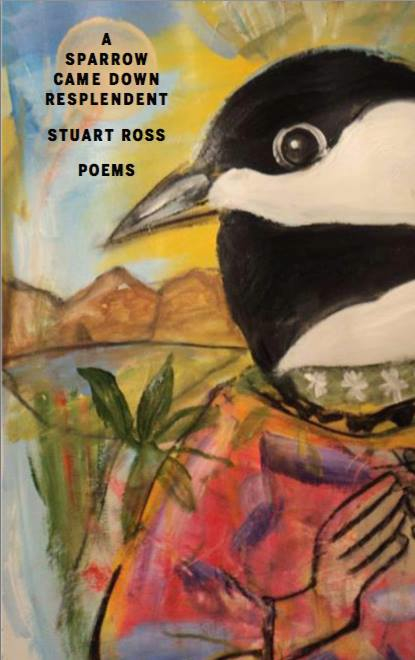
Look at what a handsome book this is. The cover painting is by the amazing Victoria painter Roy Green. Cover design is by the superbly talented Natalie Olsen of Kisscut Design. Within the covers writhe about 50 poems, and every one of them is perfectly comprehensible. So that's a first for me.
Sparrow comes on the heels of A Hamburger in a Gallery, my most weird-ass poetry book, released last year by Montreal's DC Books under Jason Camlot's Punchy Poetry imprint. Hamburger garnered somewhere in the neighbourhood of roughly zero reviews, even though it was a very exciting book, one I'm extremely proud of — complete with an odd 50-page interview with me conducted by Camlot-as-blockhead. While Jason and I were putting together Hamburger, which contains scores of personal poetic experiments, I was building a file of my most accessible, narrative, straightforward, personal poems for the subsequent book. That was the book I wanted to do next, with Paul's imprint: my "mainstream" poetry book.
I wanted a book that was as close to mainstream as I could get. (Really, I don't even know what mainstream might mean in the context of poetry.) I also wanted a book that was pretty serious. Paul was good at calling me on some of the more whacky material I tried to sneak in. I mean, I consider myself a serious poet in general, but I do recognize that readers often process my weirdness and surreality as humour.
Sparrow contains a lot of pretty personal poems. A lot of poems about death. A few questionnaires. A prose poem sequence about a version of my childhood. And a ton of homages to writers I admire. There's a lot of hero worship going on in this book. Oh, and there's a long poem about meeting up with everyone's favourite anthologist, Oscar Williams! I know this book is going to be a runaway best-seller!
A Sparrow Comes Down Resplendent has two launches lined up so far:
Toronto: May 12, 7:30 pm, The Monarch Tavern, 12 Clinton Street
Also being launched are new books by Kilby Smith-McGregor (Kids in Triage) and Susan Perly (Death Valley)
Cobourg: June 6, 7 pm, The Human Bean, 80 King Street West
Also being launched is Ashley-Elizabeth Best's Slow States of Collapse. Musical guest: Rhonda Murdoch.
I hope to get to many more towns and cities with my shameless sell-out.
Over and (sell-)out.
May 3, 2016
Giveaway of my new book!
Six signed copy of my new book are available for giveaway! Check it out!
https://www.goodreads.com/giveaway/sh...
https://www.goodreads.com/giveaway/sh...
May 1, 2016
Good night, Mark McCawley, 1964 – 2016
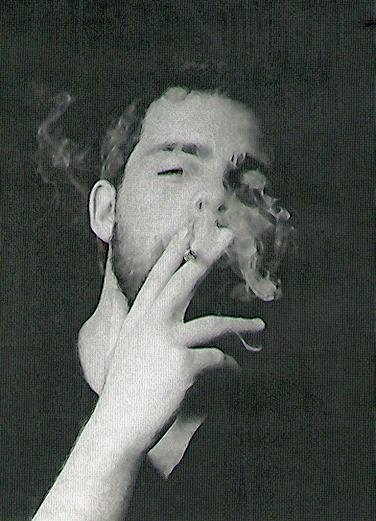 I was reading John Fante the other day, and I thought of Mark McCawley, wondered if he liked Fante. Fante was a huge influence on Bukowski, and Mark loved Bukowki. As it turns out, at the moment I was thinking about Mark, he was already gone.
I just heard this morning in a group email from the poet Chris Faiers, that Mark died, on April 19. rob mclennan wrote an obit here. Mark was nearly five years younger than I was. I know that he had health challenges and financial challenges. But in the last exchange I had with him, a week before he died, he offered to send me a small cheque to help buy a new computer because my laptop is starting to go bonkers. I thanked him for his generosity, but declined. He mentioned, as he so often did, that I was getting a bad break in the Canadian lit scene and should win a GG. I told him my stuff was way too weird for that. He wrote: "Weirdness really ought not to be a barrier to being shortlisted for the GG." He was a really great supporter of my work, and of the work of many other writers who he felt were working outside the mainstream.
He championed Daniel Jones to the end, promoting Jones's work decades after that writer's much-too-early death. More recently, he was soliciting and pirating work that excited him for his Urban Graffiti online project.
Mark was an angry guy when it came to CanLit. He was also a tender and generous man. The last time I saw him was when I visited Edmonton a bunch of years back. Mark took me to the Blue Plate, his favourite diner; we had a colourful, often dark, but ultimately inspiring visit. Mark had trouble getting around, but we took a long walk afterwards, and he showed me some neat Edmonton sights. We were looking forward to our next meeting at the Blue Plate, whenever I could get back to his town.
Mark was hardcore. Hardcore in his aesthetics. A hardcore small-presser. A hardcore promoter of the transgressive in literature. His comments on FB were often indignant, pissed-off, and outrageous. And it all came from a good and principled place. He was a very loyal guy. In Edmonton, I gave a reading in the lower level of some fancy bookstore there: the only people to attend were Catherine Owen, at whose place I was crashing, and Mark McCawley.
In December, he wrote to me: "I've sadly discovered lately that transgressive writing is disappearing from local libraries, including works by Jones, Firth, Quinn, Burnham…"
When I whined to Mark that I had become an ignored "literary geezer," he replied: "Where there is life, there is work to be written. Soon we 'geezers' will take over! Imagine a legion of literary 'geezers' with walkers…"
Mark kicked against the pricks. And he was a man who experienced a lot of pain. I hope his end, however that played out, was gentle.
I never did send him that copy of Juan Butler's Canadian Healing Oil I promised him. If he reads this and has a new address that Canada Post can reach, maybe he'll let me know. When someone dies unexpectedly, isn't there always this rush of things you wanted to say, to express, to ask?
Spend some time at his website today, will ya?
And for Mark, here's one of his favourite artists.
Over and out, Mark.
http://urbgraffiti.com<!-- /* Font Definitions */ @font-face {font-family:"MS 明朝"; mso-font-charset:78; mso-generic-font-family:auto; mso-font-pitch:variable; mso-font-signature:-536870145 1791491579 18 0 131231 0;} @font-face {font-family:"Cambria Math"; panose-1:2 4 5 3 5 4 6 3 2 4; mso-font-charset:0; mso-generic-font-family:auto; mso-font-pitch:variable; mso-font-signature:-536870145 1107305727 0 0 415 0;} @font-face {font-family:Cambria; panose-1:2 4 5 3 5 4 6 3 2 4; mso-font-charset:0; mso-generic-font-family:auto; mso-font-pitch:variable; mso-font-signature:-536870145 1073743103 0 0 415 0;} @font-face {font-family:"American Typewriter"; panose-1:2 9 6 4 2 0 4 2 3 4; mso-font-charset:0; mso-generic-font-family:auto; mso-font-pitch:variable; mso-font-signature:-1610612625 25 0 0 273 0;} /* Style Definitions */ p.MsoNormal, li.MsoNormal, div.MsoNormal {mso-style-unhide:no; mso-style-qformat:yes; mso-style-parent:""; margin:0in; margin-bottom:.0001pt; mso-pagination:widow-orphan; font-size:12.0pt; font-family:Cambria; mso-ascii-font-family:Cambria; mso-ascii-theme-font:minor-latin; mso-fareast-font-family:"MS 明朝"; mso-fareast-theme-font:minor-fareast; mso-hansi-font-family:Cambria; mso-hansi-theme-font:minor-latin; mso-bidi-font-family:"Times New Roman"; mso-bidi-theme-font:minor-bidi;} .MsoChpDefault {mso-style-type:export-only; mso-default-props:yes; font-family:Cambria; mso-ascii-font-family:Cambria; mso-ascii-theme-font:minor-latin; mso-fareast-font-family:"MS 明朝"; mso-fareast-theme-font:minor-fareast; mso-hansi-font-family:Cambria; mso-hansi-theme-font:minor-latin; mso-bidi-font-family:"Times New Roman"; mso-bidi-theme-font:minor-bidi;} @page WordSection1 {size:8.5in 11.0in; margin:1.0in 1.25in 1.0in 1.25in; mso-header-margin:.5in; mso-footer-margin:.5in; mso-paper-source:0;} div.WordSection1 {page:WordSection1;} --</style>
April 23, 2016
4 exciting new books under the "a stuart ross book" imprint
I'm pretty proud of the books I've ushered through Mansfield Press since 2007, when publisher Denis De Klerck let me aboard on a trial basis. That year I worked on new books with Lillian Necakov and Steve Venright. In all, I've brought about 45 books of poetry, fiction and non-fiction to Mansfield.
For this spring's list, I've worked with Montreal poet Sarah Burgoyne on her first book, with Kingston's Jason Heroux and Mahone Bay, Nova Scotia's Alice Burdick on their respective fourth collections, and with Paris, Ontario, poet Nelson Ball on his … well, he's got a lot of books.
Those books are launching next week in Montreal, Kingston, Toronto, and St. George, Ontario. I haven't seen them yet, but can't wait to hold them in my hands.
Denis did send me a photo of them, though, as well as the new book by Toronto's Eva HD that he saw through the press this season.

What particularly excites me about this season's crop are the challenges inherent in each book. Writers challenging readers, and also challenging themselves.
Saint Twin is Sarah Burgoyne debut, and it is as challenging as it is moving and powerful. This 160-page volume is comprised of nine sequences, a couple of which even have subsequences. Mostly, these amazing sequences are interwoven through each other throughout the book. It makes for a read that can be disorienting, but also exciting and rich, and it allows the echoes — and the distinctions — between the sequences to really stand out. It was a brave decision by Sarah — and a beautifully outrageous one — to order the book that way. I don't know of any other book of Canadian poetry that is structured quite like Saint Twin. I am immensely proud to have helped bring it into the world. I think readers are going to find extraordinary things in this glorious and hefty book.
Chewing Water is the fourth full-length collection (including next fall's Certain Details: The Poems of Nelson Ball, from WLU Press) I've worked on with Canadian poetry and publishing legend Nelson Ball. Nelson is often thought of as primarily a writer of minimalist nature poems, though people have been part of his poems for decades. Since the death of his wife, the artist and writer Barbara Caruso, in late 2009, it seems that Nelson's books are becoming increasingly "social" — lots of friends appear in the poems, as well as Barbara. Chewing Water is almost evenly divided between nature poems and people poems. At least, that's my impression. I haven't really counted the poems in each category. But it made for an interesting challenge when it came to ordering the pieces in the book. Divide it into sections, separating the different kinds of poems? Alternate? In the end, I decided to kick off with a rare childhood poem (Nelson's childhood, that is), and let intuition guide me. After a particularly emotional people poem, it seemed apt to insert a nature poem to allow for some peace and meditation. And certain nature poems suggested others, as certain people poems also suggested others. When I was done, Nelson shifted half a dozen poems around, and then we were both happy. To me, the book seems to have an almost emotional narrative. But really, with Nelson's poems, I could have thrown the pages into the air at random and ordered them how they landed and it still would have been a brilliant book.
It has been a blast to work with Jason Heroux for the third time, on his fourth collection with Mansfield. For the last book, Natural Capital, I really encouraged Jason to push himself in new directions, and he did a fantastic job. It didn't take any convincing to see Jason go even further with Hard Work Cheering Up Sad Machines. The title alone is a great departure for him. But look: there are quasi-flarf poems in this book! And about half a dozen long poems and sequences, where Jason explores different forms and different relations between the sequences' elements. This is the Kingston poet's most exciting collection so far, and his longest, by a long shot. The other thing that I could feel in this new manuscript was all the deep and close readings he has done over the years of works by poets from around the world. There is homage and respect and influence herein. Jason is a poet's poet.
And finally, it's been an intense pleasure to work with Alice Burdick on four full-length books, the first for Beth Follett's amazing Pedlar Press, and the next three with Mansfield. Again, like Nelson and Jason, Alice has been pushing herself to expand her palette ever further. Book of Short Sentences is Alice's longest and most acrobatic book yet. And it also has some very long poems, both of the prose and the linear variety. Alice's poetry is always challenging, in that very pleasurable way that John Ashbery's work is challenging. And comparisons have been made between Burdick and Ashbery, and I think they're valid to a point. Alice's work is much more deeply personal, though. And her wordplay is nearly constant (in a best-of-Nabokov/Burgess sort of way). I feel like Canadian poetry might finally be catching up to Alice Burdick, and this might be the book that brings her the recognition she so deeply deserves.
The fifth book out this season from Mansfield is Toronto poet Eva HD's follow-up to Rotten Perfect Teeth, her twice-reprinted debut from spring 2015. Shiner is the new book. This one is Denis De Klerck's project, and it is an often belligerent, often beautiful collection.
I'm on the train right now for Montreal, where we launch tomorrow (April 24) at 7 pm at the Copacabana on St. Laurent (where Nick Papaxanthos drew a huge crowd to launch his debut, Love Me Tender, this past fall). On April 25, 7 pm, we will be in Kingston at the brilliant indie bookstore Novel Idea. And then on April 26, we're in Mansfield's home turf of Toronto, at the Monarch Tavern at 7 pm. After a few days' break, we head to St. George, Ontario, Nelson Ball's neck of the woods, to launch Nelson and Alice at 2 pm at the Adelaide Hunter Hoodless Homestead.
Then, on June 16, Alice launches her book in Wolfville, Nova Scotia, at Box of Delights Bookshop, 6 pm. Joining her will be Darren Greer, launching his novel Advocate.
As always, I am grateful to Denis De Klerck for the privilege of working with such fine authors.
Come join us at a launch!
Over and out.

For this spring's list, I've worked with Montreal poet Sarah Burgoyne on her first book, with Kingston's Jason Heroux and Mahone Bay, Nova Scotia's Alice Burdick on their respective fourth collections, and with Paris, Ontario, poet Nelson Ball on his … well, he's got a lot of books.
Those books are launching next week in Montreal, Kingston, Toronto, and St. George, Ontario. I haven't seen them yet, but can't wait to hold them in my hands.
Denis did send me a photo of them, though, as well as the new book by Toronto's Eva HD that he saw through the press this season.
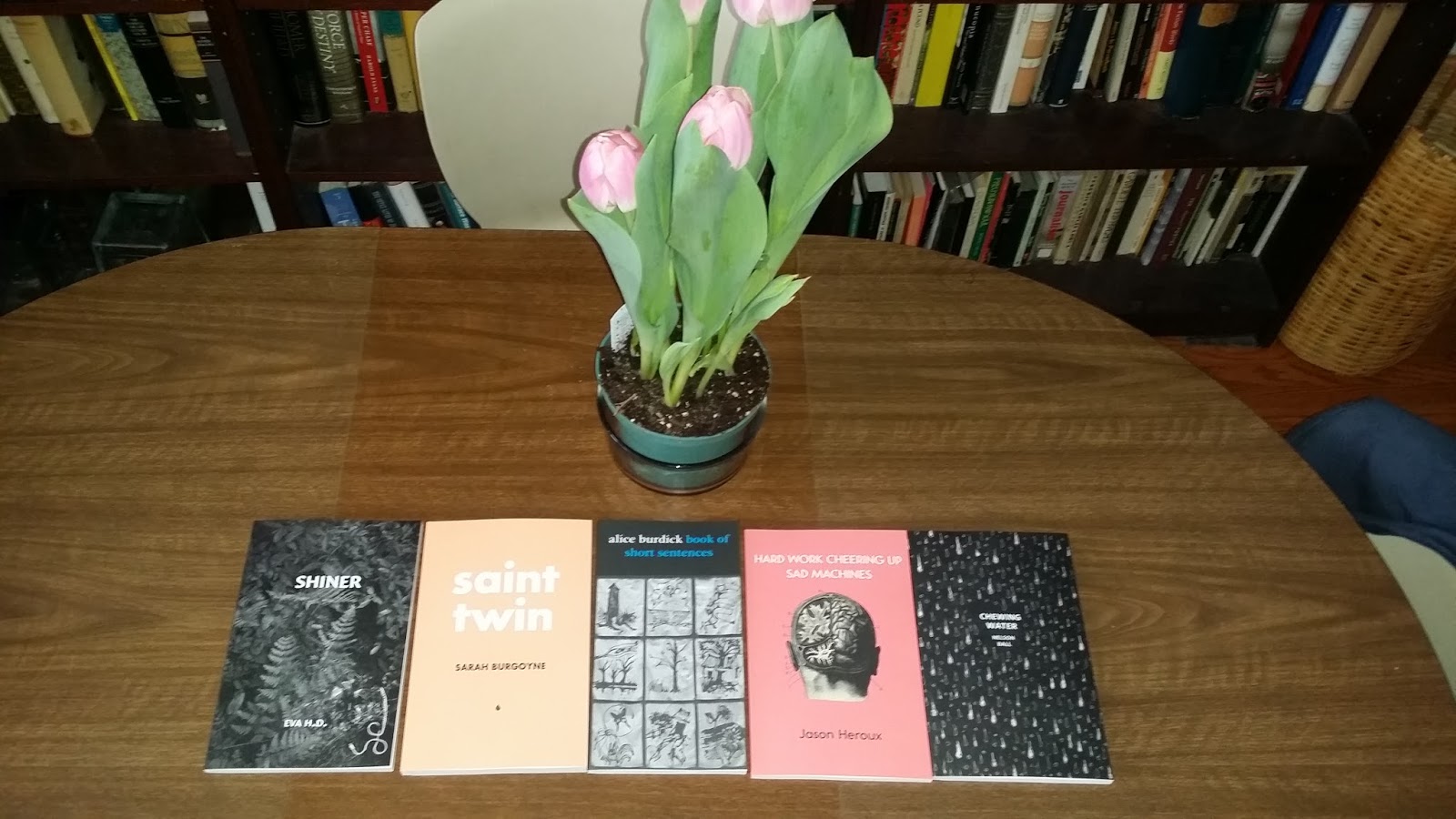
What particularly excites me about this season's crop are the challenges inherent in each book. Writers challenging readers, and also challenging themselves.
Saint Twin is Sarah Burgoyne debut, and it is as challenging as it is moving and powerful. This 160-page volume is comprised of nine sequences, a couple of which even have subsequences. Mostly, these amazing sequences are interwoven through each other throughout the book. It makes for a read that can be disorienting, but also exciting and rich, and it allows the echoes — and the distinctions — between the sequences to really stand out. It was a brave decision by Sarah — and a beautifully outrageous one — to order the book that way. I don't know of any other book of Canadian poetry that is structured quite like Saint Twin. I am immensely proud to have helped bring it into the world. I think readers are going to find extraordinary things in this glorious and hefty book.
Chewing Water is the fourth full-length collection (including next fall's Certain Details: The Poems of Nelson Ball, from WLU Press) I've worked on with Canadian poetry and publishing legend Nelson Ball. Nelson is often thought of as primarily a writer of minimalist nature poems, though people have been part of his poems for decades. Since the death of his wife, the artist and writer Barbara Caruso, in late 2009, it seems that Nelson's books are becoming increasingly "social" — lots of friends appear in the poems, as well as Barbara. Chewing Water is almost evenly divided between nature poems and people poems. At least, that's my impression. I haven't really counted the poems in each category. But it made for an interesting challenge when it came to ordering the pieces in the book. Divide it into sections, separating the different kinds of poems? Alternate? In the end, I decided to kick off with a rare childhood poem (Nelson's childhood, that is), and let intuition guide me. After a particularly emotional people poem, it seemed apt to insert a nature poem to allow for some peace and meditation. And certain nature poems suggested others, as certain people poems also suggested others. When I was done, Nelson shifted half a dozen poems around, and then we were both happy. To me, the book seems to have an almost emotional narrative. But really, with Nelson's poems, I could have thrown the pages into the air at random and ordered them how they landed and it still would have been a brilliant book.
It has been a blast to work with Jason Heroux for the third time, on his fourth collection with Mansfield. For the last book, Natural Capital, I really encouraged Jason to push himself in new directions, and he did a fantastic job. It didn't take any convincing to see Jason go even further with Hard Work Cheering Up Sad Machines. The title alone is a great departure for him. But look: there are quasi-flarf poems in this book! And about half a dozen long poems and sequences, where Jason explores different forms and different relations between the sequences' elements. This is the Kingston poet's most exciting collection so far, and his longest, by a long shot. The other thing that I could feel in this new manuscript was all the deep and close readings he has done over the years of works by poets from around the world. There is homage and respect and influence herein. Jason is a poet's poet.
And finally, it's been an intense pleasure to work with Alice Burdick on four full-length books, the first for Beth Follett's amazing Pedlar Press, and the next three with Mansfield. Again, like Nelson and Jason, Alice has been pushing herself to expand her palette ever further. Book of Short Sentences is Alice's longest and most acrobatic book yet. And it also has some very long poems, both of the prose and the linear variety. Alice's poetry is always challenging, in that very pleasurable way that John Ashbery's work is challenging. And comparisons have been made between Burdick and Ashbery, and I think they're valid to a point. Alice's work is much more deeply personal, though. And her wordplay is nearly constant (in a best-of-Nabokov/Burgess sort of way). I feel like Canadian poetry might finally be catching up to Alice Burdick, and this might be the book that brings her the recognition she so deeply deserves.
The fifth book out this season from Mansfield is Toronto poet Eva HD's follow-up to Rotten Perfect Teeth, her twice-reprinted debut from spring 2015. Shiner is the new book. This one is Denis De Klerck's project, and it is an often belligerent, often beautiful collection.
I'm on the train right now for Montreal, where we launch tomorrow (April 24) at 7 pm at the Copacabana on St. Laurent (where Nick Papaxanthos drew a huge crowd to launch his debut, Love Me Tender, this past fall). On April 25, 7 pm, we will be in Kingston at the brilliant indie bookstore Novel Idea. And then on April 26, we're in Mansfield's home turf of Toronto, at the Monarch Tavern at 7 pm. After a few days' break, we head to St. George, Ontario, Nelson Ball's neck of the woods, to launch Nelson and Alice at 2 pm at the Adelaide Hunter Hoodless Homestead.
Then, on June 16, Alice launches her book in Wolfville, Nova Scotia, at Box of Delights Bookshop, 6 pm. Joining her will be Darren Greer, launching his novel Advocate.
As always, I am grateful to Denis De Klerck for the privilege of working with such fine authors.
Come join us at a launch!
Over and out.