
Daniel Johnson's Blog, page 4
March 28, 2015
First post of the year: horses and silk
Greetings once again. Daniel is currently revising his paper on ancient horse remains in America, based on his presentation given at the BMAF conference a few years ago. Jack Welch had asked him to submit it for publication in BYU Studies Quarterly. They have been on it for a while, but finally sent back a reviewed version asking for changes. Writing a scientific paper to meet their standards is a big job, but he is tightening up some of the assertions and looking for more source material to back it all up. When it is ready, he will resubmit it. We will let you know how it progresses.
While doing more research for it, Daniel was reading sections of Prescott's Conquest of Mexico, an important work in this field, based on the reports of early Spanish chroniclers. Quite unexpectedly, he came across a passage that could be significant to the Book of Mormon mention of silk, long held by critics to be an anachronism and major goof. The account describes Hernán Cortés' meeting with ambassadors from the Aztec empire, who brought him precious gifts. Some of the items were clothing, described as "robes of cotton, fine as silk, of rich and various dyes, interwoven with feather-work that rivalled the delicacy of painting." Peter Martyr describes a curious fabric made of the hair of animals, feathers, and cotton thread, interwoven together.
More than likely, the 'silk' described in the Book of Mormon was not the kind we know, a product of Asian silkworms, but rather some costly, luxurious fabric used by the wealthy classes. 'Silk' may be the best translation into English that makes sense. We see that such cloth was had by later Mesoamerican people like the Aztecs. The fact that it came from Moctezuma shows its importance, status, and cost.
Daniel will be giving a fireside on Book of Mormon and archaeological similarities this Sunday evening at the LDS chapel in Petaluma, his first presentation of the year. Interested parties are always invited.
(For those interested in the reference to the silk-like fabric, see William H. Prescott, History of the Conquest of Mexico vol. I (Philadelphia: David McKay, Publisher, 1892), p. 295.)
While doing more research for it, Daniel was reading sections of Prescott's Conquest of Mexico, an important work in this field, based on the reports of early Spanish chroniclers. Quite unexpectedly, he came across a passage that could be significant to the Book of Mormon mention of silk, long held by critics to be an anachronism and major goof. The account describes Hernán Cortés' meeting with ambassadors from the Aztec empire, who brought him precious gifts. Some of the items were clothing, described as "robes of cotton, fine as silk, of rich and various dyes, interwoven with feather-work that rivalled the delicacy of painting." Peter Martyr describes a curious fabric made of the hair of animals, feathers, and cotton thread, interwoven together.
More than likely, the 'silk' described in the Book of Mormon was not the kind we know, a product of Asian silkworms, but rather some costly, luxurious fabric used by the wealthy classes. 'Silk' may be the best translation into English that makes sense. We see that such cloth was had by later Mesoamerican people like the Aztecs. The fact that it came from Moctezuma shows its importance, status, and cost.
Daniel will be giving a fireside on Book of Mormon and archaeological similarities this Sunday evening at the LDS chapel in Petaluma, his first presentation of the year. Interested parties are always invited.
(For those interested in the reference to the silk-like fabric, see William H. Prescott, History of the Conquest of Mexico vol. I (Philadelphia: David McKay, Publisher, 1892), p. 295.)


September 6, 2014
Maya sites newly rediscovered!
We love hearing news like this. Ancient Maya sites in the Yucatán Peninsula have been discovered recently and excavation work is proceeding. Named Chactún and Lagunita, they are located in Calakmul's Biosphere Reservation, in the southeastern corner of the Mexican state of Campeche.
Archaeologist Ivan Sprajc of Slovenia is leading the work, with approval and funding by INAH.
Archaeologist Ivan Sprajc of Slovenia is leading the work, with approval and funding by INAH.
January 28, 2014
The original language(s) of the Book of Mormon
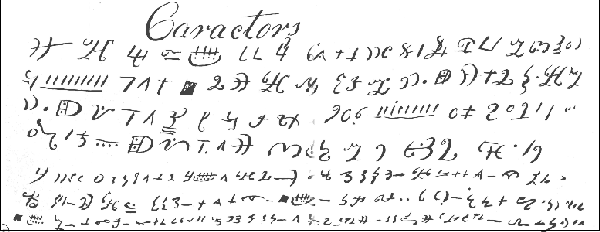
What did the writing on the plates look like? Can there be any comparison to known ancient languages? Aside from the 'Caractors' roughly drawn by Joseph or perhaps one of his scribes, we have little to go on. What is Reformed Egyptian anyway? And more importantly, what do Book of Mormon writers say themselves about the languages they used?
Our first clue comes very early in the record, when Nephi tells us that his record is in the language of his father. He then goes on to tell us that it consists of the 'learning of the Jews and the language of the Egyptians' (1 Ne 1:2). Admittedly, we don't know exactly what he means, but obviously, Lehi and his family would have spoken Hebrew, the language of the Jews. We might think we know what Hebrew looks like, but the written language was changed anciently. The block script used today was adopted by Jews in the third century BC. Before that, they used an older script called paleo-Hebrew. In the image below, the two writing systems are compared. Aleph starts on the far right, then Beth, then Gimel, and so on. Remember that Hebrew, like other Semitic languages, was written and read from right to left. The familiar Hebrew alphabet on the top line would have been unknown to the Jews of Lehi's day. They would have been using the characters shown on the bottom line.

However, Nephi seems to be telling us that he did not use Hebrew as the written language on the plates. Instead, he refers to Egyptian. It should be fairly obvious that he was not using hieroglyphics. Two other writing systems were known among the Egyptians of Lehi's day: Hieratic and Demotic. Hieratic was an early cursive writing system developed for writing with a reed brush and ink. By about 660 BC it had been replaced by Demotic for secular writings, but the priestly class continued to use Hieratic for quite some time. The question is, which system, Hieratic, or the early Demotic of his day, would Lehi have known and taught to his son? Even though Hieratic continued to be the language of religious writings, that was just among Egyptian priests. In fact, the word Demotic is derived from the Greek term for 'popular.' Egyptians referred to this written language as 'document writing.' It was commonly carved on monuments and is one of the languages found on the Rosetta Stone. It is likely that Lehi, as a non-Egyptian visitor, would have learned Demotic, shown below.
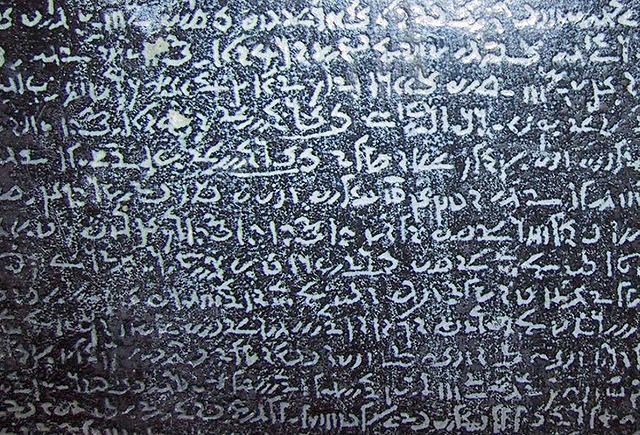 In addition, Hieratic is known for its ligatures and highly cursive nature, which may have been difficult to reproduce by engraving on plates of metal ore. For these reasons, Demotic would have been a more likely choice, but Nephi does not tell us why he chose Egyptian over Hebrew. His aforementioned statement has been interpreted by some LDS scholars as meaning that he used Egyptian letters to transliterate Hebrew words. Whatever Nephi did, it is also apparent from the Book of Mormon itself that Mormon did not copy, translate, or condense the duplicate record he found, known as the small plates of Nephi. He found them among other records in his possession. and because he found the words on these plates pleasing, he put them with the remainder of his record (WoM 1:6). Not only were these plates likely smaller than the ones Mormon had made centuries later in the 4th century AD, but they were written in a completely different and much older language than he was using on his plates: the early Demotic of 600 BC!
Regarding the language used for their record, Moroni tells us they wrote in what the Nephites called Reformed Egyptian, the most enigmatic writing system connected with the Book of Mormon. This was mentioned only once at the very end of Nephite history and was unknown to the original Nephi and probably many record keepers after him. No one besides Moroni refers to it. The only surviving example of it is presumably in the 'Caractors' drawing. We should not expect to find other examples of it, because it had evolved over the years and was known only among the Nephites; no one else knew it (Mor 9:32-34). It may also be that only keepers of the sacred records used this language. They also kept a knowledge of Hebrew alive, but Mormon chose the Egyptian over it because it was more concise (if less perfect) for writing. We are told that both Egyptian and Hebrew had been altered by the Nephites, which one might expect after being isolated from their original sources for almost a millennium and surrounded by different cultures. By Mormon and Moroni's time, Demotic had changed into reformed Egyptian and we must expect that paleo-Hebrew had become reformed Hebrew as well. Regardless of what common Nephites spoke, or what acted as a lingua franca so that different groups could communicate with each other, we know that an elite group of Nephite record holders kept alive a Semitic written tradition, including the languages and the practice of writing on metal plates. As with many Semitic languages, both Demotic and Hebrew are written from right to left and Joseph Smith confirmed that the script on the Book of Mormon was read in the same manner.
As we try to imagine the origin of Nephite languages, we must start with what would have been known in the Middle East of 600 BC: paleo-Hebrew and early Demotic Egyptian.
Click here for more information on Demotic.
The original languages of the Book of Mormon
What did the writing on the plates look like? Can there be any comparison to known ancient languages? Aside from the 'Caractors' roughly drawn by Joseph or perhaps one of his scribes, we have little to go on. What is Reformed Egyptian anyway? And more importantly, what do Book of Mormon writers say themselves about the languages they used?
Our first clue comes very early in the record, when Nephi tells us that his record is in the language of his father. He then goes on to tell us that it consists of the 'learning of the Jews and the language of the Egyptians.' (1 Ne 1:2). Admittedly, we don't know exactly what he means, but obviously, Lehi and his family would have spoken Hebrew, the language of the Jews. We might think we know what Hebrew looks like, but the written language was changed anciently. The block script used today was adopted by Jews in the third century BC. Before that, they used an older script called paleo-Hebrew. In the image below, the two writing systems are compared. Aleph starts on the far right, then Beth, then Gimel, and so on. Remember that Hebrew, like other Semitic languages, was written and read from right to left. The familiar Hebrew alphabet on the top line would have been unknown to the Jews of Lehi's day. They would have been using the characters shown on the bottom line.

January 3, 2014
Mysterious metal plates?
 We came across a webpage recently that mentioned artifacts from Calakmul that would soon be released to the public by the Mexican government. Since this is one of our favorite sites in the Yucatán, we were initially interested. Although not mentioned in the article, at least one of the artifacts looked like it could be made of metal with engraved images. However, upon closer inspection and comparison with photos of other items from the same group, it appears to be of polished, smooth stone. The greater problem is that the point of the page is to show contact with aliens and the ancient Maya, so they are likely fake. Most of the iconography doesn't really match what is known about the Maya culture and the figure in the carving on the right side of the image bears a suspicious resemblance to items seen in Indiana Jones and the Kingdom of the Crystal Skull. Mainstream archaeologists hate the suggestion of alien contact with ancient cultures, even more than they hate the idea of pre-Columbian contact between the Old World and the New.
 But a link on the page about a documentary called Revelations of the Mayans leads to some interesting information. It's a YouTube video taken from season 2 of an episode of Ancient Aliens called "Underground Aliens," broadcast on the History Channel on 18 November 2010. If this aspect of the 'evidence' is overlooked, what it shows is actually far more interesting and may have a more earthbound explanation. At 19:22 on the video, the story is told of Padre Carlos Crespi, a Silesian monk born in Italy in 1891 who served in Ecuador from 1923 until his death in 1982. In the courtyard of the Maria Auxiliadora church, he kept an enigmatic collection of artifacts given to him by the local indigenous people, the Shuar.
 Notable among his collection were metal plates with an unknown language inscribed on them. There were many other artifacts of gold, metal, and stone in the collection, but none have been the subject of serious study. Padre Crespi apparently had no interest in selling or otherwise benefiting from them, but did show them to visitors. The have been seen and photographed various times, and were filmed as part of a documentary. Items of all types were in the collection, including this stone carving showing what seems to be an elephant over marks that look like Hebrew block script letters, which were adopted by Jews in the 3rd century BC. Before that, an older writing system similar to Phoenician called paleo-Hebrew was used. The true provenance of these items is unknown, so controversial pieces like this one would be highly suspect by most archaeologists. Some of them look suspiciously too Egyptian or Babylonian.
 Sadly, the collection has vanished. Some items may have been destroyed in a fire in 1962. Others may have ended up with private collectors or may still be stored somewhere, but if any survived their current locations are unknown. None have been seen since Crespi's death. His explanation is that they all came from caves and subterranean tunnels, known only to the local Shuar. Stories were told of vast libraries of metal books hidden underground in the Ecuadorean jungle. Several people have claimed to know the location of these caves, but have since passed away. In 1976, a large expedition was organized by Scottish explorer Stan Hall. Included in the group of spelunkers, cameramen, experts, and Ecuadorean military was astronaut Niel Armstrong. They explored Cueva de los Tayos, a large cave system believed to be the origin of the artifacts, but found nothing like those kept by Padre Crespi. However, they did find a few other archaeological relics.
We are left with no definite answer as to what the items in Padre Crespi's collection were. Could they have been legitimate items carved by ancient peoples or were they modern hoaxes? Supporters of the ancient alien theory including Erich von Däniken believe that such artifacts are evidence of visits by technologically advanced or extraterrestrial beings. But we can find a much more likely and down-to-earth explanation for libraries of metal plates hidden underground and lost to later civilizations.
Click here for more information on Padre Crespi and his collection.
Click here for information on Cueva de los Tayos.
Click here for "Underground Aliens" on YouTube.
August 25, 2013
Giant skulls in Ancient America?
 Daniel has returned home to California after working for the LDS Motion Picture Studio this summer. On the way, he stopped at the Humboldt County Museum in Winnemucca, Nevada. Why, you ask? There are Internet rumors about red-haired giants, their skeletons and ancient remains having been found in the nearby Lovelock Cave. One of the skulls is said to be housed in the museum. Some Book of Mormon enthusiasts are interested in legends of giants in the Americas, claiming there might be some connection to the Jaredites, although there is no scriptural requirement for it.
Stopping in at the small museum, Daniel looked at the exhibits and asked the curators about the skull. His first disappointment came when he was told that the skull and other remains were there, but that they were not exhibited and by agreement with the local Paiute tribe, could not be shown to the public because of the sacred nature of Native American remains and their tradition against their display. He was also told that the remains were of average size and there was nothing particularly unusual about them. One curator even pulled out a photocopy of an article about the Lovelock Cave remains, debunking the claims of their giant size. It seems that others had stopped by to inquire about the skull, so the museum had a prepared document to explain and refute any such rumors.
 As usual, many of the websites about the giant skull make claims with very little support to back them up. The photo shown above came from one of them, but there is no way of knowing its origin or where these skulls are. The museum in Winnemucca now has no human remains on display. Besides, judging on the size of what is
  apparently a quarter in the photo, these skulls seem of normal size. The only other image specifically connected to this legend is shown here. The story is that someone brought in a full-size dental cast to compare it to the jawbone at the museum, often with the description that the jawbone's teeth were twice the size of the teeth in the cast. This may be true; in the past before the agreement with the Paiutes, the museum may have allowed visitors to see Native remains. The photo seems genuine, but further observation is necessary. The ancient jaw is in front and higher up, which should make it appear larger and angles can distort scale. Also, the cast is of the teeth only, not the entire jaw, so it will obviously look much smaller. But if the dental cast teeth are outlined and overlaid on the teeth of the jawbone, it can be seen that although the modern teeth appear smaller and the width of the mouth less, the distance from front to back is almost the same. Since this comparison is limited to the angle of the photo, it may not be completely accurate, but it is enough to see that the size of the jawbone for the modern teeth would be about the same size as the ancient 'giant' jaw. Actually, the modern teeth outlines would need to be sized up as they moved forward and up to match the ancient teeth, but that was not done in this comparison. In all likelihood, the dental cast teeth and the ancient teeth may be very similar in size.
Local Paiute legends tell of an ancient people they called the Si-Te-Cah, described as red-haired cannibals. Oral traditions say that after years of warfare with them, the Paiute banded together and defeated the cannibals, the last of them being trapped in what is now known as Lovelock Cave. The original traditions say nothing of giants, but some versions mention their lighter skin. The 'giant' aspect seems to have been invented by later explorers and guano miners at the cave. The article handed out at the museum does state that conspiracy theorists will claim that evidence is being covered up, but that since science has no orthodoxy, there is no need to hide surprising finds such as this. That may be true, but there are too many examples where individual scientists ignore or marginalize finds that don't fit nicely into the current scientific thinking, or 'orthodoxy.' Supporters of the Book of Mormon have experienced this phenomenon. But the red-haired giants of Lovelock Cave appear to be no more than myth. Similar giant stories of the past have relied upon evidence that has dissipated under further scrutiny. There may have been lighter skinned, red-haired giants in ancient Nevada, but so far, the proof eludes us.
Giant skulls?
Daniel has returned home to California after working for the LDS Motion Picture Studio this summer. On the way, he stopped at the Humboldt County Museum in Winnemucca, Nevada. Why, you ask? There are Internet rumors about red haired giants, their skeletons and ancient remains having been found in the nearby Lovelock Cave. One of the skulls is said to be housed in the museum. Some Book of Mormon enthusiasts are interested in legends of giants in the Americas, claiming there might be some connection to the Jaredites, although there is no scriptural requirement for it.Stopping in at the small museum, Daniel looked at the exhibits and asked the curators about the skull. The first disappointment came when he was told that the skull and other remains were there, but that they were not exhibited and by agreement with the local Paiute tribe, could not be shown to anyone because of the sacred nature of Native American remains and their tradition against their display. He was also told that the remains were of average size and there was nothing particularly unusual about them. One curator even pulled out a photocopy of an article about the Lovelock Cave remains, debunking the claims of their giant size. It seems that others had stopped by to inquire about the skull, so he museum had a prepared document to explain and refute any such rumors.
August 16, 2013
More interviews and articles
Daniel's time in Utah working for the LDS Motion Picture Studio is over and he is heading home to California. During his time in Utah, he has been able to do some interviews and talk about our books. Recently, the Uintah Basin Standard newspaper interviewed him for a book review of both An LDS Guide to Mesoamerica and An LDS Guide to the Yucatán.
He also stopped by FAIR's conference in Provo, UT earlier this month to talk to a few people and see what it was all about. Tyler Livingston, who works with FAIR, later videoed Daniel for an upcoming DVD they are working on about Book of Mormon evidences.
The blog i am a reader.com also had a post about our books and Daniel supplied some personal information for it as well. Check it out to find out his favorite flavor of ice cream and who should play him if a movie were made of his life.
Click here to read the reviews in the Uintah Basin Standard.
Click here to read the blog post about Daniel and the books.
He also stopped by FAIR's conference in Provo, UT earlier this month to talk to a few people and see what it was all about. Tyler Livingston, who works with FAIR, later videoed Daniel for an upcoming DVD they are working on about Book of Mormon evidences.
The blog i am a reader.com also had a post about our books and Daniel supplied some personal information for it as well. Check it out to find out his favorite flavor of ice cream and who should play him if a movie were made of his life.
Click here to read the reviews in the Uintah Basin Standard.
Click here to read the blog post about Daniel and the books.
July 21, 2013
Just an update
We have all been busy these days. Daniel has been living in Utah for the summer, working for the LDS Motion Picture Studio. But he has had some time to do radio interviews and try to plan some more events. He has also been asked to do a book signing, along with other authors at Education Week at BYU Idaho on Friday, 2 August. More details and archives to be posted.
Daniel's BMAF presentation on metals and gold plates is now on YouTube as a high quality video. You can watch it by clicking here.
Daniel's BMAF presentation on metals and gold plates is now on YouTube as a high quality video. You can watch it by clicking here.
June 15, 2013
Daniel interviewed for the Provo Daily Herald
 Last Sunday, the Daily Herald newspaper in Provo had an article about the development of an internal Book of Mormon maps application for tablets and phones. Jedediah McClure is taking years of study of topographic data from locations mentioned in the Book of Mormon and is working on compiling them into an interactive and animated feature-filled app. Locations will include information about what went on there, according to the scriptural account. He isn't making any attempts to match up sites with geography in Mesoamerica or any other real-world location, but his idea sounds very useful for those wishing greater understanding of its history.
Daniel was interviewed, along with Brant Gardner, for his views on Mesoamerica as a likely candidate for Book of Mormon events. We look forward to more development on this project and wish Jedediah much success. Currently, he is seeking funding on Kickstarter.
Click here to read the article at the Daily Herald.
Click here for information on the app.


