
Daniel Johnson's Blog, page 3
June 12, 2017
Recreating the Book of Mormon plates
A big part of the Book of Mormon story depends on the plates described by Joseph Smith. We have all seen paintings or representations of them, but they aren't all necessarily accurate. While we don't have the plates for scrutiny (even if we did, it's obvious that critics would still not be satisfied), we do have contemporary descriptions of them. There is a good bit we understand, but there is still space for individual interpretation on what they looked like, how many plates there were, and how deep the collection of records was.
The Church's Museum of Church History and Art has a representation of the plates on exhibit, made from historical descriptions by those who saw or handled them. Whatever our critics and detractors might say, it seems obvious that some physical object was possessed by Joseph. Even his enemies believed the stories enough to attack him and his household several times, attempting to steal them. We may never know exactly what they looked like, but the following facsimile gives a good idea and the accounts given by those who had personal experience with them should help to weed out false ideas that may have crept up over the years. However, any modern representation of them must of necessity be based partly on conjecture and educated guesses. There are some frustrating gaps in details that modern enthusiasts would like to have, but the goals of 19th-century observers of the plates in describing them would be different than ours today.
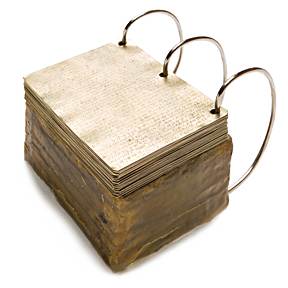 Of course, the Church's critics have all sorts of reasons the plates could not have existed as described, but most of their complaints can be resolved by relying closely on the words of those who supposedly interacted with them, rather than Mormon traditions and imaginings that have evolved over more than a century and a half. To read more about the exhibit, how this model was made, and accurate quotes by Joseph Smith and his associates, read this article on LDS.org.
The Church's Museum of Church History and Art has a representation of the plates on exhibit, made from historical descriptions by those who saw or handled them. Whatever our critics and detractors might say, it seems obvious that some physical object was possessed by Joseph. Even his enemies believed the stories enough to attack him and his household several times, attempting to steal them. We may never know exactly what they looked like, but the following facsimile gives a good idea and the accounts given by those who had personal experience with them should help to weed out false ideas that may have crept up over the years. However, any modern representation of them must of necessity be based partly on conjecture and educated guesses. There are some frustrating gaps in details that modern enthusiasts would like to have, but the goals of 19th-century observers of the plates in describing them would be different than ours today.
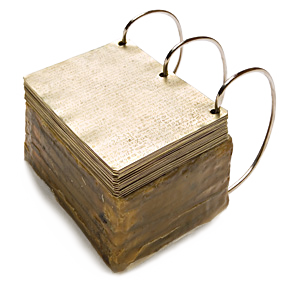 Of course, the Church's critics have all sorts of reasons the plates could not have existed as described, but most of their complaints can be resolved by relying closely on the words of those who supposedly interacted with them, rather than Mormon traditions and imaginings that have evolved over more than a century and a half. To read more about the exhibit, how this model was made, and accurate quotes by Joseph Smith and his associates, read this article on LDS.org.


April 30, 2017
A good perspective on Book of Mormon Archaeology
We all know that Book of Mormon Archaeology can be a tricky subject. Notwithstanding all the interesting and enlightening items we have found that seem to correlate with the Book of Mormon account, there is no firm proof. In all likelihood, there never will be, either for or against. This debate will never be solved by the scientific disciplines of Archaeology, Anthropology, History, Linguistics, or anything else. As evidence for this, there is no general consensus; regardless of all the archaeological 'support,' many people reject the Book of Mormon as an ancient historical document. Conversely, despite all the 'proofs' of its 19th-century origins, many accept it as a true account and holy scripture.
At the FairMormon conference in 2005, Dr. John Clark, an archaeologist at BYU who has helped us out in the past, gave a presentation that provided a needed perspective on this issue. As a comparison, many events that are crucial to the narrative of the Old Testament have no archaeological support whatsoever. However, there is no doubt that the Bible is an ancient document. If the Book of Mormon is not what it claims to be, then it must be the product of an American 19th-century environment. In his presentation, which can be read here, Dr. Clark provides a helpful chart showing 60 specific items mentioned in the Book of Mormon, compared to what what 'known' about the ancient world at the time, many of which have been called 'blunders' by critics from the very beginning. As can be seen, the weight of the evidence was strongly against its authenticity. And this chart may be a bit generous, since it shows stone monuments and large cities as Confirmed in 1842. This is correct, but likely is due to the publication of Stephens and Catherwood's accounts of travels in Mesoamerica a few years previous, but which were unknown when the Book of Mormon was published in 1830. The status of its claims at that date would have been a better benchmark.
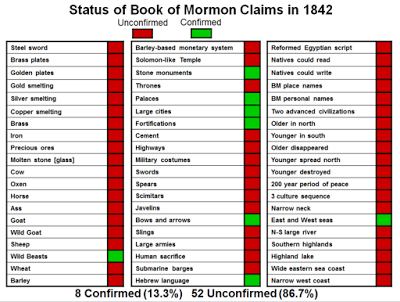
But the case was far from closed. Archaeology in the New World was practically non-existant at the time, so the apparent anachronisms lose much of their significance. The problems with this kind of evidence are obvious because of the amount of change newer discoveries can bring to overturn old beliefs, sometimes in just a few years. The chart looks very different when compiled in a more recent setting.
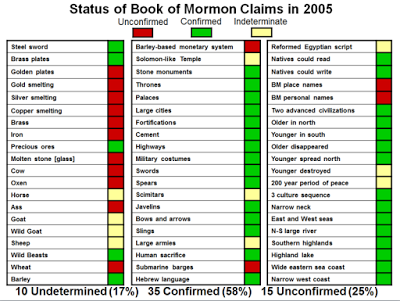
On objective observer should see that the tide of evidence has turned. Keep in mind that even this chart is now at least twelve years old, so its application is limited as well. We are pleased to see the status of horses go from Unconfirmed to Indeterminate, given the amount of research Daniel has done on this subject. That may be as good as we get. But some other topics are a bit confusing. These items seem to be relative to the Ancient Americas specifically, so we are surprised to see steel swords and brass plates. We will certainly be asking Dr. Clark about that. But also surprising and a bit disappointing is to see golden plates still at Unconfirmed, given what we have seen from sites like the Sacred Cenote at Chichén Itzá. Still, this chart is a good example of the perspective we should have on how supportive or damaging Archaeology should really be to our faith in the Book of Mormon.
Click here to read the full presentation by Dr. John Clark, Wade Arden, and Matthew Roper.
At the FairMormon conference in 2005, Dr. John Clark, an archaeologist at BYU who has helped us out in the past, gave a presentation that provided a needed perspective on this issue. As a comparison, many events that are crucial to the narrative of the Old Testament have no archaeological support whatsoever. However, there is no doubt that the Bible is an ancient document. If the Book of Mormon is not what it claims to be, then it must be the product of an American 19th-century environment. In his presentation, which can be read here, Dr. Clark provides a helpful chart showing 60 specific items mentioned in the Book of Mormon, compared to what what 'known' about the ancient world at the time, many of which have been called 'blunders' by critics from the very beginning. As can be seen, the weight of the evidence was strongly against its authenticity. And this chart may be a bit generous, since it shows stone monuments and large cities as Confirmed in 1842. This is correct, but likely is due to the publication of Stephens and Catherwood's accounts of travels in Mesoamerica a few years previous, but which were unknown when the Book of Mormon was published in 1830. The status of its claims at that date would have been a better benchmark.

But the case was far from closed. Archaeology in the New World was practically non-existant at the time, so the apparent anachronisms lose much of their significance. The problems with this kind of evidence are obvious because of the amount of change newer discoveries can bring to overturn old beliefs, sometimes in just a few years. The chart looks very different when compiled in a more recent setting.

On objective observer should see that the tide of evidence has turned. Keep in mind that even this chart is now at least twelve years old, so its application is limited as well. We are pleased to see the status of horses go from Unconfirmed to Indeterminate, given the amount of research Daniel has done on this subject. That may be as good as we get. But some other topics are a bit confusing. These items seem to be relative to the Ancient Americas specifically, so we are surprised to see steel swords and brass plates. We will certainly be asking Dr. Clark about that. But also surprising and a bit disappointing is to see golden plates still at Unconfirmed, given what we have seen from sites like the Sacred Cenote at Chichén Itzá. Still, this chart is a good example of the perspective we should have on how supportive or damaging Archaeology should really be to our faith in the Book of Mormon.
Click here to read the full presentation by Dr. John Clark, Wade Arden, and Matthew Roper.
February 28, 2017
Columbus and America
The older ones among us may remember learning in school that Cristopher Columbus discovered America. Well, the Bahamas actually. Well, he just sort sailed into them accidentally. Now we all know that he didn't really 'discover' anything. It's debatable whether he even realized that he had discovered a new continent hitherto unknown to most Europeans. And it's no longer controversial to recognize that Viking explorers made it to this hemisphere much earlier.
But were there others to arrive here even earlier? Obviously, the Book of Mormon mentions three groups that arrived outside of the accepted historical record, but we are often alone in asserting its veracity. However, the idea that many groups from various lands may have sailed to the Americas throughout its ancient history is gaining greater acceptance outside of the Church. A video on the History channel's website entitled Did Columbus Really Discover America? gives a more realistic view of his accomplishments, while suggesting that many others may have arrived, in addition to the indigenous populations that were already here, including Israelites fleeing Babylonian destruction in 600 b.c. More of this 'complicated truth' about the discovery of America (as the video states) is coming to light and we believe the Book of Mormon's account will stand the test of time. We may just need to continue to have faith.
Click here to watch the video on history.com.
But were there others to arrive here even earlier? Obviously, the Book of Mormon mentions three groups that arrived outside of the accepted historical record, but we are often alone in asserting its veracity. However, the idea that many groups from various lands may have sailed to the Americas throughout its ancient history is gaining greater acceptance outside of the Church. A video on the History channel's website entitled Did Columbus Really Discover America? gives a more realistic view of his accomplishments, while suggesting that many others may have arrived, in addition to the indigenous populations that were already here, including Israelites fleeing Babylonian destruction in 600 b.c. More of this 'complicated truth' about the discovery of America (as the video states) is coming to light and we believe the Book of Mormon's account will stand the test of time. We may just need to continue to have faith.
Click here to watch the video on history.com.
August 1, 2016
The legendary origins of yerba mate
 Because of his time as a missionary in Argentina, Daniel was introduced to the practice and culture of yerba mate, a type of tea infused from a South American plant. It's now something that we all enjoy. Many legends exist to explain the ancient origins of this drink, known to indigenous peoples of the areas that are now Argentina, Paraguay, and southern Brazil. A list of some of them is found on the website for Guayakí, a brand of mate that is based in northern California. One comes from the Guaraní people:
...the ancestors of the Guarani at one time in the distant past crossed a great and spacious ocean from a far land to settle in the Americas. They found the land both wonderful yet full of dangers; through diligence and effort they subdued the land and inaugurated a new civilization. There were two brothers that vied for leadership of the people: Tupi and Guarani. Eventually they feuded and divided the people into two separate nations. Each nation, or tribe, adopted the name of the brother who was its leader.
The Tupi tribes adopted a more fierce, nomadic lifestyle, rejecting the agricultural traditions of their fathers. They engaged in the practice of drinking large quantities of a caffeine-containing drink prepared from the guarana tree.
The Guarani tribes became a stable, God-fearing people who worked the land and became excellent craftsmen. They looked forward to the coming of a tall, fair-skinned, blue eyed, bearded God (Pa'i Shume) who, according to legend, eventually did appear and was pleased with the Guarani. He imparted religious instruction...
The similarities to major events in the Book of Mormon are remarkable: crossing an ocean, two competing brothers, nations named after them, nomadic vs. agricultural cultures, and looking forward to the arrival of a fair-skinned god. Admittedly, there is no information for the source of this legend and it is quite vague. But perhaps there is something at its foundation and the similarities can't all be coincidences. So how do we explain this? We very much doubt that that the writer of Guayakí's website chose to use the Book of Mormon as source material for this legend.
Click here to read more about this and other legends at Guayakí's site.
Click here for information on the Guaraní.
May 5, 2016
Other ideas about horses in Ancient America
Much of Daniel's recent work and research has been in checking out evidence of horses in Ancient America. This is undoubtedly a controversial topic and one that many critics use against the Book of Mormon. His recent paper published in BYU Studies Quarterly shows some strong support for the validity of the Book of Mormon's claims and examines several possibilities that explain the apparent lack of horses as noted by the first European explorers. Some of this information is also in An LDS Guide to the Yucatán.
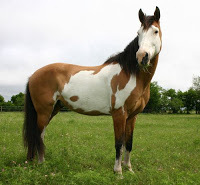 While we don't have the final answer, it's nice to know we aren't alone in suggesting that horses actually could have lived in the Americas and were known to ancient people, although that knowledge has been lost. Some indigenous cultures claim not to have lost this knowledge, but to have had it all along. The website Tuesday's Horse has an article examining Native American claims that they have always had horses, even contradicting the standard story we all know. It also mentions several legends of ancient explorers from the Old World that found their way to the Americas and mentioned large animals such as horses among peoples in this new land. While these accounts are not fully supported, there are quite a few from all over the world. The scientific community has finally accepted that others from Europe beat Columbus across the ocean and some of these other accounts are gaining greater acceptance, even among the mainstream. The Book of Mormon's claims about three separate groups traveling across the oceans to the Promised Land seem much more plausible.
Click here to read Indian Horses Before Columbus
 While we don't have the final answer, it's nice to know we aren't alone in suggesting that horses actually could have lived in the Americas and were known to ancient people, although that knowledge has been lost. Some indigenous cultures claim not to have lost this knowledge, but to have had it all along. The website Tuesday's Horse has an article examining Native American claims that they have always had horses, even contradicting the standard story we all know. It also mentions several legends of ancient explorers from the Old World that found their way to the Americas and mentioned large animals such as horses among peoples in this new land. While these accounts are not fully supported, there are quite a few from all over the world. The scientific community has finally accepted that others from Europe beat Columbus across the ocean and some of these other accounts are gaining greater acceptance, even among the mainstream. The Book of Mormon's claims about three separate groups traveling across the oceans to the Promised Land seem much more plausible.
Click here to read Indian Horses Before Columbus
January 18, 2016
Changes to the Lift event
 Lift: A Conference to Lift the Human Spirit is still going on, but with a change of venue. The event is now scheduled to be held at the Sleepy Ridge golf club house, still on the same date, 20 February. This new location should be easier to get to, especially if there are any storms coming and it's a beautiful setting.
There has also been a slight change in the lineup of presenters. Daniel will be speaking at 2:40 in the afternoon. Tickets will now be $250 at the door, but $199 by registering early. As an added bonus, if you register this month and type in 'Daniel' as the promotional code, you will save an additional $100. So for a limited time, the entire conference cost is only $99.
Click here to register early and don't forget the promotional code.
January 6, 2016
Big events coming this year
Because of the new article in BYU Studies, we have been involved in more PR for the books recently. Daniel and Ironrod Media have been planning some events this year and he has been asked to be one of the authors speaking at Lift, a Conference to Raise the Human Spirit. It will be held on 20 February at Stein Eriksen Lodge in Deer Valley.
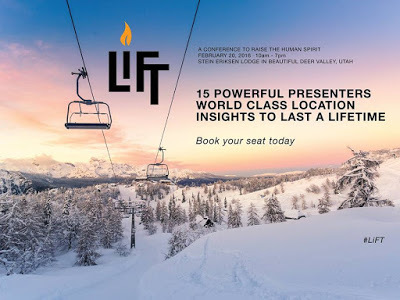 Tickets include access to 15 speakers' presentations, refreshments, and a formal lunch at the lodge. Register by 10 January to save $100 on the tickets.
Click here for more information on Facebook.
Click here to register and buy tickets.
 Tickets include access to 15 speakers' presentations, refreshments, and a formal lunch at the lodge. Register by 10 January to save $100 on the tickets.
Click here for more information on Facebook.
Click here to register and buy tickets.
November 7, 2015
Daniel's article on evidence for horses in Ancient America has been published by BYU Studies!
 It has taken a lot of time, research, editing, revision, and revisiting, but Daniel's article on horses in Ancient America has officially been published by BYU Studies Quarterly, entitled "Hard" Evidence of Ancient American Horses. It is in their latest issue, vol. 54, no. 3. Initially, the editors objected to the original title, saying that the evidence wasn't all that hard. Daniel explained that it really was a play on words, since the evidence presented consisted of bones and teeth, which are hard substances. Putting the word in quotes finally satisfied them.
We are very excited to have this information available to a wide audience. Some of it comes from the chapter on the Caves of Loltún from An LDS Guide to the Yucatán, which was further refined in Daniel's presentation on the subject at one of the Book of Mormon Archaeological Forum's annual conferences. More information was gathered during the research and preparation of this final paper, which contains images of rarely-seen artifacts from various museum collections and a graphic prepared by Daniel that visually explains the surprising findings of stratigraphic digs from sections of the Loltún Caves. We wish to thank Jack Welch for the initial suggestion and for all those who participated and assisted in bringing all this information together in final form for the publication of this article.
Click here to read the full article online from BYU Studies.
September 18, 2015
New YouTube content
Daniel has been figuring out how to organize his YouTube channel recently, and our videos are now organized in playlists. His presentations at the BMAF conferences are available, as well as videos of our first trip to the Yucatán Peninsula. He has been working lately on editing videos from our trip to Guatemala, Mexico, and Honduras to format it for YouTube. That work is still in progress, but should be up soon.
Watch Daniel's presentations on metals/plates and ancient horses.
Watch a video of our 2006 trip to the Yucatán.
Watch Daniel's presentations on metals/plates and ancient horses.
Watch a video of our 2006 trip to the Yucatán.
July 4, 2015
Getting closer to publication
With editing help from others, Daniel has finished rewriting his paper on evidence for horses in ancient America. The original text from his BMAF presentation has been formatted and updated to make it appropriate for inclusion in a scholarly journal. The last step was getting permissions for all the images included in it. Currently, it is schedule to be printed in the September issue of BYU Studies Quarterly.
Also, Daniel will be giving a fireside this Monday evening at the Rohnert Park chapel near his home. Anyone in the area that is interested is invited to attend.
Also, Daniel will be giving a fireside this Monday evening at the Rohnert Park chapel near his home. Anyone in the area that is interested is invited to attend.


