Jennifer Mosher's Blog, page 2
September 10, 2019
American Made – made my night
Last weekend we booted up Netflix to watch Tom Cruise play pilot Barry Seal in American Made and I have to say, I really enjoyed it.
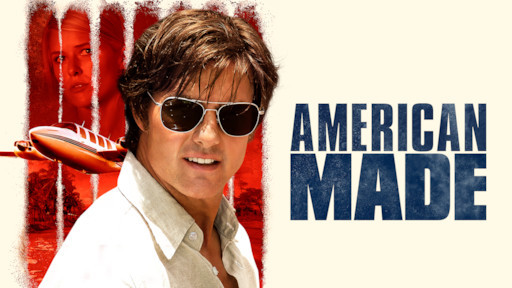 Image courtesy of Netflix
I know, I know, you hate Tom Cruise. Seems just about everybody does. But really, this thrice-divorced, couch-jumping Scientologist with a slightly off-centre set of teeth (did I miss anything?) is a bloody good actor – you just have to ignore whatever irritates you about the man and focus on his performances.
What I liked about American Made:
It was entertaining. It moved, it told a story, it had interesting, believable characters who all had their role to play. And it was quite often outright funny!
The opening scene was wonderfully original – I just watched it again this morning to remind myself how it segued from the conventional to the whimsical to the historical/educational – without me even realising it.
It was nothing like Top Gun. When I knew Cruise was playing a pilot, my first thought was ‘Ugh, bor-ing!’ But his characterisation of Seal was well-rounded, watchable and consistent. The initial scene sets the tone of his character so well.
I didn’t feel manipulated by the screenplay. So many movies attempt to amp up your love of the main character before putting them in a really dangerous situation so that your adrenaline is pumping, then saving them so you get a huge sense of relief. Unfortunately, those movies tend to just irritate me as I can see the manipulation happening. American Made doesn’t do that. Sure, you want Seal to win, even if he’s doing the wrong thing in part, and it takes good scriptwriting to get you to cheer for the guy who’s not so clean, but the script tells the story in a way that you can just sit back and enjoy it without feeling like you’re being emotionally manipulated.
It’s interesting. Depending on what you read, a lot of this movie is pure fantasy, but even if it is fully-concocted fiction, it’s still interesting: you can see how someone could be approached to work for the CIA and not be in a position to refuse. Then they’re approached by a criminal organisation with an offer to work for them, too – and again, literally not be in a position to refuse. Accept or die. And so it goes – until you have three or four masters and you’re trying to keep yourself alive while serving all of them. The ordinary person really doesn’t know – and never will know – exactly what goes on behind the closed doors of organisations like the CIA, and American Made, whether fact or fiction, did seem quite plausible to me … scarily so.
Spot the Plemons. Yes – I have developed a little game of ‘Spot the Plemons’. It seems Jesse Plemons is determined to pop up in everything I see these days, and while he only had a small role in American Made, he was, as always, worth watching. Ironically, I didn’t even notice him in The Master when I reviewed that – so he’s been popping up in front of me for longer than I realised!
The support cast – like Jesse Plemons,
the support cast were well-chosen and very watchable, believable and
entertaining.
The music! American Made makes
great use of the music of the time to remind you that you’re watching the 1980s.
So many songs I’d danced (badly) to … so many songs I’d forgotten …
It made me think – how much money is too
much money? And what’s the point in having it if you can’t spend it?
What I didn’t like:
Um … still trying to think of something …
Do yourself a favour (sorry, Molly!), and give American Made a go – especially if you’ve not watched a Cruise movie for a long time. I think you’ll be pleasantly surprised – and happily entertained!
Opinionated blogging – and movie reviewing. It’s at the top
of the page. ?
The post American Made – made my night appeared first on Jennifer Mosher.


May 24, 2019
The joy of a one-star review
In 2011, I released a little ebook called Simple Rules for Effective Business Communication. After several years and several thousand downloads, I figured I should probably make a paperback (PoD – print on demand) and audiobook version, just for those who don’t like an ebook.
Ironically, despite the thousands of downloads over the years, the ebook didn’t seem to garner any reviews – at all. But I figured no reviews was better than bad reviews – if it was that awful people would start jumping online and criticising it, so it was probably worth the effort to create the PoD and audiobook versions, which I eventually did, releasing them in 2018.
And then, thanks to the PoD paperback, it finally happened – someone reviewed it on Amazon!
With one star. 
October 23, 2018
Lest I forget Pt 2: Arthur McArdle 1898 – 1918
 Private Arthur McArdle
Born 1898 Died 1918
Today, 24 October 2018, marks exactly 100 years since my great uncle, Private Arthur McArdle of the 2nd Battalion of the Lincolnshire Regiment, lost his life on the battlefields of World War 1.
Back in April, on ANZAC Day, to be exact, I posted a sort of memorial to another great uncle – my grandfather’s younger brother, Edward Butler – who also made the ultimate sacrifice in World War I . Today’s memorial is to my grandmother‘s younger brother. I find it very sad to know that this married couple each suffered the loss of a younger brother in WW1. I suppose they would at least have had empathy for each other.
Honouring Private Arthur McArdle
Like Edward, Arthur lost his life in that last horrible year of World War I. But even sadder than Edward’s death at the age of 27, Arthur, aged just 20, was killed on 24 October 1918 – merely 18 days before the end of the war. Eighteen days. The difference between life and death. He was so close to being called home. He wouldn’t have known it, but he just had to stay alive for another eighteen days.
Like my great uncle Edward, I know very little about Private A McArdle, No. 42584, 2nd Battalion of the Lincolnshire Regiment, although from his enlistment notice I’ve worked out that he was probably born on 8 September 1898 – he was 17 years and 361 days old when he signed up for ‘Short Service’ on 12 September 1916. (Of course, 1916 was a leap year, so it’s also feasible he was born on 11 September 1916.) He was unmarried, lived at 1 College Arch, Whitehaven in Cumberland (now Cumbria) and worked as a ‘Carter and Driver’.
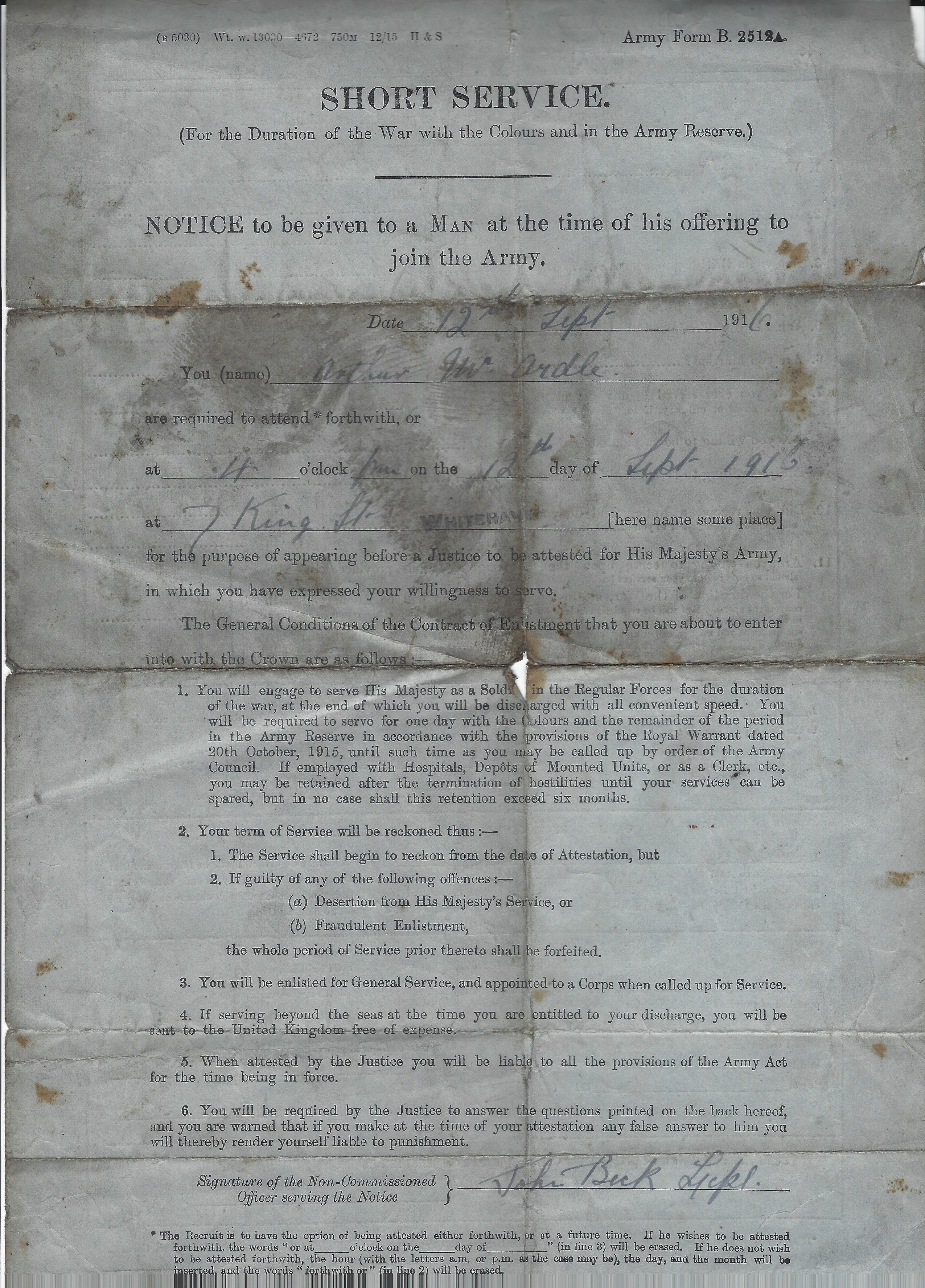 Arthur McArdle WW1 enlistment page 1
 Arthur McArdle WW1 enlistment page 2
Arthur laid to rest
I believe Arthur is buried at Delsaux Farm Cemetery, Beugny, in northern France. And following his death, the War Office paid my grandmother Rose Ann (McArdle) Butler – his oldest sister – compensation of £13 10/6, including a ‘War Gratuity’ of £9. His mother and father passed away in 1912 and 1916 respectively, and his eldest brother, John, was living in Bisbee, Arizona, at this stage, so his sister would have probably been noted as next of kin.
 Arthur McArdle’s headstone in Delsaux Farm Cemetery, Beugny, in northern France
Arthur’s nephew
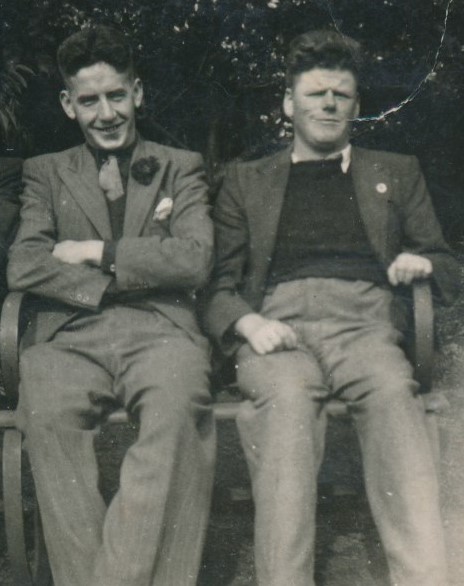 My father, Hugh Butler (l) with his older brother Arthur Butler (r) most likely named after Private Arthur McArdle
Interestingly, Arthur’s sister (my grandmother), Rose Ann (McArdle) Butler, gave birth to a baby boy in 1916 and named him Arthur, presumably in honour of her little brother, the baby’s uncle. Sadly, Arthur’s young namesake would battle polio as a child and only live until 36 years of age, passing away in 1950. Sadly, it seems no-one in the family was meant to be named ‘Arthur’.
War is a mongrel, no doubt about it. I can’t imagine how hard it must have been for my grandparents to each lose a younger sibling in that last, horrible year of World War 1. Ironically – and I only just realised this today – both Arthur and his sister’s brother-in-law, Edward Butler, served in the 2nd Battalion of the Lincolnshire Regiment. Same regiment, died six months apart.
And like Edward, Arthur died ‘without issue’ (i.e. leaving no children) and so very few people today are award he even existed. Will anyone remember either of them in a hundred years’ time?
Vale, Great Uncle Arthur. And thank you (and Edward) for making the ultimate sacrifice so that I and others like me could have the lives that we have today. I’m sorry neither of you had that chance.
The post Lest I forget Pt 2: Arthur McArdle 1898 – 1918 appeared first on Jennifer Mosher.
August 24, 2018
Getting history wrong
Back in December 2014, I wrote a post about an old photo I’d found in my late father-in-law’s little timber briefcase of photographic treasures. It was an image of a naval vessel with a partially-built Sydney Harbour Bridge in the background. On the back of the photo, someone (whom I have always assumed to have been the FiL, but it may just as easily have been the MiL) had written ‘HMAS Sydney, 1938’. As the Coathanger was opened in 1932, we knew the date was wrong and figured it was probably meant to be 1928, not ’38. But it never occurred to me that the ship (boat? vessel?) in the photo wasn’t the Sydney.
I had done a little research at the time of writing the original post as the FiL’s brother-in-law, Bernie Biram, had been on HMAS Sydney II when it went down off the West Australian coast in November, 1941. For various reasons, I figured the vessel in the photo was probably HMAS Sydney I.
I finished the post with three questions, the last of which was:
Which HMAS Sydney is it? No. I or No. II? My money is on No. I.
Well, it turns out I’m wrong – on both counts! (Yes, you read it first here, folks – a woman admitting she was wrong.) Not only is not Sydney I or II, it’s not even an HMAS Sydney!
I had an email from a lovely gentleman a few weeks ago who pointed out that it wasn’t a Sydney, that it didn’t look like one, and while I doubted he was correct, I had to prove him wrong (naturally!). And so the hunt began.
After discovering the wonderfully helpful http://www.navy.gov.au site, I was able to narrow it down to one of the Australias, and I’m pretty convinced it was Australia II. If you compare the original photo with the image below courtesy of the Australian Navy’s page here: http://www.navy.gov.au/hmas-australia-ii you can see the similarities in funnels, portholes, degrees off perpendicular which the bow and stern have been set, etc. The story of HMAS Australia II seems to fit with the photo we have on hand, so I’m hoping that we have now solved the history mystery!
 HMAS Australia II in front of the half-completed Sydney Harbour Bridge, ca 1928
 HMAS Australia II courtesy of http://www.navy.gov.au/hmas-australia-ii
So thank you, kind sir – you were right! And I am just extremely grateful that it was an HMAS Australia, and not HMAS Yarra I, for example – otherwise I’d still be hunting … 
April 24, 2018
Lest I forget Pt 1: Edward Ferguson Butler 1891 – 1918
The saddest thing to me about war is the number of people who die without leaving any children behind. Sure, it would be awful to be a child (or partner) of someone who died in battle, but a hundred years down the track, who’s going to remember and honour those individuals who haven’t left direct descendants?
Over the last decade, since the internet exploded with historical records, I’ve found that my grandparents (my father’s parents), each lost a brother in 1918 – the last year of WWI. Neither of these great uncles of mine – Edward Ferguson Butler or Arthur McArdle – had wives or children. (Certainly none that I’ve discovered so far!) And so here I am, a hundred years after the fact, and I’d be one of the few people left on the planet who knows they even existed, let alone feels a sense of sadness at their loss. And that seems bizarre to me – I never met them, have only known of their existence for the last decade, maybe 15 years tops, and yet I’m saddened at their respective deaths. I wonder why?
Honouring Private Edward Ferguson Butler
Edward Ferguson Butler first joined the 30th Northumberland Fusiliers at the ‘Apparent age’ of 19 years on 15 November 1915. He didn’t last long, though, being discharged on 27 November 1915 due to ‘suffering from ear disease with a discharge from it. He is never likely to become an efficient soldier …’
And yet, somehow, at some stage, he re-enlisted and was killed in action on 17 April 1918 – exactly one hundred years ago last week.
By this time Edward was serving with the 2nd Battalion of the Lincolnshire Regiment. I managed to find the war diaries for the week he was killed, and do you know the really sad thing? Other than officers, those reports don’t even mention the names of those who died, just the number killed (22), wounded (210), ‘wounded gassed’ (9), missing (52) and a total (293). Great Uncle Edward would have been one of the unnamed 22 soldiers killed. I suppose with numbers like that, who would have had the time, let alone the paper, to list them all when there’s the heat of battle all around you?
The end of the log reports (transcribed as typed) for the days leading up to and including Edward’s death say:
Orders were received at 4 p.m. to counter-attack at 6.0 p.m. 1st Objective – the PECKHAM – MAEDELSTREDE Line. 2nd Objective – the old line at WYTSCHAETE. The time for attack was afterwards changed to 7.30 p.m. and was to be in conjunction with the French on the right and the Seaforths on the left. The attack was most gallantly carried out under very heavy M.G. fire from the front and right flank, and pushed to a trench within 50 to 100 yards of the 1st objective, which was made good. This attack was carried out by the Battalion after a week’s heavy fighting, no sleep the previous night, and only partially reorganised after the recent SOMME fighting. It was carried out with the greatest dash and vigour, and only the fine spirit of all ranks in the face of every difficulty (such as heavy enfilade fire from the right, where the French attack never developed) enabled the attack to gain the ground it did. The Battalion consolidated the ground won, with the No. 2 Composite Battalion on their left.
The thing that strikes me about the above is the way it’s written: I can’t decide if he’s proud of the men, making excuses for them for not making more ground, or sending a veiled message back to HQ and the powers that be that they’re expecting too much of mere mortals and that these people are more than just dispensable pawns in a large, bloody game? The truth is in there somewhere, but we’ll never know now.
Losing Edward
Edward’s death place, from what I can work out, was probably near Lagache Farm or Vandamme Farm, in what was often then referred to as ‘France and Flanders’ (Belgium). I am not sure where these farms were located, but suspect they were around the Maedelstede to Wytschaete area.
And I have yet to find where Edward is actually buried. He is listed on the records for Tyne Cot Memorial, in Zonnebeke, Belgium, but doesn’t seem to actually have a grave there from what I can tell. Perhaps he was interred where he fell? Or left where he fell? Or maybe there was nothing left to bury?
Knowing Edward
I have no photos of Edward – no idea what he looked like, other than the notes made on his enlistment records for the 30th Northumberland Fusiliers, where he was described as being:
5 feet 3.25 inches in height (about 165 cms or 1.65 metres)
fully expanded chest measurement of 36.5 inches (about 93 cms)
weight 135 lbs (about 61 kgs, so a pretty healthy weight for his height)
with a ‘large hairy mole front of right arm, vertical scar front of left eyebrow’
6/6 vision in both eyes (I assume that’s what we would call 20/20 today)
no marks indicating any congenital peculiarities or previous disease
his teeth showing ‘slight defect but not sufficient to cause rejection’.
The truth is, I didn’t even know he had existed until about 10 years ago. My father (Edward’s nephew), born three years after Edward’s death, never mentioned him and I wonder if Dad even knew his Uncle Edward had existed. Did he know his father had suffered the loss of a younger brother in the war?
Remembering Edward
In July, 1919 (a year after Edward’s death), his brother and sister-in-law, my grandparents, William and Rose Ann Butler, named their newborn son Edward Ferguson Butler. That’s the most meaningful memorial I’m aware of to the life of young Private Edward Ferguson Butler. And probably nicer than any gravestone anywhere – at least his memory lived on in the family by way of his name.
Vale Great Uncle Edward. I never met you, and barely know you now, other than your physical attributes and the dates and some actions in your brief life.
But I’ll do my best to remember you.
Header shot of Tyne Cot Cemetery, Passendale courtesy of Davidh820 [CC BY-SA 3.0 (https://creativecommons.org/licenses/by-sa/3.0)], from Wikimedia Commons at https://commons.wikimedia.org/wiki/File:Tyne_Cot_Cemetery,_Passendale.jpg
The post Lest I forget Pt 1: Edward Ferguson Butler 1891 – 1918 appeared first on Jennifer Mosher.
February 1, 2018
Book review: Paradise Sky by Joe R. Lansdale
 Paradise Sky by Joe R. Lansdale
My rating: 5 of 5 stars
I bought the Kindle version of Joe R. Landsdale‘s Paradise Sky after seeing a sentence posted on Facebook by an author friend, Pemulwuy Weeatunga. Pem was highly amused by one of the lines in the book, and it amused me, too, so I asked him what he was reading. He told me the name of the book and so I downloaded the Kindle preview. I found it a little hard to get into – it wasn’t unenjoyable, just unlike anything I’d read before – but by the time I got to the end of the preview, I had to hit that ‘Buy’ button!
This book won’t appeal to everyone – the humour is deliciously off-beat, the writing is fast paced yet relaxed, and it’s historical fiction of a different kind – but it was one of the most original, entertaining pieces of educational fiction I’ve read in years. Sure, I’d suspect historians would question the integrity of some of the history lessons in there, but as an Australian, I learned things about American history that I never would have been interested in learning had I not read Paradise Sky – things such as who the Buffalo Soldiers were and why they were called that. That’s not something Aussies get exposed to. Many of us ‘more mature’ ones would know the term from the Bob Marley song, but outside of that how many of us would know it was actually real term? And why?
Mr Landsdale writes with a warm heart, a great sense of humour, and a marvellous way of mixing fact with fiction. And I do like entertainment that educates, especially when that education is incidental, as much as I like educational books that entertain.
While many of his plot points weren’t predictable, Mr Lansdale also has a way of taking you through the predictable ones in an unpredictable way. There was a point where some major drama was about to unfold, and I didn’t want to read it, expecting it to be handled the way most other authors would: as a high drama point, with lots of tension build up (usually ineffectual because the reader knows what’s coming most times anyway), and a run-of-the-mill description of the cataclysmic event. But not Mr Landsdale – he didn’t waste my time trying to wring every last vestige of emotion out of me. I think he’s smart enough to understand that if the reader is still there by that stage, they care – and don’t need him to make it unnecessarily, and tackily, worse.
Following Paradise Sky, I bought Honky Tonk Samurai, which I also enjoyed, although I probably should have started with the first in the Hap and Leonard series, not the last! (Note to self: do your research first; don’t just buy books because you like the title!)
In short: highly recommended as an enjoyable read from a refreshingly original author!
The post Book review: Paradise Sky by Joe R. Lansdale appeared first on Jennifer Mosher.
January 19, 2018
How a strained wrist saved my summer
It’s funny how different life is to what it was just fifteen years ago. We can compare even further back if you like, but there’s no need. In just fifteen years society has changed enormously, but I hadn’t really noticed the effect of certain changes until something simple and annoying made me sit up and take notice …
It doesn’t take much
I have long had to wear a wrist support on my dominant hand when typing. But in mid-November (2017) I was carrying something a little heavier than I should have in that hand, and the result was that by the end of the day my wrist was giving me masses of grief.
For the next six weeks as I worked hard to finish as much work as possible so that I could have a bit of a break over the Christmas/New Year period (hello, fellow business owners!), I found I had to ice my wrist in the evenings, give it lots of rest, and generally not do anything daft – like pouring liquid out of a container holding more than 500 ml – lest I make it even worse. (Luckily I had a willing accomplice to pour the Christmas bubbly for me!)
The main effect – apart from the pain and not being able to blindly lift or carry or move or pour whatever I wanted to – was that using the phone (as in mobile/cell phone – not landline!) hurt like hell. So texting, social media, reading stuff online etc., very quickly became painful if I did it for more than 30 seconds or so. The really weird upshot of that was I developed an almost physical reaction to the thought of putting anything on Facebook. Why? Because if I posted something on FB and someone commented, I would feel compelled to reply, to at least read and hit ‘Like’ or some relevant icon, so as not to appear rude, and I couldn’t bear the thought of getting caught in an FB conversation as I knew it was going to hurt.
Sure, I could have used FB on the PC (there’s gotta be a rap song in there somewhere …), but after being on the PC all day for work, I needed to shut it down and again, give the wrist a break. Not to mention my eyes and my hard-working PC!
So what did I do? Nothing. I posted virtually nothing to FB for about eight weeks, save for the occasional comment on someone else’s post. And do you know what happened? I had a great summer in the real world!
Admittedly, I felt a bit rude not posting anything, not sharing happy news or events etc., and not commenting on other people’s posts over those eight weeks, but living the way I used to live fifteen years ago was a revelation. I hadn’t realised how much I could achieve without all the social media interruptions. It was like giving up smoking – suddenly I had time to spare and a desire to get out and use it!
Living in the real world
Over the three and half weeks I had off we had our annual ‘MoshMas’ lunch with the kids a few days before Christmas, shifted a lot of furniture around and re-designed the office layout over about four days, visited friends and shared a bottle of bubbly with them on Christmas morning, spent the rest of Christmas Day relaxing with the jigsaw to end all jigsaws and just enough food and drink to feel happy, went to lunch with friends we hadn’t seen for nearly two years a couple of days later, the next night enjoyed a lovely dinner at our daughter’s along with her husband and in-laws.
 The jigsaw to end all jigsaws
We then spent a couple of days on my cousins’ farm and visited Fitzroy Falls for the first time in around 30 years (didn’t recognise a single part of it, which I found rather weird), had an ice cream in Kangaroo Valley (a little more familiar, thankfully, so I haven’t totally forgotten everything from the past!), visited the other half’s cousins on the way home on New Year’s Eve, spent three nights at Adina Apartments, Mascot and played tourist, and enjoyed dinner with our other daughter and her friend.
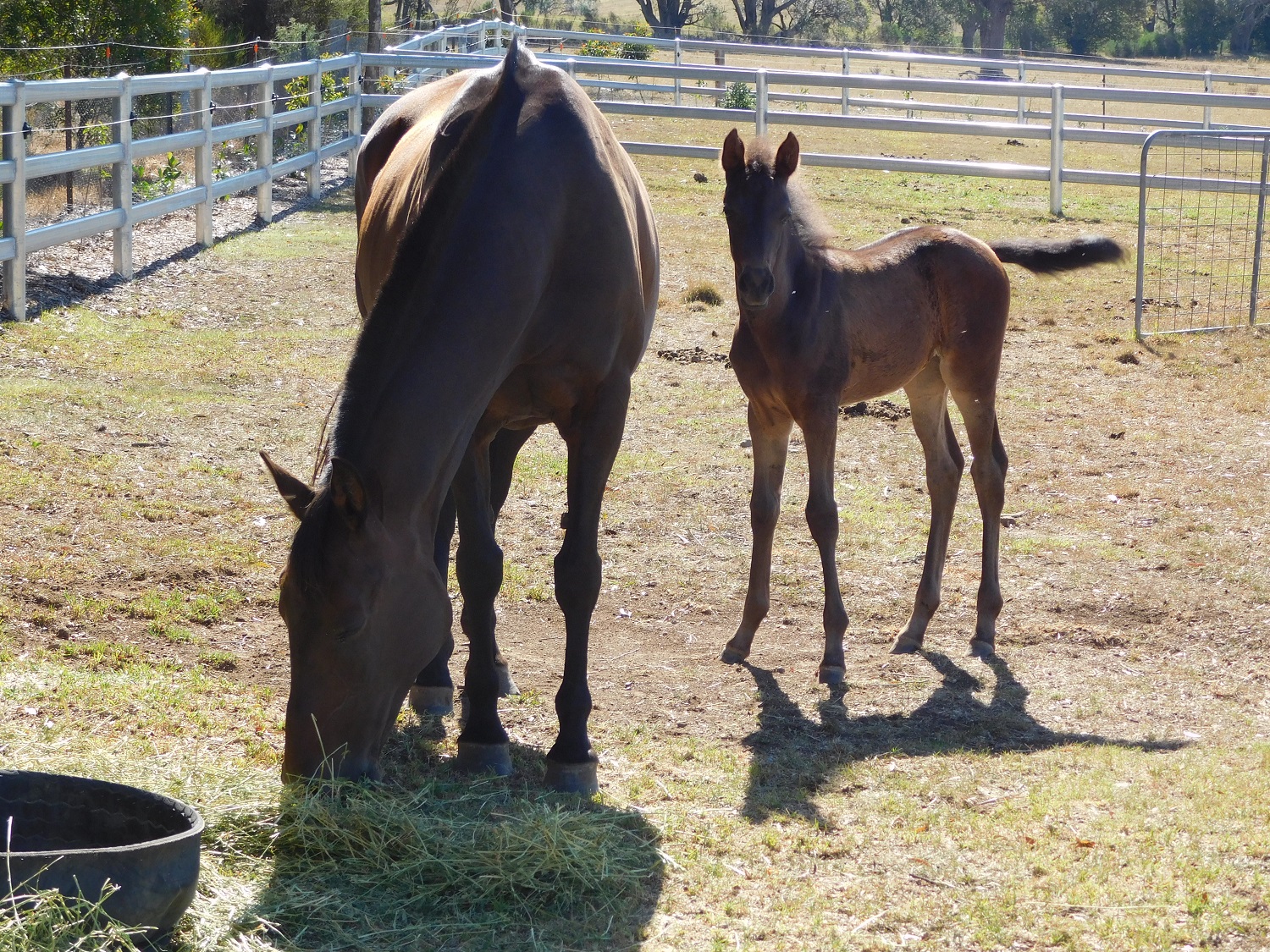 Foal on the farm
The next day we travelled to Manly via ferry, then visited a client and his wife and then other cousins in the northern beaches, then the next day did the Macquarie Street walk dropping in on Hyde Park Barracks, The Mint, NSW Parliament House, then the 1440 exhibition at the State Library, walked into the Botanic Gardens for a refresher and a visit to the Calyx exhibition/display.
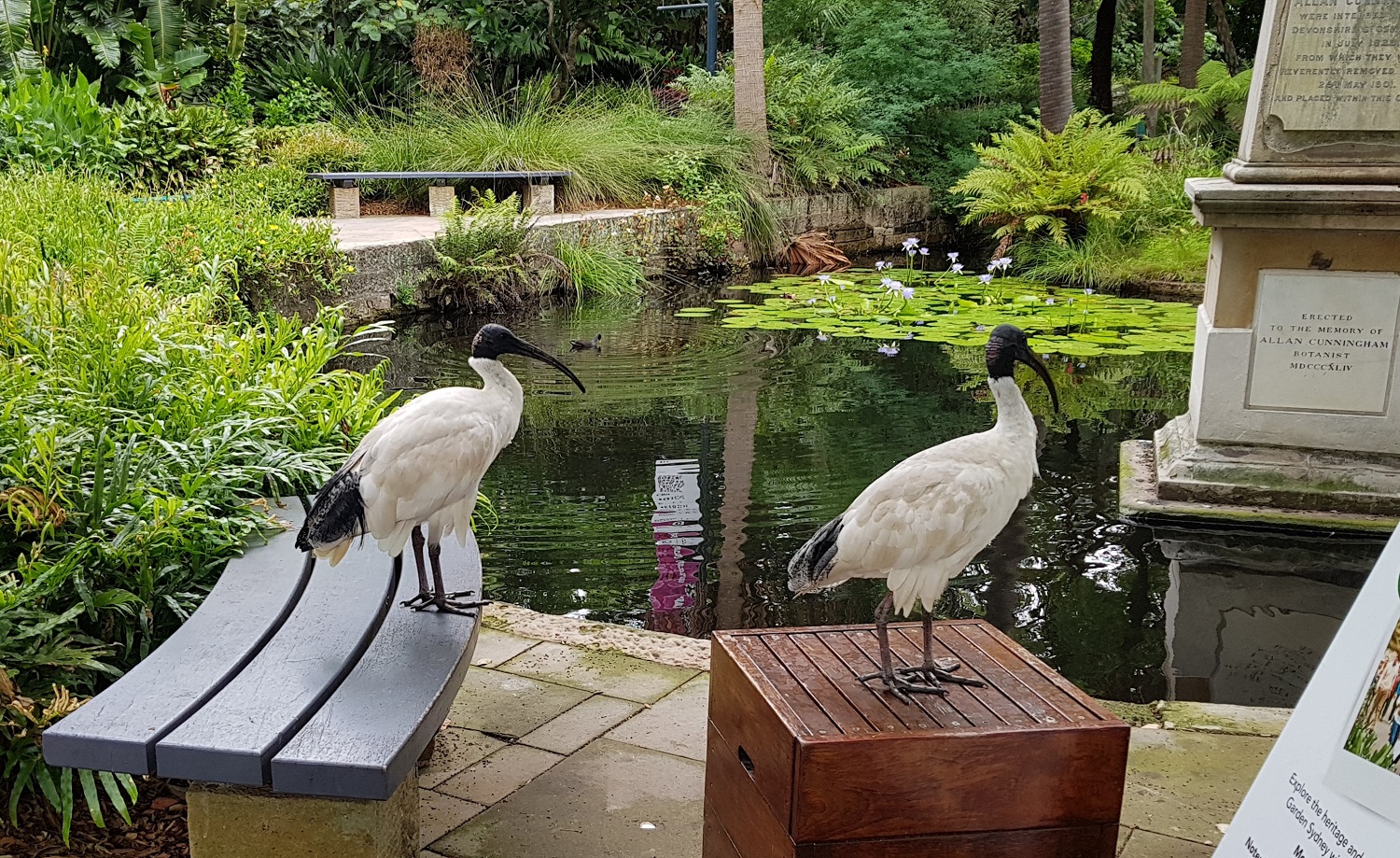 Ubiquitous bin chickens in the Royal Botanic Gardens, Sydney
After that, we sallied forth to the Museum of Sydney for the Underworld exhibition, followed by a refreshing drink in Macquarie Place thanks to Customs House Bar, with dinner at City Extra at Circular Quay as we people- and ferry-watched. (Exhausted yet? Or perhaps just plain bored? :D)
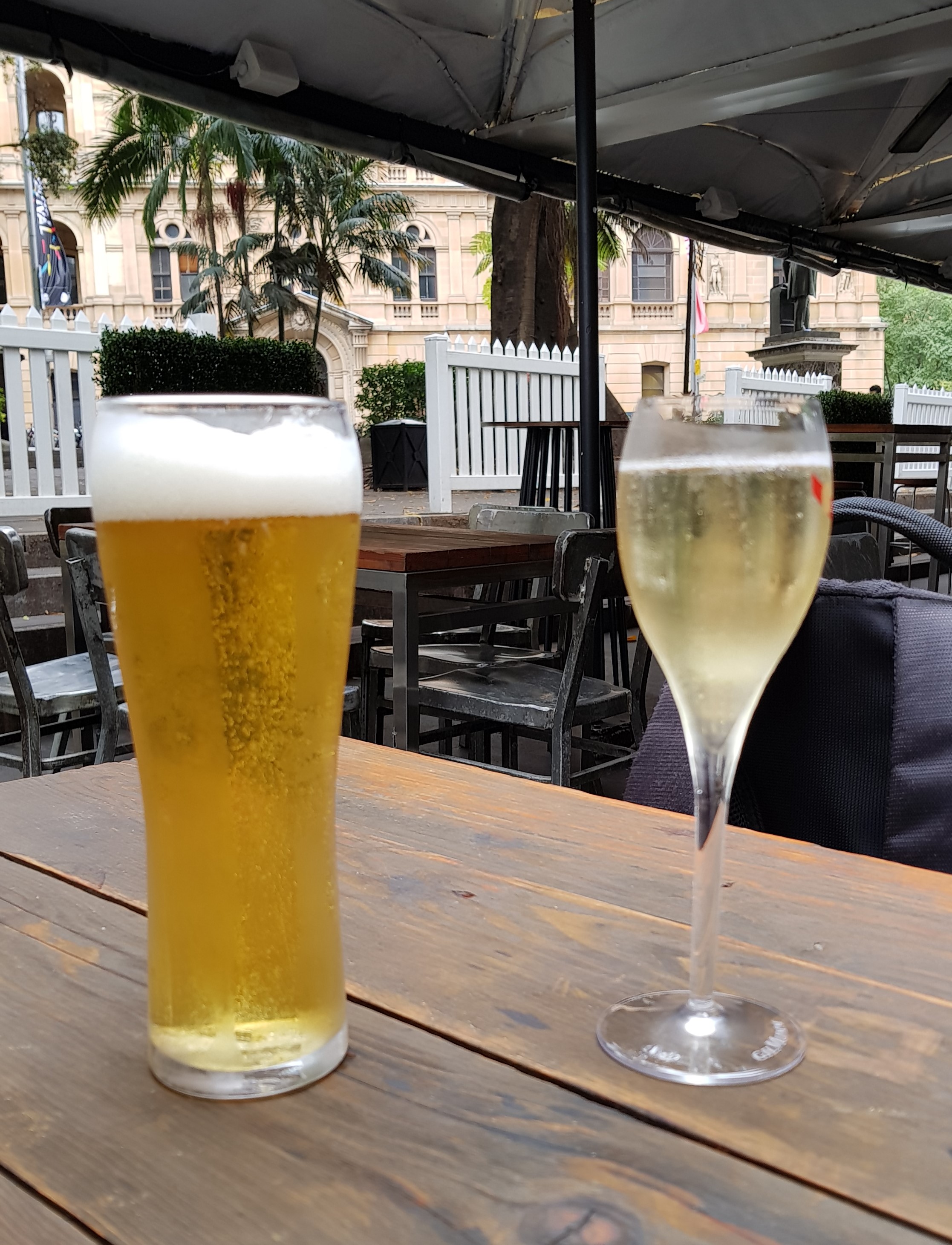 Refreshing refreshments, Customs House Bar, Macquarie Place, Sydney
At home I pottered in the garden (carefully), made some more bowls, finished a couple of paintings, did some more family tree research, had an evening on the back deck with nibblies, more bubbly and the neighbours (who then tried unsuccessfully to teach me Texas Hold ’Em when I probably should have called it quits and gone to bed), and updated my blog (with this self-indulgent diary of a blogpost).
And yes, I could have still done all those things AND posted to FB and, had my hand been good, I could have replied to comments and engaged in conversation. But without being able to do much on FB, I found that I wasn’t just doing stuff, I was engaged in what I was doing. I was present in the moment, every time. And I’d forgotten what that felt like – to just do stuff and enjoy it for what it was without thinking about how to fashion a social media post out of it.
So while I feel like I dropped off the planet as far as Facebook goes – and I’m sure one or two people out there must think I did, too (I am not going to delude myself that too many would have noticed my absence, however) – I’ve been very much alive in the real world and enjoying it in a way that I’d forgotten existed.
Back to the future
I will return slowly to FB, but probably less actively. And if I’m honest, you’ll have probably found this post as the result of an FB link. (Oh, the irony!) But having had this digital detox, I now know how good it feels to do that every now and again, and will certainly slot regular detoxes in, like a form of intermittent fasting for my mental wellbeing (not to mention my wrist), so that I can keep myself healthy in more ways than one.
Happy New Year and may you, too, enjoy the sheer indulgent pleasure of a digital detox or two in 2018.
The post How a strained wrist saved my summer appeared first on Jennifer Mosher.
June 30, 2017
Wynston Sit Stand Desk – product review
Last week I took delivery of a Wynston Sit Stand Desk from Officeworks. I’d ordered it online on Friday 16 June and it was delivered around 9.30 am on Monday 19 June. For starters – that’s PD impressive in my book! Ordering it was a pretty quick decision based on a recommendation from my ‘trusty sidekick’, Ally Mosher, who had been using hers for a couple of weeks by that stage.
A few years ago, when sharing a workspace with the delightful Sarah McCloghry, I also got to share Sarah’s Varidesk (thank you again, Sarah!). That was a pretty good experience, but Sarah’s desk weighed in at 23 kg – and that’s an awful lot of weight to add to a corner desk like mine which has no support where the sit stand desk was going to sit! So when I read that the Wynston only weighs in at 12 kg, it was a no-brainer.
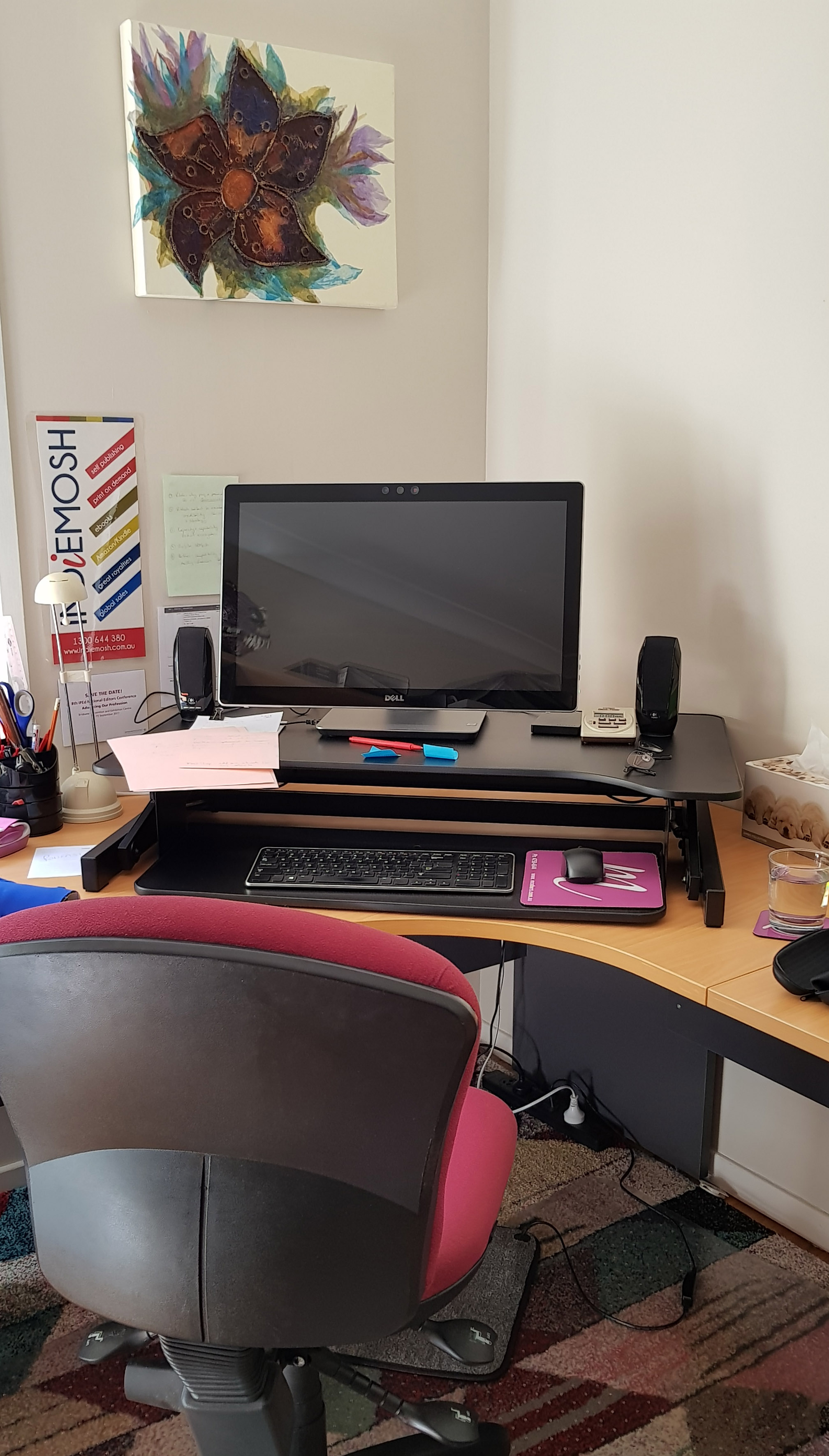 Wynston sit stand desk in seated position
The one issue I’d found with the Varidesk was the keyboard/mouse tray just wasn’t quite roomy enough for me, so when looking at the Wynston I figured I’d have to buy the large size to make sure I had enough tray space. I’m pleased to say I now do! What I also like about the Wynston’s tray space – but which will annoy others – is that it’s flat across the front, no shapely curving indent like the Varidesk, and it has a small finishing edge on it, probably for protection of the MDF, but that little lip helps stop my pens rolling off!
The keyboard tray pulls out and then pushes in when you need to get it out of the way. It will also stay out in the collapsed position, so that’s handy. I was concerned that its degree of extension would be tied to the height of the desk, but it’s not.
So I’ve been using the Wynston for just over a week now and I have to say I’m pretty thrilled. In the sit position, my monitor is actually at a better height than when it was just on the desktop. I hadn’t realised that I’d been stretching my neck muscles just that little bit and working at the wrong angle. I have a Dell all-in-one and although the monitor is large and tilts, I can’t raise or lower it. So having it at a better height when I’m seated is a bonus.
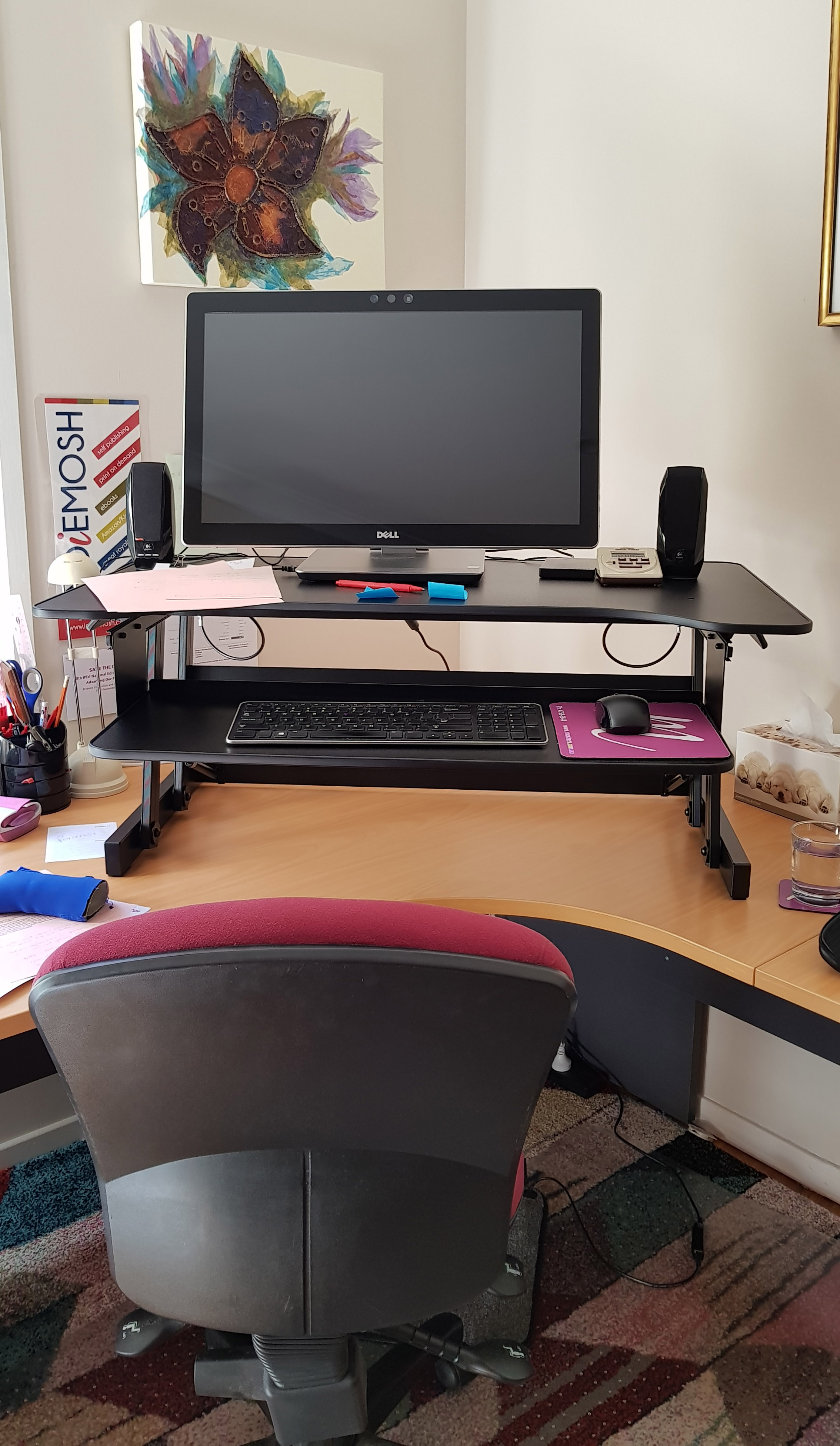 Wynston sit stand desk in standing position
The Wynston has five height settings, and when I stand, I find everything quite comfortable at the top level. I’m about 170 cm tall (five foot six inches in the old language). The monitor could probably be a little higher at that point, but it’s okay. However, for my height, I find the fourth highest level is best – it allows my shoulders to drop so that I’m not lifting my wrists to type. Again – bonus! But I find the monitor a little low at level four, so I tilt it back a bit so that it’s facing up a bit and that solves the problem. However, if I was too much taller I don’t think even the top height would be high enough for me, so if you’re more than 180 cm tall, I’d recommend trying to see one in practice before buying online so that you have a feel for whether or not you’ll need to build your desktop up.
To move the desk between its five height positions, you simply grab the release mechanisms either side of the top level of the desk and press in, then apply pressure to lower or lift the top level and the mechanism below collapses or stretches accordingly, lowering or raising the whole kit and caboodle.
The only issue I have – and I seem to recall having a similar issue with the Varidesk – is that it will ‘lift’ off the desk a little when being opened up to the standing position. I thought perhaps that I needed to pull towards myself more, rather than lifting, but this morning I managed to start pulling the whole thing towards myself – so I quickly canned that idea! It’s harder to do that with the Varidesk due to its weight. Once the day is in action and I’m putting it up and down, it moves a bit more smoothly, so it could just be that, like many of us, it’s a bit too cold to move smoothly first thing in the morning! It may also be that in time the mechanism will wear in and move more readily.
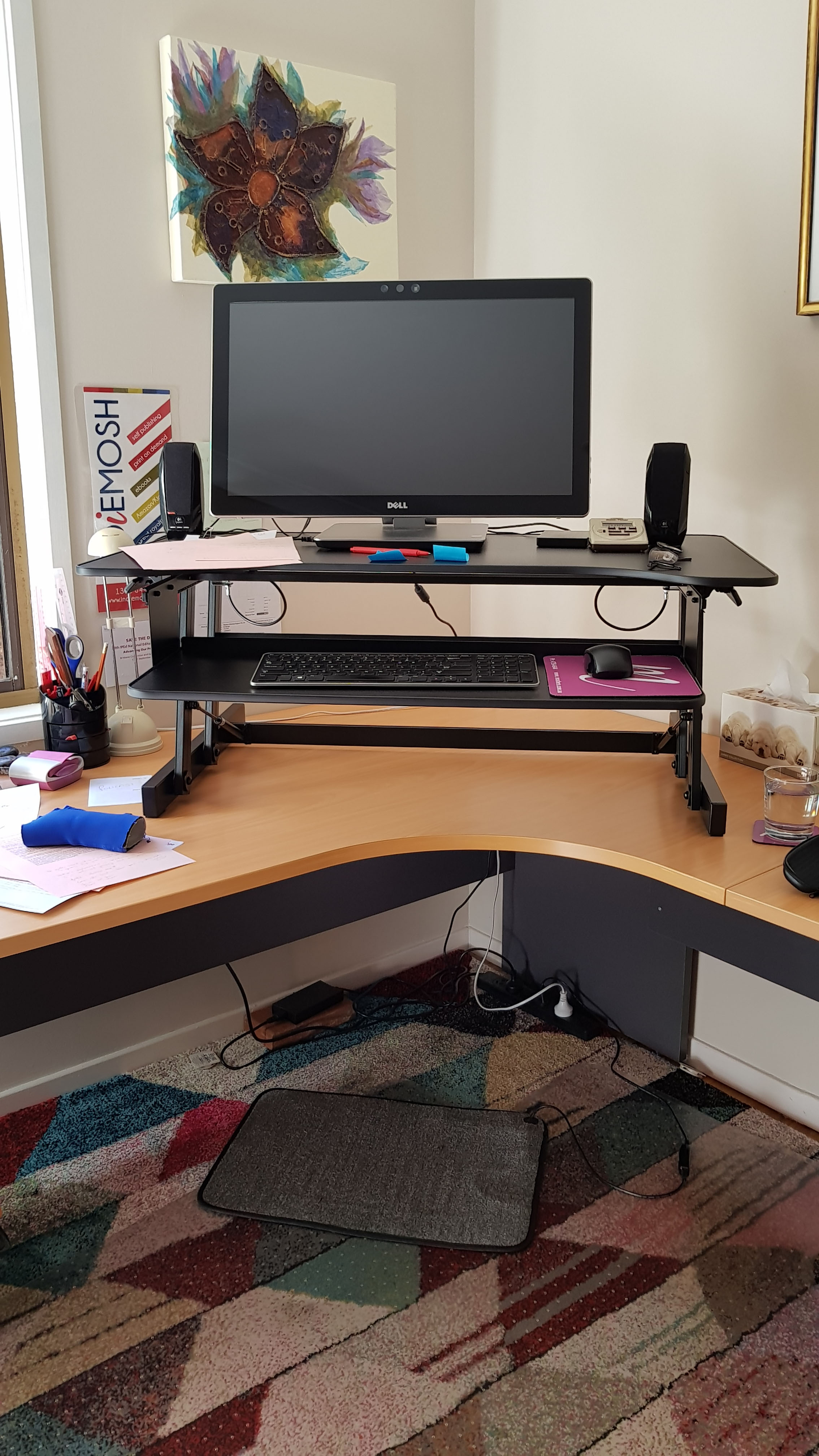 Wynston sit stand desk in standing position, sans chair (and yes, that’s a heated floor mat under my desk – lovely!)
On the first day, I stood for around two hours before suddenly realising that I’d been standing too long – and that’s something I’ve had to become aware of. I’ve dialled back my enthusiasm a little and am being more aware of how long I’ve been on my feet and returning the desk to the sit position and my bottom to the chair after about an hour. In total I’m probably getting three to four hours standing per day, on average, and that’s at the end of the first full week. So I just have to remember to change position every hour or so and I’m right!
Long story short, if you’re thinking of getting a sit stand desk and you’re worried about the investment, then start with the Wynston – the Varidesk is beautifully finished and probably a better product, but after just over a week’s full experience, and after having used both products, there is absolutely nothing wrong with the Wynston in my book.
(This is an unsolicited review and I have not been paid for it, nor do I earn any income from any of the links in this blog post. JM)
The post Wynston Sit Stand Desk – product review appeared first on Jennifer Mosher.
December 17, 2016
Author hack: How to write a book in eleven easy steps
 I meet a great variety of people in my business, but the ones who entertain me the most are those who say, ‘I want to write a book.’ My question is always, ‘What’s stopping you?’ The myriad of answers (excuses?) is always interesting (and, I have to admit, sometimes perversely entertaining), but the bottom line is that, for many of these people, they don’t really want to write a book, they want the book to write itself. They want to see a book with their name on it, but they don’t want to do the hard yakka to make it happen.
Well, sorry folks, books don’t write themselves. But if you do want to write a book and need a guide to get it done, here’s my author’s hack on how to write a book in eleven easy steps:
Think of an idea. Could be a story you’ve made up (fiction), or something real that you want to share with the world (non-fiction).
Start writing. Truly. You would be astounded to know how many people can’t even tick this step off their lists.
Keep writing until you can’t write any more. Keep writing until the book feels finished, until you’ve got nothing left to say on the topic. Don’t stop to edit. Just keep writing. Like this. One sentence after another. If you need to work out how to kill off Brad so that Janet’s left alone in the big, creepy mansion, type such a line in big red letters: ‘Work out how to kill off Brad so that Janet’s left alone in the big, creepy mansion’ and come back to it later.
When you feel that you’ve finished writing, revise, starting without working out how to kill off Brad so that Janet’s left alone in the big, creepy mansion, and the other big red issues that you’ve highlighted.
Revise, revise, revise.
Send out to beta readers. Choose a variety – people who are likely to be supportive as well as people you know will be happy to criticise you. You need to know what’s going to work and what’s not going to work for the Average Joe Reader. And ironically, it won’t be the same from one Average Joe Reader to the next.
Face the feedback. If you can’t cope with people you know making suggestions, then you’ll never handle honest reviews from total strangers!
Revise, revise, revise. You don’t have to take onboard everything your beta readers said, but you should at least consider the points they make. Then toss out what won’t work for you and adopt what sits comfortably and is in line with the sort of book you’re trying to produce.
Consult an editor. Yes, seriously. Even if you were an A grade English student in high school, consult an editor. You will be shocked to find out what you don’t know.
Revise.
Seek self publishing options. Seriously. Self publishing. If this is your first book and you’re not a celebrity chef, then you’re highly unlikely to get a publishing contract, even if Janet does escape the mansion in the most spectacular way possible thus creating the best potential movie premise ever. So don’t waste your time. And even if you’ve had five books published, even ‘traditionally published’ authors are now jumping ship and self publishing. There’s no shame in it. It is the 21st century after all.
So, follow the above steps and – voila! – you’ll have your book. Simple as, hey?
Happy writing!
Find an editor:
Editors in Australia:
IndieMosh experts: http://indiemosh.com.au/find-an-expert
IPEd: http://iped-editors.org/
Editors in the UK:
SfEP: http://www.sfep.org.uk/
Editors in the US:
ACES: http://www.copydesk.org/
Self publishing in Australia (also known as ‘shameless self promotion’):
IndieMosh: http://indiemosh.com.au/
Self publishing for Australian authors: http://jmoshereditor.com/products/books/
The post Author hack: How to write a book in eleven easy steps appeared first on Jennifer Mosher - Editor.
November 18, 2016
When I die …
 When I die, I want to be buried in a cardboard coffin. I want it to be painted cerulean blue (to reflect the Australian sky), with white clouds on top of that.
At my funeral service, I want people to be given Sharpies in bright colours so that they can write notes to me on the clouds on my coffin. I hope that I die before my children so that they can see what people write to me in their farewells.
I don’t know how I want to die. There is something to be said for it happening quickly so that you don’t have time to think about it, or know that it’s happening. But there’s also something to be said for having time to get your affairs in order, to reach out to those that you’ve been meaning to reach out to for far too long, to say your goodbyes and thank yous. (Yes, that’s ‘yous’ not ‘youse’!) I don’t think I’ll try to put an order in – I’ll just accept what comes. Not that I’ll have any choice.
I want my funeral service to be relaxed. I’m not religious, so I don’t want it in a chapel or a church – it needs to reflect me. I don’t like going out much, so perhaps it should be at home – with me in the corner, like a wake. I think that’s the Irish coming out in me. Maybe the family could put on a few drinks and munchies and set aside an afternoon for people to wander in and out and say their goodbyes, share their memories and pass on their condolences. That would be a good time for them to write on my coffin, too, me thinks. Pity I won’t be around to see what they write! Or maybe it won’t be …