
Eilis O'Neal's Blog, page 8
April 6, 2011
Narrated Dreams
Example: Two nights ago I had a dream that I was a girl in a vaguely Regency England world. I was going with my mother and sister (not that it was my actual mother, because she was really mean, or that I have a sister in real life) to a ball, one that happened to be taking place in the church that's attached to my old Catholic elementary school. I was at the dance for a bit, and then I realized that there was a group--two girls and two boys--who were acting strange. They snuck off, going up a secret stair to an upper level of the building, and I followed them. They had, it turned out, the ability to use magic, and they were being taught by an older wizard. As I was following them, though, they caught me, and I had to prove that I could use magic, too. I did so by conjuring some little balls of light without any prep, which was apparently impressive, because they invited me to join them and meet the older wizard. So I went with them, but when I met him, I realized he was Evil.
This is where the narration kicks in. I need to run away, because they're not going to let me go now that I know their secret. I run down this dusty, unused corridor, and I need some light. So I summon a couple of balls of light out of my fingers, and I hear this voice going, "She flicked three small, glowing spheres ahead of herself to light the way. They illuminated the corridor, revealing the stair that would lead back to the dance." I get downstairs and realize the dance is over, that my mother is probably looking for me, and that I'll be in even hotter water if she can't find me. Cue: "She looked frantically for her mother and sister, but they were nowhere to be seen. Behind her, she could hear the steps of the others coming down the stairs."
There was more of it, but my memory of has gotten a little hazy, because the dream started to fall apart then, as they do, eventually devolving into something to do with scooters outside my actual mother's place of work.
This isn't the first time I've had these sort of dreams, and, since I've always been a reader, I'm putting them down to the more intense writing I've been doing the last few years, rather than just my reading. Interestingly and appropriately, I generally get the narration when I'm having a dream that has a heavy story quality, not one that's bouncing around all over the place. Thinking back, I realize that it's always my voice doing the narration. The narration is never very well-written, but it's still pretty awesome, because even in the dream, some part of me recognizes it and feels like I'm in a book.
Anyway, I like that there's part of me apparently trying to write even when I'm asleep. Does anyone else have dreams like this?


March 31, 2011
New Interview Up
March 28, 2011
Bookish Nostalgia
Not so as a kid in the 1980s. Back then, I had two big options for acquiring books. The children’s sections of mall-based bookstores—big stores like B&N and Borders didn’t exist in yet in Tulsa, and there was only one independent store that my parents went to—and the library. Of course, I managed all right with these two options—my young life did not lack for books. (Still, I remember the frustration of accidentally buying the second book in Diane Duane’s Young Wizards series and not being able to find the first for over a year, because the bookstores just weren’t carrying it and the library didn't have it. And I actually convinced my school librarian to let me buy a book from my middle school library when I graduated, because it was out of print and I'd never seen a copy anywhere else. I had a list prepared to show that I was the only kid in school who'd checked it out for two years, and she actually let me buy it for a dollar.)
There were also two other ways of getting books then, ways were more limited but somehow magical when compared to the bookstores and the library. There were the Scholastic book forms that were delivered to us at school every month, and there was the school bookfair.
I loved both of these. I yearned for the days when my teachers would deliver the Scholastic book order forms printed on their thin, thin paper. My parents always set a certain dollar limit for my purchases, so I would take them home and pour over them, weighing this book against this book, deciding if I wanted three books or could handle just getting two, because one of the ones I wanted this month was more expensive than usual. I loved filling out the tiny form on the back and delivering it to my teacher. And I really loved the day the box of books came in. The best was when it came on a day with a light work load, so that the teacher might slit it open and hand out the books at 2:30. The worst was when it came and we were still working hard on something, so that the box sat there on the teacher’s desk until school ended, with me knowing that my books were inside it, begging to be let free to join me.
And then there was the school bookfair, which always took place in the library during Catholic Schools Week. Unlike the city library or the bookstores, the bookfair was just for kids—every book in it was geared towards readers my age. I would go to the bookfair every day after school to scope it out, and then, on the day where parents were allowed to come eat lunch with their kids, we would go the library after we’d eaten. Because it was a once-a-year thing, my parents went a little crazier here—I remember getting to fill my arms with books.
So, like I’ve said, as an adult in 2011 I can acquire pretty much any book in the world. And yet, I miss the magic I felt when that box showed up on my teacher’s desk or when I walked into the school bookfair for the first time. There was a special thrill, a sense of unending possibilities—one that I can’t quite capture as an adult who actually has unending book possibilities on her computer. It makes me a little sad sometimes, especially because I know I won’t ever be able to recapture it. Because it was born of not having access to any book in the world, and just of being ten years old.
Last week, though, I got to recapture just a tiny taste of it, when the University School at TU, where I work, had their own bookfair. An email went around saying that, along with the regular bookfair, they were selling some “gently used” books for children and adults. Naturally, this got me out of my office in about 10 seconds flat, and as I walked into their library, all set up with the bookfair shelves and books, I felt like I’d gone back in time. And when I got to talking to the librarian about my bookfair/ book form nostalgia, she even pulled out a sheaf of Scholastic book order forms. “Here,” she said, smiling like I'd given her a present, “you can take one with you.”
And so I did. And my inner ten-year-old was happy.
March 22, 2011
New Book Recs
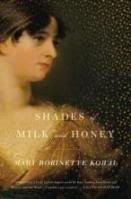
Shades of Milk and Honey
Imagine the world of Jane Austen. Remember to add sibling rivalry, foolish engagements, dances, and outings to pick strawberries. Now add that, along with skills like playing the piano and needlework, it's considered essential for a woman of quality to be able to manipulate glamour, or magic. And so you have Shades of Milk and Honey by Mary Robinette Kowal, which is the book that has charmed me the most in recent days.
Seriously, I loved this book. The magic that Kowal adds to her alternate Britain is so wonderful and unique--and even gives an actual excuse besides tight corsets for young women to faint (or at least pretend to). The characters are all nicely familiar from Austen, but without being mere copies--they're vivid and intriguing, from the Jane, the plain sister who's great at using glamour, to her beautiful sister Melody, who isn't good at anything besides being beautiful and knows it, to the gruff, often annoyed glamourist Mr. Victor. Very excited to hear that there's a sequel in the works.
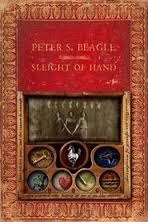
Sleight of Hand
Sleight of Hand is Peter S. Beagle's newest short story collection, and I have to say that I'm pissed at him. He made me cry--completely unexpectedly--twice during the course of reading it, once during lunch at work! The title story, about a woman whose husband and child has just died, is heart-wrenching and happy-making all at once. And the collection ends with a new story about Schmendrick, the rather hapless magician of The Last Unicorn. We get to learn a little about him before he meets a certain unicorn in a certain midnight carnival, and that's just fine with me.
Wee Free Men
So, I'm a little behind the times on this one, seeing as how it came out in 2003 and there are over 30 books in Terry Pratchett's Discworld universe. (Honestly, though, that's part of the reason I'm behind the times. Does anyone else freeze up when they find a book series or world that is ginormous? Because if you like it, that's a lot of books to buy, and a lot of time to spend reading them. It can be a bit daunting to me.) Anyway, I finally took the plunge to read the first of his books concerning young witch Tiffany Aching.
And I'm really glad I did. I wasn't sure going in how I would deal with the tone of Wee Free Men. The book is . . . silly, there's no other word for it, and mixes modernisms and typical fantasy tropes so liberally it makes Peter Beagle's "Have a taco" moment look like chump change. And sometimes I don't do very well with books like that. But Wee Free Men is just plain funny, and right when you think you're surrounded by nothing but silly, Pratchett pulls out a line or an archetype that leaves you reeling. Can't wait to read the rest of Tiffany's books, and, if I'm brave, the other Discworld books as well. (Typo when writing that last line: Discoworld. I think that would be a different thing altogether. . . . )
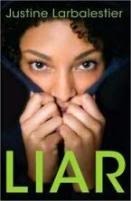
Liar
I've left this book for last because there's almost nothing I can really say about it. I mean it. Anything I say is likely to ruin some aspect of it for you. What I can say is that Liar is a psychological thriller told from the POV of a compulsive teenage liar. And it's awesome. You can read it so many ways, and probably argue with another reader (or even yourself) about them for days. Just check it out, and I think you'll be glad you did.
So, are there any books you've loved recently that I ought to add to my TBR pile (scary though it is)?
March 18, 2011
Knit One . . . Slowly
Here's what I've learned about myself and knitting so far:
Knitting is not relaxing. I generally feel like I need two extra hands, especially when learning a new stitch. And, somehow, I keep thinking that getting really good at one stitch should make it easier to learn the next one, but I always end up with that needing-four-hands feeling.Knitting doesn't actually help me take my mind off anything. Mainly because I can't just knit. If I try it, I get bored. I need to be doing something else and knitting. Which is problematic because:I'm not able to have actual conversations when knitting. If you try to talk to me while I'm knitting, I respond about ten seconds too late to everything, and generally preface that with "Wait untilI I get to the end of this row." Not very sparkling conversation. Also, I miss about half of what anyone says, because I'm counting stitches.I can, however, knit and watch/listen to TV shows that I've already seen, as long as they don't have heavy visual interest. So Buffy (especially any episode with Spike in it, because he is of very heavy visual interest) is out. But Star Trek is in. So I've knitted my way though about three seasons of TNG.I can also listen to music, so I'm hoping that when we run out of Star Trek, I can get some books on tape and knit while listening to them. Whether I'll be able to get books I've never read before remains to be seen.But, all that said, I'm really enjoying it. I feel productive when I'm knitting, and am looking forward to one day being able to make very awesome, fantasy-esque things like this and this. When this will occur, I'm not sure. But I keep telling myself that it will happen.As for what I've actually knitted, so far I've managed to make a scarf and 1/4 of a ruana. (Was very sad yesterday to realize that I was only 1/4 of the way through the ruana. I had somehow read the pattern to mean that I was halfway done.) And so, I proudly show them off:
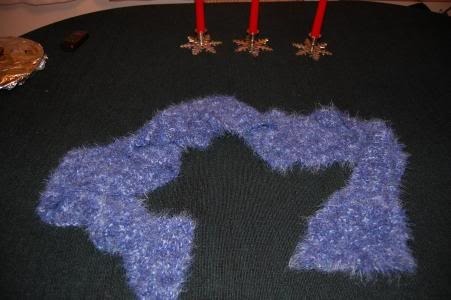
My first project.
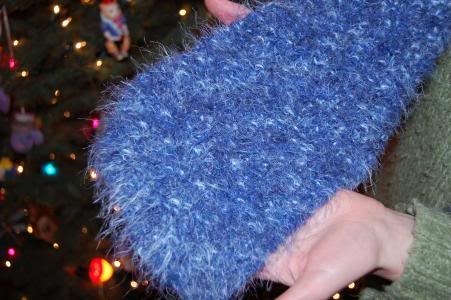
Warm fuzziness.
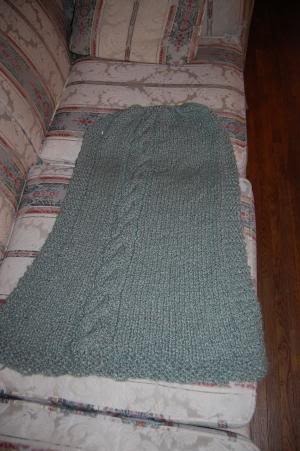
Current project. The left front of the ruana.
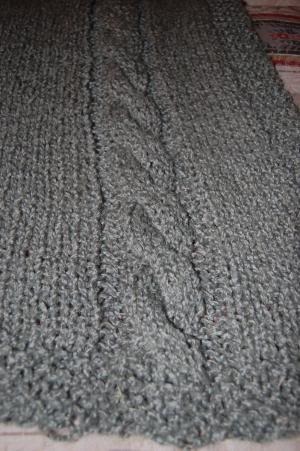
The cables of which I am ridiculously proud.
*Yes, the scary issues have, thankfully, thankfully, gone away. Hopefully never to return.
March 14, 2011
The False Princess: Name Edition II
Thorvaldor: I remember that I came up with both the name of the country of The False Princess and the name of the capital city pretty quickly. I like the strong sounds of Thorvaldor, but also that they aren't sharp. Also, the play on the word “valor.”
Vivaskari: I wanted the name of the capital city to sound bright and glittery. Something that would match the way Sinda would see it in her head once she was forced to leave it. Managed to work in the same sounds as “vivid,” which I like.
Treb: Treb is named to sound as different from Vivaskari as possible. The ultimate bumpkin town, one that you would never even think to visit, much less live in.
Isidros: In some ways, Isidros is slightly misnamed. It has a very Greek sound to it, while nothing else in the world really does, except, perhaps, to a lesser extent, the name Philantha. I think it has that Greek sound because it's where the oracle lives, and that made me immediately jump to Delphi, etc. I named it so early on, though, that I never could go back and change it.
Orianne: I wanted the name of the girl who replaces Sinda, but isn’t actually the princess, to be really princessy. Something soft sounding and very beautiful, almost calming. I also wanted it to be even “classier”, if that make sense, than the name Nalia—Melaina would have made sure that her daughter had an awesome name. FYI: Orianne is doesn’t end with the same sound as the name Anne, but with a soft a in the third syllable: “Or-ee-ahn.”
Funny story about this name. Apparently my husband would happily name a daughter this if we had one. Which I totally get, because I think it’s a beautiful name. But I keep picturing trying to explain to a kid that mommy and daddy named her after a character that mommy killed off . . . .
Melaina: Melaina wants to be queen. Since she can't be, she wants the next best thing, which is for her daughter to be queen. So I wanted her to have a name that sounded fairly regal. Melaina's also very sure of herself, and of what she views as her family's rightful place in Thorvaldor. So I wanted her name to have strong sounds to reflect that.
Neomar: Neomar has a name that is, in many ways, a red herring. Knowing that Sinda was going to see him as a suspect for the conspiracy, I wanted him to have a name that might lend itself toward people distrusting him. Thus, you have a name whose syllables read “new bad.” Also, the rather clipped, harsh sound of the name indicts that he's not going to be really nice, even though he isn't the actual Big Bad.
While we're on the subject of names, though, there's one thing other about the book that's interested me in terms of names. I've been interested to see how many people call Sinda or Mika or Orianne by the name of Nalia. It's a little odd to me, because only Mika is really named Nalia, and she is only called that once or twice in the whole book. And I never even think of her as Nalia.
It's not a bad thing, just not something I had anticipated because, for me, it ended up that no one was really named Nalia. It became a name attached to all three girls, but one that wasn't really any of theirs.
March 9, 2011
The False Princess: Name Edition
So I thought I'd share some of my thoughts about the names in The False Princess and why I picked them.
Nalia: The name of the princess of Thorvaldor, which Sinda thinks is her name for her first 16 years. I knew when I was creating the name of the princess of Thorvaldor, I wanted it to be a flowy, feminine, soft-sounding name. Something that sounded particularly princessy.
Oddly, I actually ended up stealing Nalia’s name from myself. It’s the first name of the princess in a short story I wrote called “The Prophecy Predicament,” which was published in 2006 by Leading Edge. I decided I liked the name enough to use it again, but there’s no relation between the two princesses, or the two worlds. (And that Nalia actually has much longer, very silly princessy name: Nalia Isidor Setephania Ophelie . . .)
Sinda: The true name of my main character, who has grown up believing she’s a princess. So, knowing that I wanted the official name of the princess to be breathy and princessy, I also knew that I wanted my name character’s real name to be the opposite of that. A name with harder sounds, clipped almost. Not only because the reader would feel the difference, but because Sinda herself would. Her very name, in the ways it's different than her supposed name, would make her feel her demotion even more. I also liked that the first syllable of her name is “sin,” which brings with it the idea of something wrong or bad—which Sinda initially feels about her change of circumstance.
A few people have asked me if I meant to play on the name Cinderella, and I have to say that the similarities of sounds of the two names didn’t enter my head until I was asked about it. Not that they weren’t there in my mind subconsciously, but I didn’t think of them at the time.
Also, it was actually a bit tough coming up with Sinda's name. I spent about two days writing absolutely nothing, while I tried to figure out what this girl's name was!
Kiernan: Sinda’s best friend, an Earl’s son. Kiernan’s name was one of those that I didn’t have to think very hard about. I tossed around Sinda’s name for quite a while, making sure it was right and weighing it against others. But Kiernan showed up and was named within a few minutes. In retrospect, I like that his name has some of the same sounds as the words “clear” and “keen,” because his feelings for Sinda and his loyalties are quite clear and keen. But I can’t claim credit for creating it that way.
Something I’ve noticed as I create names for book characters is that I have a weakness for boy’s names that start with K. In fact, I’ve had to occasionally force myself to choose other letters for main male characters—not everyone can have a K name, I have to tell myself! I’m not sure why this is—there aren’t even any male role models in my life with K names. I just apparently like them.
Varil: Sinda’s aunt, whom she is sent to live with after being evicted from the palace. I wanted Sinda’s aunt to have a very hard, pretty sharp sounding name. Something that would mirror her personality, and that wouldn’t sound at all comforting. To my ear, it’s harsher than Sinda’s name, but there’s a similarity about the sounds, which I wanted because they’re related.
Philantha: An eccentric wizard who takes Sinda on as a student and scribe: I wanted Philantha’s name to reflect her personality. So it’s breathy and a bit long-winded, and different from most of the other names in the book, though it still needed to sound like it fit into the world. Philantha’s name sounds the way that she talks, if that makes sense.
Tyr: A boy that Sinda meets in her Aunt's village: For the boy that Sinda would meet in her first days as a peasant, I wanted something short, but with strong sounds. Something that would play against Kiernan's name, in a way.
Next time, I'll talk about a few place names, and some characters who I can't talk about without spoilers. Also, I'll tell the story of my embarrassment in trying to buy my first book of names for writing purposes.
March 3, 2011
Thoughts on books, endings
Now, I don't know that for a fact. It's just a feeling, based on a lovely essay Bishop wrote about the book, the dedication, and the subject matter of the last story. All those things put together just seemed to say that Bishop is moving onto other things. They seemed to say: This is coming to an end. (If I'm wrong about that, though, I will do a very, very happy dance.)
And, honestly, I feel like some of my best friends have just told me that they're moving away. But not in the modern sense of moving away, where you can hop on a plane and visit even someone living on the other side of the globe, or call or email every day if you want. No, I feel like they're moving away in the colonizing of America sense of moving away--where you might never see these people again, might not even get a letter from them ever again.
Add on to that the fact that the final story deals with something that I, as a reader, have been wondering about and dreading ever since I read the first book in the series, and you end up with a scary pile of Kleenex on the couch and some seriously puffy eyes.
(For those who haven't read the Black Jewels books, they're a series of dark fantasy novels that mainly concentrate on the members of one particular family. There are multiple POVs, though with concentrations on a handful of characters. There are the original trilogy, a prequel to the trilogy, two follow up novels, and two collections of short stories. The first book is Daughter of the Blood, and, as you can tell, I love them. They're dark though, and certainly not YA novels.)
So I was--am--sad. (No, honestly, I was a bit of a train wreck yesterday. I wandered into the bathroom to blow my nose after I was done reading, and I looked like I'd been bludgeoned.) But seems like a deeper sadness than when other books I love have come to an end. I kept wondering why, and I've finally come up with a few reasons.
It's partially because, after the first trilogy, the Black Jewels books were pretty open-ended. There were stories that kept getting added to the world and the character's lives, but the arcs mainly had to do with their emotional lives, rather than having to save the world or stop that one Dreadful Thing from happening. As opposed to something like Harry Potter, that I knew from the get-go would someday come to an end, these books felt like they could go on and on. It's partially because Bishop does such a good job of the thing that my husband likes best in stories--making you feel like you know all the tiny parts of the world and the characters' lives. Half the time, you're just living with them as they make breakfast, go for walks, just live. It's partially because she really drops you into the characters' heads, and they all care so much about their relationships with each other. You don't just care about them, you care through them. It's partially because these are wonderful, fun, funny, people, and I want more of them. I want more, and I'm scared I'm not going to get it.
So I cried yesterday. Not cute, a single tear trickling down the face crying, but the ugly kind, where you can't breathe and your face hurts when you're through. And when I was finished, and I'd closed the book and was picking up my Kleenex pile, I felt wrung out and tired and sad, and really, really glad.
Because this is why I love stories, love books. Because they can let you into a world, into someone else's life and world, in such an intimate way. I'm never going to say that the relationships we have with characters in books are a substitute for relationships with real people, but I think that our relationships with book characters make us better people, and let us connect with real people more fully. The feelings and thoughts that spring up while reading a great book are so powerful, so able to change the way we think and live our lives, and I really couldn't live my own without them.
February 25, 2011
In Which I Plead for Help
Ever since, I've been on the lookout for certain of these books, the ones that I remember most fondly. And I've actually managed to find a lot of them at garage sales, used book stores, etc. But there's one book that has eluded me, because I can't remember its precise title. Neither can my parents. I've tried Amazon and Google to no avail. So, I'm pleading with the gods of the internet, in the hopes that someone who reads this blog might have a clue as to what I'm talking about.
The story is about a boy who had a hippo as a pet. He walks it around on a leash. Bu one day he ties him to a parking meter while he goes into a store. The hippo gets enticed by some sort of food and breaks free. The boy looks for him, asking a lot of people if they've seen his hippo, and eventually finds him in a pond. I think the hippo's name was Henry. (Or perhaps Humphrey, or something else with an H.)
I think this book would have been published between 1975-1985. Leaning towards saying it was a Scholastic paperback, or something similar. All this should be taken with a grain of salt, though, as we're dealing with 25-year-old memories at this point.
Anyway, if you happen to know this book, let me know. It's odd how often this gets under my skin. It's not a dire worry or anything, but it bugs me that I can't remember the title, because I remember liking the book a lot.
And, while we're on the subject, any books anyone else needs help remembering?
February 21, 2011
Letting Go: When Bookish Ideas Just Won't Work
I love boardgames. In fact, I love them so much that I’ve lost an entire closet of my house to them. Matt and I call it “The Game Closet,” and it’s so full that we’ve had to make some tough choices about which games to keep as new games come our way. (Risk lost that battle recently.)
One of the games that Matt and I have been playing a lot lately is called Race for the Galaxy. It’s a space-themed card game where you build tableau of cards around a particular strategy—military strength, consumer goods, settling planets, etc. (It’s a great game, because each time you play it you get different cards and so have to create a different strategy. Also, once you learn the rules, it's quick: about 30 minutes per game.)
I have a weakness when it comes to the game, though. At the beginning of it, you get a “start planet” that has certain powers and a hand of 6 cards, some of which you have to ditch and some of which you choose to keep. So you pick out a strategy, saying to yourself, “This time I’m going to be a tough military force” or “I’m going to buy all the Alien goods I can.” And then you play, trying to get cards that compliment your strategy.
Except that, sometimes, those cards seem to have gone on strike. You want those military forces, but they’re nowhere to be found; you have tons of alien planets but no consumer powers to trade their goods. And that’s where things start to fall apart for me, because at some point you have to accept that your starting strategy just isn’t working out. And you have to get a new one. I’m . . . not good at this. I tend to keep digging through the deck for the cards I think I ought to have, or hang on to cards that aren’t doing me any good because I think that will change next turn.
Which brings me around to the point of today’s post, and the difficulty of letting go of ideas that just aren’t working for a book.
Beginning a book is always a hairy process. You have to figure out who your characters are, what the world they live in is like, what their problems are. In a fantasy novel, you have to create a magic system that makes sense and, often, build a world from its history up. In short, it’s a lot of work. But, generally, I at least have a few shining ideas, the ones that caught my attention first and made me want to write this particular story. I tend to feel very fondly toward those ideas, protective even.
Except that, as I mull the idea for a book around in my head and even sometimes after I start writing it, I realize that one of my darlings, one of my cool, nifty ideas, just isn’t quite right for the book. And that’s where the trouble starts.
Usually when this happens, I balk first. Wait a minute, I say. I’m just not thinking this through. There’s a way for my original idea to exist in this novel as it’s taken shape in my head on in its first 50 pages. I just need to work it out. And so I’ll try that, brainstorming and scribbling and agonizing to try to force that shiny idea into the shape that the book has actually become.
The problem is that this strategy often doesn’t work very well. The original idea is still wonderful, but it doesn’t add to the story as it’s evolved. It's wrong somehow, or just doesn't fit in with anything else in the book. And that leads me to the time that I hate, the time that always makes me cringe inside. Because I hate the time when I have to admit to myself that some part of my original idea just doesn't work anymore, not with the book as it is now. And I have to give it up, and find something new to put in its place.
Sometimes I think it shouldn’t be as hard as it is. After all, it’s not like the idea’s dead. I can use it in another book down the line (though I always worry that I won’t.) But somehow it’s always difficult for me when I have to give that shiny idea up. I always feel a bit like a parent who was really excited at the idea of their kid becoming a ballerina, only to find out that she’s actually going to be a soccer player. You’re still love the kid, of course, and you're super excited that she's so good at soccer. But still, you always feel a little pang when you pass a ballet studio.


