
Eilis O'Neal's Blog, page 4
March 19, 2012
Springtime Happiness
Now that spring--in the form of birds chirping at my windows, plants beginning to show their heads in my garden, and my allergies making themselves known in unpleasant ways--appears to be here, I thought I'd mention some of the things I'm looking forward to most this season.
Books:
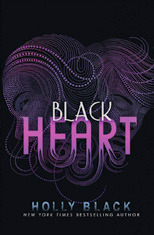
Black Heart by Holly Black. The third book of the Curse Workers series is probably my most anticipated book of the spring. I'm absolutely dying (and I mean that in a fairly literal way, because I'm absolutely worried and freaked out) to find out what happens to Cassel and Lila. I'll be pulling a late-nighter with this one, I'm sure.
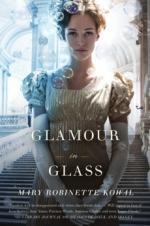
Glamour in Glass by Mary Robinette Kowal. As I've mentioned several times, I loved the first novel in this series, Shades of Milk and Honey. It was the perfect blend of magic with Austen-like romance and manners. In fact, my husband, who is also an Austen lover (I'm still sort of psyched that I managed to convert him so early in our relationship, and how easy it was, and how permanent), is also eagerly awaiting the 2nd book.
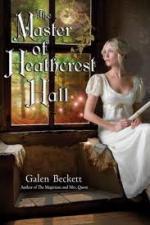
The Master of Heathcrest Hall by Galen Beckett. And, speaking of Austen, I'm also really looking forward to Beckett's version of magic and manners. The first book in this trilogy, The Magicians and Mrs. Quent, leaned pretty heavily on Austen and Bronte, though not in a bad way. The second book, The House on Durrow Street, stepped farther away from them, and then took an almost science fictional turn I did not see coming. I have no idea where the third one is going, but I can't wait to find out.
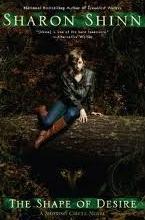
The Shape of Desire by Sharon Shinn. I have to admit that I know little about this book aside from the jacket copy. But Shinn is one of those authors that I don't really need to know that information to know that I'll buy the book. I buy all of her books and--with only one exception out of about 20 novels--they thrill me every time. So I'm always looking forward to her books.
On the Screen:
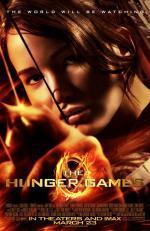
I'm not alone in this--in fact, this lake is so big I'm not even a drop in it--but I really, really am looking forward to The Hunger Games movie. I'm equally freaked out about it, because I have a history of feeling dissatisfied with movies based on books that I really love. I did the best with The Lord of the Rings movies (aside from the second one, which had me cursing as I left the theater because of the whole Faramir issue). I've been lukewarm on most of the Harry Potter movies (but that has more to do, I think, with the fact that so much as to be left out for time considerations). Hunger Games isn't long, so I'm hoping the Harry Potter issues won't crop up. I am hoping that they do a good job with the film, that it stays true to the books in the ways that matter and brings them to life in a way that's enjoyable. Fingers crossed.
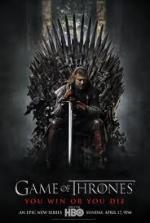
Game of Thrones Season Two. I thought HBO did a really good job with the adaptation of the first book. Nothing important left out, great production values, great actors. I'm hoping that they continue it in Season 2. Of course, doing as good a job will, in some ways, mean that Season 2 is even more torturous than Season 1. Partially because bad things continue to happen to good people, and most of the bad people who you want to see maimed don't start getting their just desserts nearly quickly enough, but also because the second book starts in with some of the things about the series that Irritate Me. Not talking about things on a story level here, but on an authorial level, because as much as I love the books there are also some particular things about them that really, really bug me. And I'll have to relive those during the show. But I'll be watching every week. Oh yeah.
What are you looking forward to most this spring?
Books:
Black Heart by Holly Black. The third book of the Curse Workers series is probably my most anticipated book of the spring. I'm absolutely dying (and I mean that in a fairly literal way, because I'm absolutely worried and freaked out) to find out what happens to Cassel and Lila. I'll be pulling a late-nighter with this one, I'm sure.
Glamour in Glass by Mary Robinette Kowal. As I've mentioned several times, I loved the first novel in this series, Shades of Milk and Honey. It was the perfect blend of magic with Austen-like romance and manners. In fact, my husband, who is also an Austen lover (I'm still sort of psyched that I managed to convert him so early in our relationship, and how easy it was, and how permanent), is also eagerly awaiting the 2nd book.
The Master of Heathcrest Hall by Galen Beckett. And, speaking of Austen, I'm also really looking forward to Beckett's version of magic and manners. The first book in this trilogy, The Magicians and Mrs. Quent, leaned pretty heavily on Austen and Bronte, though not in a bad way. The second book, The House on Durrow Street, stepped farther away from them, and then took an almost science fictional turn I did not see coming. I have no idea where the third one is going, but I can't wait to find out.
The Shape of Desire by Sharon Shinn. I have to admit that I know little about this book aside from the jacket copy. But Shinn is one of those authors that I don't really need to know that information to know that I'll buy the book. I buy all of her books and--with only one exception out of about 20 novels--they thrill me every time. So I'm always looking forward to her books.
On the Screen:
I'm not alone in this--in fact, this lake is so big I'm not even a drop in it--but I really, really am looking forward to The Hunger Games movie. I'm equally freaked out about it, because I have a history of feeling dissatisfied with movies based on books that I really love. I did the best with The Lord of the Rings movies (aside from the second one, which had me cursing as I left the theater because of the whole Faramir issue). I've been lukewarm on most of the Harry Potter movies (but that has more to do, I think, with the fact that so much as to be left out for time considerations). Hunger Games isn't long, so I'm hoping the Harry Potter issues won't crop up. I am hoping that they do a good job with the film, that it stays true to the books in the ways that matter and brings them to life in a way that's enjoyable. Fingers crossed.
Game of Thrones Season Two. I thought HBO did a really good job with the adaptation of the first book. Nothing important left out, great production values, great actors. I'm hoping that they continue it in Season 2. Of course, doing as good a job will, in some ways, mean that Season 2 is even more torturous than Season 1. Partially because bad things continue to happen to good people, and most of the bad people who you want to see maimed don't start getting their just desserts nearly quickly enough, but also because the second book starts in with some of the things about the series that Irritate Me. Not talking about things on a story level here, but on an authorial level, because as much as I love the books there are also some particular things about them that really, really bug me. And I'll have to relive those during the show. But I'll be watching every week. Oh yeah.
What are you looking forward to most this spring?


March 14, 2012
Tumblr(ing) Along
I have a Tumblr!
It's new, so there's not much there yet, but there will be. (Insert evil laugh here.)
Seriously, though, join me there. I'll be posting pics of the dogs, my spring garden, knitting projects, books--all sorts of things, basically. And there's an "Ask Me" section, so if you have burning questions about what Kiernan would do in a particular situation, how I deal with writer's block, my favorite flavor of ice cream, or whatever, you can ask me there. I promise to give truthful, insightful, humorous answers, though not necessarily all at the same time. Seriously, though, ask me something--I like questions.
Also, I'm going to be having a contest soon for Tumblr followers, so check back here and there soon!
It's new, so there's not much there yet, but there will be. (Insert evil laugh here.)
Seriously, though, join me there. I'll be posting pics of the dogs, my spring garden, knitting projects, books--all sorts of things, basically. And there's an "Ask Me" section, so if you have burning questions about what Kiernan would do in a particular situation, how I deal with writer's block, my favorite flavor of ice cream, or whatever, you can ask me there. I promise to give truthful, insightful, humorous answers, though not necessarily all at the same time. Seriously, though, ask me something--I like questions.
Also, I'm going to be having a contest soon for Tumblr followers, so check back here and there soon!
February 27, 2012
AWP Conference
This week I'll be at the Association of Writers and Writing Program's annual conference (AWP) in Chicago. The conference is huge one--they actually had to cancel late registration this year because 10,000 people have already signed up. (Which is pretty amazing, given that the first AWP I went to in Kansas City in 2000 had only a few thousand people at it, as far as I know.)
I won't be on any programming at AWP, because it's mainly geared toward literary fiction, poetry and creative nonfiction. But in case there are any YA or genre fans in the mix as well, I wanted to mention that I'll be running Nimrod Journal's book table at the bookfair each morning until about 11:30. The table is K20, and while I'll mostly be handing out information about the journal, I would love to chat with any YA fantasy and sf lovers who want to drop by. So if you'll be there, don't be shy--come see me! Here's the info:
AWP Conference 2012: Chicago
Thursday, March 1 - Saturday, March 3
Nimrod Journal's booktable, table K20
I may be around other times, but you can be sure to catch me between 8:30 and 11:30 a.m.
I won't be on any programming at AWP, because it's mainly geared toward literary fiction, poetry and creative nonfiction. But in case there are any YA or genre fans in the mix as well, I wanted to mention that I'll be running Nimrod Journal's book table at the bookfair each morning until about 11:30. The table is K20, and while I'll mostly be handing out information about the journal, I would love to chat with any YA fantasy and sf lovers who want to drop by. So if you'll be there, don't be shy--come see me! Here's the info:
AWP Conference 2012: Chicago
Thursday, March 1 - Saturday, March 3
Nimrod Journal's booktable, table K20
I may be around other times, but you can be sure to catch me between 8:30 and 11:30 a.m.
February 8, 2012
In Which I Make Very Little Progress
So for the last two years I've been learning to knit. And in the last two years, I've managed to complete . . . one and a half projects.
Seriously, I think I may be the slowest knitter in existence. Here's my first post about my knitting, where you can see the scarf I made as my first project and one half of the front of the ruana I was (and am still currently) making as my second project. Sadly, this post is dated March 11th, 2011, and as you can see from the pictures below, I've basically still got half the ruana to go.
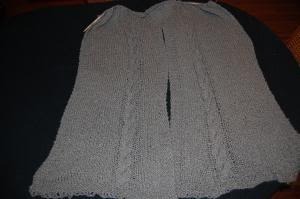
The front and a little of the back of the ruana. I really do like it, especially the cable. Also, it's very soft.
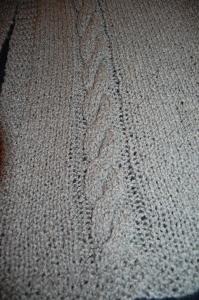
Cable close up. I'm sort of dorkily proud of it.
So now I'm working on the back of the ruana. When I saw that the back has no pattern, that it's just knit-knit-knit, purl-purl-purl, I thought, Yes! This is going to go so much faster since I don't have to count stitches and keep track of the cable and all that finicky stuff! What I forgot to factor into that thought was that I've now joined the two sides of the front up, which means that the back is twice as long as anything I was working on before. As in, it feels like it goes on for twelve years. I'm averaging about 2 rows in fifteen minutes of knitting. And I have to make the back as long as the front. How much have I gotten done so far?
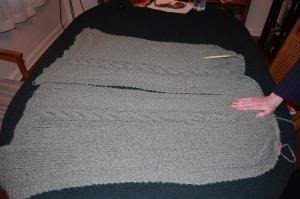
That much.
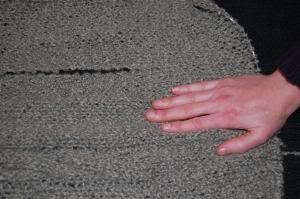
As in, my hand much. Which isn't very much at all.
So, things are moving slowly. But the real problem is that I have to have very particular circumstances to knit. I don't want to just knit. That's boring. I'd like to be able to watch TV and knit, and I sort of can. As long as it's a show I've seen multiple times that doesn't have that much visual interest. I knitted to Star Trek Next Gen, and that worked well, because I don't need to be able to actually watch the TV to know what's going on. But Buffy, which I also know pretty well, is out because, well, I don't want to miss even a second of Spike. (Among other reasons. Really, I promise.) But there just aren't a lot of shows that fall into that category that I'm interested in rewatching at the moment.
I can kind of hold conversations and knit, as long as the other person does 85% of the talking. So that's pretty much out.
Recently, I've decided to try listening to books on tape while I read (and wow, that's exactly how I typed that out, without thinking, and really that just dated me). But, again, it has to be a book that I've already read, so that if I miss a line or two, it doesn't matter. I think I'm going to try the Harry Potter books and see how that goes.
In short, I'm still debating with myself as to whether or not I can call knitting a hobby, since I'm not sure something you do this infrequently counts. But I'm having fun. Though I think I know now to pick a shorter project for my third, just so the sense of accomplishment comes a little quicker. . . .
Seriously, I think I may be the slowest knitter in existence. Here's my first post about my knitting, where you can see the scarf I made as my first project and one half of the front of the ruana I was (and am still currently) making as my second project. Sadly, this post is dated March 11th, 2011, and as you can see from the pictures below, I've basically still got half the ruana to go.
The front and a little of the back of the ruana. I really do like it, especially the cable. Also, it's very soft.
Cable close up. I'm sort of dorkily proud of it.
So now I'm working on the back of the ruana. When I saw that the back has no pattern, that it's just knit-knit-knit, purl-purl-purl, I thought, Yes! This is going to go so much faster since I don't have to count stitches and keep track of the cable and all that finicky stuff! What I forgot to factor into that thought was that I've now joined the two sides of the front up, which means that the back is twice as long as anything I was working on before. As in, it feels like it goes on for twelve years. I'm averaging about 2 rows in fifteen minutes of knitting. And I have to make the back as long as the front. How much have I gotten done so far?
That much.
As in, my hand much. Which isn't very much at all.
So, things are moving slowly. But the real problem is that I have to have very particular circumstances to knit. I don't want to just knit. That's boring. I'd like to be able to watch TV and knit, and I sort of can. As long as it's a show I've seen multiple times that doesn't have that much visual interest. I knitted to Star Trek Next Gen, and that worked well, because I don't need to be able to actually watch the TV to know what's going on. But Buffy, which I also know pretty well, is out because, well, I don't want to miss even a second of Spike. (Among other reasons. Really, I promise.) But there just aren't a lot of shows that fall into that category that I'm interested in rewatching at the moment.
I can kind of hold conversations and knit, as long as the other person does 85% of the talking. So that's pretty much out.
Recently, I've decided to try listening to books on tape while I read (and wow, that's exactly how I typed that out, without thinking, and really that just dated me). But, again, it has to be a book that I've already read, so that if I miss a line or two, it doesn't matter. I think I'm going to try the Harry Potter books and see how that goes.
In short, I'm still debating with myself as to whether or not I can call knitting a hobby, since I'm not sure something you do this infrequently counts. But I'm having fun. Though I think I know now to pick a shorter project for my third, just so the sense of accomplishment comes a little quicker. . . .
February 2, 2012
Book Recs, Book Recs, Book Recs
In my best books of 2011 post, I mentioned several books that I hadn't actually had the time to do a full rec post on. So, to catch up at least a little. . . .

Delirium by Lauren Oliver
Before scientists found the cure, people thought love was a good thing. They didn't understand that once love--the deliria--blooms in your blood, there is no escaping its hold.
Things are different now. Scientists are able to eradicate love, and the government demands that all citizens receive the cure upon turning eighteen. Lena Haloway has always looked forward to the day when she'll be cured. A life without love is a life without pain: safe, measured, predictable, and happy.
But with ninety-five days left until her treatment, Lena does the unthinkable: she falls in love.
One of the thoughts that crossed my mind when I read the description of Delirium was “Man, I hope this isn’t just another girl-falling-in-love-against-all-odds story.” And, I’m happy to say, it isn’t. Not that romantic love isn’t a central component of the story—it’s probably the central component. But what I liked best about Delirium is the way that Oliver depicts a society devoid of all sorts of love, including familial love. Lena’s younger cousin is so starved of love and affection—because, while her parents provide her with clothes and food and shelter, they never hug or comfort her—that she doesn’t ever speak. It’s not just an imagining of what might happen without romantic love, but without true family, without true friends.
Oliver also does a great job of ratcheting up the tension as the novel progresses and Lena begins to take more and more risks in the name of love. I liked her relationship with her best friend, and the ways that it frays throughout the course of the book. My only complaint arises from the fact that Lena’s society is supposedly very closed, with her town being cut off from the wild and other towns. And yet the defenses for keeping people in consist of a fence that doesn’t do its job very well at all. This seems to be a feature cropping up more and more in dystopian YA—the supposedly impenetrable fence that is really pretty, well, useless. It doesn’t get in the way of the story too much here, but it did give me pause, because I’ve seen this brand of fence before. Still, I recommend Delirium and am certainly looking forward to the sequel.

The Unbecoming of Mara Dyer by Michelle Hodkin
Mara Dyer believes life can't get any stranger than waking up in a hospital with no memory of how she got there.
It can.
She believes there must be more to the accident she can't remember that killed her friends and left her strangely unharmed.
There is.
The Unbecoming of Mara Dyer centers around a girl who believes that she might be going crazy. Things happen around her that she can’t explain, or that she can only explain in ways that don’t make sense. On top of this, she’s grieving from the loss of her friends in an accident that she can’t remember and only she survived, and the fact that her family has uprooted itself to Florida to take her away from anything that reminds her of her friends. All this leads to a weird, fluid sort of book, but works in a weird, fluid sort of way. Mara’s not sure of herself and what’s happening in her life, and that comes through not only via the events of the book, but the way that they’re told. It occasionally take a little backtracking or mental-looping to get your head around, but I liked it.
If I have a quibble, it’s with the descriptions of the Mara’s love interest, Noah. I like their relationship—there’s some nice heat there and Noah’s clever in a way that’s very fun to read. But there were just a few too many lingering mentions of how gorgeous he is. It’s not that I have a problem with hot guys, but just that too much emphasis on a character’s handsomeness, especially in a first person narrative, starts to get me annoyed with the main character. That said, Mara Dyer ends on a cliffhanger, and I’m looking forward to seeing where it goes next.
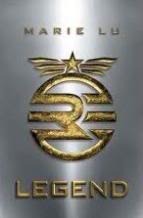
Legend by Marie Lu
The flooded coast of former Los Angeles. Two warring nations of North America—the Republic and the Colonies. Born into an elite family in one of the Republic’s wealthiest districts, fifteen -year-old June is a prodigy. Obedient, passionate, and committed to her country, she is being groomed for success in the Republic’s highest military circles.
Born into the slums of the Republic’s Lake Sector, fifteen-year-old Day is the country’s most wanted criminal. But his motives may not be as malicious as they seem.
From different worlds, June and Day have no reason to cross paths—until the day June’s brother is murdered. And Day becomes the prime suspect. Now, caught in the ultimate game of cat and mouse, Day is in a race for his family’s survival while June tries desperately to avenge her brother’s death. But in a shocking turn of events, the two uncover the truth of what has really brought them together and the sinister lengths their country will go to in order to keep its secrets.
I’ve picked up several futuristic dystopian YA novels over the last couple of months, and I just haven’t been impressed with them. The worldbuilding seemed shoddy, or the characters were flat, or the situations that they had to deal with seemed way too unlikely. So I was feeling a little trepidation when I started on Legend . . . . but I’m really happy to report that my worries didn’t last long.
Legend is one of the most successful action dystopian novel that I’ve read since Hunger Games. (I’m calling it an action dystopian rather than a social dystopian, where the repression mainly centers around controlling people’s thoughts, marriage prospects or ability to read what books they want.) I immediately connected with the two main characters, Day and June, and, just as importantly, I believed in their connection when they met. Lu does a great job with her threatening Republic—not pulling her punches, and actually making their crimes a bit grittier than some other authors might have.
If I have a critique, it’s about a secondary character who makes a big sacrifice toward the end of the book. Though effective, I think it would have been a bit more so if we’d spent a bit more time around this person or had just a bit more information about them. Still, this is a minor issue with an otherwise stellar book—one where I can’t wait to read the sequel.
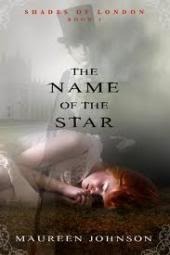
The Name of the Star by Maureen Johnson
The day Louisiana teenager Rory Deveaux arrives in London marks a memorable occasion. For Rory, it's the start of a new life at a London boarding school. But for many, this will be remembered as the day a series of brutal murders broke out across the city, gruesome crimes mimicking the horrific Jack the Ripper events of more than a century ago.
Soon “Rippermania” takes hold of modern-day London, and the police are left with few leads and no witnesses. Except one. Rory spotted the man police believe to be the prime suspect. But she is the only one who saw him. Even her roommate, who was walking with her at the time, didn't notice the mysterious man. So why can only Rory see him? And more urgently, why has Rory become his next target? In this edge-of-your-seat thriller, full of suspense, humor, and romance, Rory will learn the truth about the secret ghost police of London and discover her own shocking abilities.
The Name of the Star is a great read, one that combines several elements that I happen to like very much. You have the English boarding school (+1 for my love of anything English and +1 for board school stories). You have a main character who’s just a little weird and who’s new to the school (+1 for quirky girls). You have friends for the main character who are sharp and well-depicted (+1 for avoiding the annoying/undefined best friend issue). You have a new twist on the Jack the Ripper mythos (+1 because Jack the Ripper is just interesting). And, finally, you have a bad guy creepy enough to give me one of the worst nightmares I’ve had in a long time (I’m not sure if this gets a plus, because I woke up thinking I was about to die, though it certainly means that the book made in impression!). In short, The Name of the Star is great fun, and it’s just the first in a series!
Additionally, one of my main pet peeves with a lot of paranormal and fantasy YA set in the modern world is the voice. I hate it when I’m reading along and the main character—usually a teenage girl—doesn’t sound authentic. It’s something I’m sensitive to, and something that will make me put a book down pretty quickly. I was really, really pleased with Rory’s voice—it drew me into the story immediately. So that’s another plus.
Delirium by Lauren Oliver
Before scientists found the cure, people thought love was a good thing. They didn't understand that once love--the deliria--blooms in your blood, there is no escaping its hold.
Things are different now. Scientists are able to eradicate love, and the government demands that all citizens receive the cure upon turning eighteen. Lena Haloway has always looked forward to the day when she'll be cured. A life without love is a life without pain: safe, measured, predictable, and happy.
But with ninety-five days left until her treatment, Lena does the unthinkable: she falls in love.
One of the thoughts that crossed my mind when I read the description of Delirium was “Man, I hope this isn’t just another girl-falling-in-love-against-all-odds story.” And, I’m happy to say, it isn’t. Not that romantic love isn’t a central component of the story—it’s probably the central component. But what I liked best about Delirium is the way that Oliver depicts a society devoid of all sorts of love, including familial love. Lena’s younger cousin is so starved of love and affection—because, while her parents provide her with clothes and food and shelter, they never hug or comfort her—that she doesn’t ever speak. It’s not just an imagining of what might happen without romantic love, but without true family, without true friends.
Oliver also does a great job of ratcheting up the tension as the novel progresses and Lena begins to take more and more risks in the name of love. I liked her relationship with her best friend, and the ways that it frays throughout the course of the book. My only complaint arises from the fact that Lena’s society is supposedly very closed, with her town being cut off from the wild and other towns. And yet the defenses for keeping people in consist of a fence that doesn’t do its job very well at all. This seems to be a feature cropping up more and more in dystopian YA—the supposedly impenetrable fence that is really pretty, well, useless. It doesn’t get in the way of the story too much here, but it did give me pause, because I’ve seen this brand of fence before. Still, I recommend Delirium and am certainly looking forward to the sequel.
The Unbecoming of Mara Dyer by Michelle Hodkin
Mara Dyer believes life can't get any stranger than waking up in a hospital with no memory of how she got there.
It can.
She believes there must be more to the accident she can't remember that killed her friends and left her strangely unharmed.
There is.
The Unbecoming of Mara Dyer centers around a girl who believes that she might be going crazy. Things happen around her that she can’t explain, or that she can only explain in ways that don’t make sense. On top of this, she’s grieving from the loss of her friends in an accident that she can’t remember and only she survived, and the fact that her family has uprooted itself to Florida to take her away from anything that reminds her of her friends. All this leads to a weird, fluid sort of book, but works in a weird, fluid sort of way. Mara’s not sure of herself and what’s happening in her life, and that comes through not only via the events of the book, but the way that they’re told. It occasionally take a little backtracking or mental-looping to get your head around, but I liked it.
If I have a quibble, it’s with the descriptions of the Mara’s love interest, Noah. I like their relationship—there’s some nice heat there and Noah’s clever in a way that’s very fun to read. But there were just a few too many lingering mentions of how gorgeous he is. It’s not that I have a problem with hot guys, but just that too much emphasis on a character’s handsomeness, especially in a first person narrative, starts to get me annoyed with the main character. That said, Mara Dyer ends on a cliffhanger, and I’m looking forward to seeing where it goes next.
Legend by Marie Lu
The flooded coast of former Los Angeles. Two warring nations of North America—the Republic and the Colonies. Born into an elite family in one of the Republic’s wealthiest districts, fifteen -year-old June is a prodigy. Obedient, passionate, and committed to her country, she is being groomed for success in the Republic’s highest military circles.
Born into the slums of the Republic’s Lake Sector, fifteen-year-old Day is the country’s most wanted criminal. But his motives may not be as malicious as they seem.
From different worlds, June and Day have no reason to cross paths—until the day June’s brother is murdered. And Day becomes the prime suspect. Now, caught in the ultimate game of cat and mouse, Day is in a race for his family’s survival while June tries desperately to avenge her brother’s death. But in a shocking turn of events, the two uncover the truth of what has really brought them together and the sinister lengths their country will go to in order to keep its secrets.
I’ve picked up several futuristic dystopian YA novels over the last couple of months, and I just haven’t been impressed with them. The worldbuilding seemed shoddy, or the characters were flat, or the situations that they had to deal with seemed way too unlikely. So I was feeling a little trepidation when I started on Legend . . . . but I’m really happy to report that my worries didn’t last long.
Legend is one of the most successful action dystopian novel that I’ve read since Hunger Games. (I’m calling it an action dystopian rather than a social dystopian, where the repression mainly centers around controlling people’s thoughts, marriage prospects or ability to read what books they want.) I immediately connected with the two main characters, Day and June, and, just as importantly, I believed in their connection when they met. Lu does a great job with her threatening Republic—not pulling her punches, and actually making their crimes a bit grittier than some other authors might have.
If I have a critique, it’s about a secondary character who makes a big sacrifice toward the end of the book. Though effective, I think it would have been a bit more so if we’d spent a bit more time around this person or had just a bit more information about them. Still, this is a minor issue with an otherwise stellar book—one where I can’t wait to read the sequel.
The Name of the Star by Maureen Johnson
The day Louisiana teenager Rory Deveaux arrives in London marks a memorable occasion. For Rory, it's the start of a new life at a London boarding school. But for many, this will be remembered as the day a series of brutal murders broke out across the city, gruesome crimes mimicking the horrific Jack the Ripper events of more than a century ago.
Soon “Rippermania” takes hold of modern-day London, and the police are left with few leads and no witnesses. Except one. Rory spotted the man police believe to be the prime suspect. But she is the only one who saw him. Even her roommate, who was walking with her at the time, didn't notice the mysterious man. So why can only Rory see him? And more urgently, why has Rory become his next target? In this edge-of-your-seat thriller, full of suspense, humor, and romance, Rory will learn the truth about the secret ghost police of London and discover her own shocking abilities.
The Name of the Star is a great read, one that combines several elements that I happen to like very much. You have the English boarding school (+1 for my love of anything English and +1 for board school stories). You have a main character who’s just a little weird and who’s new to the school (+1 for quirky girls). You have friends for the main character who are sharp and well-depicted (+1 for avoiding the annoying/undefined best friend issue). You have a new twist on the Jack the Ripper mythos (+1 because Jack the Ripper is just interesting). And, finally, you have a bad guy creepy enough to give me one of the worst nightmares I’ve had in a long time (I’m not sure if this gets a plus, because I woke up thinking I was about to die, though it certainly means that the book made in impression!). In short, The Name of the Star is great fun, and it’s just the first in a series!
Additionally, one of my main pet peeves with a lot of paranormal and fantasy YA set in the modern world is the voice. I hate it when I’m reading along and the main character—usually a teenage girl—doesn’t sound authentic. It’s something I’m sensitive to, and something that will make me put a book down pretty quickly. I was really, really pleased with Rory’s voice—it drew me into the story immediately. So that’s another plus.
January 23, 2012
Ch-Ch-Chang(ing) Characters
I started watching the TV show Glee soon after it came out, and it didn’t take long before I was hooked. I gathered with friends to watch each new episode, downloaded music, bought the DVDs, groaned and laughed over the exploits of Sue Sylvester, Will Schuester, and the kids of the McKinley High School Glee Club. Did it grab my geek heart that way that Buffy did, fill me with a sense of boundless possibilities the way Firefly did, or make me want to read pop culture and philosophy books the way Battlestar Galactica did? Not really. (And not that I’m sure there are any The Philosophy of Glee books the way there are with BSG or Buffy, but I digress.) I knew that Glee was a candy show, albeit one that occasionally jabs you with An Actual Emotional Truth (generally, for me, involving Kurt). No, I was ready and willing to enjoy it as such—and for a while, I did.
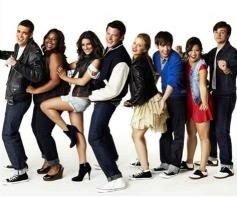
But then I started noticing a change. I’d be watching and something would happen that would make me scrunch up my nose or roll my eyes. I’d be tossed out of the scene and left floundering for a few moments as I tried to get back in. At first, I just put it down to a few poorly written episodes, but it just kept happening. And finally I realized that all the things that were bothering me really boiled down to just one thing:
That Glee has an immense problem with change, both character change and regular old this-happened-this-way-once-but-now-is-totally-different continuity.
Emma and Will have major relationship issues one day and have moved in together with no mention of said issues the next day. It’s hinted that two characters have a thing for each other, not mentioned for five episodes, then brought up again as if they were talking about it yesterday. I could keep this list going until next Thursday, but a serious picking-apart of Glee isn’t actually the point of this blog post.
Rather, the point is that watching Glee and suffering through dozens of cases of show-amnesia has made think about the way that we want characters to change in books and on screen. And that is believably.
Do we want our characters to change? Yes—a resounding, no-holds-barred yes. If, at the end of a book, your central characters are the same people that they were on page one, then you have a problem. And so will your readers, who will probably be asking themselves “What was the point of reading this if this nobody grew, or made mistakes and learned from them, or changed the way they felt about the world or themselves?”
But we want characters to change in a way that makes sense to us as readers and viewers, though there aren’t hard and fast rules for how to make this happen or indicate that change is occurring. Sometimes it happens slowly. The rule-following girl in a tightly controlled society starts noticing small things that disquiet her, things that lead her to start breaking little rules, which as she breaks them open up even more questions about how her society is run, until she realizes that she disagrees with nearly everything about it. Sometimes it happens quickly. A zombie apocalypse forces a boy who had been timid and fearful to make quick decisions to protect his younger siblings, giving him no choice but to move into the role of protector. Sometimes the changes will actually gets discussed in the story—whether out loud or in just in the character's own mind. Sometimes it will just be a glance between characters, or a telling hesitation, or a sentence that seems to mean one thing when it’s first read but is shown to mean something else by the end of the story.
But with well-crafted storytelling, we can always look back through the pages and point to the instances where the characters began to look at the world or themselves differently, places where they began to behave in new ways, events that forced them to change themselves. And we can understand why those changes occurred. The solider who has always been stalwart in his defense of the empire may decide to join the rebellion, but we know why he does that. He doesn’t just wake up on Chapter 13 and decide to leave his fatigues behind with no explanation. Or, if he does, we’d better get that explanation before the story ends.
And what happens if we can’t do this? First off, the reader might abandon the story entirely. But even if the reader stays, then they’ll probably have the same problem that I’m currently having with Glee, and that is that they won’t invest as heavily in the story and characters. Because why invest in characters who are this way one day and that way another, with no link between the two and no explanation as to why the change happened in the first place?
One of the problems that I think many new writers have is that they sometimes forget to put the reasons for character change on the page. When characters and story events have been living inside your head for months or years, you get to know a lot more about them than will ever make it to the page. Sometimes so much that you forget that not everyone knows all the backstory that you do, or that not everyone has the same depth of understanding of the character’s inner life. So when I’m editing a book or story, I have to keep reminding myself to read what’s actually on the page, and not fill in any gaps with all the insider knowledge I have in my head.
I don’t know if this is the problem with Glee, or if it comes from dealing with a large cast where the writers are trying to give everyone “their moment,” or if it’s just shoddy, not-paying-attention writing. What I do know is that watching it has made me watch my own writing a bit more carefully.
But then I started noticing a change. I’d be watching and something would happen that would make me scrunch up my nose or roll my eyes. I’d be tossed out of the scene and left floundering for a few moments as I tried to get back in. At first, I just put it down to a few poorly written episodes, but it just kept happening. And finally I realized that all the things that were bothering me really boiled down to just one thing:
That Glee has an immense problem with change, both character change and regular old this-happened-this-way-once-but-now-is-totally-different continuity.
Emma and Will have major relationship issues one day and have moved in together with no mention of said issues the next day. It’s hinted that two characters have a thing for each other, not mentioned for five episodes, then brought up again as if they were talking about it yesterday. I could keep this list going until next Thursday, but a serious picking-apart of Glee isn’t actually the point of this blog post.
Rather, the point is that watching Glee and suffering through dozens of cases of show-amnesia has made think about the way that we want characters to change in books and on screen. And that is believably.
Do we want our characters to change? Yes—a resounding, no-holds-barred yes. If, at the end of a book, your central characters are the same people that they were on page one, then you have a problem. And so will your readers, who will probably be asking themselves “What was the point of reading this if this nobody grew, or made mistakes and learned from them, or changed the way they felt about the world or themselves?”
But we want characters to change in a way that makes sense to us as readers and viewers, though there aren’t hard and fast rules for how to make this happen or indicate that change is occurring. Sometimes it happens slowly. The rule-following girl in a tightly controlled society starts noticing small things that disquiet her, things that lead her to start breaking little rules, which as she breaks them open up even more questions about how her society is run, until she realizes that she disagrees with nearly everything about it. Sometimes it happens quickly. A zombie apocalypse forces a boy who had been timid and fearful to make quick decisions to protect his younger siblings, giving him no choice but to move into the role of protector. Sometimes the changes will actually gets discussed in the story—whether out loud or in just in the character's own mind. Sometimes it will just be a glance between characters, or a telling hesitation, or a sentence that seems to mean one thing when it’s first read but is shown to mean something else by the end of the story.
But with well-crafted storytelling, we can always look back through the pages and point to the instances where the characters began to look at the world or themselves differently, places where they began to behave in new ways, events that forced them to change themselves. And we can understand why those changes occurred. The solider who has always been stalwart in his defense of the empire may decide to join the rebellion, but we know why he does that. He doesn’t just wake up on Chapter 13 and decide to leave his fatigues behind with no explanation. Or, if he does, we’d better get that explanation before the story ends.
And what happens if we can’t do this? First off, the reader might abandon the story entirely. But even if the reader stays, then they’ll probably have the same problem that I’m currently having with Glee, and that is that they won’t invest as heavily in the story and characters. Because why invest in characters who are this way one day and that way another, with no link between the two and no explanation as to why the change happened in the first place?
One of the problems that I think many new writers have is that they sometimes forget to put the reasons for character change on the page. When characters and story events have been living inside your head for months or years, you get to know a lot more about them than will ever make it to the page. Sometimes so much that you forget that not everyone knows all the backstory that you do, or that not everyone has the same depth of understanding of the character’s inner life. So when I’m editing a book or story, I have to keep reminding myself to read what’s actually on the page, and not fill in any gaps with all the insider knowledge I have in my head.
I don’t know if this is the problem with Glee, or if it comes from dealing with a large cast where the writers are trying to give everyone “their moment,” or if it’s just shoddy, not-paying-attention writing. What I do know is that watching it has made me watch my own writing a bit more carefully.
January 9, 2012
Just For Fun
Because work started back up last week and I'm trying to revise/reorganize six chapters that are resisting with all their might, something silly:
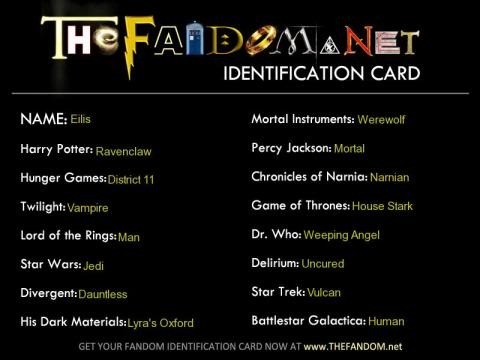
I can agree with:
Harry Potter: Totally. There's never been any other house for me.
Star Wars: Yeah, don't think I'll be seduced by the Dark Side.
His Dark Materials: I'd love to live there! Give me a daemon!
Narnia: Sounds great!
GoT: Out of all the houses, probably. Though hopefully more in an Arya way than a Ned way. (There's a time and place to be noble, but it isn't all the time, every hour of the bloody day.)
Delirium: Most definitely.
BSG: Yeah. Though I'm not opposed to slinky read dresses. Just saying.
I'm on the fence about:
Hunger Games: Yes, because of the political leaning there. But I'm not sure I'd be a good farmer. I like the outdoors, but not in an agricultural sense.
Twilight: Kinda hands up in a shrug here. Not sure I know what makes someone a vampire, werewolf or human.
Mortal Instruments: Again not sure where the dividing line is. Perhaps I'm just less strident than some Shadowhunters?
No way!
Divergent: I have no head for heights. Really, I don't. No, I mean, really. Probably would be Erudite (though without all the creepy taking over everyone thing).
Vulcan: Uh, no. Just no. *shakes head at quiz*
(Haven't seen/read Dr Who or the Percy Jackson Books, so I can't comment on those.)
How about you?
I can agree with:
Harry Potter: Totally. There's never been any other house for me.
Star Wars: Yeah, don't think I'll be seduced by the Dark Side.
His Dark Materials: I'd love to live there! Give me a daemon!
Narnia: Sounds great!
GoT: Out of all the houses, probably. Though hopefully more in an Arya way than a Ned way. (There's a time and place to be noble, but it isn't all the time, every hour of the bloody day.)
Delirium: Most definitely.
BSG: Yeah. Though I'm not opposed to slinky read dresses. Just saying.
I'm on the fence about:
Hunger Games: Yes, because of the political leaning there. But I'm not sure I'd be a good farmer. I like the outdoors, but not in an agricultural sense.
Twilight: Kinda hands up in a shrug here. Not sure I know what makes someone a vampire, werewolf or human.
Mortal Instruments: Again not sure where the dividing line is. Perhaps I'm just less strident than some Shadowhunters?
No way!
Divergent: I have no head for heights. Really, I don't. No, I mean, really. Probably would be Erudite (though without all the creepy taking over everyone thing).
Vulcan: Uh, no. Just no. *shakes head at quiz*
(Haven't seen/read Dr Who or the Percy Jackson Books, so I can't comment on those.)
How about you?
January 2, 2012
Reading Report and Best Books 2011
Being a fairly type-A person, I have a particular love for organizing and list-making. And being a reader and writer, I have a particular love for brandishing the books that I like at other people and telling them that they should read them right now. And so you get:
Eilis’ Annual Reading Report and Best Books of 2011
I read a total of 103 books in 2011, 27 more than last year. (Which actually makes me feel pretty good, especially because I read all of the Song of Ice and Fire books currently out this year. About 5,000 pages of reading and I only got to mark down 5 books for it.) Here’s a break-down by genre. (And yes, I agonized over some of those genre distinctions. It’s hard, particularly with some of the dystopian novels. Are they science fiction-type dystopias, or are they just taking place in the future with no real science fictional aspects? So this is me going with my gut on that.)
2011
YA Fantasy: 28
Fantasy: 14
YA Dystopian Science Fiction: 10
Science Fiction Mystery: 9
YA Science Fiction: 9
YA Paranormal: 8
Short Fantasy: 5
Nonfiction: 6
Non-Genre Middle Grade: 3
Paranormal: 2
Non-Genre Fiction: 2
Middle Grade Fantasy: 2
YA Dystopian: 2
YA Short Fantasy: 3
YA Total: 65
Non-YA Total: 38
Of these, 18 were re-reads.
Not surprised that YA fantasy is the clear front-runner, and not really surprised by the large winning margin either. I am pleased that there’s more and more YA science fiction to add to the list, something that you just weren’t seeing a few years ago. Of course, a lot of it is “light” sf or strongly dystopian flavored sf, but still, it’s good. (And, honestly, I don’t read that much hard sf of the adult variety anyway, so I doubt I would read it in YA.)
So which of these books were my favorites this year? Here’s the list, though it contains only books that were new to me, and not my “oldies but goodies” re-reads. (Some of them may not have been released in 2011, though, if I got to them a bit late.)
Twilight’s Dawn by Anne Bishop. This collection won’t make sense to anyone who hasn’t already read the other books in Bishop’s Black Jewels world, but for those who have, it is a wonderful, bittersweet wrap-up to the series. (Matt, who is reading this over my shoulder, wants me to add that if you haven't read the Black Jewels books you need to drop whatever you're doing and go get them yesterday. I tend to agree, though probably these are better for adults or older teens. There's some serious darkness in them, particularly in the first three.)
White Cat and Red Glove by Holly Black. The Curse Workers series is addictive—so much so that I made my husband and his parents listen to White Cat on our drive back from Thanksgiving in Colorado. Along the with characters, I just love the world created here (especially after inheriting 7 sets of beauteous gloves from my grandmother). Can’t wait for the final book, Black Heart!
Zombies vs Unicorns, edited by Holly Black and Justine Larbalestier. A great collection of short stories debating that eternal question: Are zombies or unicorns more awesome? (Team Unicorn FTW, if you’re wondering.)
Naamah’s Blessing by Jacquelne Carey. This was a great end to Carey’s latest Terre de Ange trilogy. My first love in this world will always be Phedre, but Moirin is a close second.
The Name of the Star by Maureen Johnson. What I liked most about this Jack the Ripper inspired ghost story was the voice. Johnson really nailed the teenage girl voice for Rory, something I’m especially sensitive to. Also this book gave me the worst nightmare, which can only mean it really got into my head.
Shades of Milk and Honey by Mary Robinette Kowal. This book is perfect for Jane Austen fans who also love fantasy—PERFECT! I seriously cannot wait for the sequel, Glamour in Glass.
Liar by Justine Larbalestier. This is a frustrating book to recommend, because I can’t really talk about what makes it so awesome without spoiling what makes it so awesome. What I’ll say is that there are secrets within secrets within lies within truths here, and unraveling them is what makes the book so fun.
Legend by Marie Lu. One of the best dystopian books I’ve read recently. Really, really solid, with characters that you connect with right away and a government that you seriously hate.
The Night Circus by Erin Morgenstern. Just as you probably have, I had heard tons about this book before I ever opened it. Happily, it lived up to the hype. It’s an odd book, but one that’s delicately done and that makes you want to visit the titular circus so much that it hurts a little.
Delirium by Lauren Oliver. A fun twist on the “you can’t love this person” trope, because in this society, you can’t love anyone. And not just limited to romantic love, either, which I appreciated.
The Near Witch by Victoria Schwab. One of the things I liked best about this book is how quiet it is. Nothing blows up or and there's not a huge amount of angsting over anything--which is nice, actually. It's very contained in setting, and that helps make the world feel very real.
The Scorpio Races by Maggie Stiefvator. This book was a pleasure to read—a serious pleasure. Quiet, without too many bangs and flashes, it digs into the meanings of family, loyalty, place . . . and, in case that wasn’t enough, it’s full of killer water horses.
Daughter of Smoke and Bone by Laini Taylor. This was one of those books that I let out a howl of anguish when I finished, because I so do not want to have to wait for the sequel. There's a lot going on here—including great worldbuilding in our world and a in a unique created world—and a main character who's spunky, sarcastic, and awesome.
So that's what I loved this year. What were your favorite reads?
Eilis’ Annual Reading Report and Best Books of 2011
I read a total of 103 books in 2011, 27 more than last year. (Which actually makes me feel pretty good, especially because I read all of the Song of Ice and Fire books currently out this year. About 5,000 pages of reading and I only got to mark down 5 books for it.) Here’s a break-down by genre. (And yes, I agonized over some of those genre distinctions. It’s hard, particularly with some of the dystopian novels. Are they science fiction-type dystopias, or are they just taking place in the future with no real science fictional aspects? So this is me going with my gut on that.)
2011
YA Fantasy: 28
Fantasy: 14
YA Dystopian Science Fiction: 10
Science Fiction Mystery: 9
YA Science Fiction: 9
YA Paranormal: 8
Short Fantasy: 5
Nonfiction: 6
Non-Genre Middle Grade: 3
Paranormal: 2
Non-Genre Fiction: 2
Middle Grade Fantasy: 2
YA Dystopian: 2
YA Short Fantasy: 3
YA Total: 65
Non-YA Total: 38
Of these, 18 were re-reads.
Not surprised that YA fantasy is the clear front-runner, and not really surprised by the large winning margin either. I am pleased that there’s more and more YA science fiction to add to the list, something that you just weren’t seeing a few years ago. Of course, a lot of it is “light” sf or strongly dystopian flavored sf, but still, it’s good. (And, honestly, I don’t read that much hard sf of the adult variety anyway, so I doubt I would read it in YA.)
So which of these books were my favorites this year? Here’s the list, though it contains only books that were new to me, and not my “oldies but goodies” re-reads. (Some of them may not have been released in 2011, though, if I got to them a bit late.)
Twilight’s Dawn by Anne Bishop. This collection won’t make sense to anyone who hasn’t already read the other books in Bishop’s Black Jewels world, but for those who have, it is a wonderful, bittersweet wrap-up to the series. (Matt, who is reading this over my shoulder, wants me to add that if you haven't read the Black Jewels books you need to drop whatever you're doing and go get them yesterday. I tend to agree, though probably these are better for adults or older teens. There's some serious darkness in them, particularly in the first three.)
White Cat and Red Glove by Holly Black. The Curse Workers series is addictive—so much so that I made my husband and his parents listen to White Cat on our drive back from Thanksgiving in Colorado. Along the with characters, I just love the world created here (especially after inheriting 7 sets of beauteous gloves from my grandmother). Can’t wait for the final book, Black Heart!
Zombies vs Unicorns, edited by Holly Black and Justine Larbalestier. A great collection of short stories debating that eternal question: Are zombies or unicorns more awesome? (Team Unicorn FTW, if you’re wondering.)
Naamah’s Blessing by Jacquelne Carey. This was a great end to Carey’s latest Terre de Ange trilogy. My first love in this world will always be Phedre, but Moirin is a close second.
The Name of the Star by Maureen Johnson. What I liked most about this Jack the Ripper inspired ghost story was the voice. Johnson really nailed the teenage girl voice for Rory, something I’m especially sensitive to. Also this book gave me the worst nightmare, which can only mean it really got into my head.
Shades of Milk and Honey by Mary Robinette Kowal. This book is perfect for Jane Austen fans who also love fantasy—PERFECT! I seriously cannot wait for the sequel, Glamour in Glass.
Liar by Justine Larbalestier. This is a frustrating book to recommend, because I can’t really talk about what makes it so awesome without spoiling what makes it so awesome. What I’ll say is that there are secrets within secrets within lies within truths here, and unraveling them is what makes the book so fun.
Legend by Marie Lu. One of the best dystopian books I’ve read recently. Really, really solid, with characters that you connect with right away and a government that you seriously hate.
The Night Circus by Erin Morgenstern. Just as you probably have, I had heard tons about this book before I ever opened it. Happily, it lived up to the hype. It’s an odd book, but one that’s delicately done and that makes you want to visit the titular circus so much that it hurts a little.
Delirium by Lauren Oliver. A fun twist on the “you can’t love this person” trope, because in this society, you can’t love anyone. And not just limited to romantic love, either, which I appreciated.
The Near Witch by Victoria Schwab. One of the things I liked best about this book is how quiet it is. Nothing blows up or and there's not a huge amount of angsting over anything--which is nice, actually. It's very contained in setting, and that helps make the world feel very real.
The Scorpio Races by Maggie Stiefvator. This book was a pleasure to read—a serious pleasure. Quiet, without too many bangs and flashes, it digs into the meanings of family, loyalty, place . . . and, in case that wasn’t enough, it’s full of killer water horses.
Daughter of Smoke and Bone by Laini Taylor. This was one of those books that I let out a howl of anguish when I finished, because I so do not want to have to wait for the sequel. There's a lot going on here—including great worldbuilding in our world and a in a unique created world—and a main character who's spunky, sarcastic, and awesome.
So that's what I loved this year. What were your favorite reads?
December 23, 2011
Christmas Traditions
One of the things I like best about Christmas is the traditions. Since Christmas is nearly upon us, I thought I'd share a few of the traditions that I like best.
The Books. We had a large collection of Christmas picture books when I was a kid. I loved unpacking them every year, and I actually apologized to them (and to my Christmas stuffed animals) when we had to put them away for the year. Though I don't have kids myself, I still love these books and go through them every year. Here are a few favorites (several of which, sadly, appear to be out of print at this point).
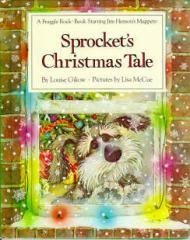
Sprocket's Christmas Tale by Louise Gikow. My mom had a love/hate relationship with this book, because it is SO LONG.
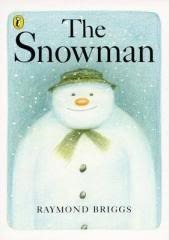
The Snowman by Raymond Briggs. No words, just pictures so great you don't need them.
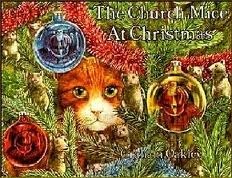
The Church Mice at Christmas by Graham Oakley. Oddly, our copy of this book has a very distinctive smell. It's not bad, but it's odd. And, of course, I now associate that smell with Christmas.
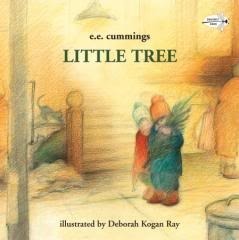
Little Tree by e. e. cummings. (Granted, I like this one more as an adult than I did as a kid.)

On Christmas Eve by Peter Collington. Another no words book, this one with fairies.
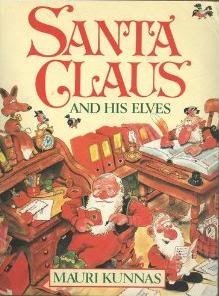
Santa Claus and His Elves by Mauri Kunnas. I used to pick out which elf I wanted to be on each page.
The movies. Ah, the power of nostalgia! Everyone has their favorite Christmas movies, movies that they're prepared to defend to the death, no matter how cheesy they are. Here are my must-sees. (Of course, I don't think mine are cheesy at all . . . )
"The Bells of Fraggle Rock."
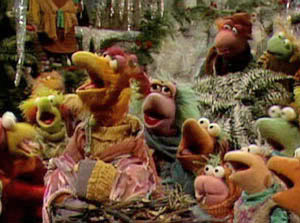

This is Fraggle Rock's only holiday episode, and I watch it on the Solstice each year, since that's when it takes place. The songs are exceptional (even counting the Weeba beast song, which is ridiculously silly and great fun), Cantus makes a guest appearance, and it makes a lovely Christmas point without being pointed about it. It's one of my favorite Fraggle episodes, which is saying a lot. (I could--and may someday--write an entire post about the sheer awesome that is Fraggle Rock.)
Love Actually.

This movies makes me happy. Period. Bonus to get to see Billy Nighy chew scenery as Billy Mack.
The Snowman.
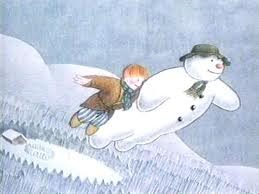
I don't remember whether I read the book first or saw the movie first, but I love them both. The movie has the added advantage of an absolutely wonderful soundtrack.
Christmas Eve. Even as a kid, I think I liked Christmas Eve a smidgen better than actual Christmas. The anticipation, the tree, the hot chocolate, the stories . . . I still love it. One of my favorite aspects of Christmas Eve in my family are two special Christmas stories--one an actual short story and one a poem. Both of these appeared in magazines in the 1950s, and both were read every Christmas Eve to my mother and her siblings by my grandmother. My mom kept that tradition when she had kids, and we still read them every Christmas Eve. The first story is "A Christmas Miniature" by Pearl S. Buck.
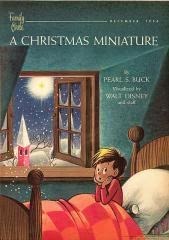
This story appeared in Family Circle Magazine in December 1956, and you can actually read the whole thing here. My mom reads this story to us each year.
The second story is a long poem called "The Year Without a Santa Claus" by Phyllis McGinley. I believe that they made a rather terrible stop-motion movie based on it, but I've only seen five minutes of that because it looked awful and appeared to have nothing to do with the poem. But the poem is great. I've been searching the internet for a picture from the magazine that we have, but to no avail (though it does look like they printed a picture book of it at some point; the pictures don't look as cool as the originals, but the poem is worth dealing with that). I read this every year to the family on Christmas Eve. I've had the practice, as it was actually the poem that I took to State in Oklahoma's speech and debate tournaments in high school.
So those are my favorite Christmas touchstones. What are yours?
The Books. We had a large collection of Christmas picture books when I was a kid. I loved unpacking them every year, and I actually apologized to them (and to my Christmas stuffed animals) when we had to put them away for the year. Though I don't have kids myself, I still love these books and go through them every year. Here are a few favorites (several of which, sadly, appear to be out of print at this point).
Sprocket's Christmas Tale by Louise Gikow. My mom had a love/hate relationship with this book, because it is SO LONG.
The Snowman by Raymond Briggs. No words, just pictures so great you don't need them.
The Church Mice at Christmas by Graham Oakley. Oddly, our copy of this book has a very distinctive smell. It's not bad, but it's odd. And, of course, I now associate that smell with Christmas.
Little Tree by e. e. cummings. (Granted, I like this one more as an adult than I did as a kid.)
On Christmas Eve by Peter Collington. Another no words book, this one with fairies.
Santa Claus and His Elves by Mauri Kunnas. I used to pick out which elf I wanted to be on each page.
The movies. Ah, the power of nostalgia! Everyone has their favorite Christmas movies, movies that they're prepared to defend to the death, no matter how cheesy they are. Here are my must-sees. (Of course, I don't think mine are cheesy at all . . . )
"The Bells of Fraggle Rock."
This is Fraggle Rock's only holiday episode, and I watch it on the Solstice each year, since that's when it takes place. The songs are exceptional (even counting the Weeba beast song, which is ridiculously silly and great fun), Cantus makes a guest appearance, and it makes a lovely Christmas point without being pointed about it. It's one of my favorite Fraggle episodes, which is saying a lot. (I could--and may someday--write an entire post about the sheer awesome that is Fraggle Rock.)
Love Actually.
This movies makes me happy. Period. Bonus to get to see Billy Nighy chew scenery as Billy Mack.
The Snowman.
I don't remember whether I read the book first or saw the movie first, but I love them both. The movie has the added advantage of an absolutely wonderful soundtrack.
Christmas Eve. Even as a kid, I think I liked Christmas Eve a smidgen better than actual Christmas. The anticipation, the tree, the hot chocolate, the stories . . . I still love it. One of my favorite aspects of Christmas Eve in my family are two special Christmas stories--one an actual short story and one a poem. Both of these appeared in magazines in the 1950s, and both were read every Christmas Eve to my mother and her siblings by my grandmother. My mom kept that tradition when she had kids, and we still read them every Christmas Eve. The first story is "A Christmas Miniature" by Pearl S. Buck.
This story appeared in Family Circle Magazine in December 1956, and you can actually read the whole thing here. My mom reads this story to us each year.
The second story is a long poem called "The Year Without a Santa Claus" by Phyllis McGinley. I believe that they made a rather terrible stop-motion movie based on it, but I've only seen five minutes of that because it looked awful and appeared to have nothing to do with the poem. But the poem is great. I've been searching the internet for a picture from the magazine that we have, but to no avail (though it does look like they printed a picture book of it at some point; the pictures don't look as cool as the originals, but the poem is worth dealing with that). I read this every year to the family on Christmas Eve. I've had the practice, as it was actually the poem that I took to State in Oklahoma's speech and debate tournaments in high school.
So those are my favorite Christmas touchstones. What are yours?
December 12, 2011
"Good" Books
We’ve all read books like this. The book that you keep tilted down while reading it at work so that no one can see the dustcover. Or, for the more seriously covert, the book that you swapped the dustcover on before taking it to work, replacing it with the dustcover from another book. The book that you blush or stammer over when someone asks you what you're reading. In short, the book that you don’t really want to get caught reading because you are, in some way, ashamed to be thought of as someone who reads “those kinds of books.”
(What kind of books? Depends on the person. Sometimes it’s a YA book for an adult, who doesn’t want to accused of reading stuff that’s “for kids.” Sometimes it’s a genre book—romance, sf, fantasy—anything that could be pointed at as “escapist.” Or it could be a graphic novel, or worse, a comic book, because only anti-social, pimple-faced teenagers are supposed to read those, right? In general, though, it’s usually something that you wouldn't find in the “Literature” section of the bookstore. Anything with a colorful cover can be suspect.)
I actually had a moment like this of my own recently. A friend of mine had recommended that I try J. D. Robb’s “In Death” series, which starts with Naked in Death.
I was initially a little resistant, because J. D. Robb is a pseudonym for Nora Roberts and I “didn't read romance novels.” But my friend insisted that I would like the mystery-science-fiction-romance blend of these books, that I would love the tough cop main character and her now-reformed criminal husband, and so I gave them a shot. And I got hooked, reading ten of them over the summer and fall. (There are something like forty in the series right now, though, so it’s not like you can read them all in a row.)
And then a different friend asked what I was reading one day. And I found myself blushing and stammering and rushing to explain the merits of the books, lest she think I was reading romance novels.
After I hung up, though, I couldn’t shake an itchy sort of feeling—one that I finally realized was disappointment with myself. Why had I been defensive about my liking of these books, instead of just saying, “Yeah, I’m reading these news books and they’re really great. I like the strong female character; I like how sexy her love interest is; I like the pacing and the cool near-future technology used to solve the crimes; I like these books." Particularly when I write in a genre—fantasy—that is often looked down on (and then doubly so, sometimes, because its young adult fantasy). Why was I encouraging my friend to look down at another genre by my reluctance to embrace what I was enjoying reading?
Because, sadly, as a culture we’ve had it ingrained in us that some reading is good and some is . . . not. It’s “fluff reading” or “escapist” or “beach reads.” Pick any descriptor you want, but what they all mean is that those books aren’t as good for you as “real books.” There are mountains of books that we’re, apparently, supposed to feel a wee bit guilty about reading. Books that supposedly aren’t challenging us, aren’t teaching us some valuable lesson, aren’t improving us. Books that we can read, but only in small doses, and only if we blush a little when we admit to reading them.
To which I say: screw that.
I’m tired of the idea that certain books are intrinsically worthy and some aren’t, with the unworthy ones often being judged by people who haven’t read them and won’t ever read them. You know what the true definition of a good book is?
One that someone enjoys reading.
Is that to say that there aren’t books that affect us more than others? No. But it is to say that reading a certain type of book is not inherently better than reading another, that to choose to read a romance novel or a book about spaceships isn’t less valid than to read a book about a couple getting divorced in 1950s America. They’re all stories, and they’re all reading—something that that we ought to be encouraging in any way that we can. And the stories that people return to—whether they’re about “real life” or not—are generally going to be stories that contain a core of truth, regardless of whether or not they hang that truth on their sleeve. They’re going to be books that illuminate something about our desires, that make us look at the world differently, that feed some part of us that needs feeding.
In 2012, I’m going to try to embrace my reading—all of it. No hiding the covers from my office mates, no stammering when friends ask what I’m reading. I’ve always been proud to be a bookworm, a book pusher, a reader—someone who stands up for books. So I’m going to make sure that I stand up for all the books I like. After all, I think that's the very least that I can do for them, considering all they do for me.
(What kind of books? Depends on the person. Sometimes it’s a YA book for an adult, who doesn’t want to accused of reading stuff that’s “for kids.” Sometimes it’s a genre book—romance, sf, fantasy—anything that could be pointed at as “escapist.” Or it could be a graphic novel, or worse, a comic book, because only anti-social, pimple-faced teenagers are supposed to read those, right? In general, though, it’s usually something that you wouldn't find in the “Literature” section of the bookstore. Anything with a colorful cover can be suspect.)
I actually had a moment like this of my own recently. A friend of mine had recommended that I try J. D. Robb’s “In Death” series, which starts with Naked in Death.
I was initially a little resistant, because J. D. Robb is a pseudonym for Nora Roberts and I “didn't read romance novels.” But my friend insisted that I would like the mystery-science-fiction-romance blend of these books, that I would love the tough cop main character and her now-reformed criminal husband, and so I gave them a shot. And I got hooked, reading ten of them over the summer and fall. (There are something like forty in the series right now, though, so it’s not like you can read them all in a row.)
And then a different friend asked what I was reading one day. And I found myself blushing and stammering and rushing to explain the merits of the books, lest she think I was reading romance novels.
After I hung up, though, I couldn’t shake an itchy sort of feeling—one that I finally realized was disappointment with myself. Why had I been defensive about my liking of these books, instead of just saying, “Yeah, I’m reading these news books and they’re really great. I like the strong female character; I like how sexy her love interest is; I like the pacing and the cool near-future technology used to solve the crimes; I like these books." Particularly when I write in a genre—fantasy—that is often looked down on (and then doubly so, sometimes, because its young adult fantasy). Why was I encouraging my friend to look down at another genre by my reluctance to embrace what I was enjoying reading?
Because, sadly, as a culture we’ve had it ingrained in us that some reading is good and some is . . . not. It’s “fluff reading” or “escapist” or “beach reads.” Pick any descriptor you want, but what they all mean is that those books aren’t as good for you as “real books.” There are mountains of books that we’re, apparently, supposed to feel a wee bit guilty about reading. Books that supposedly aren’t challenging us, aren’t teaching us some valuable lesson, aren’t improving us. Books that we can read, but only in small doses, and only if we blush a little when we admit to reading them.
To which I say: screw that.
I’m tired of the idea that certain books are intrinsically worthy and some aren’t, with the unworthy ones often being judged by people who haven’t read them and won’t ever read them. You know what the true definition of a good book is?
One that someone enjoys reading.
Is that to say that there aren’t books that affect us more than others? No. But it is to say that reading a certain type of book is not inherently better than reading another, that to choose to read a romance novel or a book about spaceships isn’t less valid than to read a book about a couple getting divorced in 1950s America. They’re all stories, and they’re all reading—something that that we ought to be encouraging in any way that we can. And the stories that people return to—whether they’re about “real life” or not—are generally going to be stories that contain a core of truth, regardless of whether or not they hang that truth on their sleeve. They’re going to be books that illuminate something about our desires, that make us look at the world differently, that feed some part of us that needs feeding.
In 2012, I’m going to try to embrace my reading—all of it. No hiding the covers from my office mates, no stammering when friends ask what I’m reading. I’ve always been proud to be a bookworm, a book pusher, a reader—someone who stands up for books. So I’m going to make sure that I stand up for all the books I like. After all, I think that's the very least that I can do for them, considering all they do for me.


